
Revision Notes
AQA A Level Law (7162): Liability in Negligence for Physical Injury to People and Damage to Property – Revision Notes
Recall notes on the neighbour principle, Caparo, the objective standard, but-for causation, intervening acts and remoteness for AQA A Level Law 7162 negligence.
- Subject
- Law
- Level
- A LEVELS
- Topic
- Tort
- Author
- Marlbridge Academic Team
- Updated
- Reviewed by
- Aizaz Raoof Ali (what this means)
Aligned to AQA A Level Law (7162), For teaching from September 2017 onwards, A-level exams 2019 onwards. Official specification .
Syllabus page (what it covers and how it is assessed): AQA A Level Law.
Syllabus points this page covers
7162
- Liability in negligence for physical injury to people and damage to property
Found an error? Report a correction.
Need help with this topic? Request a free trial class for A Level Law (7162).
Condensed notes for the section 3.3 row Liability in negligence for physical injury to people and damage to property: duty of care (“the ‘neighbour’ principle; the Caparo three-part test”), breach (“the objective standard of care”) and damage (“factual causation and legal causation (remoteness of damage)”). For explanation and a worked problem, use the negligence for physical injury and property damage study guide.
The structure
DUTY  ->  BREACH  ->  CAUSATION (but for)  ->  REMOTENESS (foreseeable type)
                                    |
                     intervening act may break the chain
Burden: claimant, balance of probabilities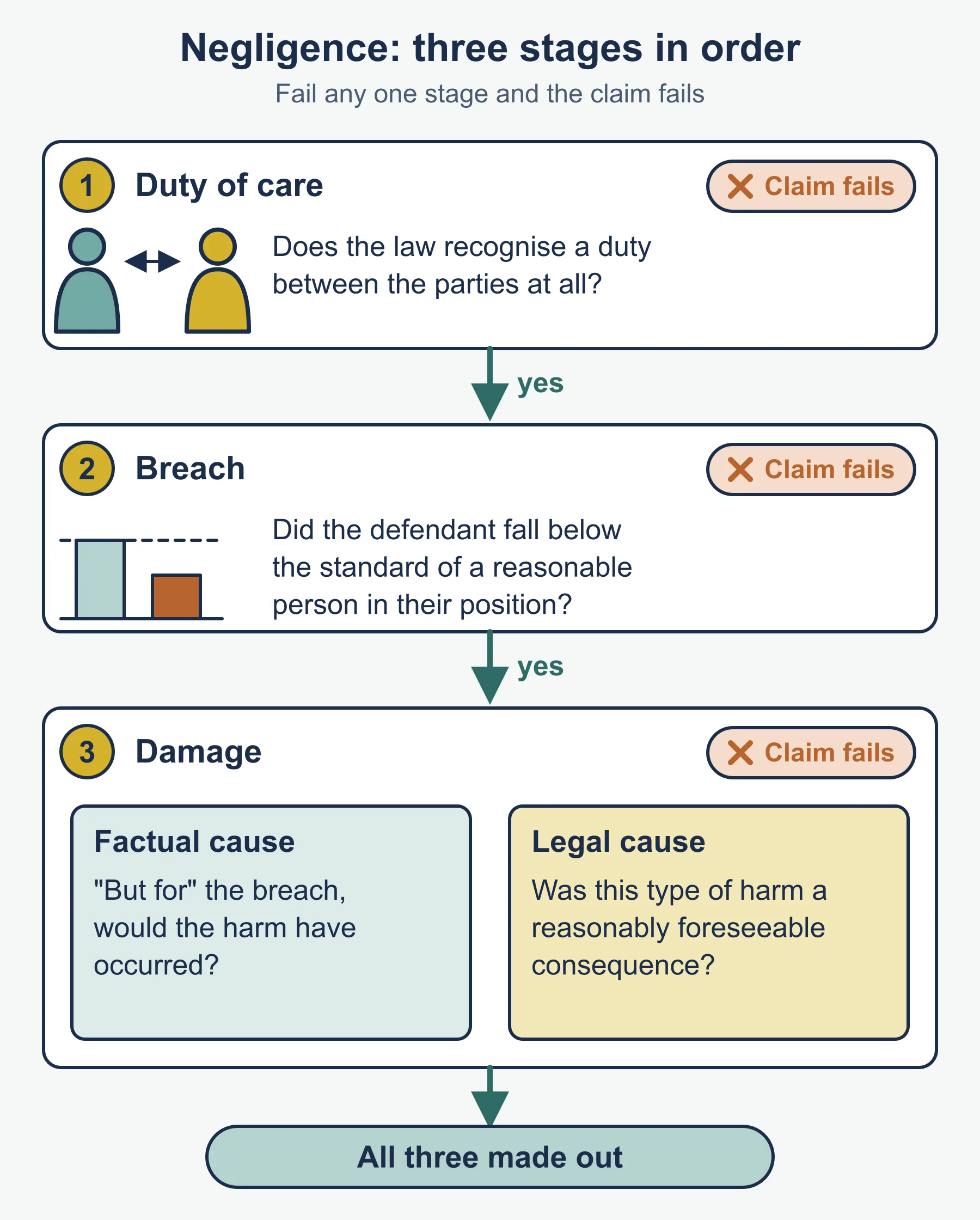
Duty of care
- Neighbour principle: Donoghue v Stevenson (1932), Lord Atkin. Persons so closely and directly affected that you ought reasonably to have them in contemplation.
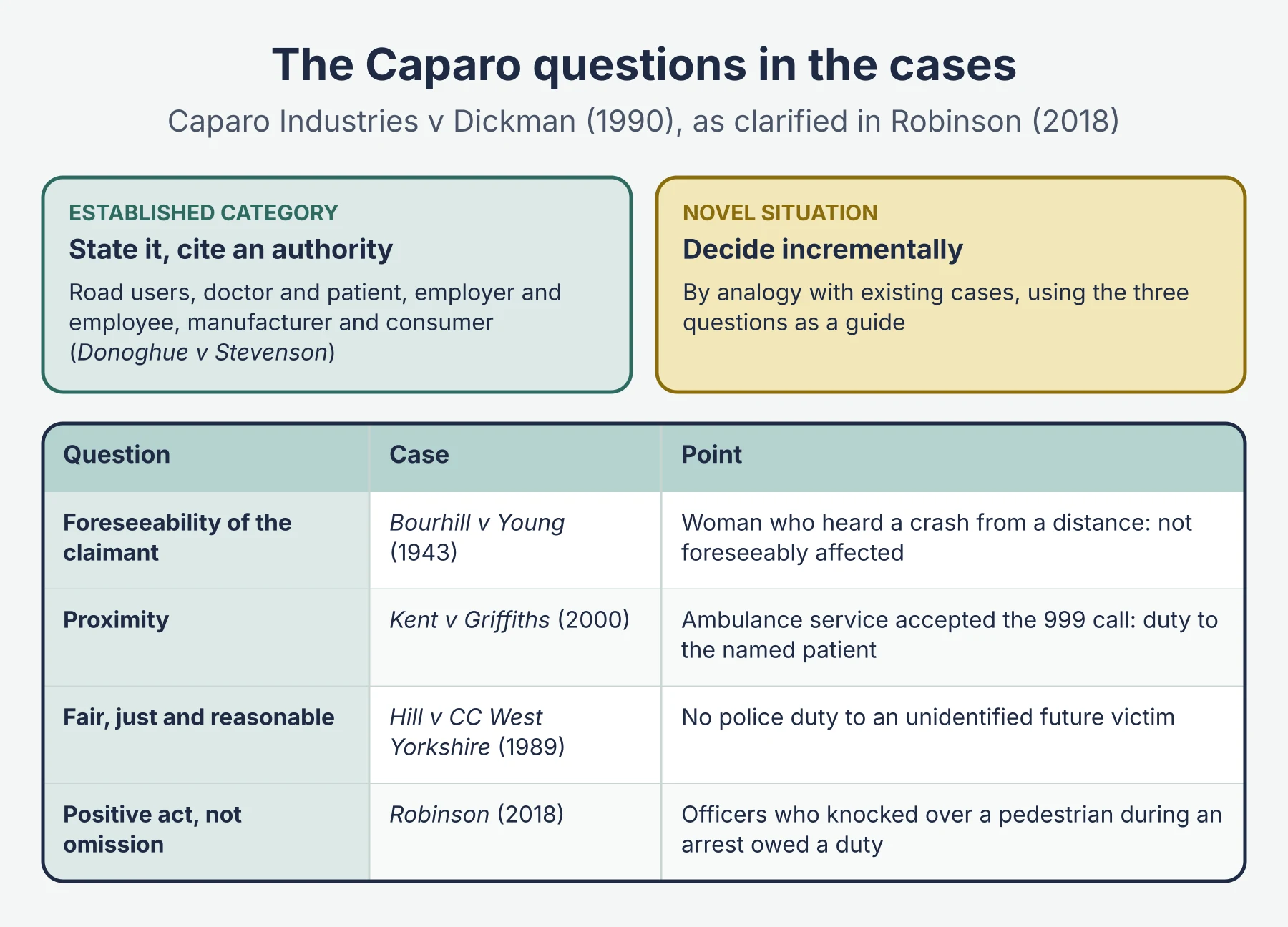
- Caparo test (1990): foreseeability; proximity; fair, just and reasonable.
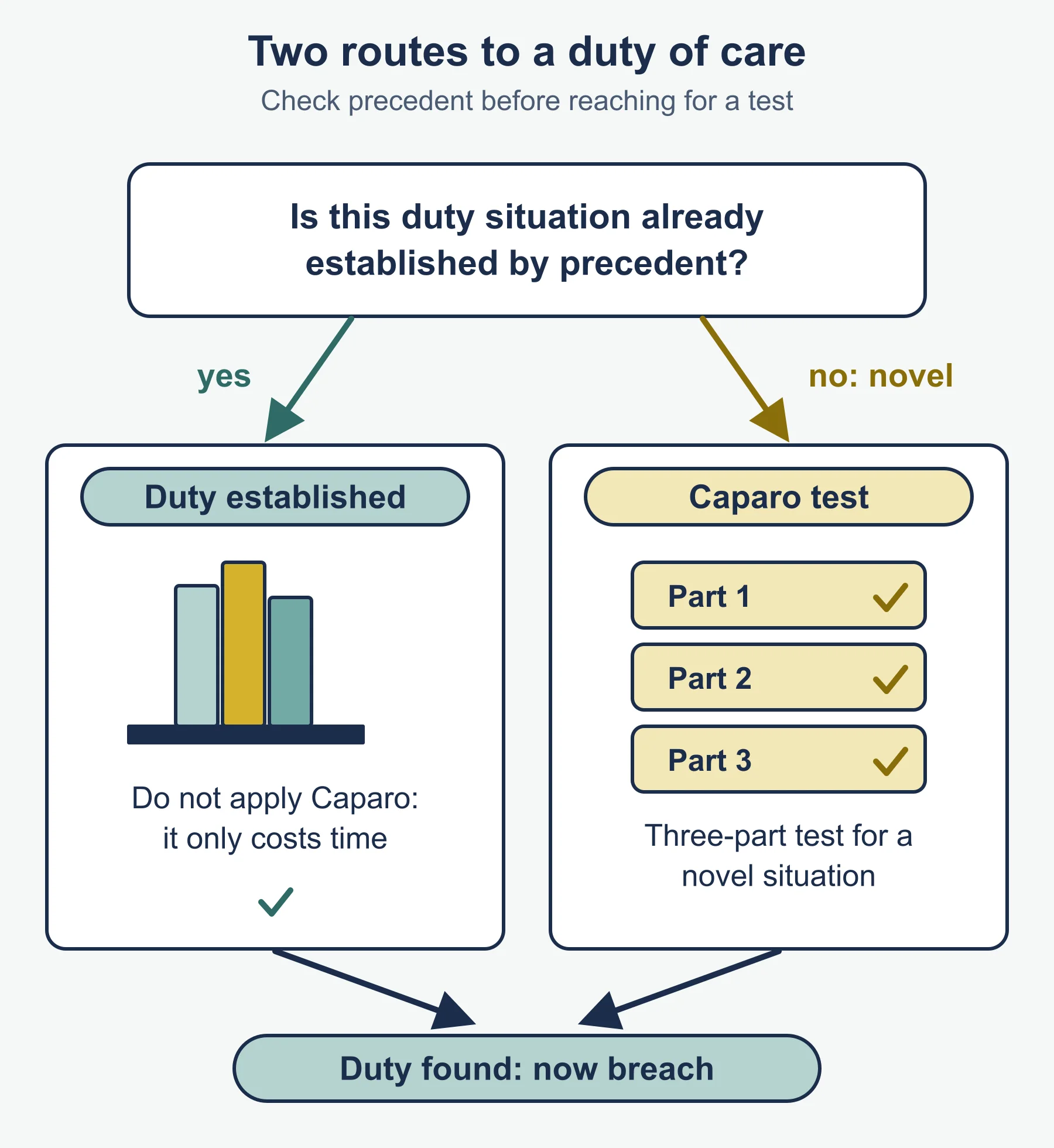
- Robinson (2018): apply established duties directly; Caparo reasoning only for novel cases, developed incrementally by analogy.
| Established duty | Example |
|---|---|
| Road users to each other | Nettleship v Weston (1971) |
| Manufacturer to consumer | Donoghue v Stevenson (1932) |
| Doctor to patient | Bolam (1957) |
| Ambulance service once call accepted | Kent v Griffiths (2000) |
| Police for positive acts | Robinson (2018) |
No duty: claimant not foreseeable (Bourhill v Young, 1943); not fair, just and reasonable (Hill, 1989).
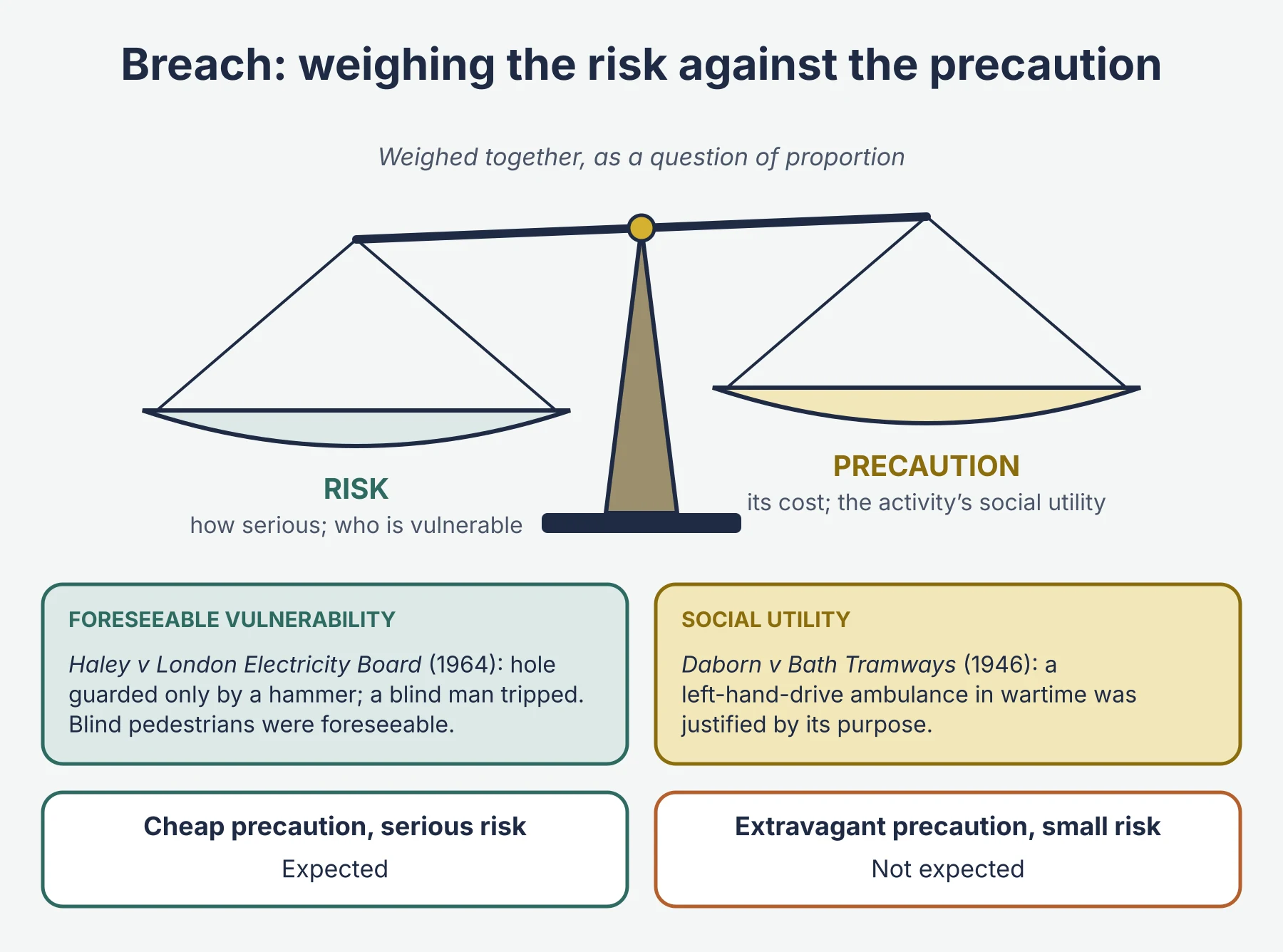
Breach of duty
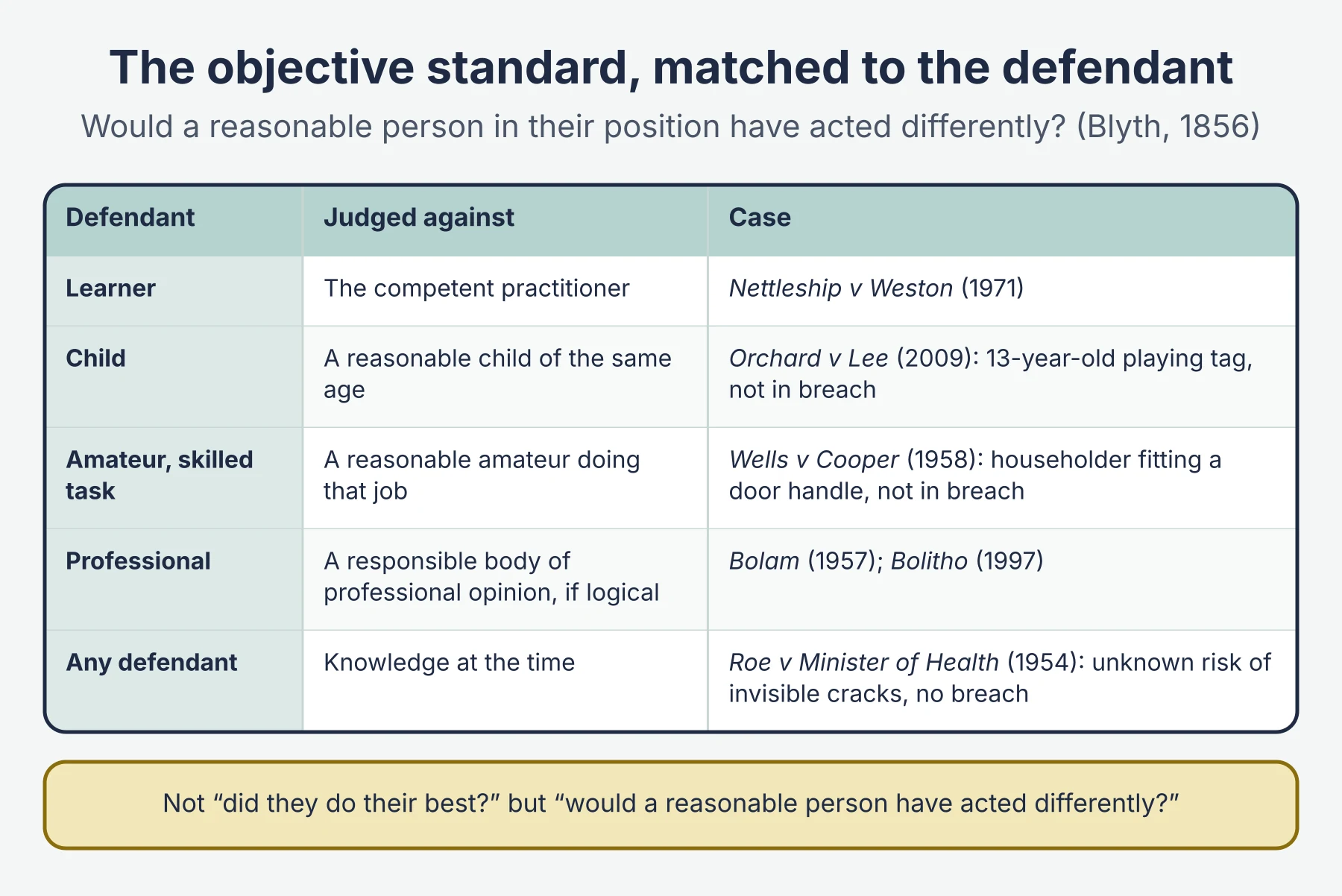
Standard: the reasonable person (Blyth, 1856). Objective: personal inexperience is irrelevant.
| Defendant | Standard | Case |
|---|---|---|
| Learner | Competent practitioner | Nettleship v Weston (1971) |
| Child | Reasonable child of that age | Mullin v Richards (1998); Orchard v Lee (2009) |
| Amateur doing DIY | Reasonable amateur | Wells v Cooper (1958) |
| Professional | Responsible body of opinion, logically defensible | Bolam (1957); Bolitho (1997) |
| Anyone | Knowledge at the time | Roe v Minister of Health (1954) |
Risk factors:
| Factor | Raises or lowers standard | Case |
|---|---|---|
| Low probability | Lowers | Bolton v Stone (1951) |
| Foreseeable vulnerable claimants | Raises | Haley v LEB (1964); Paris v Stepney (1951) |
| High cost / impracticable precaution | Lowers | Latimer v AEC (1953) |
| Social utility | Lowers | Watt v Herts CC (1954); Daborn v Bath Tramways (1946) |
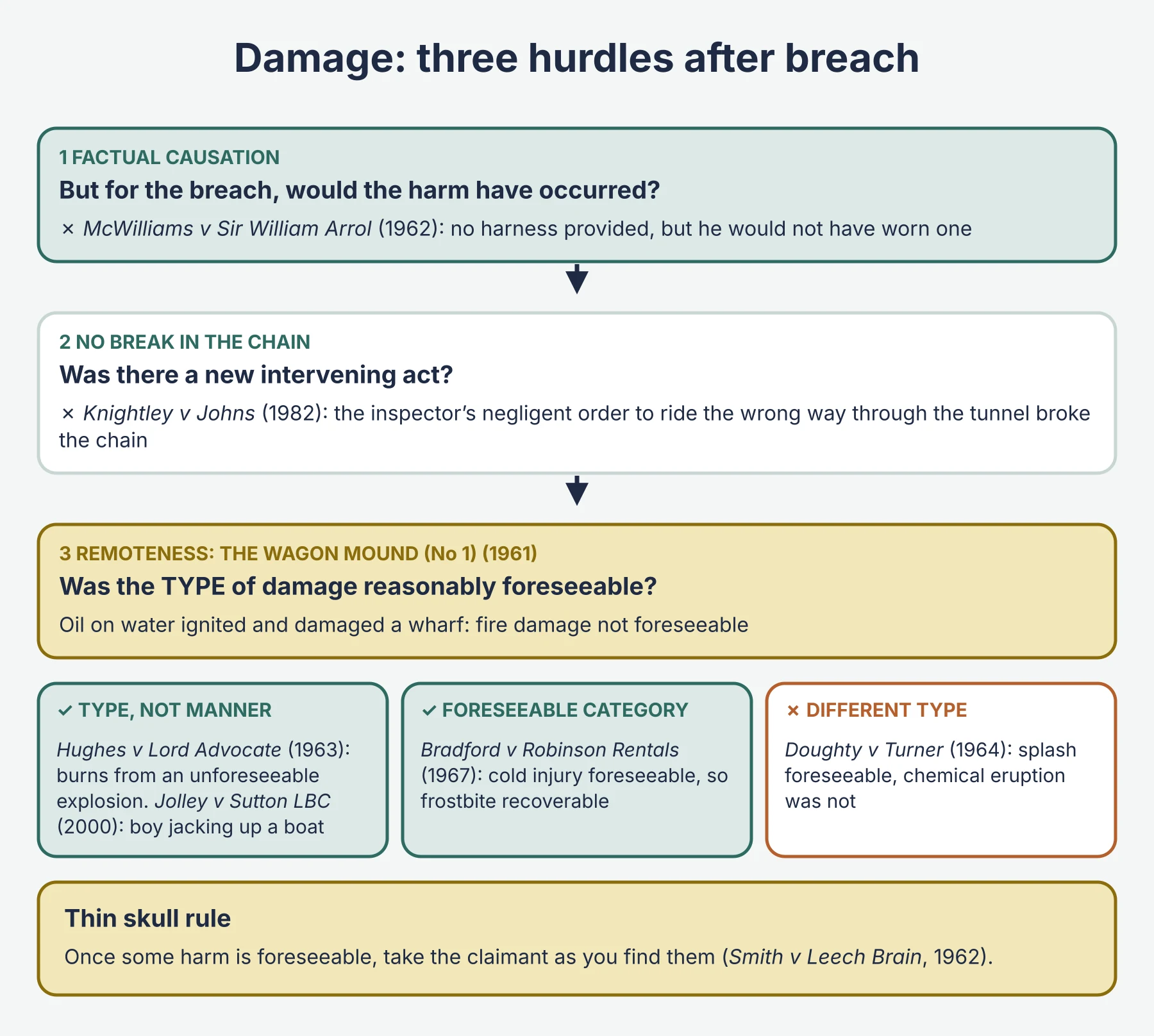
Damage
Factual causation: “but for” test.
- Barnett v Chelsea and Kensington HMC (1969): patient would have died anyway.
- McWilliams v Sir William Arrol (1962): worker would not have worn a harness anyway.
Intervening act: Knightley v Johns (1982): inspector’s negligent order broke the chain.
Remoteness: type of damage must be reasonably foreseeable (The Wagon Mound (No 1), 1961).
| Rule | Case |
|---|---|
| Manner unforeseeable, type foreseeable: liable | Hughes v Lord Advocate (1963) |
| Foreseeable type includes children’s meddling injuries | Jolley v Sutton LBC (2000) |
| Different kind of risk: not liable | Doughty v Turner (1964) |
| Foreseeable category (cold injury): liable for frostbite | Bradford v Robinson Rentals (1967) |
| Extent unforeseeable: thin skull rule | Smith v Leech Brain (1962) |
Property damage: same stages; The Wagon Mound was a wharf-damage claim.
Evaluation points
- Duty: Robinson brought certainty by ending repeated use of Caparo, but the incremental approach still leaves novel cases hard to predict.
- Breach: the objective standard protects claimants equally but labels honest learners as careless; insurance explains the result (Nettleship).
- Causation: “but for” struggles where the claimant would have acted differently anyway, as McWilliams shows: the employer escaped despite a clear breach.
- Remoteness: the line between a different “type” of harm (Doughty) and a different “manner” (Hughes) is fine and can seem arbitrary.
Key terms
| Term | Meaning |
|---|---|
| Duty of care | A legal obligation to take reasonable care not to harm the claimant |
| Proximity | A sufficiently close relationship between the parties |
| Incremental approach | Developing new duties by analogy with existing ones |
| Objective standard | Judged against the reasonable person, not the defendant’s own ability |
| Factual causation | The breach must be a “but for” cause of the harm |
| Novus actus interveniens | A new intervening act that breaks the chain of causation |
| Remoteness | Limit on liability to damage of a foreseeable type |
| Thin skull rule | Defendant takes the claimant as found once some harm is foreseeable |
Exam traps
- Running Caparo on an established duty: cite Robinson and move on.
- “She was only a learner” is never a defence to breach.
- Confusing Hughes (liable: type foreseeable) with Doughty (not liable: different risk).
- Using the thin skull rule to establish liability; it only extends the damages once liability exists.
- Forgetting a property claim hidden in the facts.
Self-test
- Which case gave the neighbour principle? Donoghue v Stevenson (1932).
- What are the three parts of the Caparo test? Foreseeability, proximity, fair just and reasonable.
- What did Robinson (2018) decide about Caparo? It is not applied where a duty is established; novel cases develop incrementally.
- Why did the claimant fail in Bourhill v Young? She was not a foreseeable claimant.
- What standard applies to a DIY householder? A reasonably competent amateur doing that job (Wells v Cooper).
- What did Bolitho add to Bolam? The body of professional opinion must be logically defensible.
- Why was there no breach in Roe v Minister of Health? The risk was unknown at the time.
- What made the precautions inadequate in Haley v LEB? Blind pedestrians were foreseeable and the guard would not protect them.
- Why did the claim fail in McWilliams? The worker would not have used a harness, so the breach was not a but-for cause.
- What broke the chain in Knightley v Johns? The inspector’s negligent order to ride against the traffic.
- Distinguish Hughes and Doughty. In Hughes the type of harm (burns) was foreseeable; in Doughty an eruption was a different kind of risk from a splash.
- What does the thin skull rule mean? The defendant is liable for the full extent of harm even if worsened by the claimant’s condition.
More resources on this topic
Negligence for physical injury and property damage practice questions | Tort revision notes
Related resources
-
Study guides
AQA A Level Law (7162): Nuisance and the Escape of Dangerous Things
Private nuisance and the rule in Rylands v Fletcher: who can sue and be sued, unreasonable use, each Rylands element and a worked problem, AQA Law 7162.
Law · AQA · A Level
Read guide -
Practice questions
AQA A Level Law (7162): Nuisance and the Escape of Dangerous Things – Practice Questions
Original practice questions with mark-scheme answers on private nuisance and the rule in Rylands v Fletcher, with problem scenarios, for AQA Law 7162.
Law · AQA · A Level
Try questions -
Revision notes
AQA A Level Law (7162): Nuisance and the Escape of Dangerous Things – Revision Notes
Recall notes on private nuisance parties, the unreasonableness factors, planning permission and every element of Rylands v Fletcher, for AQA A Level Law 7162.
Law · AQA · A Level
Revise topic
Get free revision emails (optional)
Occasional emails with practice questions, worked explanations and links to free resources for the qualification and subjects you choose. No spam, and you can unsubscribe from any email. The free tools on this site never need an email.