
Study Guides
AQA A Level Law (7162): Remedies in Tort
Compensatory damages for injury, property damage and economic loss, mitigation of loss, and injunctions with damages in lieu, for AQA A Level Law 7162 tort.
- Subject
- Law
- Level
- A LEVELS
- Topic
- Tort
- Author
- Marlbridge Academic Team
- Updated
- Reviewed by
- Aizaz Raoof Ali (what this means)
Aligned to AQA A Level Law (7162), For teaching from September 2017 onwards, A-level exams 2019 onwards. Official specification .
Syllabus page (what it covers and how it is assessed): AQA A Level Law.
Syllabus points this page covers
7162
- Remedies
Found an error? Report a correction.
Need help with this topic? Request a free trial class for A Level Law (7162).
This guide covers the section 3.3 row Remedies in AQA A-level Law (7162). The specification names two statements: “Basic understanding of compensatory damages for physical injury to people, damage to property and economic loss; basic understanding of the principle of mitigation of loss” and “Injunctions”. Note the words “basic understanding”: you need the principles and the main categories, not the detailed arithmetic of large personal injury awards. The Tort cases, defences and remedies study guide gives a short summary; this page explains each head of damages, shows mitigation at work, and sets out how a court decides between an injunction and damages.
Where remedies fit
Remedies come last in a tort answer: establish the tort, consider defences (which may reduce or remove damages), then say what the claimant can obtain. A short, accurate remedies paragraph is often what lifts a problem answer from a “sound” to a “detailed” conclusion.
Compensatory damages: the aim
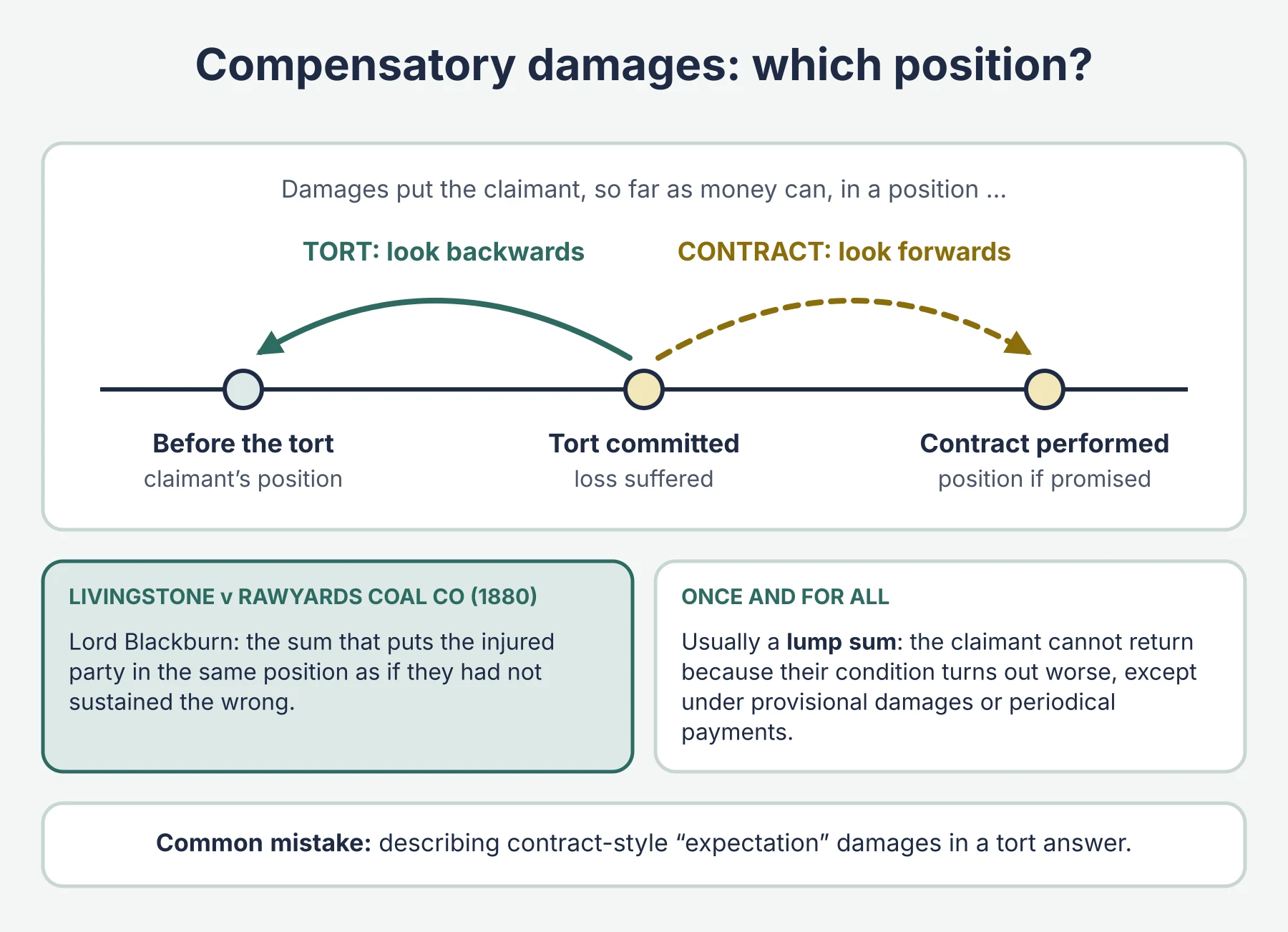
Compensatory damages aim to put the claimant, so far as money can, in the position they would have been in if the tort had not been committed. Lord Blackburn in Livingstone v Rawyards Coal Co (1880) described this as the sum that will put the injured party in the same position as if they had not sustained the wrong. Damages in tort look backwards to the claimant’s position before the tort, unlike contract damages, which look forward to the position if the contract had been performed.
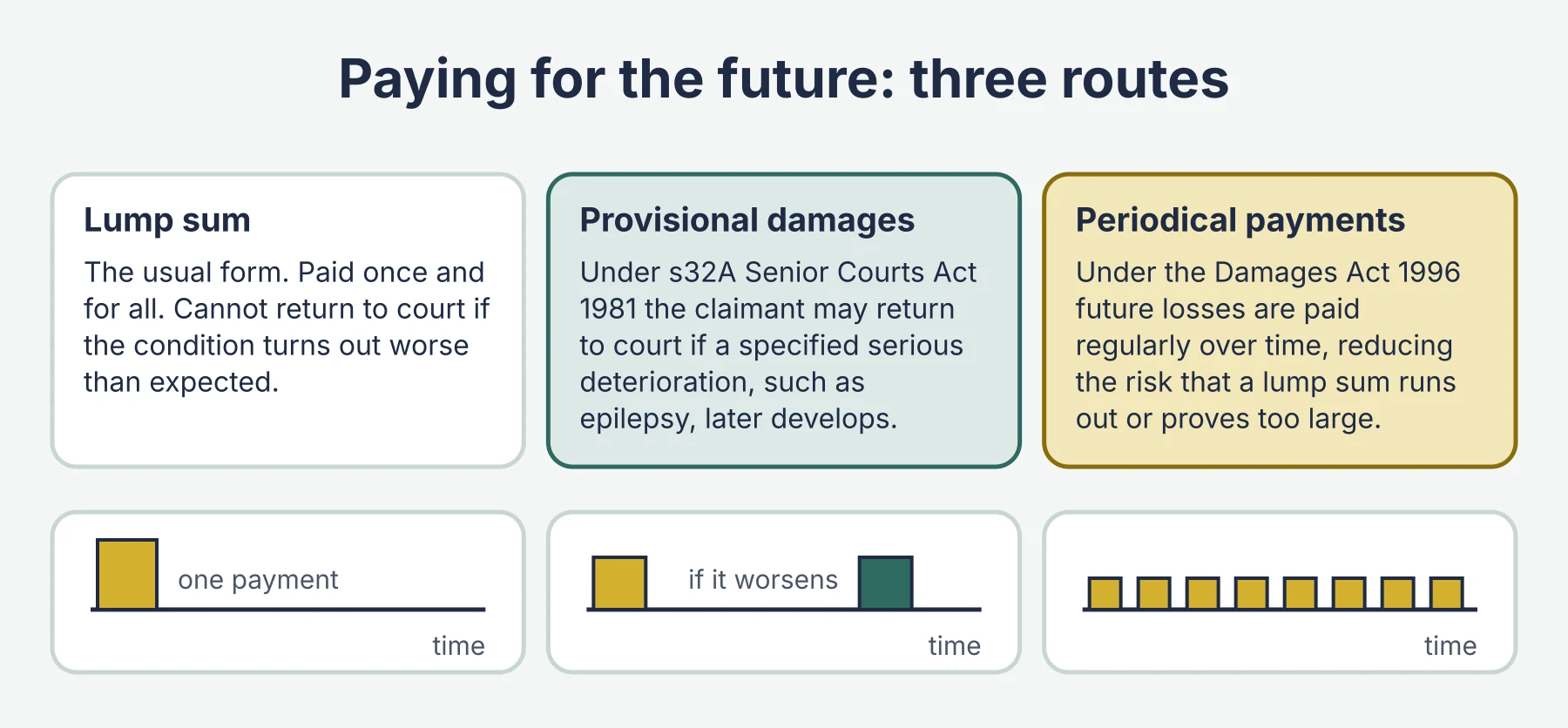
Damages are usually paid as a lump sum, once and for all. The claimant cannot return to court because their condition turns out worse than expected, except under the arrangements below.
Damages for physical injury
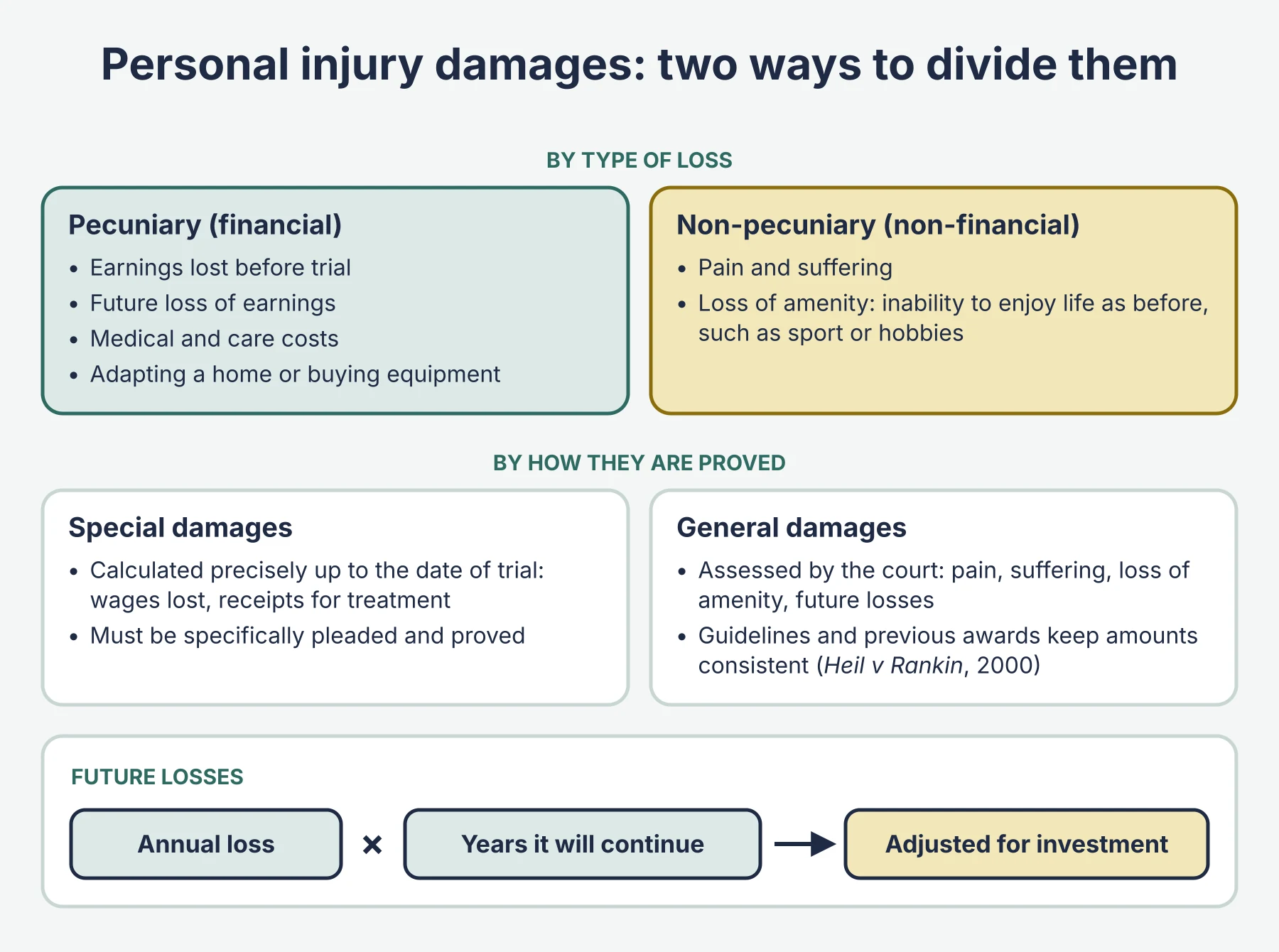
Personal injury damages are divided in two ways.
By type of loss
| Pecuniary loss (financial) | Non-pecuniary loss (non-financial) |
|---|---|
| Earnings lost before trial | Pain and suffering |
| Future loss of earnings | Loss of amenity: inability to enjoy life as before, such as sport or hobbies |
| Medical and care costs | |
| Cost of adapting a home or buying equipment |
By how they are proved
- Special damages are losses that can be calculated precisely up to the date of trial, such as wages lost and receipts for treatment. They must be specifically pleaded and proved.
- General damages are assessed by the court, such as pain, suffering and loss of amenity, and future losses. Courts use guidelines and previous awards to keep amounts consistent; in Heil v Rankin (2000) the Court of Appeal increased awards for the most serious non-pecuniary losses.
Future losses. The court estimates the annual loss and multiplies it by a figure reflecting how many years it will continue, adjusted for the fact that a lump sum paid now can be invested. This is why awards for young, seriously injured claimants are very large.
Alternatives to a single lump sum
- Provisional damages under s32A Senior Courts Act 1981 allow a claimant to return to court if a specified serious deterioration, such as epilepsy, later develops.
- Periodical payments under the Damages Act 1996 allow future losses to be paid regularly over time, reducing the risk that a lump sum runs out or proves too large.
Damages for damage to property
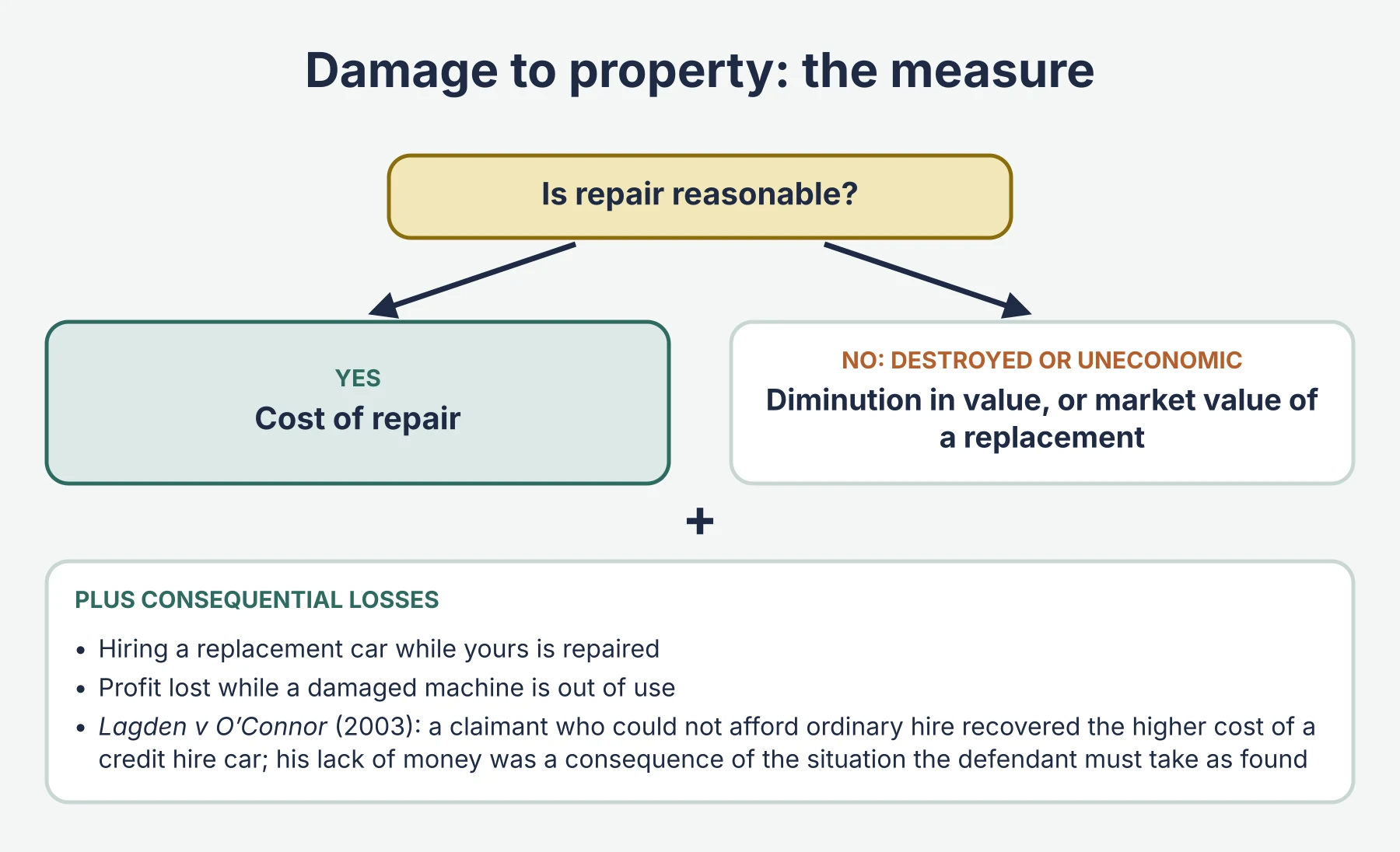
The usual measure is:
- the cost of repair, if repair is reasonable; or
- the diminution in value or the market value of a replacement, if the item is destroyed or repair would be uneconomic.
Consequential losses are also recoverable, such as the cost of hiring a replacement car while yours is repaired, or profit lost while a damaged machine is out of use. In Lagden v O’Connor (2003) a claimant who could not afford ordinary hire charges recovered the higher cost of a credit hire car, because his lack of money was a consequence of the situation the defendant must take as found.
Damages for economic loss
Where economic loss is recoverable (consequential on physical damage, or within a Hedley Byrne special relationship), damages compensate the financial loss actually caused. In Spartan Steel v Martin (1973) the claimant recovered the loss in value of the damaged melt and the profit it would have made on that melt. For negligent advice, the claimant recovers what they lost by relying on it, measured by comparing their position with what it would have been had the advice not been given.
Mitigation of loss
A claimant must take reasonable steps to limit their loss. They cannot recover for any part of the loss that reasonable steps would have avoided, but they can recover the reasonable cost of taking those steps.
- In Darbishire v Warran (1963) the claimant’s car was damaged. The cost of repair was much greater than its market value, but he had it repaired anyway. He recovered only the market value, because a reasonable person would have bought a replacement.
- In Geest plc v Lansiquot (2002) the Privy Council confirmed that the defendant bears the burden of proving that the claimant failed to mitigate.
- The standard is not demanding. The claimant need only act reasonably; they are not judged harshly for choices made in a situation the defendant created.
Example (invented figures). Ria’s van is damaged by a negligent driver. She cannot work for 10 days. Repairs cost £3,000. A replacement van could have been hired for £80 a day, allowing her to keep earning £200 a day. She hires nothing.
Repairs:                        £3,000 (recoverable)
Lost earnings claimed:          10 x £200 = £2,000
Reasonable mitigation:          hire at £80 a day for 10 days = £800,
                                avoiding the £2,000 loss
Recoverable for loss of use:    £800 (the cost of reasonable mitigation),
                                not £2,000
Total:                          £3,000 + £800 = £3,800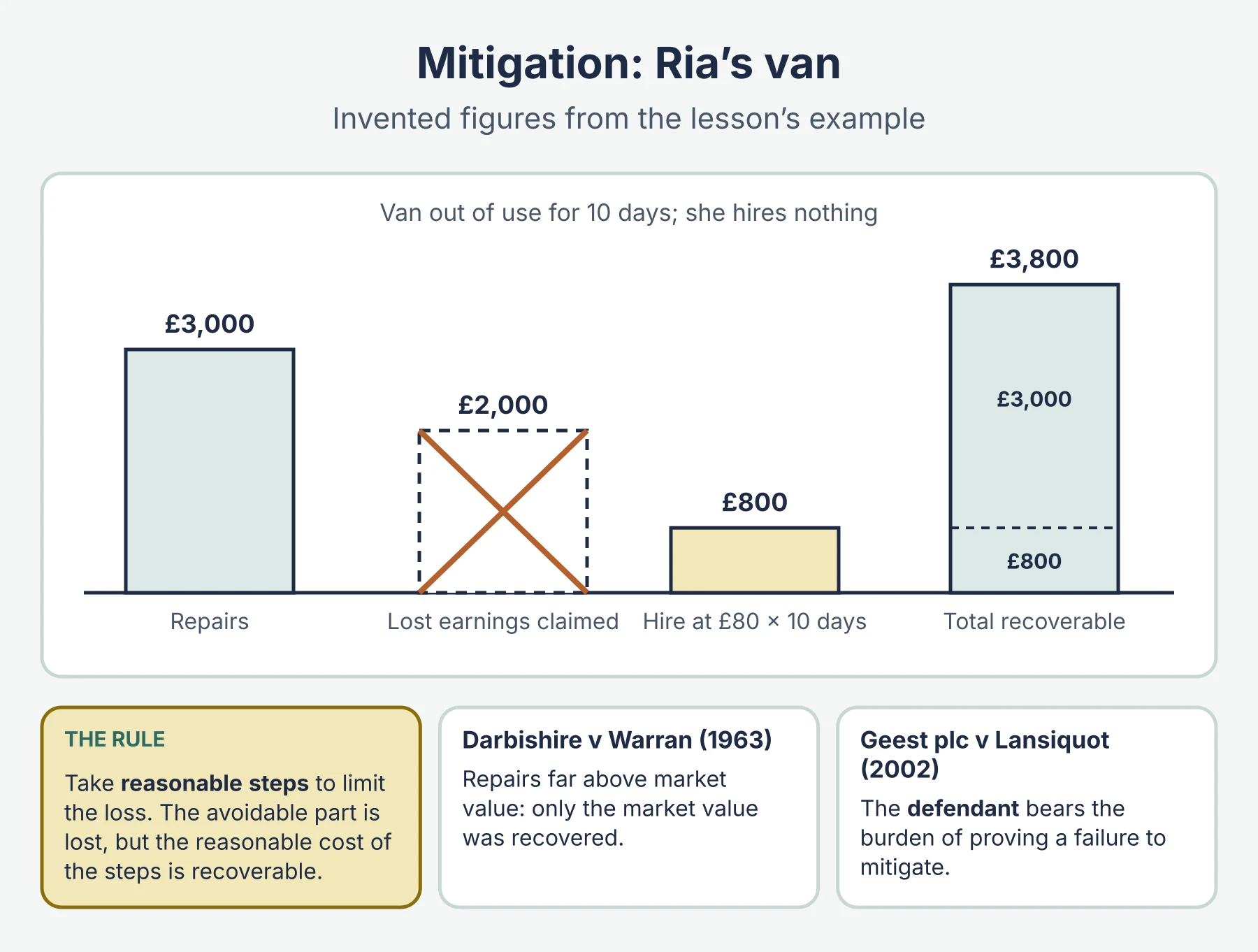
Injunctions
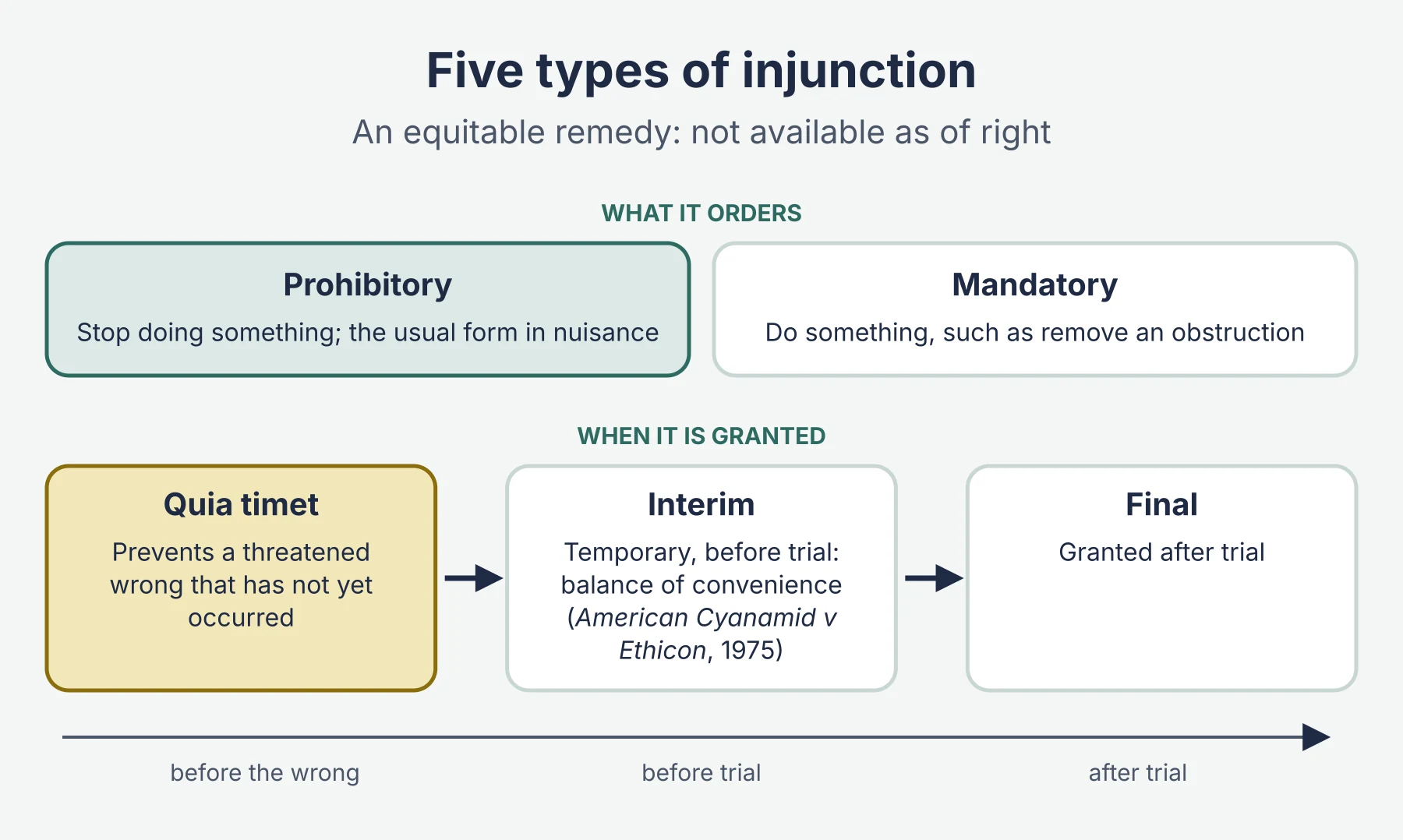
Types
| Type | Purpose |
|---|---|
| Prohibitory | Orders the defendant to stop doing something; the usual form in nuisance |
| Mandatory | Orders the defendant to do something, such as remove an obstruction |
| Interim | Temporary order before trial; granted on the balance of convenience (American Cyanamid v Ethicon, 1975) |
| Final | Granted after trial |
| Quia timet | Granted to prevent a threatened wrong that has not yet occurred |
Discretion
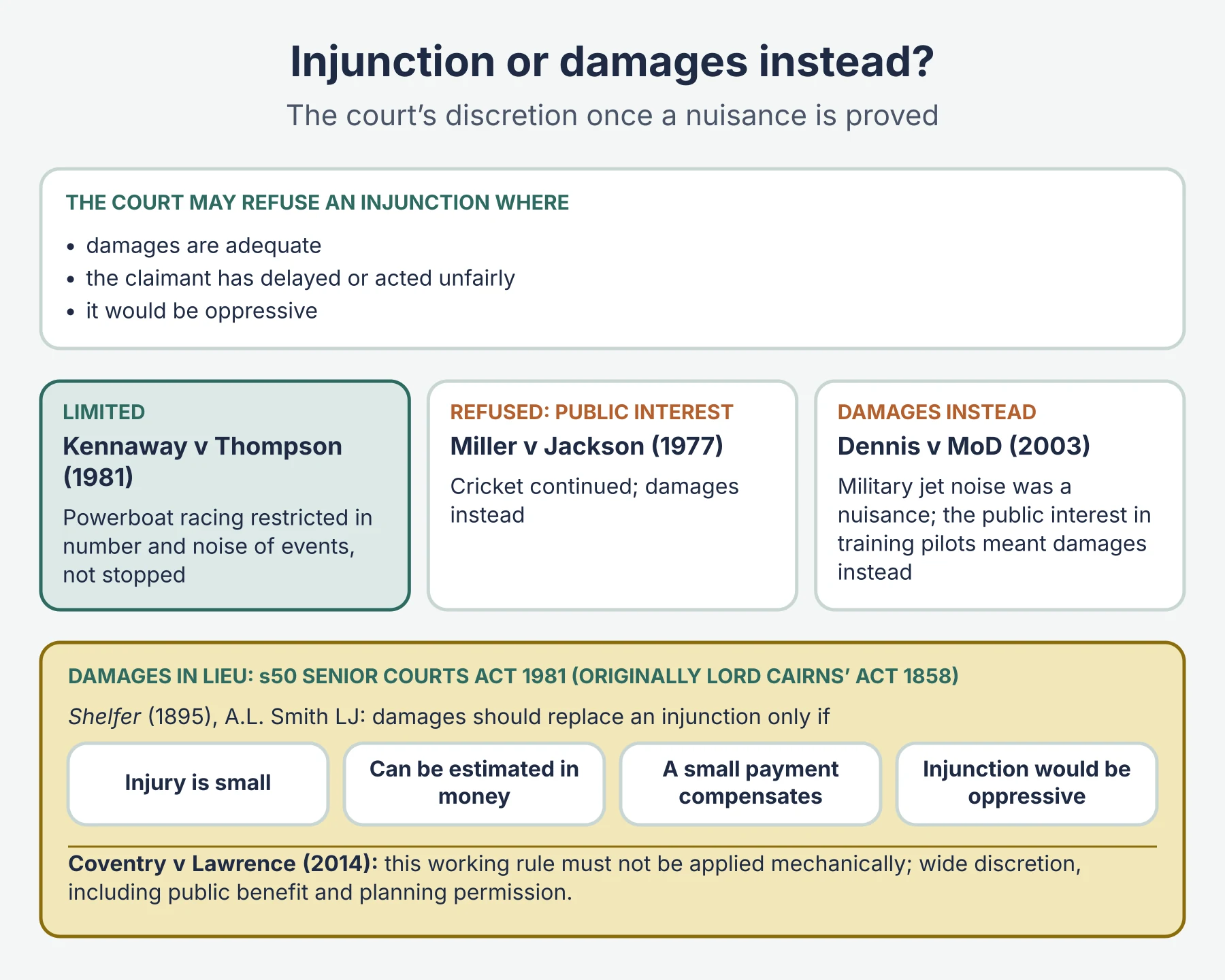
An injunction is equitable, so it is not available as of right. The court may refuse it where damages are adequate, where the claimant has delayed or acted unfairly, or where it would be oppressive. It may tailor the order to the facts.
- Limited injunction: Kennaway v Thompson (1981): powerboat racing restricted in number and noise level of events rather than stopped.
- Refused for public interest: Miller v Jackson (1977): cricket continued; damages instead.
- Damages instead in the national interest: Dennis v Ministry of Defence (2003): noise from military jets training at an air base was a nuisance, but the public interest in training pilots meant damages were awarded instead of an injunction.
Damages in lieu of an injunction
The court has power to award damages instead of an injunction (now s50 Senior Courts Act 1981, originally Lord Cairns’ Act 1858). In Shelfer v City of London Electric Lighting (1895) A.L. Smith LJ suggested damages should replace an injunction only if the injury is small, capable of being estimated in money, adequately compensated by a small money payment, and an injunction would be oppressive. In Coventry v Lawrence (2014) the Supreme Court said this working rule must not be applied mechanically: the court has a wide discretion and may consider public benefit and planning permission.
Common mistakes
- Describing contract-style “expectation” damages in a tort answer.
- Saying a claimant who fails to mitigate recovers nothing: they lose only the avoidable part.
- Treating an injunction as automatic once a nuisance is proved.
- Forgetting that defences such as contributory negligence reduce the damages.
Exam technique
In problem answers, end each claimant’s section with the remedy: identify the heads of damages (for example, lost earnings as special damages, pain and suffering as general damages), mention mitigation where the facts raise it, and for nuisance say whether an injunction is likely and in what form. Theory questions on injunctions belong to the theory row and need evaluation of how conflicting interests are balanced.
More resources on this topic
Remedies in tort revision notes | Remedies in tort practice questions | Defences in tort study guide
Related resources
-
Practice questions
AQA A Level Law (7162): Remedies in Tort – Practice Questions
Original practice questions with mark-scheme answers on compensatory damages, mitigation of loss and injunctions in tort, for AQA A Level Law 7162 Paper 2.
Law · AQA · A Level
Try questions -
Revision notes
AQA A Level Law (7162): Remedies in Tort – Revision Notes
Recall notes on compensatory damages for injury, property and economic loss, mitigation, types of injunction and damages in lieu, for AQA A Level Law 7162.
Law · AQA · A Level
Revise topic -
Study guides
AQA A Level Law (7162): The Rules of Tort Law
How tort rules work: sources, burden of proof, fault and strict liability across the torts, defences and remedies, and a method for problems, for AQA Law 7162.
Law · AQA · A Level
Read guide
Get free revision emails (optional)
Occasional emails with practice questions, worked explanations and links to free resources for the qualification and subjects you choose. No spam, and you can unsubscribe from any email. The free tools on this site never need an email.