
Revision Notes
AQA A Level Law (7162): Defences in Tort – Revision Notes
Recall notes on contributory negligence, apportionment, volenti non fit injuria and the defences to nuisance and Rylands v Fletcher, for AQA A Level Law 7162.
- Subject
- Law
- Level
- A LEVELS
- Topic
- Tort
- Author
- Marlbridge Academic Team
- Updated
- Reviewed by
- Aizaz Raoof Ali (what this means)
Aligned to AQA A Level Law (7162), For teaching from September 2017 onwards, A-level exams 2019 onwards. Official specification .
Syllabus page (what it covers and how it is assessed): AQA A Level Law.
Syllabus points this page covers
7162
- Defences
Found an error? Report a correction.
Need help with this topic? Request a free trial class for A Level Law (7162).
Condensed notes for the section 3.3 row Defences: “Contributory negligence”, “Consent (volenti non fit injuria)” and “Defences specific to private nuisance and the rule in Rylands v Fletcher”. For explanation and worked examples, use the defences in tort study guide.
Overview
Tort established  ->  Defence?  ->  Effect on damages
   Contributory negligence  -> PARTIAL: reduced by claimant's share
   Consent (volenti)        -> COMPLETE: nothing
   Nuisance / Rylands       -> COMPLETE
Burden: defendant, balance of probabilities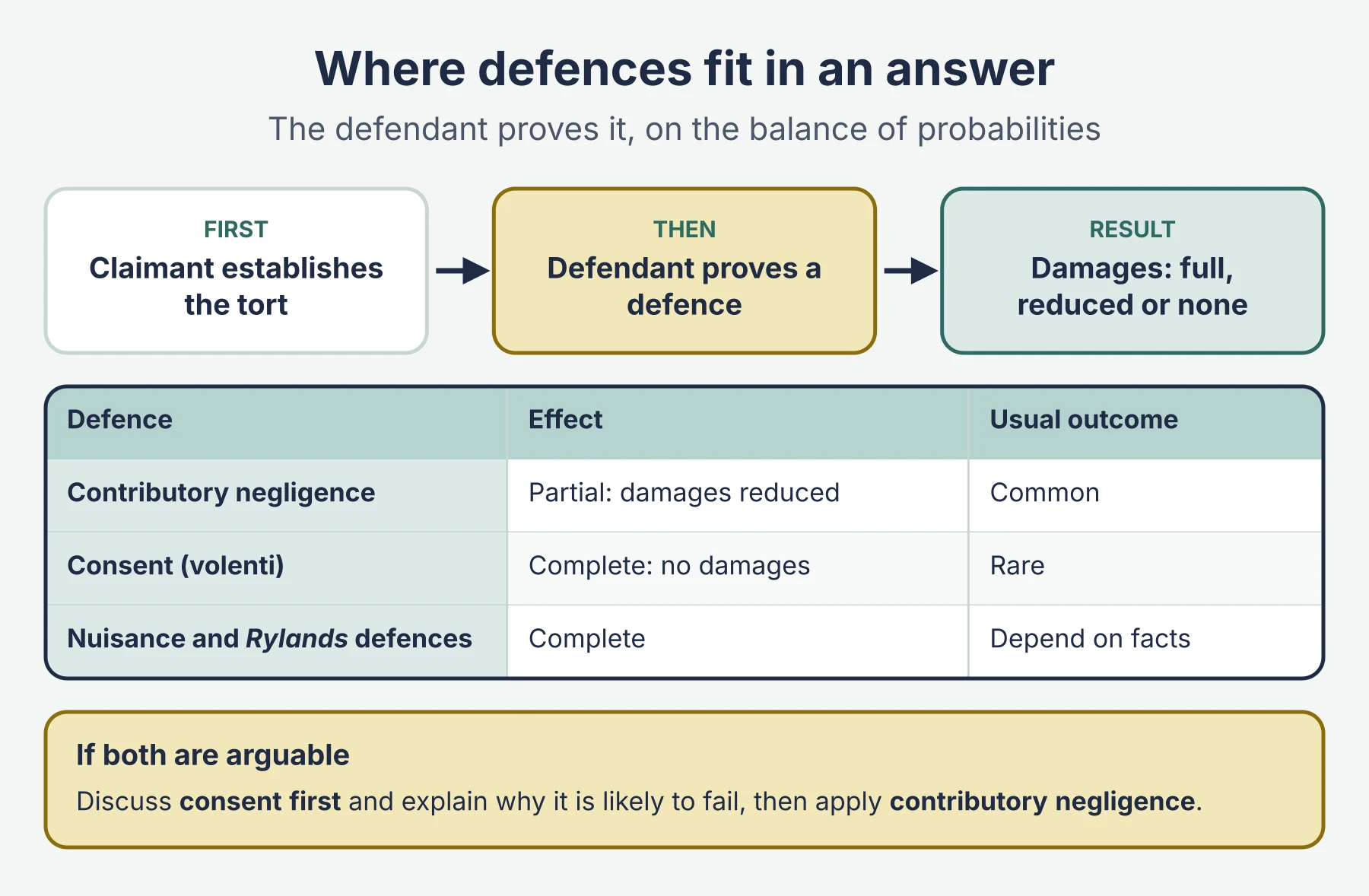
Contributory negligence
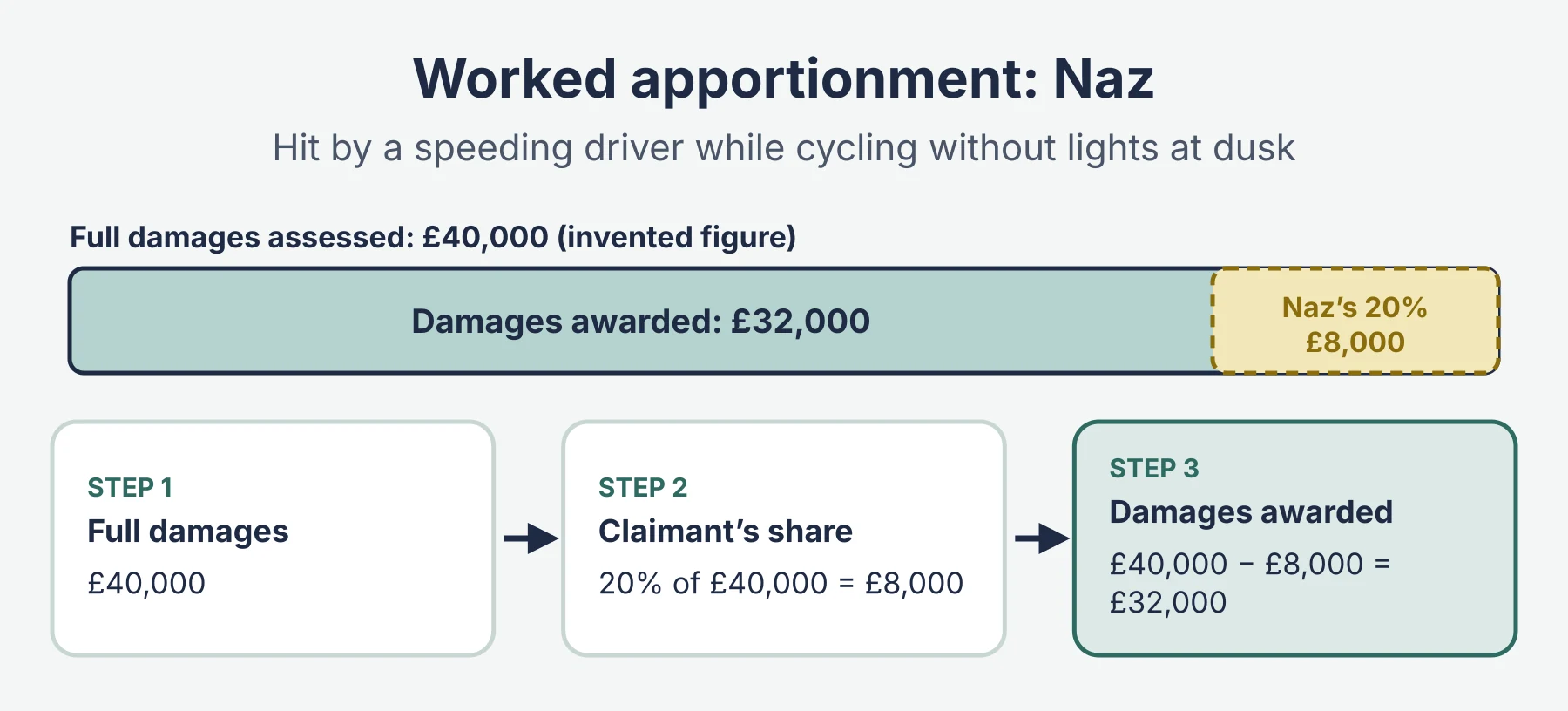
Statute: s1(1) Law Reform (Contributory Negligence) Act 1945: damages reduced as “just and equitable having regard to the claimant’s share in the responsibility for the damage”.
Elements:
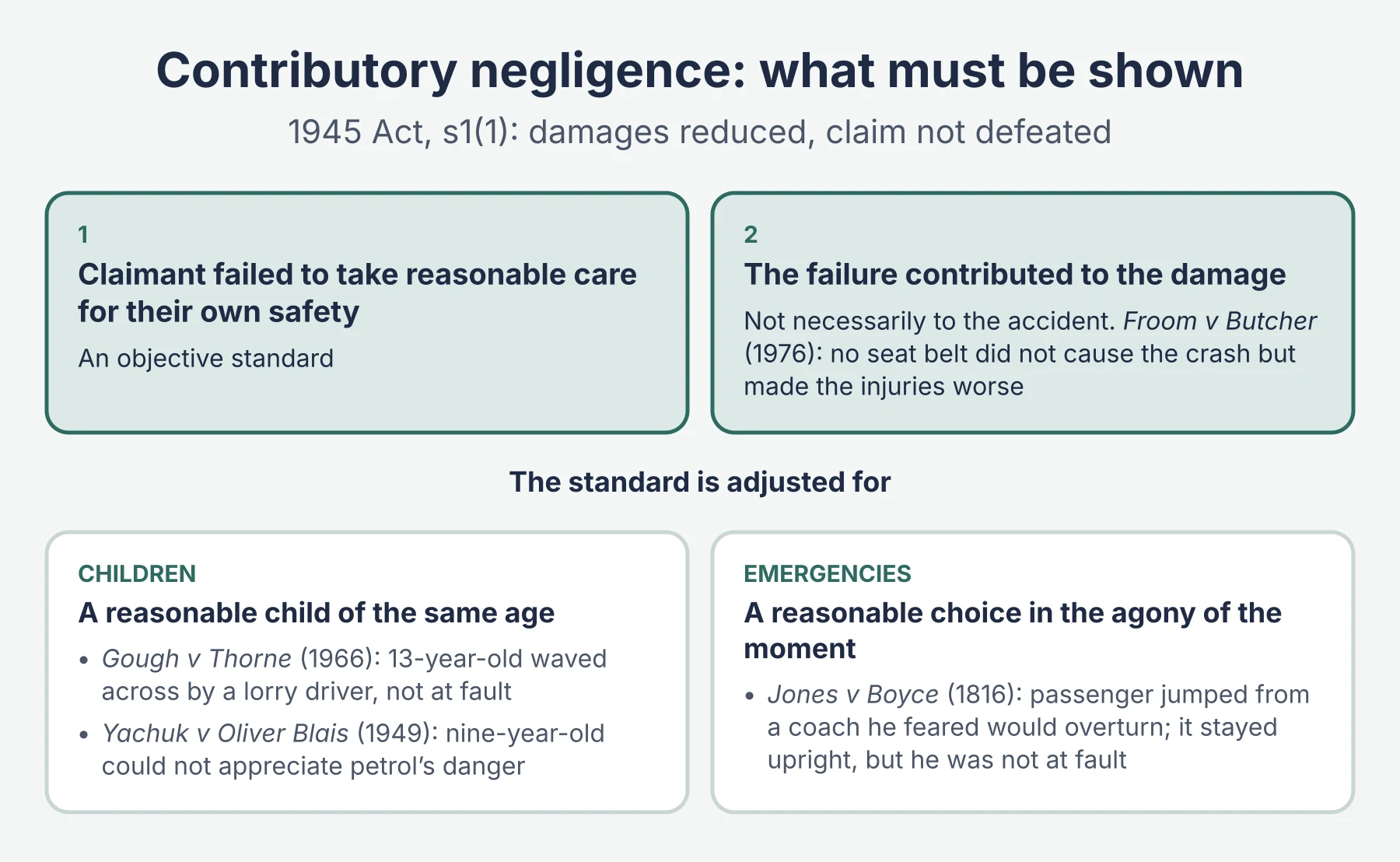
- Claimant failed to take reasonable care for own safety (objective).
- That failure contributed to the damage (not necessarily the accident): Froom v Butcher (1976).
Adjustments:
- Children: reasonable child of that age: Gough v Thorne (1966); Yachuk v Oliver Blais (1949).
- Emergencies: agony of the moment: Jones v Boyce (1816).
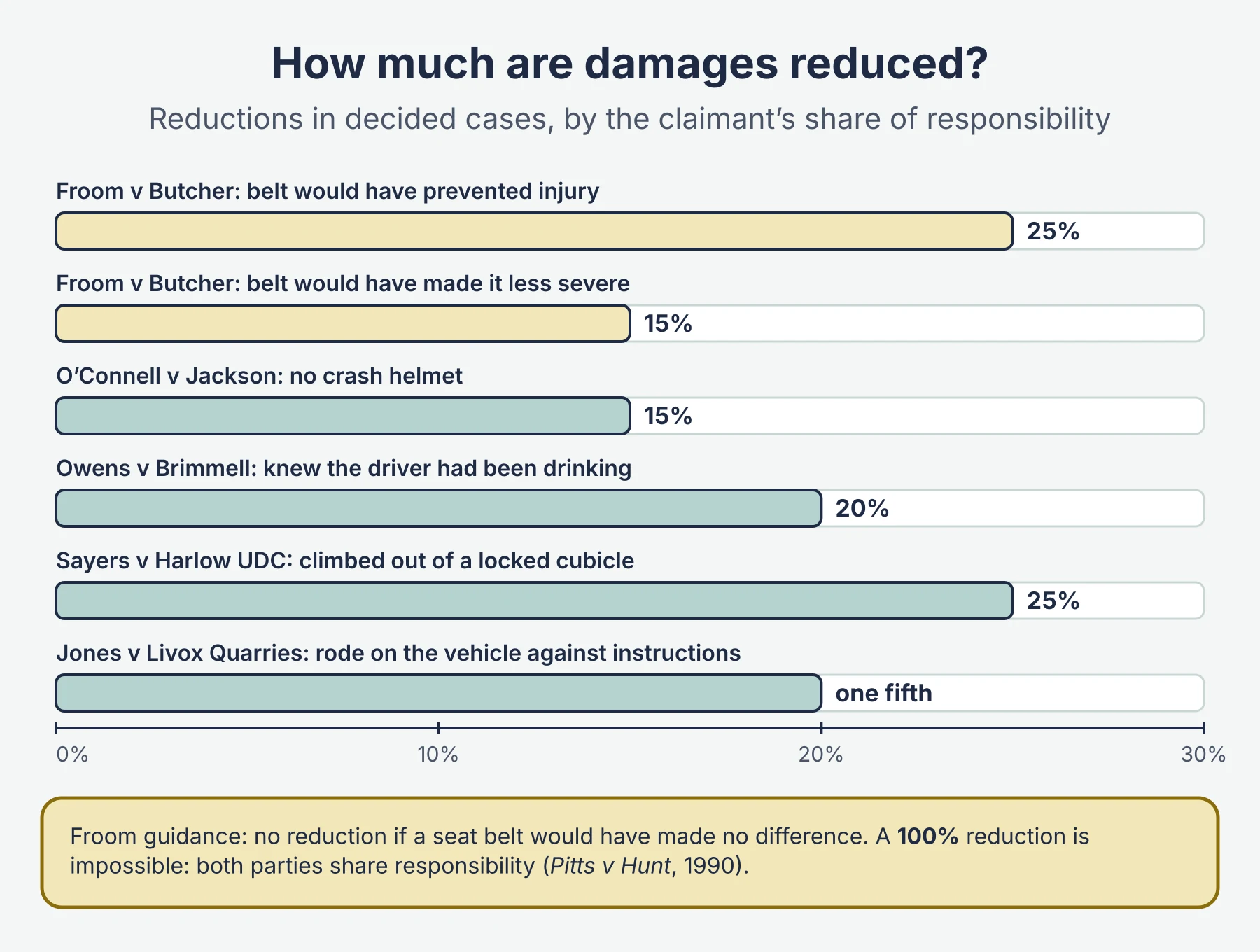
- No 100% reduction: Pitts v Hunt (1990).
| Case | Fault | Reduction |
|---|---|---|
| Froom v Butcher (1976) | No seat belt | 25% / 15% / 0 guidance |
| O’Connell v Jackson (1972) | No crash helmet | 15% |
| Owens v Brimmell (1977) | Lift from drinking driver | 20% |
| Sayers v Harlow UDC (1957) | Climbing out of locked toilet | 25% |
| Jones v Livox Quarries (1952) | Riding on back of vehicle | One fifth |
Consent (volenti non fit injuria)
Requirements:
- Full knowledge of the nature and extent of the risk.
- Voluntary agreement to accept it, waiving any claim.
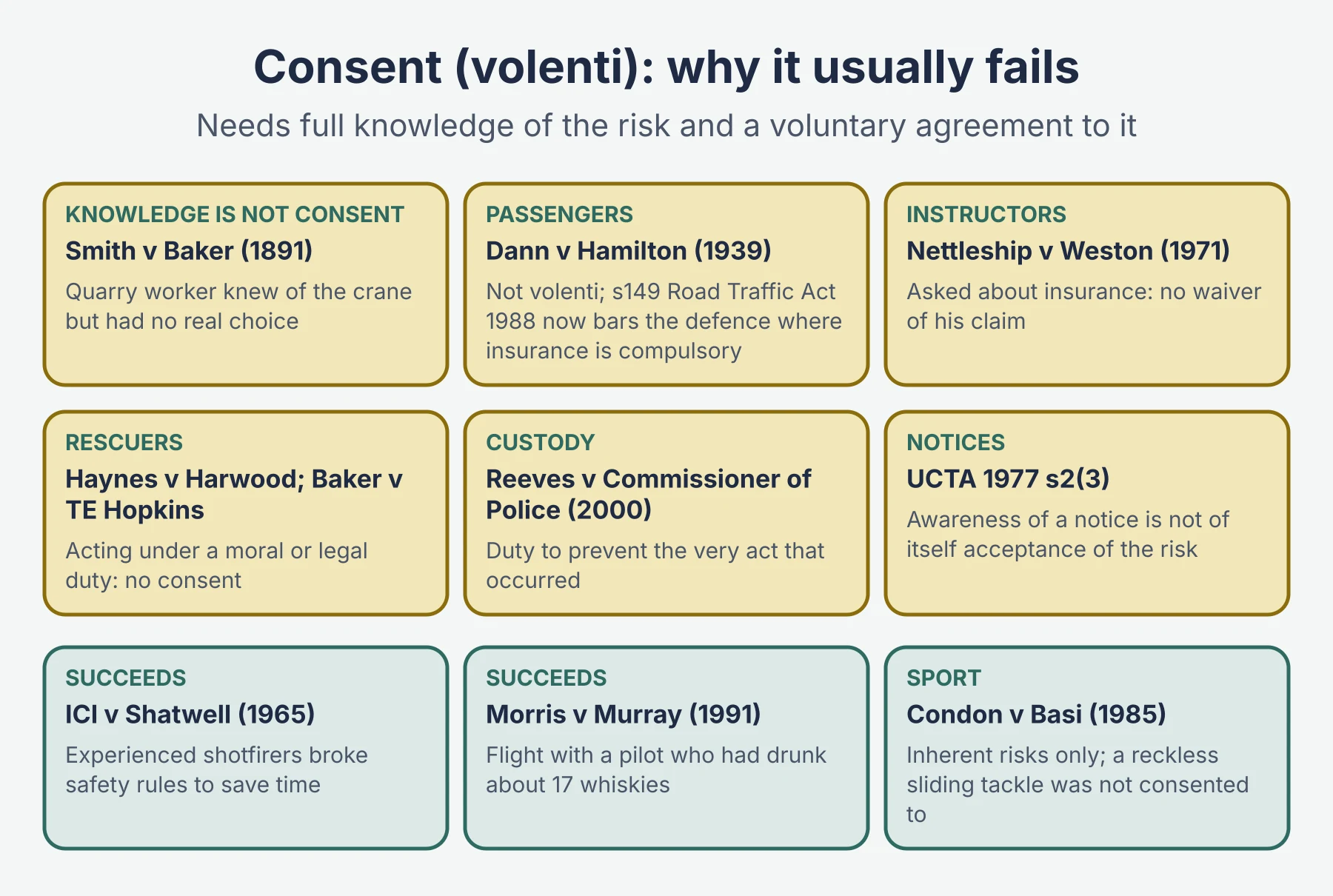
Fails:
| Situation | Case / provision |
|---|---|
| Employee knows of risk but has no real choice | Smith v Baker (1891) |
| Passenger with drinking driver | Dann v Hamilton (1939); s149 RTA 1988 |
| Instructor who checked insurance | Nettleship v Weston (1971) |
| Rescuers | Haynes v Harwood (1935); Baker v TE Hopkins (1959) |
| Duty to prevent the very act | Reeves v Commissioner of Police (2000) |
| Notice alone | s2(3) UCTA 1977 |
Succeeds:
- ICI v Shatwell (1965): experienced shotfirers broke safety rules.
- Morris v Murray (1991): flight with an obviously drunk pilot.
Sport: consent only to risks within the rules and conventions: Condon v Basi (1985). Occupiers: s2(5) OLA 1957; s1(6) OLA 1984.
Defences to private nuisance
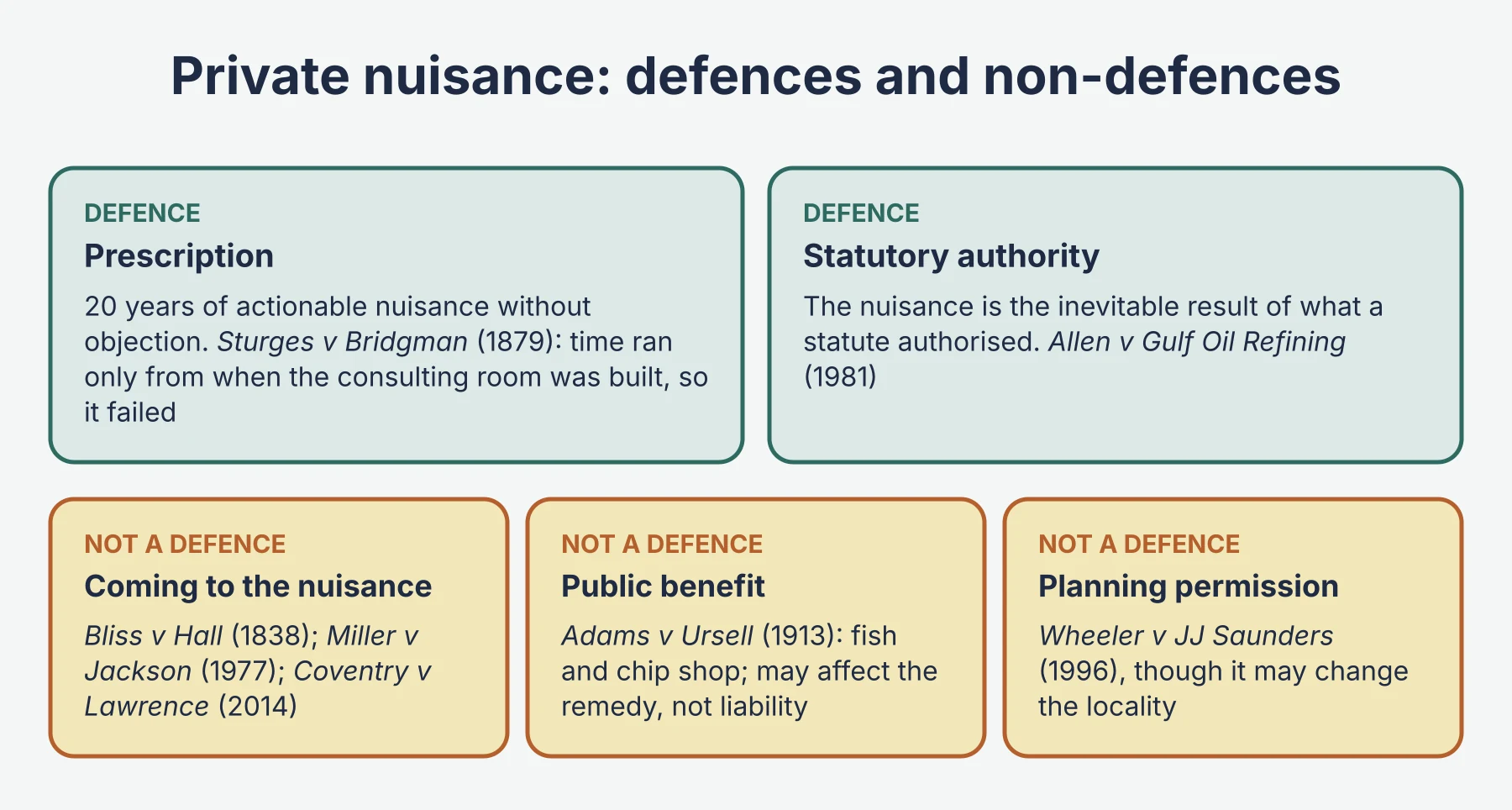
| Defence | Rule | Case |
|---|---|---|
| Prescription | 20 years of actionable nuisance | Sturges v Bridgman (1879): time runs from when it became a nuisance to the claimant |
| Statutory authority | Inevitable result of authorised activity | Allen v Gulf Oil (1981) |
Not defences: coming to the nuisance (Bliss v Hall, 1838; Miller v Jackson, 1977; Coventry v Lawrence, 2014); public benefit (Adams v Ursell, 1913); planning permission (Wheeler v JJ Saunders, 1996).
Defences to Rylands v Fletcher
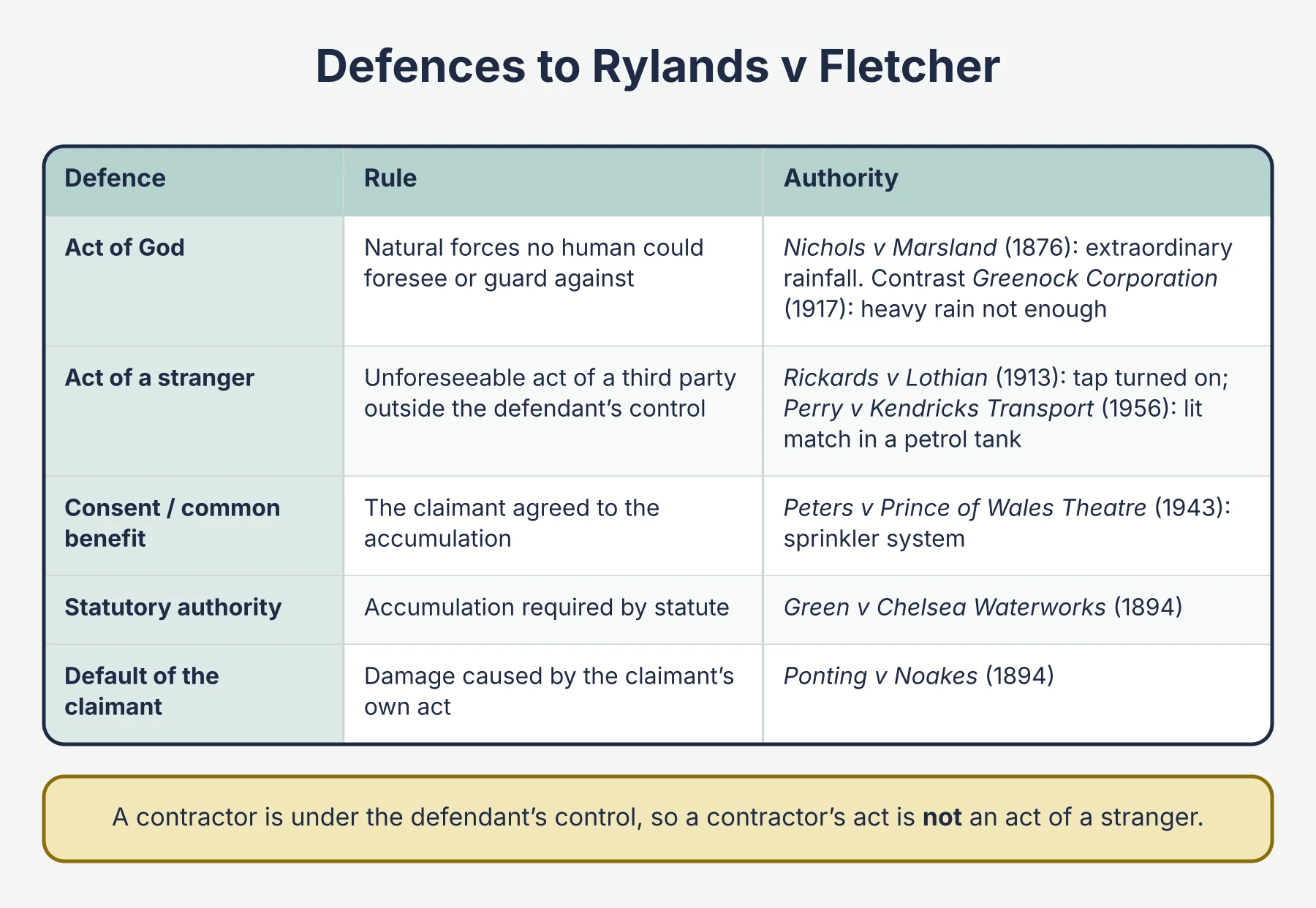
| Defence | Case |
|---|---|
| Act of God | Nichols v Marsland (1876); contrast Greenock Corp v Caledonian Railway (1917) |
| Act of a stranger | Rickards v Lothian (1913); Perry v Kendricks Transport (1956) |
| Consent / common benefit | Peters v Prince of Wales Theatre (1943) |
| Statutory authority | Green v Chelsea Waterworks (1894) |
| Claimant’s default | Ponting v Noakes (1894) |
Evaluation points
- Contributory negligence is fairer than the pre-1945 all-or-nothing rule, but percentages are fixed by judicial impression; the Froom guidance adds some consistency.
- Consent is narrow because courts protect people who face risks through economic pressure (Smith v Baker) or moral duty (rescuers).
- Nuisance defences favour the claimant: refusing a defence of coming to the nuisance protects property rights, while public benefit is handled through the remedy.
- Rylands defences largely re-introduce fault ideas into a “strict” tort.
Key terms
| Term | Meaning |
|---|---|
| Contributory negligence | Claimant’s own fault contributing to their damage |
| Apportionment | Dividing responsibility between claimant and defendant |
| Volenti non fit injuria | “To one who is willing, no harm is done”: consent to the risk |
| Agony of the moment | Reasonable choice made under sudden danger |
| Prescription | Right acquired by 20 years of actionable nuisance |
| Statutory authority | Statute authorises the activity causing harm |
| Act of God | Extraordinary natural event no one could foresee or guard against |
| Act of a stranger | Unforeseeable act of a third party outside the defendant’s control |
Exam traps
- Contributory negligence reduces; it never defeats the whole claim.
- Knowledge of a risk is not consent (Smith v Baker).
- Car passengers: s149 RTA 1988 blocks volenti.
- Prescription runs from when the activity became a nuisance to this claimant.
- Heavy but foreseeable rain is not an Act of God.
Self-test
- What is the effect of contributory negligence? Damages are reduced by the claimant’s share of responsibility.
- Which Act governs it? The Law Reform (Contributory Negligence) Act 1945.
- What did Froom v Butcher decide about causation? The fault need only contribute to the damage, not the accident.
- Why was the child not at fault in Gough v Thorne? A reasonable 13-year-old would rely on the lorry driver’s signal.
- What principle comes from Jones v Boyce? A reasonable choice in an emergency is not contributory negligence.
- State the two requirements of volenti. Full knowledge of the risk and voluntary agreement to accept it.
- Why did volenti fail in Smith v Baker? The worker knew of the risk but did not freely consent.
- Why did volenti succeed in ICI v Shatwell? Experienced workers deliberately broke safety rules, freely accepting the risk.
- Which statute prevents volenti against car passengers? s149 Road Traffic Act 1988.
- Why did prescription fail in Sturges v Bridgman? There was no nuisance to the doctor until his consulting room was built.
- Is coming to the nuisance a defence? No (Miller v Jackson; Coventry v Lawrence).
- Name two defences to Rylands. Any two: Act of God, act of a stranger, consent, statutory authority, claimant’s default.
More resources on this topic
Related resources
-
Study guides
AQA A Level Law (7162): Liability in Negligence for Economic Loss and Psychiatric Injury
Pure economic loss from negligent acts and misstatements, and psychiatric injury to primary and secondary victims, applied to problems for AQA A Level Law 7162.
Law · AQA · A Level
Read guide -
Practice questions
AQA A Level Law (7162): Liability in Negligence for Economic Loss and Psychiatric Injury – Practice Questions
Original practice questions with mark-scheme answers on pure economic loss, negligent misstatements and primary and secondary victims, for AQA A Level Law 7162.
Law · AQA · A Level
Try questions -
Revision notes
AQA A Level Law (7162): Liability in Negligence for Economic Loss and Psychiatric Injury – Revision Notes
Recall notes on pure economic loss, Hedley Byrne special relationships, primary and secondary victims and the Alcock controls for AQA A Level Law 7162 tort.
Law · AQA · A Level
Revise topic
Get free revision emails (optional)
Occasional emails with practice questions, worked explanations and links to free resources for the qualification and subjects you choose. No spam, and you can unsubscribe from any email. The free tools on this site never need an email.