
Study Guides
AQA A Level Law (7162): Defences in Tort
Contributory negligence, consent (volenti) and the defences to private nuisance and Rylands v Fletcher, with apportionment examples, for AQA Law 7162.
- Subject
- Law
- Level
- A LEVELS
- Topic
- Tort
- Author
- Marlbridge Academic Team
- Updated
- Reviewed by
- Aizaz Raoof Ali (what this means)
Aligned to AQA A Level Law (7162), For teaching from September 2017 onwards, A-level exams 2019 onwards. Official specification .
Syllabus page (what it covers and how it is assessed): AQA A Level Law.
Syllabus points this page covers
7162
- Defences
Found an error? Report a correction.
Need help with this topic? Request a free trial class for A Level Law (7162).
This guide covers the section 3.3 row Defences in AQA A-level Law (7162). The specification names three statements: “Contributory negligence”, “Consent (volenti non fit injuria)” and “Defences specific to private nuisance and the rule in Rylands v Fletcher”. The Tort cases, defences and remedies study guide lists the main authorities; this page explains how each defence is proved, how damages are apportioned, why consent so often fails, and how to use the land-based defences in problem answers.
How defences fit into an answer
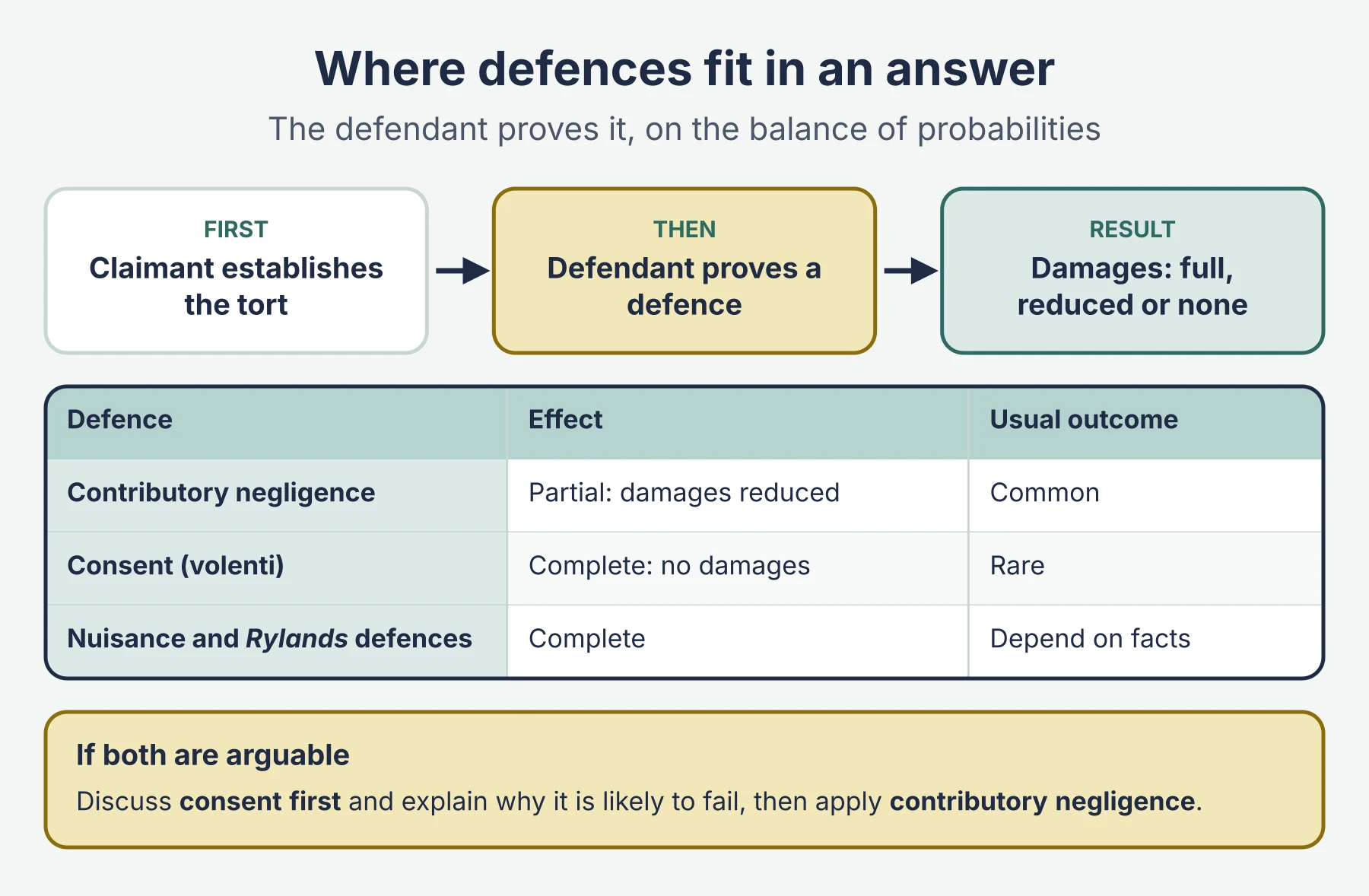
A defence is raised only after the claimant has established the tort. The defendant bears the burden of proving the defence on the balance of probabilities. Two of the defences have very different effects:
| Defence | Effect | Usual outcome |
|---|---|---|
| Contributory negligence | Partial: damages reduced | Common |
| Consent (volenti) | Complete: no damages | Rare |
| Nuisance and Rylands defences | Complete | Depend on facts |
If both contributory negligence and consent are arguable, discuss consent first and explain why it is likely to fail, then apply contributory negligence.
Contributory negligence
The statute
Section 1(1) Law Reform (Contributory Negligence) Act 1945 provides that where a person suffers damage partly through their own fault and partly through the fault of another, the claim is not defeated, but damages are reduced “to such extent as the court thinks just and equitable having regard to the claimant’s share in the responsibility for the damage”. Before 1945, any contributory negligence defeated the claim entirely.
What the defendant must show
- The claimant failed to take reasonable care for their own safety. The standard is objective.
- That failure contributed to the damage. It need not have contributed to the accident. In Froom v Butcher (1976) the claimant’s failure to wear a seat belt did not cause the crash, but it made his injuries worse.
Adjusting the standard
- Children are judged against a reasonable child of the same age. In Gough v Thorne (1966) a 13-year-old crossing a road when a lorry driver waved her on was not contributorily negligent. In Yachuk v Oliver Blais (1949) a nine-year-old who bought petrol, having lied about its use, was not at fault because he could not appreciate its danger.
- Emergencies: a claimant who makes a reasonable choice in the agony of the moment is not at fault even if, with hindsight, the choice was wrong. In Jones v Boyce (1816) a coach passenger jumped off, fearing the coach would overturn, and broke his leg; the coach stayed upright, but he was not at fault.
Apportionment
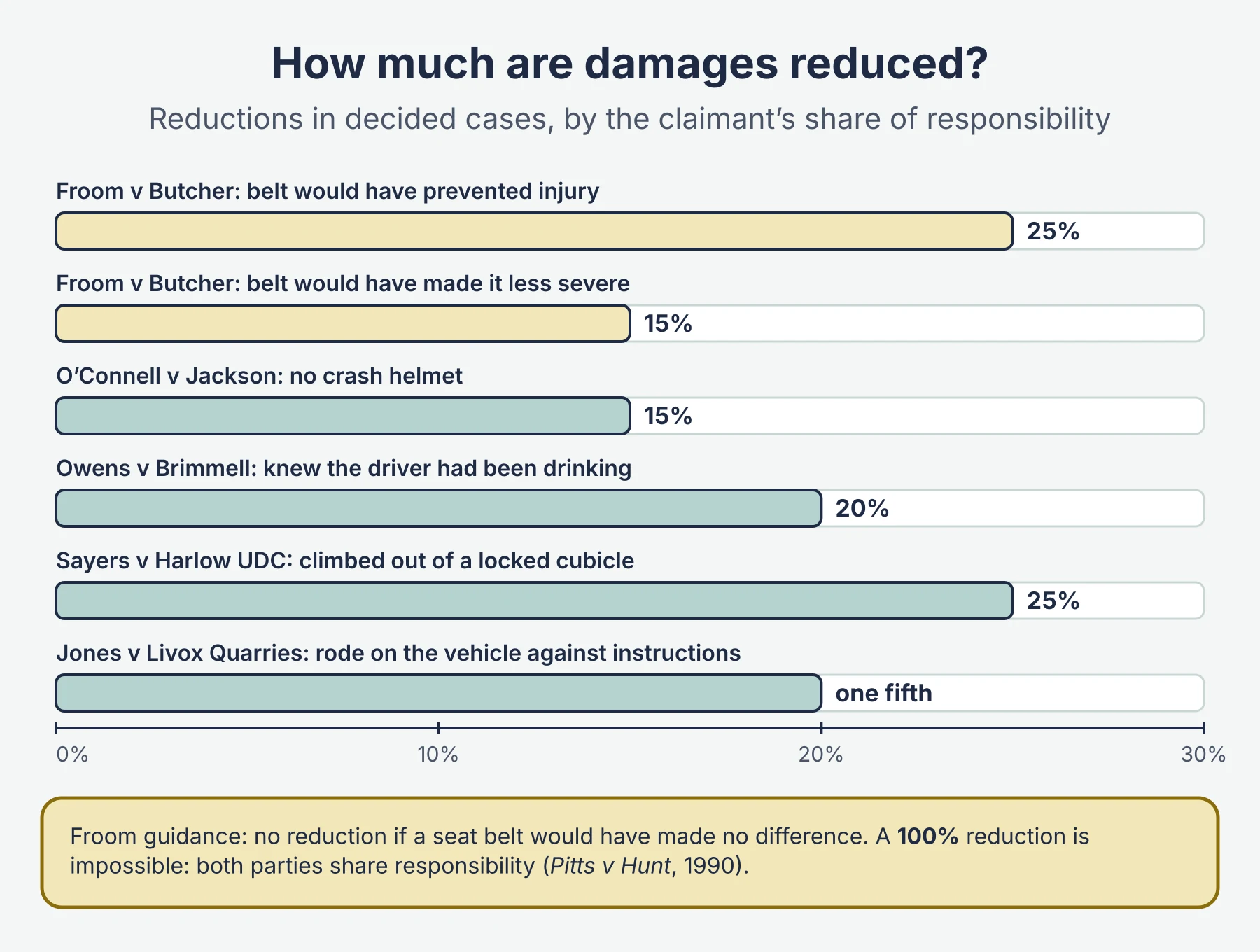
The court compares the parties’ blameworthiness and the causal effect of each one’s fault. Examples:
| Case | Claimant’s fault | Reduction |
|---|---|---|
| Froom v Butcher (1976) | No seat belt | Guidance: 25% if wearing one would have prevented the injury; 15% if it would have made it less severe; none if no difference |
| O’Connell v Jackson (1972) | Motorcyclist without a crash helmet | 15% |
| Owens v Brimmell (1977) | Passenger with a driver he knew had been drinking | 20% |
| Sayers v Harlow UDC (1957) | Climbed out of a locked public toilet cubicle, standing on the toilet roll holder | 25% |
| Jones v Livox Quarries (1952) | Rode on the back of a vehicle against instructions and was hit by another | One fifth |
A reduction of 100% is not possible, because the Act assumes both parties share responsibility (Pitts v Hunt, 1990).
Worked apportionment
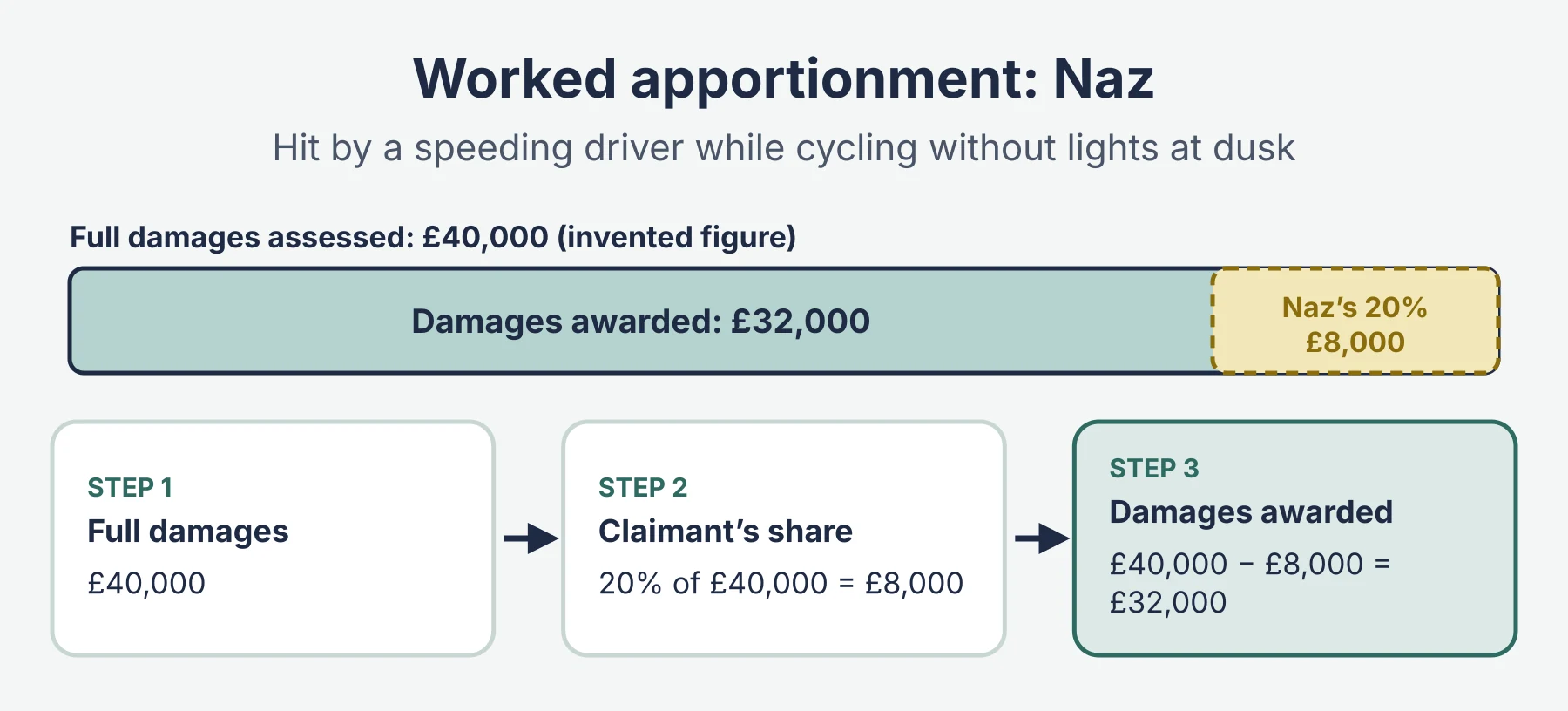
Naz is hit by a speeding driver while cycling without lights at dusk. Her damages are assessed at £40,000 (invented figure). The court finds her 20% responsible.
Full damages:            £40,000
Claimant's share:        20% of £40,000 = £8,000
Damages awarded:         £40,000 - £8,000 = £32,000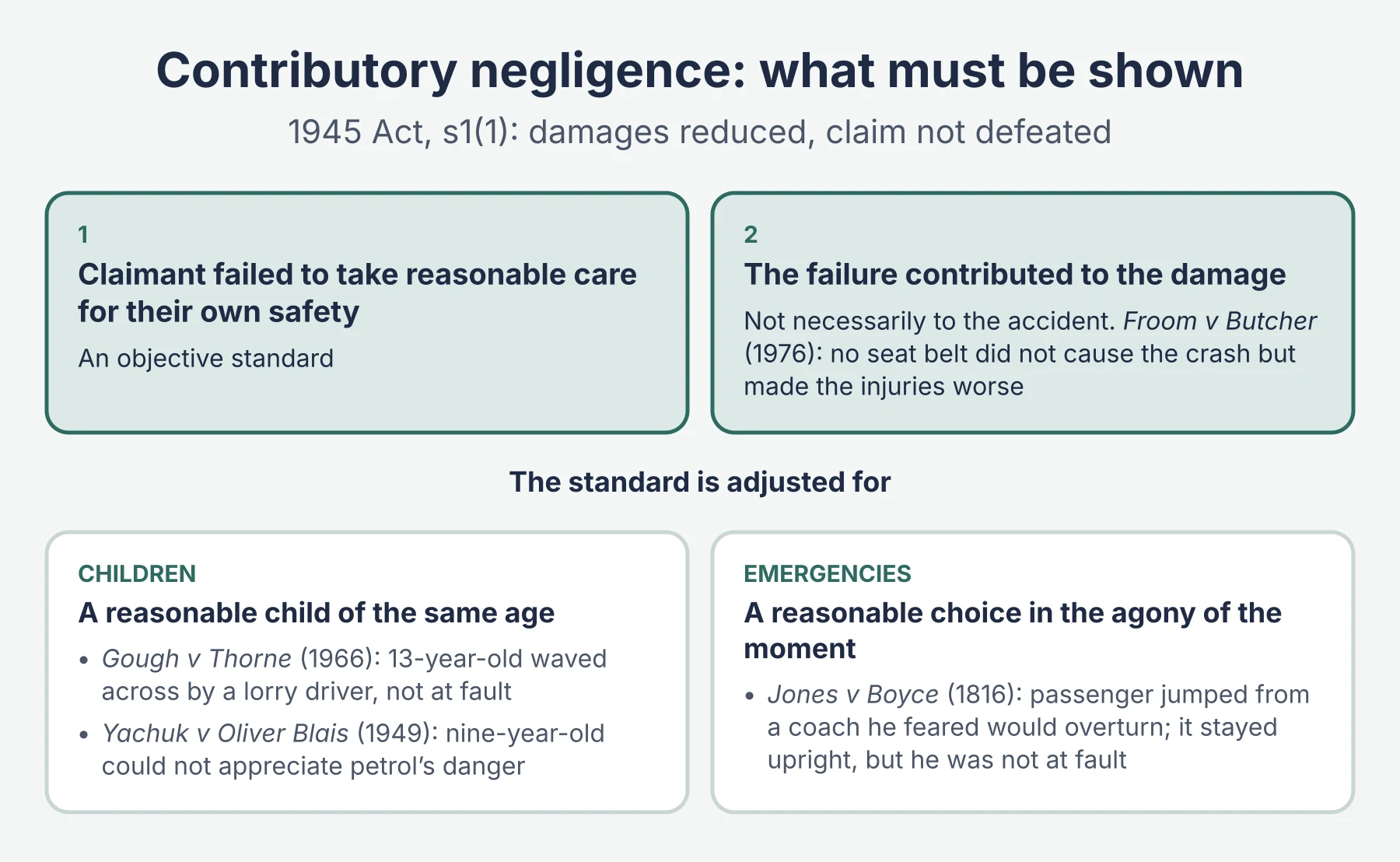
Consent: volenti non fit injuria
The requirements
“To one who is willing, no harm is done.” The defendant must prove that the claimant:
- had full knowledge of the nature and extent of the risk; and
- voluntarily agreed to accept that risk, including the risk of the defendant’s negligence, giving up any legal claim.
Why it usually fails
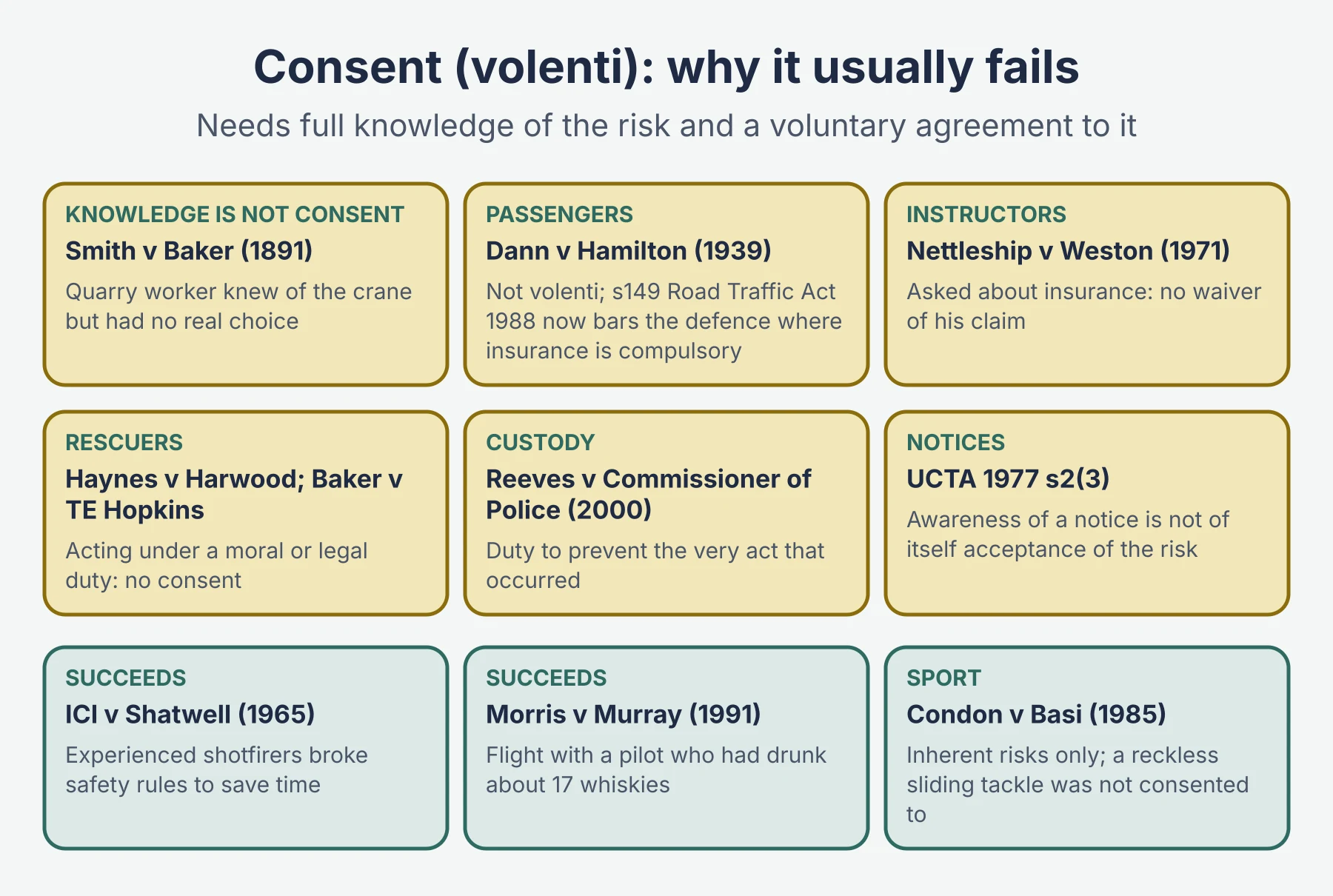
- Knowledge is not consent. In Smith v Baker (1891) a quarry worker knew stones were swung over his head by a crane but had no real choice if he wanted to keep his job. Employees are rarely held to consent to their employer’s negligence.
- Passengers. In Dann v Hamilton (1939) a passenger who accepted a lift from a driver she knew had been drinking was not volenti. Section 149 Road Traffic Act 1988 now prevents the defence being used against passengers in cases where insurance is compulsory.
- Learner drivers and instructors. In Nettleship v Weston (1971) the instructor had asked about insurance before the lessons, showing that he did not agree to waive his claim.
- Rescuers. A rescuer acting under a moral or legal duty does not consent: Haynes v Harwood (1935), a police officer injured stopping runaway horses; Baker v TE Hopkins (1959), a doctor who died trying to save workers in a well full of fumes.
- Suicide in custody. In Reeves v Commissioner of Police (2000) consent failed because the police owed a duty to prevent the very act that occurred.
- Notices. Under s2(3) Unfair Contract Terms Act 1977, a person’s agreement to or awareness of a term or notice excluding negligence liability is not of itself to be taken as voluntary acceptance of the risk.
When it succeeds
- ICI v Shatwell (1965): two experienced shotfirers deliberately broke statutory safety rules to save time; one was injured. Each had freely chosen the risk, and the employer was not liable.
- Morris v Murray (1991): the claimant went on a flight with a pilot who had drunk the equivalent of about 17 whiskies; the danger was so obvious that he was taken to have accepted it.
Sport
Participants consent to the risks inherent in the game played within its rules and conventions, but not to a reckless or dangerous foul. In Condon v Basi (1985) a footballer who broke an opponent’s leg with a reckless sliding tackle was liable.
Occupiers’ liability
Both Acts keep the defence: s2(5) Occupiers’ Liability Act 1957 and s1(6) Occupiers’ Liability Act 1984 provide that no duty is owed for risks willingly accepted.
Defences specific to private nuisance
| Defence | Rule | Authority |
|---|---|---|
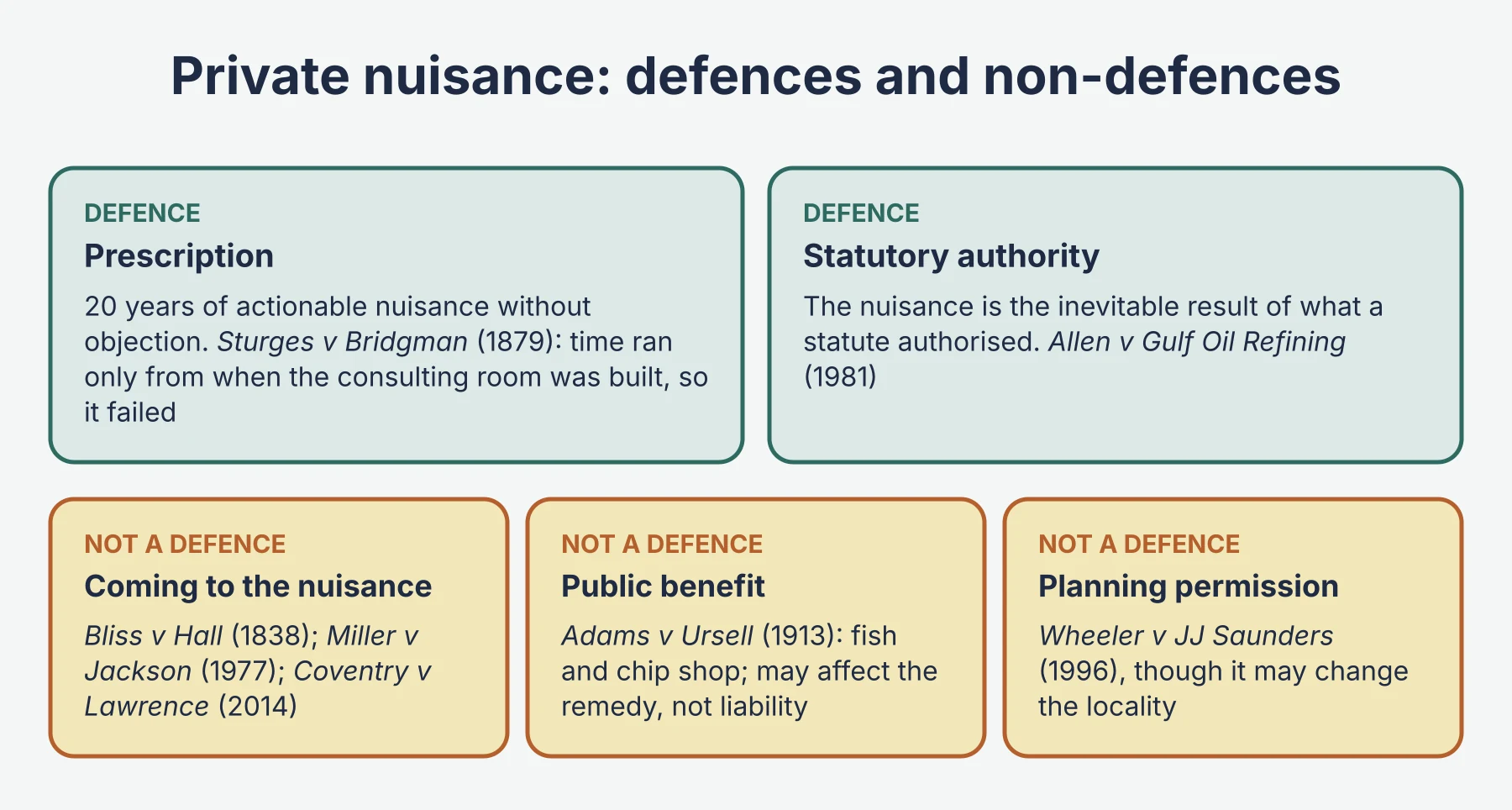
| Prescription | A right to commit a private nuisance can be acquired after 20 years of actionable nuisance, without the claimant objecting | Sturges v Bridgman (1879): time ran only from when the doctor’s consulting room was built, so the defence failed |
| Statutory authority | No liability where the nuisance is the inevitable result of what a statute authorised | Allen v Gulf Oil Refining (1981) |
Arguments that are not defences:
- Coming to the nuisance: Bliss v Hall (1838); Miller v Jackson (1977); Coventry v Lawrence (2014).
- Public benefit: in Adams v Ursell (1913) a fish and chip shop in a residential street was a nuisance despite its value to local people; public benefit may affect the remedy, not liability.
- Planning permission (Wheeler v JJ Saunders, 1996), though it may change the locality.
Defences to Rylands v Fletcher
| Defence | Rule | Authority |
|---|---|---|
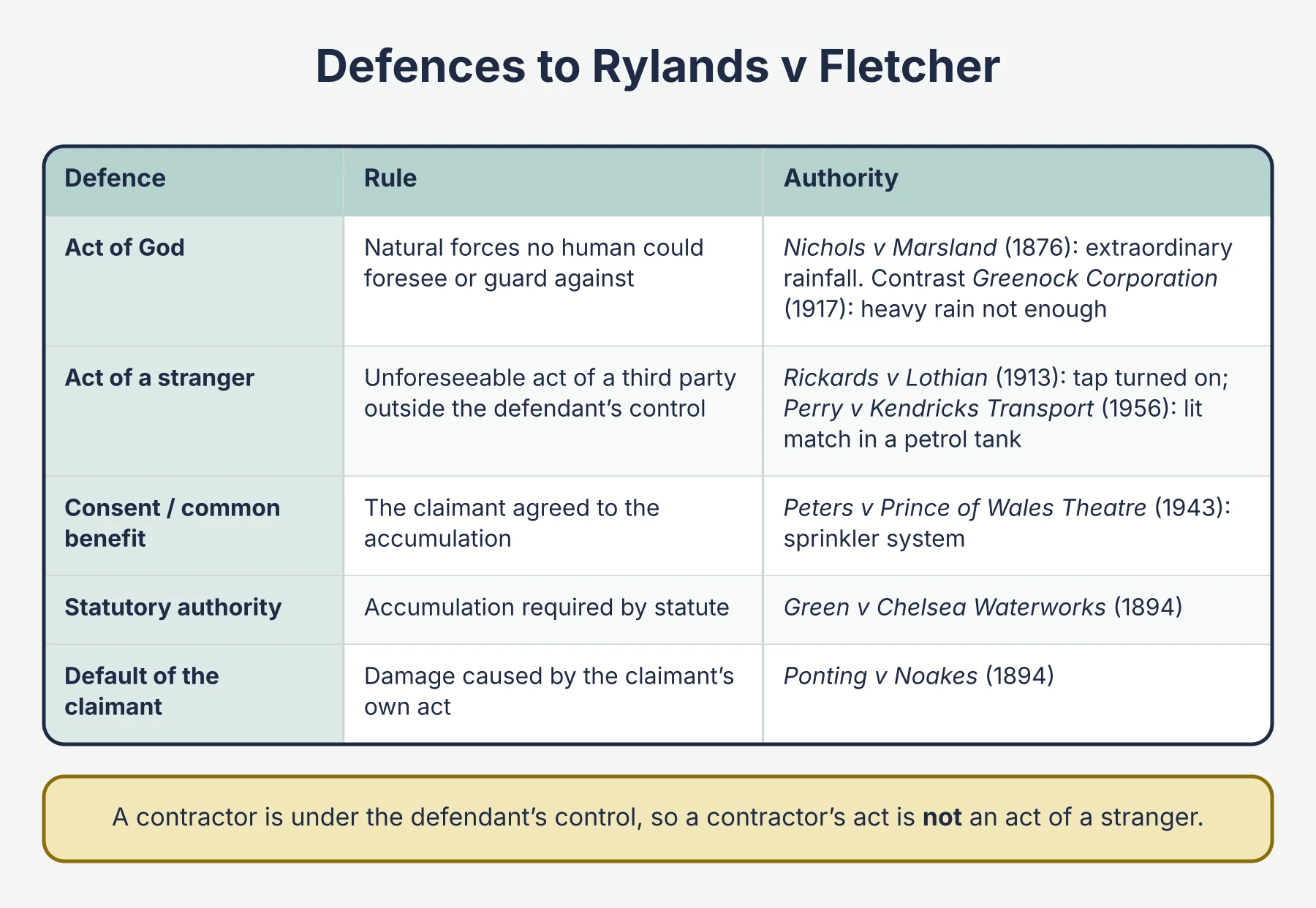
| Act of God | Natural forces no human could foresee or guard against | Nichols v Marsland (1876): extraordinary rainfall; contrast Greenock Corporation v Caledonian Railway (1917): heavy rain not an Act of God |
| Act of a stranger | Unforeseeable act of a third party outside the defendant’s control | Rickards v Lothian (1913): tap turned on by an unknown person; Perry v Kendricks Transport (1956): children threw a lit match into a coach’s petrol tank |
| Consent / common benefit | The claimant agreed to the accumulation, often because it benefits both | Peters v Prince of Wales Theatre (1943): sprinkler system |
| Statutory authority | Accumulation required by statute | Green v Chelsea Waterworks (1894) |
| Default of the claimant | Damage caused by the claimant’s own act; contributory negligence may reduce damages | Ponting v Noakes (1894) |
Common mistakes
- Treating contributory negligence as a complete defence.
- Arguing volenti from mere knowledge of a risk.
- Forgetting s149 Road Traffic Act 1988 for car passengers.
- Saying the claimant “came to the nuisance” and so loses.
- Using a contractor’s act as an “act of a stranger”: contractors are under the defendant’s control.
Exam technique
Name the defence, state its requirements with authority, apply them, and state the effect on damages. With contributory negligence, suggest a realistic percentage by analogy with a decided case rather than an arbitrary figure.
More resources on this topic
Defences in tort revision notes | Defences in tort practice questions | Nuisance and Rylands v Fletcher study guide
Related resources
-
Practice questions
AQA A Level Law (7162): Defences in Tort – Practice Questions
Original practice questions with mark-scheme answers on contributory negligence, consent and the nuisance and Rylands v Fletcher defences, AQA Law 7162.
Law · AQA · A Level
Try questions -
Revision notes
AQA A Level Law (7162): Defences in Tort – Revision Notes
Recall notes on contributory negligence, apportionment, volenti non fit injuria and the defences to nuisance and Rylands v Fletcher, for AQA A Level Law 7162.
Law · AQA · A Level
Revise topic -
Study guides
AQA A Level Law (7162): Liability in Negligence for Economic Loss and Psychiatric Injury
Pure economic loss from negligent acts and misstatements, and psychiatric injury to primary and secondary victims, applied to problems for AQA A Level Law 7162.
Law · AQA · A Level
Read guide
Get free revision emails (optional)
Occasional emails with practice questions, worked explanations and links to free resources for the qualification and subjects you choose. No spam, and you can unsubscribe from any email. The free tools on this site never need an email.