
Revision Notes
AQA AS-Level Business: People management (7137) – Revision Notes
Condensed revision notes for AQA AS Business 7137 section 3.2.1 People management: formulas, models, contrasts, self-test and common mark losses.
- Subject
- Business
- Level
- AS LEVEL
- Topic
- Managing people and operations
- Author
- Marlbridge Academic Team
- Updated
- Reviewed by
- Salman Ahmad (what this means)
Aligned to AQA AS Level Business (7137), For first teaching from September 2026. Official specification .
Syllabus page (what it covers and how it is assessed): AQA AS Level Business.
Syllabus points this page covers
7137
- 3.2.1 People management
Found an error? Report a correction.
Need help with this topic? Request a free trial class for AS Level Business (7137).
Quick recall for AQA AS Business (7137), for first teaching from September 2026, section 3.2.1 People management. For full explanations and a worked data example, use the study guide. Test yourself with the practice questions. The AQA AS Business hub, the checklist and the diagnostics cover the rest of the course. Ethics in HR is not included. For stakeholder links see What Is Business? and for the course layout the course structure guide.
Key definitions
- HR objectives: targets for the number and skills of employees, turnover and retention, engagement, employee costs, and equality, diversity, inclusion and belonging.
- HR planning: matching the workforce to future needs through recruitment, training, retention, redeployment and redundancy.
- Flexible employment: a mix of employment types and patterns so the workforce can change with demand.
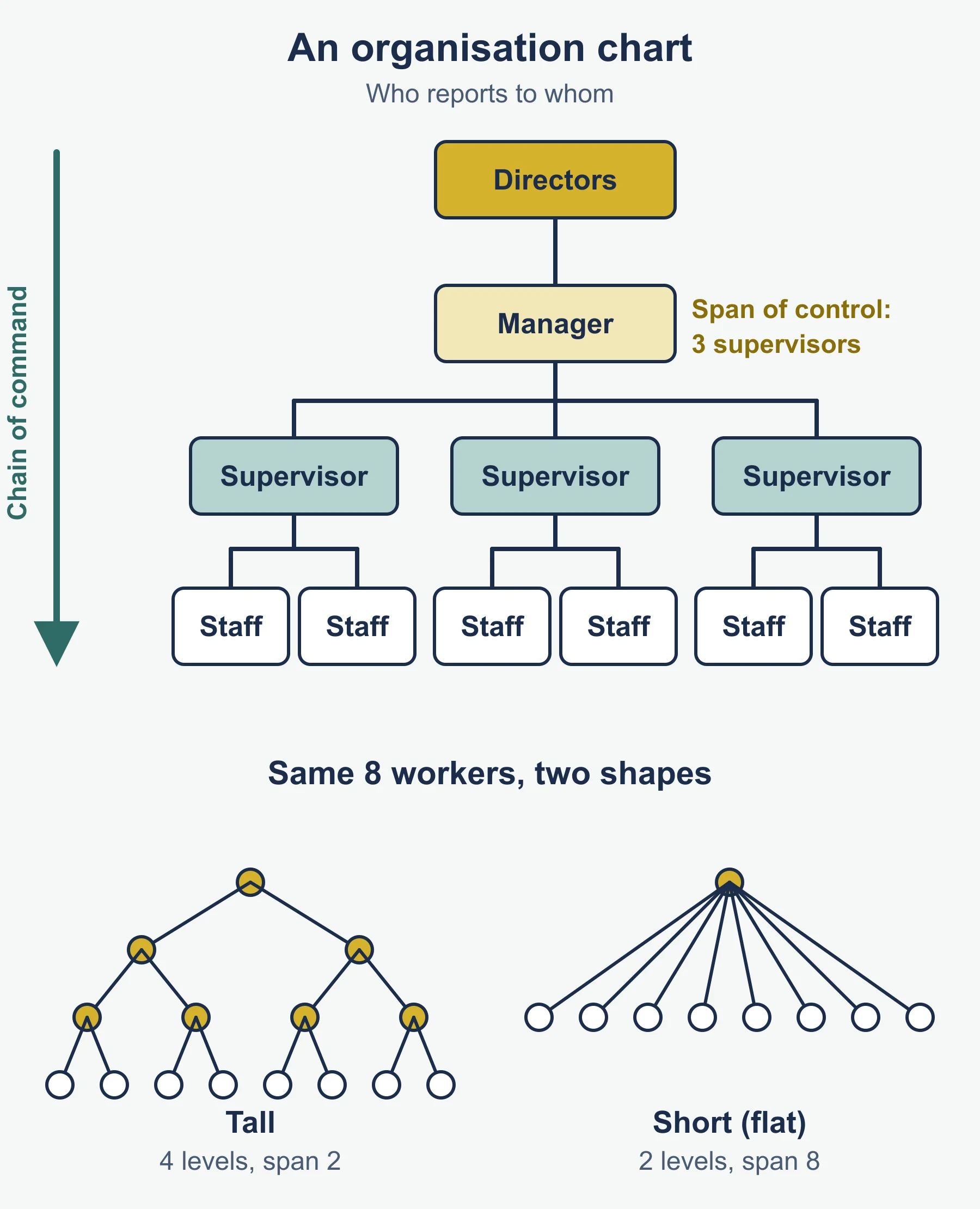
- Span of control: the number of people reporting directly to one manager.
- Levels of hierarchy: the layers of authority in the structure.
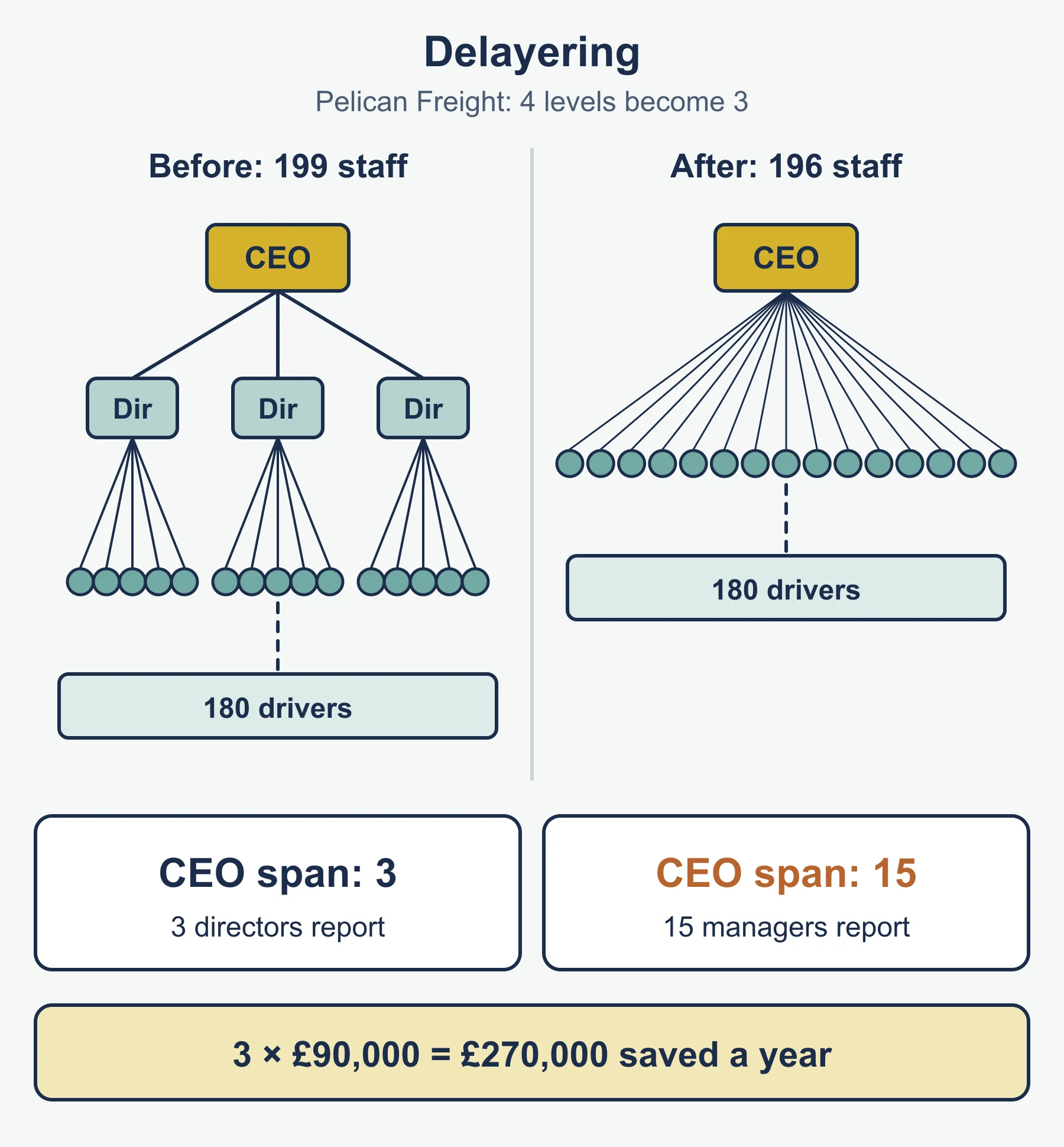
- Delayering: removing one or more levels of hierarchy.
- Appraisal: a regular review of performance against agreed targets.
- Talent management: acquiring, managing, developing and retaining valuable people.
- Employee voice: the way staff express views and influence decisions.
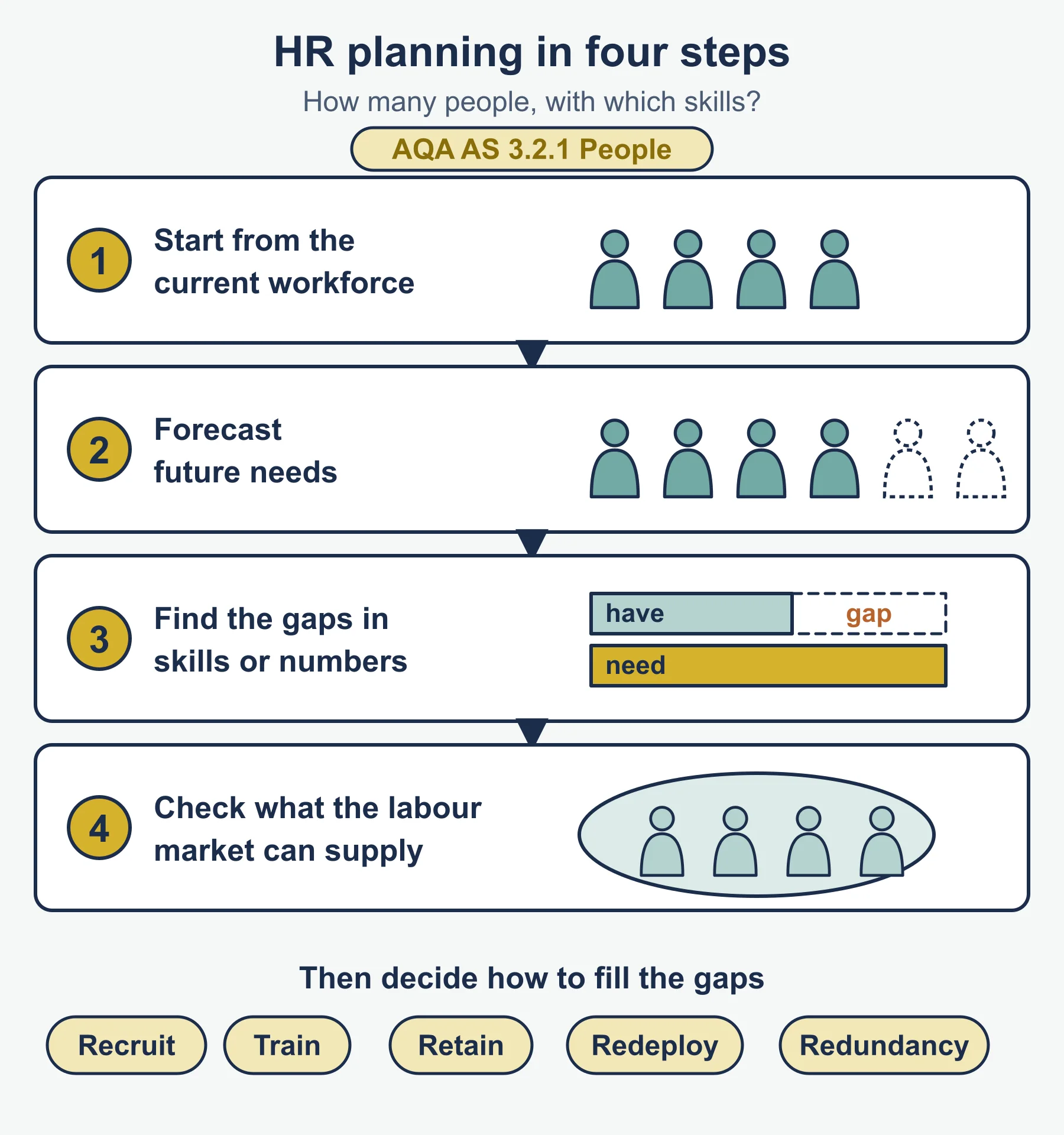
HR planning in steps
- Set the HR objectives from the corporate objectives.
- Audit the current workforce: numbers, skills, age, location.
- Forecast future needs from expected demand and strategy.
- Identify gaps in numbers or skills, and surplus.
- Choose actions: recruit, train, retain, redeploy or make redundant.
- Check what the labour market can supply and review.
Employment types at a glance
| Type | Main plus | Main minus |
|---|---|---|
| Full-time | Cover and commitment | Fixed cost |
| Part-time | Matches demand | Handover and admin |
| Permanent | Loyalty, training pays back | Redundancy cost |
| Temporary | Peak cover | Low commitment |
| Zero-hours | Hours track demand | Insecurity, turnover |
| Freelance | Specialist skill on demand | Little control |
HR data formulas (standard forms)
| Measure | Formula |
|---|---|
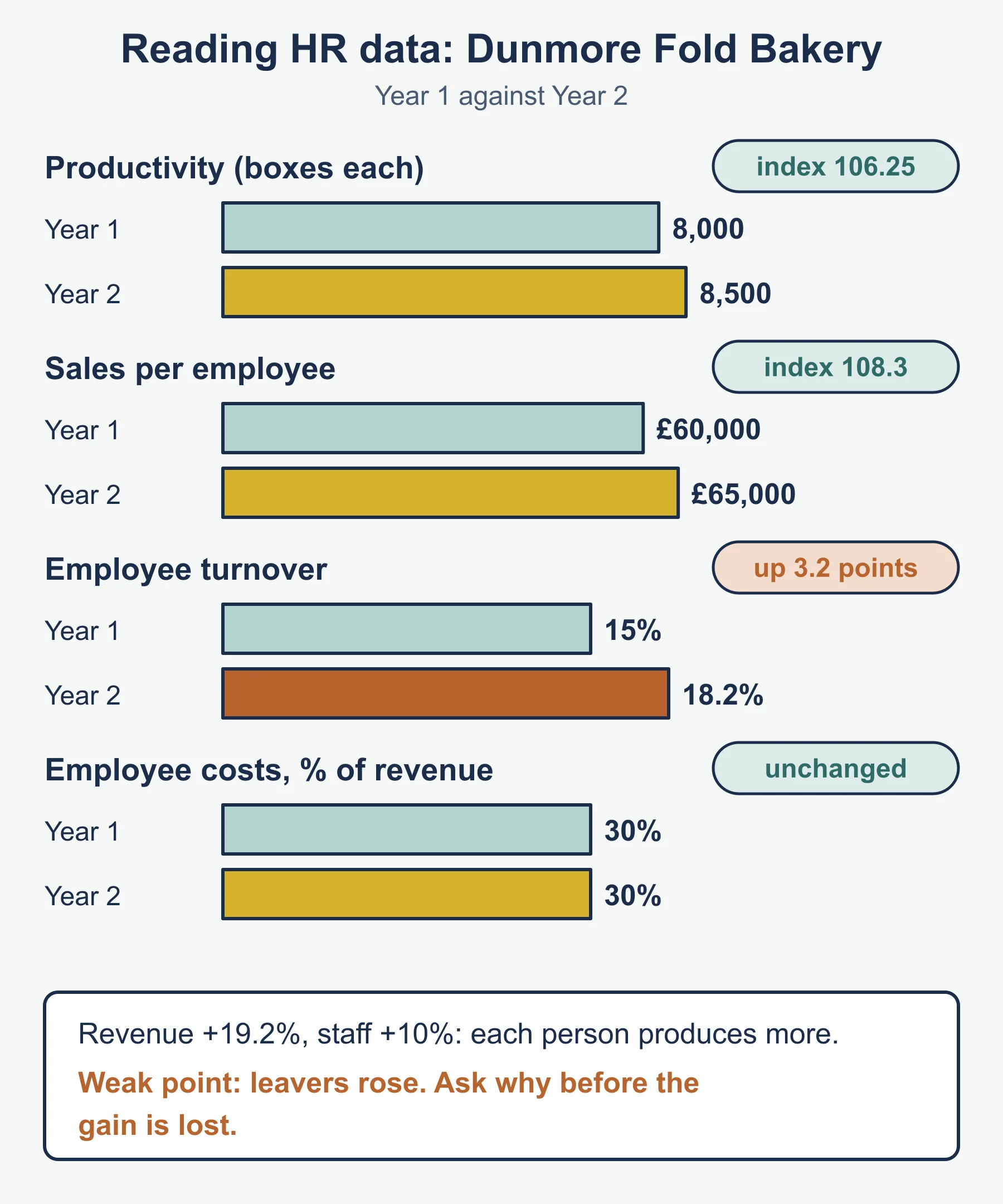
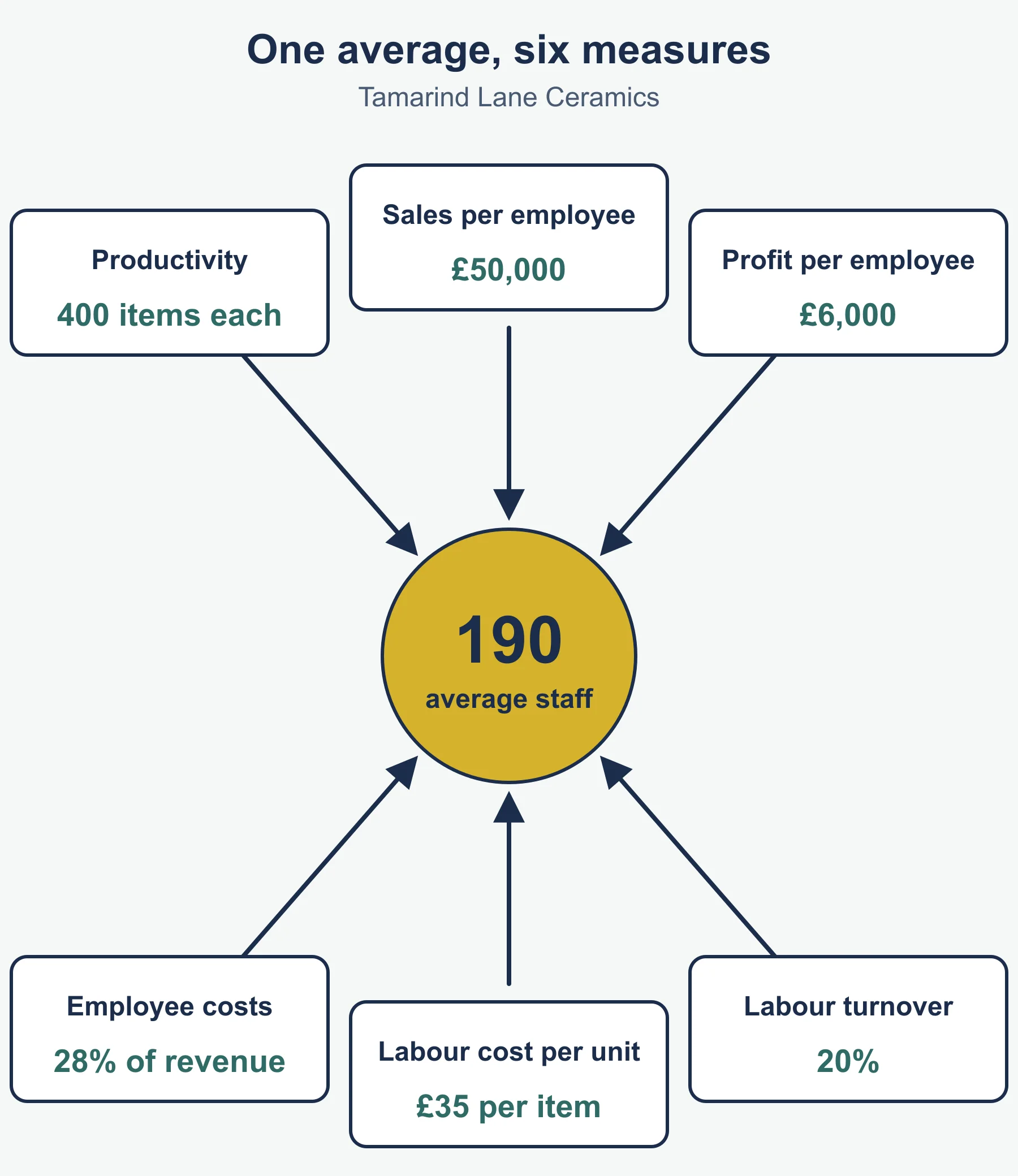
| Productivity | output ÷ employees |
| Sales per employee | revenue ÷ employees |
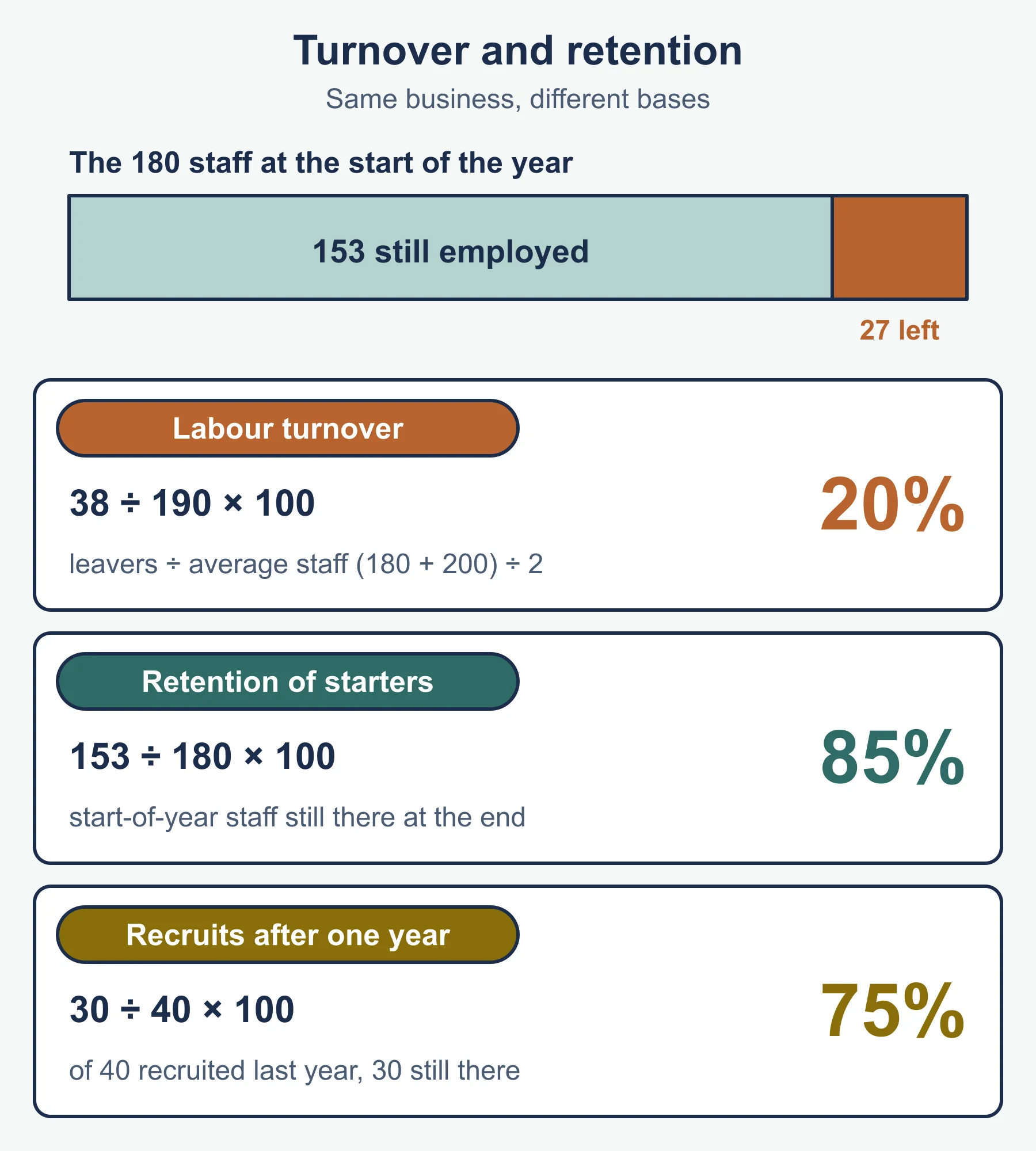
| Employee turnover | leavers ÷ average employees × 100 |
| Employee costs % of revenue | employee costs ÷ revenue × 100 |
| Percentage change | (new − old) ÷ old × 100 |
| Index number | new ÷ base × 100 |
Method for a data question. Write the formula, substitute, give units or a percentage, then comment on what it means for the business and what else you would want to know.
Worked reminder: Calder Quay Couriers.
| Year 1 | Year 2 | |
|---|---|---|
| Employees | 25 | 24 |
| Deliveries | 300,000 | 336,000 |
| Revenue | £1,500,000 | £1,620,000 |
| Employee costs | £480,000 | £486,000 |
| Leavers | 5 | 3 |
- Productivity: 12,000 then 14,000 deliveries per employee, an index of 116.7 (up 16.7%).
- Sales per employee: £60,000 then £67,500, an index of 112.5.
- Employee turnover: 20% then 12.5%.
- Employee costs as a percentage of revenue: 32% then 30%.
- Revenue rose 8% but employee costs rose only 1.25%.
Comment: fewer staff are doing more, and turnover has fallen, so the position has improved on every measure. The risk is overload on 24 people, so engagement and wellbeing data should be checked. Also say why the HR data matters: engagement, representation, diversity and wellbeing are measured so that problems are found early.
Structures
| Feature | Tall | Flat |
|---|---|---|
| Levels | Many | Few |
| Span | Narrow | Wide |
| Communication | Slow | Faster |
| Management cost | High | Lower |
| Supervision | Close | Limited |
| Promotion steps | Many | Few |
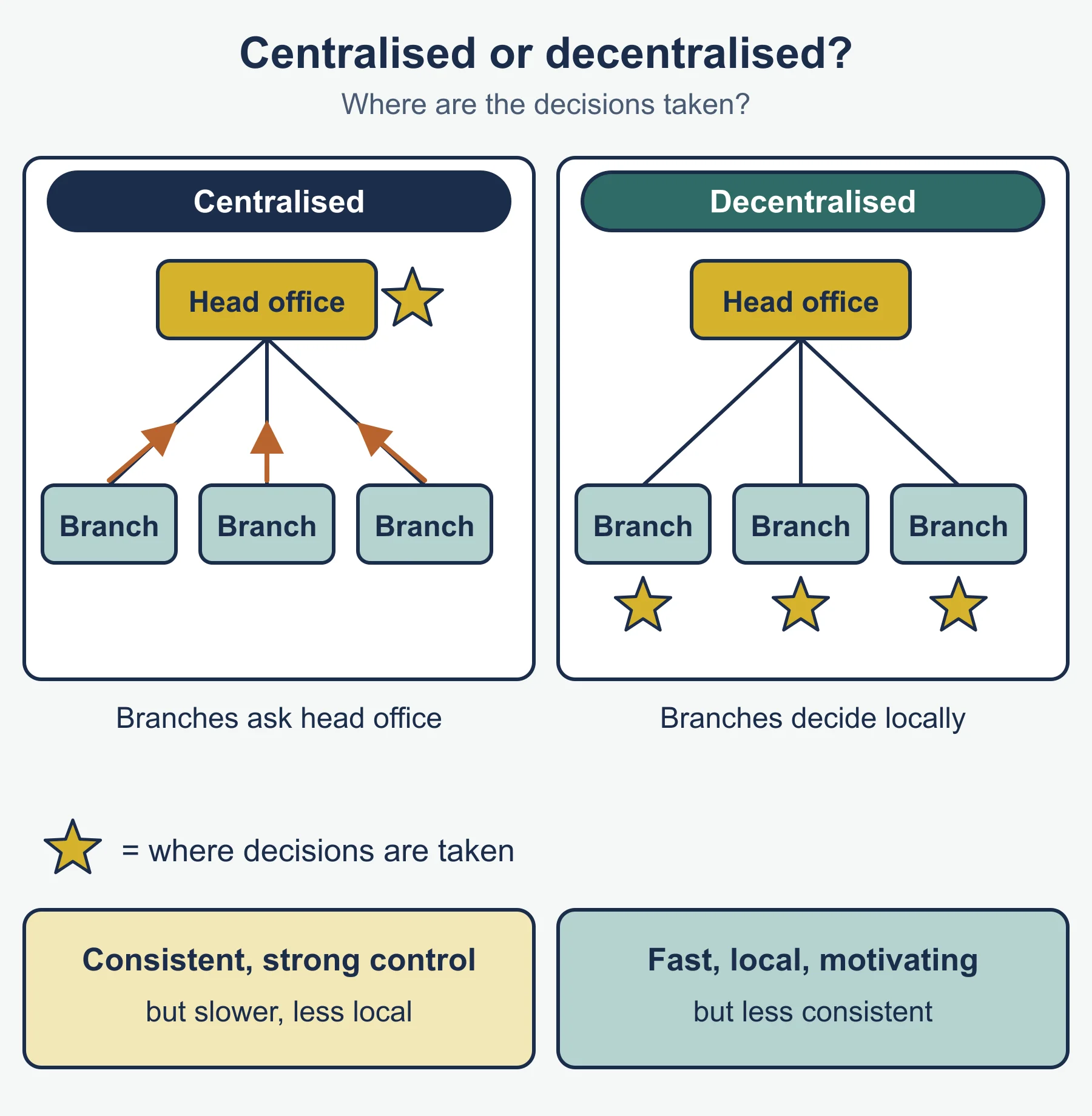
| Feature | Centralised | Decentralised |
|---|---|---|
| Decisions made | At the top | Lower down |
| Plus | Consistency, control | Speed, local knowledge, staff development |
| Minus | Slow, demotivating | Inconsistency, less control |
Delayering / restructuring: cuts cost, speeds communication, widens spans; but redundancy, overload, lost experience and falling morale.
Quick sum: levels needed fall as span widens. With 56 staff and a span of 8, seven supervisors are needed.
Leadership
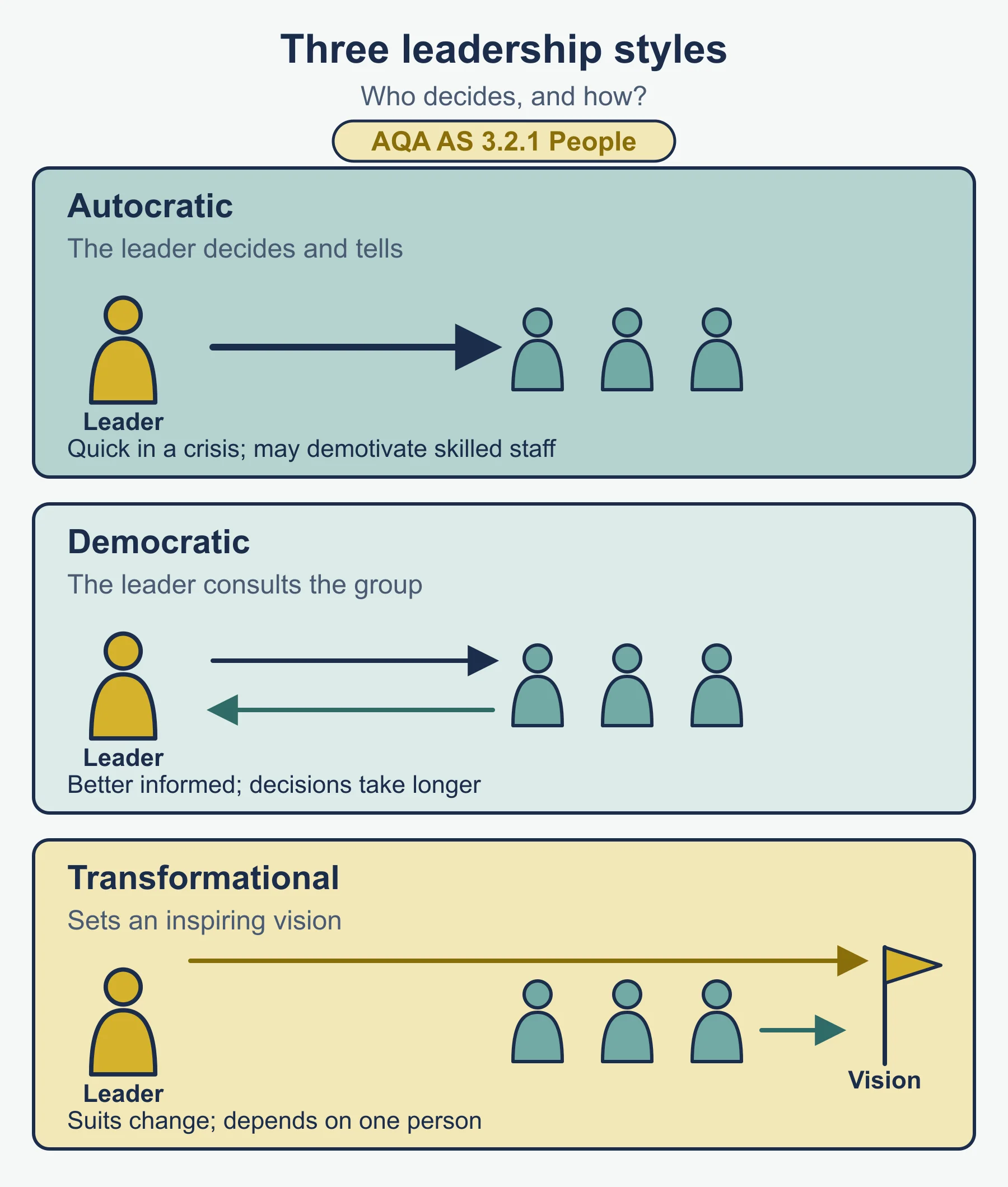
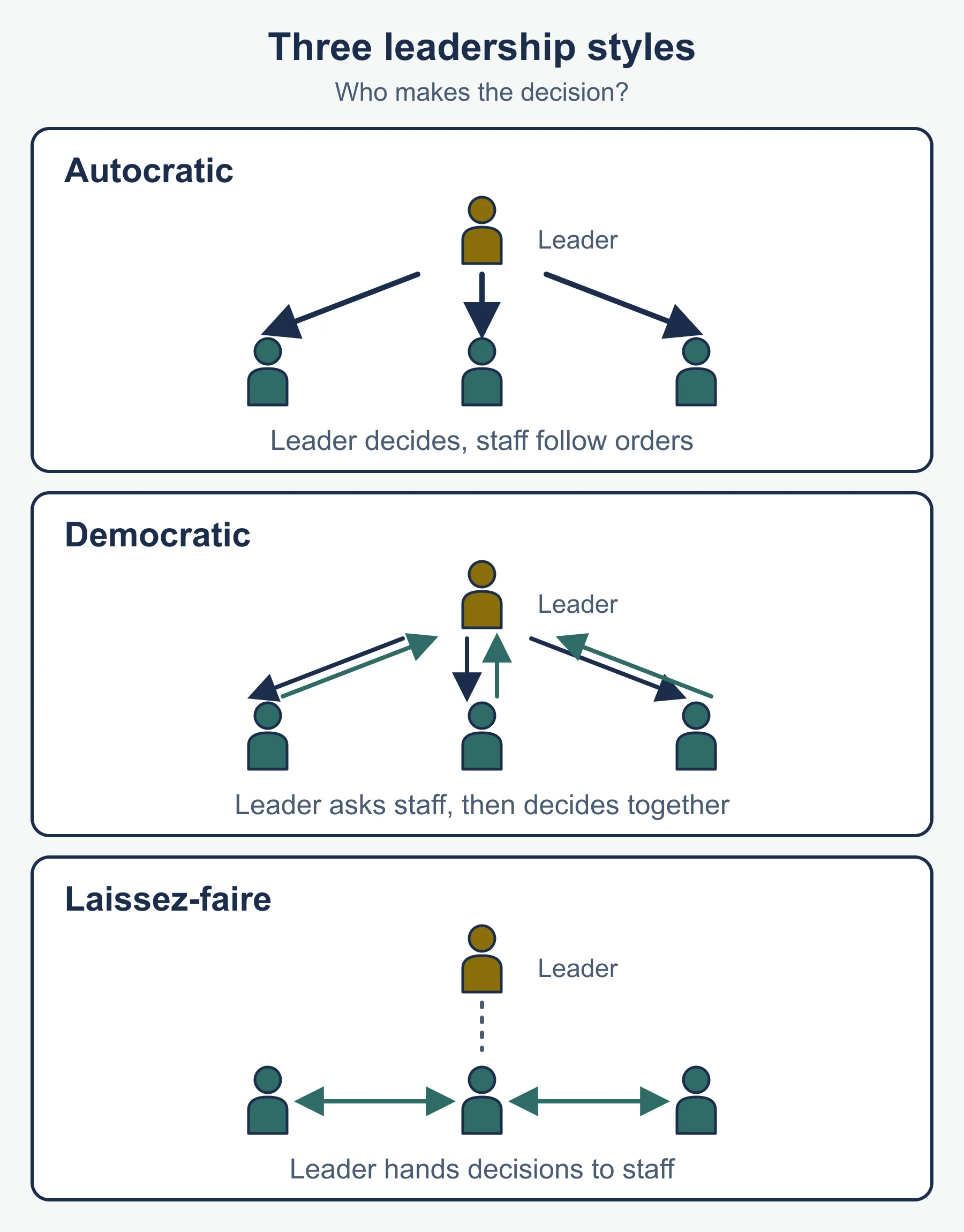
| Style | Feature | Fits | Risk |
|---|---|---|---|
| Autocratic | Leader decides | Crisis, unskilled team | Resentment, turnover |
| Democratic | Leader consults | Skilled team, complex issues | Slow decisions |
| Transformational | Vision, inspiration, change | Growth or major change | Depends on the leader |
Impact: individuals (motivation, stress), teams (cooperation), the business (performance, retention). Influences on choice: personality, staff skills, urgency, culture.
Developing people and teams
- Appraisal: feedback, training needs, link to pay or promotion. Risk: feels like criticism.
- Talent: adds hard-to-copy skills. Challenges: cost, poaching by rivals, trained staff leaving.
- Teams: share skills and ideas and spread the load; risks include conflict and free-riding.
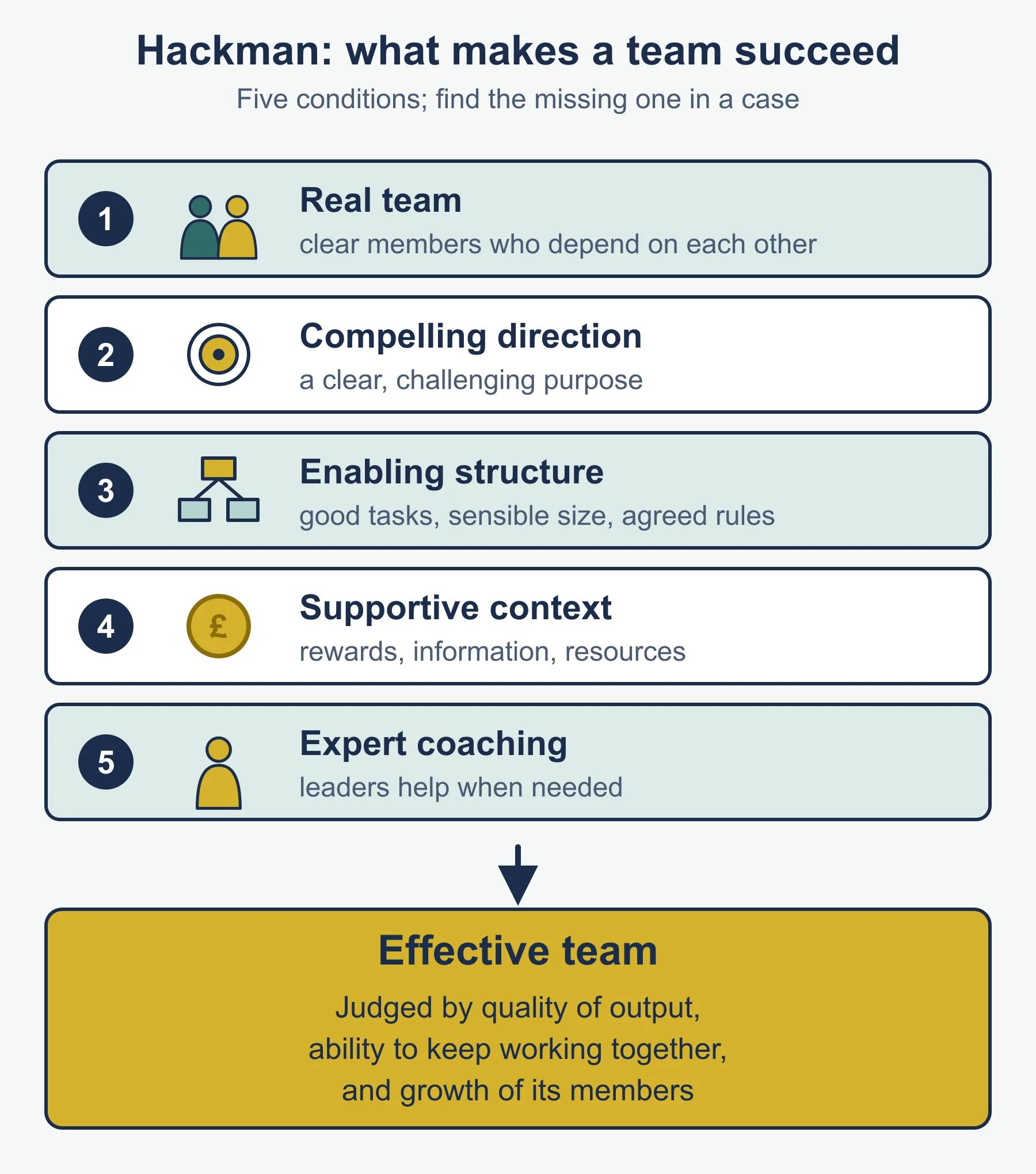
Hackman’s model, five conditions: real team; compelling direction; enabling structure; supportive context; expert coaching. Judged on output quality, ability to keep working together, and member growth. Exam use: spot the missing condition in the case.
Motivation theories
| Theory | Core idea | Business use | Limit |
|---|---|---|---|
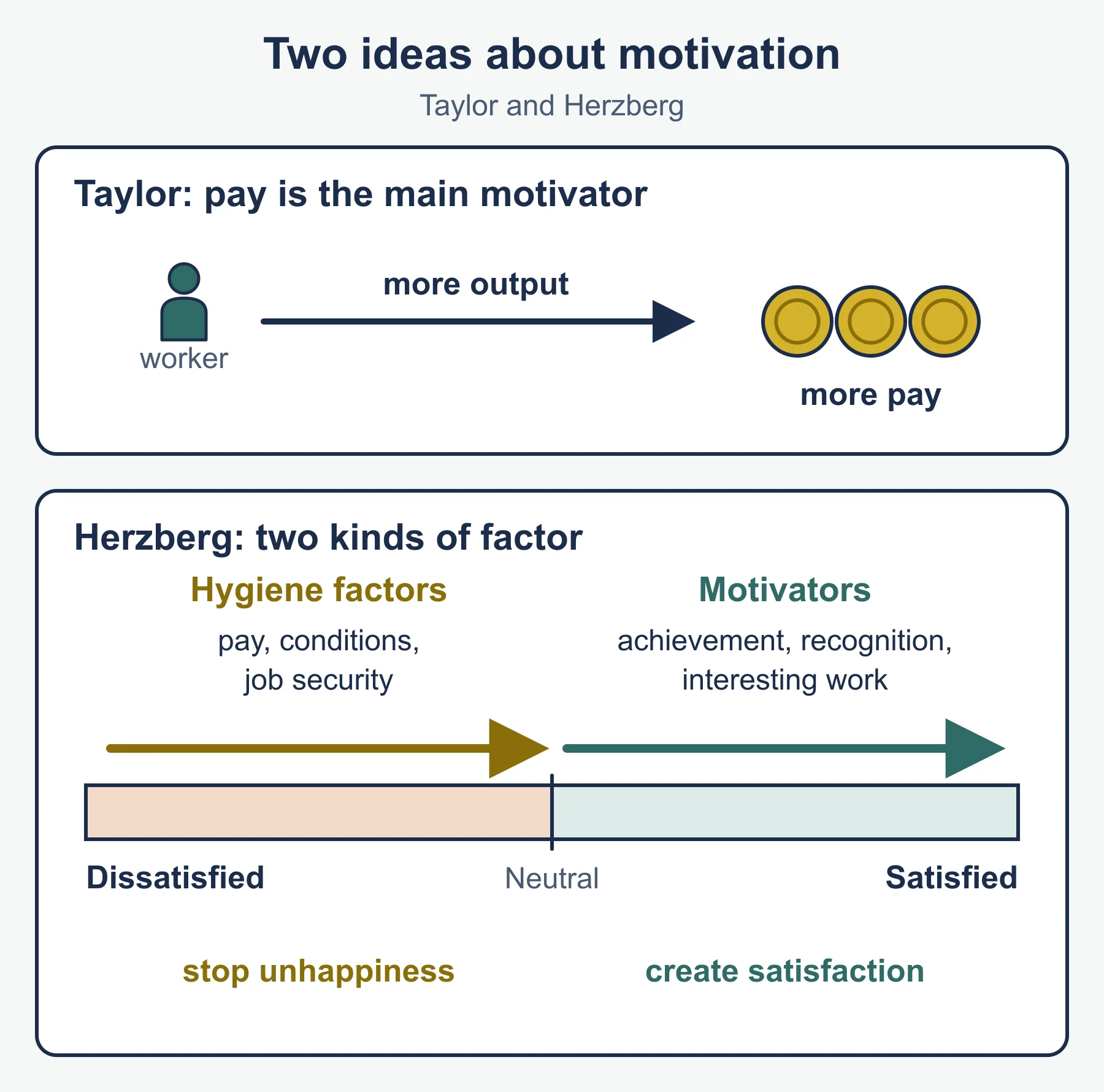
| Taylor | Pay is the main motivator; simple timed tasks | Piece rate, tight methods | Ignores other needs; monotony |
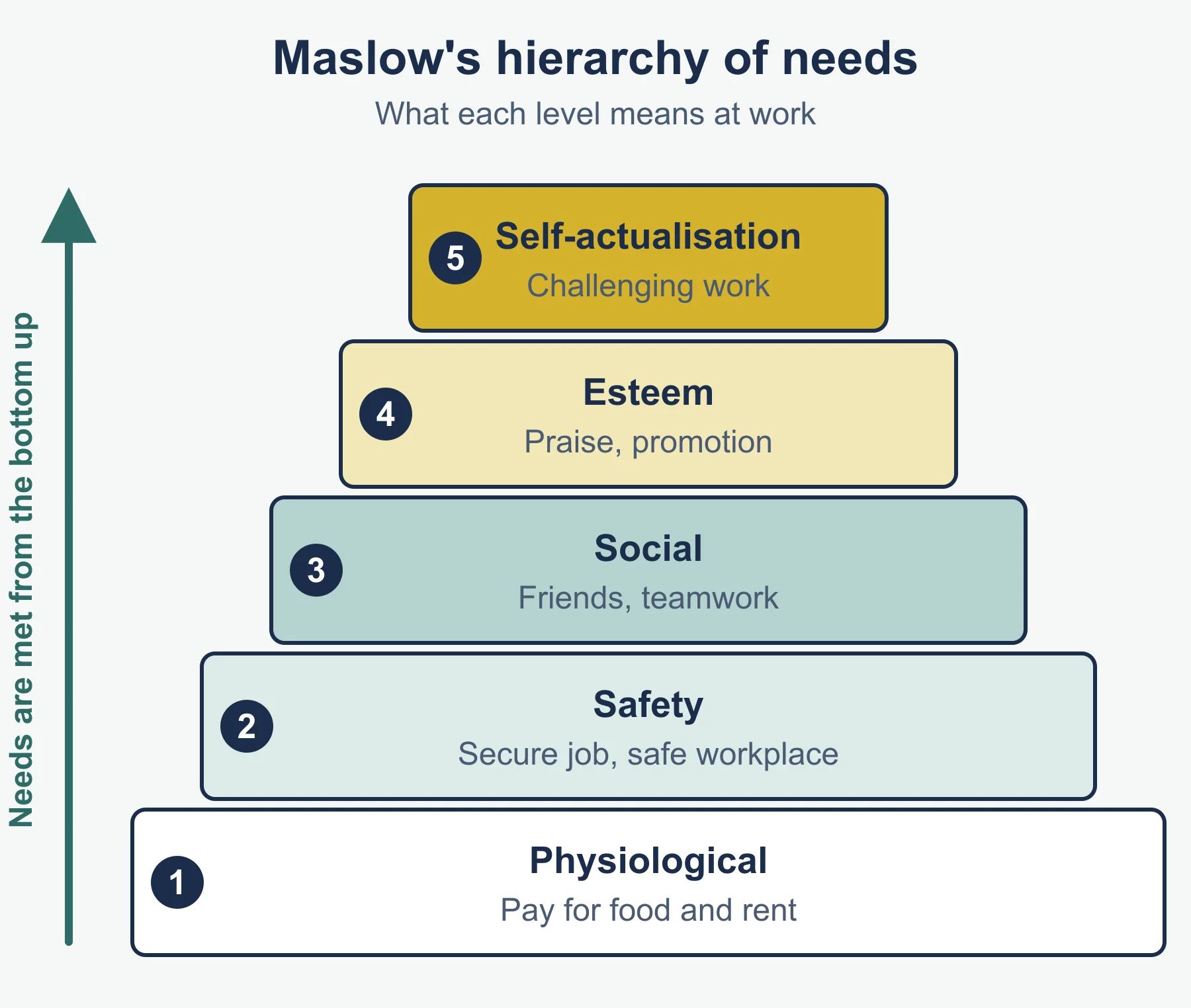
| Maslow | Hierarchy: physiological, safety, social, esteem, self-actualisation | Meet the next unmet need | Not everyone follows the order |
| Herzberg | Hygiene factors prevent dissatisfaction; motivators raise motivation | Enrich jobs, delegate | Hard to separate in practice |
Rewards
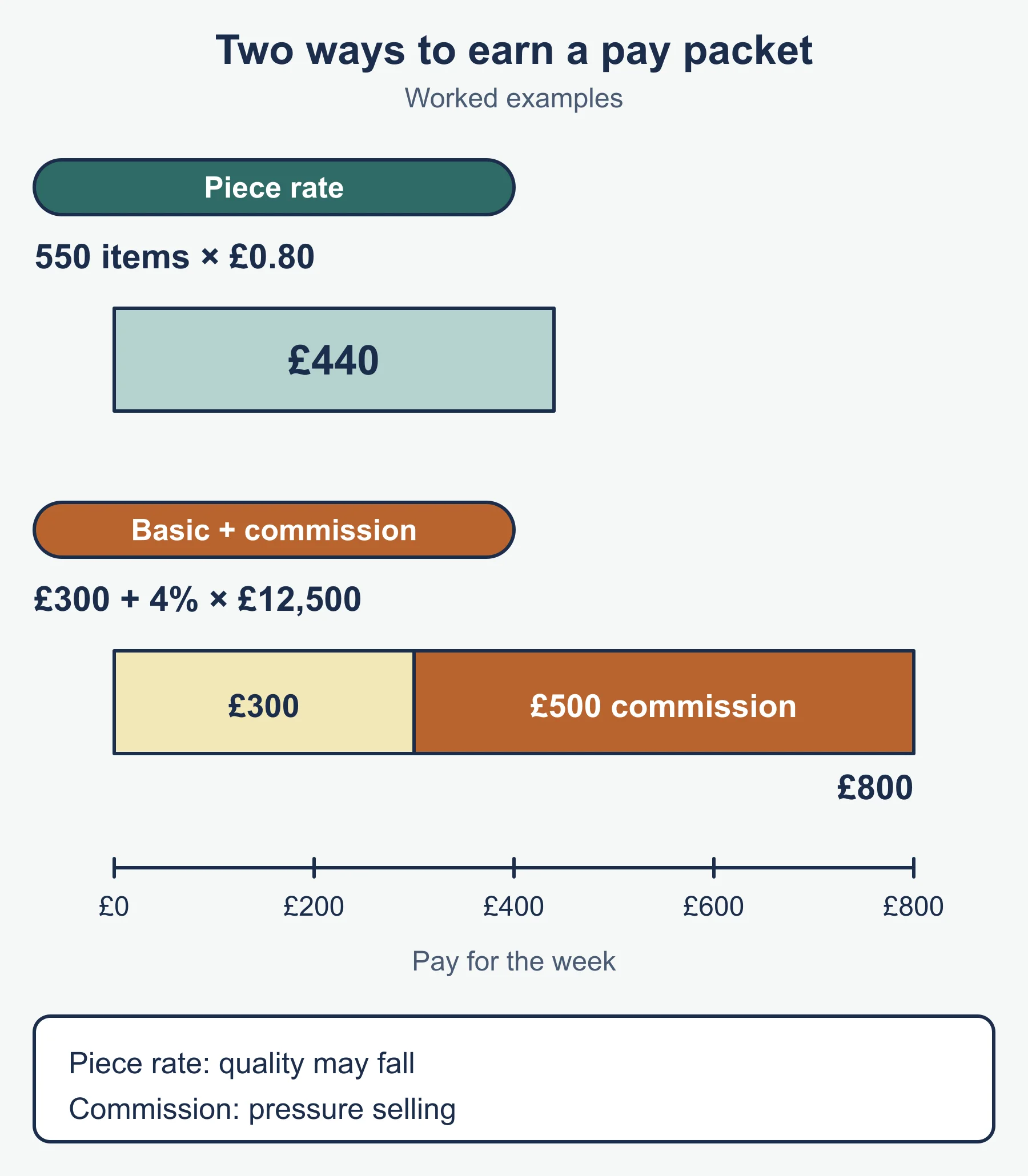
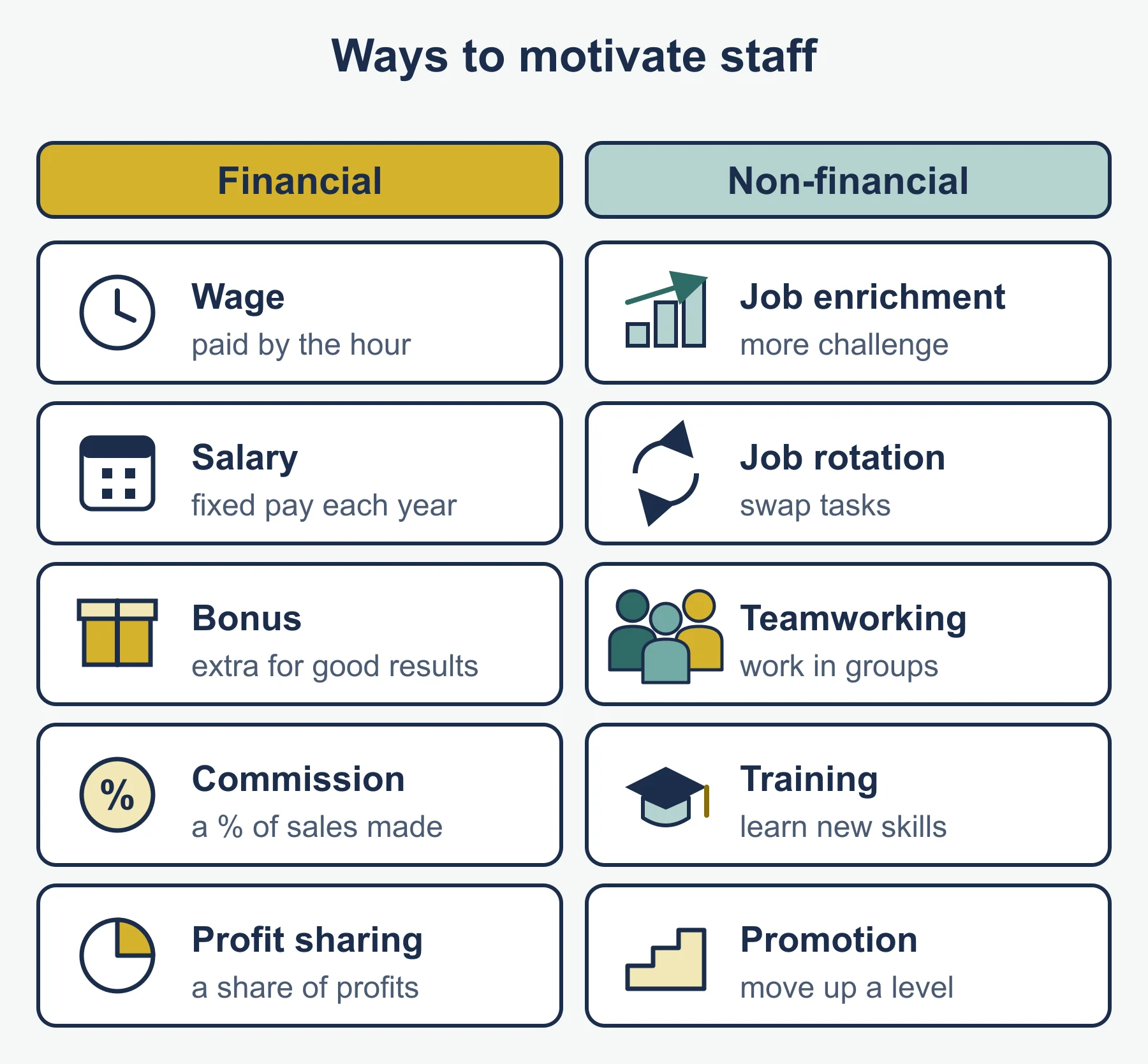
- Financial: wages, salaries, piece rate, commission, performance-related pay, shares, fringe benefits. Plus: attract and direct effort. Minus: cost, narrow focus, short-lived effect.
- Non-financial: delegation, empowerment, job enrichment, training and development, remote, hybrid and flexible working. Plus: meets higher needs. Minus: needs trust and skilled management.
Wellbeing, representation and relations
- Wellbeing methods: physical and mental health support, inclusive environment, employee voice, flexible working. Benefits: lower absence, retention, engagement. Challenges: cost, hard to measure.
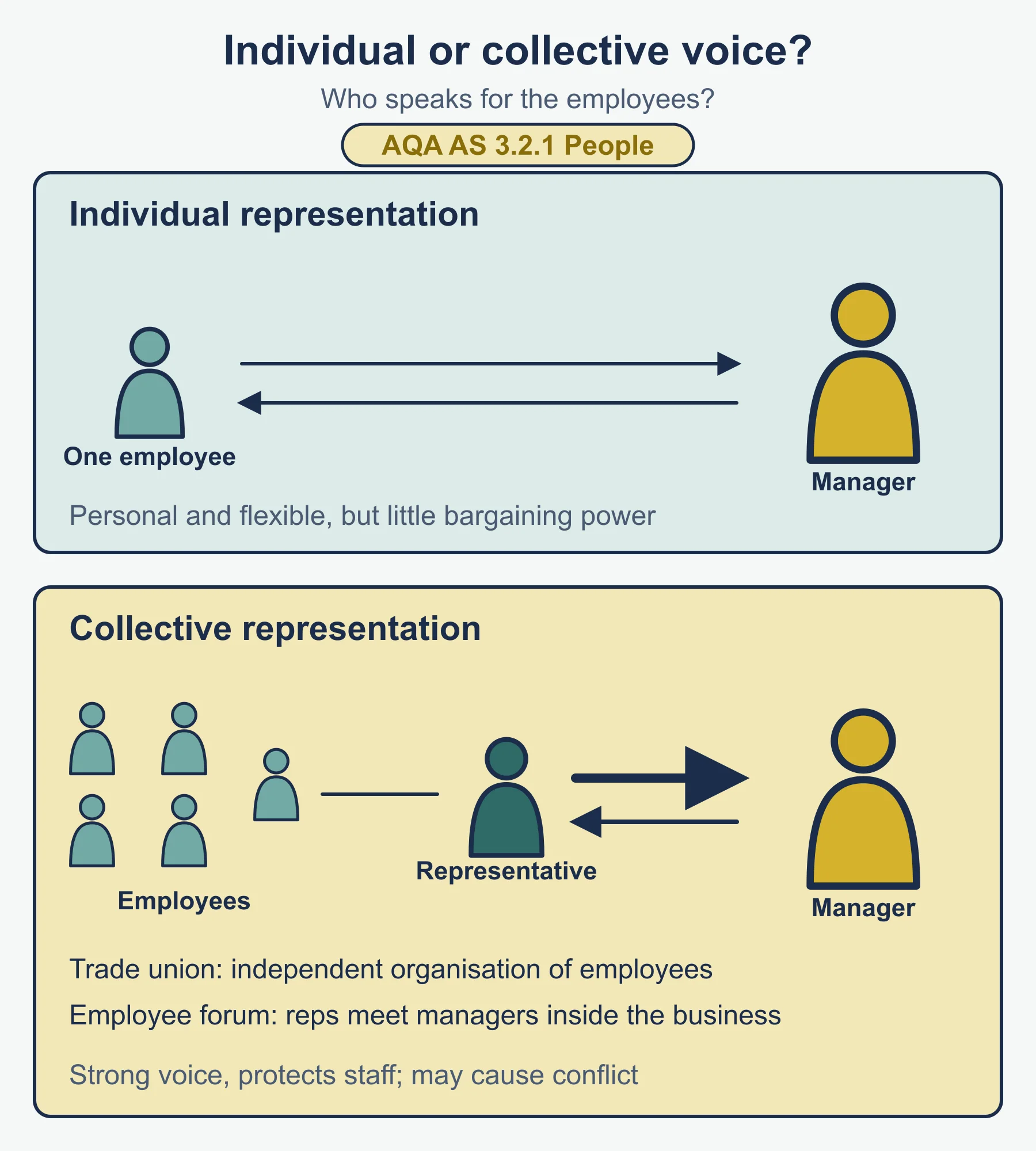
- Individual representation: flexible, personal; low bargaining power. Collective (trade unions, employee forums): strong voice, protection; may bring conflict and delay.
- Poor relations, causes: pay disputes, poor communication, unfair treatment, sudden change. Consequences: strikes, absence, turnover, lower productivity, reputation. Improving: communicate, consult, fair pay, resolve grievances.
Influences and links to other functions
- Influences on HR objectives: the corporate objectives, business size and sector, finances, the labour market, the culture and competitors’ pay.
- Influences on HR planning: the current workforce, future needs, skills and numbers gaps, and the labour market.
- Finance: sets the pay budget and shows employee costs against revenue.
- Marketing: forecasts demand, which drives staffing numbers and the skills needed.
- Operations: sets output targets, shift patterns and the training needed for equipment.
- Competitiveness: skilled, motivated and well-led people improve service, quality, productivity and the ability to adapt, which are hard for rivals to copy.
Case-study skills for people questions
- Define or identify the term in a few words.
- Apply it: use a figure, job role or fact from the case.
- Analyse: explain a chain of cause and effect, such as flatter structure, faster decisions, higher manager workload, lower service quality.
- Evaluate: weigh both sides, then reach a judgement that depends on a stated factor such as business size, staff skills, urgency or cost.
- Check the command word: state needs one fact; explain needs a reason; evaluate and justify need a judgement.
For calculation questions, show the formula, the working and the unit, then say what the answer suggests.
Must-know distinctions
- Employee turnover (staff leaving) is not revenue.
- Span of control is not the number of levels.
- Hygiene factors prevent dissatisfaction; motivators create motivation.
- Delegation passes tasks; empowerment passes decision-making power.
- Individual representation is one person; collective representation is a group voice.
Quick self-test
- A shop averages 60 staff and 9 leave. Calculate employee turnover.
- Employee costs are £84,000 and revenue £420,000. Calculate employee costs as a percentage of revenue.
- A team of 18 produces 12,600 units. Calculate productivity.
- An index rises from 120 to 138. What is the percentage change?
- Sales per employee rises from £52,000 to £57,200. Give the index with the first figure as 100.
- A worker is paid £2.40 per unit and makes 310 units. Calculate pay.
- Fifty-six staff are managed with a span of control of 8. How many managers are needed?
- Is pay a hygiene factor or a motivator in Herzberg’s theory?
- Name two of Hackman’s conditions.
- State one disadvantage of delayering.
- Give one advantage of a zero-hours contract to the employer.
Answers
- 9 ÷ 60 × 100 = 15%.
- 84,000 ÷ 420,000 × 100 = 20%.
- 12,600 ÷ 18 = 700 units per employee.
- (138 − 120) ÷ 120 × 100 = 15%.
- 57,200 ÷ 52,000 × 100 = 110.
- 310 × 2.40 = £744.
- 56 ÷ 8 = 7 managers.
- A hygiene factor.
- Any two of: real team, compelling direction, enabling structure, supportive context, expert coaching.
- Any one of: redundancy costs, larger workloads, falling morale, loss of experience.
- Hours can follow demand, so there is little paid idle time.
Where marks are usually lost
- Using the wrong base in a percentage change or index number.
- Forgetting the percentage sign or units in a calculation.
- Calculating a figure and not saying what it means for the business.
- Mixing up employee turnover with revenue.
- Listing Maslow’s levels or Hackman’s conditions without applying them to the case.
- Treating Herzberg’s pay as a motivator.
- Saying tall or flat structures are good or bad with no link to the business.
- Writing about only one side in an evaluation, with no judgement.
- Ignoring the data supplied in the case study.
Frequently asked questions
What does employee turnover mean in AQA AS Business? In HR, employee turnover is the number of staff leaving as a percentage of the average number employed. It is not the same as revenue, which is sometimes also called turnover.
What is the difference between delegation and empowerment? Delegation passes tasks down to an employee. Empowerment passes decision-making power, so the employee decides how the work is done.
What is the difference between a tall and a flat structure? A tall structure has many levels and narrow spans of control, giving close supervision but slower communication. A flat structure has few levels and wide spans, giving faster communication and lower management cost but less supervision.
Which motivation theories are named in AQA AS Business (7137) section 3.2.1? Taylor, Maslow and Herzberg. Each should be applied to the business in the case and judged on its limits, not just described.
How do you calculate an index number from HR data? Divide the new figure by the base figure and multiply by 100, so the base period is 100. Using the wrong base is a common error.
Official syllabus
AQA AS and A-level Business specification (7137, 7138), for first teaching from September 2026, section 3.2.1 People management.
Get free revision emails (optional)
Occasional emails with practice questions, worked explanations and links to free resources for the qualification and subjects you choose. No spam, and you can unsubscribe from any email. The free tools on this site never need an email.
Related resources
-
Study guides
AQA AS-Level Business: Operations management (7137)
Study guide to operations objectives, KPIs, efficiency, quality, supply chains, inventory, innovation, network analysis and scale for AQA AS Business (7137).
Business · AQA · AS Level
Read guide -
Practice questions
AQA AS-Level Business: Operations management (7137) – Practice Questions
Original practice questions with worked answers on productivity, capacity, inventory, quality, projects and suppliers for AQA AS-Level Business (7137).
Business · AQA · AS Level
Try questions -
Revision notes
AQA AS-Level Business: Operations management (7137) – Revision Notes
Condensed revision notes on operations objectives, KPIs, efficiency, quality, supply chains, inventory, projects and scale for AQA AS-Level Business (7137).
Business · AQA · AS Level
Revise topic
Related articles
-
teaching
A Level tuition in Dubai: Cambridge or Pearson Edexcel International A Level?
Schools in Dubai and Abu Dhabi teach either Cambridge International AS & A Level or Pearson Edexcel International A Level. How the two are structured, why it matters for tuition, and how online classes from Lahore work.
9 October 2026
-
curriculum guides
Choosing subjects at IGCSE and A Level
How subject choices at 14 and 16 affect university options later, and how to keep pathways open without overloading a timetable.
28 July 2026
Studying this with a teacher
Working through Business AS LEVEL?
This page is free and stays free. If you would rather be taught it, Marlbridge runs Business classes one-to-one and in small groups of up to 15, online in your own time zone. The first trial class is free. WhatsApp replies within an hour (8am–11pm Pakistan time, every day); email the same day.
AQA Business teachers at Marlbridge
