
Revision Notes
AQA AS-Level Business: Operations management (7137) – Revision Notes
Condensed revision notes on operations objectives, KPIs, efficiency, quality, supply chains, inventory, projects and scale for AQA AS-Level Business (7137).
- Subject
- Business
- Level
- AS LEVEL
- Topic
- Managing people and operations
- Author
- Marlbridge Academic Team
- Updated
- Reviewed by
- Salman Ahmad (what this means)
Aligned to AQA AS Level Business (7137), For first teaching from September 2026. Official specification .
Syllabus page (what it covers and how it is assessed): AQA AS Level Business.
Syllabus points this page covers
7137
- 3.2.2 Operations management
Found an error? Report a correction.
Need help with this topic? Request a free trial class for AS Level Business (7137).
These revision notes condense 3.2.2 Operations management for AQA AS-Level Business (7137). They were checked on 5 November 2026 against AQA’s AS and A-level Business specification (7137/7138), Version 1.1, November 2025; “the specification” below means that document, and formulas are from its annex. For full explanations and worked examples, read the study guide. Ethics in operations is A-level only and is left out.
Also useful: the practice questions, the AQA AS Business hub, the printable checklist, the marketing management notes and the free diagnostics.
Managing operations
- Five operations objectives: efficiency, quality, volume of goods and services, flexibility, environmental impact. They can conflict.
- Influences: internal (finance, skills, equipment, other objectives) and external (competitors, customers, technology, suppliers, law, environmental pressure).
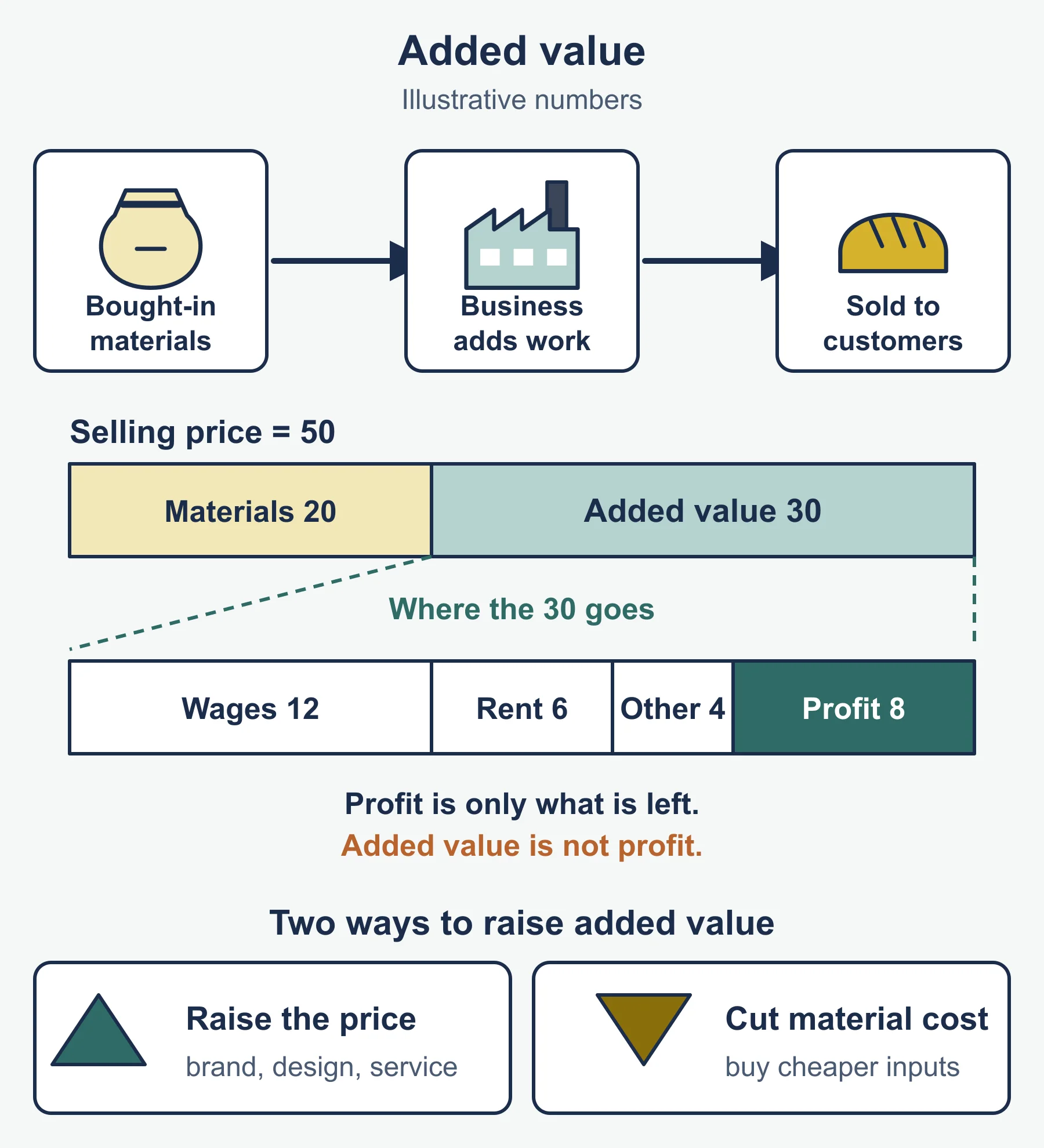
- Added value = selling price − cost of bought-in materials and services. Operations adds value through quality, design, speed or less waste.
- Location factors: costs, demand, access to resources and markets, infrastructure, government incentives, ethical and people considerations, break-even, return on investment, environmental.
- Operations links to finance, marketing and people, and drives competitiveness through cost, quality and flexibility.
Operations data and KPIs
| Measure | Formula |
|---|---|
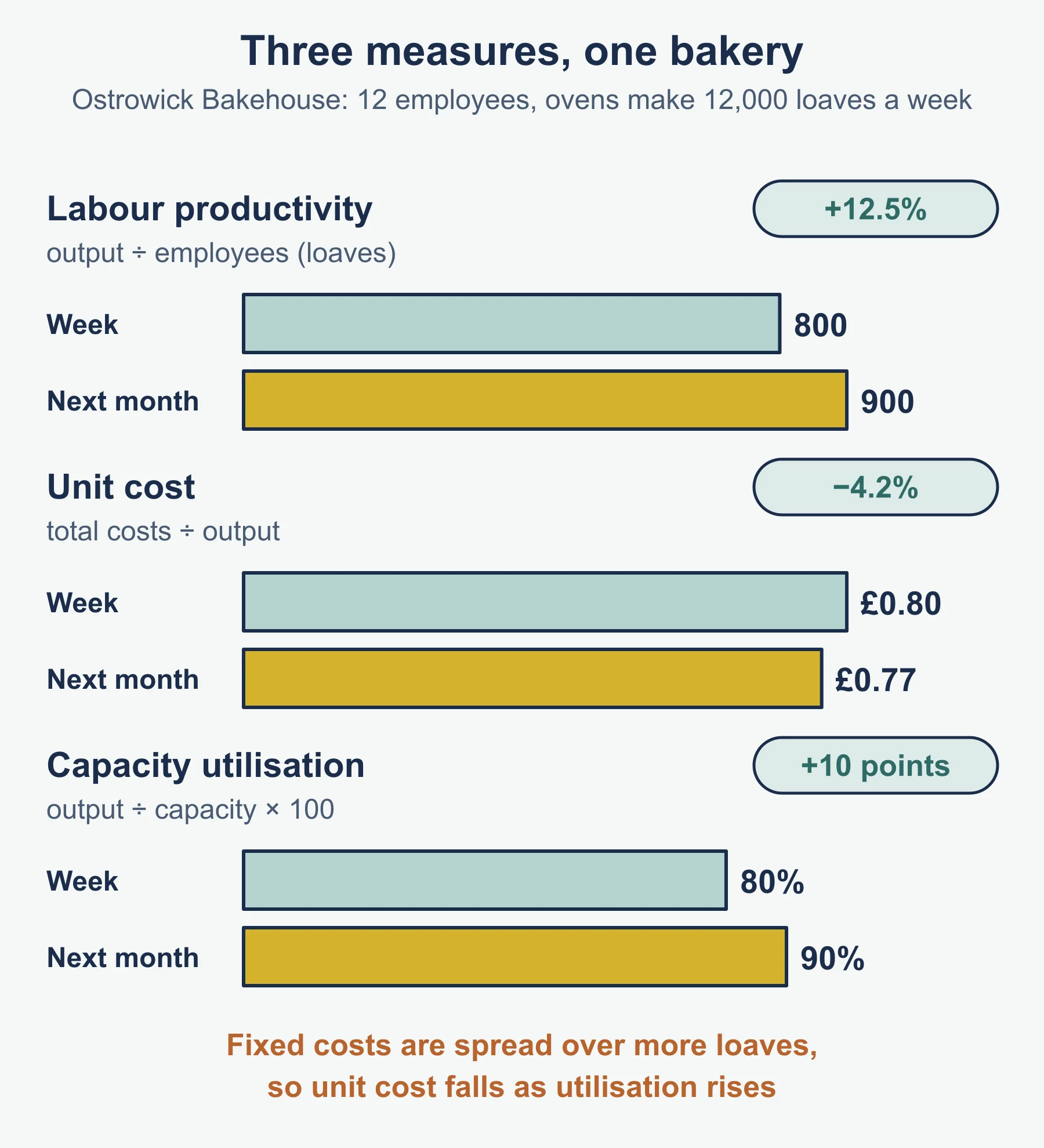
| Employee productivity | Output over a time period ÷ number of employees |
| Unit costs (average costs) | Total costs ÷ number of units of output |
| Capacity utilisation (%) | Actual output ÷ maximum possible output × 100 |
| Inventory turnover | Cost of sales ÷ average inventories held |
Method: write the formula, check the time periods match, substitute, add units, then say what the figure means.
Interpret only: wait times, returns, defects, complaints, speed of response, delivery times, customer service and satisfaction ratings, and environmental and sustainability measures. Use index numbers and percentage changes.
Efficiency
Ways to improve resource utilisation and efficiency: improved capacity utilisation; lean production (reducing inventory, re-works, waiting times and transportation times; kaizen; standardised processes); reducing waste, recycling and reusing materials; effective scheduling; improving employee productivity; improving cost control. Weigh each against its cost, staff resistance and possible harm to quality.
Quality
- Costs of poor quality: re-works, waste, returns, lost sales, damaged reputation, compensation.
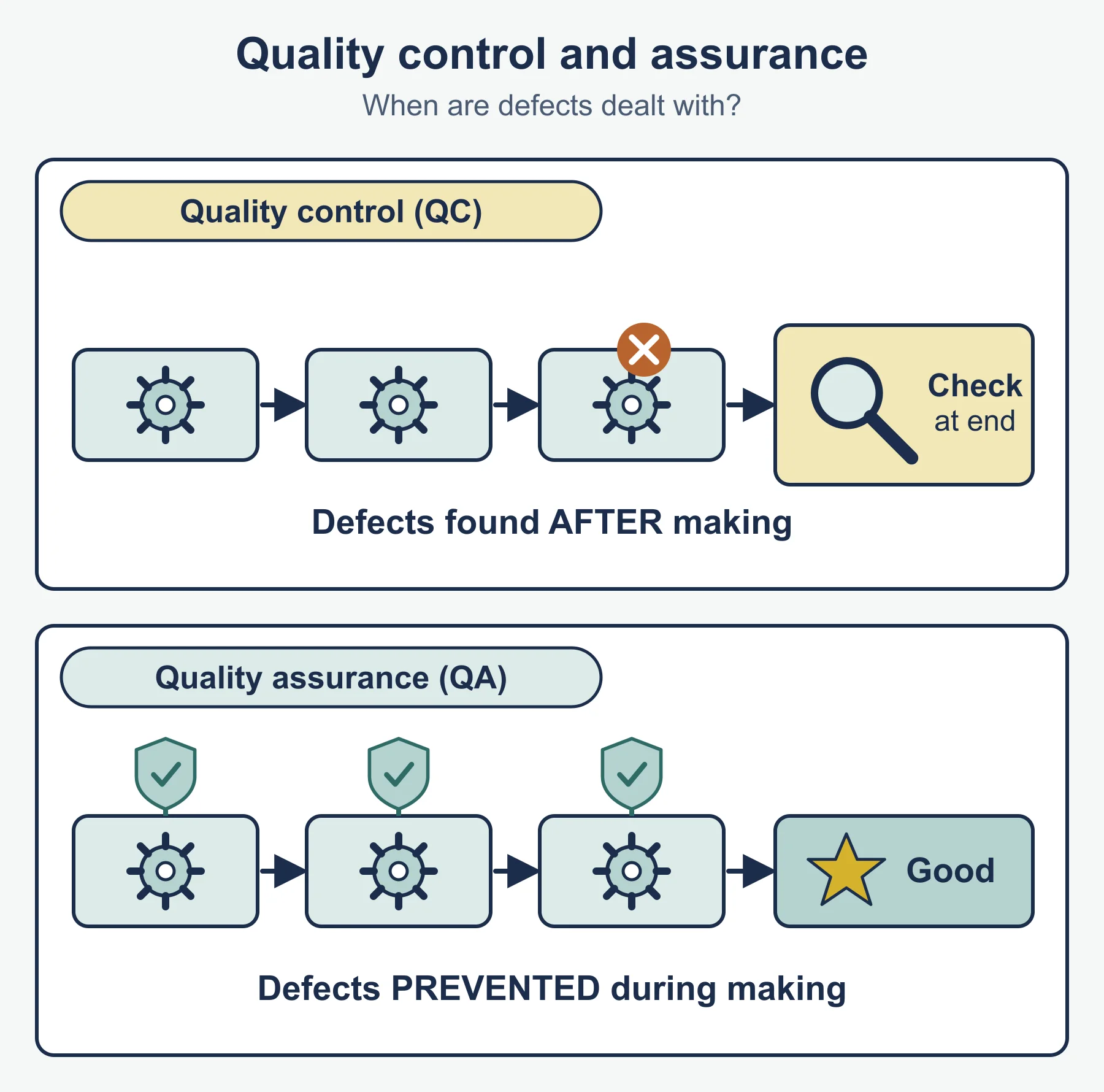
- Methods: quality control (inspect to find faults), quality assurance (prevent faults at every stage), Total Quality Management (everyone responsible for quality), quality circles (staff groups solving quality problems), benchmarking (copying best practice).
- Better quality costs money first; the case is that it costs less than poor quality.
Environmental impact
- Value: lower costs, compliance, reputation, access to customers who demand sustainability.
- Ways: waste reduction, resource efficiency, reducing emissions, cutting the carbon footprint, sustainable sourcing, circularity.
- Challenges: cost, supply chain limitations, disruption to change processes.
Matching output to demand
For high, low and fluctuating (cyclical or seasonal) demand: change production scheduling; increase or decrease inventory; use part-time, temporary, zero-hours or freelance staff; outsource; invest in capital and technology; increase or decrease capacity. Not matching supply to demand means lost sales or idle, costly resources.
Supply chain and inventory
- Make or buy in: control and margin against lower cost, expertise and no capital outlay.
- Supply chain management: supplier relationships and logistics; number and choice of suppliers; impact of supply chain issues; how profit is shared along the chain; transparency and third-party accreditations.
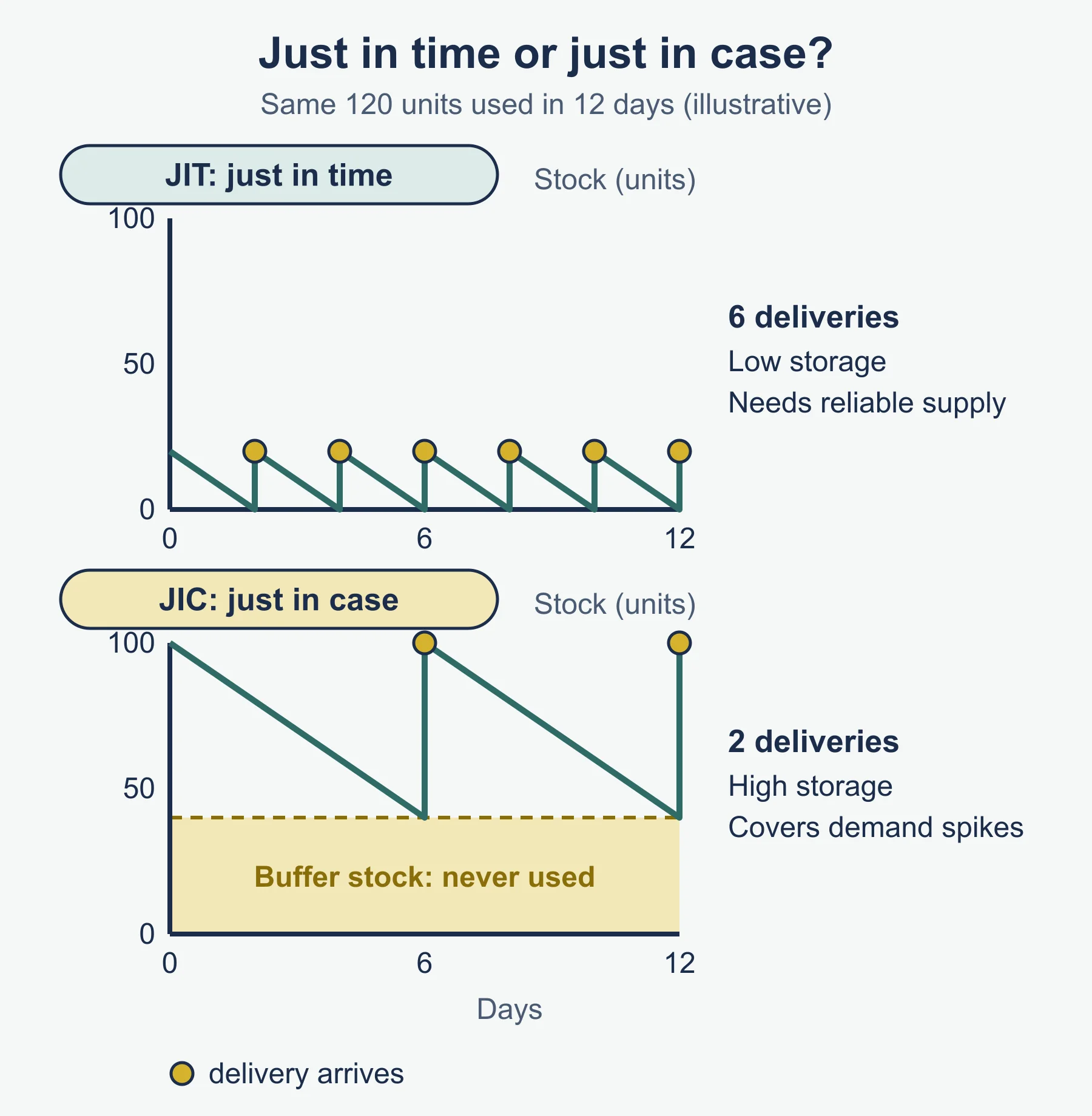
- Inventory: reasons to hold it, influences on how much, and just in time (low holding cost, but delays stop production) versus just in case (buffer covers delays and spikes, but higher storage cost and cash tied up).
- Worked reminder: cost of sales £300,000, opening inventory £22,000, closing £28,000. Average inventory £25,000; inventory turnover = 300,000 ÷ 25,000 = 12 times a year.
Innovation, projects, scale and technology
- Innovation: purpose, value and challenges; developed through R&D, talent acquisition and retention, cross-functional teams, intrapreneurship; protected by patents and copyrights.
- Network analysis: float time = latest finish time − duration − earliest start time. Activities with zero float form the critical path, which sets the shortest project time.
- Economies of scale: technical, purchasing, financial. Diseconomies: control, communication, coordination.
- Technology (including AI): in inventory management, supply chain management and automation, to improve competitiveness; costs are investment, training, system failure and job losses.
Case-study technique
Use the figures in the case: calculate, then interpret against targets, the past and rivals. Name the operations objective the business is chasing, judge the trade-off (cost against quality, flexibility against efficiency), and finish with a recommendation and the condition it depends on.
Must-know distinctions
| Pair | Difference |
|---|---|
| Productivity and production | Output per employee against total output |
| Quality control and quality assurance | Finding faults after production against preventing them throughout |
| Just in time and just in case | Minimal stock delivered as needed against buffer stock held |
| Economies and diseconomies of scale | Unit costs falling with size against rising with size |
| Critical and non-critical activities | Zero float against some float |
Quick self-test
- Name the five operations objectives in the specification.
- A bakery makes 5,400 pies with a capacity of 6,000. Calculate capacity utilisation.
- A team of 15 makes 6,900 items. Calculate employee productivity.
- Output per worker rises from 400 to 460. Calculate the percentage change.
- A firm sells an item for £85 using £52 of bought-in materials. Calculate the added value.
- Total costs are £31,500 for 4,500 units. Calculate unit cost.
- Cost of sales is £180,000 and average inventory is £15,000. Calculate inventory turnover.
- An activity has an earliest start time of 4 days, a duration of 3 days and a latest finish time of 9 days. Calculate its float.
- State one benefit and one difficulty of just in time.
- Give two ways a business can match supply to demand at a seasonal peak.
- What is the difference between quality assurance and quality control?
- Name the three economies of scale in the specification.
Answers
- Efficiency, quality, volume of goods and services, flexibility, environmental impact.
- 5,400 ÷ 6,000 × 100 = 90%.
- 6,900 ÷ 15 = 460 items per employee.
- (460 − 400) ÷ 400 × 100 = 15% increase.
- £85 − £52 = £33, which is 38.8% of the price.
- £31,500 ÷ 4,500 = £7.00.
- 180,000 ÷ 15,000 = 12 times.
- 9 − 3 − 4 = 2 days.
- Benefit: lower holding costs. Difficulty: any supplier delay stops production.
- Any two of: changing production scheduling, building inventory beforehand, part-time, temporary, zero-hours or freelance staff, outsourcing.
- Quality assurance prevents faults throughout the process; quality control inspects output to find faults after they have been made.
- Technical, purchasing and financial.
Where marks are usually lost
- Writing a formula and no workings, or leaving out the units.
- Mixing time periods, such as monthly output with weekly capacity.
- Calculating unit cost from variable costs only.
- Using closing inventory instead of average inventory in inventory turnover.
- Describing JIT or lean production without applying it to the business in the case.
- Listing benefits of improving quality with no reference to the cost of doing so.
- Calling a rise in productivity good without asking whether the extra output can be sold.
- Evaluation that ends with “it depends” and no reasoned decision.
Frequently asked questions
What is the difference between quality control and quality assurance? Quality control inspects output, usually at the end, to find faults after they have happened. Quality assurance builds quality into every stage of the process to prevent faults in the first place.
How do you calculate float time in network analysis? Float time equals the latest finish time minus the duration minus the earliest start time. Activities with zero float are on the critical path.
What is the difference between just in time and just in case? Just in time keeps minimal stock, with materials delivered only as needed, which cuts holding costs. Just in case holds buffer stock, which covers delays and demand spikes but costs more to store.
Which economies of scale are named in the AQA AS Business (7137) specification? Technical, purchasing and financial economies of scale. Diseconomies of scale come from problems of control, communication and coordination as a business grows.
What is the difference between productivity and production? Production is total output. Productivity is output per employee over a time period, so a firm can raise production without improving productivity.
Official syllabus
AQA AS and A-level Business (7137, 7138) specification, Version 1.1 (November 2025), for first teaching from September 2026: section 3.2.2 Operations management and Annex 7, Formulae and key data. Checked against these notes on 5 November 2026.
Get free revision emails (optional)
Occasional emails with practice questions, worked explanations and links to free resources for the qualification and subjects you choose. No spam, and you can unsubscribe from any email. The free tools on this site never need an email.
Related resources
-
Study guides
AQA AS-Level Business: People management (7137)
Full study guide to AQA AS Business 7137 section 3.2.1 People management: HR planning, HR data, structures, leadership, motivation, rewards and relations.
Business · AQA · AS Level
Read guide -
Practice questions
AQA AS-Level Business: People management (7137) – Practice Questions
Original worked practice questions for AQA AS Business 7137 section 3.2.1 People management, with HR data, structures, motivation and case studies.
Business · AQA · AS Level
Try questions -
Revision notes
AQA AS-Level Business: People management (7137) – Revision Notes
Condensed revision notes for AQA AS Business 7137 section 3.2.1 People management: formulas, models, contrasts, self-test and common mark losses.
Business · AQA · AS Level
Revise topic
Related articles
-
teaching
A Level tuition in Dubai: Cambridge or Pearson Edexcel International A Level?
Schools in Dubai and Abu Dhabi teach either Cambridge International AS & A Level or Pearson Edexcel International A Level. How the two are structured, why it matters for tuition, and how online classes from Lahore work.
9 October 2026
-
curriculum guides
Choosing subjects at IGCSE and A Level
How subject choices at 14 and 16 affect university options later, and how to keep pathways open without overloading a timetable.
28 July 2026
Studying this with a teacher
Working through Business AS LEVEL?
This page is free and stays free. If you would rather be taught it, Marlbridge runs Business classes one-to-one and in small groups of up to 15, online in your own time zone. The first trial class is free. WhatsApp replies within an hour (8am–11pm Pakistan time, every day); email the same day.
AQA Business teachers at Marlbridge
