
Revision Notes
AQA GCSE Business: Human resources (8132) – Revision Notes
Condensed revision notes for AQA GCSE Business 8132 topic 3.4 Human resources: structures, recruitment, motivation and training, with a self-test.
- Subject
- Business
- Level
- GCSE
- Topic
- Human resources
- Author
- Marlbridge Academic Team
- Updated
- Reviewed by
- Salman Ahmad (what this means)
Aligned to AQA GCSE Business (8132), For first teaching from September 2017. Official specification .
Syllabus page (what it covers and how it is assessed): AQA GCSE Business.
Syllabus points this page covers
8132
- 3.4.1 Organisational structures
- 3.4.2 Recruitment and selection of employees
- 3.4.3 Motivating employees
- 3.4.4 Training
Found an error? Report a correction.
Need help with this topic? Request a free trial class for GCSE Business (8132).
These revision notes condense topic 3.4 Human resources from the AQA GCSE Business (8132) specification, for first teaching from September 2017. The topic sits within Paper 1, “Influences of operations and HRM on business activity”. For full explanations, start with the study guide, then use the practice questions. Related reading: Business operations. Course hub: /boards/aqa/gcse/business/. Printable checklist: /checklists/aqa/gcse/business/. Free diagnostics show which sections need work.
Purpose and links with other functions
- Human resources (HR) finds, rewards, develops and keeps the workforce. Its role is to supply the right people with the right skills, willing to work.
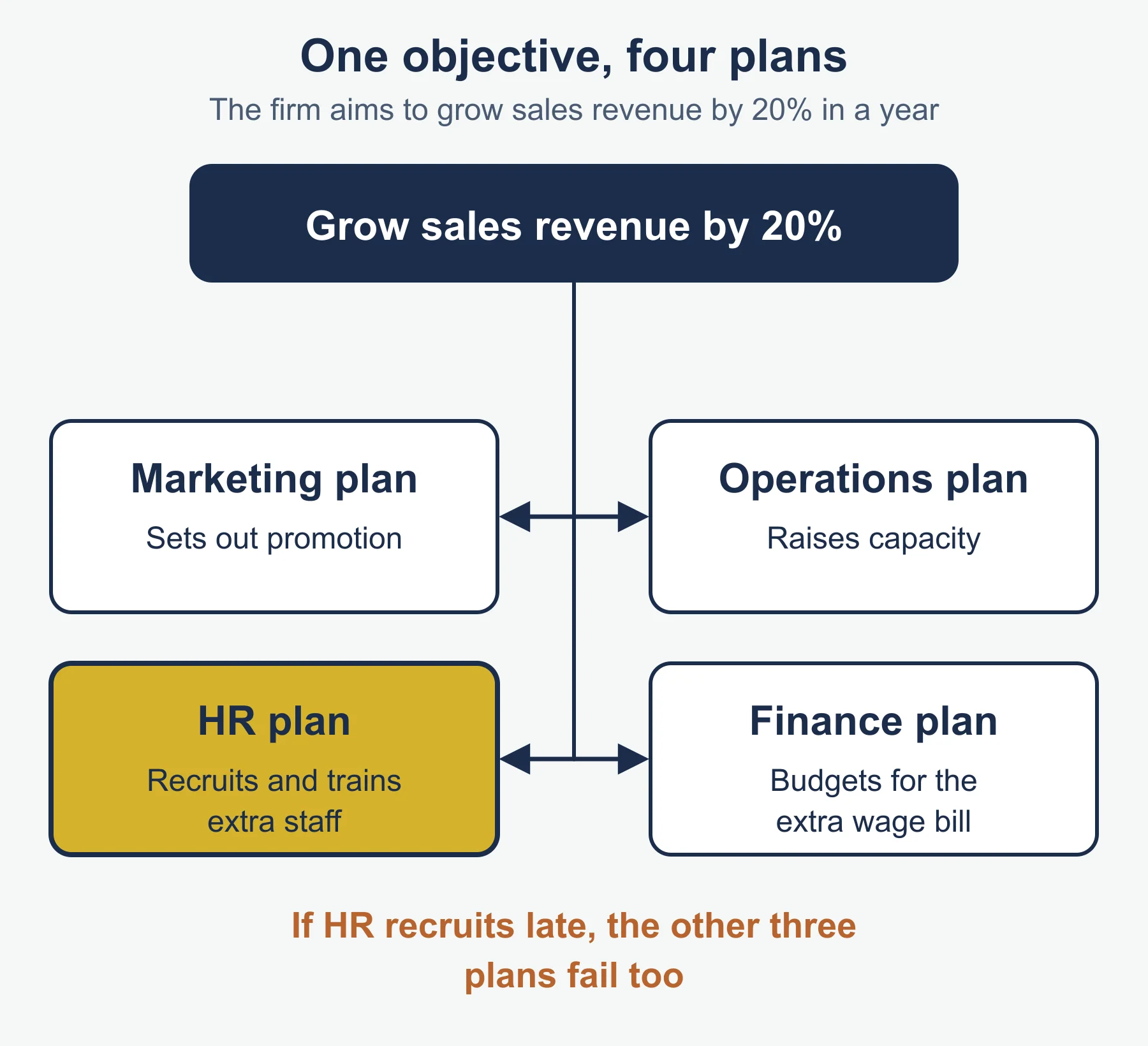
- It is interdependent with operations, marketing and finance: each needs staff, and each depends on HR plans being delivered.
- Business objectives are split into functional plans (operations, HR, marketing, finance) with clear links back to the objective.
- Quick check: if the objective is a new branch, HR needs to recruit and train staff, finance needs to budget for wages, and operations needs the site ready.
3.4.1 Organisational structures
Definitions
| Term | Meaning |
|---|---|
| Organisational structure | How the business is arranged: roles, responsibilities and reporting lines |
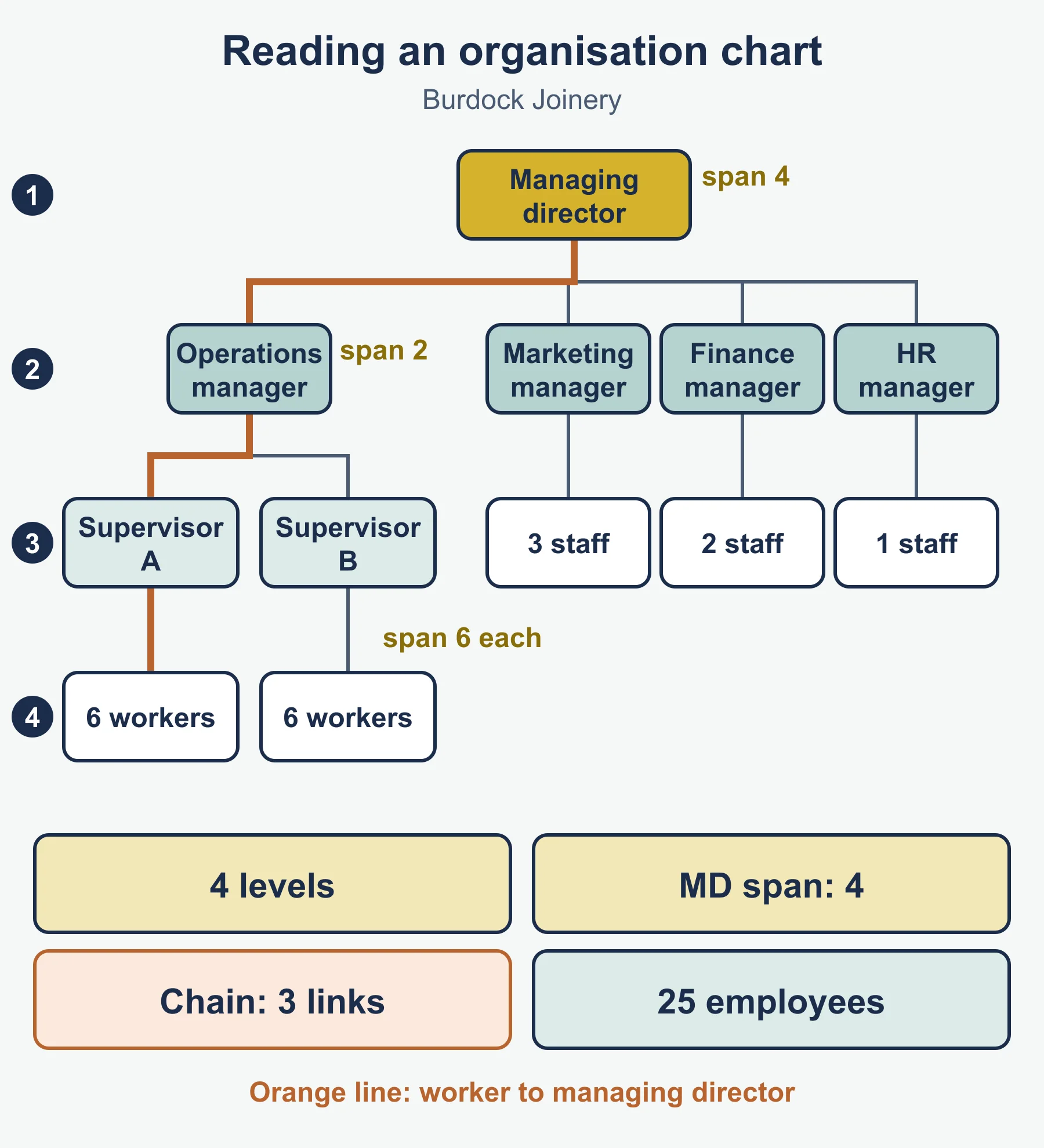
| Chain of command | Route by which authority passes from senior to junior staff |
| Span of control | How many staff report straight to a single manager |
| Delegation | Handing a task and the authority to decide it to a lower level |
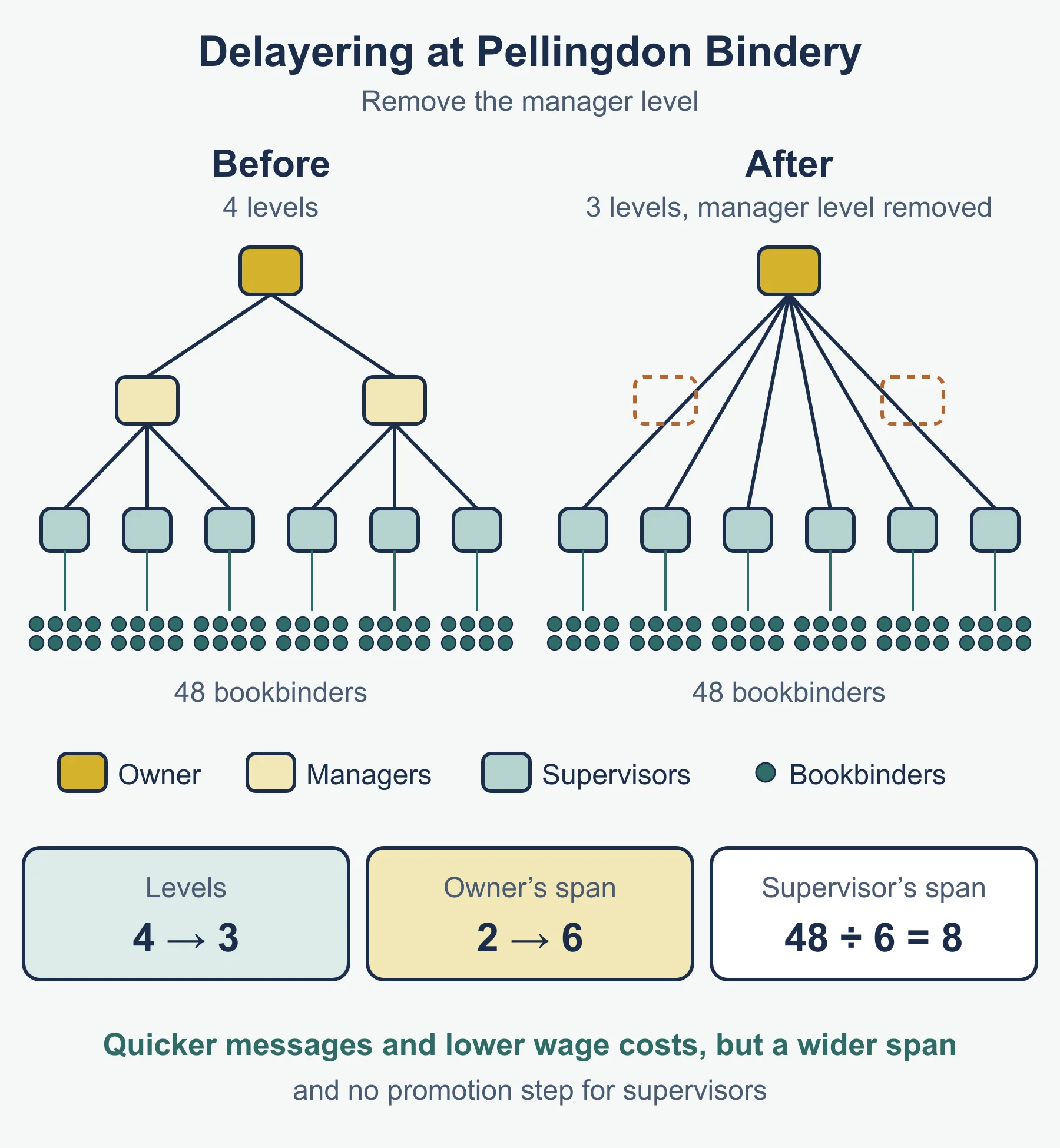
| Delayering | Taking out a layer or layers of management |
| Centralisation | Decisions made at the top |
| Decentralisation | Decisions made lower down |
Why have a structure: clear job roles, clear responsibilities, a route for decisions and instructions, less duplication.
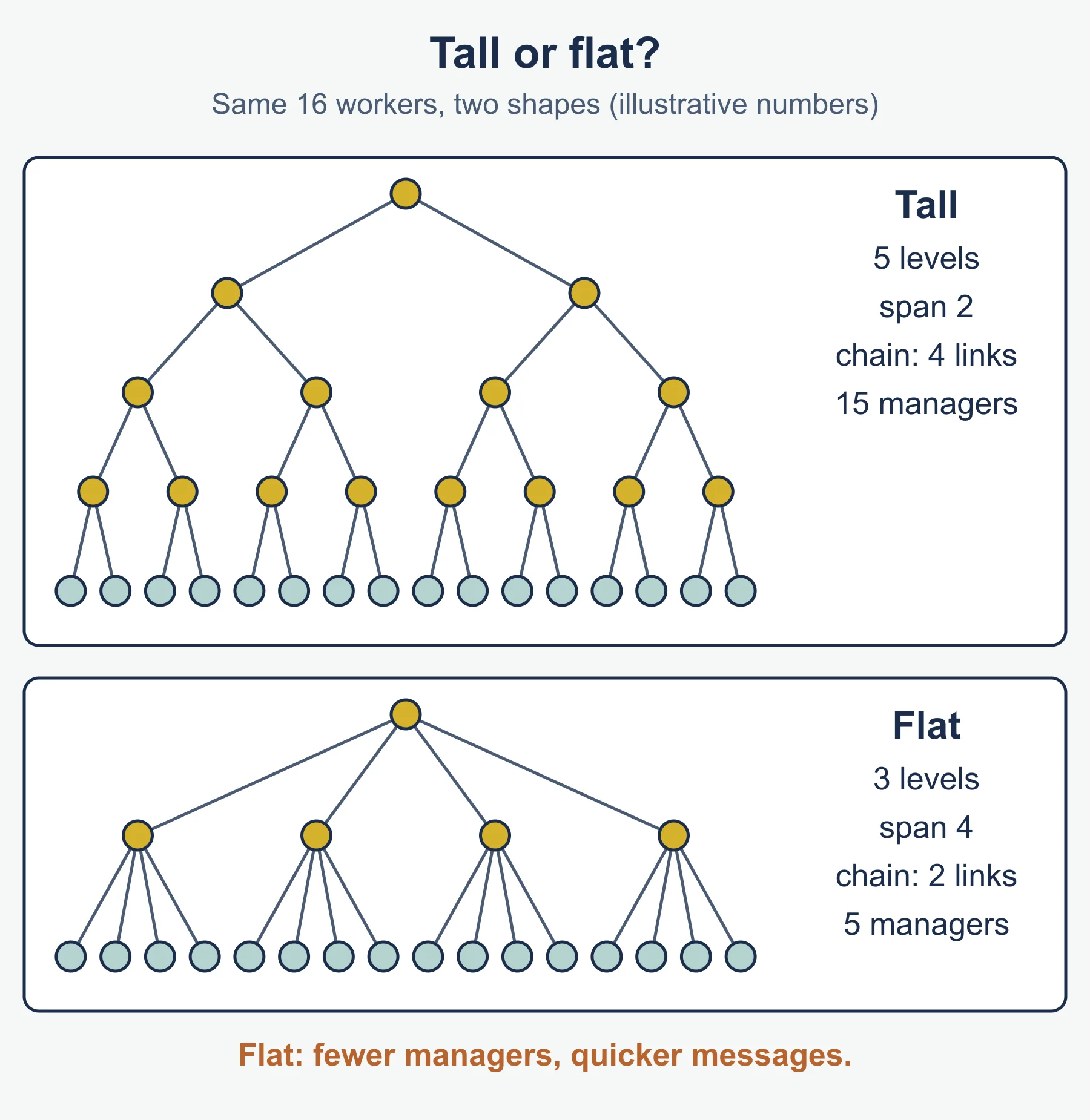
Tall and flat
| Tall | Flat | |
|---|---|---|
| Levels | Many | Few |
| Span | Narrow | Wide |
| Chain of command | Long | Short |
| Communication | Slow, can be distorted | Quicker, more direct |
| Management | Close control, promotion steps | Staff more independent, wider responsibility |
| Wage cost | Higher | Lower |
Method for span of control: span = number of subordinates / number of managers at that level. Example: Westerholt Cycles has 35 mechanics and 5 team leaders, so span is 35 / 5 = 7. If the firm hires two more team leaders, span narrows to 35 / 7 = 5, and the structure becomes taller if a level is added above them.
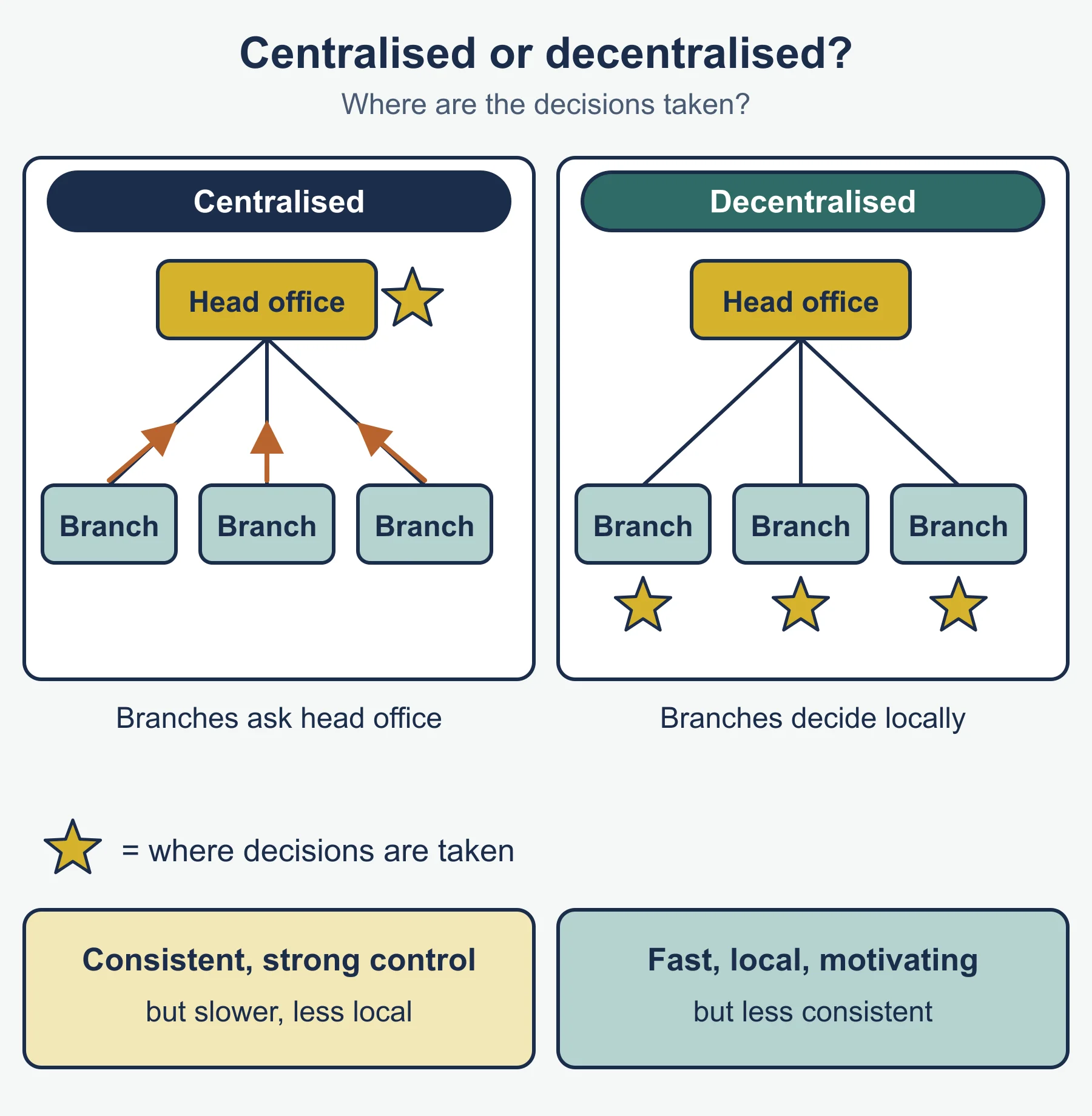
Centralised or decentralised
- Centralised: consistent, tight control, slow, may demotivate.
- Decentralised: fast, locally informed, motivating, but decisions may differ between sites.
- Appropriate structure depends on size, type of work, staff skills, and the speed of decisions needed.
3.4.2 Recruitment and selection
Why recruit
Growth, replacing leavers, new skills, new roles.
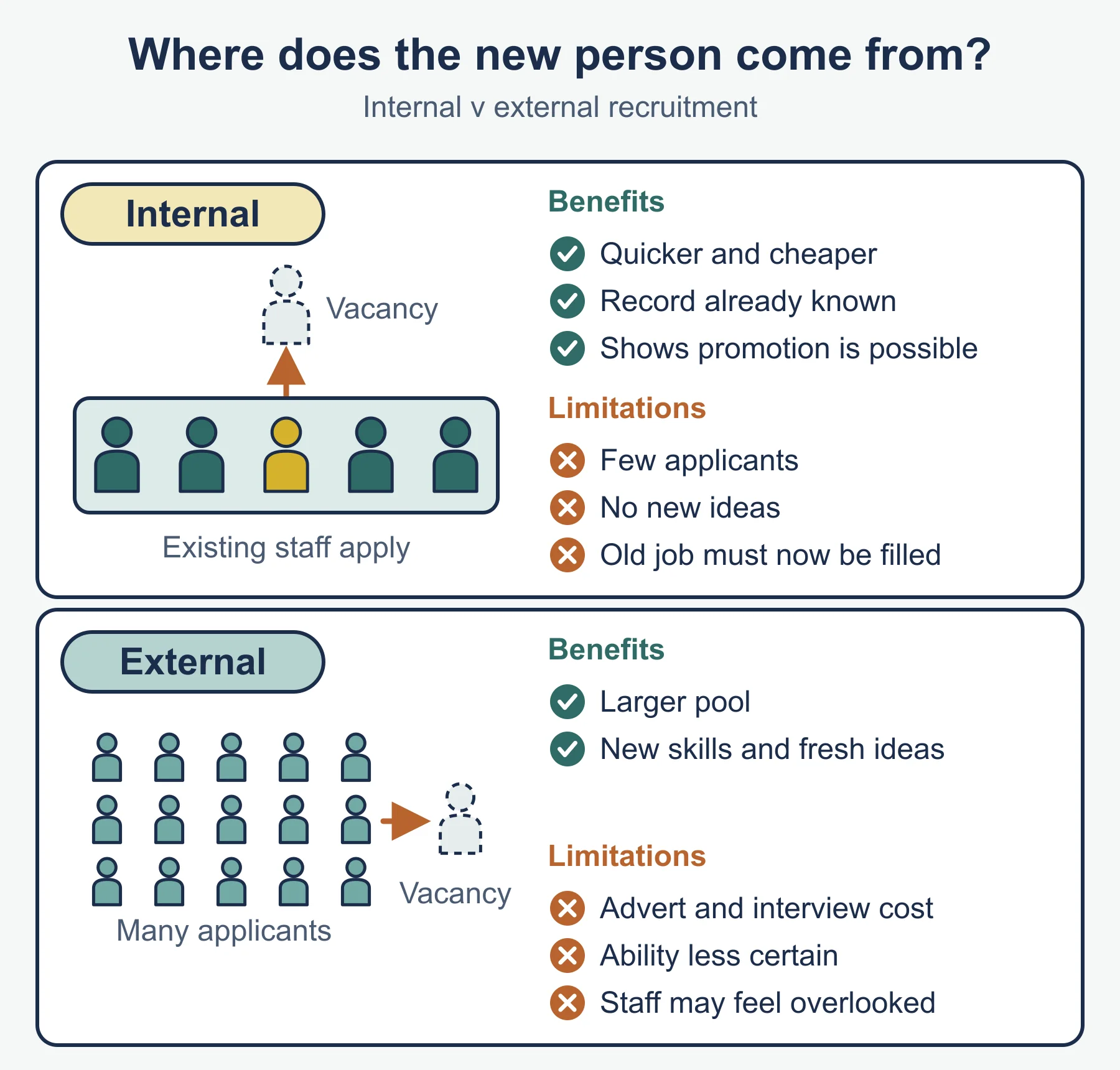
Internal versus external
| Internal | External | |
|---|---|---|
| For | Cheap, quick, known person, motivates staff, little induction | Wider choice, new ideas and skills |
| Against | Narrow choice, no fresh ideas, creates another vacancy | Costly, slower, unknown person, more induction, may upset current staff |
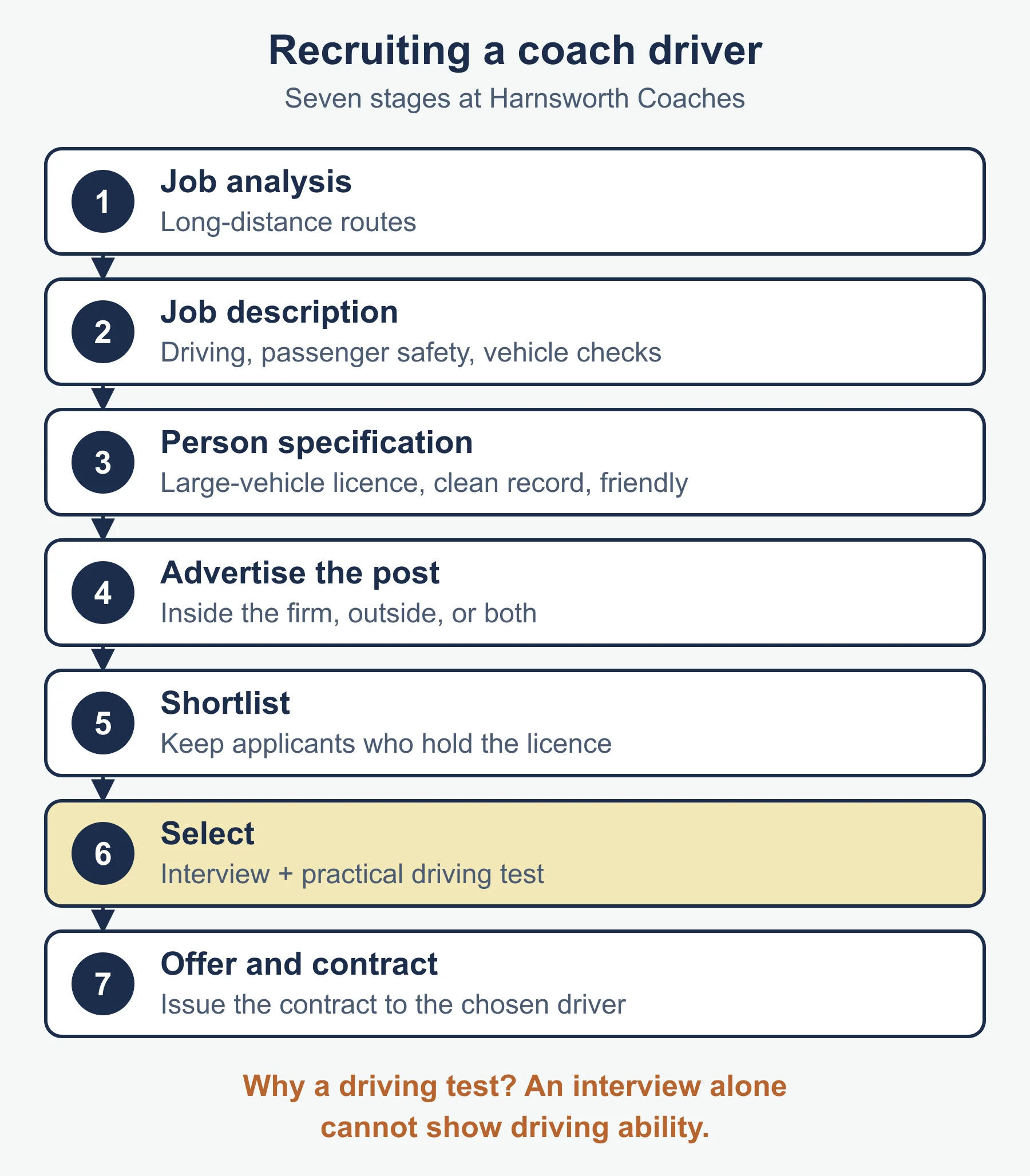
The process in order
- Job analysis.
- Job description: title, duties, responsibilities.
- Person specification: qualifications, skills, experience, qualities.
- Advertise.
- Shortlist.
- Selection methods: interview, tests, assessment centre, references.
- Offer and contract.
Memory hook: the job description is about the job; the person specification is about the person.
Benefits of an effective process
- High productivity from the right skills.
- High quality output or customer service.
- Staff retention, saving repeated recruitment costs.
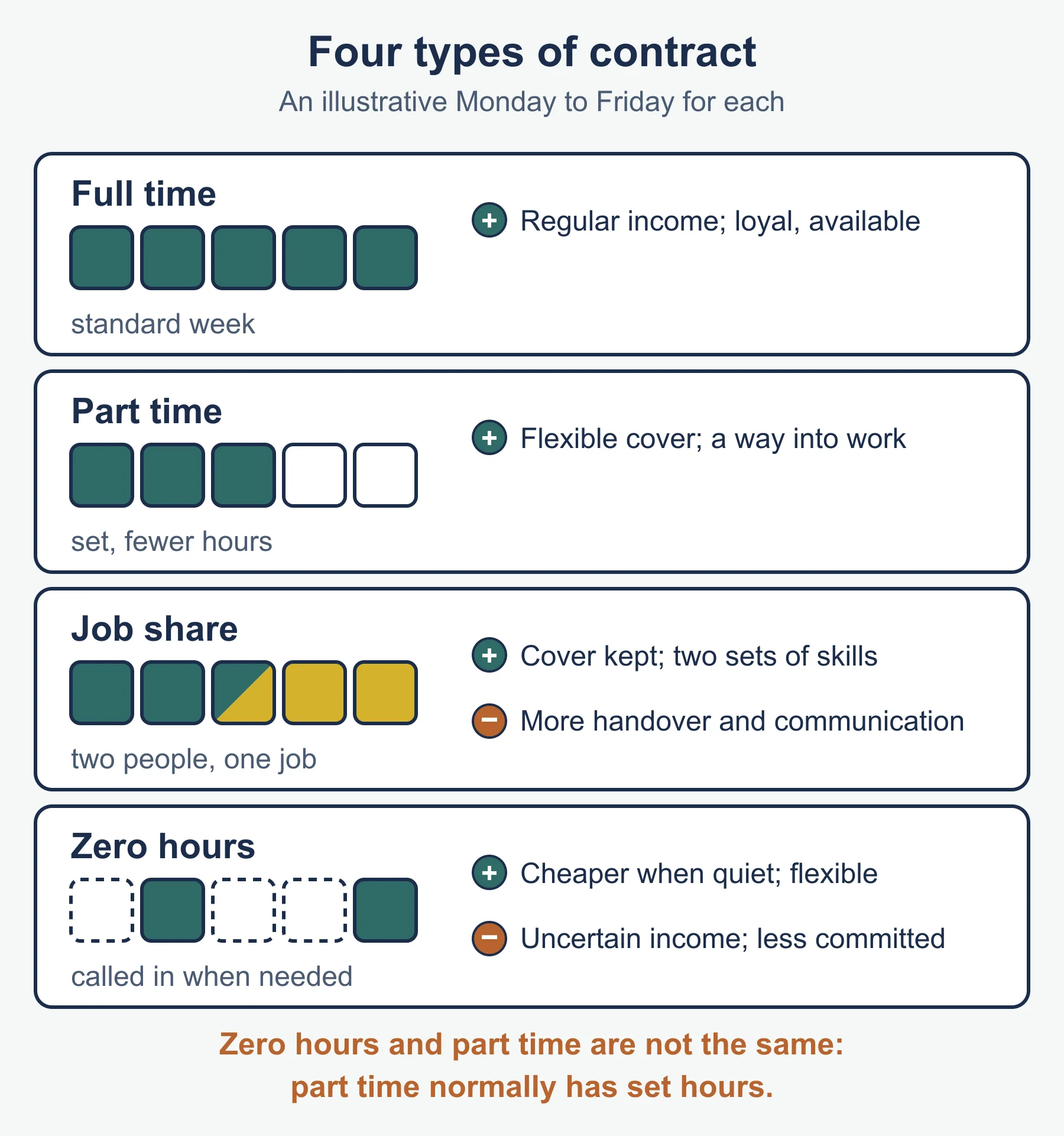
Contracts
| Contract | Key feature | Benefit | Drawback |
|---|---|---|---|
| Full time | Standard full working week | Reliable cover, regular pay | Fixed wage cost |
| Part time | Fewer hours | Flexible, matches busy times | Less availability |
| Job share | One job split between two | Cover and mix of skills | More handovers |
| Zero hours | No guaranteed hours | Flexible, low cost when quiet | Uncertain income, less loyalty |
3.4.3 Motivating employees
A motivated workforce brings staff retention (lower recruitment and training costs) and high productivity. Named motivation theories (the specification’s example is Maslow) are not examined.
Financial
| Method | Key point |
|---|---|
| Salary | Fixed yearly sum, security |
| Wage | Hourly rate times hours worked |
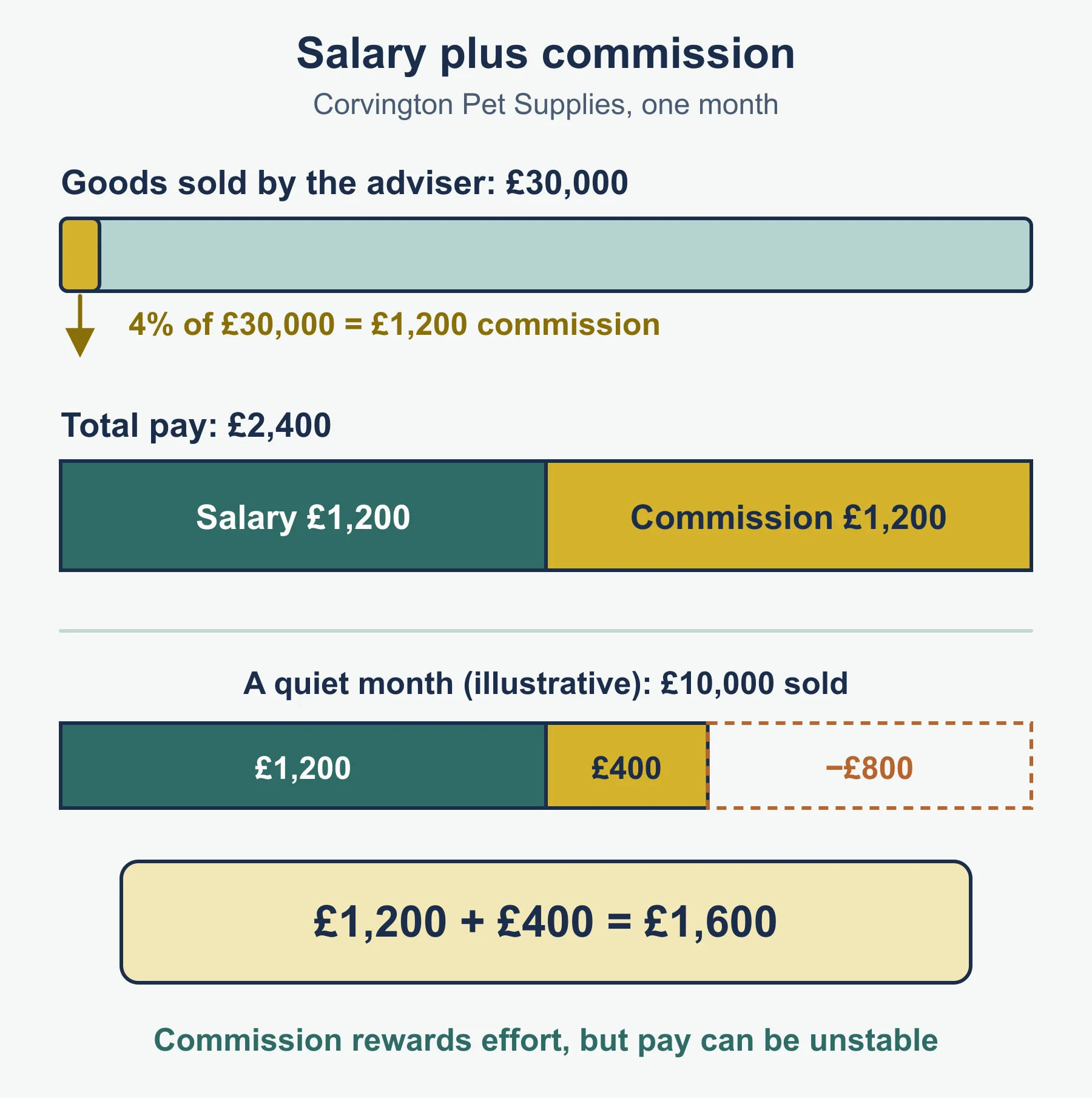
| Commission | Percentage of sales |
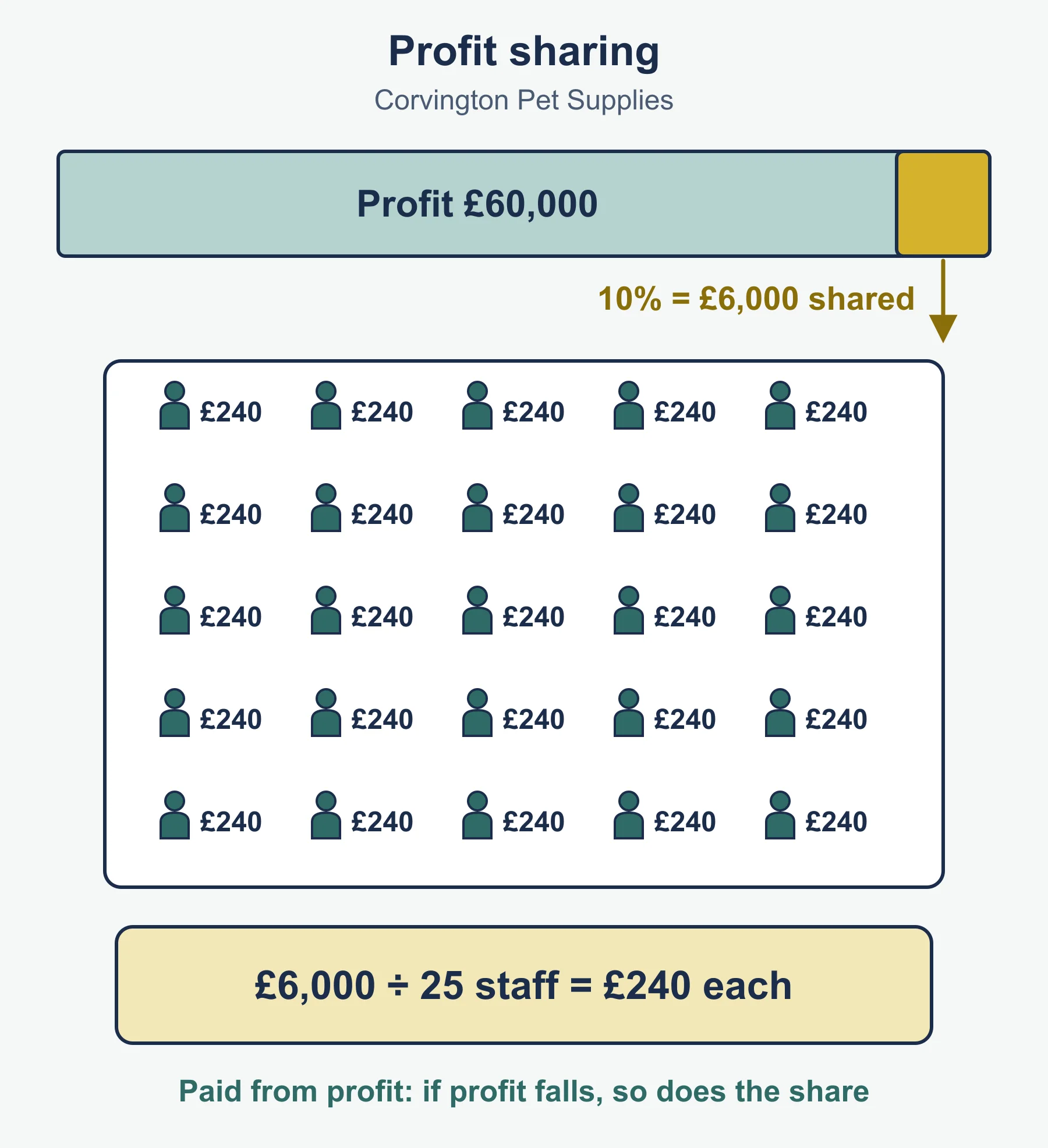
| Profit sharing | Employees receive a share of profits |
Worked reminders, using Ottenshaw Dental Studio:
- Wage: a dental nurse works 30 hours at £9.80 an hour, so weekly wage is 30 x 9.80 = £294.
- Commission: a receptionist earns a £1,000 monthly salary plus 6% commission on £18,000 of whitening treatments sold. Commission is £1,080, so total pay is £2,080.
- Profit sharing: 12% of a £50,000 profit shared equally among 20 staff gives £6,000 / 20 = £300 each.
Non-financial
- Styles of management: consulting and listening.
- Training: shows value, opens promotion.
- Greater responsibility: trust and challenge.
- Fringe benefits: extras beyond pay.
Evaluation point: financial methods work well for staff with low pay or sales roles; non-financial methods matter where pay is already fair. A mix often works best.
3.4.4 Training
Benefits
Increased productivity, coping with technology change, increased motivation, staff retention, high-quality goods, good customer service.
Methods
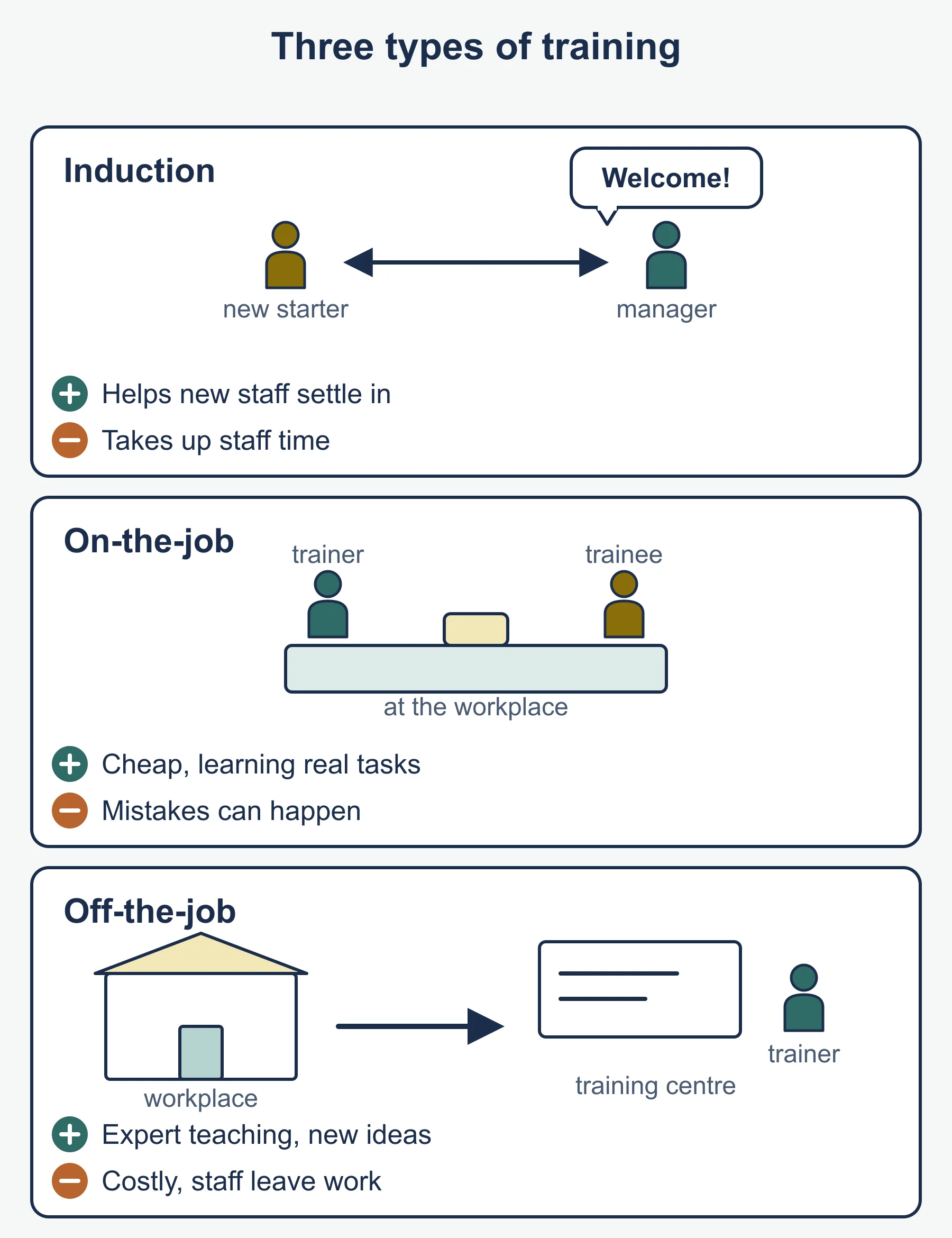
| Method | Benefits | Drawbacks |
|---|---|---|
| Induction | Settles new staff, safe working, quicker productivity, retention | Takes time before real work starts |
| On the job | Cheaper, learner productive, relevant to the real job | Trainer’s output falls, bad habits, errors in front of customers |
| Off the job | Expert teaching, wider skills, qualifications | Dearer, worker absent |
Choosing a method: say which suits the business, give a case reason (cost, size, technology, risk to customers), and weigh the alternative.
Must-know distinctions
- Span of control is sideways (how many people under one manager); levels of hierarchy are vertical (how many layers).
- Delegation passes down a task and the authority to do it; the manager stays accountable.
- Delayering removes a layer; decentralisation moves decisions down. A business can do one without the other.
- Part time has set, shorter hours; zero hours has none guaranteed; job share splits one post between two people.
- Salary is a fixed sum; wage depends on hours; commission depends on sales; profit sharing depends on the business result.
- Induction is for new starters and covers the workplace; on the job and off the job describe where other training happens.
Answering case-study questions
- State: give a short, correct fact or definition.
- Explain: add a reason, using “because” or “which leads to”.
- Analyse: build a chain of consequences, for example narrow span, then close supervision, then slower decisions, then higher costs.
- Evaluate or justify: weigh both sides, link to the business in the stem, and finish with a reasoned judgement that says which matters most and why.
- Always use the name of the business and details such as its size, staff or product in at least one sentence.
Quick self-test
- Define the term span of control.
- State two effects of delayering.
- Give two features of a flat structure.
- Give one benefit and one drawback of internal recruitment.
- How does a job description differ from a person specification?
- State what a zero hours contract is.
- Name two financial methods of motivation.
- Calculate the total pay of a worker on a salary of £1,500 a month plus 3% commission on sales of £20,000.
- Give two non-financial methods of motivation.
- Explain one benefit of induction training.
- Why might a business choose off the job training?
- State one benefit of decentralisation.
Answers
- How many staff answer directly to a single manager.
- Any two: fewer levels; lower wage costs; shorter chain of command; quicker communication; wider spans of control; fewer promotion steps.
- Any two: few levels; wide spans of control; short chain of command; more delegation; quicker communication.
- Benefit: cheaper or quicker, or motivates staff. Drawback: smaller choice of applicants, or no new ideas.
- The job description lists the duties and responsibilities of the post; the person specification lists the qualifications, skills and qualities wanted in the candidate.
- A contract with no guaranteed hours; the worker works only when the employer asks.
- Any two of salary, wage, commission, profit sharing.
- Commission = 3% of 20,000 = £600; total = £1,500 + £600 = £2,100.
- Any two of styles of management, training, greater responsibility, fringe benefits.
- New staff learn rules, safety and routines quickly, so they become productive sooner and are more likely to stay.
- It gives expert teaching and can lead to recognised qualifications, useful for new technology or skills nobody inside the business has.
- Quicker decisions made by people close to the customer, or staff feel more motivated.
Where marks are usually lost
- Giving a definition from memory without applying it to the business named in the question.
- Writing “cheaper” with nothing to compare against, or saying a method is “better” without a reason.
- Mixing up job description and person specification.
- Treating delayering as simply “sacking staff”.
- Forgetting the drawback side when asked to analyse or evaluate.
- Calculating commission on the wrong figure or forgetting to add the base salary.
- Giving only a list when a question asks for a judgement.
- Describing Maslow-style theory instead of practical motivation methods.
Frequently asked questions
What is the difference between a tall and a flat organisational structure? A tall structure has many levels, narrow spans of control and a long chain of command, so communication is slower. A flat structure has few levels, wide spans and a short chain of command, with quicker communication and lower wage costs.
What is the difference between delayering and decentralisation? Delayering removes one or more layers of management. Decentralisation moves decisions lower down the business; a business can do one without the other.
What are the financial methods of motivation in AQA GCSE Business (8132)? Salary, wage, commission and profit sharing. Non-financial methods include styles of management, training, greater responsibility and fringe benefits.
What are the three methods of training in the specification? Induction for new starters, on the job training while doing the real work, and off the job training away from the workplace, which gives expert teaching but costs more.
Official syllabus
AQA GCSE Business (8132), specification for first teaching from September 2017, published by AQA. These notes follow section 3.4 Human resources, including 3.4.1 to 3.4.4.
Get free revision emails (optional)
Occasional emails with practice questions, worked explanations and links to free resources for the qualification and subjects you choose. No spam, and you can unsubscribe from any email. The free tools on this site never need an email.
Related resources
-
Study guides
AQA GCSE Business: Human resources (8132)
A full study guide to topic 3.4 Human resources in AQA GCSE Business 8132: structures, recruitment, motivation and training, with worked examples.
Business · AQA · GCSE
Read guide -
Practice questions
AQA GCSE Business: Human resources (8132) – Practice Questions
Eleven original practice questions with worked answers on AQA GCSE Business 8132 topic 3.4 Human resources, from short answers to case studies.
Business · AQA · GCSE
Try questions -
Study guides
AQA GCSE Business: Marketing (8132)
Study guide to AQA GCSE Business Marketing: customers, segmentation, market research, the 4Ps, product life cycle, Boston Matrix and e-commerce.
Business · AQA · GCSE
Read guide
Related articles
-
teaching
A Level tuition in Dubai: Cambridge or Pearson Edexcel International A Level?
Schools in Dubai and Abu Dhabi teach either Cambridge International AS & A Level or Pearson Edexcel International A Level. How the two are structured, why it matters for tuition, and how online classes from Lahore work.
9 October 2026
-
curriculum guides
Choosing subjects at IGCSE and A Level
How subject choices at 14 and 16 affect university options later, and how to keep pathways open without overloading a timetable.
28 July 2026
Studying this with a teacher
Working through Business GCSE?
This page is free and stays free. If you would rather be taught it, Marlbridge runs Business classes one-to-one and in small groups of up to 15, online in your own time zone. The first trial class is free. WhatsApp replies within an hour (8am–11pm Pakistan time, every day); email the same day.
AQA Business teachers at Marlbridge
