
Study Guides
AQA GCSE Business: Human resources (8132)
A full study guide to topic 3.4 Human resources in AQA GCSE Business 8132: structures, recruitment, motivation and training, with worked examples.
- Subject
- Business
- Level
- GCSE
- Topic
- Human resources
- Author
- Marlbridge Academic Team
- Updated
- Reviewed by
- Salman Ahmad (what this means)
Aligned to AQA GCSE Business (8132), For first teaching from September 2017. Official specification .
Syllabus page (what it covers and how it is assessed): AQA GCSE Business.
Syllabus points this page covers
8132
- 3.4.1 Organisational structures
- 3.4.2 Recruitment and selection of employees
- 3.4.3 Motivating employees
- 3.4.4 Training
Found an error? Report a correction.
Need help with this topic? Request a free trial class for GCSE Business (8132).
This guide covers topic 3.4 Human resources from the AQA GCSE Business (8132) specification, for first teaching from September 2017. The specification places it in Paper 1, “Influences of operations and HRM on business activity”. It covers all four sections: organisational structures, recruitment and selection, motivating employees, and training. For revision, use the revision notes, then try the practice questions. Operations is the other half of Paper 1: see Business operations. The course hub is at /boards/aqa/gcse/business/ and the printable checklist is at /checklists/aqa/gcse/business/. To find your weak spots first, try the free diagnostics.
Map of the topic
| Part | Points to learn |
|---|---|
| Opening statement | Interdependence of the four functions; objectives broken into functional plans; purpose, role and influence of HR |
| 3.4.1 Organisational structures | Terms such as delegation and delayering; reasons for structures and job roles; tall versus flat; communication; centralised versus decentralised; appropriateness |
| 3.4.2 Recruitment and selection | Why recruit; internal versus external; the stages from job analysis to selection; gains from doing it well; contract types |
| 3.4.3 Motivating employees | Why motivation matters; pay-based methods; other methods |
| 3.4.4 Training | Reasons to train; induction, on the job, off the job; strengths and weaknesses; matching method to business |
The role of human resources
Human resources (HR) is the function that finds, rewards, develops and keeps the people a business needs. Its purpose is to make sure the business has enough workers with the right skills, who are willing to work well. That influences business activity directly: a firm with too few trained staff cannot raise output, and a firm whose staff keep leaving wastes money on replacing them.
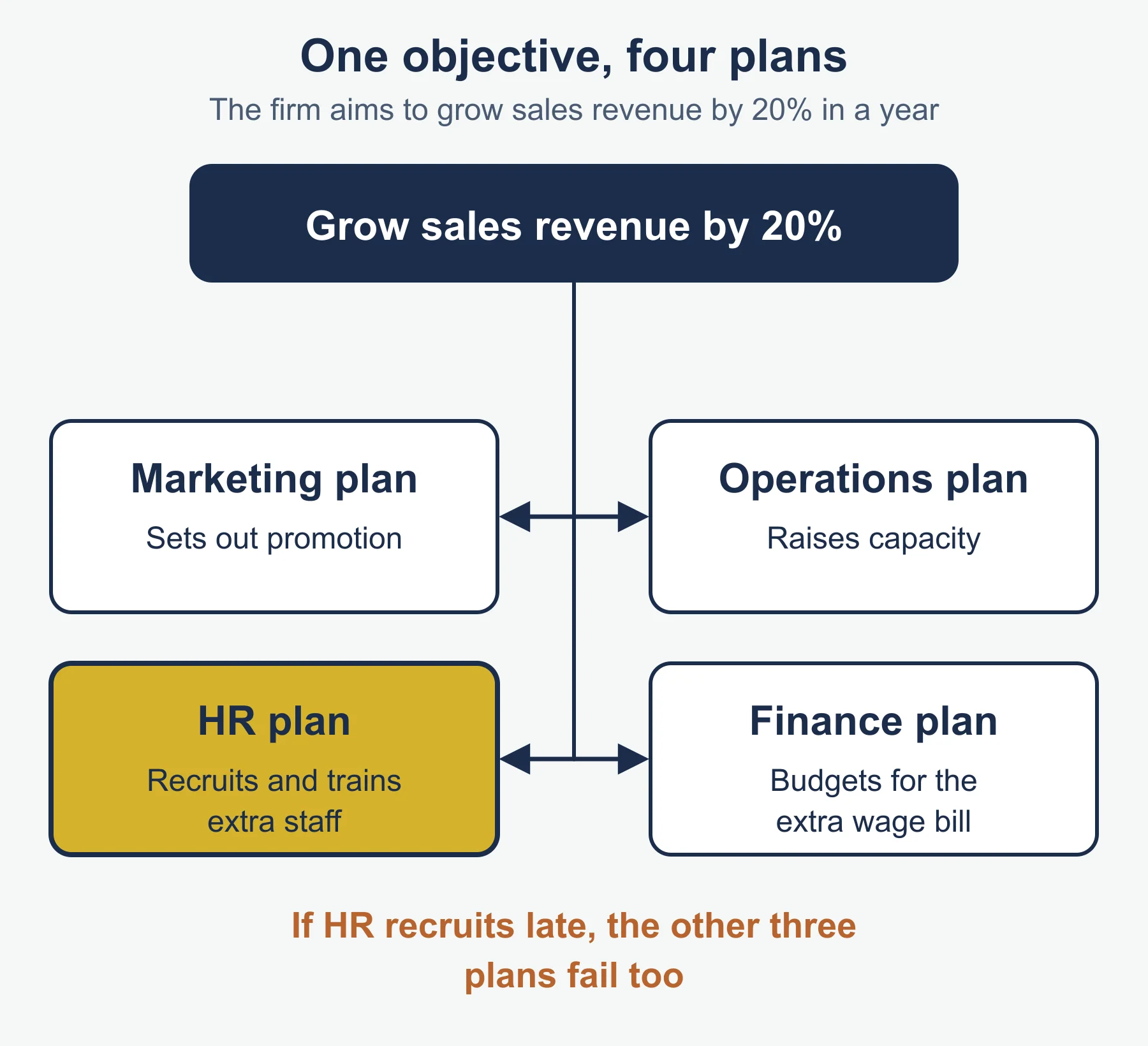
The functions depend on each other. Operations needs workers to produce, marketing needs staff to promote and sell, and finance needs to pay wages and approve budgets. Business objectives are split into functional plans, each with links back to the main objective. Suppose a firm aims to grow sales revenue by 20% in a year. The marketing plan sets out promotion; the operations plan raises capacity; the HR plan recruits and trains extra staff; the finance plan budgets for the extra wage bill. If HR fails to recruit in time, the other three plans fail too.
3.4.1 Organisational structures
A structure is the business’s internal layout of jobs: it shows who holds which responsibilities and who answers to whom. Businesses need one so that job roles and responsibilities are clear, work is not duplicated or missed, and everyone knows who to ask for decisions. Typical roles run from directors, who set strategy, through managers and supervisors to operatives who do the day-to-day work.
Key terms
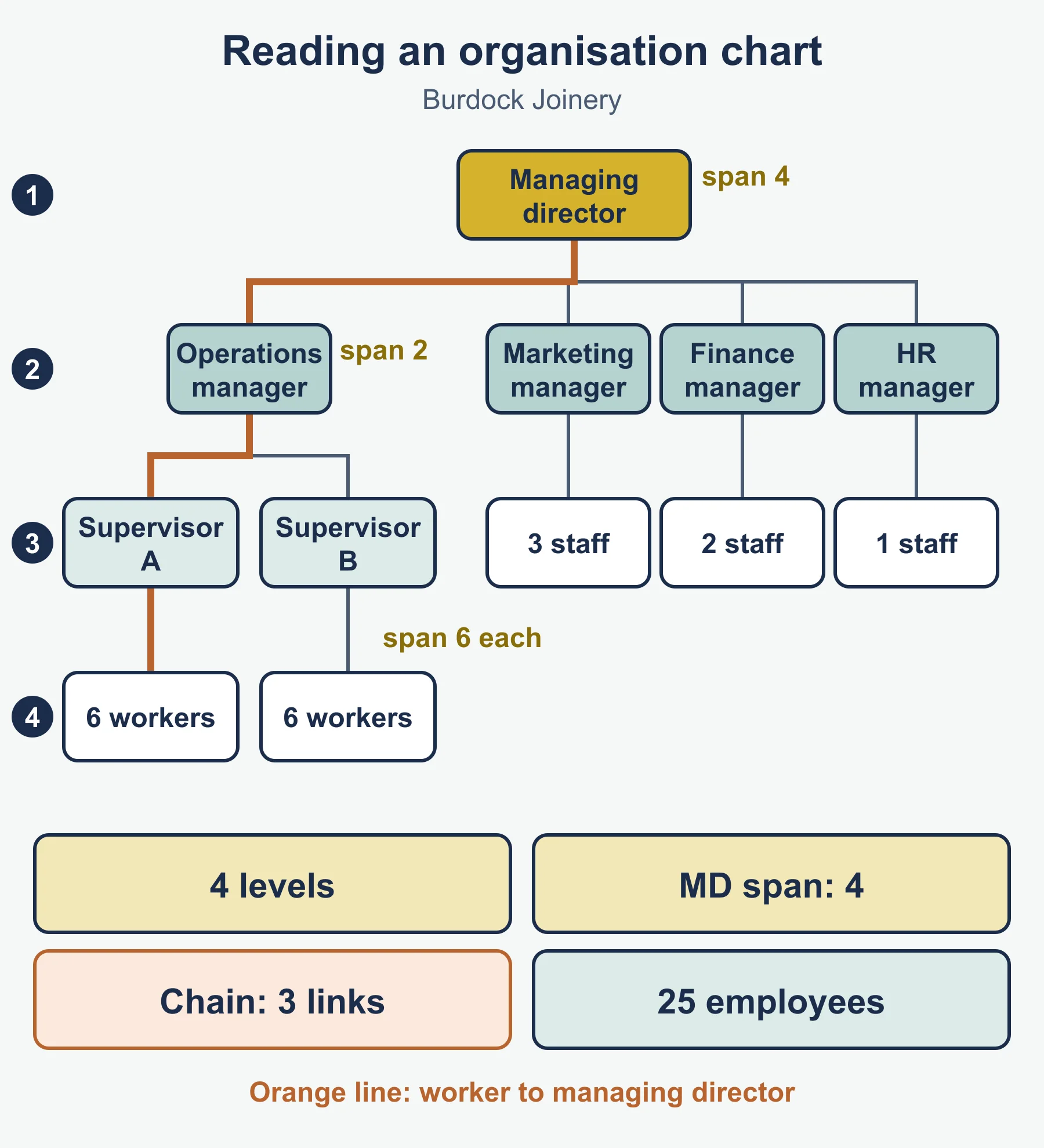
- Chain of command: the route along which authority flows from senior to junior staff; orders travel down it and feedback travels up.
- Span of control: how many staff answer directly to a single manager.
- Delegation: handing a task, and the authority to decide how to do it, to a person lower down the structure. The manager stays accountable for the result.
- Delayering: removing one or more levels of hierarchy from the structure.
Worked example: span of control and delayering
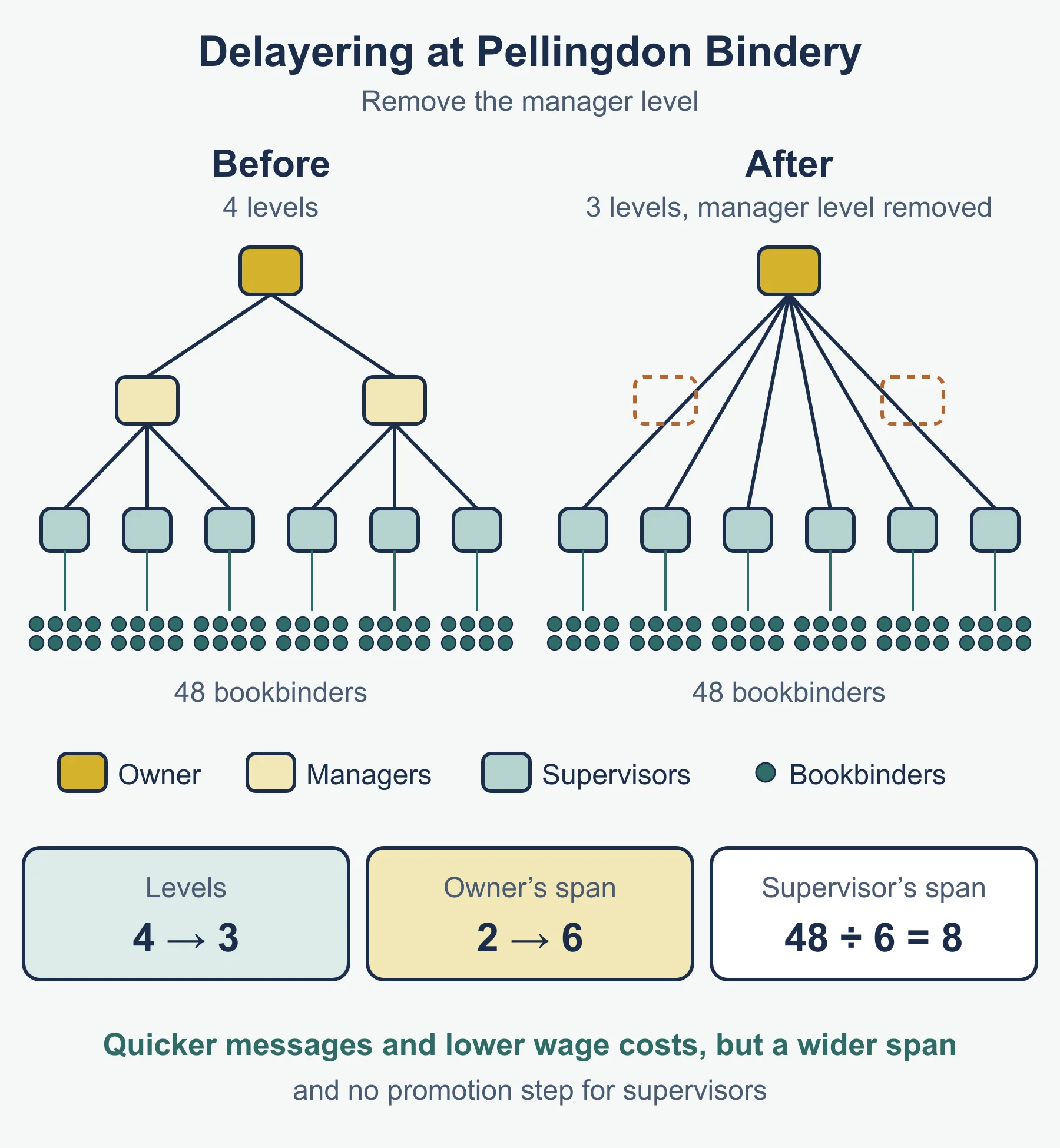
Pellingdon Bindery employs 48 bookbinders. They report to 6 supervisors, so each supervisor’s span of control is 48 / 6 = 8. The supervisors report to 2 managers, who report to the owner. That gives four levels: owner, managers, supervisors, bookbinders.
The owner removes the manager level (delayering). The 6 supervisors now report straight to the owner, so the structure has three levels. The owner’s span of control rises from 2 to 6. Effects: wage costs fall because two salaries go; messages pass through fewer people, so communication is quicker; but the owner has more people to oversee, and the promotion route for supervisors disappears.
Tall and flat structures
| Tall structure | Flat structure | |
|---|---|---|
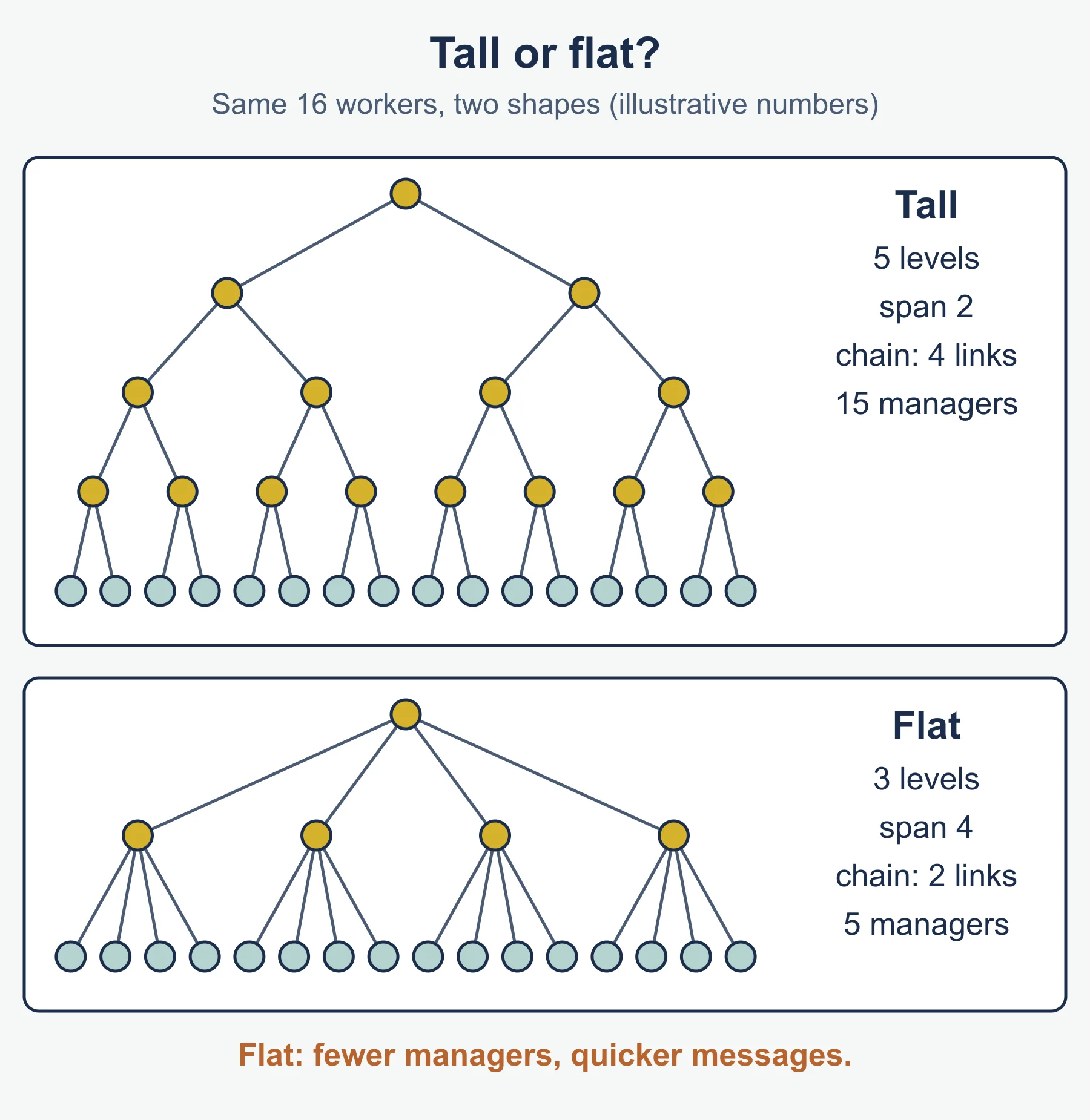
| Layers of management | Numerous | Not many |
| Span of control | Small | Large |
| Chain of command | Lengthy | Brief |
| Management | Close supervision, clear promotion steps | Staff given more responsibility and independence |
| Communication | Slower, and messages can be changed as they pass through levels | Faster and more direct |
| Cost | More managers to pay | Fewer managers to pay |
Communication can move in different directions. In a tall structure it is mostly vertical, up and down a long chain. In a flat structure there are fewer links, so managers hear from staff more directly, although a manager with a wide span has less time for each person.
Centralisation and decentralisation
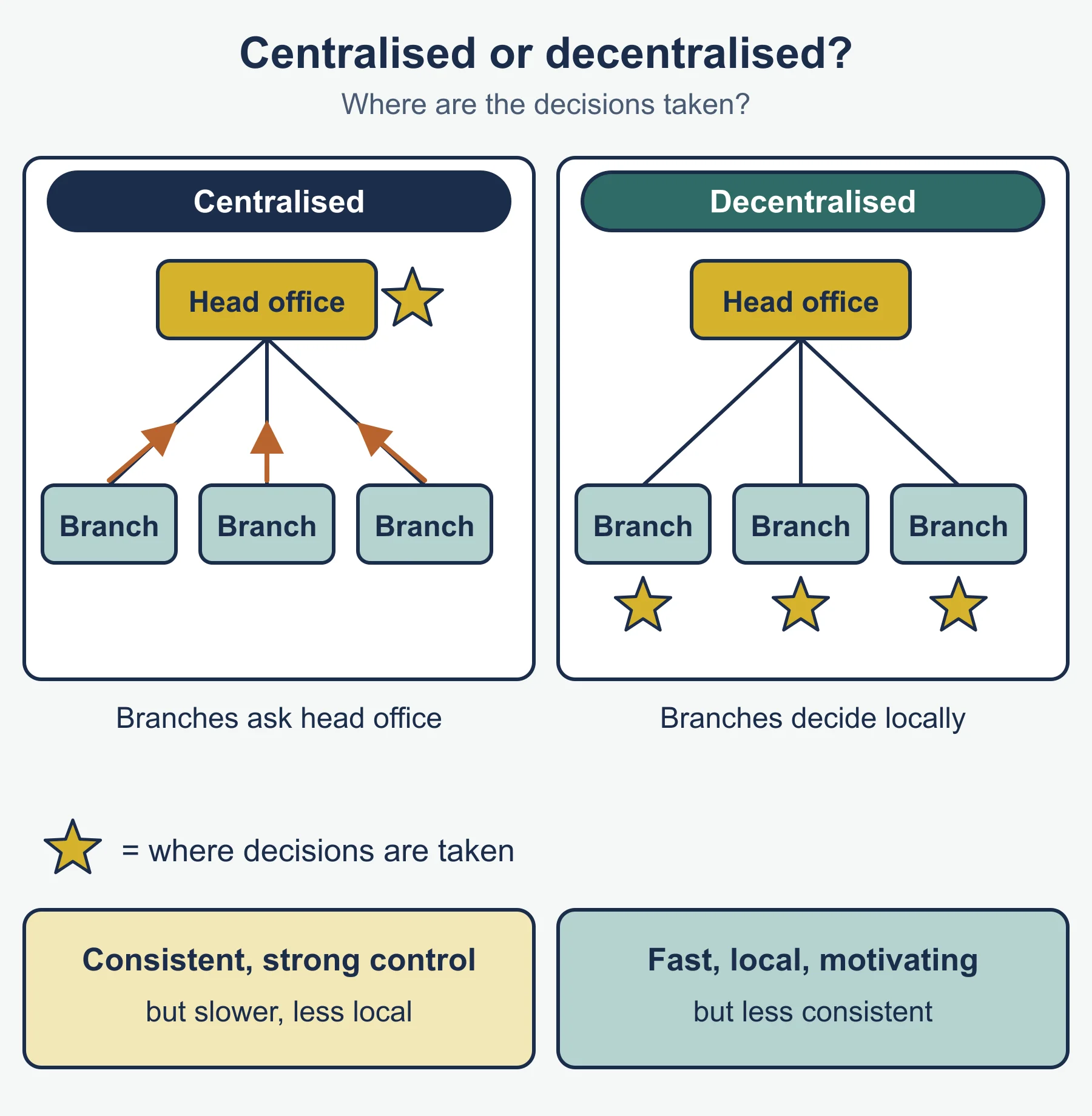
A centralised business keeps decision-making with senior managers. This gives consistency and strong control, but it can be slow and staff may feel unmotivated. A decentralised business pushes decisions down to lower-level managers, often those nearest customers. Decisions are quicker and more informed locally, and staff gain responsibility, but there is a risk of inconsistent decisions across the business.
Appropriateness
No structure suits every business. A small café employing six people can run well with a flat structure in which the owner decides most things. A national chain with hundreds of branches needs more levels and some decentralisation so that branch managers can respond locally. Judge appropriateness by the firm’s size, what kind of work is done, how skilled the staff are, and how quickly choices must be made.
3.4.2 Recruitment and selection of employees
A business needs to recruit when it expands, when someone leaves or retires, when it needs new skills, or when it creates a new role.
Internal and external recruitment
| Benefits | Drawbacks | |
|---|---|---|
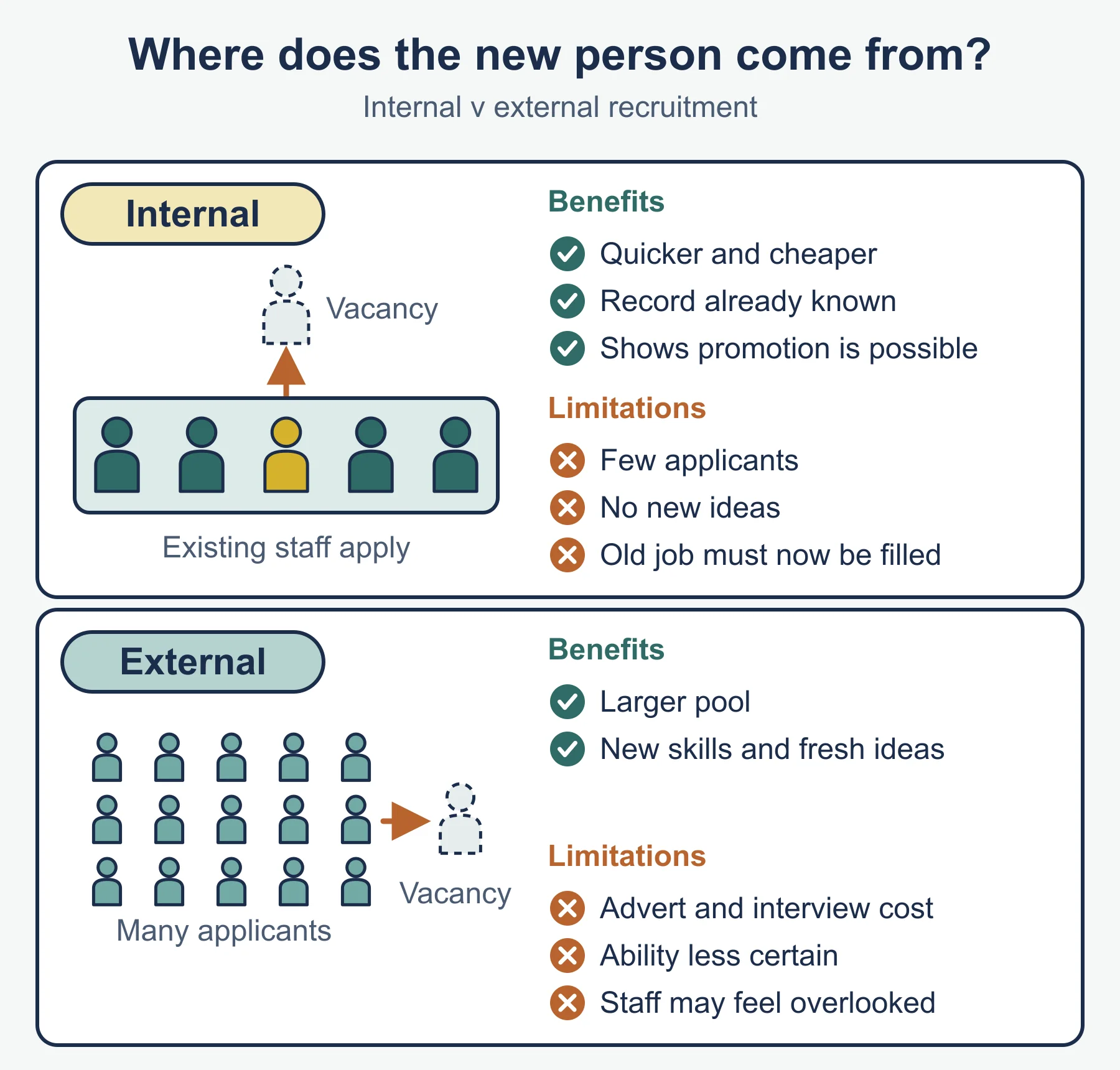
| Internal (filling the post from existing staff) | Cheaper and quicker; the business already knows the person; they know the firm, so little induction is needed; it motivates staff by showing promotion is possible | Smaller choice; no new ideas; the person’s old job must then be filled; unsuccessful applicants may feel resentful |
| External (recruiting from outside) | Larger pool of applicants; new skills and fresh ideas; can fill a skills gap | More expensive and slower to advertise and interview; the person is less known; more induction needed; existing staff may feel overlooked |
Stages in recruitment and selection
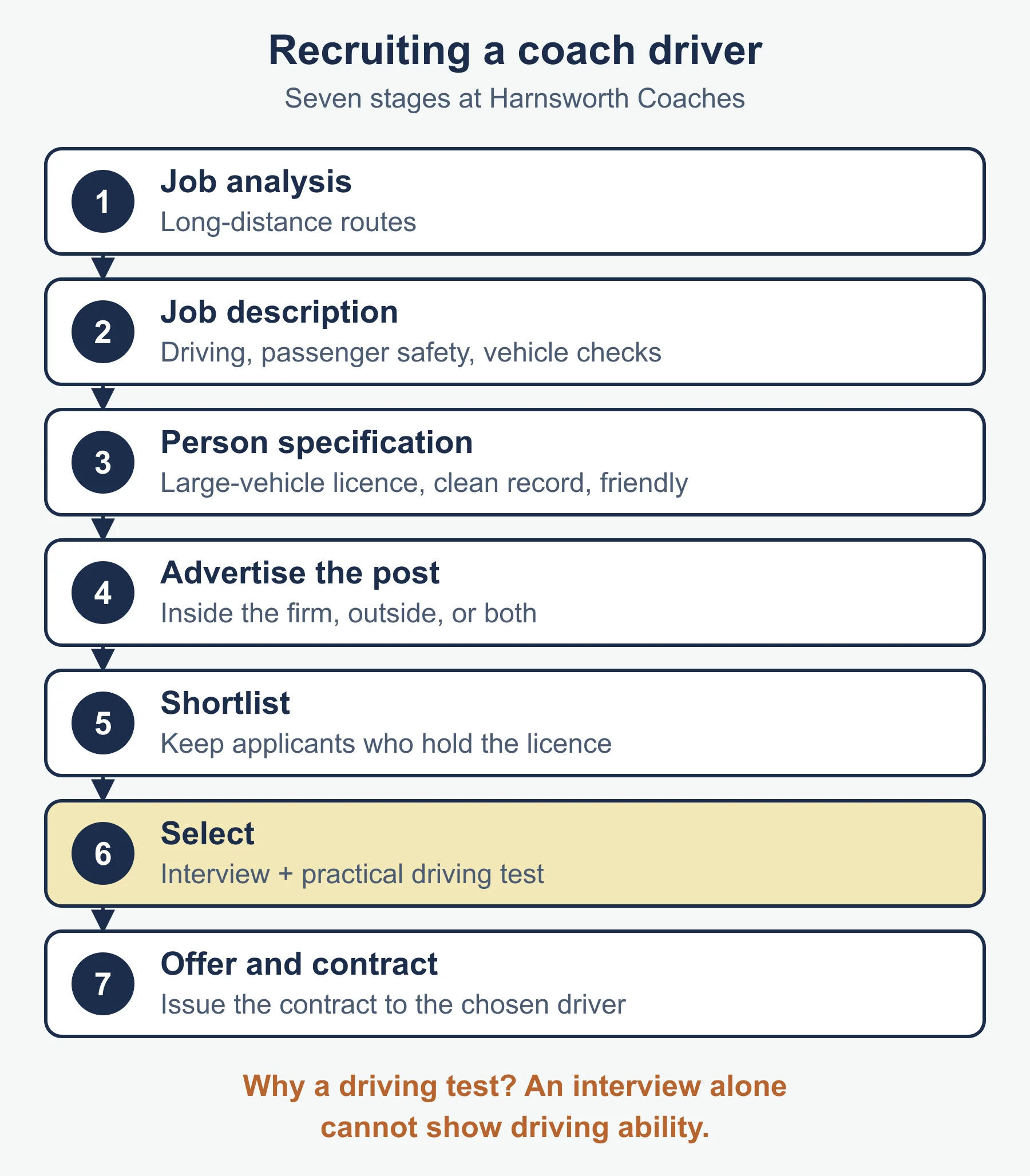
- Job analysis: work out what the job involves and why it is needed.
- Job description: a document listing the job title, main duties, responsibilities and who the post reports to.
- Person specification: a profile of the ideal candidate, covering qualifications, skills, experience and personal qualities.
- Advertise the post, internally, externally or both.
- Shortlist applicants by comparing applications (a CV or application form) with the person specification.
- Selection methods: interviews, tests, assessment days, references. Choose methods that suit the job.
- Offer the post and issue a contract.
Worked example: Harnsworth Coaches needs a new coach driver. Job analysis shows the role involves long-distance routes. The job description lists driving, passenger safety and daily vehicle checks. The person specification requires a full licence for large passenger vehicles, a clean record and a friendly manner. Harnsworth shortlists those with the licence, then uses an interview and a short practical driving test, because an interview alone cannot show driving ability.
Benefits of an effective process
Recruiting the right person first time brings high productivity because the worker has the right skills; higher quality output or better customer service; and staff retention, because people who suit the job are more likely to stay. That saves the cost of repeating the whole process.
Contracts of employment
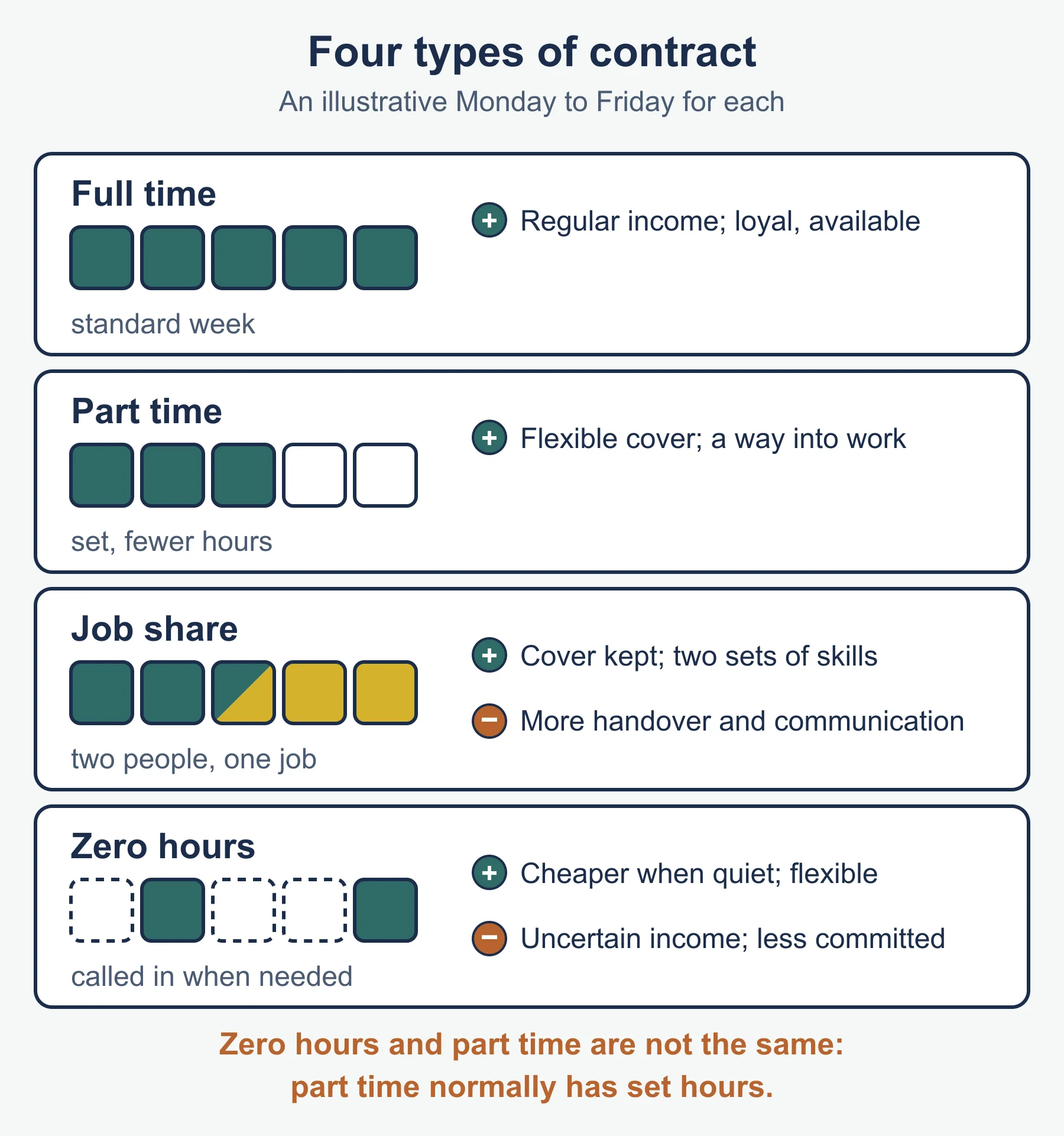
A contract of employment sets out the terms under which someone works.
- Full time: the standard working week for the business. Benefits: regular income for the worker, and loyalty and good availability for the employer.
- Part time: fewer hours than full time. Benefits: flexibility for the employer, who can match staff to busy periods, and a way into work for people who cannot work full time.
- Job share: one full-time job divided between two people. The employer keeps cover and gains two sets of skills; the drawback is more handover and communication.
- Zero hours: no guaranteed hours; the worker is called in when needed. The employer gains flexibility and lower costs when work is quiet, but workers face uncertain income and may be less committed.
3.4.3 Motivating employees
Motivation is the willingness of staff to put effort into their work. A motivated workforce brings staff retention, so lower recruitment and training costs, and high productivity. Unmotivated staff are more likely to be absent, make errors and leave. The specification says named motivational theories (it gives Maslow as its example) will not be examined, so concentrate on practical methods.
Financial methods
- Salary: a fixed annual amount, paid monthly. It gives security but does not reward extra effort.
- Wage: pay for hours worked, at an hourly rate. Example: 38 hours at £12.50 an hour gives a weekly wage of £475.
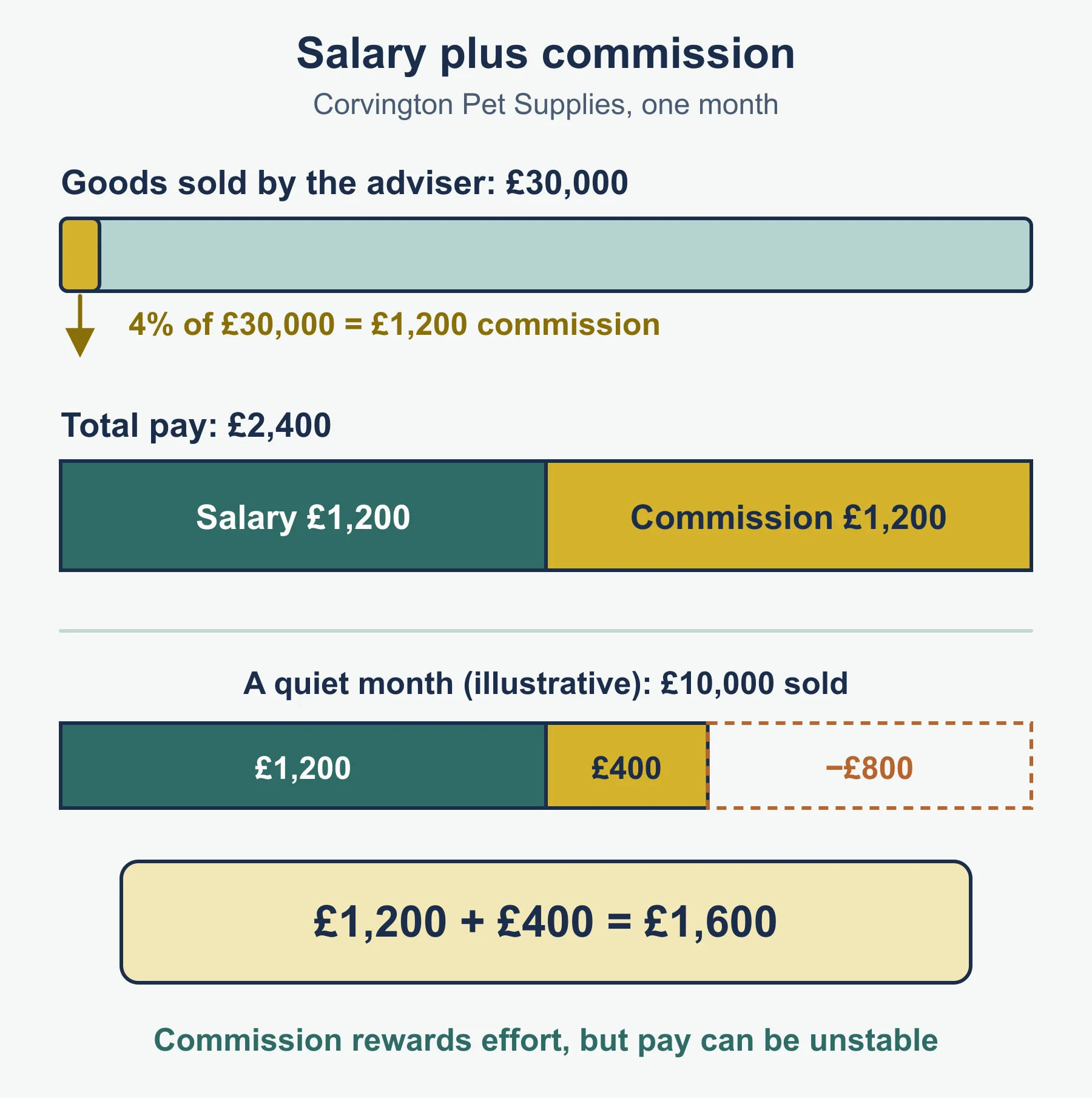
- Commission: a percentage of sales made. It rewards effort directly but pay can be unstable.
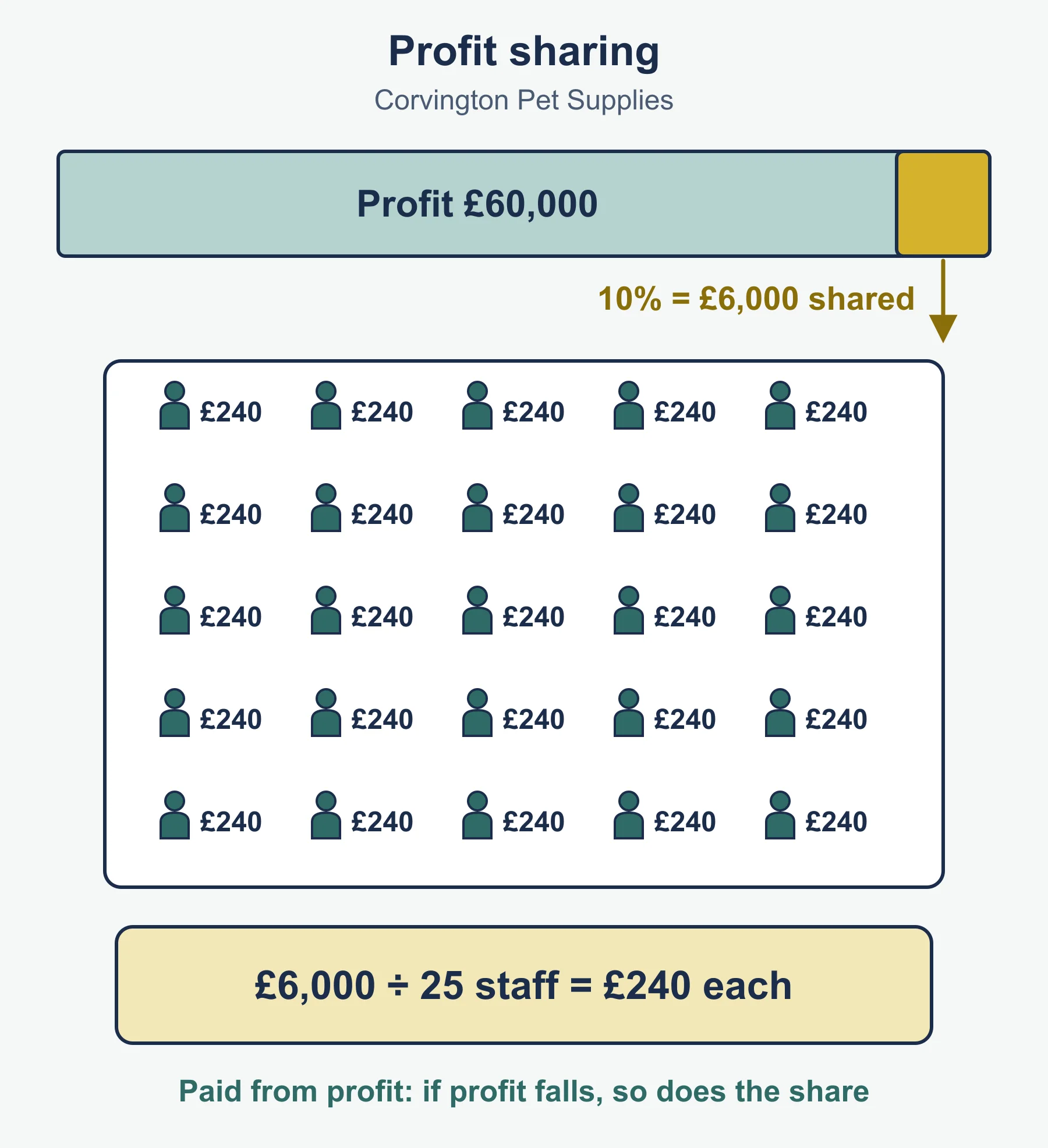
- Profit sharing: a share of the profits paid to employees.
Worked example: Corvington Pet Supplies pays a sales adviser a salary of £1,200 a month plus 4% commission. In a month when the adviser sells £30,000 of goods, commission is 4% of £30,000 = £1,200, so total pay is £2,400. The firm also shares 10% of its £60,000 profit equally between its 25 staff: £6,000 / 25 = £240 each.
Non-financial methods
- Styles of management: a manager who consults staff and listens to ideas tends to motivate more than one who simply gives orders.
- Training: it shows the business values the worker and opens routes to promotion.
- Greater responsibility: more authority and more interesting tasks give a sense of trust and achievement.
- Fringe benefits: extras beyond pay, such as a company car, staff discount or private health cover.
Money does not suit everyone. A well-paid worker with no say and no chance to progress may still leave, so a mix of methods usually works best.
3.4.4 Training
Training gives employees the skills and knowledge to do their job. Its benefits are higher productivity, coping when technology changes, a more motivated workforce, keeping staff, better-quality goods, and good customer service. The drawbacks are cost and lost working time, and trained staff may leave for better-paid jobs.
Types of training
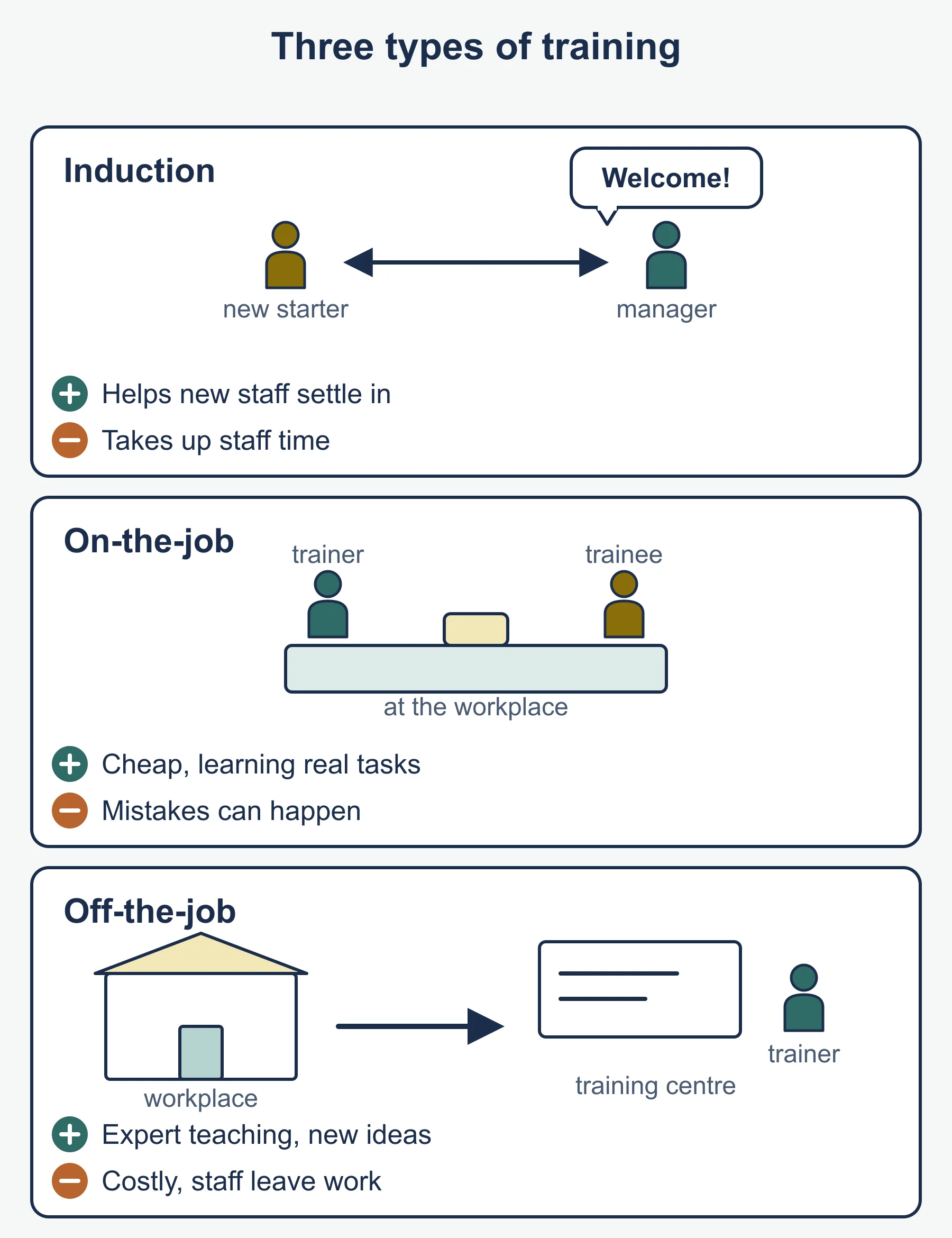
- Induction training: given to new starters. It covers the layout of the site, health and safety, key rules and introductions to colleagues. Benefits: new staff settle quickly, work safely and become productive sooner, and are more likely to stay.
- On the job training: learning while doing the real job, for example by shadowing an experienced worker. It is cheaper, and the learner is productive, but the trainer’s output falls and the learner may pick up bad habits or make mistakes in front of customers.
- Off the job training: away from the workplace, for example a college course or a specialist trainer. It can teach wider skills from experts and give recognised qualifications, but it is dearer and the worker is absent from the job.
Choosing a method
Worked example: Tavistowe Packaging buys a new automated labelling machine. Its operators need training in two weeks. On the job training is quick but only the one supplier’s technician knows the machine well, so an off the job course run by the supplier is more appropriate for the first group. Those trained can then train others on the job. A judgement like this should state the method, give a reason tied to the case, and weigh cost against quality of learning.
Common errors
- Confusing span of control (people under one manager) with the number of levels in the structure.
- Saying delayering means sacking workers. It removes a level, which may mean redundancies or moving people elsewhere.
- Calling zero hours and part time contracts the same. Part time normally has set hours.
- Writing that money is always the best motivator. Argue both sides.
- Listing a method without linking it to the business in the case study.
Frequently asked questions
What is the difference between internal and external recruitment? Internal recruitment fills a post from existing staff, which is cheaper and quicker and the business already knows the person. External recruitment brings a larger pool of applicants with new skills and ideas, but costs more and takes longer.
What are the stages of recruitment and selection in AQA GCSE Business (8132)? Job analysis, job description, person specification, advertising the post, shortlisting, selection methods such as interviews and tests, and offering the post with a contract.
What is a zero hours contract? A contract with no guaranteed hours, where the worker is called in only when needed. It is flexible and low cost for the employer but gives the worker an uncertain income.
Is money always the best motivator? No. Financial methods suit some staff, such as those on low pay or in sales roles, but a well-paid worker with no say and no chance to progress may still lack motivation, so argue both sides.
Official syllabus
AQA GCSE Business (8132), specification for first teaching from September 2017, published by AQA. This guide follows section 3.4 Human resources, including 3.4.1 to 3.4.4.
Get free revision emails (optional)
Occasional emails with practice questions, worked explanations and links to free resources for the qualification and subjects you choose. No spam, and you can unsubscribe from any email. The free tools on this site never need an email.
Related resources
-
Practice questions
AQA GCSE Business: Human resources (8132) – Practice Questions
Eleven original practice questions with worked answers on AQA GCSE Business 8132 topic 3.4 Human resources, from short answers to case studies.
Business · AQA · GCSE
Try questions -
Revision notes
AQA GCSE Business: Human resources (8132) – Revision Notes
Condensed revision notes for AQA GCSE Business 8132 topic 3.4 Human resources: structures, recruitment, motivation and training, with a self-test.
Business · AQA · GCSE
Revise topic -
Study guides
AQA GCSE Business: Marketing (8132)
Study guide to AQA GCSE Business Marketing: customers, segmentation, market research, the 4Ps, product life cycle, Boston Matrix and e-commerce.
Business · AQA · GCSE
Read guide
Related articles
-
teaching
A Level tuition in Dubai: Cambridge or Pearson Edexcel International A Level?
Schools in Dubai and Abu Dhabi teach either Cambridge International AS & A Level or Pearson Edexcel International A Level. How the two are structured, why it matters for tuition, and how online classes from Lahore work.
9 October 2026
-
curriculum guides
Choosing subjects at IGCSE and A Level
How subject choices at 14 and 16 affect university options later, and how to keep pathways open without overloading a timetable.
28 July 2026
Studying this with a teacher
Working through Business GCSE?
This page is free and stays free. If you would rather be taught it, Marlbridge runs Business classes one-to-one and in small groups of up to 15, online in your own time zone. The first trial class is free. WhatsApp replies within an hour (8am–11pm Pakistan time, every day); email the same day.
AQA Business teachers at Marlbridge
