
Study Guides
A Level Accounting: Activity based costing (Cambridge 9706)
Cost drivers, cost pools, ABC unit costs and selling prices, uses and limitations, and ABC versus traditional absorption, for Cambridge 9706.
- Subject
- Accounting
- Level
- A LEVEL
- Topic
- Cost and management accounting
- Author
- Marlbridge Academic Team
- Updated
- Reviewed by
- Zain Ud Din Ahmed (what this means)
Aligned to Cambridge A Level Accounting (9706), 2026-2028. Official specification .
Syllabus page (what it covers and how it is assessed): Cambridge A Level Accounting.
Syllabus points this page covers
9706 (A Level)
- 4.1 Activity based costing (ABC)
Found an error? Report a correction.
Need help with this topic? Request a free trial class for A Level Accounting (9706).
This guide covers 4.1 Activity based costing (ABC), from section 4, Cost and management accounting (A Level), of the Cambridge International AS & A Level Accounting 9706 syllabus for 2026, 2027 and 2028. Section 4 is assessed in Paper 4, which the syllabus describes as two structured questions worth 50 marks in 1 hour, with AS Level content assumed knowledge. All businesses and figures are invented and all amounts are in dollars.
Use it with the revision notes and the practice questions. The course hub, the printable checklist and the exam preparation guide sit alongside. To find weak spots first, try the free 10-minute diagnostics.
What this unit covers
| Syllabus point (4.1.1) | Where it is taught below |
|---|---|
| The application of ABC | Method in five steps; Worked example 1 |
| What a cost driver is | Cost drivers |
| Identifying the appropriate cost driver | Choosing a cost driver |
| Apportioning and allocating overheads | Steps 2 to 4 |
| Total cost and selling price of a unit | Worked example 1, step 5 |
| Effect of different overhead absorption methods on cost and profit | How the method changes cost and profit |
| Uses and limitations of ABC | Uses; Limitations |
| Decisions and recommendations using data | Worked example 2 |
Traditional absorption versus ABC
The syllabus presents ABC as a contrast to the traditional methods in 2.2. Absorption costing shares production overheads using a single basis such as direct labour hours. That works when every product consumes overhead in proportion to labour time. It misleads when a product is made in small batches, needs many inspections or generates many orders, because those costs have nothing to do with labour hours.
ABC links overheads to the activities that cause them. Each product then picks up overhead according to how many times it uses each activity.
Cost drivers
A cost driver is the factor that causes the cost of an activity to be incurred. If the factor doubles, the cost of the activity tends to rise too. The driver also measures how much of the activity each product uses, which is what lets you share the cost fairly.
| Activity | Possible cost driver |
|---|---|
| Changing a machine between batches | Number of set-ups |
| Checking quality | Number of inspections |
| Buying materials | Number of purchase orders |
| Running machines | Machine hours |
| Processing customer orders | Number of orders despatched |
The ABC method in five steps
- Group overheads into cost pools, one for each activity.
- Identify the cost driver for each pool.
- Calculate a cost driver rate for each pool: pool cost divided by total driver quantity.
- Allocate overhead to each product: driver rate multiplied by the product’s use of the driver. Divide by units made to get overhead per unit.
- Add direct costs to find total cost per unit, then add the mark-up or margin to find the selling price.
Worked example 1: Calderfell Plastics
Calderfell Plastics makes the Standard crate (S) and the Custom crate (C). It makes 24,000 S and 3,000 C. Direct materials are 7.50 per S and 12.00 per C. Direct labour is 0.25 hours per S and 1.00 hour per C at 16 per hour. Machine time is 0.20 hours per S and 0.40 hours per C. Overheads are 198,000. Prices are set at cost plus a 25% mark-up on cost.
Steps 1 to 3: pools, drivers and rates
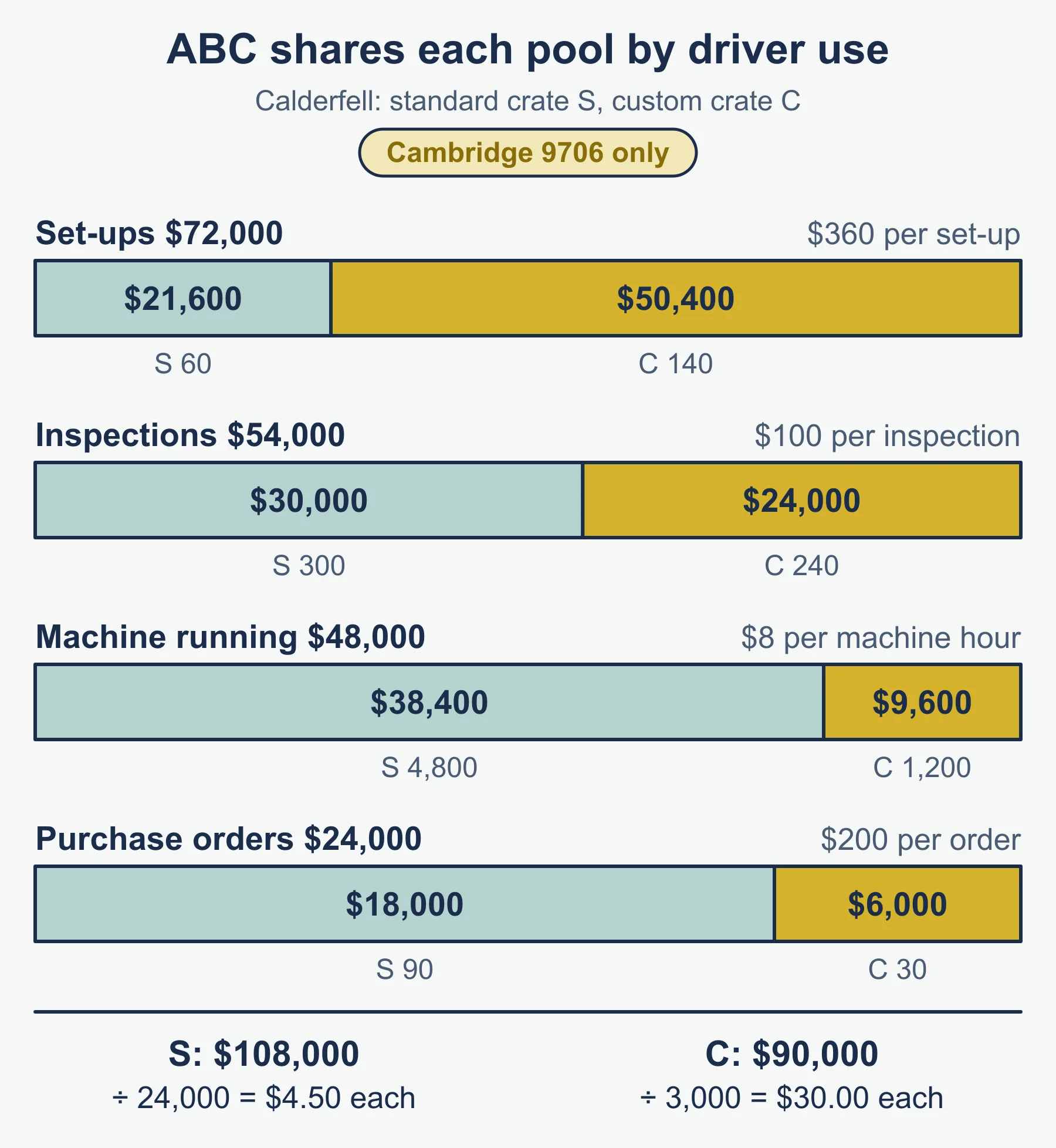
| Activity pool | Cost | Driver | S use | C use | Total | Rate |
|---|---|---|---|---|---|---|
| Machine set-ups | 72,000 | Set-ups | 60 | 140 | 200 | 360 |
| Quality inspections | 54,000 | Inspections | 300 | 240 | 540 | 100 |
| Machine running | 48,000 | Machine hours | 4,800 | 1,200 | 6,000 | 8 |
| Purchase orders | 24,000 | Orders placed | 90 | 30 | 120 | 200 |
Step 4: overhead allocated
| Pool | S | C |
|---|---|---|
| Set-ups | 21,600 | 50,400 |
| Inspections | 30,000 | 24,000 |
| Machine running | 38,400 | 9,600 |
| Purchase orders | 18,000 | 6,000 |
| Total | 108,000 | 90,000 |
| Per unit | 4.50 | 30.00 |
The two totals add to 198,000, so all overhead has been shared out.
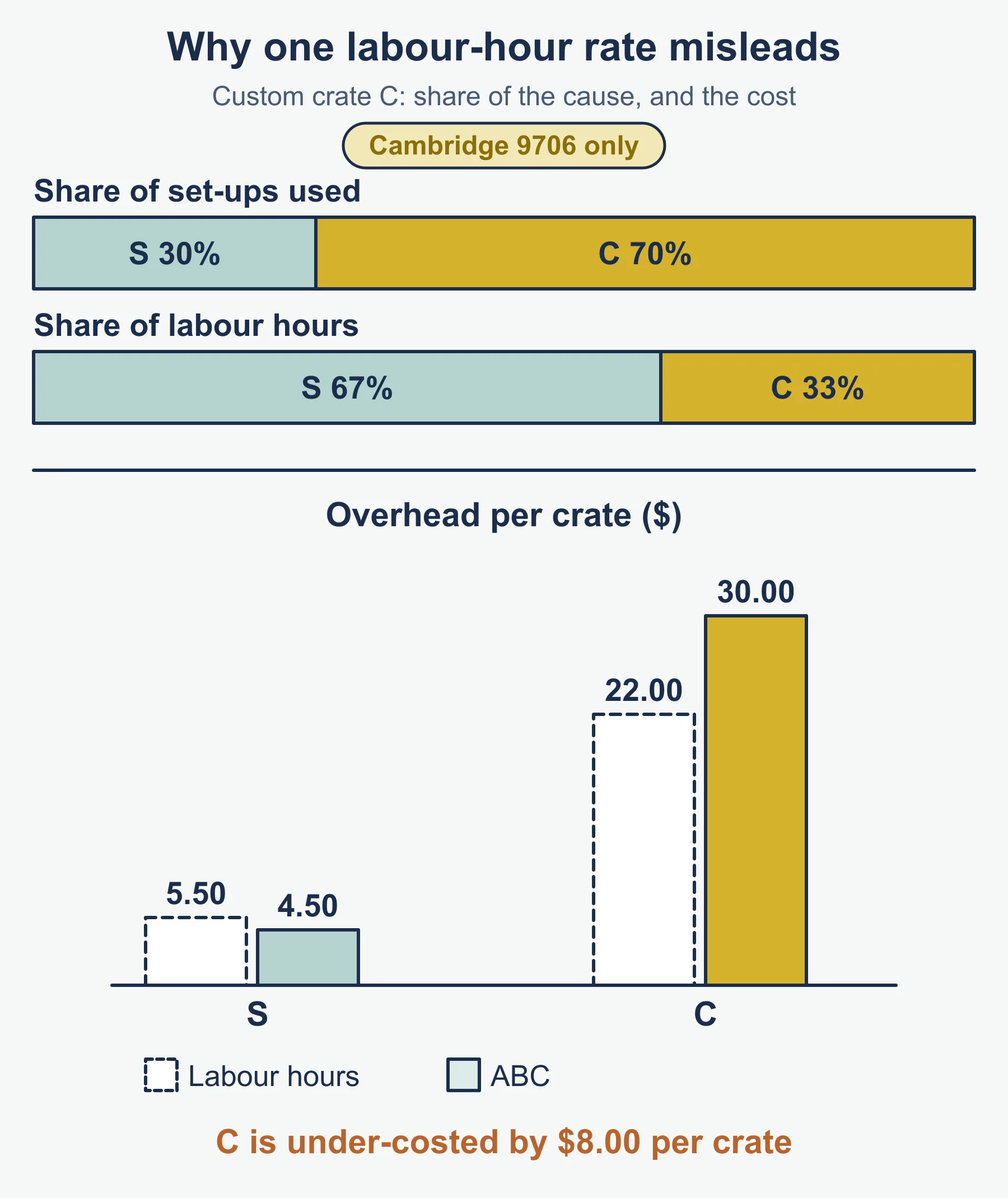
Traditional comparison. Labour hours are 6,000 (S) plus 3,000 (C) = 9,000. The absorption rate is 198,000 / 9,000 = 22.00 per hour. S takes 0.25 × 22 = 5.50 and C takes 1.00 × 22 = 22.00.
Step 5: unit cost and selling price
| Per unit | S traditional | S ABC | C traditional | C ABC |
|---|---|---|---|---|
| Direct materials | 7.50 | 7.50 | 12.00 | 12.00 |
| Direct labour | 4.00 | 4.00 | 16.00 | 16.00 |
| Overhead | 5.50 | 4.50 | 22.00 | 30.00 |
| Total cost | 17.00 | 16.00 | 50.00 | 58.00 |
| Price at 25% mark-up | 21.25 | 20.00 | 62.50 | 72.50 |
Custom crates are made in small runs, so they use 70% of set-ups (140 of 200) while accounting for only 33% of labour hours. Traditional costing hides this and under-costs C by 8.00 per unit.
How the method changes cost and profit
Changing the absorption method does not change total overheads. It changes how they are split between products, and so each product’s reported cost and profit.
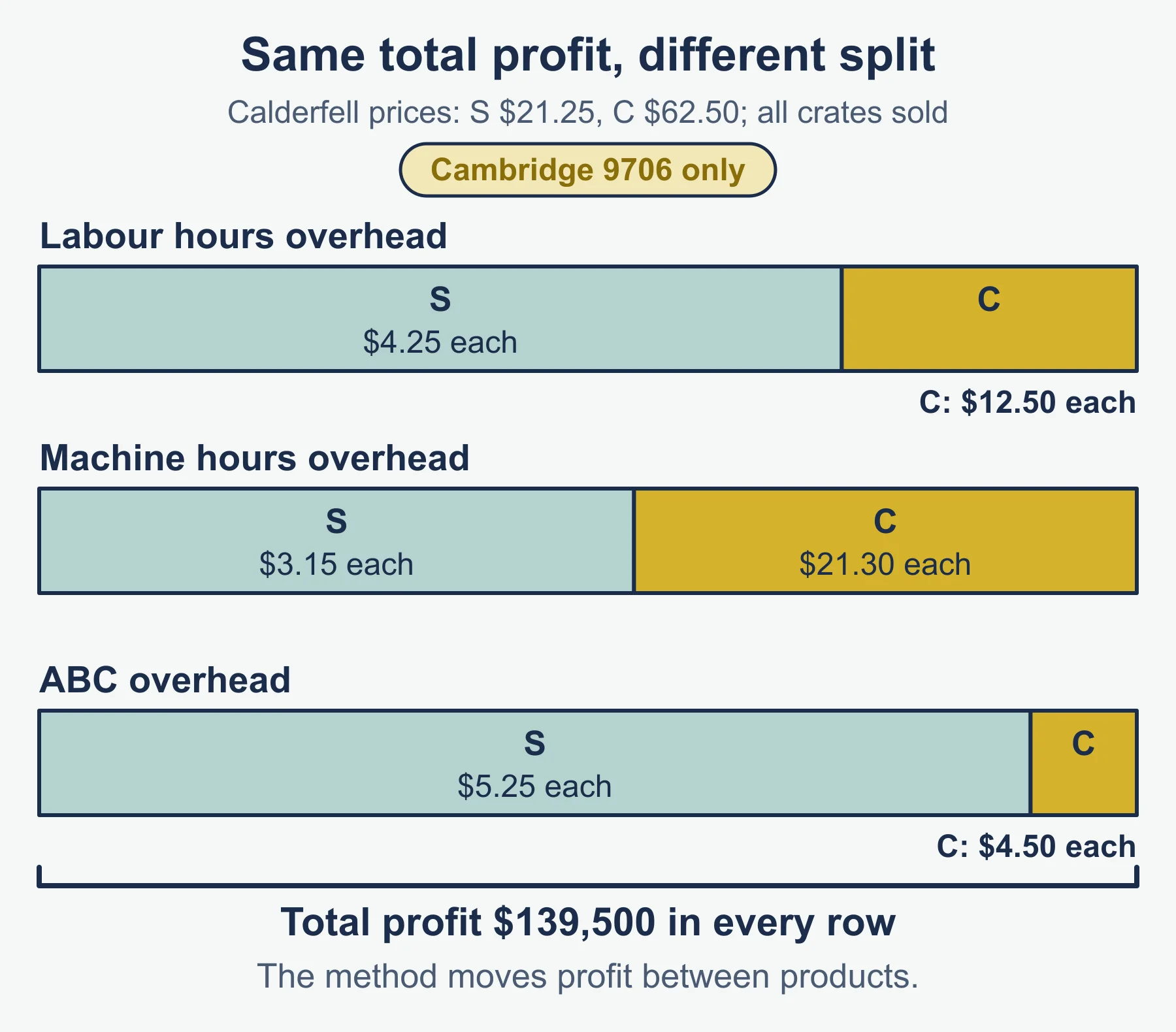
Suppose Calderfell’s current prices were set using the traditional costs: 21.25 for S and 62.50 for C. Machine hours give an alternative traditional basis: 198,000 / 6,000 = 33 per hour, so S takes 0.20 × 33 = 6.60 and C takes 0.40 × 33 = 13.20.
| Per unit | Labour hours | Machine hours | ABC |
|---|---|---|---|
| S overhead | 5.50 | 6.60 | 4.50 |
| C overhead | 22.00 | 13.20 | 30.00 |
| S profit at 21.25 | 4.25 | 3.15 | 5.25 |
| C profit at 62.50 | 12.50 | 21.30 | 4.50 |
Total profit is 139,500 under all three methods, because every unit made was sold. The method only moves profit between products. The reported profit of C ranges from 4.50 to 21.30 per unit, which could lead a manager to the wrong decision.
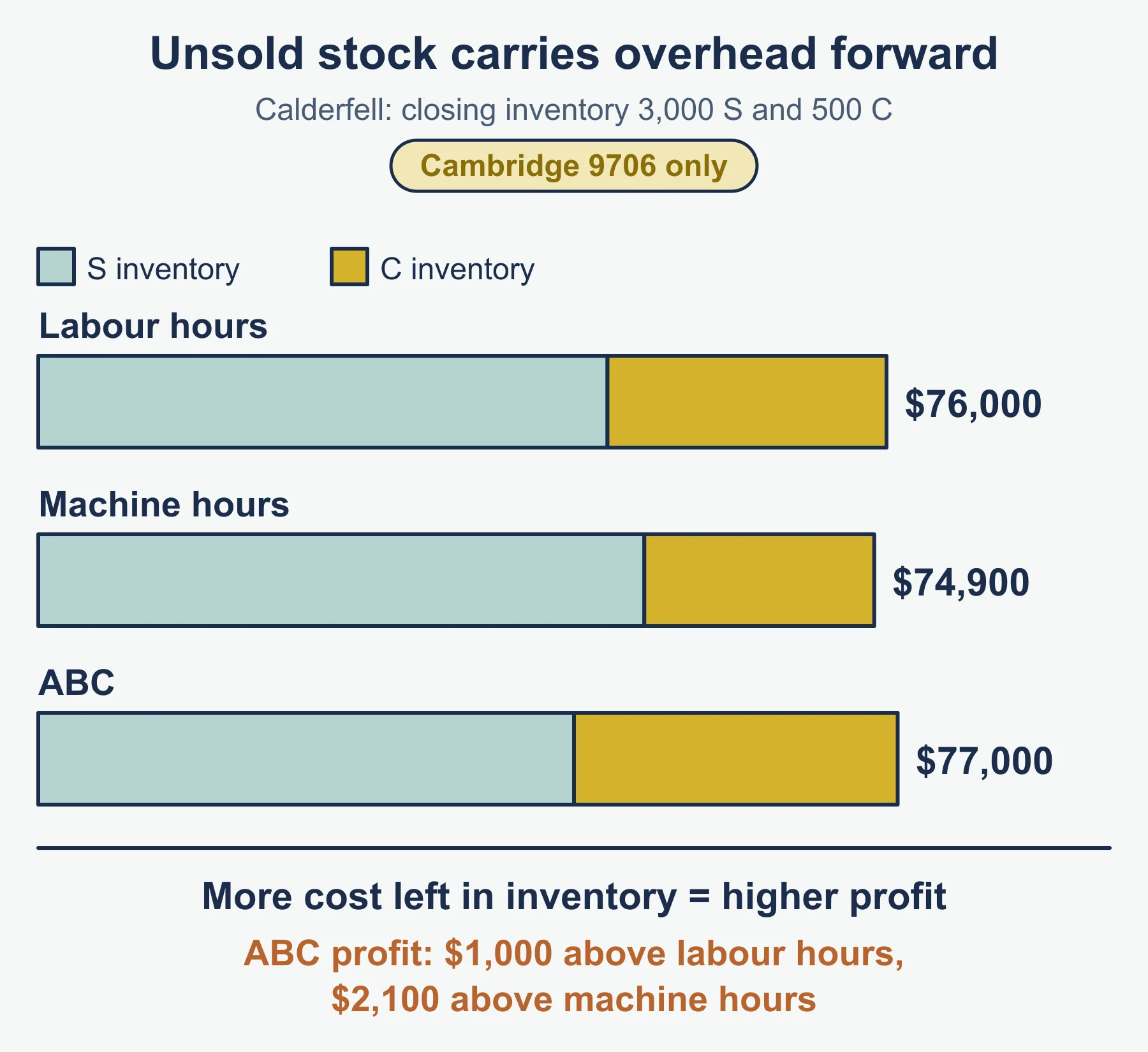
Effect when inventory is left unsold. Total profit for the period does change if production and sales differ, because overhead carried in closing inventory is not charged to the period. Suppose Calderfell sells 21,000 S and 2,500 C. Closing inventory is 3,000 S and 500 C, valued at full cost:
| Basis | Closing inventory value |
|---|---|
| Labour hours | 3,000 × 17.00 + 500 × 50.00 = 76,000 |
| Machine hours | 3,000 × 18.10 + 500 × 41.20 = 74,900 |
| ABC | 3,000 × 16.00 + 500 × 58.00 = 77,000 |
A higher closing inventory means less cost is charged against sales, so profit is higher. ABC profit is 1,000 above the labour hours profit and 2,100 above the machine hours profit.
Uses of ABC
- More accurate product costs, because overhead follows the activities that cause it.
- Better pricing: prices reflect the real cost of complex or low-volume products.
- Spotting products that look profitable but are not, as with C above.
- Cost control: managers can target the drivers, for example cutting set-ups by making longer production runs.
- Support for decisions on product range, pricing and process changes.
Limitations
- Cost and time: identifying pools, drivers and collecting data is expensive, and the system must be kept up to date.
- Judgement: choosing pools and drivers is subjective, and some costs, such as factory rent, have no clear driver and are still shared arbitrarily.
- Fixed costs do not fall automatically: if set-ups fall by 40, the saving appears only when the resources (staff hours, equipment) are actually removed.
- Historical data: costs are based on past activity levels, which may not suit changed conditions.
- Limited gain for some businesses: where overheads are small or products use activities in similar proportions, ABC and traditional results will be close.
Choosing a cost driver
A good driver passes these tests:
- Cause and effect: more of the driver really does mean more cost in that pool.
- Measurable: the quantity can be recorded for each product.
- Available at reasonable cost: records already exist or are cheap to create.
- Differs between products: if every product uses the activity in the same proportion, any driver gives the same answer.
For a pool covering invoicing, the number of invoices issued is better than direct labour hours, because invoices cause the work.
Worked example 2: a pricing recommendation
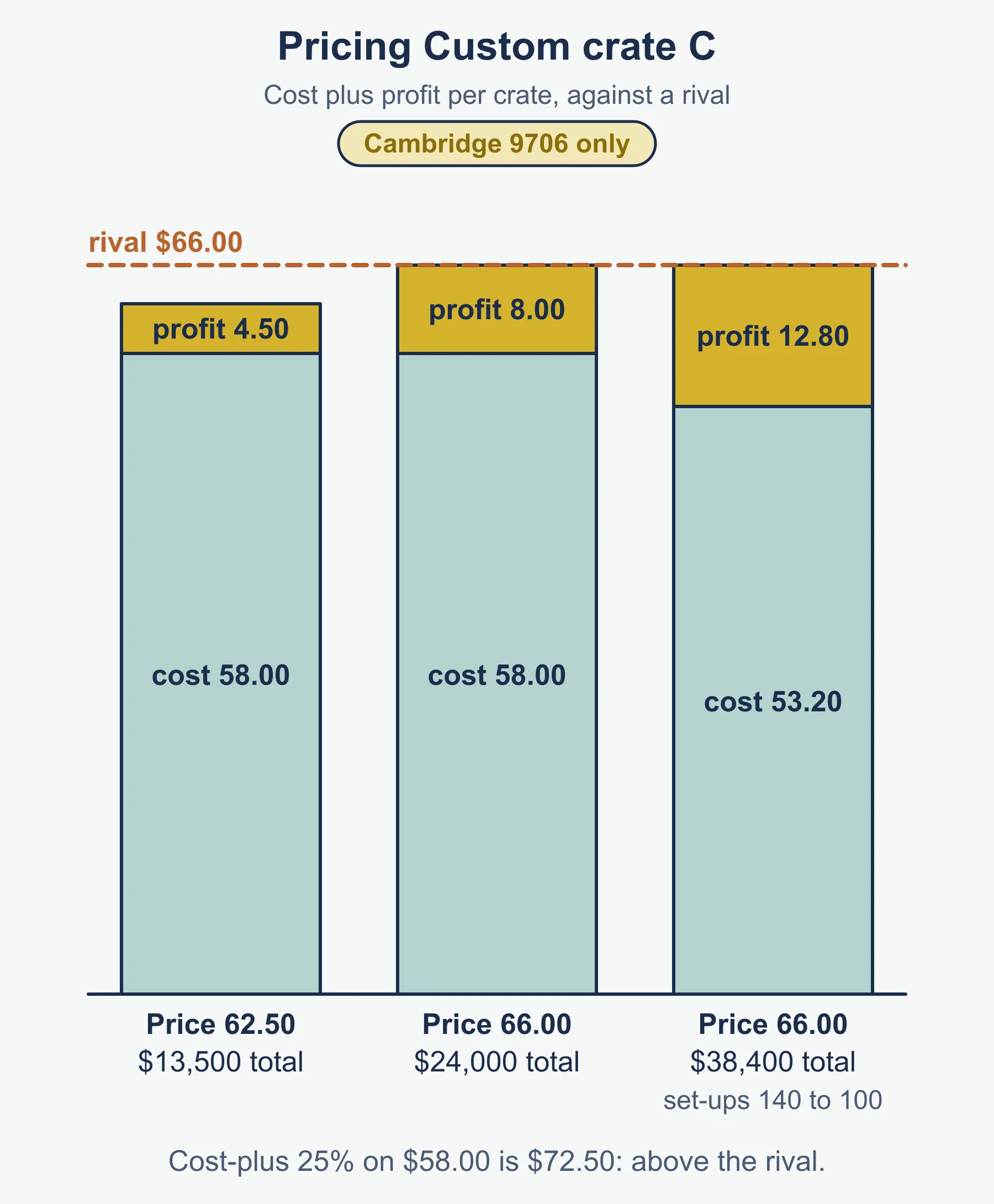
Calderfell’s competitor sells a similar Custom crate at 66.00. Managers ask what to do about C.
- ABC total cost of C is 58.00. A 25% mark-up gives 72.50, which is above the rival’s price.
- At the old price of 62.50, profit is 4.50 per unit, or 13,500 for 3,000 units.
- At 66.00, profit is 8.00 per unit. As a mark-up on cost this is 8.00 / 58.00 = 13.8%. Profit is 24,000 for the same volume.
- If larger batches cut C set-ups from 140 to 100, and the cost of those 40 set-ups (40 × 360 = 14,400) is genuinely removed, C overhead falls to 75,600, or 25.20 per unit. Total cost becomes 53.20 and profit at 66.00 is 12.80 per unit, or 38,400.
Recommendation. Set the price at 66.00 and move to larger batches. This keeps C competitive and raises profit. Balance this against non-financial factors: larger batches mean customers wait longer for custom orders, which could damage relationships, and the saving depends on reducing staff hours. Review results after one quarter. Paper 4 expects recommendations supported by a balance of reasons, so always give a reason on each side before you decide.
Common errors
- Dividing a pool by units produced instead of by driver quantity.
- Using labour hours as the driver for every pool, which reproduces traditional costing.
- Forgetting to divide product overhead by units to reach overhead per unit.
- Adding the mark-up to overhead only, instead of to total cost.
- Claiming ABC changes total overhead. It changes the split between products, and total profit only where inventory changes.
- Describing a driver as “the activity”. The driver is the measure of the activity.
Frequently asked questions
What is a cost driver in activity based costing? A cost driver is the factor that causes the cost of an activity to be incurred, such as the number of set-ups for a set-up cost pool. The driver is the measure of the activity, not the activity itself.
What are the steps in activity based costing? Group overheads into cost pools, identify each pool’s cost driver, calculate a driver rate (pool cost ÷ total driver quantity), allocate overhead to products by their use of the driver, then add direct costs to find total cost per unit and the selling price.
Does activity based costing change total profit? No, not when every unit made is sold: ABC changes how overheads are split between products, not the total. Total profit changes only when production and sales differ, because closing inventory is valued differently.
What are the limitations of ABC? ABC is costly and time-consuming to set up, choosing pools and drivers needs judgement, some costs such as rent have no clear driver, fixed costs do not fall automatically, and there is limited gain where products use activities in similar proportions.
Which section of Cambridge 9706 covers activity based costing? Activity based costing is section 4.1, part of the A Level cost and management accounting content of Cambridge International AS and A Level Accounting 9706.
Official syllabus
Cambridge International AS & A Level Accounting 9706 syllabus for examination in 2026, 2027 and 2028, published by Cambridge University Press & Assessment, section 4.1 Activity based costing (ABC).
Get free revision emails (optional)
Occasional emails with practice questions, worked explanations and links to free resources for the qualification and subjects you choose. No spam, and you can unsubscribe from any email. The free tools on this site never need an email.
Related resources
-
Study guides
A Level Accounting: Accounting for Non-Current Assets (Cambridge 9706)
Capital versus revenue spending, why assets depreciate depreciation methods, cost and revaluation models and disposals, for Cambridge 9706 Accounting topic 1.3.
Accounting · Cambridge · AS Level
Read guide -
Practice questions
A Level Accounting: Activity based costing (Cambridge 9706) – Practice Questions
Ten original ABC questions with worked answers for Cambridge A Level Accounting 9706: cost driver rates, unit costs, prices, inventory and recommendations.
Accounting · Cambridge · A Level
Try questions -
Revision notes
A Level Accounting: Activity based costing (Cambridge 9706) – Revision Notes
Condensed ABC notes for Cambridge A Level Accounting 9706: driver rates, unit cost and price, uses, limitations, absorption methods and a self-test.
Accounting · Cambridge · A Level
Revise topic
Related articles
-
teaching
A Level tuition in Dubai: Cambridge or Pearson Edexcel International A Level?
Schools in Dubai and Abu Dhabi teach either Cambridge International AS & A Level or Pearson Edexcel International A Level. How the two are structured, why it matters for tuition, and how online classes from Lahore work.
9 October 2026
-
curriculum guides
Choosing subjects at IGCSE and A Level
How subject choices at 14 and 16 affect university options later, and how to keep pathways open without overloading a timetable.
28 July 2026
Studying this with a teacher
Working through Accounting A LEVEL?
This page is free and stays free. If you would rather be taught it, Marlbridge runs Accounting classes one-to-one and in small groups of up to 15, online in your own time zone. The first trial class is free. WhatsApp replies within an hour (8am–11pm Pakistan time, every day); email the same day.
Cambridge Accounting teachers at Marlbridge

