
Revision Notes
A Level Accounting: Activity based costing (Cambridge 9706) – Revision Notes
Condensed ABC notes for Cambridge A Level Accounting 9706: driver rates, unit cost and price, uses, limitations, absorption methods and a self-test.
- Subject
- Accounting
- Level
- A LEVEL
- Topic
- Cost and management accounting
- Author
- Marlbridge Academic Team
- Updated
- Reviewed by
- Zain Ud Din Ahmed (what this means)
Aligned to Cambridge A Level Accounting (9706), 2026-2028. Official specification .
Syllabus page (what it covers and how it is assessed): Cambridge A Level Accounting.
Syllabus points this page covers
9706 (A Level)
- 4.1 Activity based costing (ABC)
Found an error? Report a correction.
Need help with this topic? Request a free trial class for A Level Accounting (9706).
These notes condense 4.1 Activity based costing (ABC) from section 4, Cost and management accounting (A Level), of the Cambridge International AS & A Level Accounting 9706 syllabus for 2026, 2027 and 2028. For full explanations and a longer worked example, use the study guide. Then test yourself with the practice questions. The course hub, the printable checklist and the free 10-minute diagnostics help you plan revision. All amounts are in dollars and all businesses are invented.
Key terms
| Term | Meaning |
|---|---|
| Activity | Something that causes overhead cost, such as setting up machines or processing orders |
| Cost pool | The overhead cost collected for one activity |
| Cost driver | The factor that causes the cost of an activity and measures each product’s use of it |
| Cost driver rate | Cost pool divided by total quantity of the driver |
| Absorption rate (traditional) | Total overheads divided by one basis, such as direct labour hours |
Formulae
| Item | Formula |
|---|---|
| Driver rate | Pool cost / total driver quantity |
| Overhead for a product from one pool | Driver rate × product’s use of the driver |
| Overhead per unit | Total overhead for the product / units made |
| Total cost per unit | Direct costs per unit + overhead per unit |
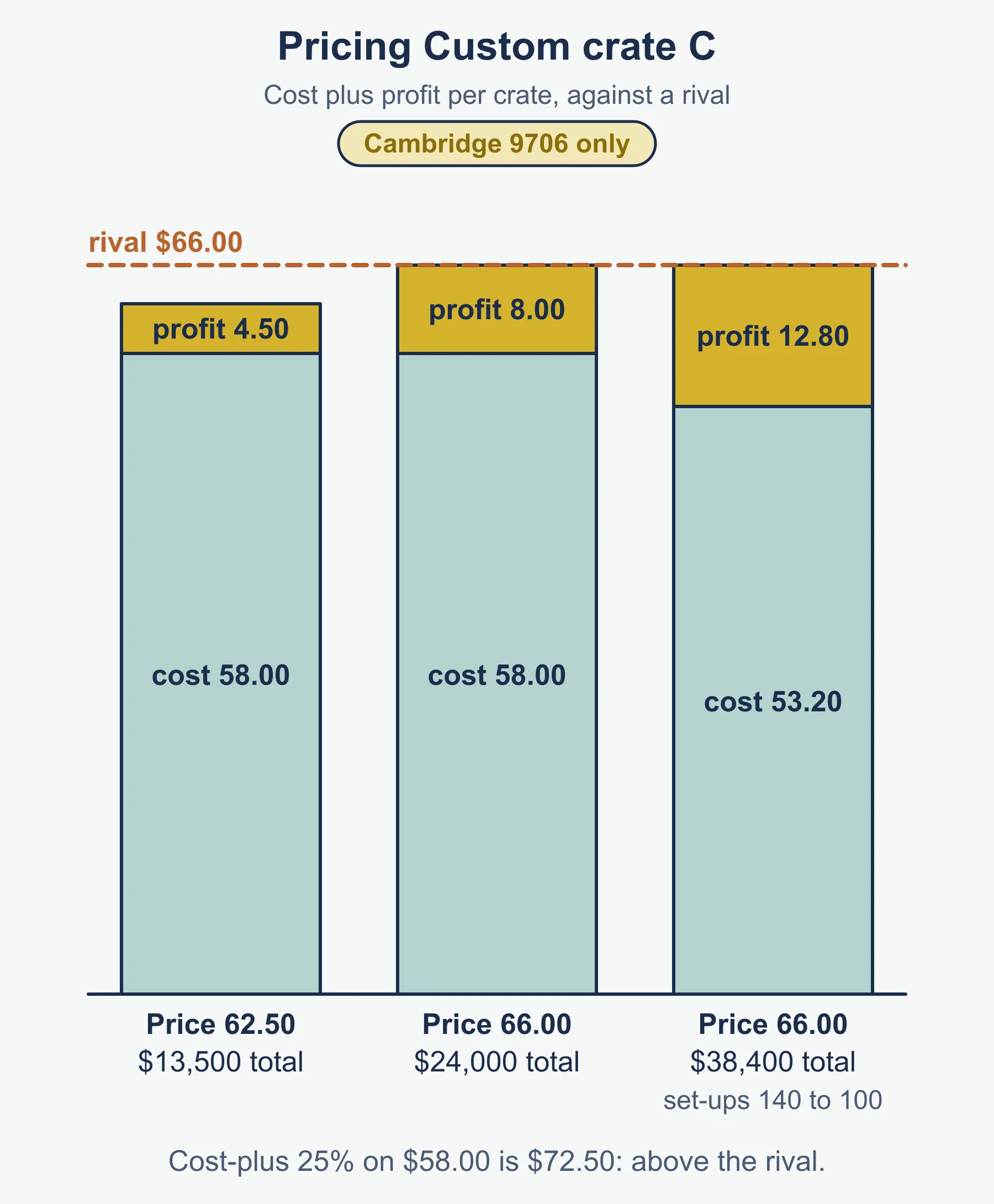
| Selling price (mark-up) | Total cost × (1 + mark-up %) |
| Selling price (margin) | Total cost / (1 − margin %) |
| Traditional rate | Total overheads / total hours (or other basis) |
Mark-up is profit as a percentage of cost. Margin is profit as a percentage of selling price. Read the question to see which is asked for.
Method in steps
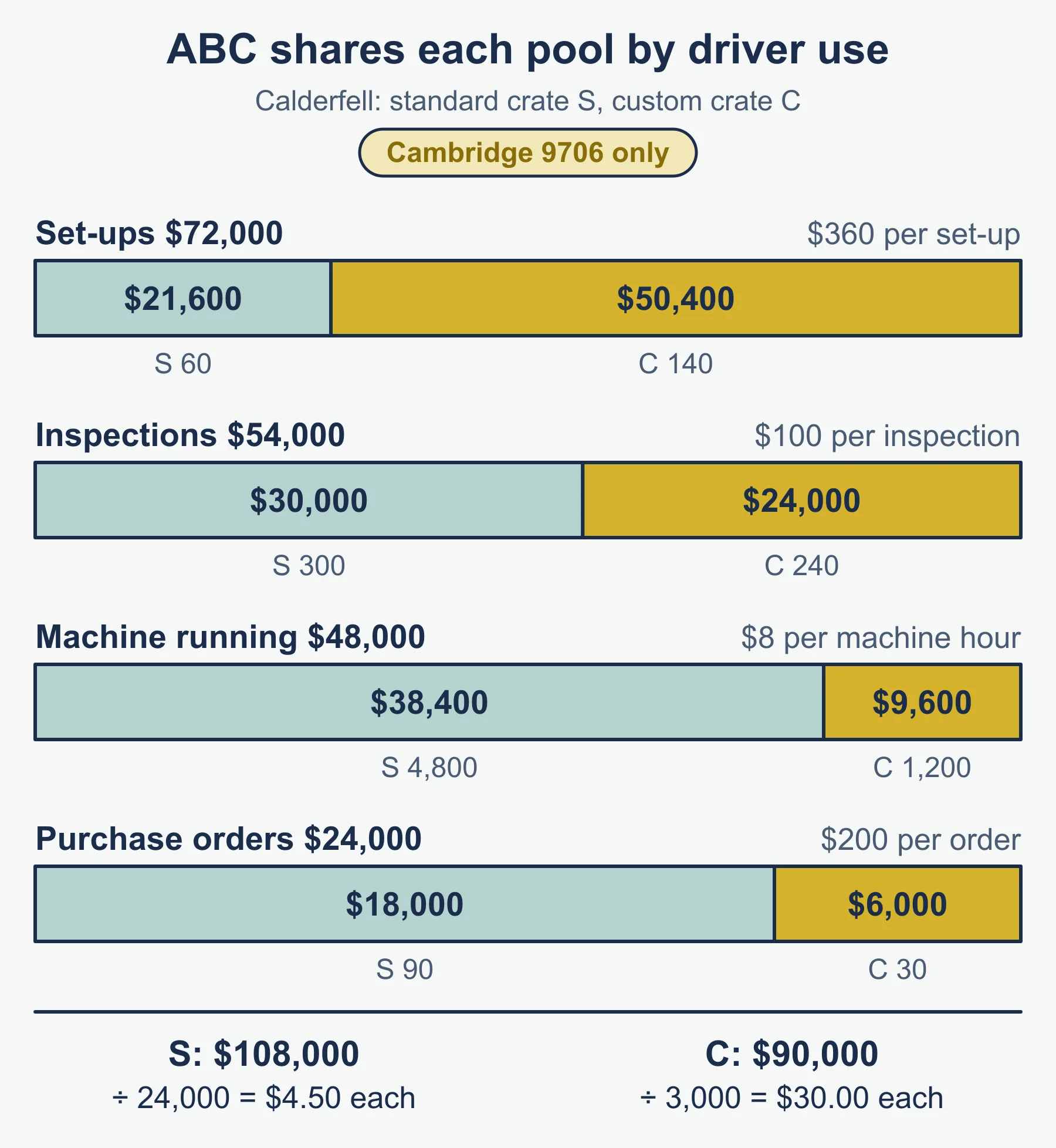
- Split overheads into cost pools, one per activity.
- Choose the cost driver for each pool.
- Calculate each driver rate.
- Multiply each rate by each product’s driver quantity, add the pools and divide by units.
- Add direct costs, then add the mark-up or margin to reach the price.
- Check: product overheads must add back to the total overhead.
Choosing a cost driver
- Cause and effect: the driver really changes the pool cost.
- Measurable for each product.
- Data available at reasonable cost.
- Products use it in different proportions (otherwise the answer is the same as traditional costing).
Examples: set-ups cost, number of set-ups. Invoicing, number of invoices. Stores handling, number of requisitions. Machine power, machine hours.
Must-know distinctions
| Traditional absorption | ABC | |
|---|---|---|
| Overhead pools | One, or one per department | One per activity |
| Basis | One volume measure, such as labour hours | Several cost drivers |
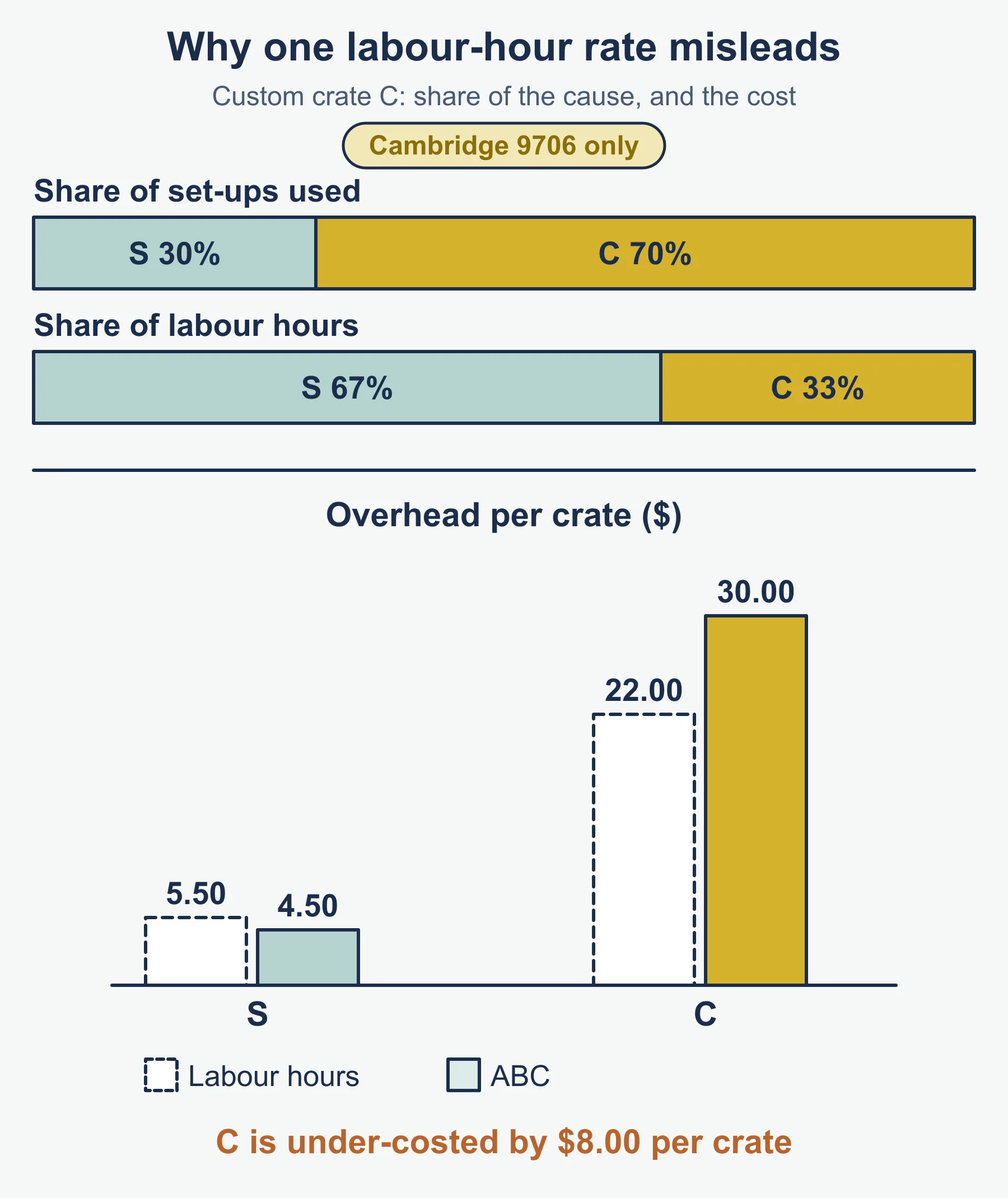
| Product costs | Can over-cost high-volume products and under-cost complex, low-volume ones | Follow each product’s use of activities |
| Effort and data | Low | High |
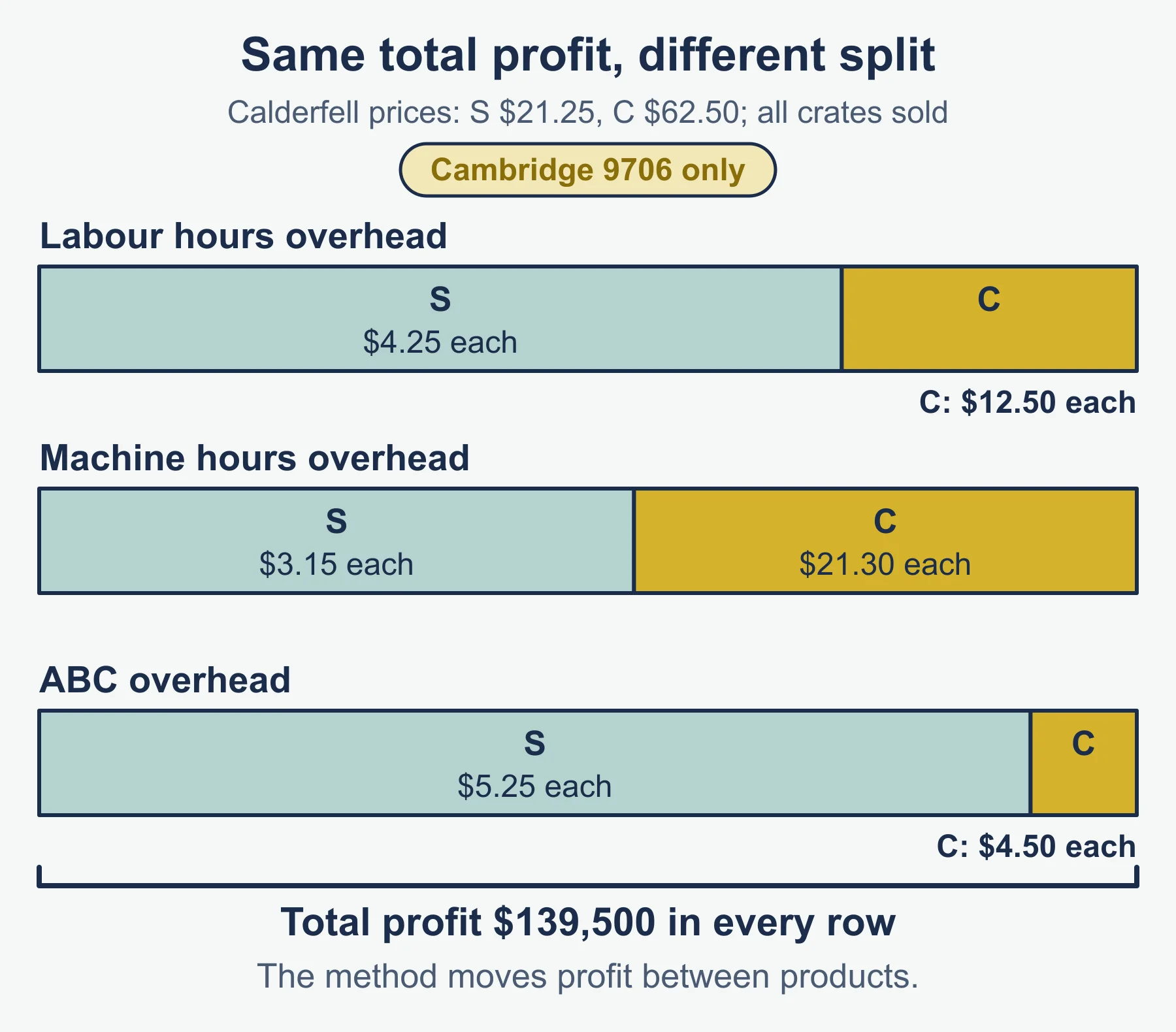
Total overhead is the same under both. The method changes how it is shared out between products, so product profit changes. Total profit changes only when closing inventory differs, because overhead is carried forward in inventory valuation.
Uses and limitations
| Uses | Limitations |
|---|---|
| More accurate product costs | Costly and time-consuming to set up and run |
| Better pricing for complex products | Choice of pools and drivers needs judgement |
| Exposes products that look profitable but are not | Some overheads have no clear driver |
| Targets cost control through the drivers | Savings appear only if resources are removed |
| Supports range and process decisions | Based on past data; little gain where overheads are small |
Worked reminder: a service business
Verdane Linen Services washes linen for hotels (H) and restaurants (R). Overheads of 180,000 are currently shared on service labour hours: 8,000 for H and 4,000 for R, a total of 12,000. The rate is 15 per hour. Hotels take 120,000 and restaurants take 60,000. Hotels send 160,000 kg a year and restaurants 80,000 kg. That makes the overhead 0.75 per kg for each.
| Pool | Cost | Driver | H | R | Rate |
|---|---|---|---|---|---|
| Collections | 36,000 | Visits | 600 | 1,200 | 20 |
| Washing | 96,000 | Kilograms | 160,000 | 80,000 | 0.40 |
| Stain treatment | 30,000 | Items treated | 2,000 | 8,000 | 3 |
| Invoicing | 18,000 | Invoices | 120 | 480 | 30 |
ABC overhead: H = 12,000 + 64,000 + 6,000 + 3,600 = 85,600, or 0.535 per kg. R = 24,000 + 32,000 + 24,000 + 14,400 = 94,400, or 1.18 per kg. The total is 180,000.
With direct costs of 0.55 per kg and a price of 1.60 per kg for both, the traditional margin is 0.30 per kg on each. ABC gives hotels 0.515 per kg profit and restaurants a loss of 0.13 per kg. The restaurants need many small collections and stain treatments. A sensible response is to raise restaurant prices, charge for stain treatment or reduce visits, but weigh this against the risk of losing those customers.
Absorption method, cost and profit
- If everything made is sold, total profit is the same under every method. Only the profit reported for each product changes.
- If a product’s ABC cost is higher than its traditional cost, traditional costing was under-costing it, and a price built on the old figure may be too low.
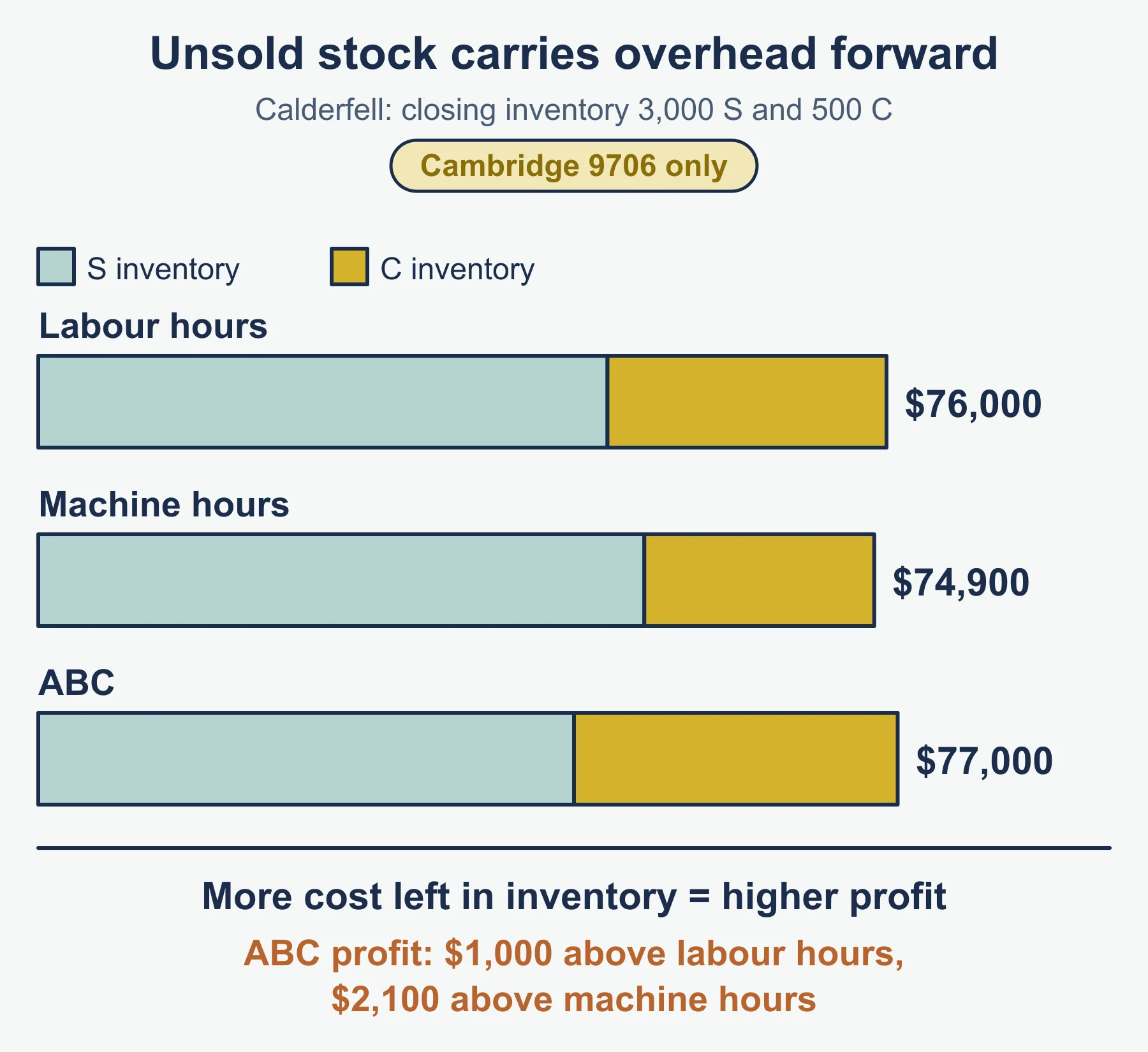
- If units are left in closing inventory, the method matters for total profit. Overhead sits in the inventory value, so the method giving the higher unit cost gives the higher closing inventory and the higher profit.
- Compare methods by working out both unit costs, then both profits, then saying what the manager should do differently.
Example: 500 units are unsold. Unit overhead is 7.00 under ABC and 5.50 under labour hours. Closing inventory carries 500 × 1.50 = 750 more overhead under ABC, so profit is 750 higher.
Decisions and recommendations
For any recommendation question:
- State the ABC cost and profit for each product.
- Compare with the traditional figures and say why they differ.
- Give financial reasons for and against each option.
- Add non-financial factors, such as customer relationships, reputation, capacity and staff.
- Make a clear recommendation and justify it. The syllabus says Paper 4 candidates should support decisions with a balance of reasons.
Quick self-test
- Define a cost driver.
- A pool of 45,000 is driven by 150 inspections. What is the rate?
- A product needs 12 inspections and 800 units are made. Find the inspection cost per unit.
- Direct costs are 9.00 per unit. Using your answer to question 3 as the only overhead, find the total cost and the selling price with a 40% mark-up on cost.
- What is the profit margin on that price?
- Which is the better driver for an invoicing pool: direct labour hours or number of invoices?
- Overheads of 90,000 and 12,000 labour hours: what is the traditional rate, and what overhead does a unit taking 2 hours absorb?
- Give two limitations of ABC.
- All 800 units were made, but 400 remain in closing inventory. ABC overhead is 6.00 per unit and traditional is 4.50. How much higher is profit under ABC?
- Why can ABC raise the cost of a low-volume product?
Answers
- The factor that causes the cost of an activity to be incurred, and which measures how much of it each product uses.
- 45,000 / 150 = 300 per inspection.
- 12 × 300 = 3,600; 3,600 / 800 = 4.50 per unit.
- Total cost = 9.00 + 4.50 = 13.50. Price = 13.50 × 1.40 = 18.90.
- Profit = 18.90 − 13.50 = 5.40; 5.40 / 18.90 = 28.6% of selling price.
- Number of invoices, because invoices cause the work.
- 90,000 / 12,000 = 7.50 per hour; 2 × 7.50 = 15.00.
- For example: high cost and time to set up and maintain; subjective choice of pools and drivers; some costs with no clear driver; savings need resources to be removed.
- 400 × (6.00 − 4.50) = 600 higher under ABC, because more overhead is carried forward in inventory.
- Low-volume products use set-ups, inspections and orders heavily relative to their size. Traditional labour hours spread these costs over high-volume lines, so ABC moves the cost back to the products that cause it.
Where marks are usually lost
- Dividing a pool by units made rather than by the total driver quantity.
- Using the same driver for every pool, which gives the traditional answer.
- Stopping at overhead per unit and not adding direct costs.
- Confusing mark-up on cost with margin on selling price.
- Leaving out the check that product overheads sum to the total.
- Writing a recommendation with no reasons against it, or with no non-financial points.
- Saying ABC reduces costs. It changes the cost shares, and savings come only from acting on the drivers.
- Describing limitations in general terms, with no link to the business in the question.
Frequently asked questions
What makes a good cost driver? A good driver has a cause-and-effect link with the pool’s cost, can be measured for each product, is available at reasonable cost, and differs between products.
Does ABC reduce costs? Not by itself. ABC changes the share of costs given to each product; savings come only when managers act on the drivers, for example by cutting set-ups and removing the resources.
What is the most common mistake in ABC calculations? Dividing a cost pool by the number of units made rather than by the total driver quantity. Using the same driver for every pool is another error, because it simply gives the traditional answer.
What should an ABC recommendation include? Use the ABC figures, give reasons for and against, include non-financial points, and link any limitations to the business in the question.
Official syllabus
Cambridge International AS & A Level Accounting 9706 syllabus for examination in 2026, 2027 and 2028, published by Cambridge University Press & Assessment, section 4.1 Activity based costing (ABC).
Get free revision emails (optional)
Occasional emails with practice questions, worked explanations and links to free resources for the qualification and subjects you choose. No spam, and you can unsubscribe from any email. The free tools on this site never need an email.
Related resources
-
Study guides
A Level Accounting: Accounting for Non-Current Assets (Cambridge 9706)
Capital versus revenue spending, why assets depreciate depreciation methods, cost and revaluation models and disposals, for Cambridge 9706 Accounting topic 1.3.
Accounting · Cambridge · AS Level
Read guide -
Study guides
A Level Accounting: Budgeting and budgetary control (Cambridge 9706)
Study guide to budgets, the master budget, flexible budgets, reconciliations and behavioural issues, for Cambridge A Level Accounting 9706 section 4.3.
Accounting · Cambridge · A Level
Read guide -
Practice questions
A Level Accounting: Budgeting and budgetary control (Cambridge 9706) – Practice Questions
Ten original questions with worked answers on budgets, cash budgets, flexible budgets, reconciliations and behaviour, for Cambridge A Level Accounting.
Accounting · Cambridge · A Level
Try questions
Related articles
-
teaching
A Level tuition in Dubai: Cambridge or Pearson Edexcel International A Level?
Schools in Dubai and Abu Dhabi teach either Cambridge International AS & A Level or Pearson Edexcel International A Level. How the two are structured, why it matters for tuition, and how online classes from Lahore work.
9 October 2026
-
curriculum guides
Choosing subjects at IGCSE and A Level
How subject choices at 14 and 16 affect university options later, and how to keep pathways open without overloading a timetable.
28 July 2026
Studying this with a teacher
Working through Accounting A LEVEL?
This page is free and stays free. If you would rather be taught it, Marlbridge runs Accounting classes one-to-one and in small groups of up to 15, online in your own time zone. The first trial class is free. WhatsApp replies within an hour (8am–11pm Pakistan time, every day); email the same day.
Cambridge Accounting teachers at Marlbridge

