
Study Guides
A Level Accounting: Standard costing (Cambridge 9706)
A full guide to standard costing and variances for Cambridge A Level Accounting 9706, with one worked example from cost card to profit reconciliation.
- Subject
- Accounting
- Level
- A LEVEL
- Topic
- Cost and management accounting
- Author
- Marlbridge Academic Team
- Updated
- Reviewed by
- Zain Ud Din Ahmed (what this means)
Aligned to Cambridge A Level Accounting (9706), 2026-2028. Official specification .
Syllabus page (what it covers and how it is assessed): Cambridge A Level Accounting.
Syllabus points this page covers
9706 (A Level)
- 4.2 Standard costing
Found an error? Report a correction.
Need help with this topic? Request a free trial class for A Level Accounting (9706).
This guide covers section 4.2 Standard costing (A Level content) of the Cambridge International AS & A Level Accounting 9706 syllabus for 2026, 2027 and 2028. It sits in topic 4, Cost and management accounting, which is assessed in Paper 4 (one hour, two structured questions, 25 marks each). AS Level content is assumed knowledge. Every business and figure below is invented and amounts are in dollars. Use it with the revision notes and the practice questions, then see the course hub, the printable checklist and the free diagnostics.
What 4.2.1 asks you to do
| Syllabus point | Where it is covered |
|---|---|
| Meaning of a standard costing system | Section 1 |
| Advantages and disadvantages | Section 2 |
| Standard costing as an aid to improving performance | Section 2 |
| Direct material price and usage; direct labour rate and efficiency | Sections 3 and 4 |
| Fixed overhead expenditure and volume; capacity and efficiency sub-variances | Section 5 |
| Sales price and volume | Section 6 |
| Causes of favourable or adverse variances and how they relate | Section 8 |
| Decisions and recommendations from data; non-financial factors | Section 9 |
1. What a standard costing system is
A standard costing system sets predetermined values for what a unit of output should cost and what it should sell for. Actual results are then compared with these standards. Each difference is a variance. A variance is favourable (F) if it makes actual profit higher than the standard would give, and adverse (A) if it makes profit lower.
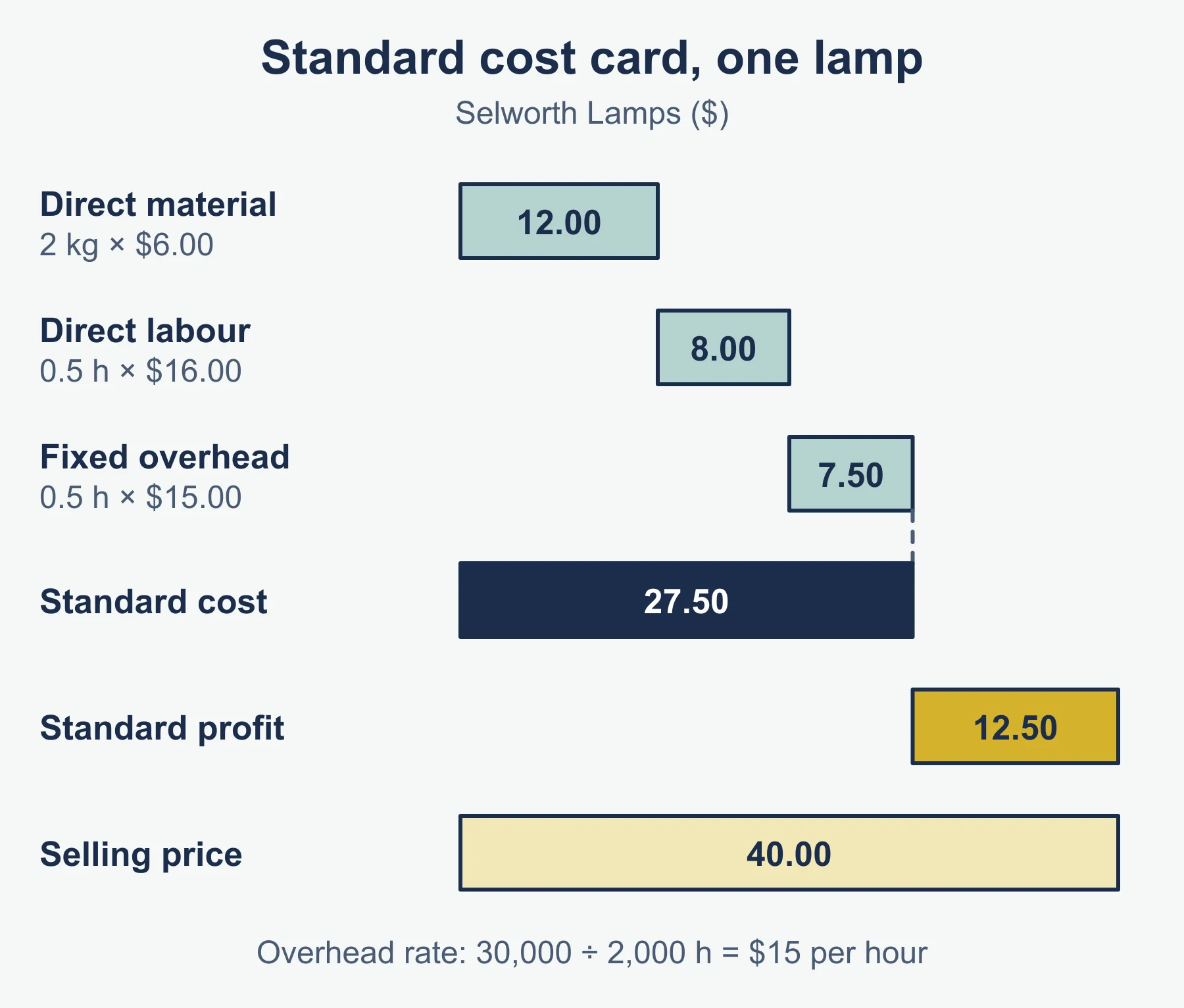
The standards are collected on a standard cost card. This is the card used throughout the guide, for Selworth Lamps, which makes one type of desk lamp.
| Per lamp | Quantity | Standard | Cost |
|---|---|---|---|
| Direct material | 2 kg | 6.00 per kg | 12.00 |
| Direct labour | 0.5 hours | 16.00 per hour | 8.00 |
| Fixed overhead | 0.5 hours | 15.00 per labour hour | 7.50 |
| Standard cost | 27.50 | ||
| Standard selling price | 40.00 | ||
| Standard profit | 12.50 |
The fixed overhead rate comes from the budget: budgeted fixed overhead of 30,000 divided by budgeted labour hours of 2,000 (4,000 lamps at 0.5 hours). Budgeted profit is 4,000 lamps at 12.50, which is 50,000.
Actual results for the period: 4,300 lamps made and sold at an average price of 39.00; 8,900 kg of material bought and used for 55,180; 2,050 labour hours worked and paid at a total of 34,850; fixed overhead of 31,400.
2. Advantages, disadvantages and improving performance
Advantages
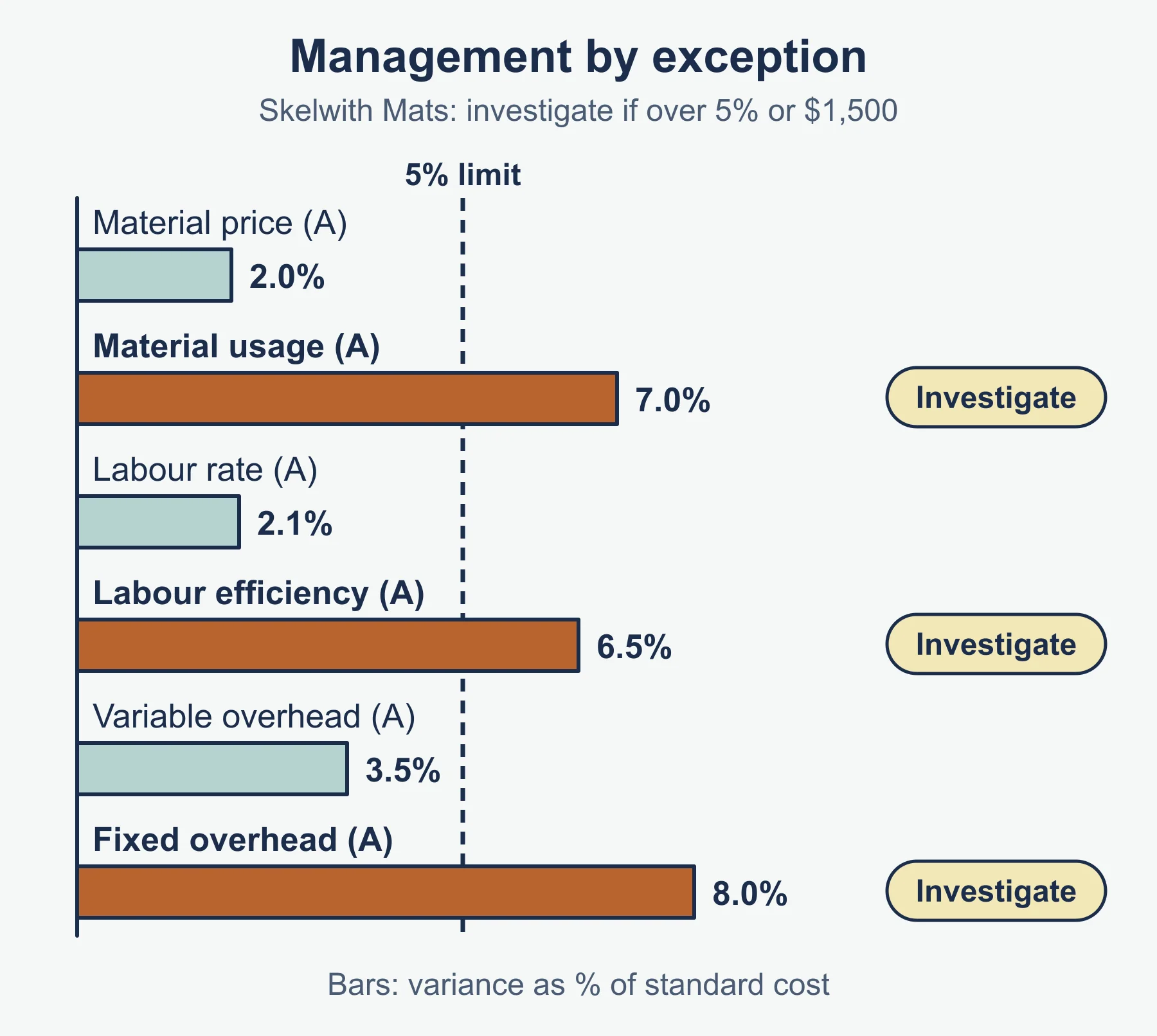
- Variances show where actual results depart from the plan, so managers can concentrate on the exceptions rather than every figure.
- Each variance can be tied to a manager (purchasing for material price, production for usage), which supports responsibility and control.
- Standards give staff a clear target, which can motivate.
- Setting standards forces the business to plan costs carefully, and variances feed back into the next budget.
- Costing is quicker because inventory and cost of sales can be valued at standard.
Disadvantages
- Setting and updating standards takes time and skill, and is costly for a business with many products.
- Standards become out of date when prices or methods change, so variances may reflect a poor standard rather than poor performance.
- Staff may feel pressure to meet standards at the expense of quality or safety.
- Variances are calculated after the event, and an unrealistic standard (too tight or too loose) can demotivate or hide inefficiency.
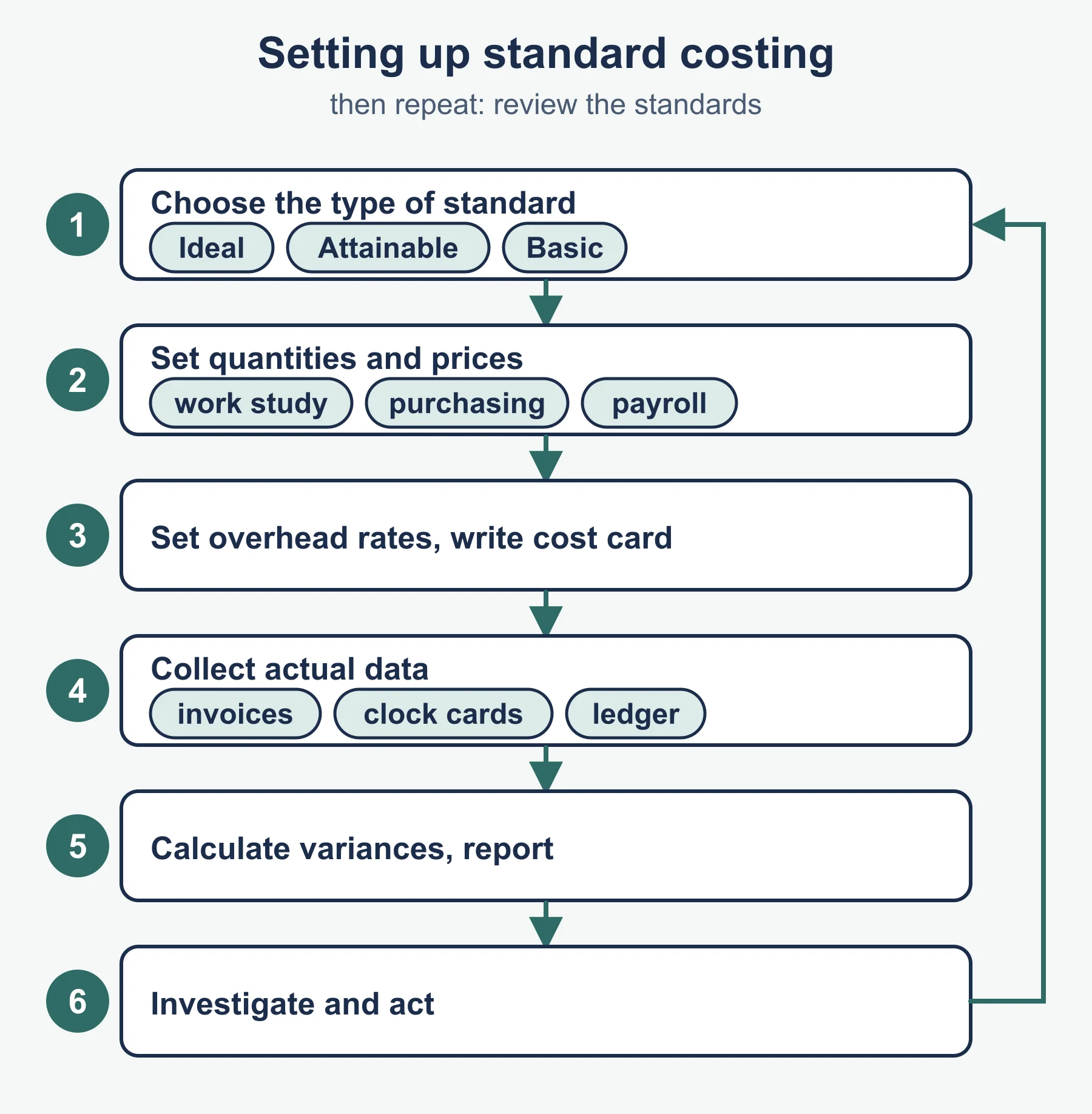
Improving performance. Standard costing helps when managers investigate the significant variances, find the cause, act on it and revise the standard if the cause is permanent. It also improves budget preparation, because actual prices, times and volumes show whether the next budget should use different figures.
3. Direct material variances
| Variance | Formula |
|---|---|
| Material price | (standard price - actual price) x actual quantity bought |
| Material usage | (standard quantity for actual output - actual quantity used) x standard price |
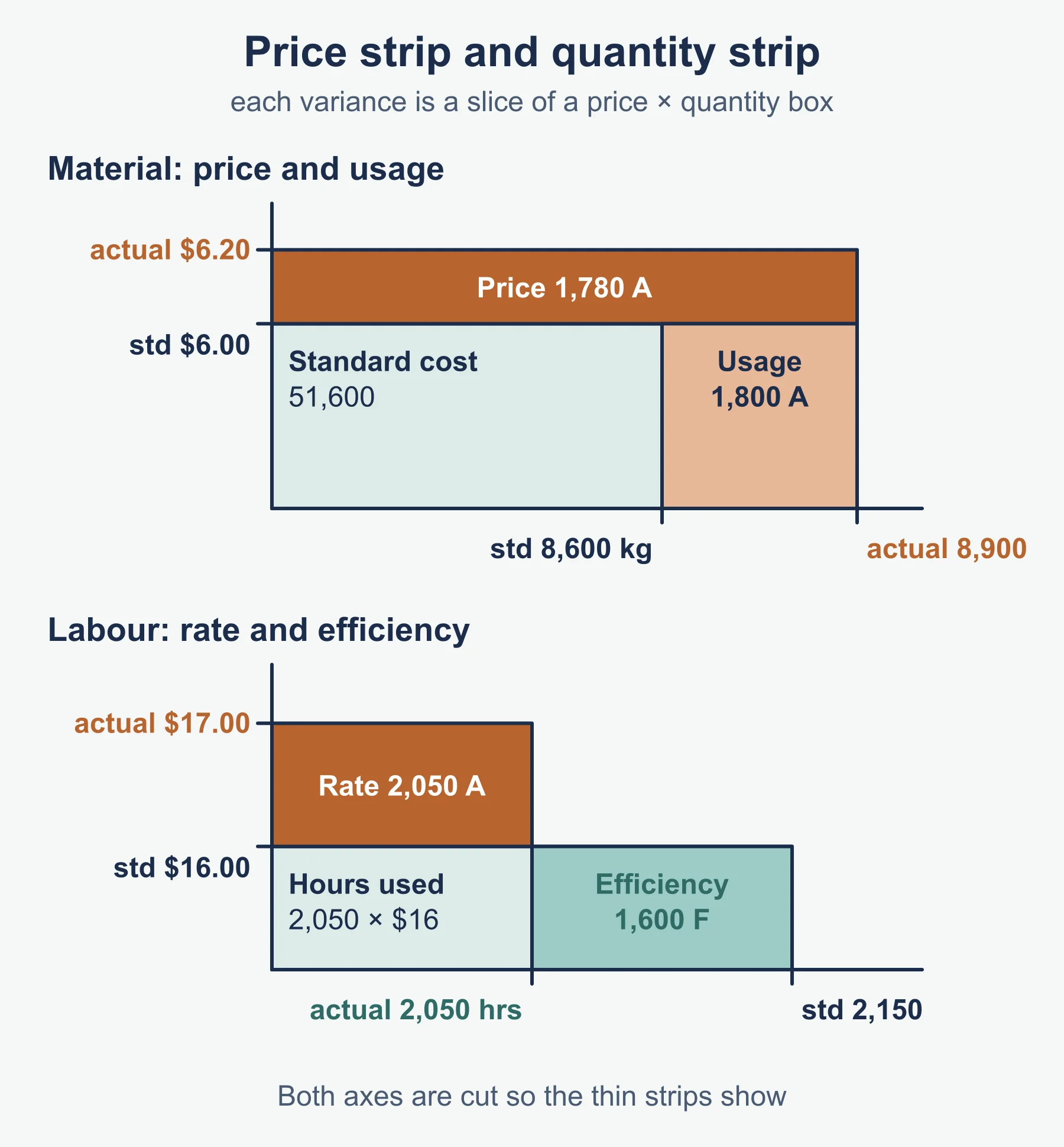
In this guide the quantity bought equals the quantity used, so one quantity serves both. Selworth’s standard quantity for 4,300 lamps is 4,300 x 2 = 8,600 kg. The actual price is 55,180 / 8,900 = 6.20 per kg.
Material price  = (6.00 - 6.20) x 8,900            = 1,780 A
Material usage  = (8,600 - 8,900) x 6.00           = 1,800 A
Check: standard cost of 8,600 kg is 51,600, and the actual cost is 55,180, a difference of 3,580 adverse. That is the sum of the two variances (1,780 + 1,800).
4. Direct labour variances
| Variance | Formula |
|---|---|
| Labour rate | (standard rate - actual rate) x actual hours worked |
| Labour efficiency | (standard hours for actual output - actual hours worked) x standard rate |
Standard hours for 4,300 lamps are 4,300 x 0.5 = 2,150. The actual rate is 34,850 / 2,050 = 17.00 per hour.
Labour rate       = (16.00 - 17.00) x 2,050        = 2,050 A
Labour efficiency = (2,150 - 2,050) x 16.00        = 1,600 F
The workforce paid more than the standard rate but produced 4,300 lamps in fewer hours than allowed.
5. Fixed overhead variances
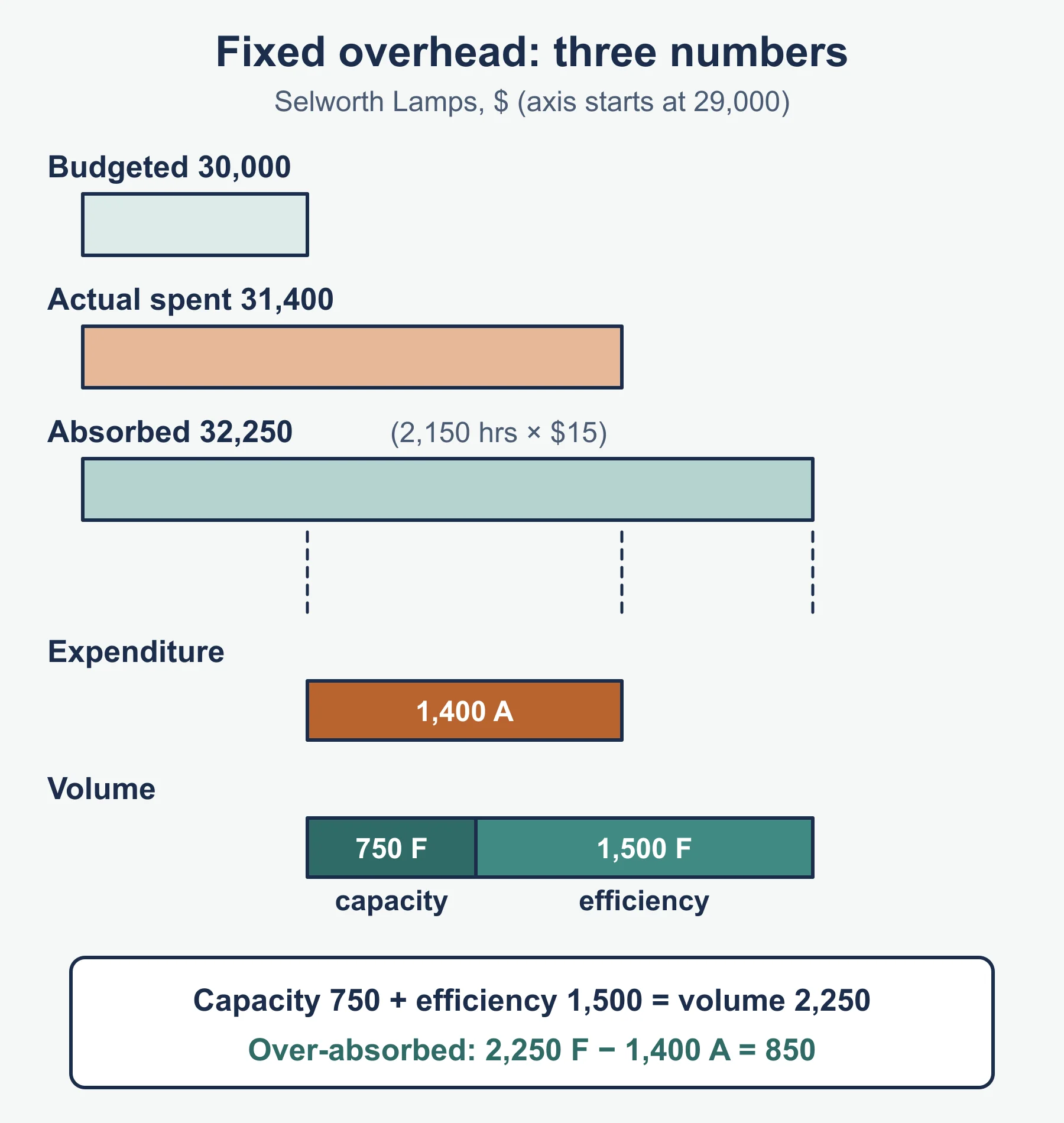
Fixed overhead is absorbed into output at a rate set from the budget. Absorbed overhead for the period is standard hours for actual output times the rate: 2,150 x 15 = 32,250. Actual overhead was 31,400.
| Variance | Formula |
|---|---|
| Fixed overhead expenditure | budgeted fixed overhead - actual fixed overhead |
| Fixed overhead volume | (actual output - budgeted output) x standard fixed overhead per unit |
| Capacity sub-variance | (actual hours worked - budgeted hours) x rate per hour |
| Efficiency sub-variance | (standard hours for actual output - actual hours worked) x rate per hour |
Expenditure = 30,000 - 31,400                       = 1,400 A
Volume      = (4,300 - 4,000) x 7.50                = 2,250 F
Capacity    = (2,050 - 2,000) x 15.00               =   750 F
Efficiency  = (2,150 - 2,050) x 15.00               = 1,500 F
Capacity plus efficiency equals volume (750 + 1,500 = 2,250). The expenditure and volume variances together equal the over-absorption of 850: absorbed 32,250 less actual 31,400, which is 2,250 - 1,400. Capacity shows whether the planned hours were used. Efficiency shows whether the hours worked produced more or less than planned, so it has the same cause as labour efficiency and the same size in hours.
6. Sales variances
| Variance | Formula |
|---|---|
| Sales price | (actual selling price - standard selling price) x actual units sold |
| Sales volume | (actual units sold - budgeted units) x standard profit per unit |
The sales volume variance here uses the standard profit per unit after fixed overhead has been absorbed (12.50). If a question names another basis, follow the question.
Sales price  = (39.00 - 40.00) x 4,300              = 4,300 A
Sales volume = (4,300 - 4,000) x 12.50              = 3,750 F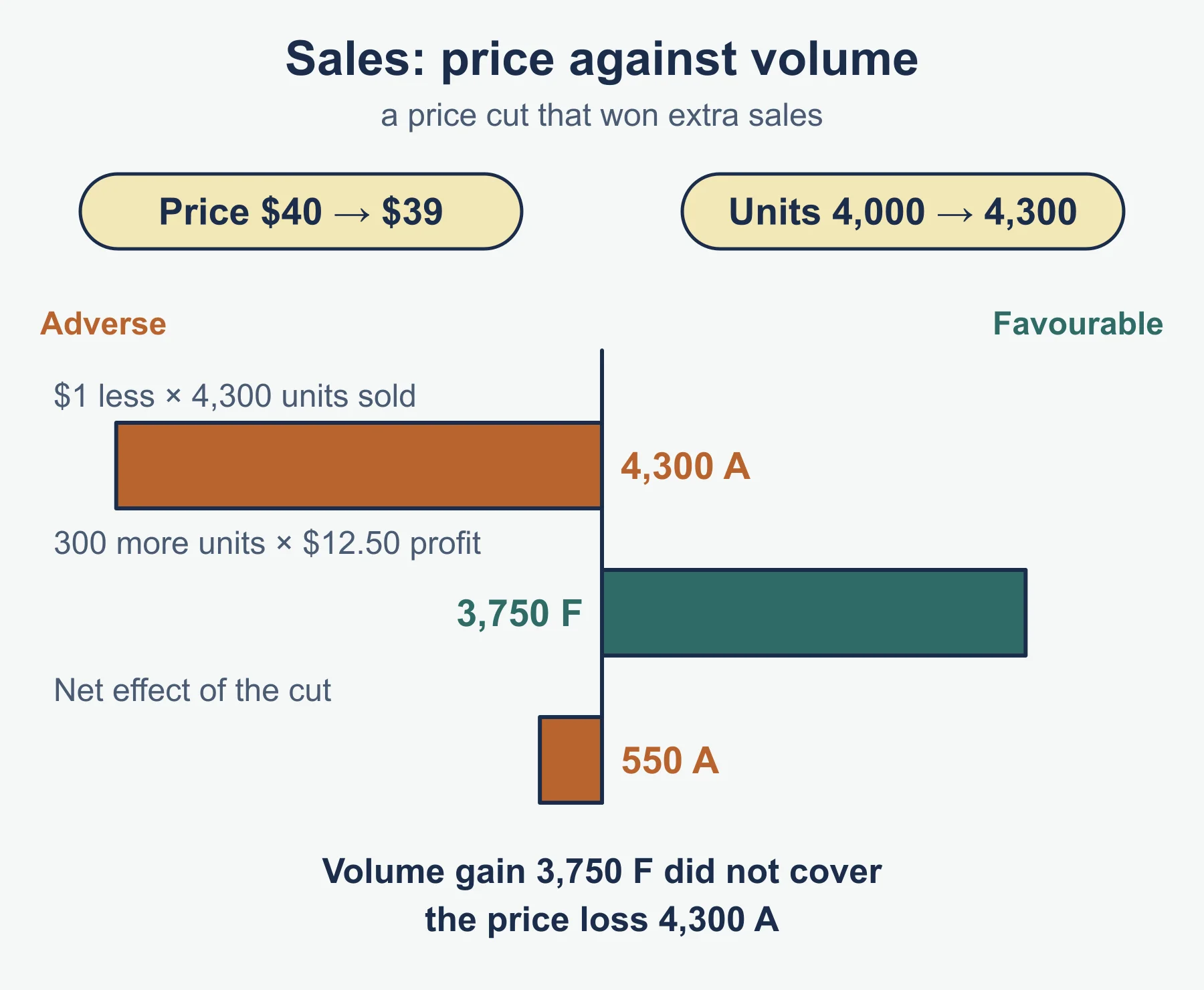
7. Summarising the variances
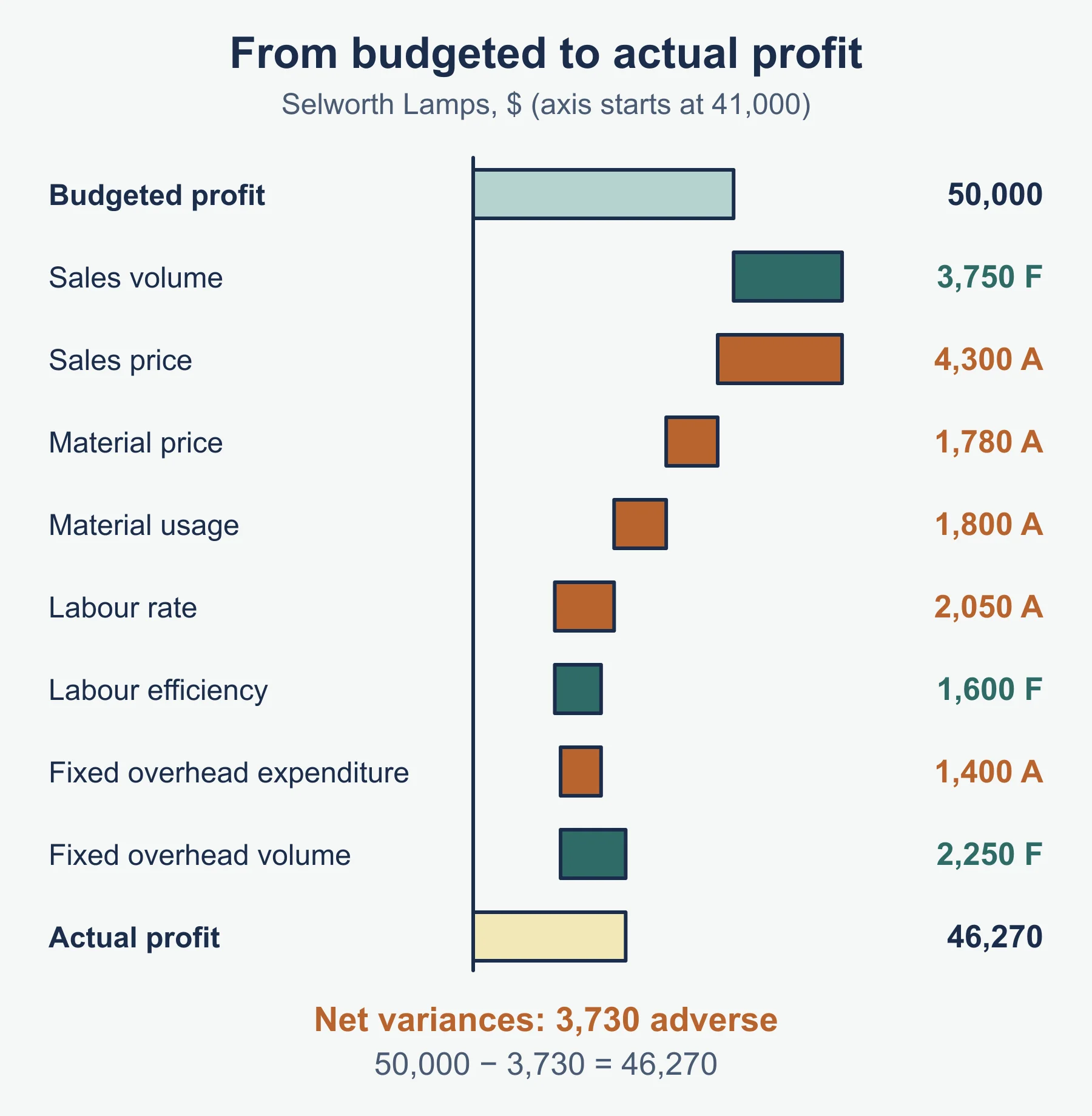
Starting from budgeted profit and adding favourable variances and subtracting adverse ones gives the actual profit. This is a useful check on your arithmetic.
| Amount | Total | |
|---|---|---|
| Budgeted profit | 50,000 | |
| Sales volume | 3,750 F | |
| Sales price | (4,300) A | |
| Material price | (1,780) A | |
| Material usage | (1,800) A | |
| Labour rate | (2,050) A | |
| Labour efficiency | 1,600 F | |
| Fixed overhead expenditure | (1,400) A | |
| Fixed overhead volume | 2,250 F | |
| Net variances | (3,730) | |
| Actual profit | 46,270 |
Actual revenue is 4,300 x 39 = 167,700 and actual costs are 55,180 + 34,850 + 31,400 = 121,430, so actual profit is 46,270. The statement agrees.
8. Causes of variances and how they relate
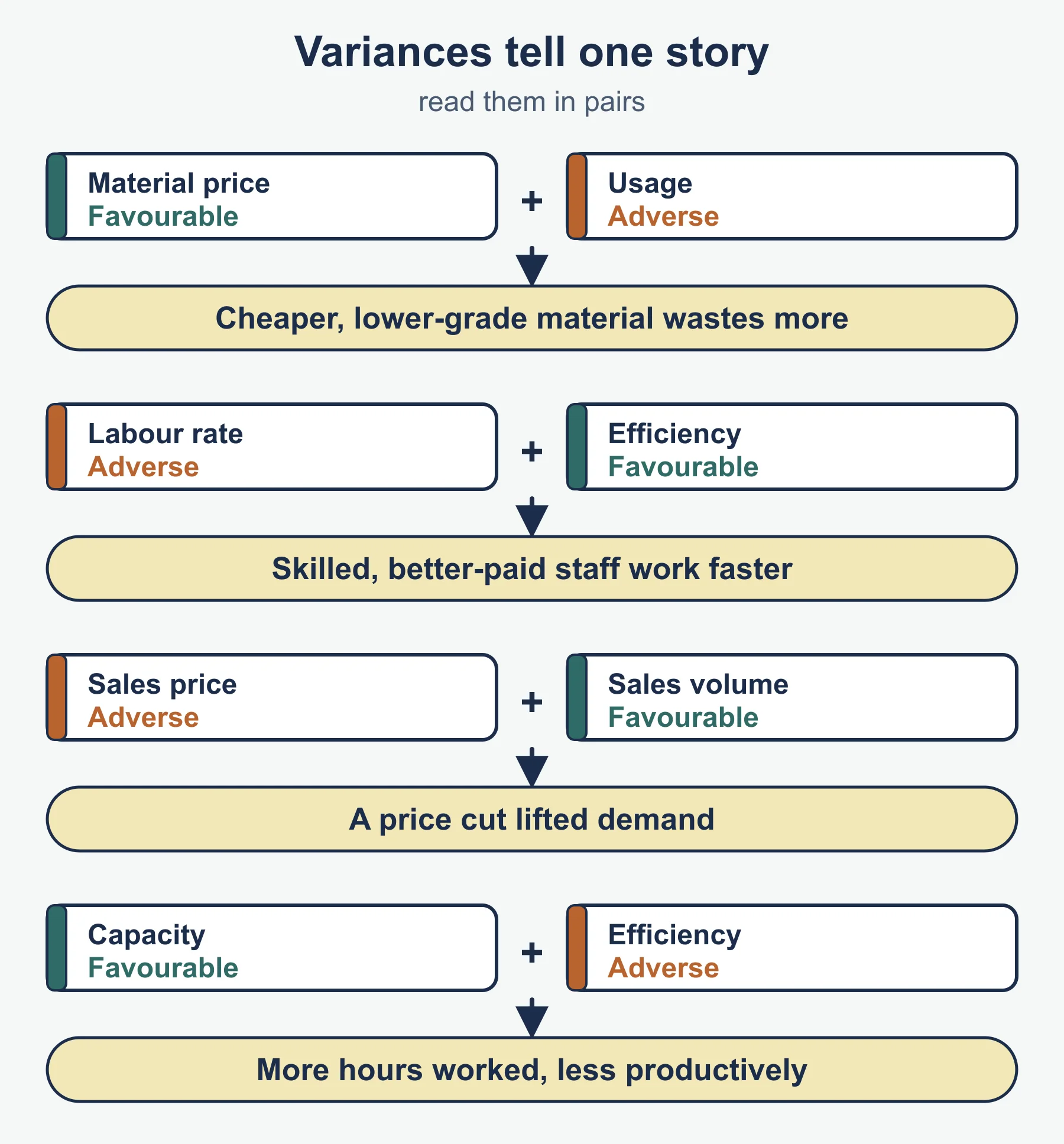
Variances are rarely independent. A cause behind one variance often shows up in another.
| Pattern | Possible explanation |
|---|---|
| Material price F, usage A | Cheaper, lower-grade material that wastes more in production |
| Material price A, usage F | Better material that is dearer but gives less waste |
| Labour rate A, efficiency F | Skilled, better-paid staff who work faster |
| Labour rate F, efficiency A | Trainees or less experienced staff on lower pay |
| Labour rate A | Overtime premiums, a wage award, using agency staff |
| Material usage A with labour efficiency A | Poor material that slows work; faulty machines |
| Capacity A | Machine breakdown, absent staff, lack of orders |
| Capacity F with efficiency A | More hours worked than budgeted, but spent less productively |
| Fixed overhead expenditure A | Higher rent, supervisor pay or insurance than budgeted |
| Sales price A, volume F | A price cut that increased demand |
| Sales price F, volume A | Higher prices that lost some customers |
Selworth’s results fit a story. It paid higher wages, perhaps for faster staff, who produced more per hour than planned (efficiency F). It also worked more hours than budgeted (capacity F). The adverse material variances might point to the cost of that haste.
9. Decisions, recommendations and non-financial factors
A recommendation should use the data, give balanced reasons and reach a justified conclusion. For Selworth, the net variances are 3,730 adverse. The largest adverse items are the sales price (4,300) and labour rate (2,050). One reading is that a small price cut won extra sales worth 3,750 but cost more in price. The sales price and volume variances net to 550 adverse, so the cut did not pay for itself on these figures alone.
Before deciding, consider non-financial factors:
- Quality and reputation. Cheaper material may harm product quality and customer loyalty.
- Staff. Pay pressure, overtime and tight targets affect morale, turnover and safety.
- Suppliers. Changing supplier for price may damage a reliable relationship.
- Customers. A price cut may signal lower quality or set an expectation of discounts.
- Environment and ethics. Waste and energy use may matter beyond cost.
A recommendation for Selworth: investigate material usage first, check whether the 17 rate is now the normal rate and, if so, revise the standard before the next budget.
Common errors
- Reading F and A from the sign of the arithmetic without checking the logic: higher actual cost than standard is adverse, higher actual revenue is favourable.
- Using actual output instead of standard hours for actual output in the efficiency variances.
- Using budgeted units in the sales price variance. Use units actually sold.
- Forgetting that capacity plus efficiency must equal volume.
- Giving a cause without saying which variance it explains, or stating a cause that contradicts the signs.
- Ending with a list of variances and no recommendation.
Frequently asked questions
What is a standard cost card? A standard cost card collects the predetermined values for one unit of output: the standard quantity and price of materials, the standard hours and rate of labour, the fixed overhead absorbed, and the standard selling price and profit.
How do you calculate the labour rate and efficiency variances? Labour rate variance = (standard rate − actual rate) × actual hours. Labour efficiency variance = (standard hours for actual output − actual hours) × standard rate.
What are the fixed overhead variances in Cambridge 9706? The fixed overhead variances are expenditure, volume, capacity and efficiency. Capacity plus efficiency must equal the volume variance.
How is the sales volume variance valued in Cambridge 9706? In this guide the sales volume variance uses the standard profit per unit after fixed overhead has been absorbed: (actual units sold − budgeted units) × standard profit per unit.
Which section of Cambridge 9706 covers standard costing? Standard costing is section 4.2, A Level content within the cost and management accounting topic of Cambridge International AS and A Level Accounting 9706.
Official syllabus
Cambridge International AS & A Level Accounting 9706 syllabus for examination in 2026, 2027 and 2028, published by Cambridge University Press & Assessment (Cambridge International Education), section 4.2 Standard costing.
Get free revision emails (optional)
Occasional emails with practice questions, worked explanations and links to free resources for the qualification and subjects you choose. No spam, and you can unsubscribe from any email. The free tools on this site never need an email.
Related resources
-
Study guides
A Level Accounting: Accounting for Non-Current Assets (Cambridge 9706)
Capital versus revenue spending, why assets depreciate depreciation methods, cost and revaluation models and disposals, for Cambridge 9706 Accounting topic 1.3.
Accounting · Cambridge · AS Level
Read guide -
Practice questions
A Level Accounting: Standard costing (Cambridge 9706) – Practice Questions
Eleven original questions with full worked answers on standard costing, variances, causes and recommendations, for Cambridge A Level Accounting 9706.
Accounting · Cambridge · A Level
Try questions -
Revision notes
A Level Accounting: Standard costing (Cambridge 9706) – Revision Notes
Condensed revision notes on standard costing for Cambridge A Level Accounting 9706: every variance formula, causes, pitfalls and a quick self-test.
Accounting · Cambridge · A Level
Revise topic
Related articles
-
teaching
A Level tuition in Dubai: Cambridge or Pearson Edexcel International A Level?
Schools in Dubai and Abu Dhabi teach either Cambridge International AS & A Level or Pearson Edexcel International A Level. How the two are structured, why it matters for tuition, and how online classes from Lahore work.
9 October 2026
-
curriculum guides
Choosing subjects at IGCSE and A Level
How subject choices at 14 and 16 affect university options later, and how to keep pathways open without overloading a timetable.
28 July 2026
Studying this with a teacher
Working through Accounting A LEVEL?
This page is free and stays free. If you would rather be taught it, Marlbridge runs Accounting classes one-to-one and in small groups of up to 15, online in your own time zone. The first trial class is free. WhatsApp replies within an hour (8am–11pm Pakistan time, every day); email the same day.
Cambridge Accounting teachers at Marlbridge

