
Revision Notes
A Level Accounting: Standard costing (Cambridge 9706) – Revision Notes
Condensed revision notes on standard costing for Cambridge A Level Accounting 9706: every variance formula, causes, pitfalls and a quick self-test.
- Subject
- Accounting
- Level
- A LEVEL
- Topic
- Cost and management accounting
- Author
- Marlbridge Academic Team
- Updated
- Reviewed by
- Zain Ud Din Ahmed (what this means)
Aligned to Cambridge A Level Accounting (9706), 2026-2028. Official specification .
Syllabus page (what it covers and how it is assessed): Cambridge A Level Accounting.
Syllabus points this page covers
9706 (A Level)
- 4.2 Standard costing
Found an error? Report a correction.
Need help with this topic? Request a free trial class for A Level Accounting (9706).
These notes condense section 4.2 Standard costing (A Level content) of the Cambridge International AS & A Level Accounting 9706 syllabus for 2026, 2027 and 2028. For full explanations and a complete worked example, read the study guide, then test yourself with the practice questions. See also the course hub, the printable checklist and the free diagnostics. All businesses and figures are invented and amounts are in dollars.
Definitions to know
- Standard costing system: a system in which predetermined (planned) costs and revenues per unit are set, actual results are compared with them, and the differences (variances) are analysed to assess performance.
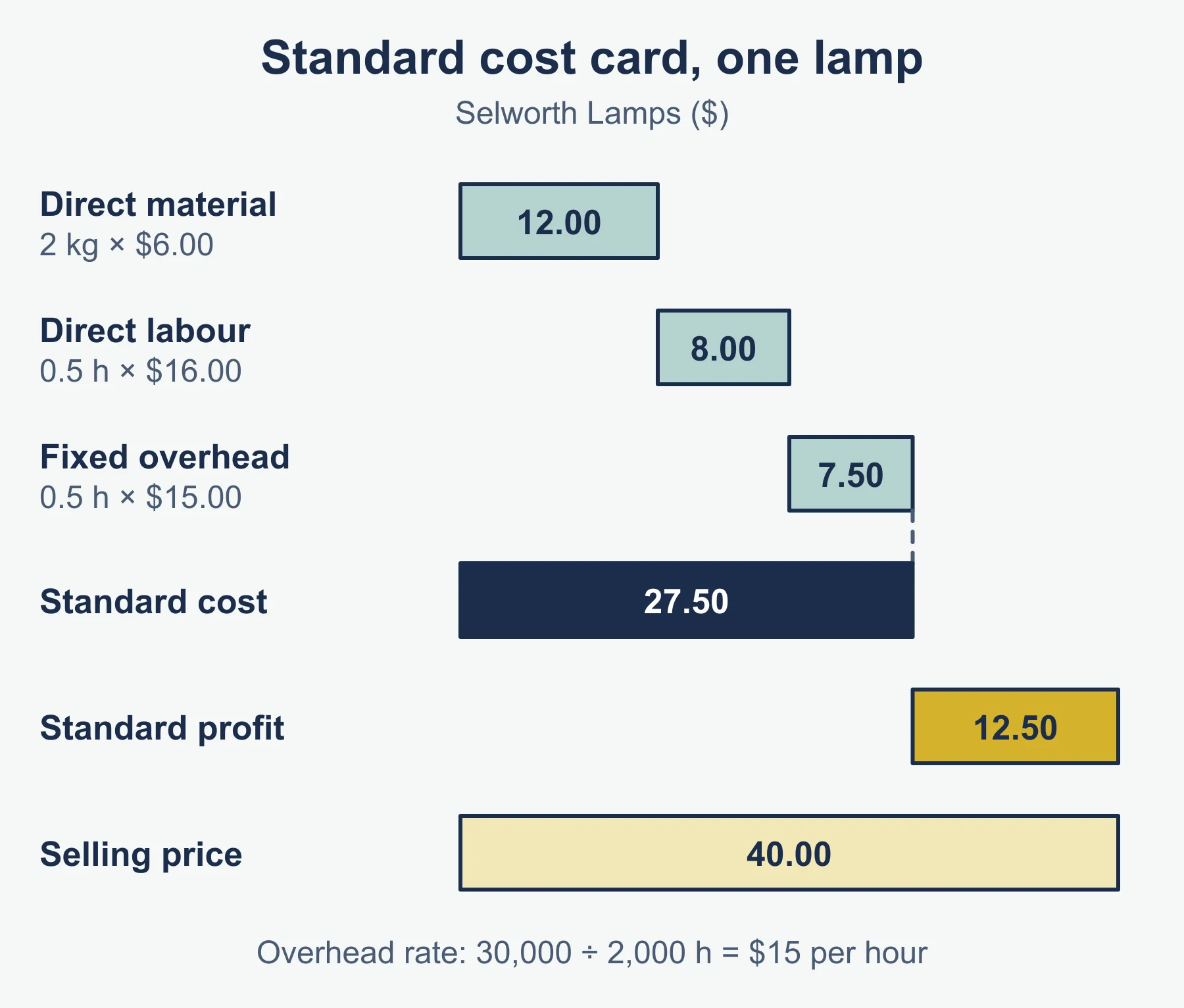
- Standard cost card: lists the standard quantity and price of each cost per unit, the standard cost, the standard selling price and the standard profit.
- Favourable (F): the variance raises profit above the standard result.
- Adverse (A): the variance lowers profit below the standard result.
- Standard hours for actual output: actual units produced multiplied by the standard hours for one unit. It is not the same as hours actually worked.
Formula table
| Variance | Formula |
|---|---|
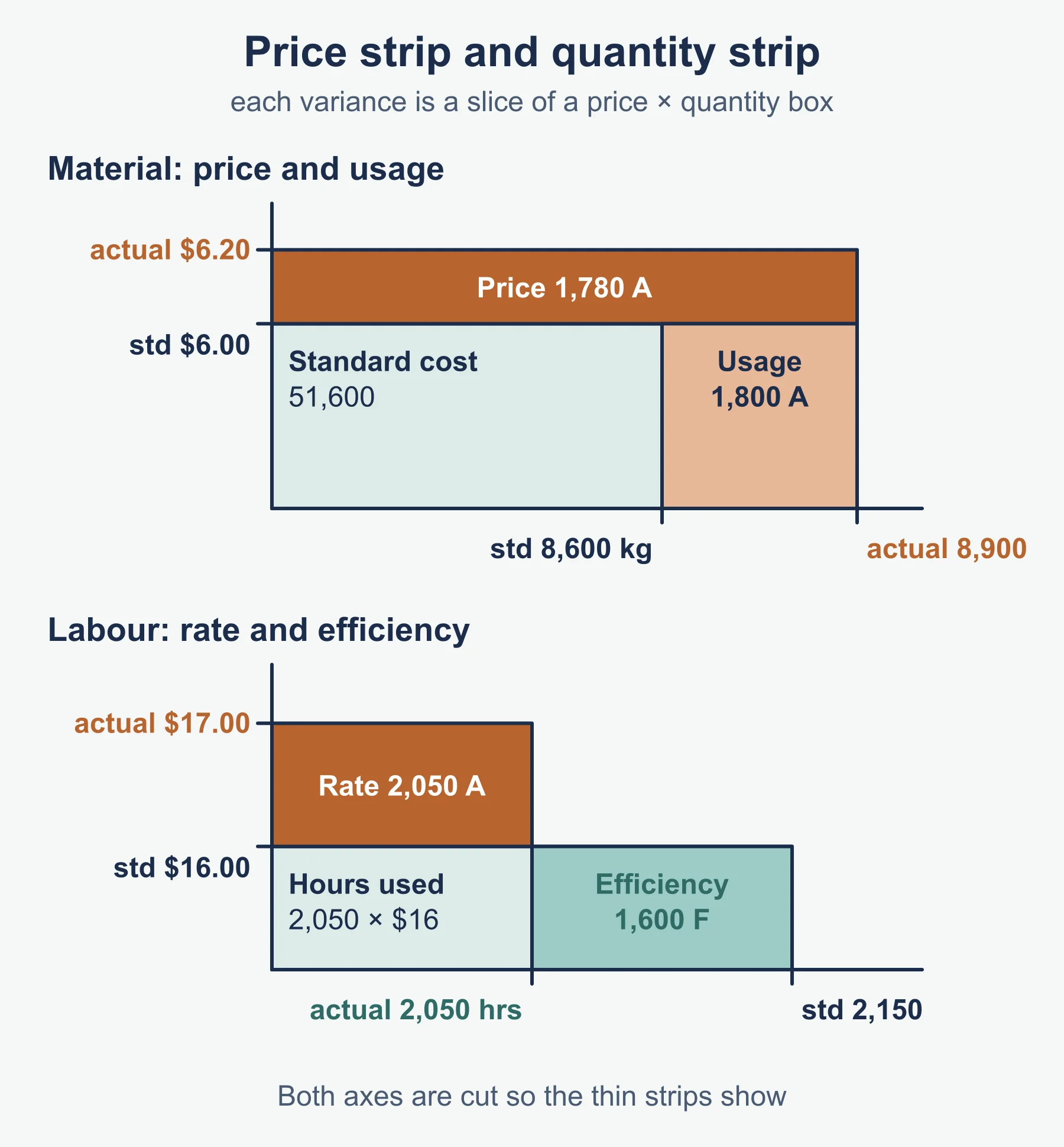
| Direct material price | (standard price - actual price) x actual quantity bought |
| Direct material usage | (standard quantity for actual output - actual quantity used) x standard price |
| Direct labour rate | (standard rate - actual rate) x actual hours worked |
| Direct labour efficiency | (standard hours for actual output - actual hours worked) x standard rate |
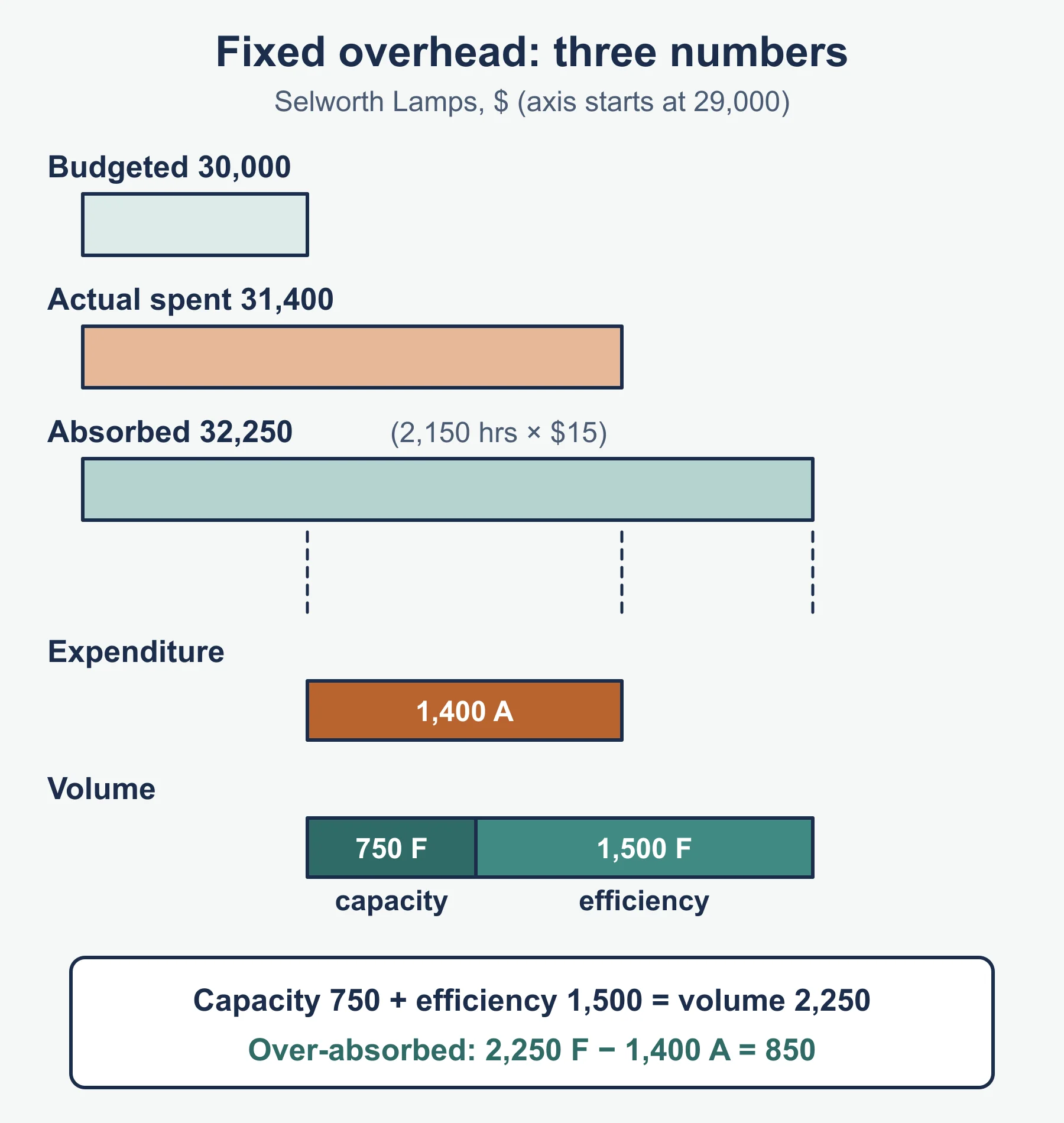
| Fixed overhead expenditure | budgeted fixed overhead - actual fixed overhead |
| Fixed overhead volume | (actual output - budgeted output) x standard fixed overhead per unit |
| Capacity sub-variance | (actual hours worked - budgeted hours) x fixed overhead rate per hour |
| Efficiency sub-variance | (standard hours for actual output - actual hours worked) x fixed overhead rate per hour |
| Sales price | (actual price - standard price) x actual units sold |
| Sales volume | (actual units sold - budgeted units) x standard profit per unit |
Links to remember:
- Capacity + efficiency = fixed overhead volume.
- Expenditure + volume = total fixed overhead variance (overhead absorbed less actual overhead).
- Material price + usage = total material cost variance. Labour rate + efficiency = total labour cost variance.
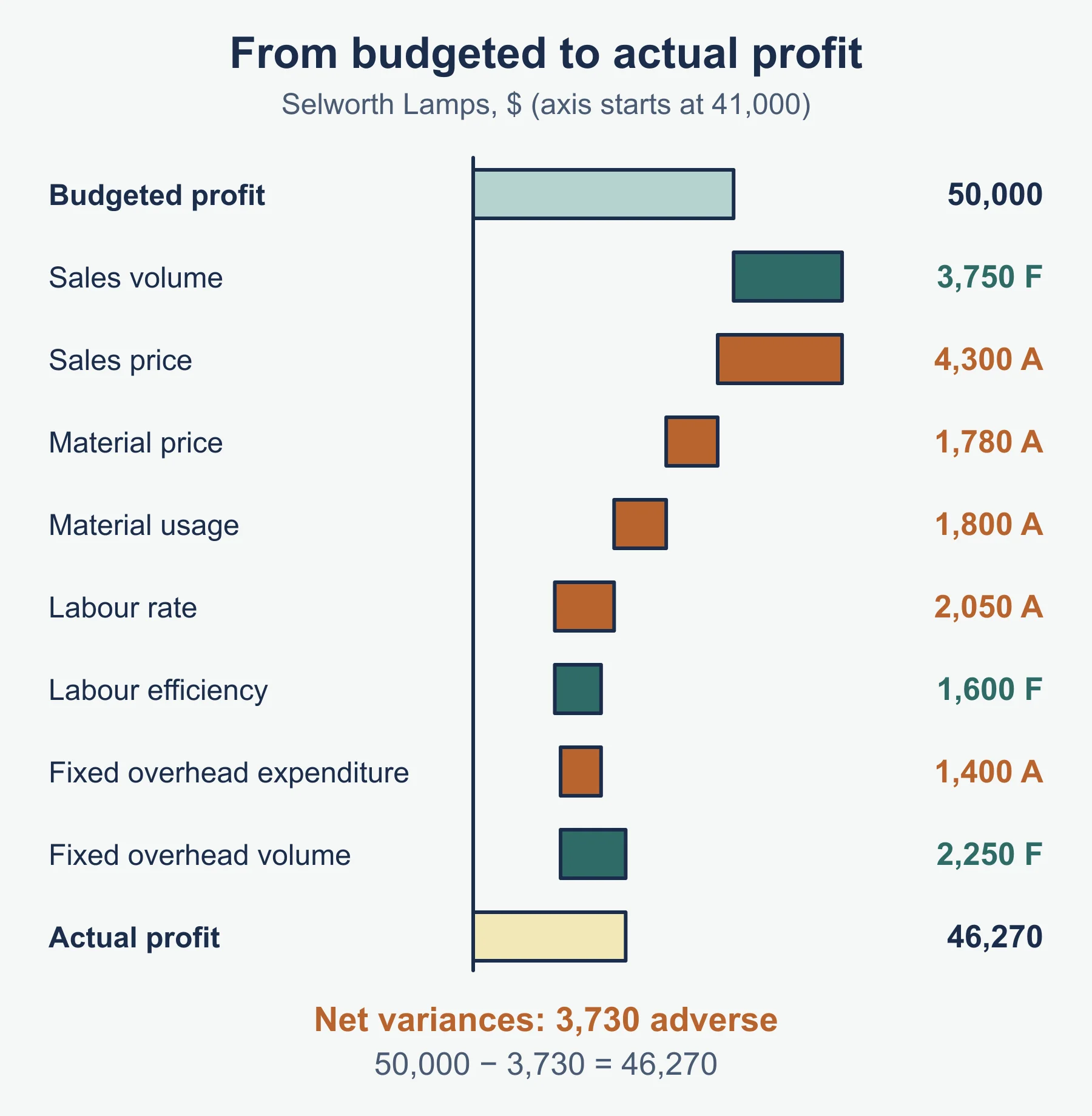
- Budgeted profit, plus favourable and minus adverse variances, gives actual profit.
Method in steps
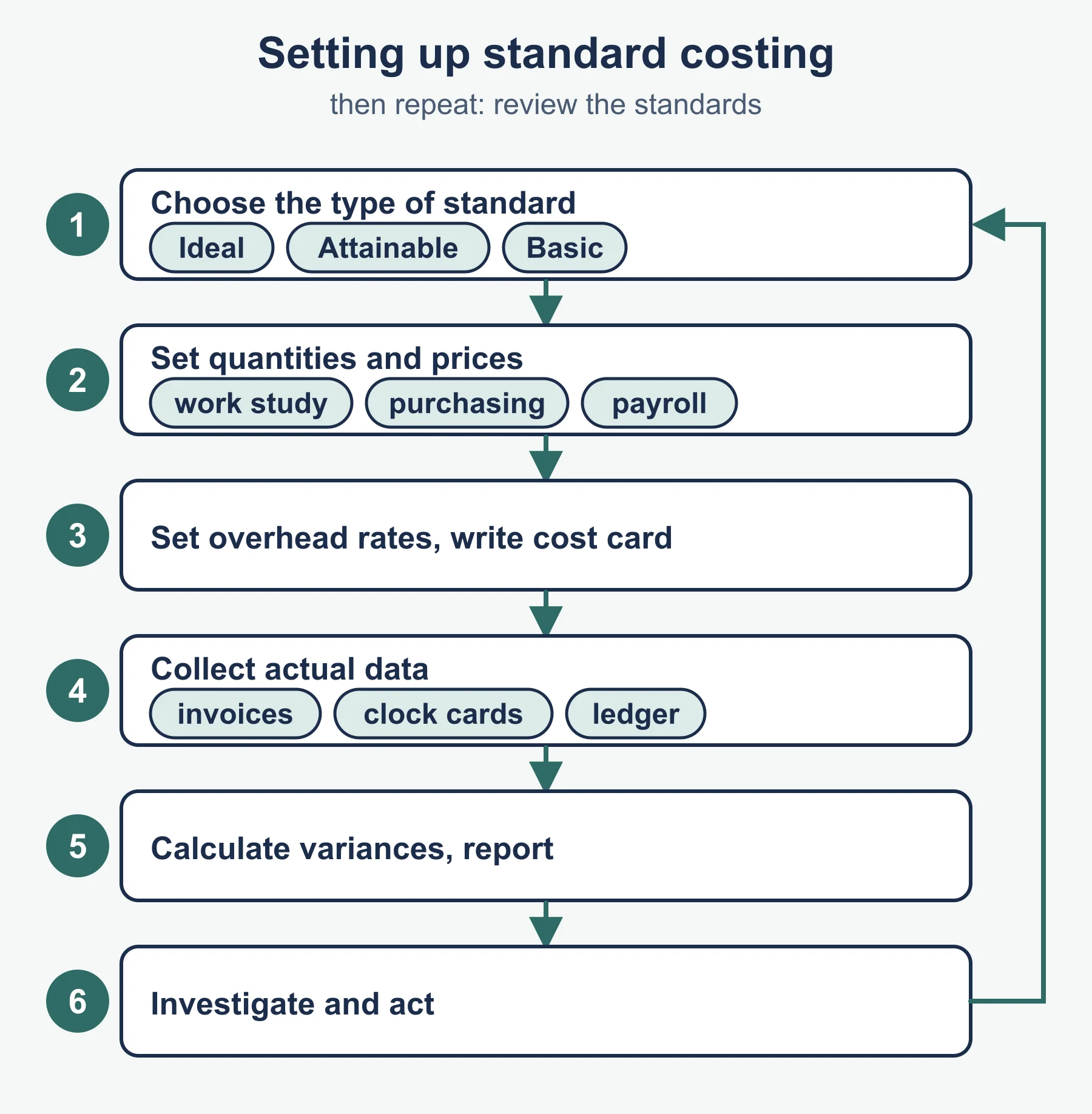
- Write the standard card: quantity, price and cost per unit for each item.
- Find the standard quantity or hours for the actual output (actual units x per-unit standard).
- For each variance, write the formula with the figures in it, then the answer.
- Label F or A. Ask: did this make profit higher or lower than planned?
- Check totals: standard cost of actual output less actual cost should equal the sum of the cost variances.
- If asked for a comment or a recommendation, link each large variance to a cause and an action.
Worked reminder: fixed overhead
Pellington Preserves budgeted 5,000 jars, at 0.2 labour hours each, so 1,000 hours, with fixed overhead of 12,000. The rate is 12,000 / 1,000 = 12.00 per hour, or 2.40 per jar. Actual results: 4,600 jars, 950 hours worked, fixed overhead of 12,500. Standard hours for actual output are 4,600 x 0.2 = 920.
Expenditure = 12,000 - 12,500            = 500 A
Volume      = (4,600 - 5,000) x 2.40     = 960 A
Capacity    = (950 - 1,000) x 12.00      = 600 A
Efficiency  = (920 - 950) x 12.00        = 360 A
Check: 600 + 360 = 960
The business worked 50 fewer hours than budgeted and, in the hours it did work, made fewer jars than the standard allowed.
Must-know distinctions
| Pair | Difference |
|---|---|
| Material price and usage | Price is what was paid for the quantity bought. Usage is how much was used for the output made. |
| Labour rate and efficiency | Rate is pay per hour. Efficiency is hours taken against hours allowed. |
| Expenditure and volume | Expenditure is about money spent. Volume is about output compared with budget. |
| Capacity and efficiency | Capacity compares hours worked with budgeted hours. Efficiency compares hours allowed for the output with hours worked. |
| Sales price and sales volume | Price is the selling price per unit. Volume is the number sold, valued at standard profit per unit. |
Causes and how variances connect
| Variance pair | Possible explanation |
|---|---|
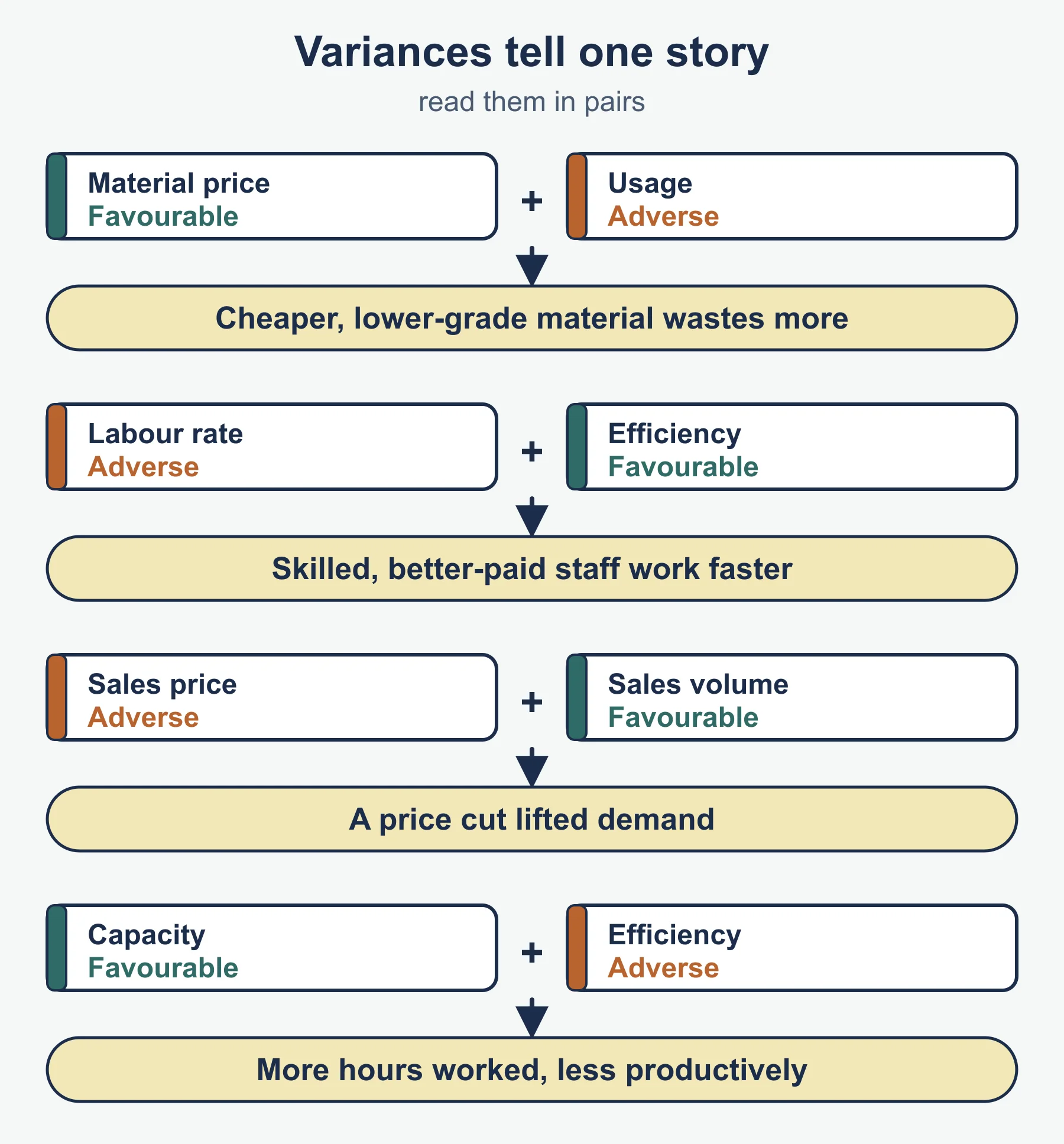
| Material price F, usage A | Cheaper material wasted more |
| Material price A, usage F | Dearer material wasted less |
| Labour rate A, efficiency F | Skilled staff, paid more, work faster |
| Labour rate F, efficiency A | Trainees, paid less, work slower |
| Capacity A | Breakdowns, absence, shortage of orders |
| Capacity F, efficiency A | More hours, but poorly used |
| Expenditure A | Higher rent, supervision or insurance than budgeted |
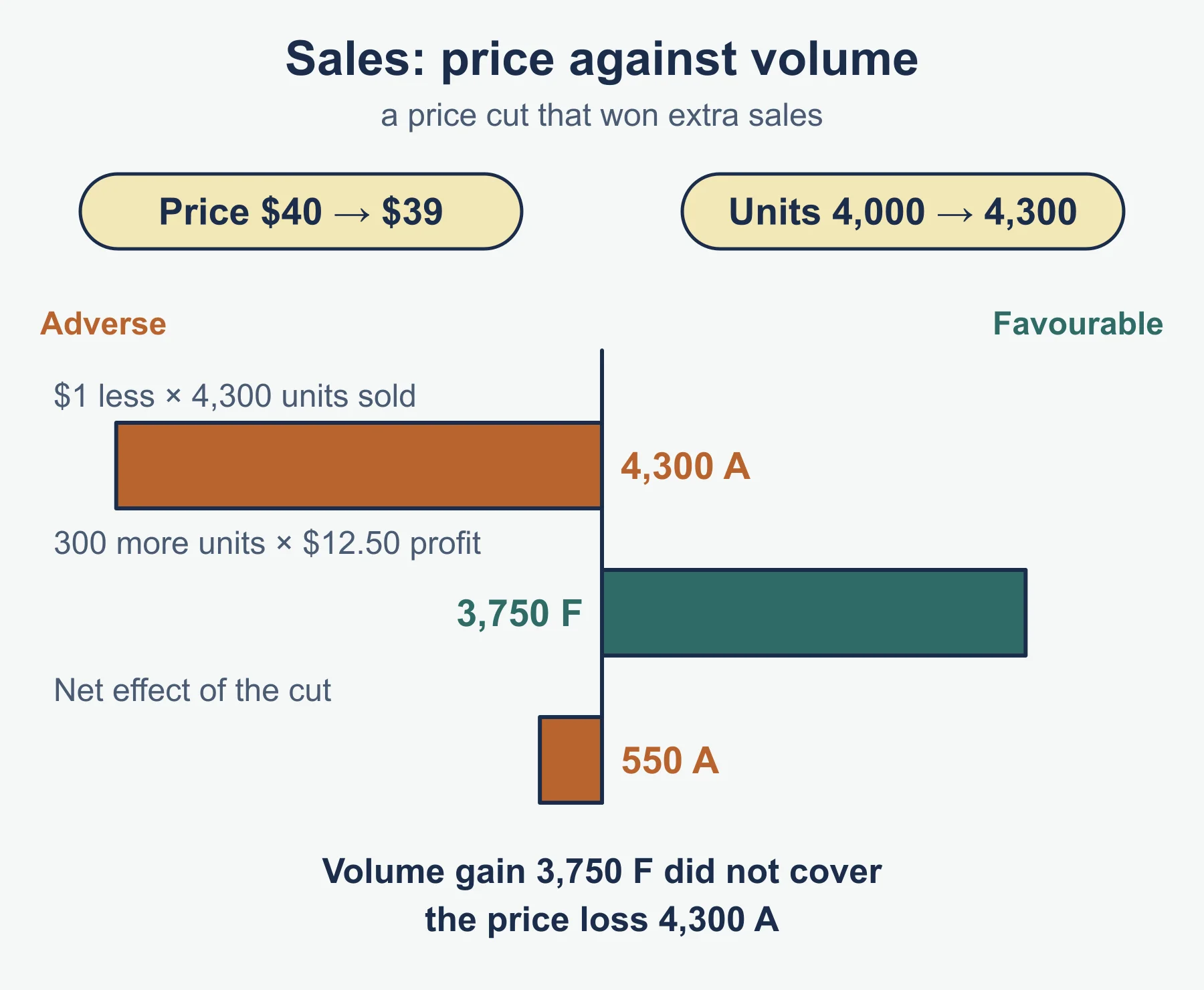
| Sales price A, volume F | Price cut raised demand |
| Sales price F, volume A | Price rise lost customers |
Also useful: an adverse material usage variance and an adverse labour efficiency variance may share a cause such as poor materials or faulty machines. A favourable volume variance does not mean overheads were controlled. It may only mean more output than budgeted.
Advantages and disadvantages
| Advantages | Disadvantages |
|---|---|
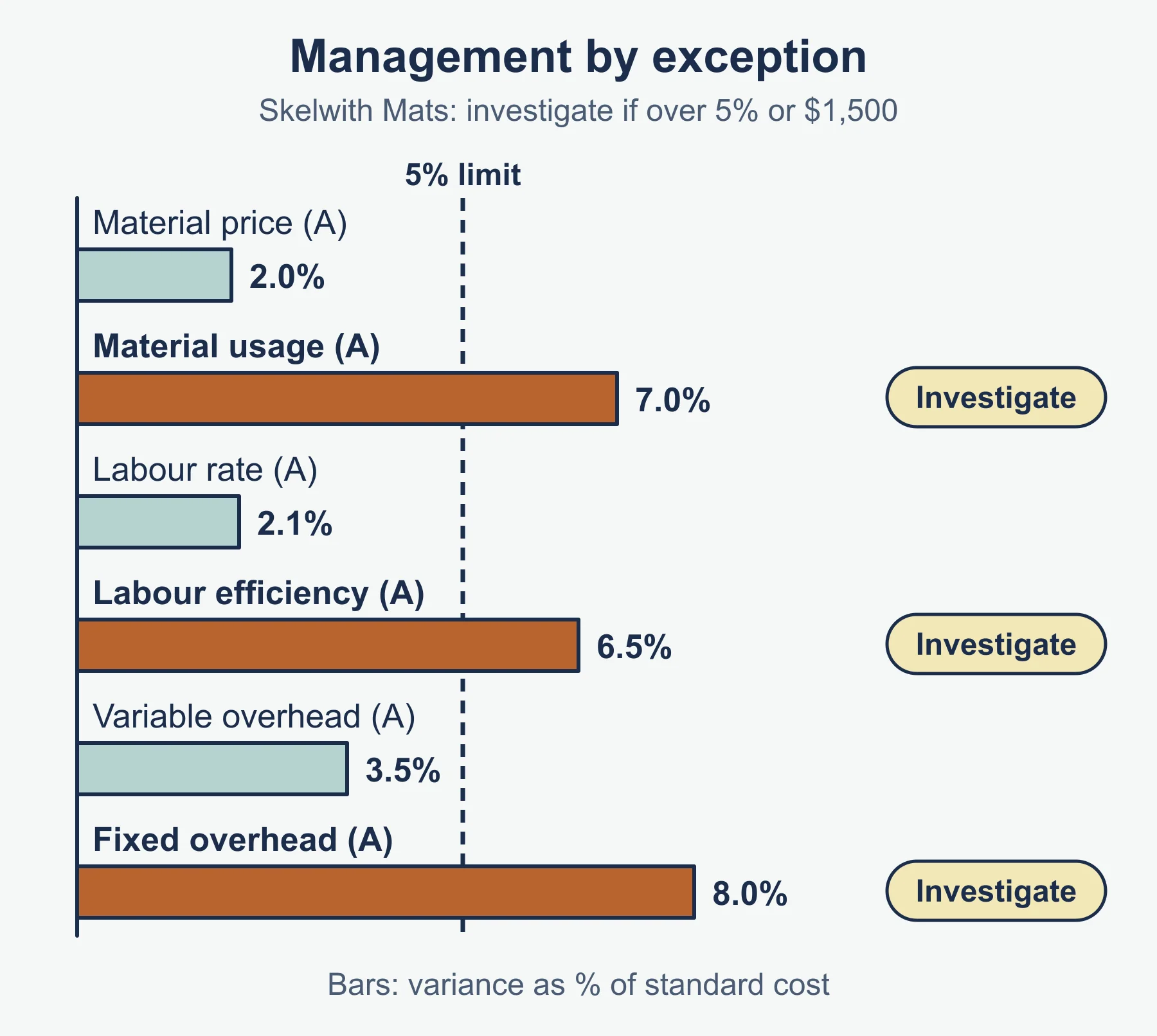
| Management by exception: focus on the large variances | Standards are costly to set and update |
| Variances can be assigned to managers | Out-of-date standards give misleading variances |
| Targets can motivate | Pressure may harm quality or safety |
| Feeds back into better budgets | Needs a stable production process |
| Simplifies inventory valuation | Variances are known only after the event |
Improving performance: investigate the significant variances, find the cause, act, and revise the standard if the change is permanent.
Non-financial factors
Quality and brand reputation; staff morale, training and turnover; supplier reliability and relationships; customer service and loyalty; safety; environmental impact. Always weigh these against the financial figures before recommending a change.
Quick self-test
Compute the answers from the information given, then check below.
- Define a standard cost.
- Standard: 3 metres of fabric at 4.00 per metre per unit. For 500 units, 1,540 metres were used and cost 6,468. Calculate the material price and usage variances.
- Standard: 2 hours at 9.00 per hour per unit. For 300 units, 590 hours were worked and 5,605 was paid. Calculate the labour rate and efficiency variances.
- Budgeted fixed overhead is 18,000 for 3,000 budgeted hours. Calculate the rate per hour.
- Using that rate, 3,100 hours were worked. Calculate the capacity variance.
- A product has a standard price of 12.00. A business sold 2,000 units at 12.60. Calculate the sales price variance.
- Budgeted sales were 1,800 units and actual sales 2,000 units. Standard profit is 4.50 per unit. Calculate the sales volume variance.
- Which manager would normally answer for a material price variance?
- Give one possible reason for a favourable labour rate variance with an adverse efficiency variance.
- Give one disadvantage of standard costing for a business that changes its products often.
- Capacity variance is 400 F and efficiency variance is 250 A. What is the volume variance?
- Actual output is 120 units; the standard is 3 kg per unit at 5.00 per kg. 380 kg were used. Calculate the usage variance.
Answers
- A predetermined cost per unit of output, based on planned quantities and prices, used as a basis for comparison with actual cost.
- Standard quantity 500 x 3 = 1,500 m. Price = 1,540 x 4.00 - 6,468 = 308 A. Usage = (1,500 - 1,540) x 4.00 = 160 A.
- Standard hours 300 x 2 = 600. Rate = 590 x 9.00 - 5,605 = 295 A. Efficiency = (600 - 590) x 9.00 = 90 F.
- 18,000 / 3,000 = 6.00 per hour.
- (3,100 - 3,000) x 6.00 = 600 F.
- (12.60 - 12.00) x 2,000 = 1,200 F.
- (2,000 - 1,800) x 4.50 = 900 F.
- The purchasing manager.
- Less experienced or trainee staff on lower pay who take longer, or a lower-paid workforce with poorer skills.
- Standards must be reset often, which takes time and cost, and early variances may be misleading.
- 400 - 250 = 150 F.
- Standard quantity 120 x 3 = 360 kg. Usage = (360 - 380) x 5.00 = 100 A.
Where marks are usually lost
- Using the wrong quantity: actual hours or actual quantity in place of standard for actual output, or the reverse.
- Mixing up price and quantity in the formula, so the sign is the wrong way round.
- Writing a number without F or A. The label is part of the answer.
- Using budgeted units in the sales price variance instead of units actually sold.
- Calculating sales volume at the standard selling price when the question uses the standard profit per unit.
- Giving a cause that does not match the direction of the variance.
- Stating a favourable variance is good without asking why it arose and whether it can be repeated.
- Stopping at calculations when a question asks for a recommendation. Give a balanced reason, mention non-financial factors and state a justified decision.
- Leaving out units or currency in the answer line.
Frequently asked questions
Is a favourable variance always good? No. Ask why it arose and whether it can be repeated; for example, a favourable material price variance from cheaper material may cause an adverse usage variance elsewhere.
Which units are used in the sales price variance? Use the units actually sold, not the budgeted units: sales price variance = (actual price − standard price) × actual units sold.
What are the advantages of standard costing? Variances show where results depart from the plan so managers can focus on exceptions, each variance can be tied to a responsible manager, standards give staff a clear target, and inventory can be valued quickly at standard.
What should a standard costing recommendation include? Give a balanced reason using the data, mention non-financial factors such as quality, staff and suppliers, and state a justified decision. Stopping at the calculations loses marks.
Official syllabus
Cambridge International AS & A Level Accounting 9706 syllabus for examination in 2026, 2027 and 2028, published by Cambridge University Press & Assessment (Cambridge International Education), section 4.2 Standard costing.
Get free revision emails (optional)
Occasional emails with practice questions, worked explanations and links to free resources for the qualification and subjects you choose. No spam, and you can unsubscribe from any email. The free tools on this site never need an email.
Related resources
-
Study guides
A Level Accounting: Accounting for Non-Current Assets (Cambridge 9706)
Capital versus revenue spending, why assets depreciate depreciation methods, cost and revaluation models and disposals, for Cambridge 9706 Accounting topic 1.3.
Accounting · Cambridge · AS Level
Read guide -
Study guides
A Level Accounting: Activity based costing (Cambridge 9706)
Cost drivers, cost pools, ABC unit costs and selling prices, uses and limitations, and ABC versus traditional absorption, for Cambridge 9706.
Accounting · Cambridge · A Level
Read guide -
Practice questions
A Level Accounting: Activity based costing (Cambridge 9706) – Practice Questions
Ten original ABC questions with worked answers for Cambridge A Level Accounting 9706: cost driver rates, unit costs, prices, inventory and recommendations.
Accounting · Cambridge · A Level
Try questions
Related articles
-
teaching
A Level tuition in Dubai: Cambridge or Pearson Edexcel International A Level?
Schools in Dubai and Abu Dhabi teach either Cambridge International AS & A Level or Pearson Edexcel International A Level. How the two are structured, why it matters for tuition, and how online classes from Lahore work.
9 October 2026
-
curriculum guides
Choosing subjects at IGCSE and A Level
How subject choices at 14 and 16 affect university options later, and how to keep pathways open without overloading a timetable.
28 July 2026
Studying this with a teacher
Working through Accounting A LEVEL?
This page is free and stays free. If you would rather be taught it, Marlbridge runs Accounting classes one-to-one and in small groups of up to 15, online in your own time zone. The first trial class is free. WhatsApp replies within an hour (8am–11pm Pakistan time, every day); email the same day.
Cambridge Accounting teachers at Marlbridge

