
Study Guides
A Level Accounting: Budgeting and budgetary control (Cambridge 9706)
Study guide to budgets, the master budget, flexible budgets, reconciliations and behavioural issues, for Cambridge A Level Accounting 9706 section 4.3.
- Subject
- Accounting
- Level
- A LEVEL
- Topic
- Cost and management accounting
- Author
- Marlbridge Academic Team
- Updated
- Reviewed by
- Zain Ud Din Ahmed (what this means)
Aligned to Cambridge A Level Accounting (9706), 2026-2028. Official specification .
Syllabus page (what it covers and how it is assessed): Cambridge A Level Accounting.
Syllabus points this page covers
9706 (A Level)
- 4.3 Budgeting and budgetary control
Found an error? Report a correction.
Need help with this topic? Request a free trial class for A Level Accounting (9706).
This guide follows the Cambridge International AS & A Level Accounting 9706 syllabus for 2026, 2027 and 2028, section 4.3 Budgeting and budgetary control (A Level content, within topic 4 Cost and management accounting). The syllabus says Paper 4 questions are based on section 4 of the subject content and that AS Level content is assumed knowledge. All businesses and figures are invented and amounts are in dollars. See the course hub, the printable checklist, the revision notes, the practice questions, the exam preparation guide and the free diagnostics.
What 4.3.1 asks you to do
| Outcome | Where covered |
|---|---|
| Advantages and disadvantages of budgetary control; of spreadsheets | Sections 1 and 2 |
| Master budget; the nine budgets; limiting factors | Sections 3 and 4 |
| Flexible versus fixed budgeting; flexible budget statement | Section 5 |
| Causes of differences; two reconciliation statements | Sections 6 and 7 |
| Decisions, behavioural aspects, non-financial factors | Sections 8 and 9 |
1. Budgetary control
A budget is a plan, stated in money terms, for a coming period. Budgetary control compares actual results with the budget, investigates differences and takes action. The syllabus asks for advantages and disadvantages to the organisation.
Advantages: it forces planning ahead; it co-ordinates departments (production cannot plan without the sales budget); it communicates targets; it sets a benchmark so managers can concentrate on large differences; it supports decisions about resources; it can motivate staff.
Disadvantages: preparing and revising budgets takes time and money; forecasts can be wrong, so budgets can mislead; a fixed plan can be rigid when conditions change; managers may add slack or spend unused budgets; targets seen as unfair can demotivate; a focus on money may hide quality, customer and staff issues.
2. Spreadsheets
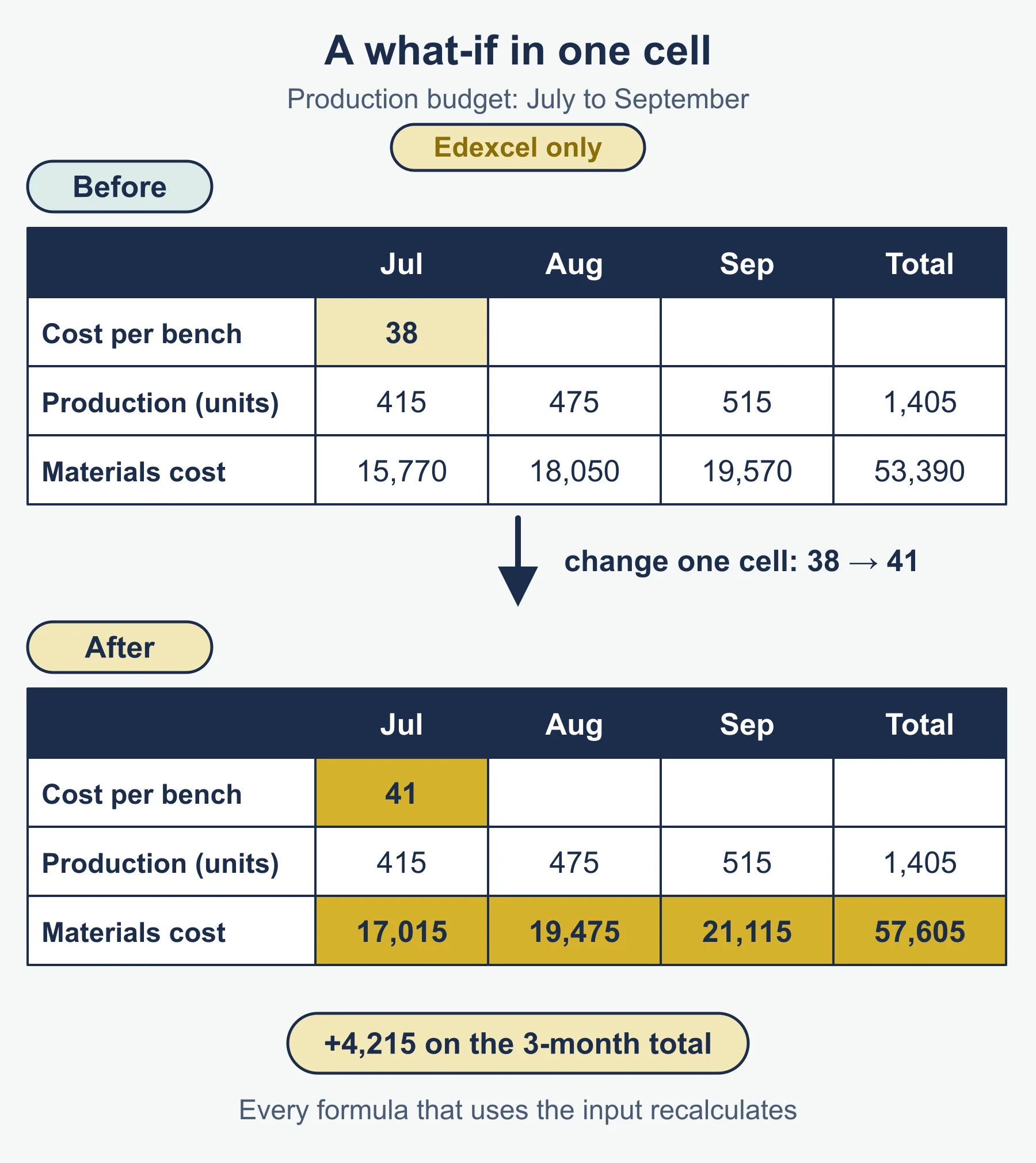
Advantages: formulas recalculate every linked budget instantly when an assumption changes, so what-if questions are quick; arithmetic is more accurate; templates can be reused each period; charts and summaries are easy to produce.
Disadvantages: a wrong formula or hard-coded number can pass unnoticed and spread through linked sheets; weak version control and access control; files can be lost or altered without a record; staff need skills; a polished layout can hide poor assumptions.
3. The master budget
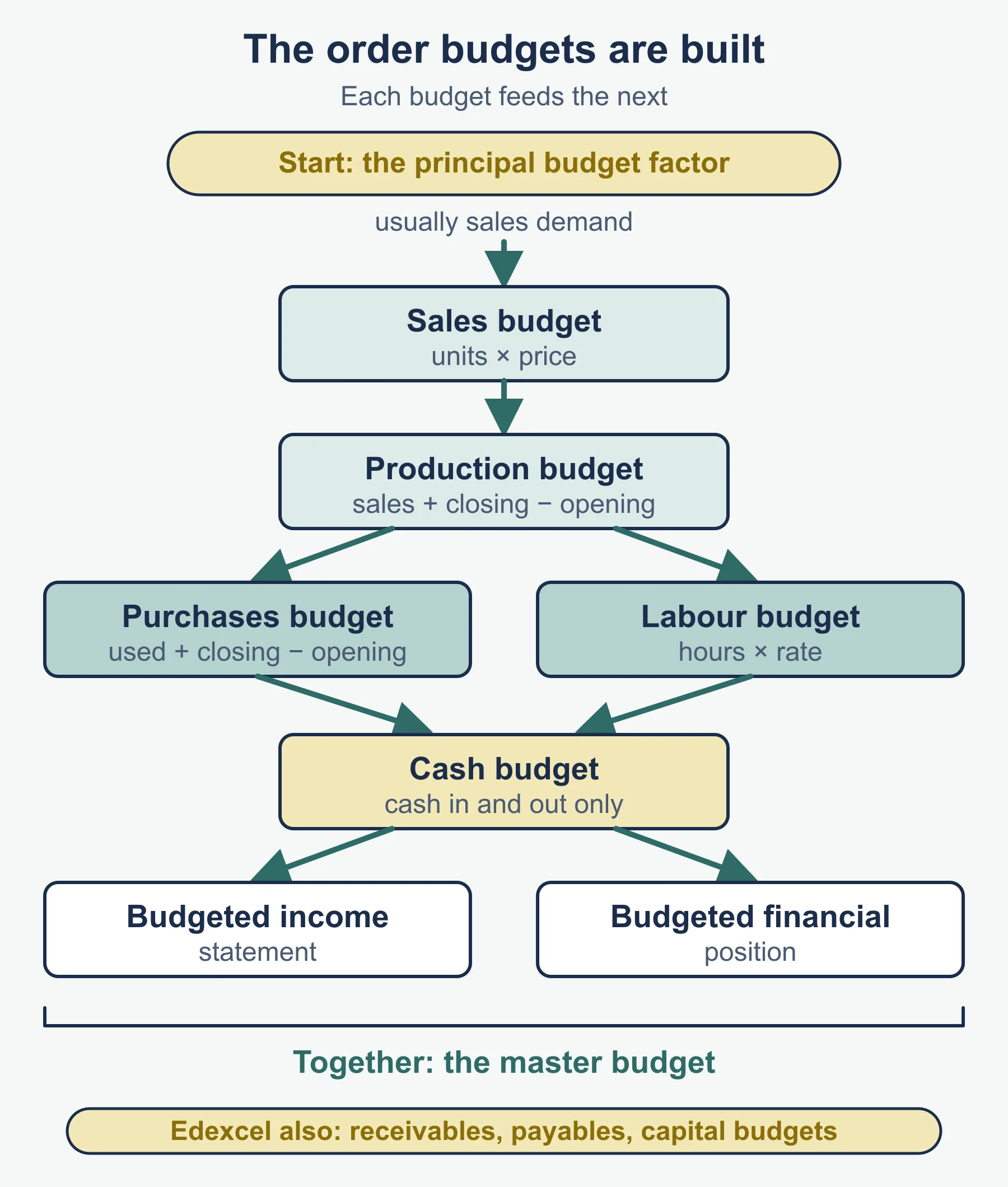
The master budget brings the functional budgets together into a summary: usually the budgeted statement of profit or loss, the budgeted statement of financial position and the cash budget. Management and owners can then see whether the plan achieves the organisation’s objectives.
4. Limiting factors and preparing the budgets
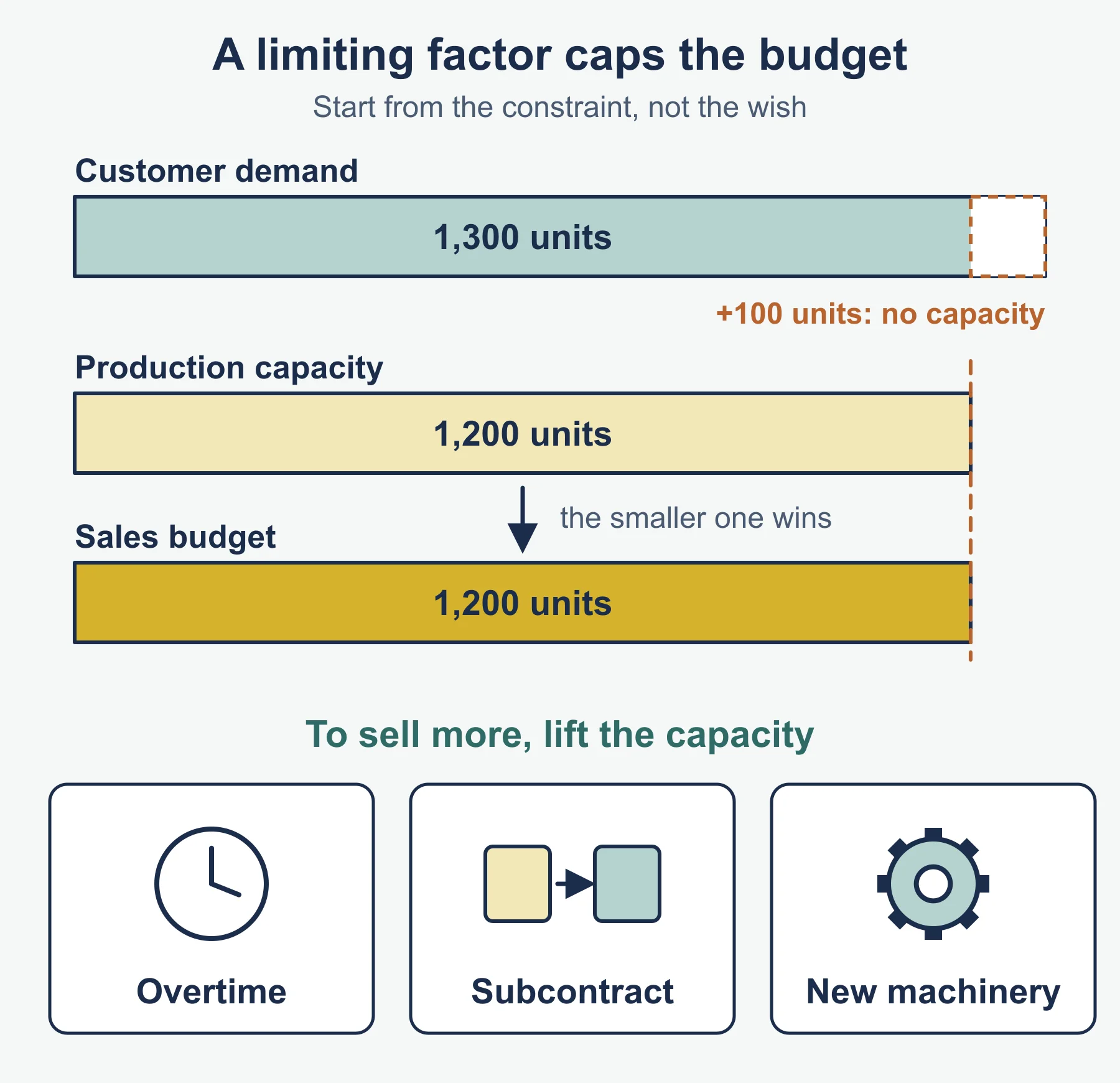
A limiting factor (principal budget factor) is the resource or condition that restricts activity, such as customer demand, skilled labour, material supply, machine capacity or cash. Identify it first and build the other budgets around it. If demand is 1,300 units but capacity is 1,200, the sales budget is capped at 1,200 unless capacity is increased, for example by overtime, subcontracting or new machinery. The budget starts from the constraint, not from the wish.
Normal order: sales, production, purchases and labour, receivables and payables, cash, then the statement of profit or loss, then the statement of financial position.
Worked example: Ormesby Planters, April to June
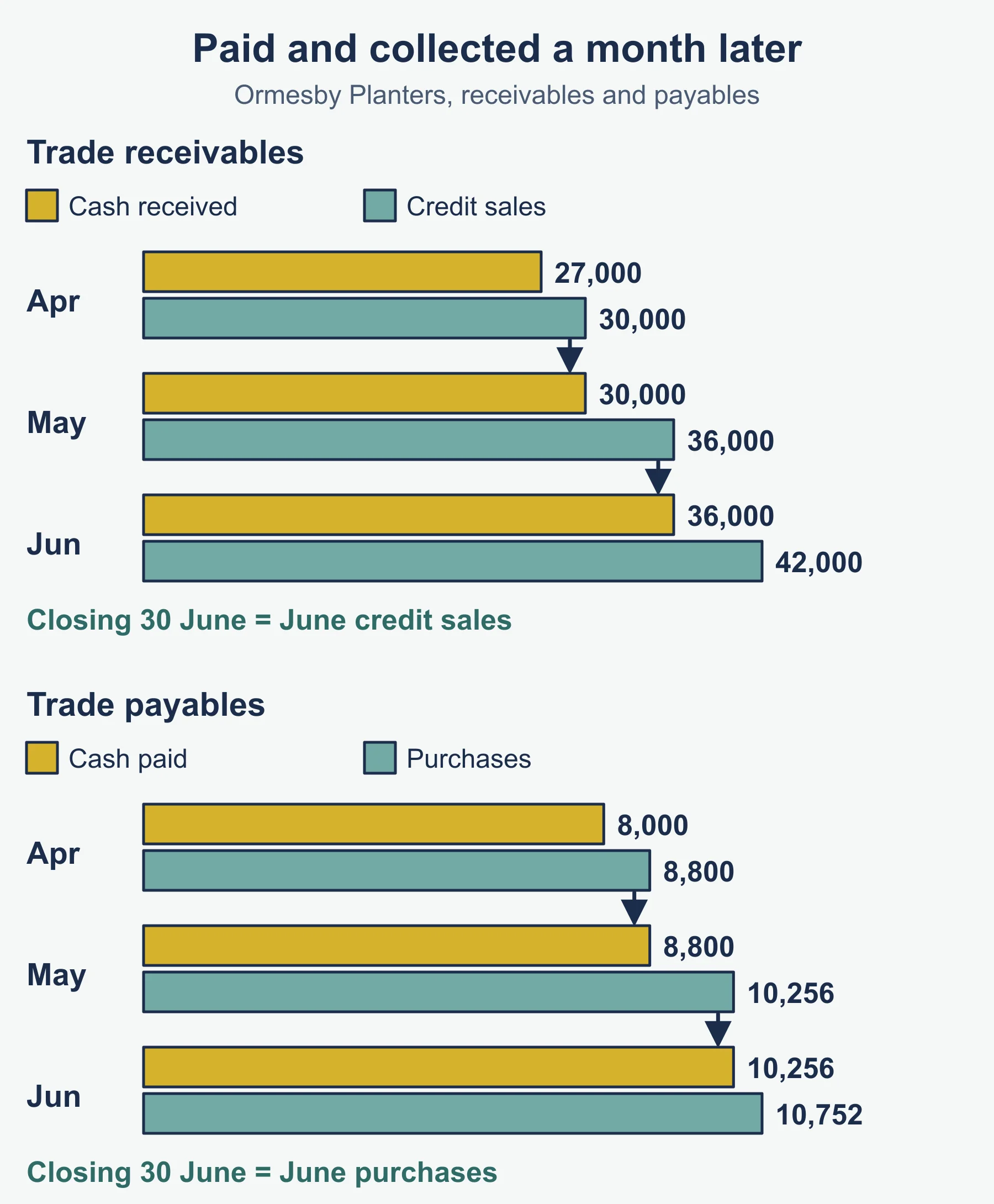
- Sales units: March 900, April 1,000, May 1,200, June 1,400, July 1,300. Selling price 40 per planter. Of sales, 25% are for cash and 75% on credit; credit customers pay in the following month.
- Closing finished goods are 20% of next month’s sales; 200 units on 1 April.
- Each planter uses 2 kg of material at 4 per kg, 0.75 labour hours at 12 per hour and 3 of variable production overhead per planter, so production cost is 20 per unit.
- Closing materials are 30% of next month’s usage; 624 kg on 1 April; July production is 1,260 units.
- Suppliers are paid in the month after purchase; March purchases were 8,000.
- Wages, variable overhead and selling expenses (5% of revenue) are paid in the month. Fixed overheads are 9,000 a month including depreciation of 800. Equipment costing 14,000 is paid for in April. Opening cash is 1,000. Ignore tax and dividends.
Sales budget
| Apr | May | Jun | Total | |
|---|---|---|---|---|
| Units | 1,000 | 1,200 | 1,400 | 3,600 |
| Revenue | 40,000 | 48,000 | 56,000 | 144,000 |
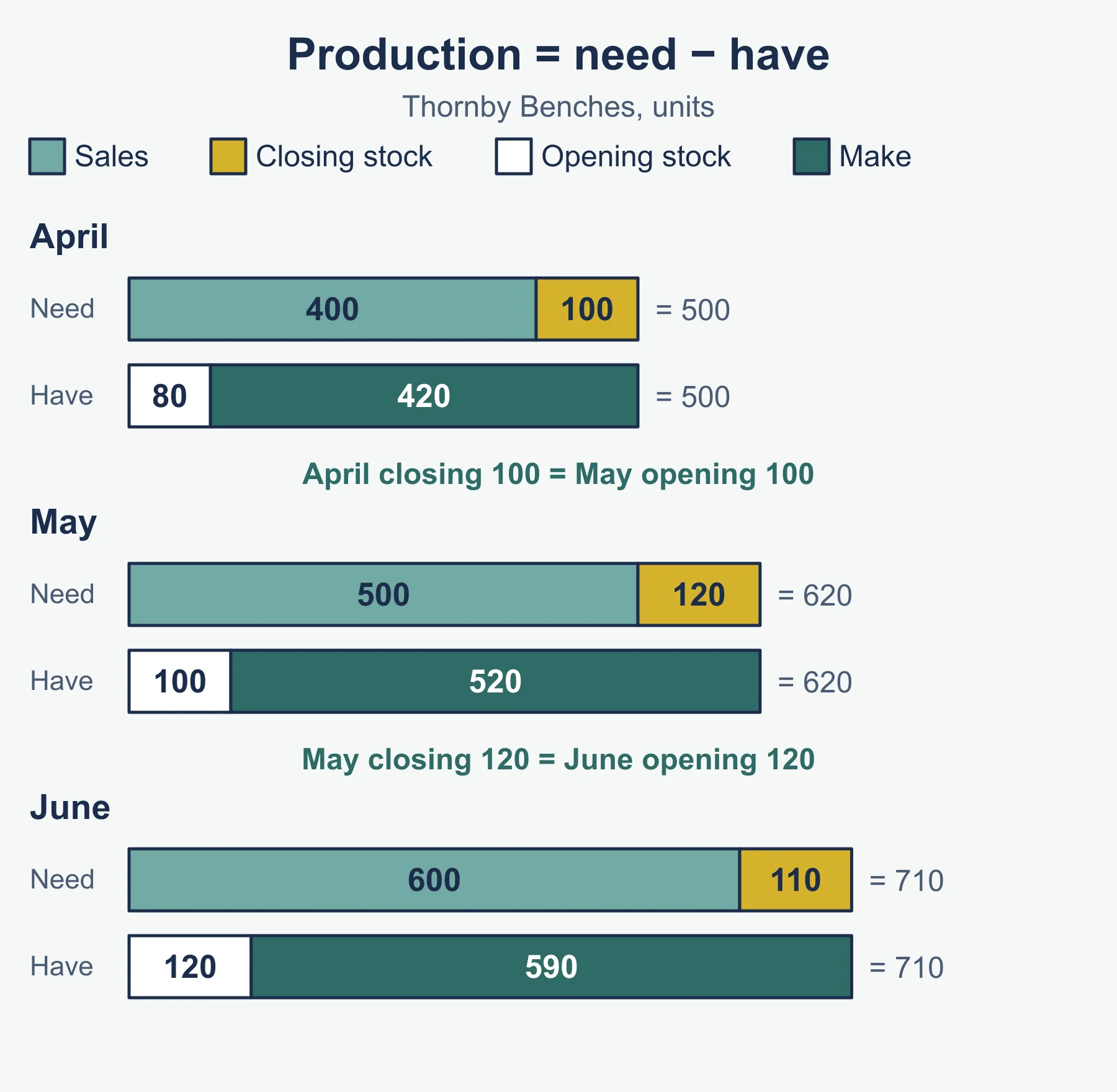
Production budget (units): sales + closing inventory - opening inventory.
| Apr | May | Jun | Total | |
|---|---|---|---|---|
| Sales | 1,000 | 1,200 | 1,400 | 3,600 |
| Add closing | 240 | 280 | 260 | 260 |
| Less opening | (200) | (240) | (280) | (200) |
| Production | 1,040 | 1,240 | 1,380 | 3,660 |
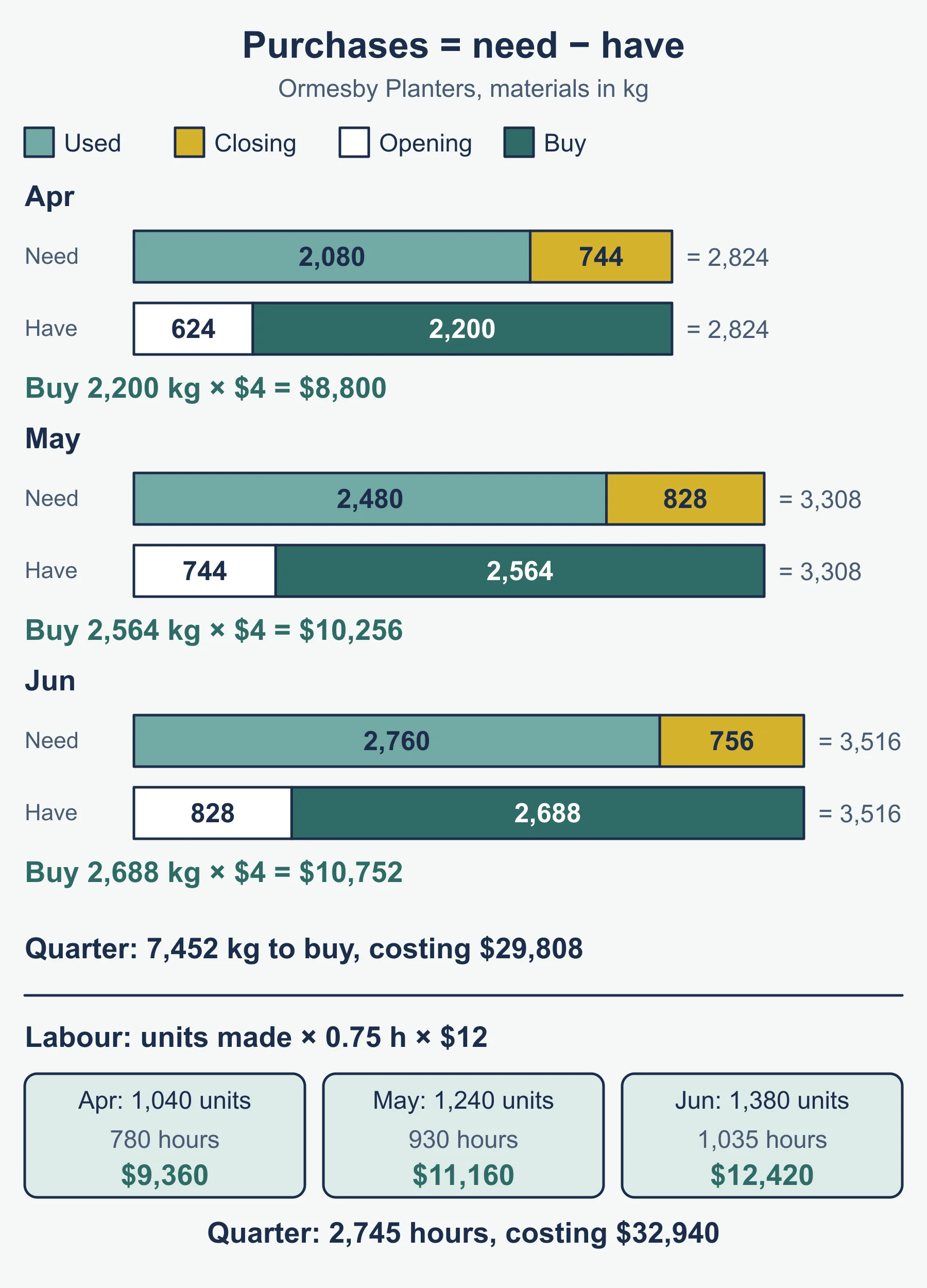
Purchases budget: materials used + closing - opening.
| Apr | May | Jun | Total | |
|---|---|---|---|---|
| Used (kg) | 2,080 | 2,480 | 2,760 | 7,320 |
| Add closing | 744 | 828 | 756 | 756 |
| Less opening | (624) | (744) | (828) | (624) |
| Purchases (kg) | 2,200 | 2,564 | 2,688 | 7,452 |
| Cost at 4 per kg | 8,800 | 10,256 | 10,752 | 29,808 |
Labour budget
| Apr | May | Jun | Total | |
|---|---|---|---|---|
| Hours (production x 0.75) | 780 | 930 | 1,035 | 2,745 |
| Cost at 12 per hour | 9,360 | 11,160 | 12,420 | 32,940 |
Trade receivables budget and trade payables budget
| Receivables | Apr | May | Jun |
|---|---|---|---|
| Opening | 27,000 | 30,000 | 36,000 |
| Credit sales | 30,000 | 36,000 | 42,000 |
| Cash received | (27,000) | (30,000) | (36,000) |
| Closing | 30,000 | 36,000 | 42,000 |
| Payables | Apr | May | Jun |
|---|---|---|---|
| Opening | 8,000 | 8,800 | 10,256 |
| Purchases | 8,800 | 10,256 | 10,752 |
| Cash paid | (8,000) | (8,800) | (10,256) |
| Closing | 8,800 | 10,256 | 10,752 |
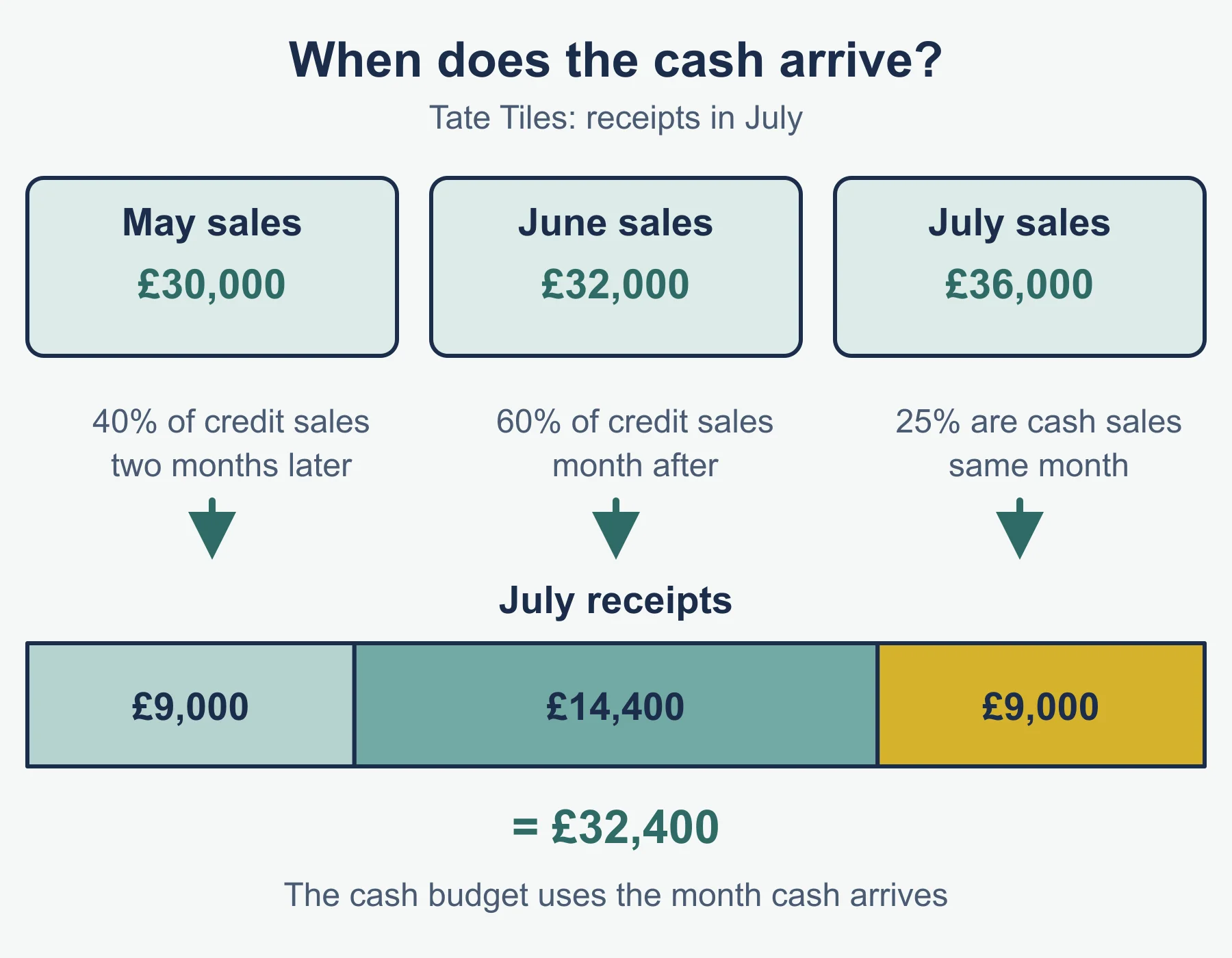
Cash budget
| Apr | May | Jun | |
|---|---|---|---|
| Cash sales | 10,000 | 12,000 | 14,000 |
| From receivables | 27,000 | 30,000 | 36,000 |
| Total receipts | 37,000 | 42,000 | 50,000 |
| Suppliers | 8,000 | 8,800 | 10,256 |
| Wages | 9,360 | 11,160 | 12,420 |
| Variable overhead | 3,120 | 3,720 | 4,140 |
| Fixed overheads (no depreciation) | 8,200 | 8,200 | 8,200 |
| Selling expenses | 2,000 | 2,400 | 2,800 |
| Equipment | 14,000 | 0 | 0 |
| Total payments | 44,680 | 34,280 | 37,816 |
| Net cash flow | (7,680) | 7,720 | 12,184 |
| Opening cash | 1,000 | (6,680) | 1,040 |
| Closing cash | (6,680) | 1,040 | 13,224 |
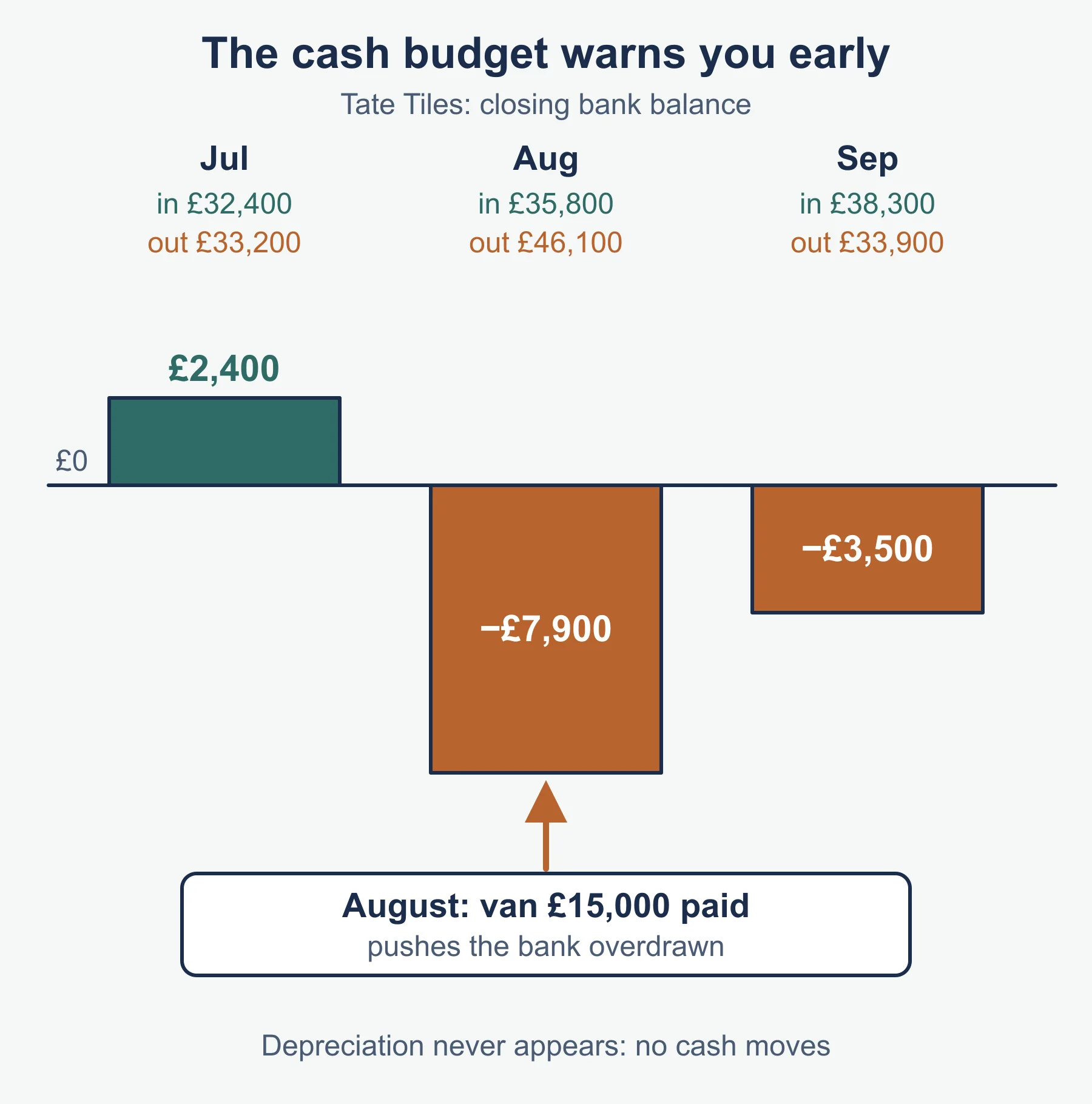
April ends overdrawn, so the business should arrange an overdraft or delay the equipment. The budget has done its job by warning of this before it happens.
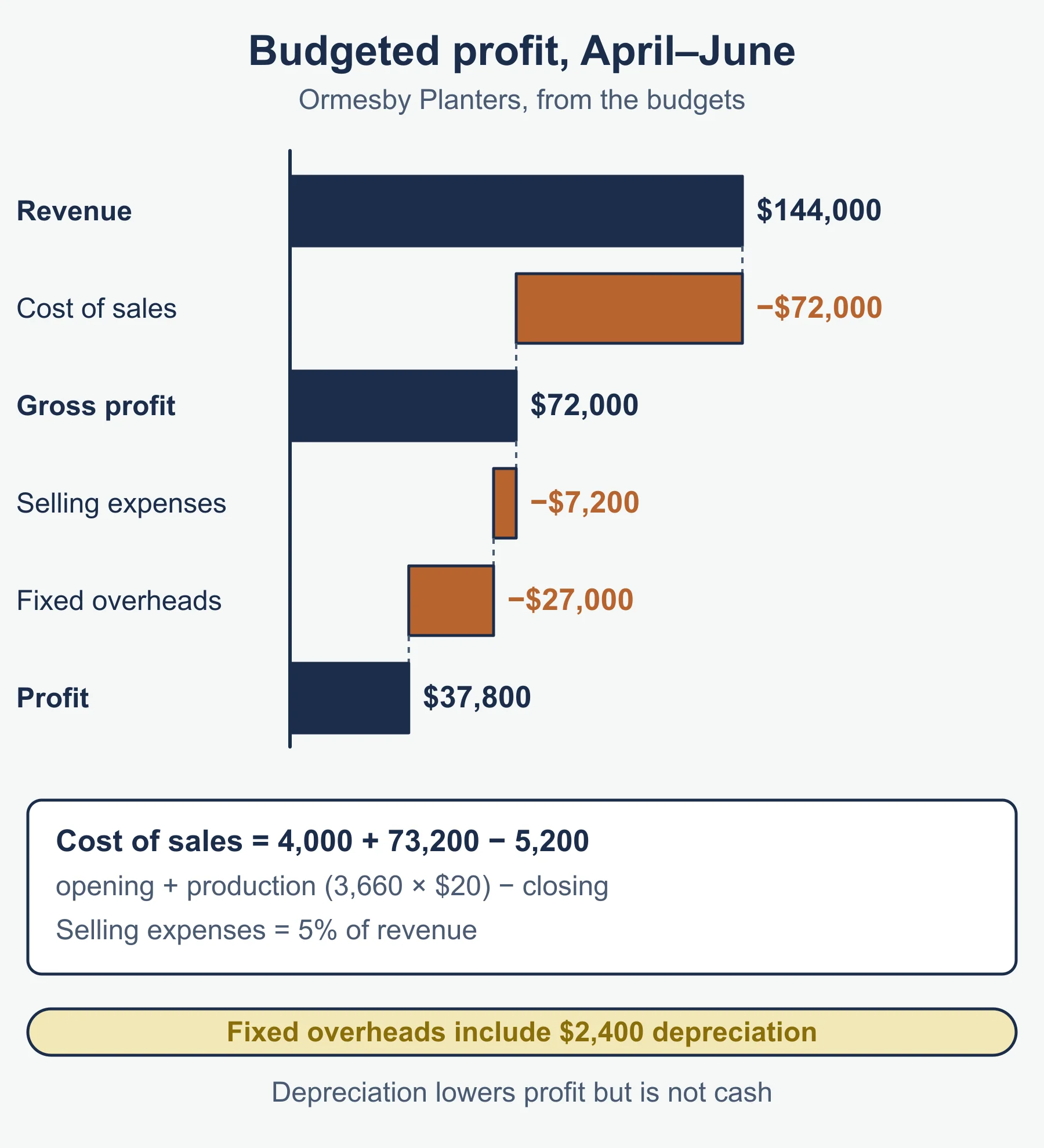
Budgeted statement of profit or loss, April to June
| Amount | |
|---|---|
| Revenue | 144,000 |
| Opening inventory (finished goods) | 4,000 |
| Add production cost (3,660 x 20) | 73,200 |
| Less closing inventory (260 x 20) | (5,200) |
| Cost of sales | 72,000 |
| Gross profit | 72,000 |
| Selling expenses | (7,200) |
| Fixed overheads (including depreciation 2,400) | (27,000) |
| Profit for the period | 37,800 |
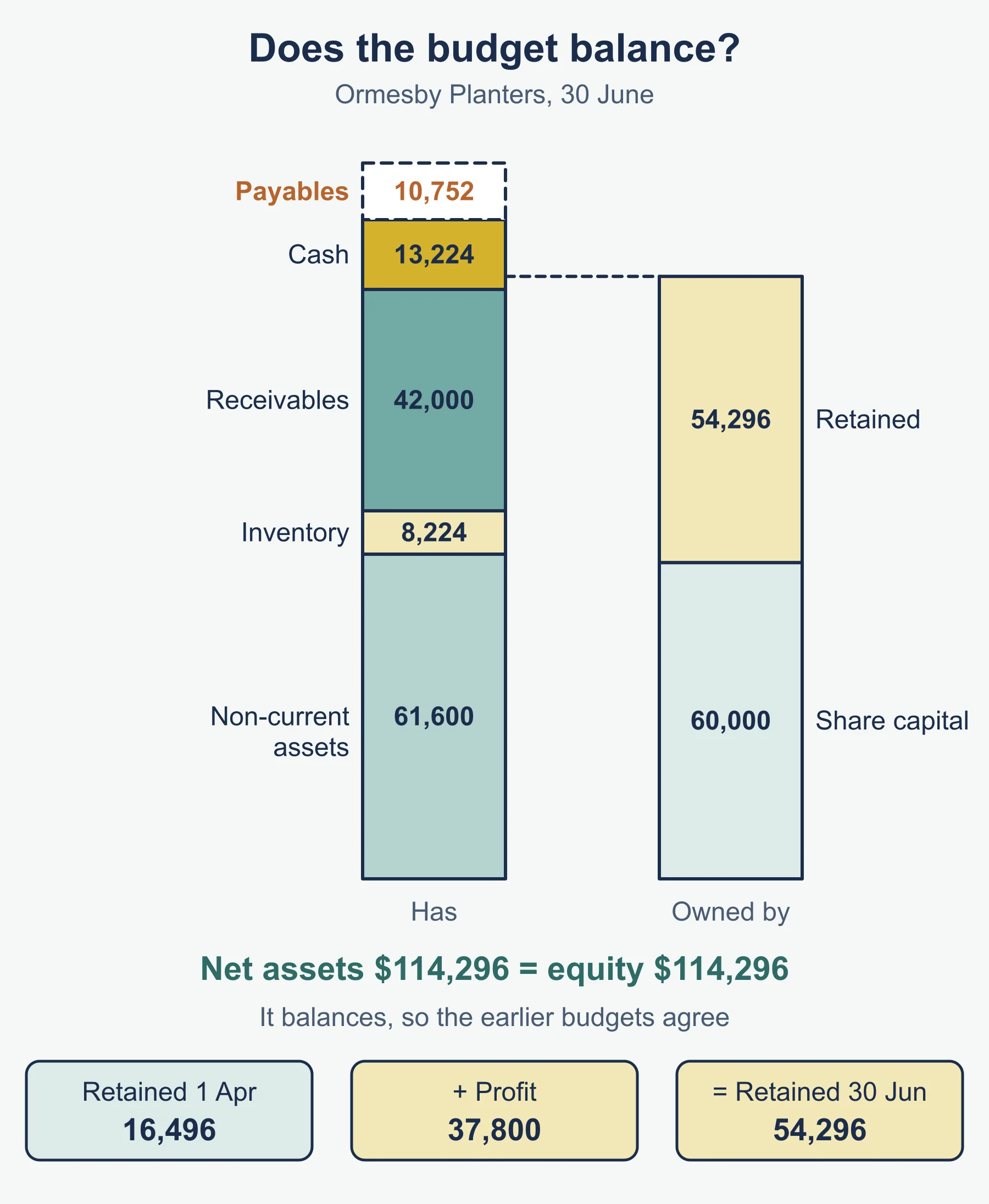
Budgeted statement of financial position
| 1 April | 30 June | |
|---|---|---|
| Non-current assets (carrying amount) | 50,000 | 61,600 |
| Inventory (materials and finished goods) | 6,496 | 8,224 |
| Trade receivables | 27,000 | 42,000 |
| Cash and cash equivalents | 1,000 | 13,224 |
| Trade payables | (8,000) | (10,752) |
| Net assets | 76,496 | 114,296 |
| Share capital | 60,000 | 60,000 |
| Retained earnings | 16,496 | 54,296 |
| Equity | 76,496 | 114,296 |
Non-current assets: 50,000 + 14,000 - 2,400 depreciation = 61,600. Retained earnings: 16,496 + 37,800 = 54,296. Closing inventory: materials 756 kg x 4 = 3,024 plus finished goods 5,200. The statement balances, which checks the earlier budgets.
5. Flexible budgets
A fixed budget is set for one planned activity level and is not changed. If actual output differs, comparing actual costs with it is unfair: higher output naturally costs more. A flexible budget restates the budget for the actual activity level. Variable items are recalculated per unit; fixed items stay the same within the normal range of activity.
Benefits over fixed budgeting: like-for-like comparison; clearer responsibility, since volume effects are removed; better cost control and planning; more realistic targets, so managers accept them.
Worked example: Sutterby Lamps
Planned sales and output were 2,000 lamps; 2,300 were made and sold. Selling price was 50 per lamp. Budgeted cost per lamp: materials 12, labour 10, variable production overhead 3 and variable selling expense 2. Fixed production overhead 12,000 and fixed administration and selling costs 14,000.
| Fixed budget 2,000 | Flexed budget 2,300 | Actual 2,300 | Difference F / (A) | |
|---|---|---|---|---|
| Revenue | 100,000 | 115,000 | 112,700 | (2,300) |
| Materials | 24,000 | 27,600 | 29,900 | (2,300) |
| Labour | 20,000 | 23,000 | 22,700 | 300 |
| Variable production overhead | 6,000 | 6,900 | 7,500 | (600) |
| Fixed production overhead | 12,000 | 12,000 | 12,400 | (400) |
| Variable selling | 4,000 | 4,600 | 4,800 | (200) |
| Fixed administration and selling | 14,000 | 14,000 | 14,300 | (300) |
| Profit | 20,000 | 26,900 | 21,100 | (5,800) |
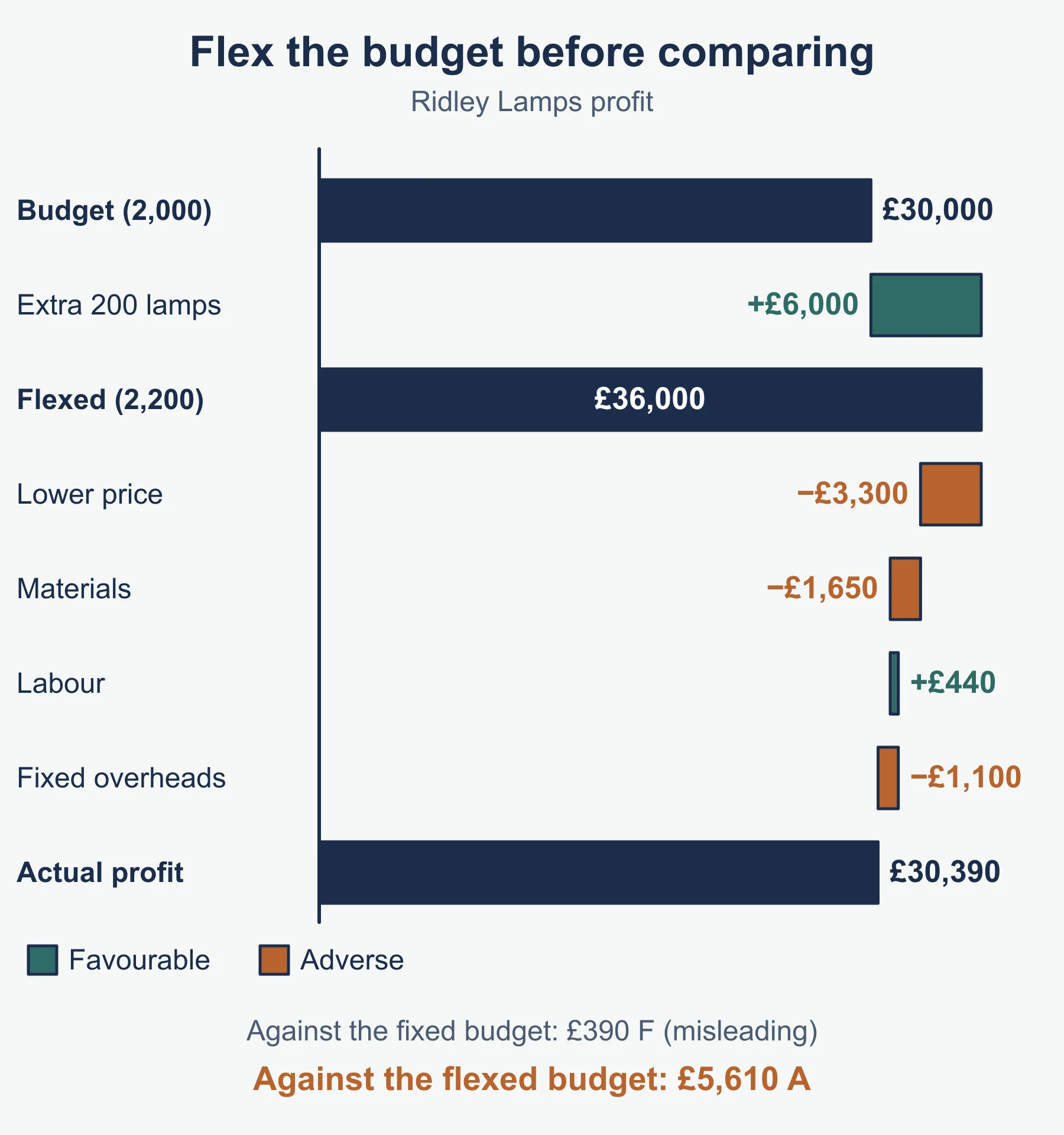
Against the fixed budget, profit looks 1,100 better. Against the flexed budget it is 5,800 worse. The extra 300 lamps explain a rise of 6,900 (300 x 23 contribution); the cost and price differences explain the rest.
6. Causes of differences
Differences between actual and flexed figures are not caused by volume. Possible causes: supplier price changes or discounts; poorer or better quality material; waste and spoilage; labour overtime, pay awards or slower work; machine breakdowns; selling price cuts or discounts to win sales; inflation in overheads; budget errors. Causes can be linked: cheaper low-quality material may give an adverse usage difference, and a price cut might lift volume. Adverse means profit is lower than the flexed budget; favourable means higher.
7. The two reconciliation statements
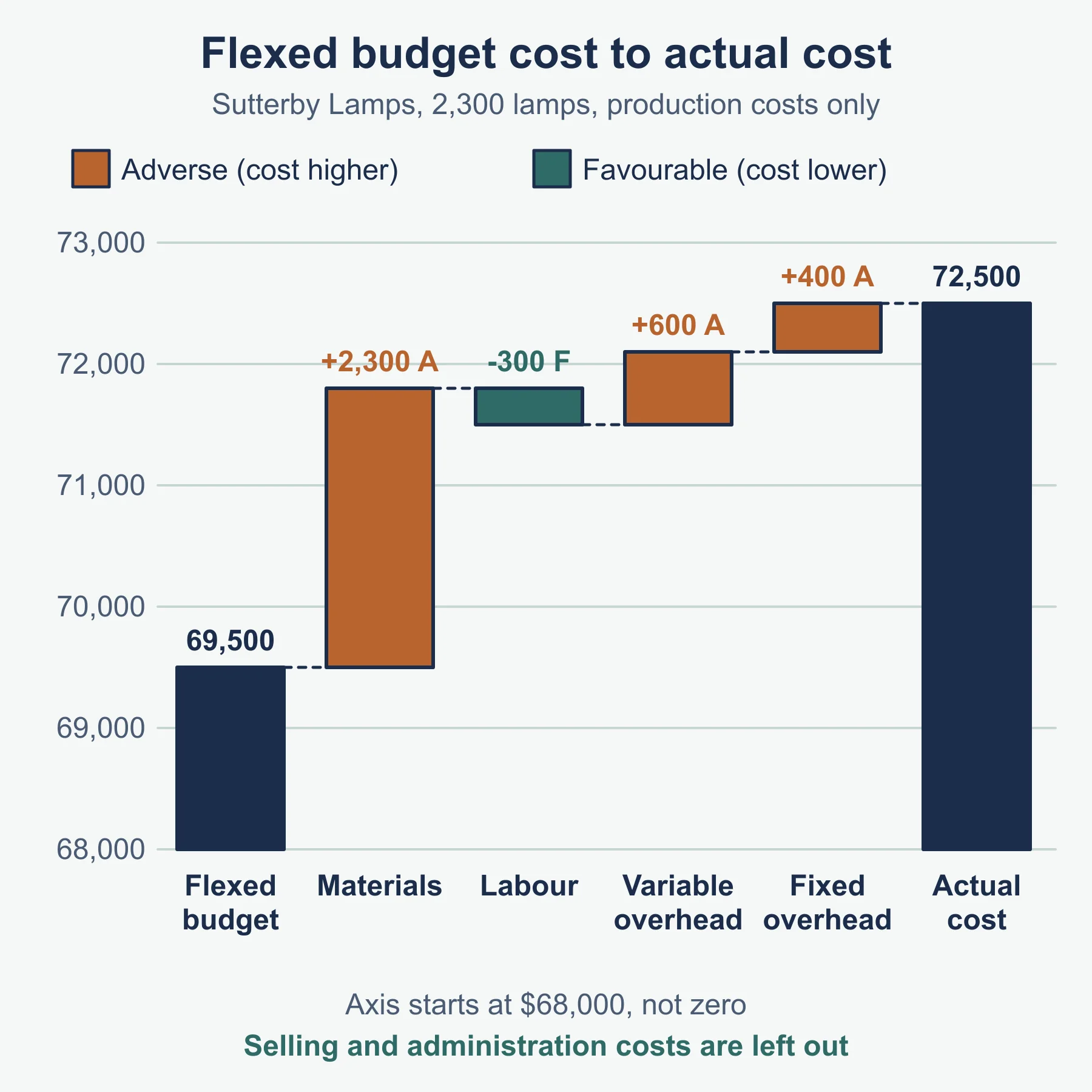
Flexible budgeted cost of production to actual cost of production: production costs are materials, labour, variable production overhead and fixed production overhead. Selling and administration costs are excluded.
| Sutterby Lamps | Amount |
|---|---|
| Flexible budgeted cost of production (2,300 lamps) | 69,500 |
| Materials | 2,300 adverse |
| Labour | 300 favourable |
| Variable production overhead | 600 adverse |
| Fixed production overhead | 400 adverse |
| Actual cost of production | 72,500 |
Check: 69,500 + 2,300 - 300 + 600 + 400 = 72,500.
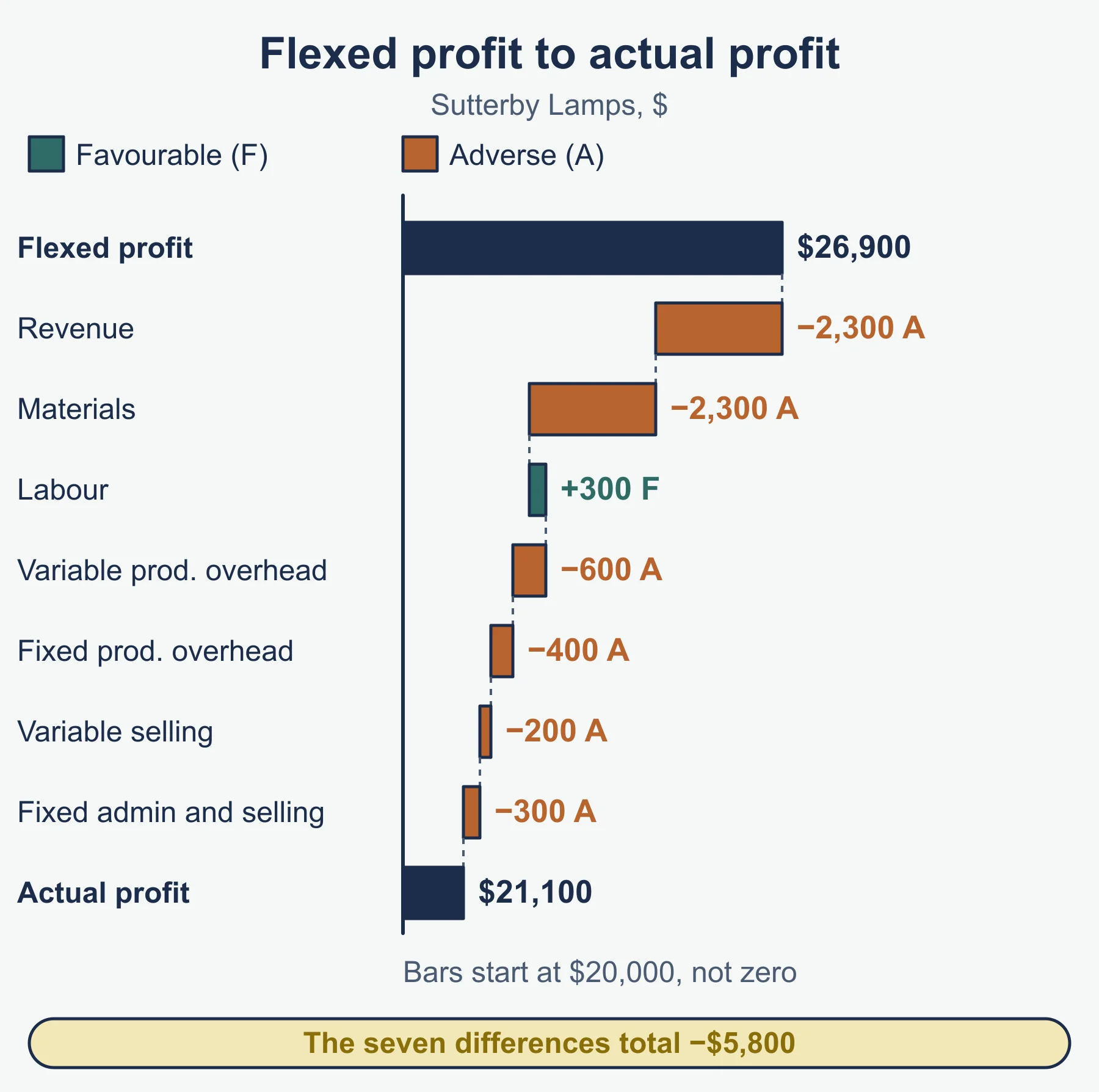
Flexible budgeted profit to actual profit: start with 26,900, add favourable and deduct adverse differences, including revenue and selling costs: 26,900 - 2,300 (revenue) - 2,300 + 300 - 600 - 400 - 200 - 300 = 21,100.
8. Behavioural aspects
Budgets influence people, so the process matters.
- Targets: too easy and staff coast; too hard and they give up. Stretching but achievable targets work best.
- Participation: managers who help set the budget are more likely to accept it. Imposed budgets can cause resentment, though top-down control is quicker and keeps goals aligned with the organisation.
- Incentives: bonuses linked to budget achievement can motivate but also encourage slack, short-term cuts in training, maintenance or quality, or year-end spending just to use up budgets.
- Controllability: judge managers on costs they can control.
9. Decisions and non-financial factors
Recommendations need a balance of reasons and a justified conclusion. In Sutterby’s case, higher volume was good, but material cost and price differences need investigation. Non-financial factors include staff morale, customer satisfaction, product quality, supplier relationships, environmental impact, reputation and long-term sustainability. A cut that improves the budget this year can harm these.
Common errors
- Production budget: forgetting to add closing and subtract opening inventory.
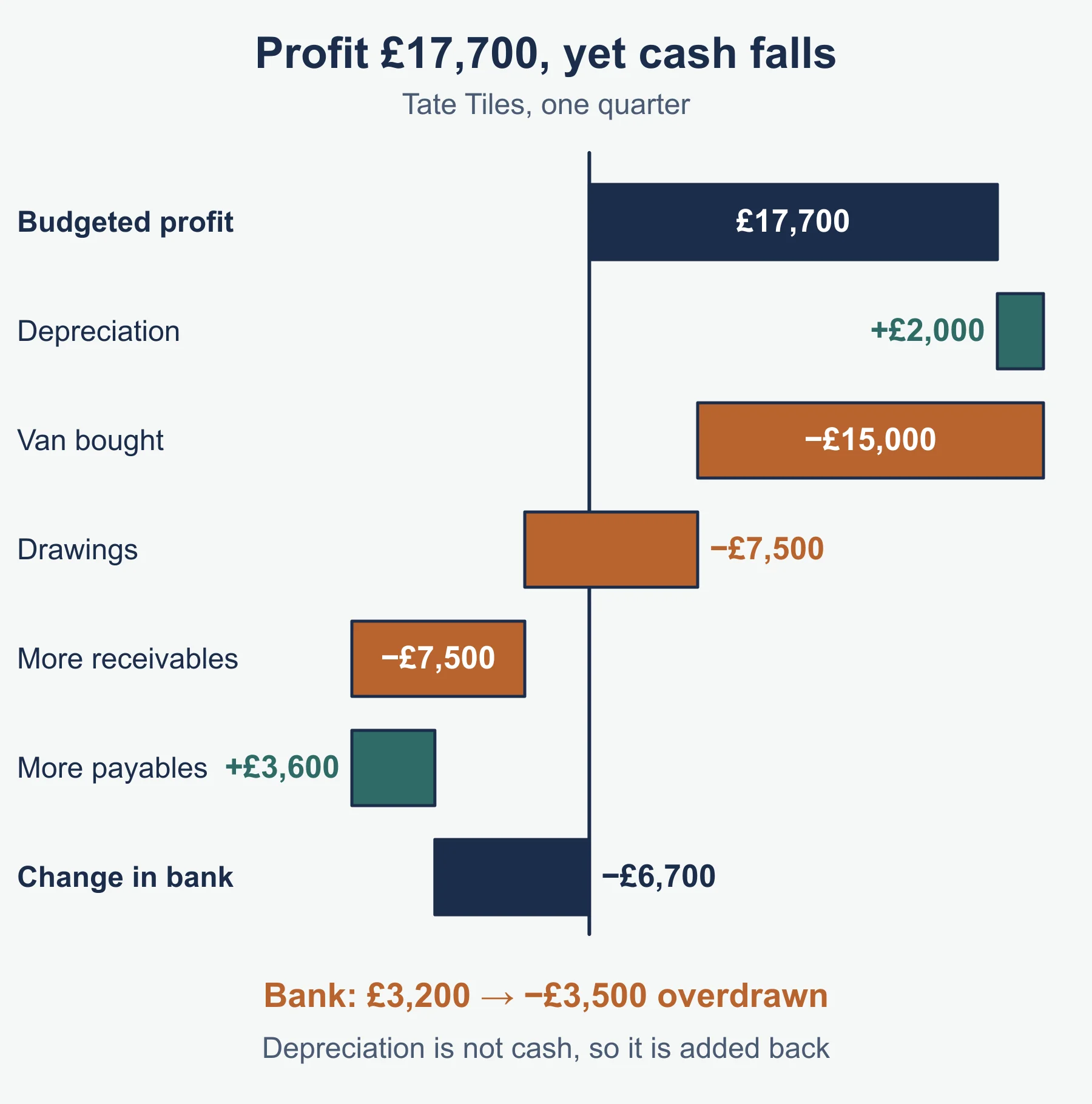
- Putting depreciation in the cash budget; it is not a cash flow.
- Flexing fixed costs, or leaving variable costs unflexed.
- Calling a difference favourable because actual cost is higher than the fixed budget.
- Cash budget: using credit sales when cash is received a month later.
Frequently asked questions
What is a limiting factor in budgeting? A limiting factor, or principal budget factor, is the resource or condition that restricts activity, such as customer demand or production capacity. Its budget is prepared first because it sets the level for the others.
In what order are budgets prepared? The normal order is sales, production, purchases and labour, receivables and payables, cash, then the budgeted statements, which together form the master budget.
What is a flexible budget? A flexible budget recalculates the budget at the actual level of activity, flexing variable costs and revenue while leaving fixed costs unchanged. It gives a like-for-like comparison with actual results.
Why is depreciation not included in a cash budget? Depreciation is not a cash flow, so it never appears in a cash budget. It is included in the budgeted statement of profit or loss.
What are the behavioural aspects of budgeting? Targets should be stretching but achievable, managers who take part in setting budgets are more likely to accept them, bonuses linked to budgets can encourage slack or short-term thinking, and managers should be judged only on costs they can control.
Official syllabus
Cambridge International AS & A Level Accounting 9706 syllabus for 2026, 2027 and 2028, section 4.3 Budgeting and budgetary control, published by Cambridge International.
Get free revision emails (optional)
Occasional emails with practice questions, worked explanations and links to free resources for the qualification and subjects you choose. No spam, and you can unsubscribe from any email. The free tools on this site never need an email.
Related resources
-
Study guides
A Level Accounting: Accounting for Non-Current Assets (Cambridge 9706)
Capital versus revenue spending, why assets depreciate depreciation methods, cost and revaluation models and disposals, for Cambridge 9706 Accounting topic 1.3.
Accounting · Cambridge · AS Level
Read guide -
Practice questions
A Level Accounting: Budgeting and budgetary control (Cambridge 9706) – Practice Questions
Ten original questions with worked answers on budgets, cash budgets, flexible budgets, reconciliations and behaviour, for Cambridge A Level Accounting.
Accounting · Cambridge · A Level
Try questions -
Revision notes
A Level Accounting: Budgeting and budgetary control (Cambridge 9706) – Revision Notes
Revision notes on budgets, flexible budgeting, reconciliations and behaviour, with a self-test, for Cambridge A Level Accounting 9706 section 4.3.
Accounting · Cambridge · A Level
Revise topic
Related articles
-
teaching
A Level tuition in Dubai: Cambridge or Pearson Edexcel International A Level?
Schools in Dubai and Abu Dhabi teach either Cambridge International AS & A Level or Pearson Edexcel International A Level. How the two are structured, why it matters for tuition, and how online classes from Lahore work.
9 October 2026
-
curriculum guides
Choosing subjects at IGCSE and A Level
How subject choices at 14 and 16 affect university options later, and how to keep pathways open without overloading a timetable.
28 July 2026
Studying this with a teacher
Working through Accounting A LEVEL?
This page is free and stays free. If you would rather be taught it, Marlbridge runs Accounting classes one-to-one and in small groups of up to 15, online in your own time zone. The first trial class is free. WhatsApp replies within an hour (8am–11pm Pakistan time, every day); email the same day.
Cambridge Accounting teachers at Marlbridge

