
Revision Notes
A Level Accounting: Budgeting and budgetary control (Cambridge 9706) – Revision Notes
Revision notes on budgets, flexible budgeting, reconciliations and behaviour, with a self-test, for Cambridge A Level Accounting 9706 section 4.3.
- Subject
- Accounting
- Level
- A LEVEL
- Topic
- Cost and management accounting
- Author
- Marlbridge Academic Team
- Updated
- Reviewed by
- Zain Ud Din Ahmed (what this means)
Aligned to Cambridge A Level Accounting (9706), 2026-2028. Official specification .
Syllabus page (what it covers and how it is assessed): Cambridge A Level Accounting.
Syllabus points this page covers
9706 (A Level)
- 4.3 Budgeting and budgetary control
Found an error? Report a correction.
Need help with this topic? Request a free trial class for A Level Accounting (9706).
These notes condense section 4.3 Budgeting and budgetary control (A Level content) of the Cambridge International AS & A Level Accounting 9706 syllabus for 2026, 2027 and 2028. For full explanations and a complete master budget, read the study guide. Then test yourself with the practice questions. Other links: course hub, printable checklist, exam preparation guide and free diagnostics. Businesses and figures are invented; amounts are in dollars.
Key terms
| Term | Meaning |
|---|---|
| Budget | A financial plan for a future period |
| Budgetary control | Comparing actual with budget, investigating differences, acting |
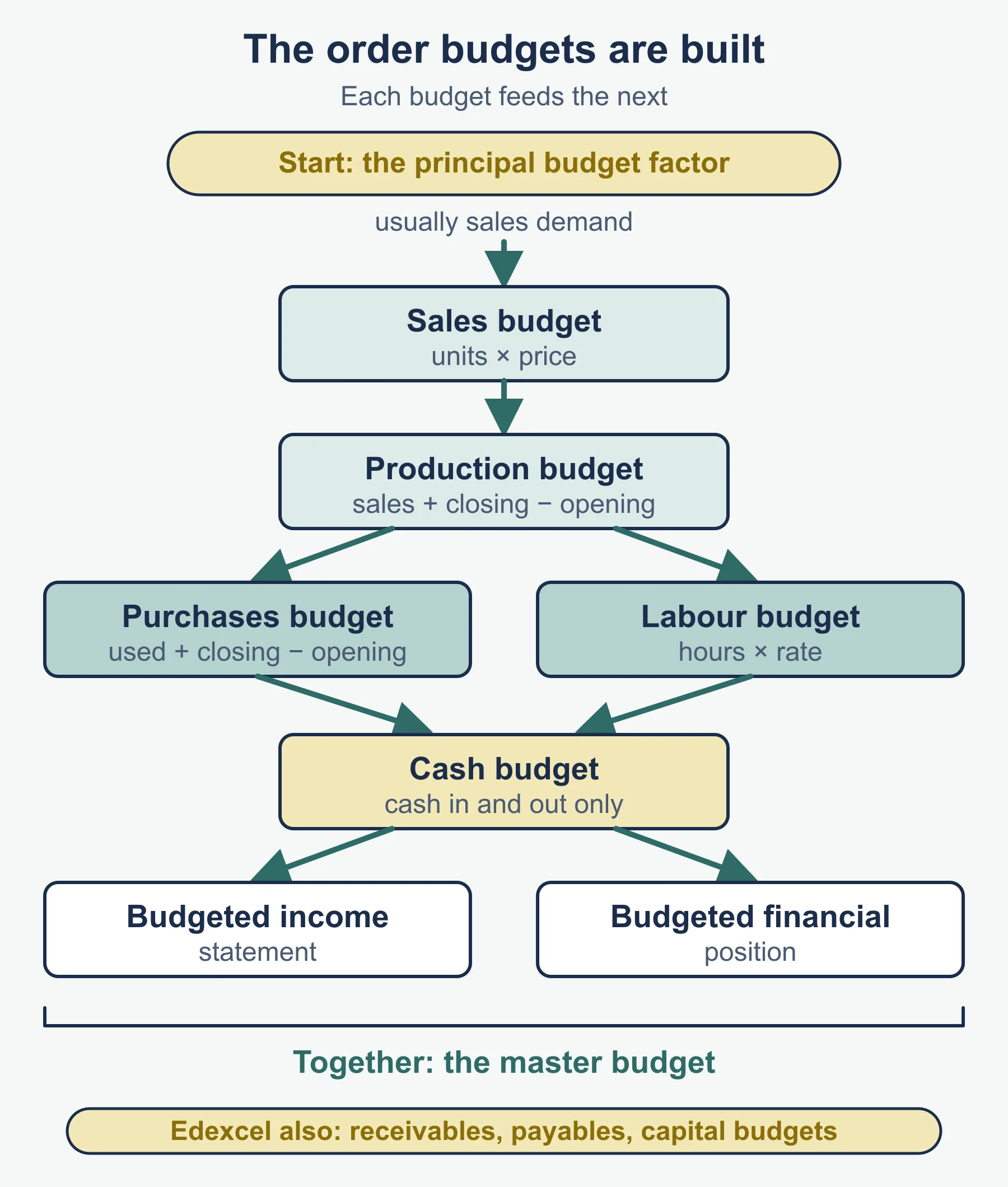
| Master budget | Summary of all budgets: budgeted statement of profit or loss, statement of financial position, cash budget |
| Limiting factor | The scarce resource or condition that caps activity |
| Fixed budget | Set for one activity level; not revised |
| Flexible budget | Restated for the actual activity level |
| Favourable / adverse | Actual profit higher / lower than the comparison budget |
Budgetary control: for and against
| Advantages | Disadvantages |
|---|---|
| Planning and co-ordination across departments | Time-consuming and costly |
| Targets communicated; performance benchmark | Forecasts may be wrong |
| Focus on large differences | Rigid if conditions change |
| Helps allocate scarce resources | Slack, padding, spend-it-or-lose-it |
| Can motivate | Unfair targets demotivate; money focus ignores quality |
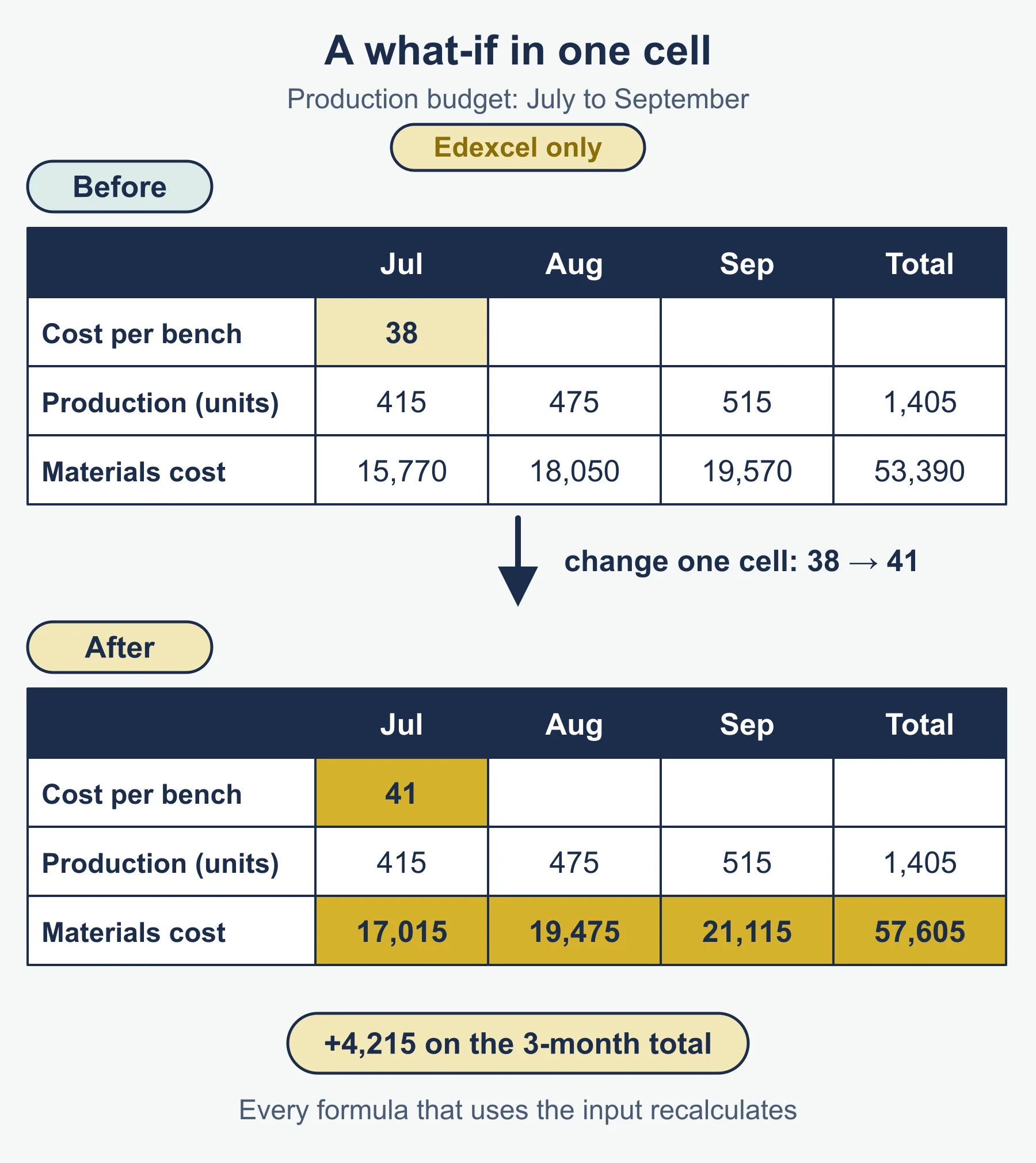
Spreadsheets: for and against
| Advantages | Disadvantages |
|---|---|
| Instant recalculation across linked budgets | Hidden formula or input errors spread |
| Quick what-if testing | Weak audit trail, access and version control |
| Fewer arithmetic slips | Risk of loss or unauthorised change |
| Reusable templates; charts | Needs skilled users; layout can mask poor assumptions |
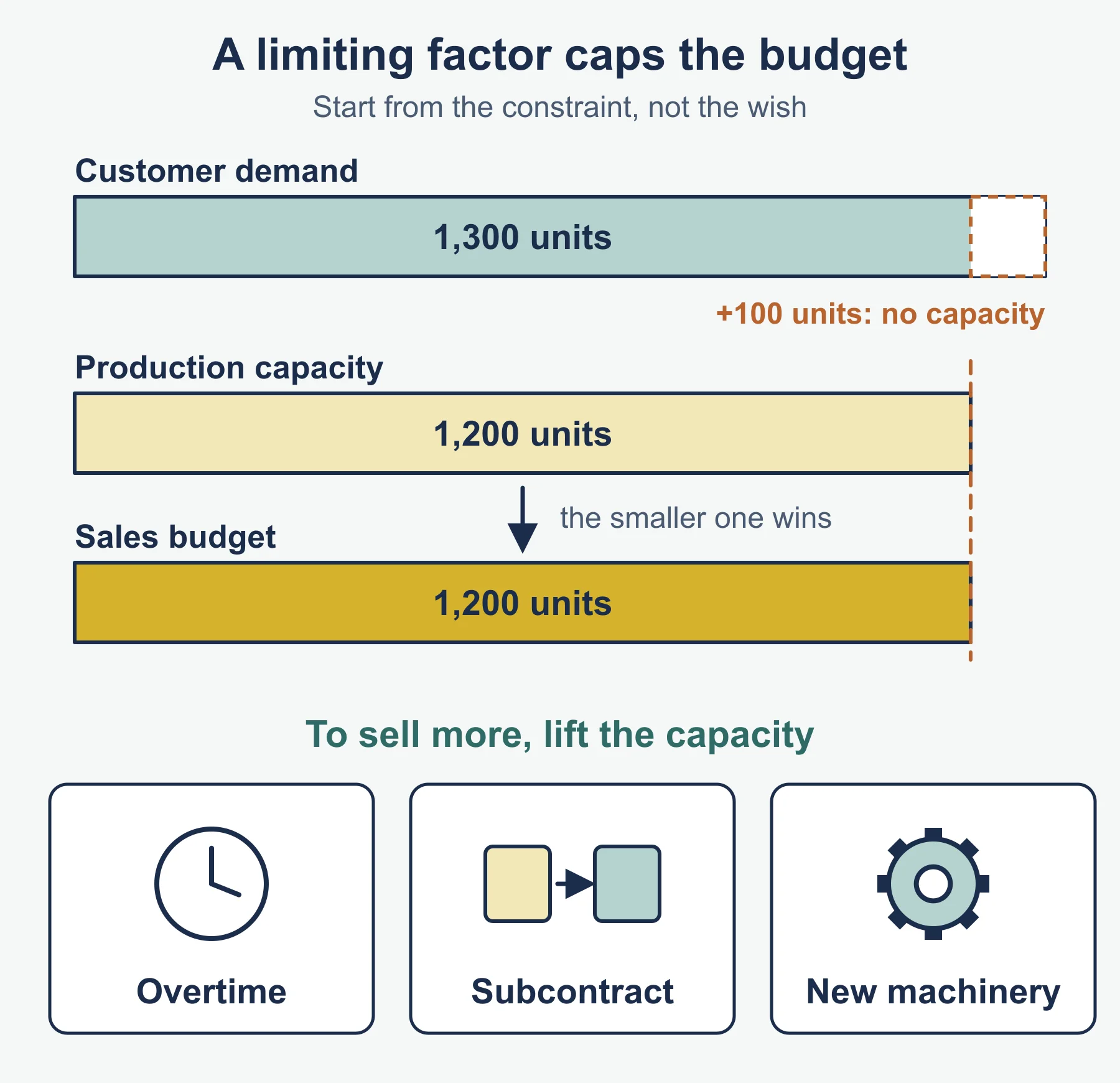
Limiting factors
- Identify the factor (demand, labour, material, machine hours, cash).
- Budget that function first, then fit the others to it.
- If the constraint can be relaxed (overtime, outsourcing, extra finance), say what it costs.
Example: sales demand is 5,000 units but machines can make 4,200. The sales budget is held to 4,200 unless capacity grows.
Formula table
| Budget | Calculation |
|---|---|
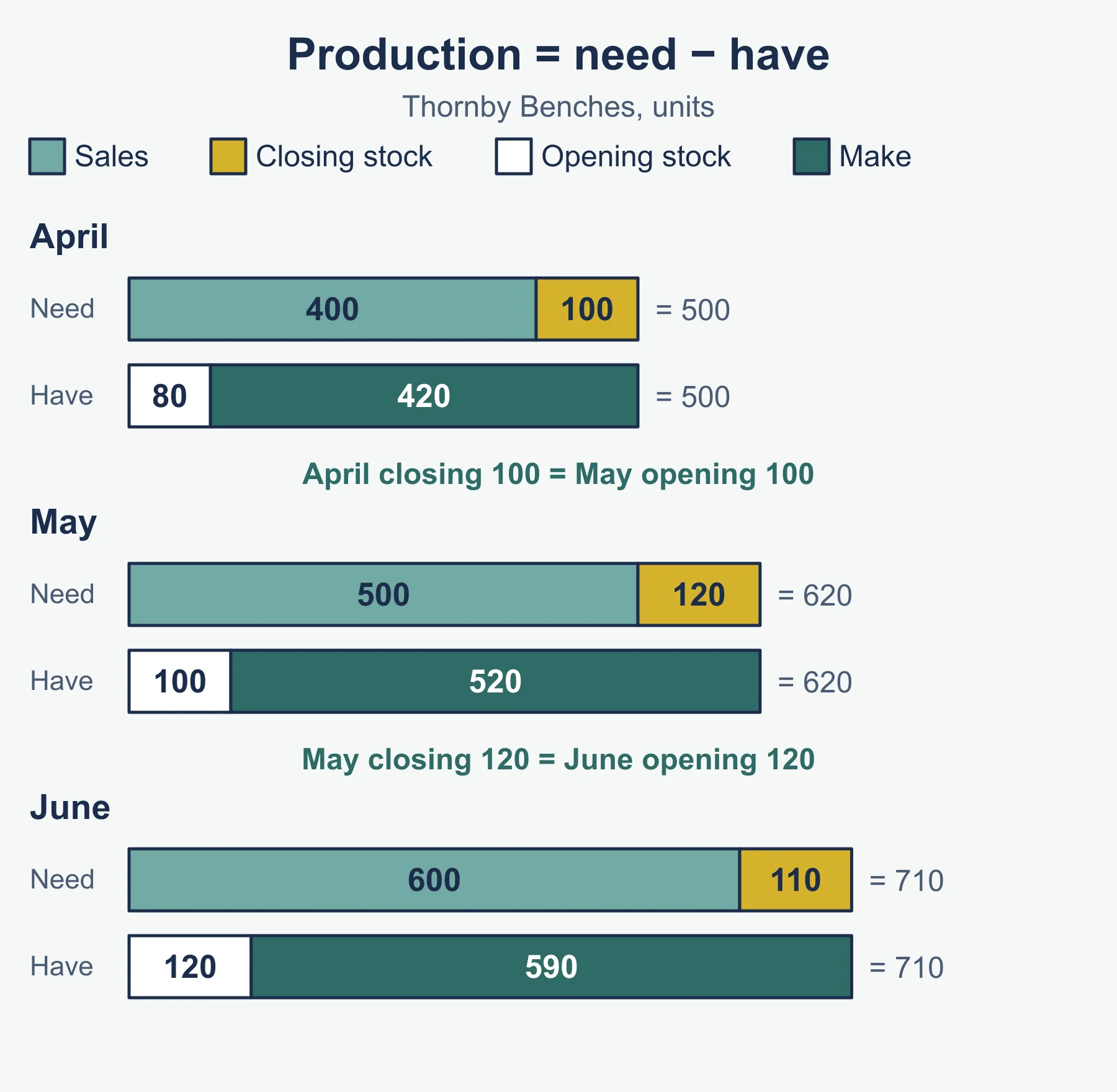
| Production (units) | Sales + closing inventory - opening inventory |
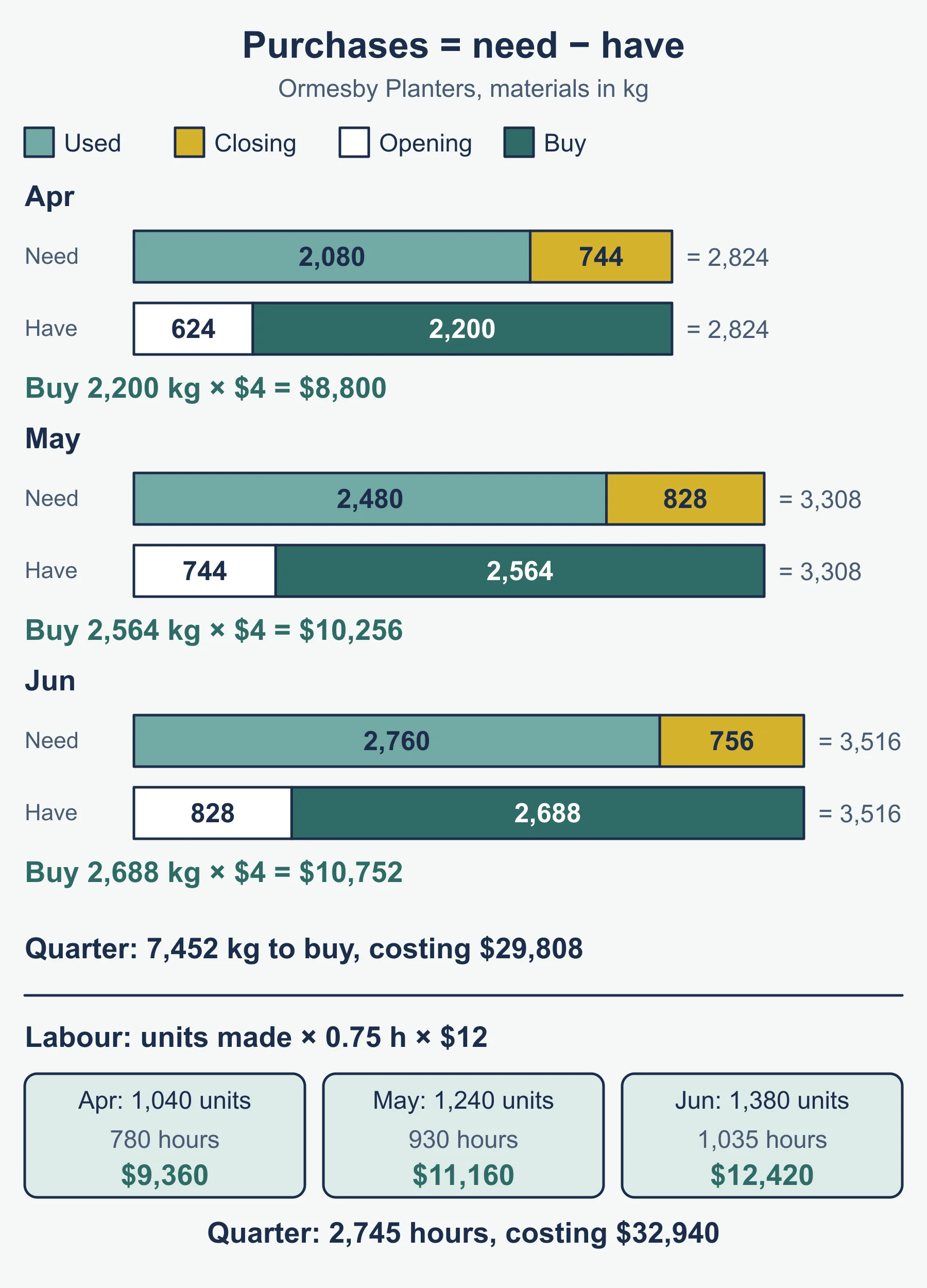
| Purchases (quantity) | Used in production + closing materials - opening materials |
| Labour cost | Units produced x hours per unit x rate per hour |
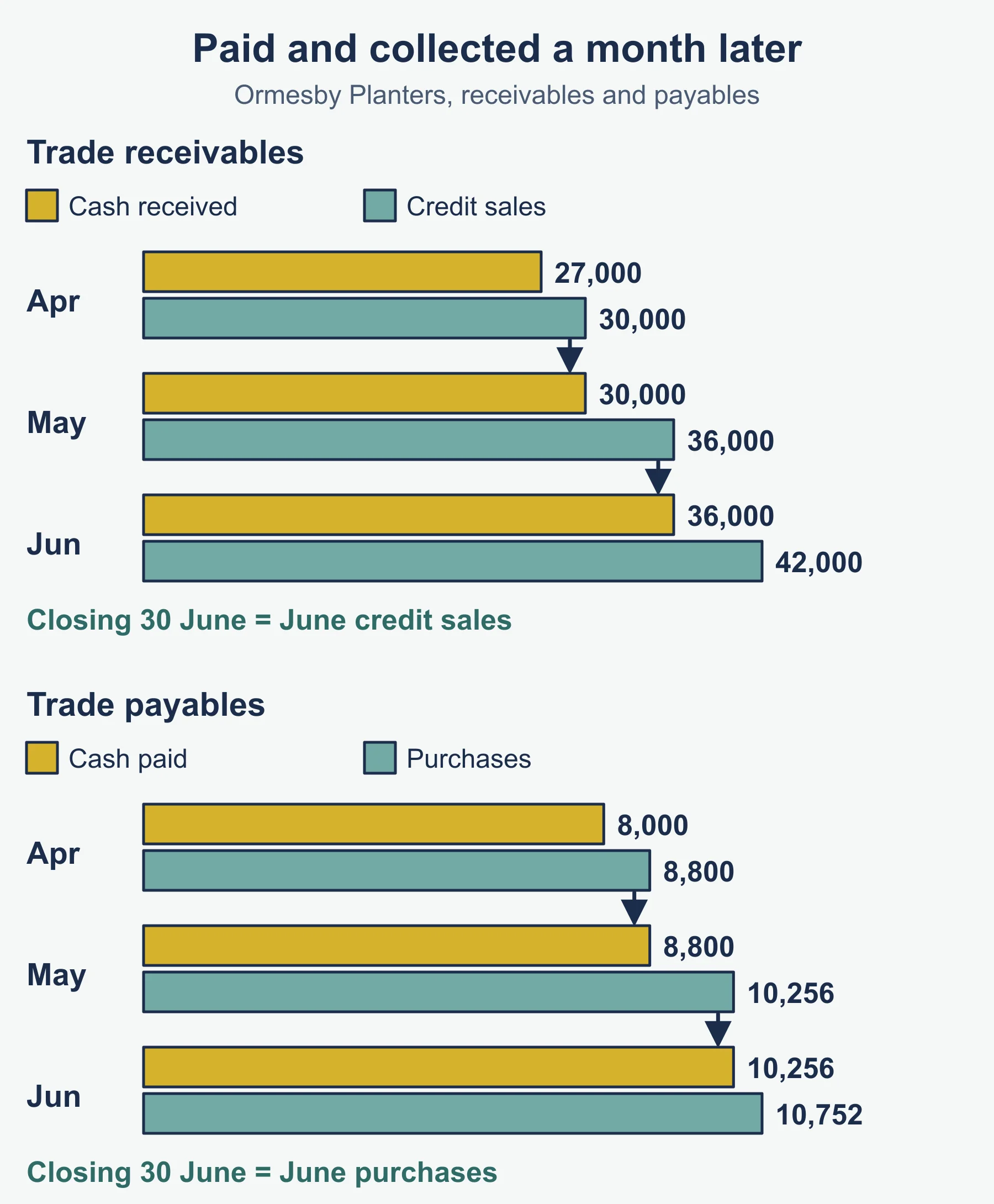
| Receivables, closing | Opening + credit sales - cash received |
| Payables, closing | Opening + credit purchases - cash paid |
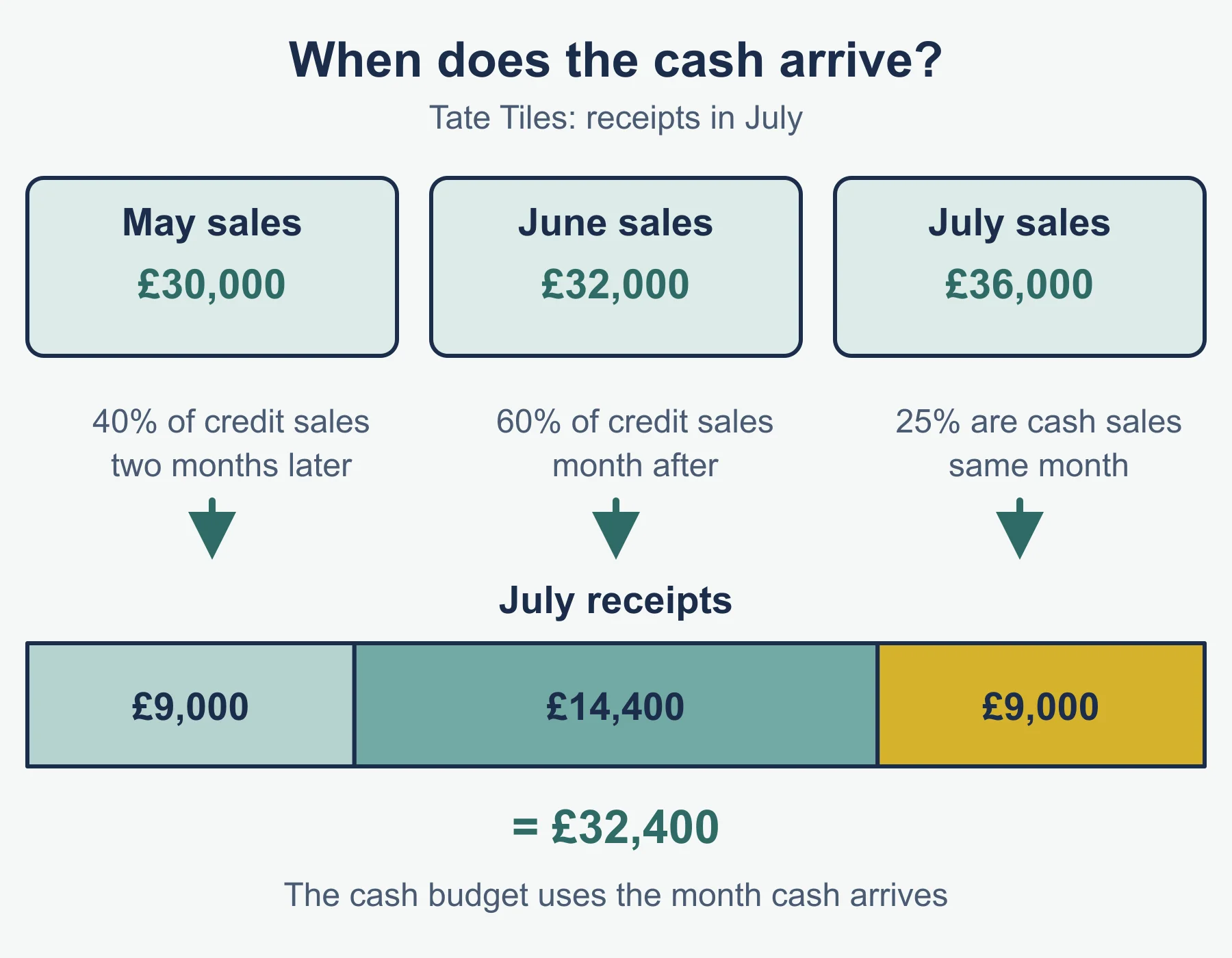
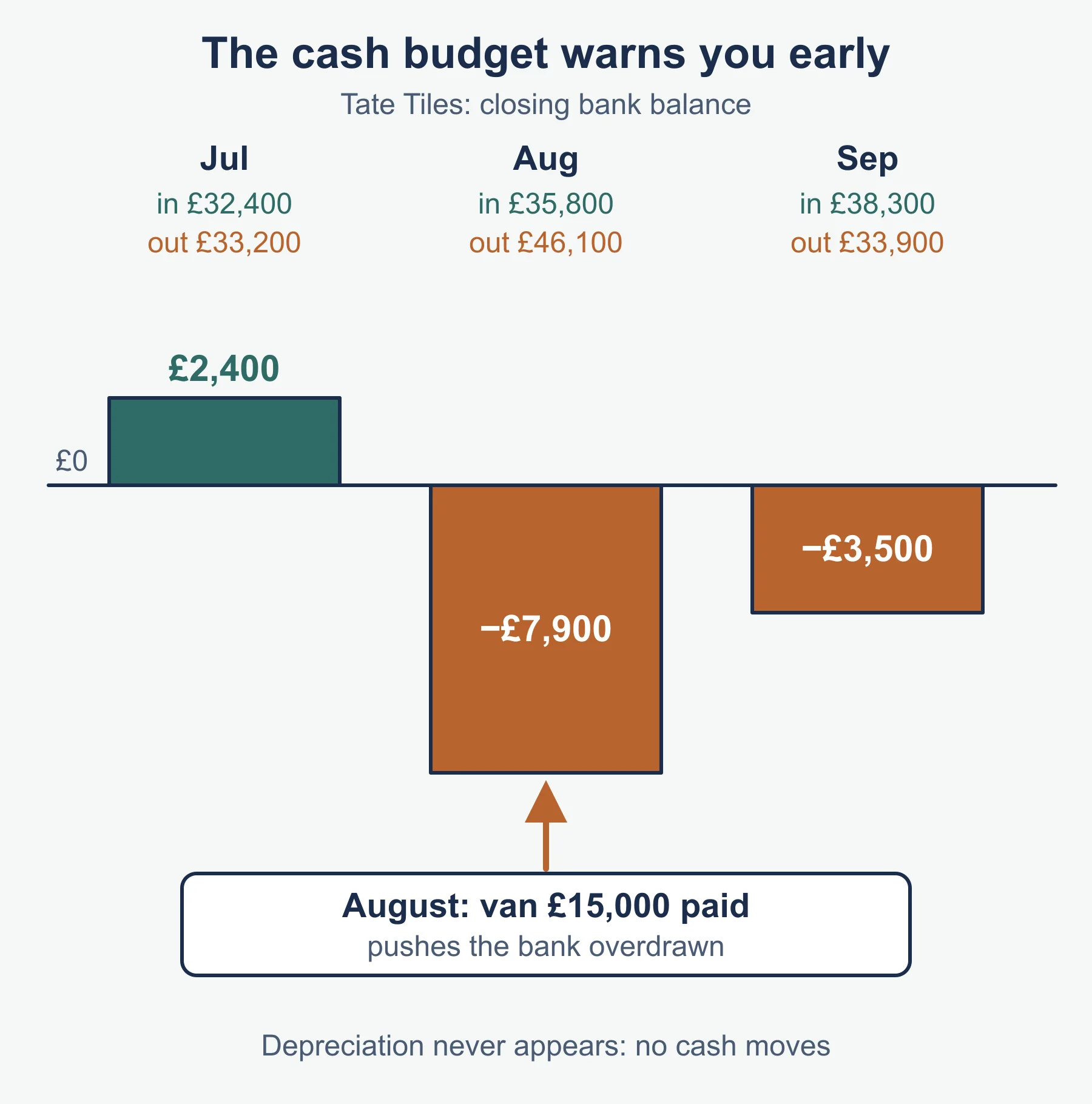
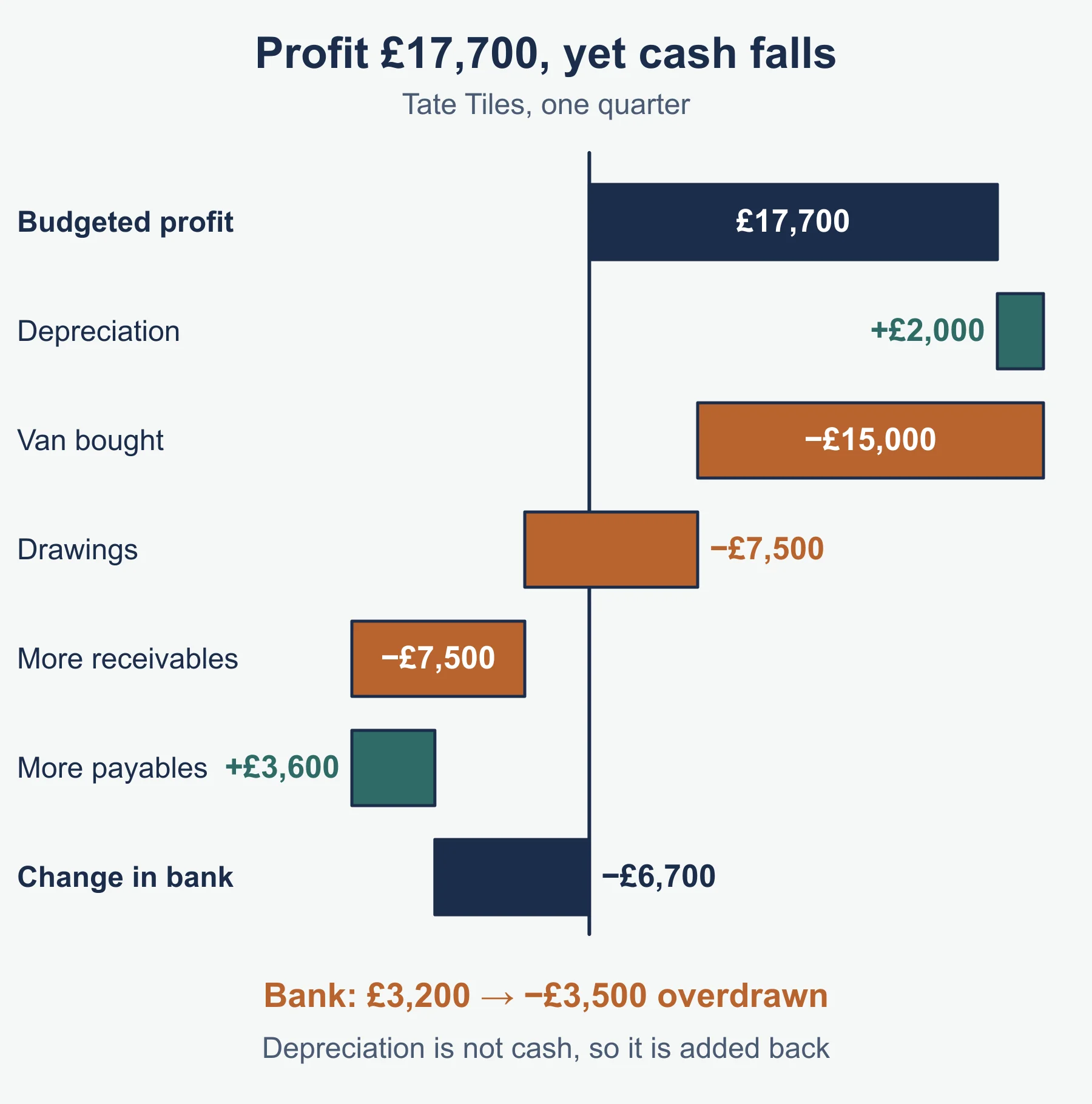
| Cash budget | Receipts - payments; add opening cash; exclude depreciation |
| Flexed variable cost | Budget cost per unit x actual units |
| Flexed fixed cost | Unchanged (within normal activity range) |
Method for the cash budget
- List receipts by month: cash sales, then receivables collected from the receivables budget.
- List payments by month: suppliers from the payables budget, wages, overheads paid, capital items, other cash outflows.
- Net cash flow, add opening cash, carry the closing figure forward.
- Comment on any overdraft month and what to do about it.
Worked reminder 1: production, purchases and timing
Kelsale Candles sells 500 (January), 600 (February), 800 (March) and 700 (April) candles at 25 each. Closing inventory is 10% of next month’s sales. Each candle uses 0.4 kg of wax costing 5 per kg. Closing wax is 90 kg (January), 100 kg (February) and 120 kg (March). All sales are on credit: 60% is paid in the month after sale and 40% two months after.
| Feb | Mar | |
|---|---|---|
| Sales | 600 | 800 |
| Closing inventory | 80 | 70 |
| Opening inventory | 60 | 80 |
| Production | 620 | 790 |
| Wax used (kg) | 248 | 316 |
| Closing wax | 100 | 120 |
| Opening wax | 90 | 100 |
| Wax purchased (kg) | 258 | 336 |
| Cost at 5 per kg | 1,290 | 1,680 |
March cash from customers: 40% of January sales (500 x 25 = 12,500) plus 60% of February sales (600 x 25 = 15,000) = 5,000 + 9,000 = 14,000.
Worked reminder 2: flexible budget and reconciliations
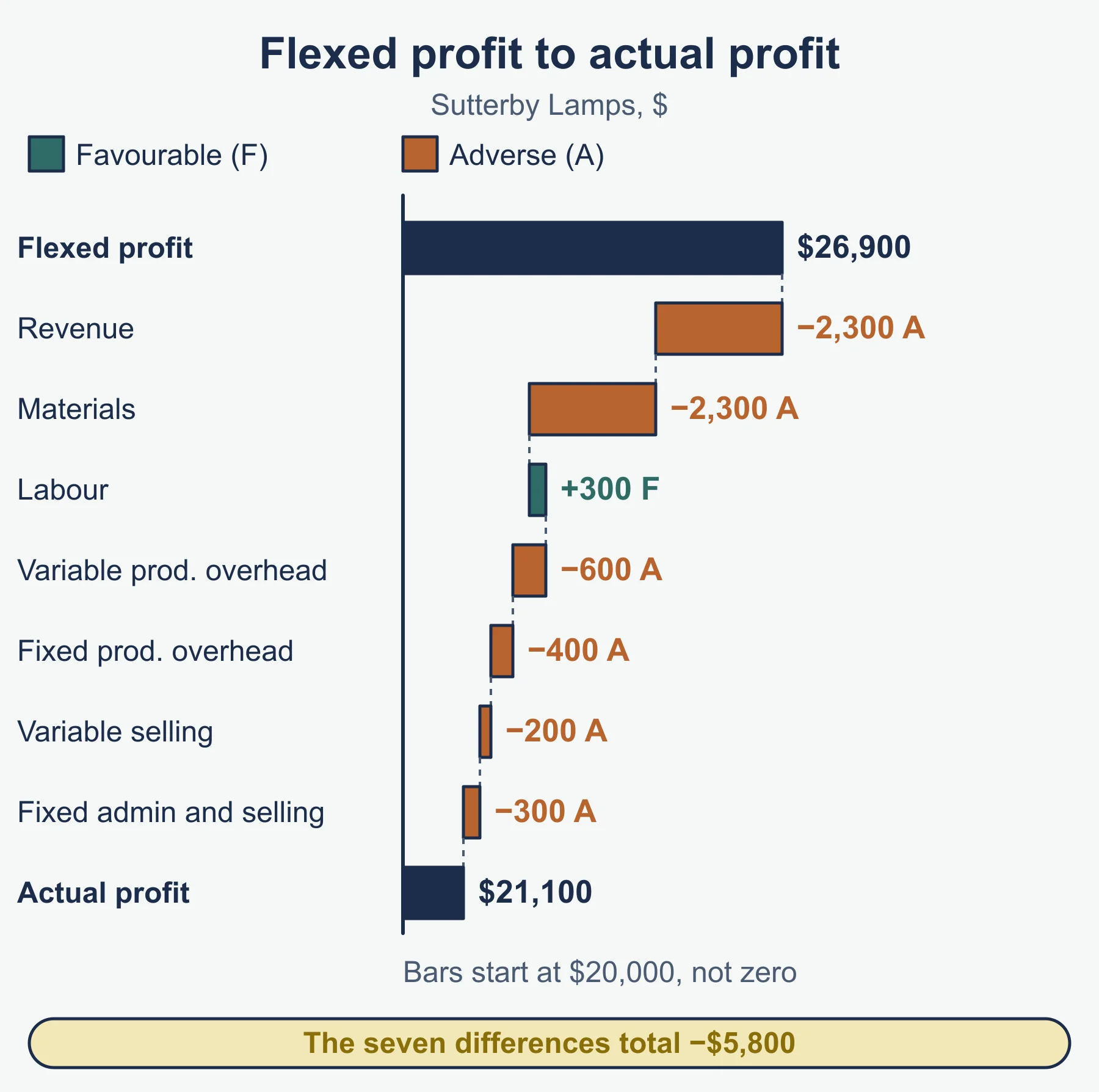
Thurlow Bikes budgeted 800 bikes at 60 each: materials 18, labour 14 and variable overhead 6 per bike, plus fixed overhead 9,600. It made and sold 950 bikes. Actual: revenue 56,050, materials 16,150, labour 14,250, variable overhead 5,700, fixed overhead 9,900.
| Fixed budget 800 | Flexed budget 950 | Actual 950 | F / (A) | |
|---|---|---|---|---|
| Revenue | 48,000 | 57,000 | 56,050 | (950) |
| Materials | 14,400 | 17,100 | 16,150 | 950 |
| Labour | 11,200 | 13,300 | 14,250 | (950) |
| Variable overhead | 4,800 | 5,700 | 5,700 | 0 |
| Fixed overhead | 9,600 | 9,600 | 9,900 | (300) |
| Profit | 8,000 | 11,300 | 10,050 | (1,250) |
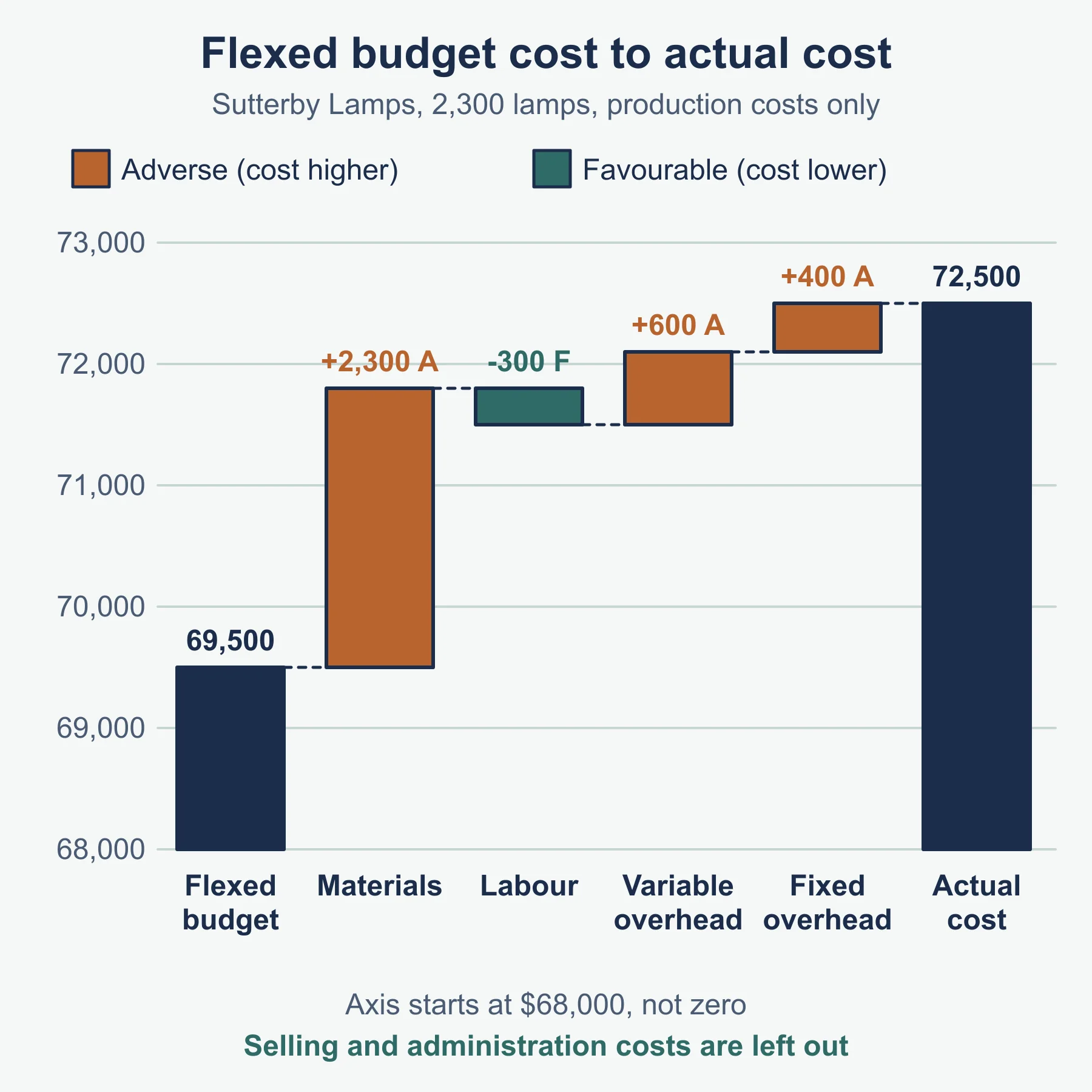
Cost of production: flexed 45,700, less materials 950 favourable, plus labour 950 adverse, plus fixed overhead 300 adverse = actual 46,000.
Profit: flexed 11,300 - 950 (revenue) + 950 (materials) - 950 (labour) - 300 (fixed overhead) = actual 10,050.
Fixed budget profit 8,000 plus volume effect 3,300 (150 extra bikes x 22 contribution) gives the flexed profit of 11,300.
Method for the budgeted statements
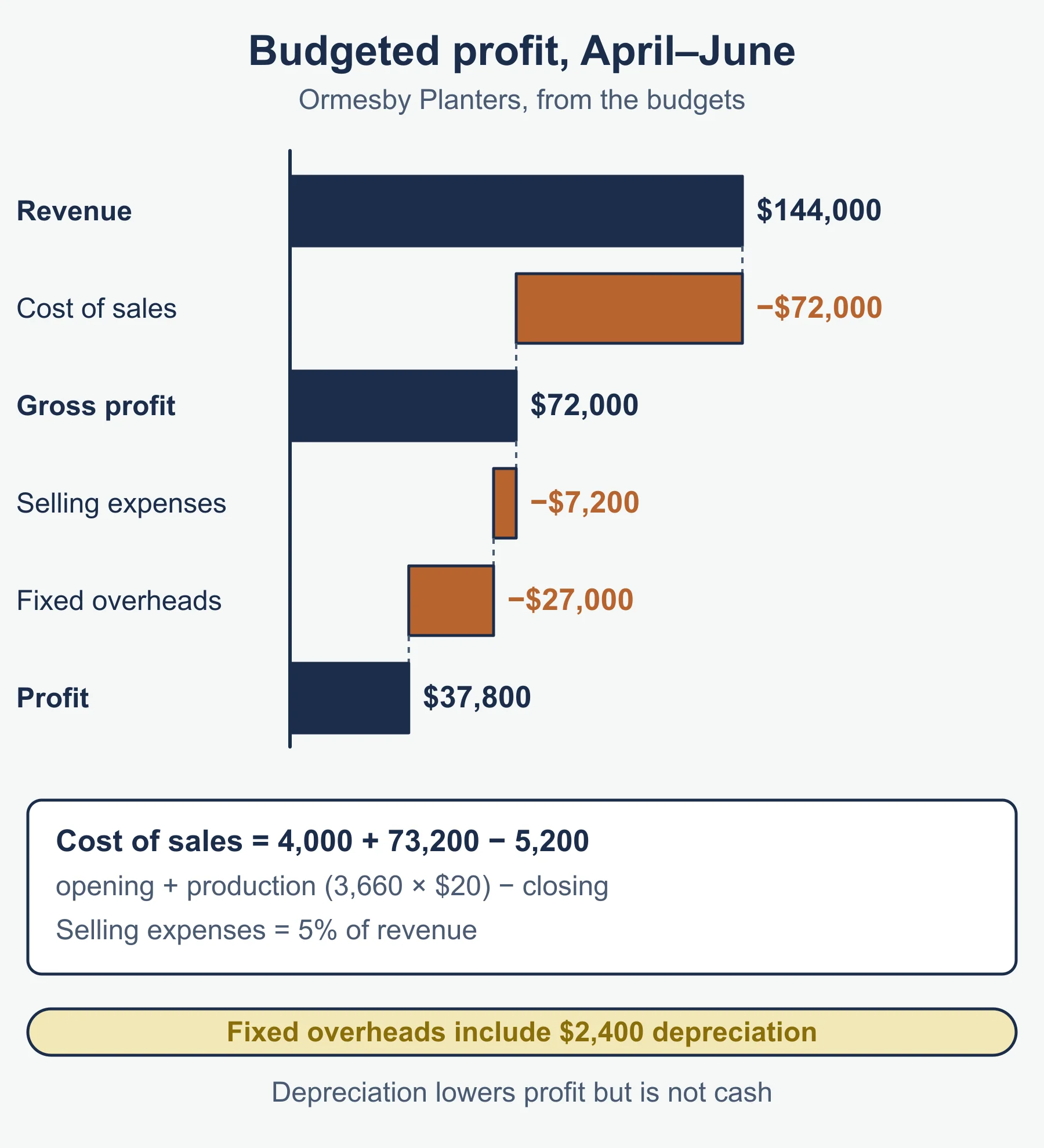
- Statement of profit or loss: revenue from the sales budget; cost of sales = opening finished goods + production cost - closing finished goods; deduct selling and fixed overheads; include depreciation here even though it is not in the cash budget.
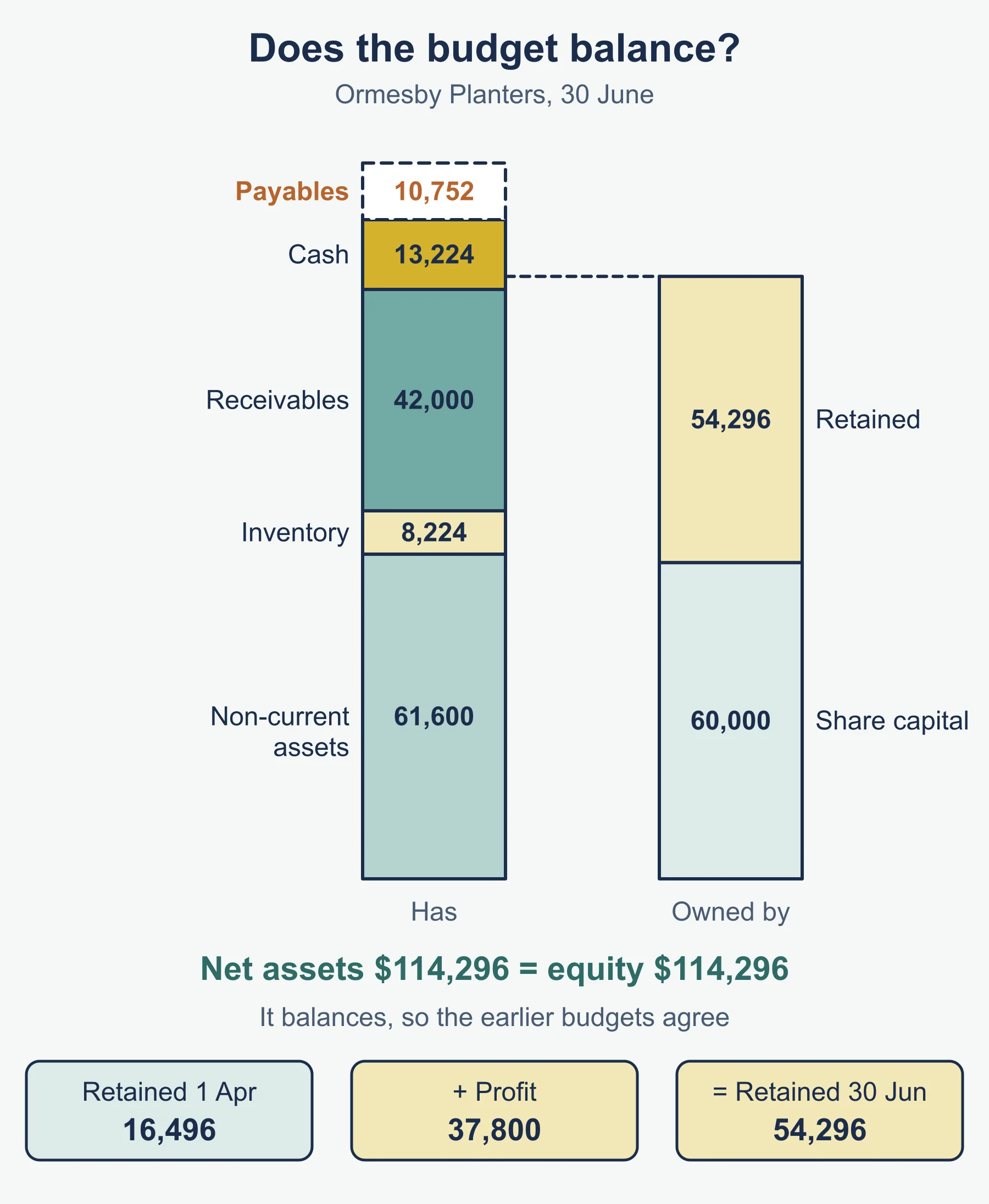
- Statement of financial position: non-current assets = opening + purchases - depreciation; inventory from the production and purchases budgets; receivables and payables from their budgets; cash from the cash budget; equity = opening equity + budgeted profit (less any drawings or dividends).
- Check that total assets less liabilities equal equity. An imbalance points to an error in an earlier budget.
Why flexible budgets beat fixed budgets
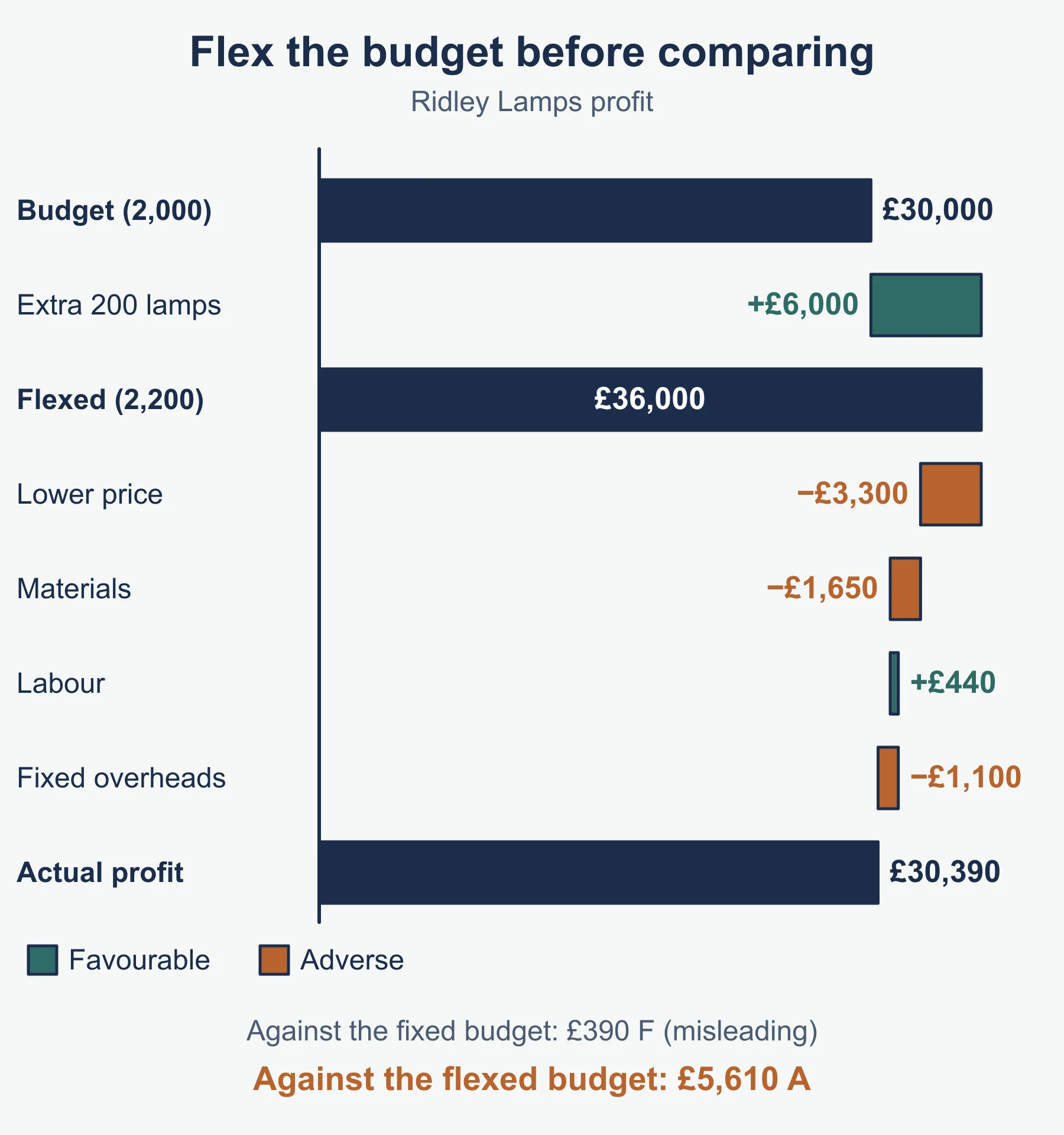
- The comparison is like for like, because both sets of figures relate to the same output.
- Managers are held to account for price, efficiency and spending, not for sales volume they did not control.
- Targets look fairer, so they are more likely to be accepted.
- The size of the difference caused by volume alone can be shown separately (extra units x contribution per unit).
Layout of the two reconciliations
| Cost of production | Profit |
|---|---|
| Flexible budgeted cost of production | Flexible budgeted profit |
| Add adverse / deduct favourable: materials, labour, variable production overhead, fixed production overhead | Add favourable / deduct adverse: revenue, materials, labour, overheads, selling and administration costs |
| Actual cost of production | Actual profit |
Notice the direction. A favourable cost difference lowers the cost of production, but raises profit.
Causes of differences
- Price: supplier changes, discounts, pay awards, inflation, selling price cuts.
- Quantity or efficiency: waste, material quality, machine breakdown, staff skill and training, overtime.
- Overheads: unplanned repairs, rent or utility changes.
- Planning: an unrealistic budget in the first place.
Differences can be linked: cheaper material may lower the price paid but raise waste and labour time.
Behavioural aspects
| Issue | Positive effect | Risk |
|---|---|---|
| Targets | Stretching but achievable targets give direction | Too easy: complacency. Too hard: demotivation |
| Participation | Ownership and commitment | Slack built into requests |
| Imposed budgets | Speed; alignment with objectives | Resentment, low acceptance |
| Incentives | Effort aimed at targets | Manipulation, short-termism, cutting quality |
| Controllability | Fair judgement | Blame for costs a manager cannot influence |
Non-financial factors
Staff morale and turnover, customer satisfaction, quality, supplier relationships, environmental impact, reputation, ethics, long-term sustainability. In a recommendation, give a balance of reasons, then a justified decision.
Quick self-test
- Define a master budget.
- Sales are 450 units, opening inventory is 60 and closing inventory is 90. How many units are produced?
- A firm uses 1,200 kg of material, with opening inventory of 150 kg and closing inventory of 200 kg. What is the purchases quantity, and the cost at 3.20 per kg?
- Why is depreciation left out of a cash budget?
- Sales were 10,000 (January) and 12,000 (February). Customers pay 70% one month after sale and 30% two months after. What is received in March?
- Variable costs are 18,000 at 600 units. What is the flexed figure at 750 units?
- Give two causes of an adverse materials difference.
- State one limiting factor and one way to ease it.
- Flexed profit is 14,200. Revenue is 800 favourable, materials 1,400 adverse, labour 700 adverse and other items nil. What is actual profit?
- Opening receivables are 8,500, credit sales 41,000 and cash received 39,000. What is the closing balance?
- Why compare actual results with a flexed rather than a fixed budget?
- Give one advantage and one disadvantage of imposed budgets.
Answers
- The summary of all the budgets, usually the budgeted statement of profit or loss, statement of financial position and cash budget.
- 450 + 90 - 60 = 480 units.
- 1,200 + 200 - 150 = 1,250 kg; 1,250 x 3.20 = 4,000.
- It is a non-cash expense; no money leaves the business.
- 30% x 10,000 + 70% x 12,000 = 3,000 + 8,400 = 11,400.
- 18,000 / 600 = 30 per unit; 30 x 750 = 22,500.
- For example a supplier price rise, or extra waste from poor quality or machine faults.
- Skilled labour is scarce; train staff, use overtime or subcontract.
- 14,200 + 800 - 1,400 - 700 = 12,900.
- 8,500 + 41,000 - 39,000 = 10,500.
- The flexed budget is at actual activity, so remaining differences come from price, efficiency and spending, not volume.
- Advantage: quick and aligned with objectives. Disadvantage: managers may reject targets they did not help set.
Where marks are usually lost
- Production budget: using sales units alone, or reversing opening and closing inventory.
- Putting depreciation, or credit sales rather than cash received, in the cash budget.
- Using the wrong collection timing when customers pay over two months.
- Flexing fixed costs, or leaving variable costs at the fixed budget level.
- Adding and subtracting in the wrong direction in a reconciliation; label each line favourable or adverse.
- Reconciling the production cost but including selling costs.
- Listing advantages and disadvantages without applying them to the business in the question.
- Recommendations that ignore non-financial factors or give no justified conclusion.
- Statement of financial position that does not balance, usually from a missed cash or retained earnings figure.
Frequently asked questions
Which section of Cambridge 9706 covers budgeting? Section 4.3 Budgeting and budgetary control is A Level content in Cambridge International AS and A Level Accounting 9706. It covers budgetary control, spreadsheets, the master budget, flexible budgets, reconciliations and behavioural aspects.
What are the two budget reconciliation statements? One reconciles the flexible budgeted cost of production with the actual cost of production, and the other reconciles flexible budgeted profit with actual profit. Selling and administration costs belong only in the profit reconciliation.
How do you calculate the production budget? Production = sales + closing inventory − opening inventory. Using sales units alone, or reversing opening and closing inventory, is a common mistake.
What are the advantages of preparing budgets on a spreadsheet? Formulas recalculate every linked budget instantly when an assumption changes, which makes what-if testing quick. However, a wrong formula or hard-coded number can pass unnoticed and spread through linked budgets.
Official syllabus
Cambridge International AS & A Level Accounting 9706 syllabus for 2026, 2027 and 2028, section 4.3 Budgeting and budgetary control, published by Cambridge International.
Get free revision emails (optional)
Occasional emails with practice questions, worked explanations and links to free resources for the qualification and subjects you choose. No spam, and you can unsubscribe from any email. The free tools on this site never need an email.
Related resources
-
Study guides
A Level Accounting: Accounting for Non-Current Assets (Cambridge 9706)
Capital versus revenue spending, why assets depreciate depreciation methods, cost and revaluation models and disposals, for Cambridge 9706 Accounting topic 1.3.
Accounting · Cambridge · AS Level
Read guide -
Study guides
A Level Accounting: Costs, cost behaviour and traditional costing methods (Cambridge 9706)
A study guide to cost classification, inventory valuation, absorption and marginal costing and break-even analysis for Cambridge AS & A Level Accounting.
Accounting · Cambridge · AS Level
Read guide -
Practice questions
A Level Accounting: Costs, cost behaviour and traditional costing (Cambridge 9706) – Practice Questions
Eleven original questions with worked answers on cost behaviour, inventory, absorption and marginal costing and decisions for Cambridge 9706 AS Accounting.
Accounting · Cambridge · AS Level
Try questions
Related articles
-
teaching
A Level tuition in Dubai: Cambridge or Pearson Edexcel International A Level?
Schools in Dubai and Abu Dhabi teach either Cambridge International AS & A Level or Pearson Edexcel International A Level. How the two are structured, why it matters for tuition, and how online classes from Lahore work.
9 October 2026
-
curriculum guides
Choosing subjects at IGCSE and A Level
How subject choices at 14 and 16 affect university options later, and how to keep pathways open without overloading a timetable.
28 July 2026
Studying this with a teacher
Working through Accounting A LEVEL?
This page is free and stays free. If you would rather be taught it, Marlbridge runs Accounting classes one-to-one and in small groups of up to 15, online in your own time zone. The first trial class is free. WhatsApp replies within an hour (8am–11pm Pakistan time, every day); email the same day.
Cambridge Accounting teachers at Marlbridge

