
Study Guides
A Level Accounting: Investment appraisal (Cambridge 9706)
Payback, accounting rate of return, NPV and IRR, cash flows versus profits, and non-financial factors, for Cambridge A Level Accounting 9706 section 4.4.
- Subject
- Accounting
- Level
- A LEVEL
- Topic
- Cost and management accounting
- Author
- Marlbridge Academic Team
- Updated
- Reviewed by
- Zain Ud Din Ahmed (what this means)
Aligned to Cambridge A Level Accounting (9706), 2026-2028. Official specification .
Syllabus page (what it covers and how it is assessed): Cambridge A Level Accounting.
Syllabus points this page covers
9706 (A Level)
- 4.4 Investment appraisal
Found an error? Report a correction.
Need help with this topic? Request a free trial class for A Level Accounting (9706).
This guide covers 4.4 Investment appraisal (4.4.1), A Level content within Topic 4, Cost and management accounting, for the Cambridge International AS & A Level Accounting 9706 syllabus for 2026, 2027 and 2028. All businesses and figures are invented and all amounts are in dollars. Practise on the practice questions, condense the ideas with the revision notes, and check your readiness with the free diagnostics. See also the course hub and the printable checklist.
What the syllabus asks for
| 4.4.1 point | What you must be able to do |
|---|---|
| Future net cash inflows and outflows | Identify the cash flows a project causes, and separate them from accounting profit |
| Payback | Calculate and interpret |
| Accounting rate of return (ARR) | Calculate using average profit divided by average investment, times 100 |
| Net present value (NPV) | Discount cash flows and interpret the result |
| Internal rate of return (IRR) | Find by trial rates and interpolation, and interpret |
| Advantages and disadvantages | Judge each technique |
| Investment decisions and recommendations | Use the data to recommend, with reasons |
| Non-financial factors | Explain how they affect the decision |
The syllabus states that questions on discounted payback will not be set, and that questions involving a residual value at the end of a project will not be set. This guide leaves both out.
Cash flows, not profits
An investment appraisal asks whether spending money now is worth the cash it brings back later. The relevant items are the future net cash inflows and outflows caused by the project. Accounting profit is a different measure, because it follows the accruals concept.
Differences between profit and cash flow include:
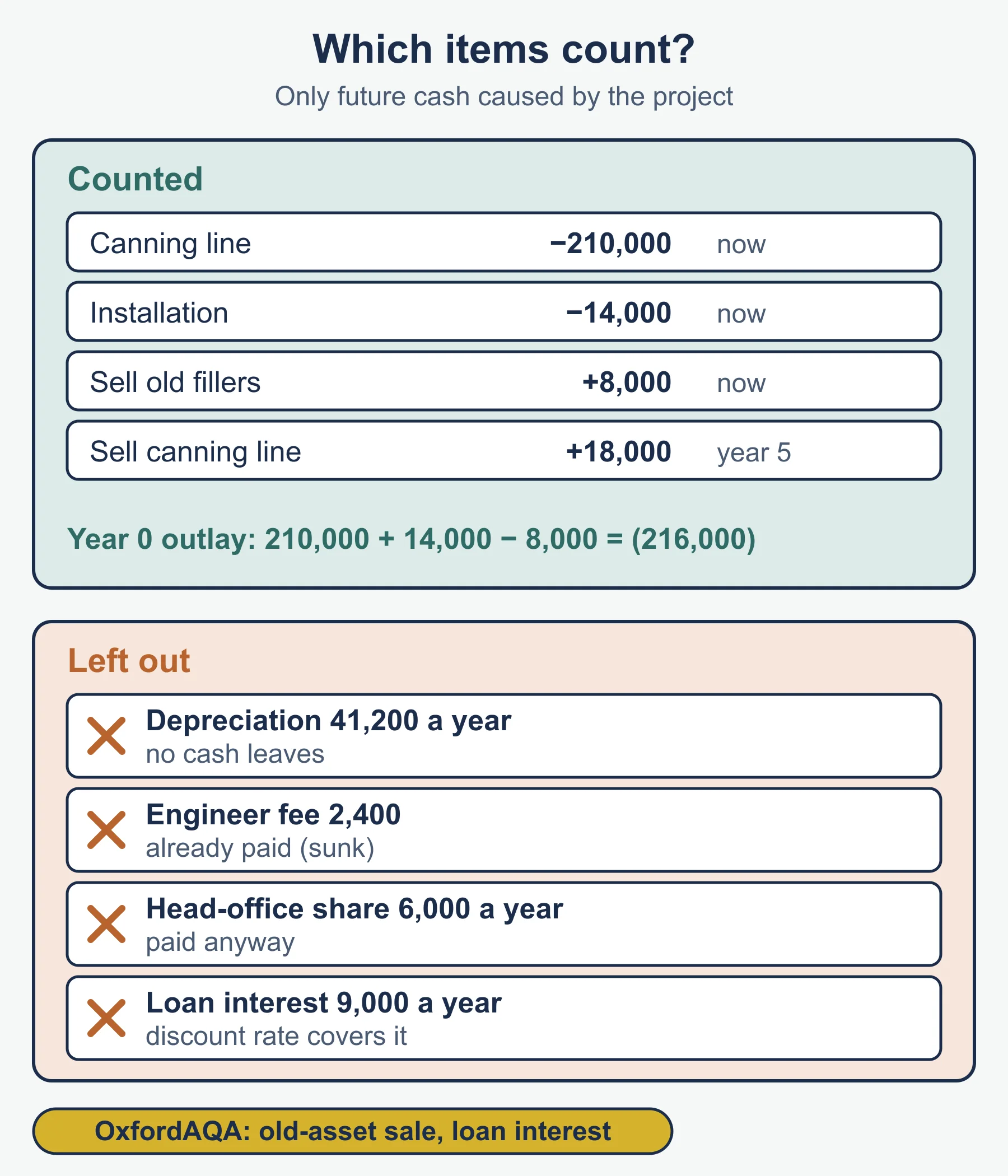
- Depreciation reduces profit but no cash leaves the business, so it is added back.
- Buying the asset is a cash outflow at the start, yet it only reaches profit gradually as depreciation.
- A share of existing head office costs charged to the project is not a new cash flow if those costs continue anyway.
- Money already spent, such as a feasibility fee of 4,000 paid last month, cannot be recovered whichever way the decision goes, so it is left out.
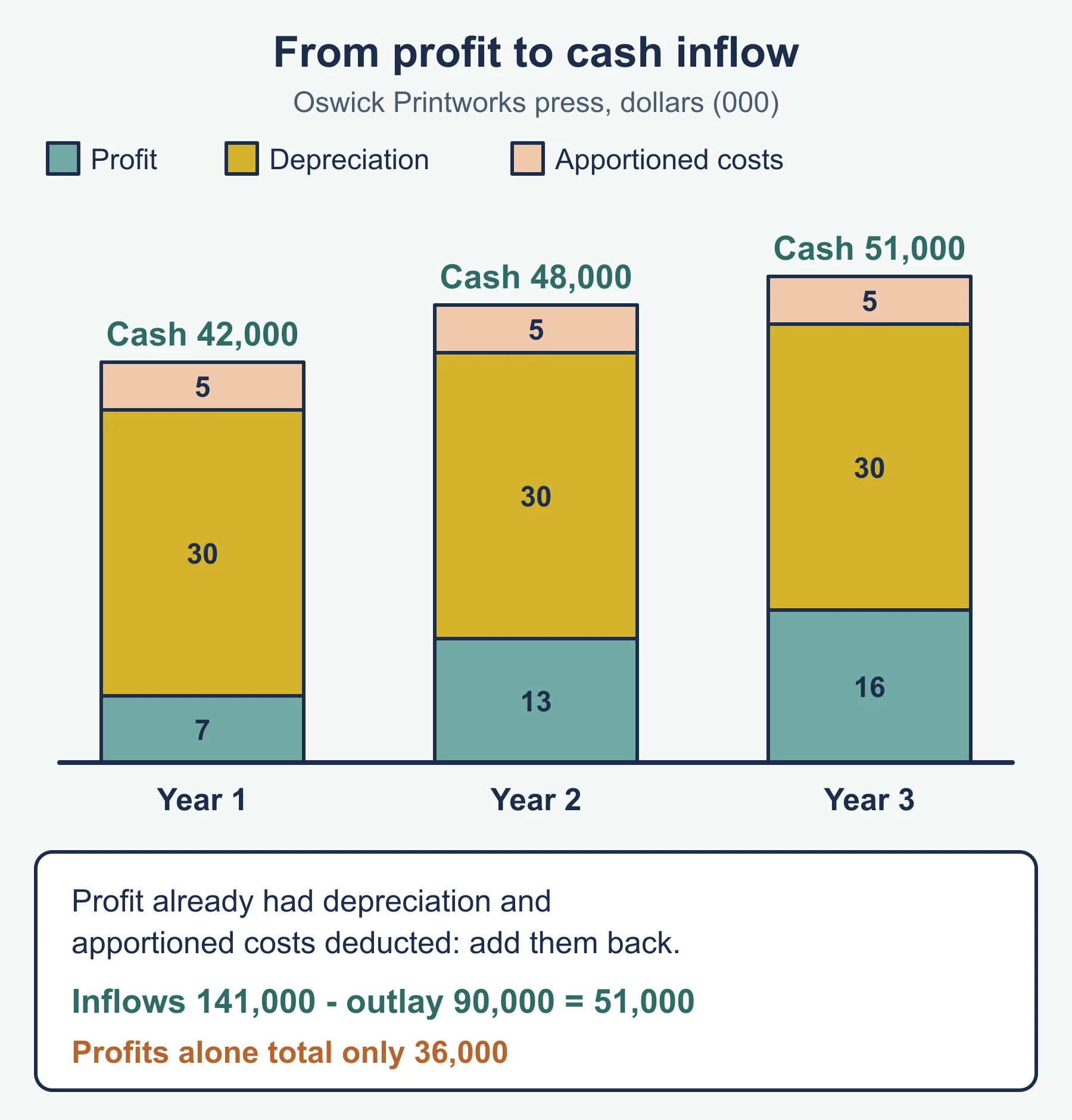
Worked example 1. Oswick Printworks may buy a press for 90,000 (paid at the start, year 0). Its life is 3 years, with straight line depreciation and no residual value, so the charge is 90,000 / 3 = 30,000 a year. The forecast profits already deduct that depreciation and 5,000 a year of apportioned head office costs.
| Year | Profit | Add back depreciation | Add back apportioned costs | Net cash inflow |
|---|---|---|---|---|
| 1 | 7,000 | 30,000 | 5,000 | 42,000 |
| 2 | 13,000 | 30,000 | 5,000 | 48,000 |
| 3 | 16,000 | 30,000 | 5,000 | 51,000 |
The three inflows total 141,000, which is 51,000 more than the 90,000 outlay. The forecast profits total only 36,000, because depreciation and the apportioned costs are deducted in arriving at them.
Payback
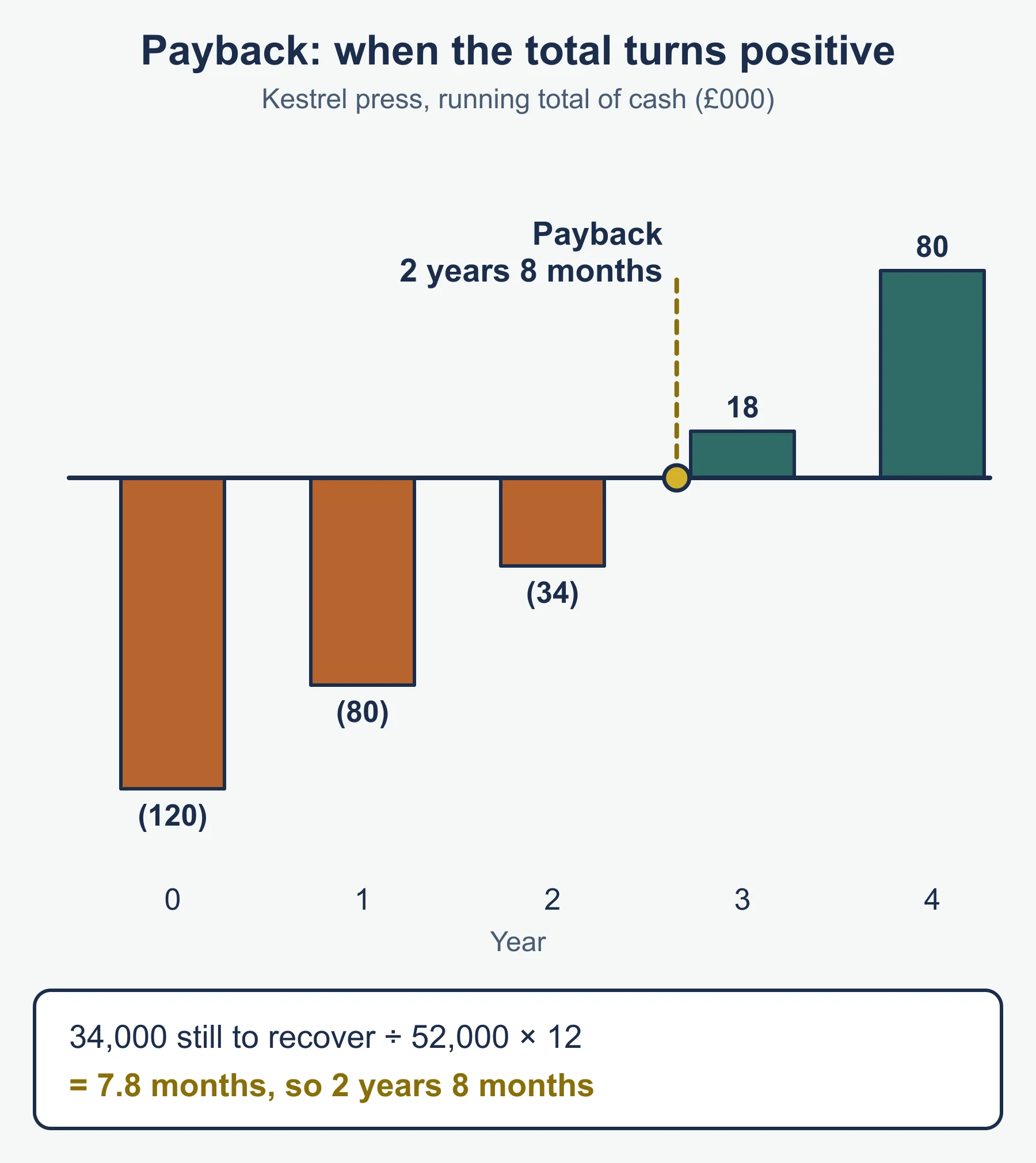
Payback is the time taken for cumulative net cash inflows to repay the initial outlay. For even inflows, divide the outlay by the annual inflow. For uneven inflows, accumulate year by year and assume each year’s cash arrives evenly through the year.
For Oswick, cumulative inflow is 42,000 after year 1 and 90,000 after year 2, so payback is exactly 2 years.
Decision rule: accept if payback is within the business’s target period. If projects compete, the shorter payback is preferred.
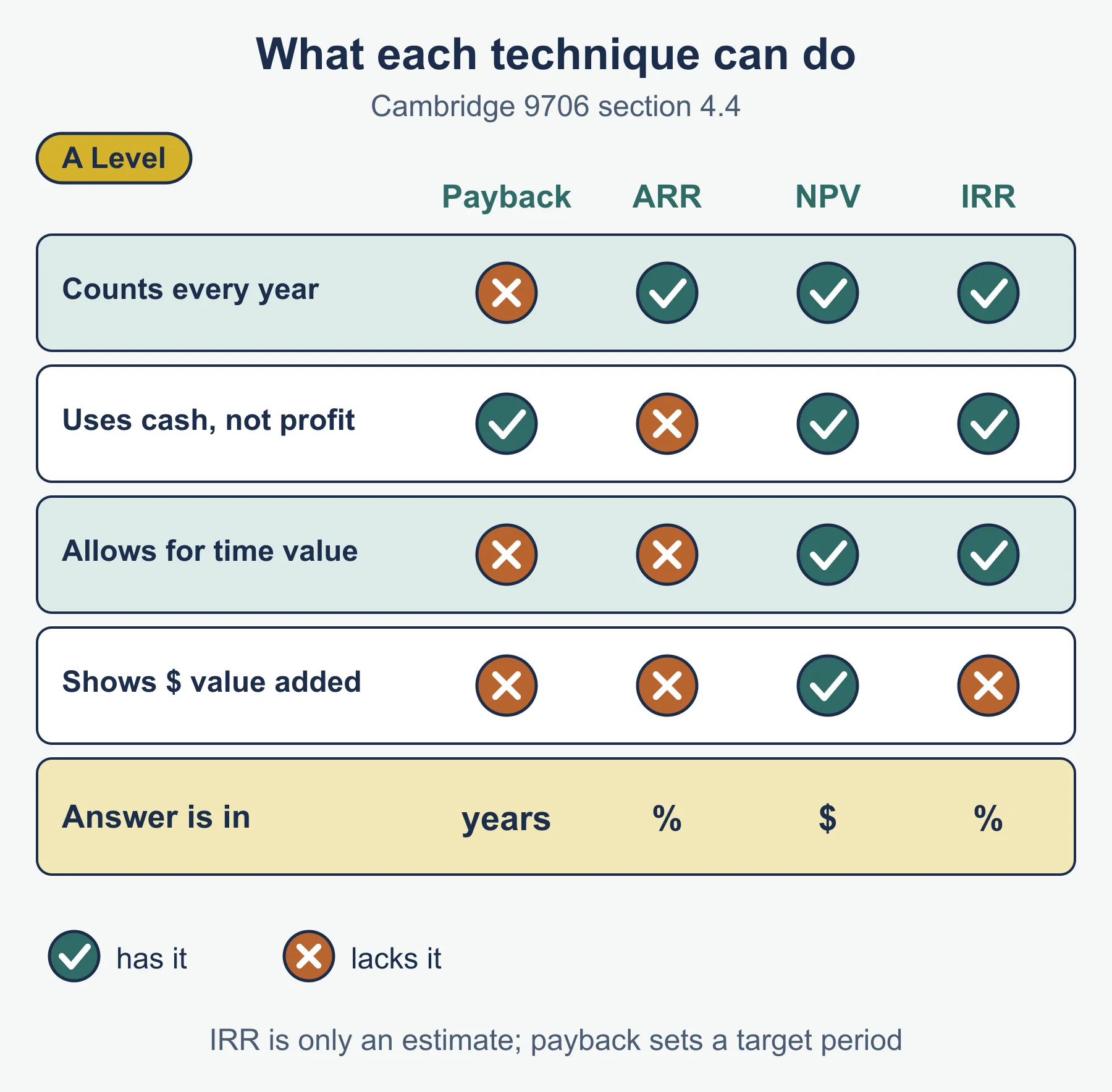
| Advantages | Disadvantages |
|---|---|
| Simple to calculate and explain | Ignores cash flows after the payback date |
| Favours quick return of cash, which helps liquidity | Ignores the time value of money |
| Reduces exposure to forecasts far into the future | The target period is a judgement, not a calculated figure |
Accounting rate of return (ARR)
The syllabus formula is ARR = (average profit / average investment) × 100.
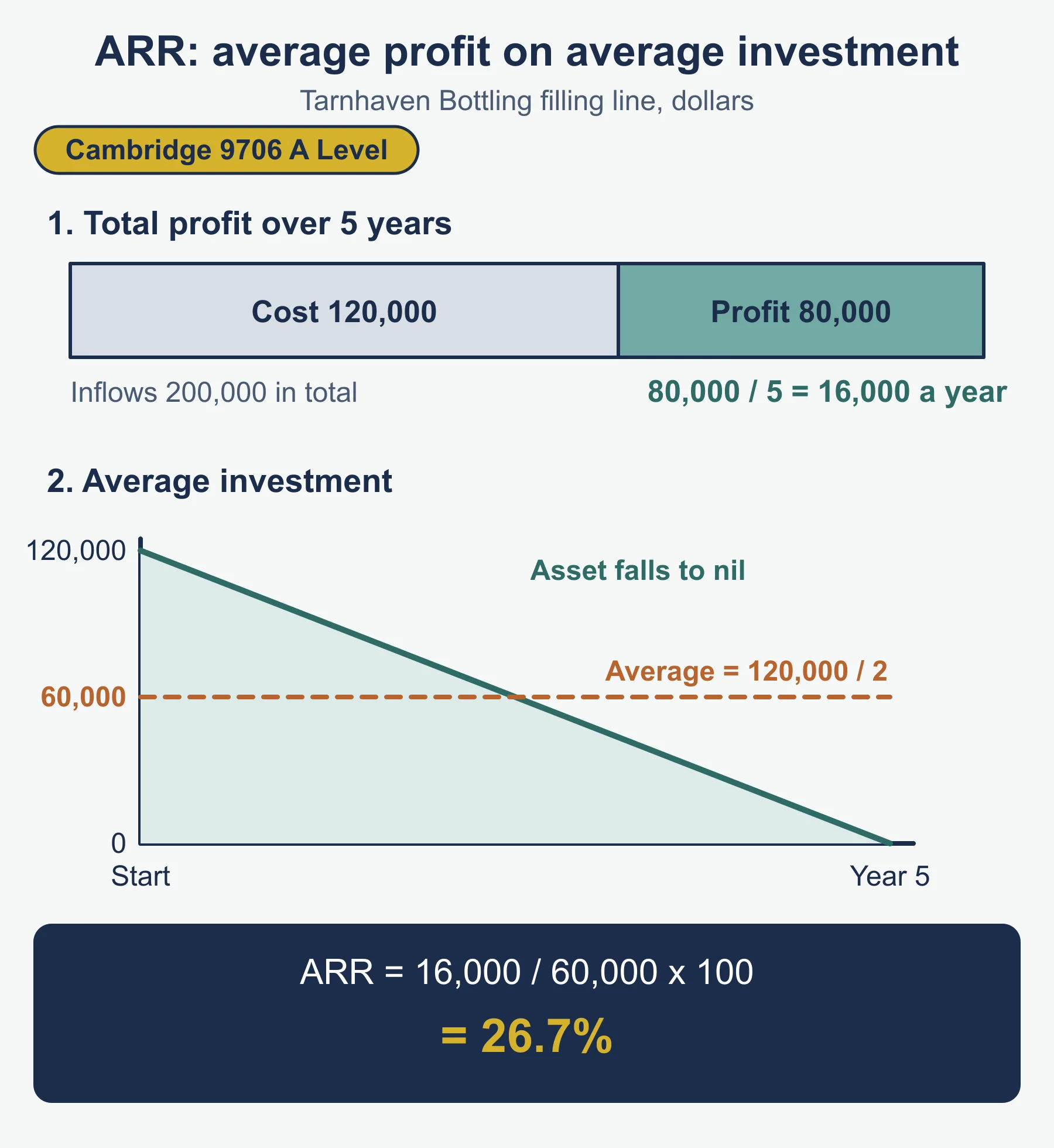
- Average profit = total profit over the life of the project divided by the number of years. Total profit is total net cash inflows minus the cost of the asset (the cost of the asset is spread as depreciation).
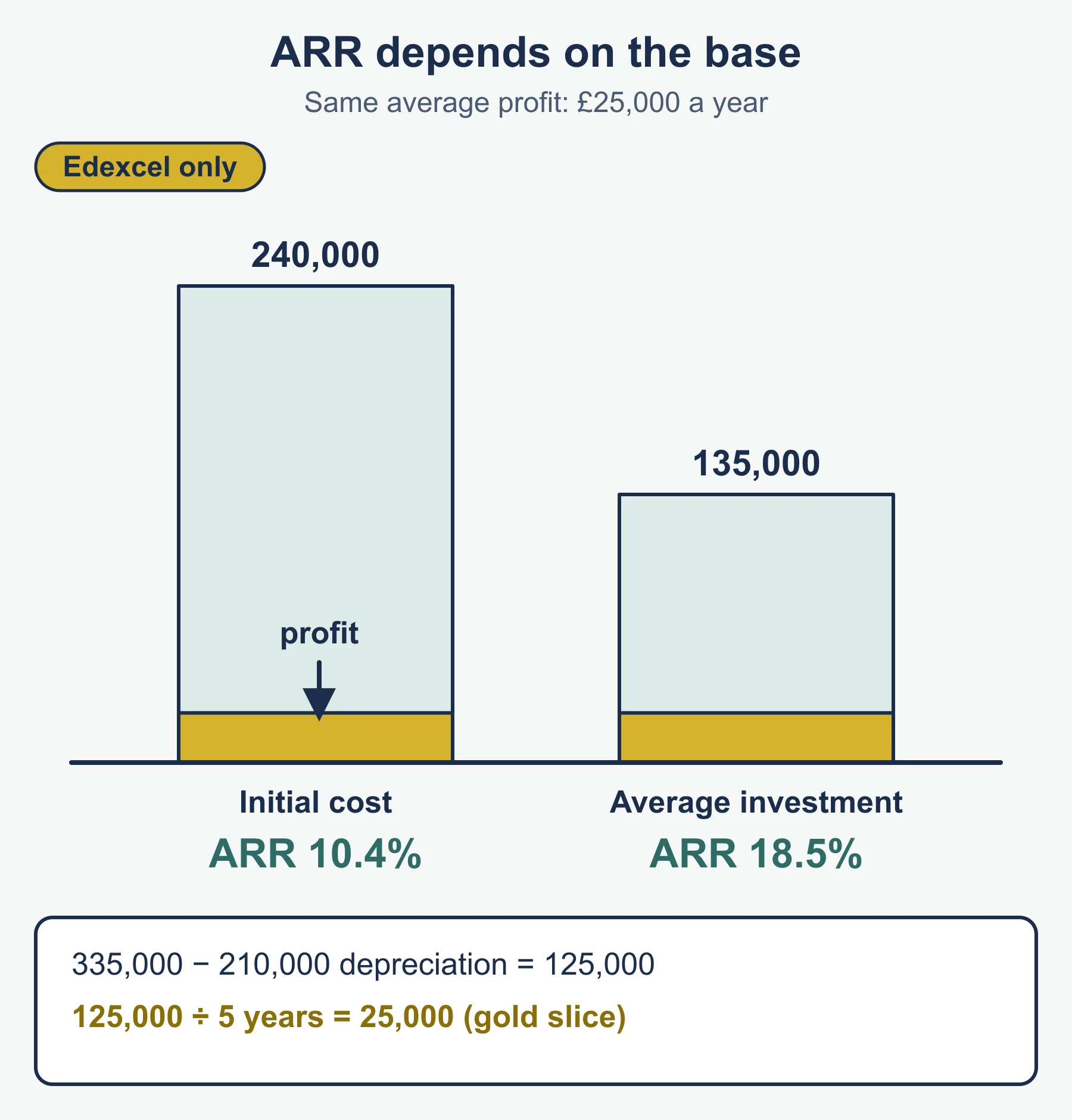
- Average investment = (initial investment + value at the end) / 2. With no residual value this is half the initial cost. Read how a question defines it.
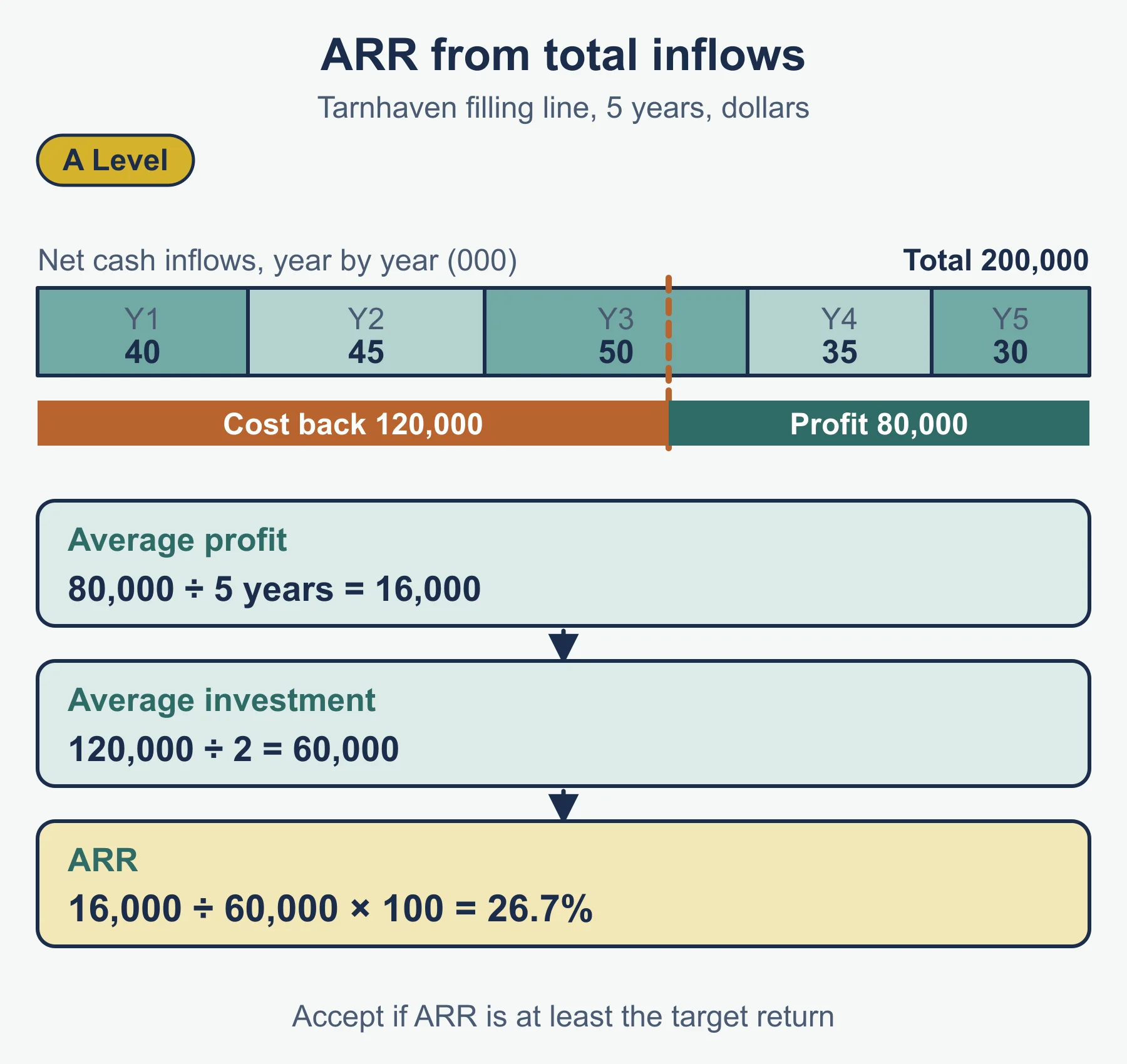
Worked example 2. Tarnhaven Bottling is considering a filling line costing 120,000 with a 5-year life. Net cash inflows are 40,000, 45,000, 50,000, 35,000 and 30,000.
Total inflows 200,000, less cost 120,000, gives total profit of 80,000. Average profit = 80,000 / 5 = 16,000. Average investment = 120,000 / 2 = 60,000. ARR = 16,000 / 60,000 × 100 = 26.7%.
Decision rule: accept if ARR is at least the target return.
| Advantages | Disadvantages |
|---|---|
| Uses profit over the whole life | Based on profit, not cash flow |
| Gives a percentage that is easy to compare with a target | Ignores when profits arise |
| Links to profit measures managers already use | A percentage hides the scale of the project |
Time value of money and net present value (NPV)
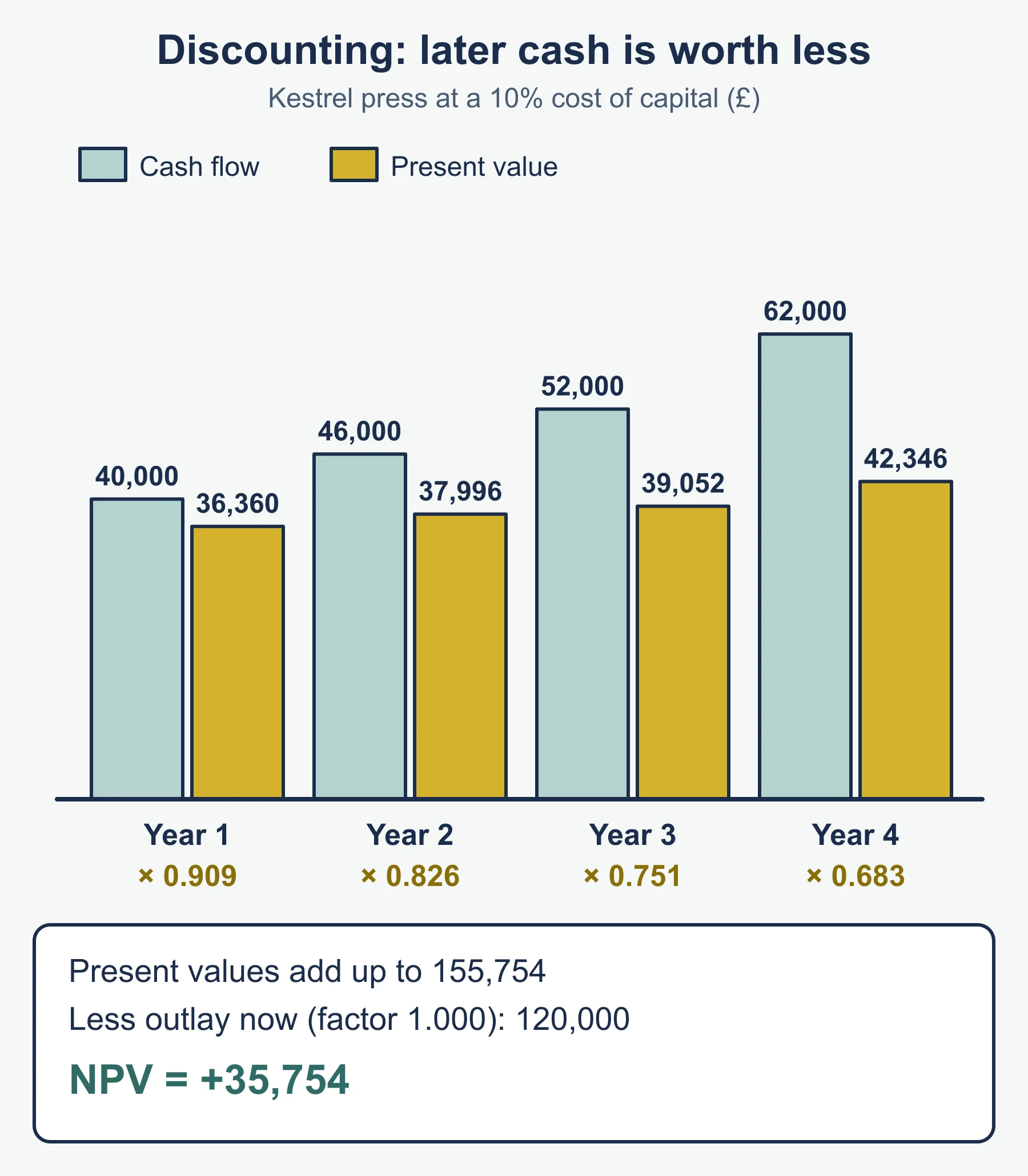
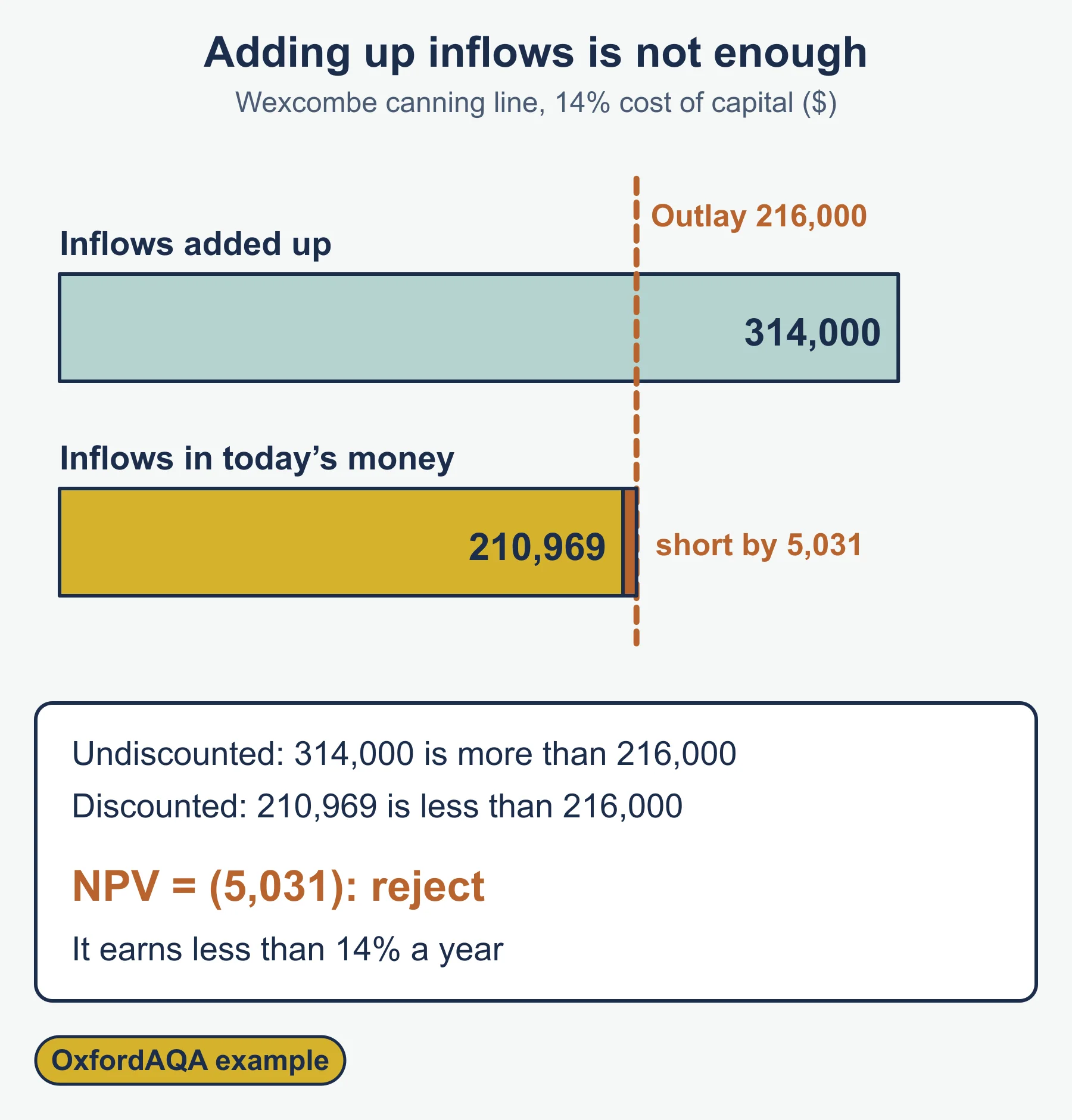
A dollar received next year is worth less than a dollar today, because cash today can be invested or used to repay finance, and because the future is uncertain. Discounting converts each future cash flow into its present value:
present value = cash flow × discount factor, where discount factor = 1 / (1 + r)ⁿ
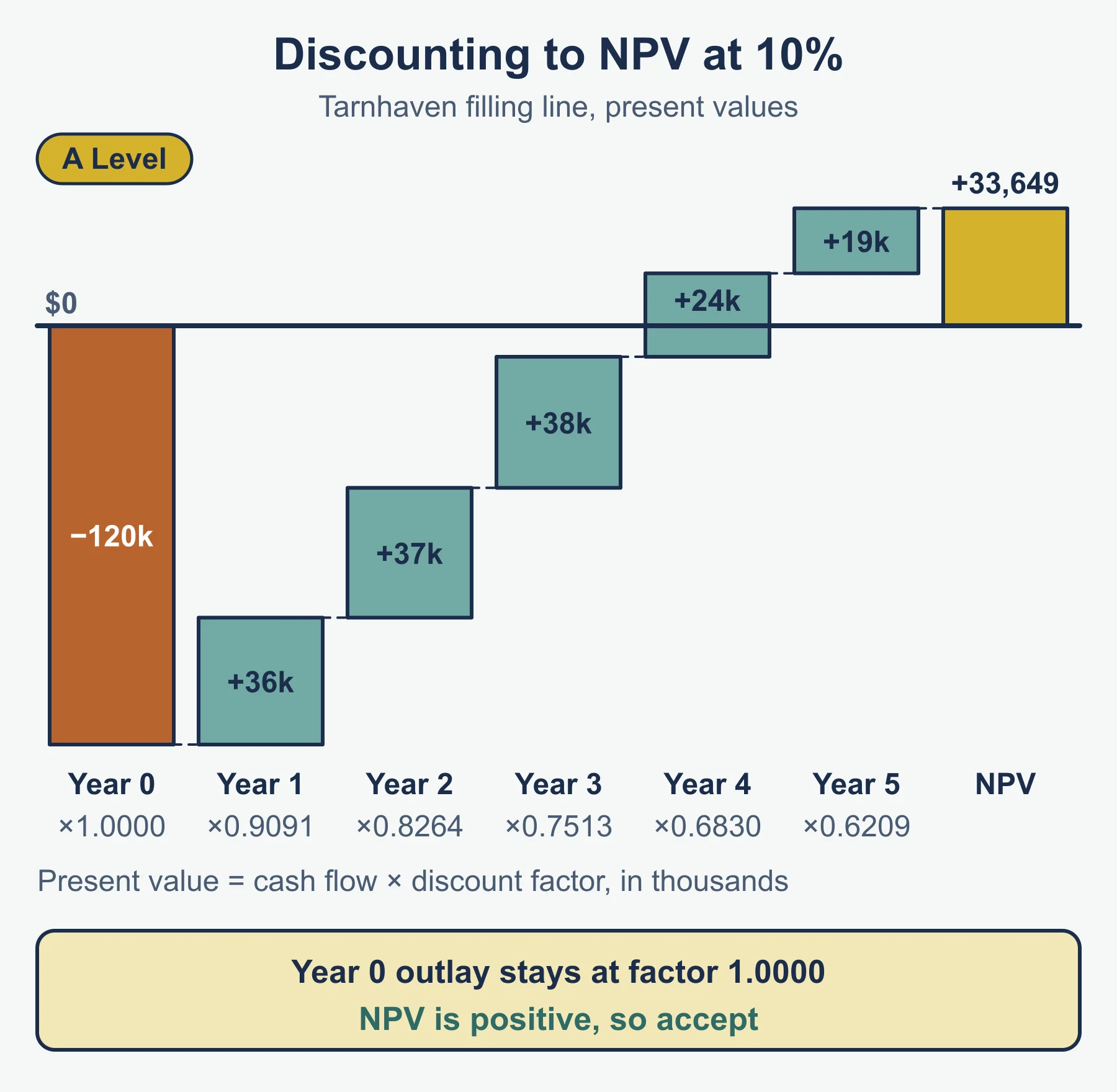
Here r is the business’s cost of capital (the required rate of return) as a decimal and n is the year. Year 0 has a factor of 1. NPV is the sum of the present values, with the outlay shown as negative.
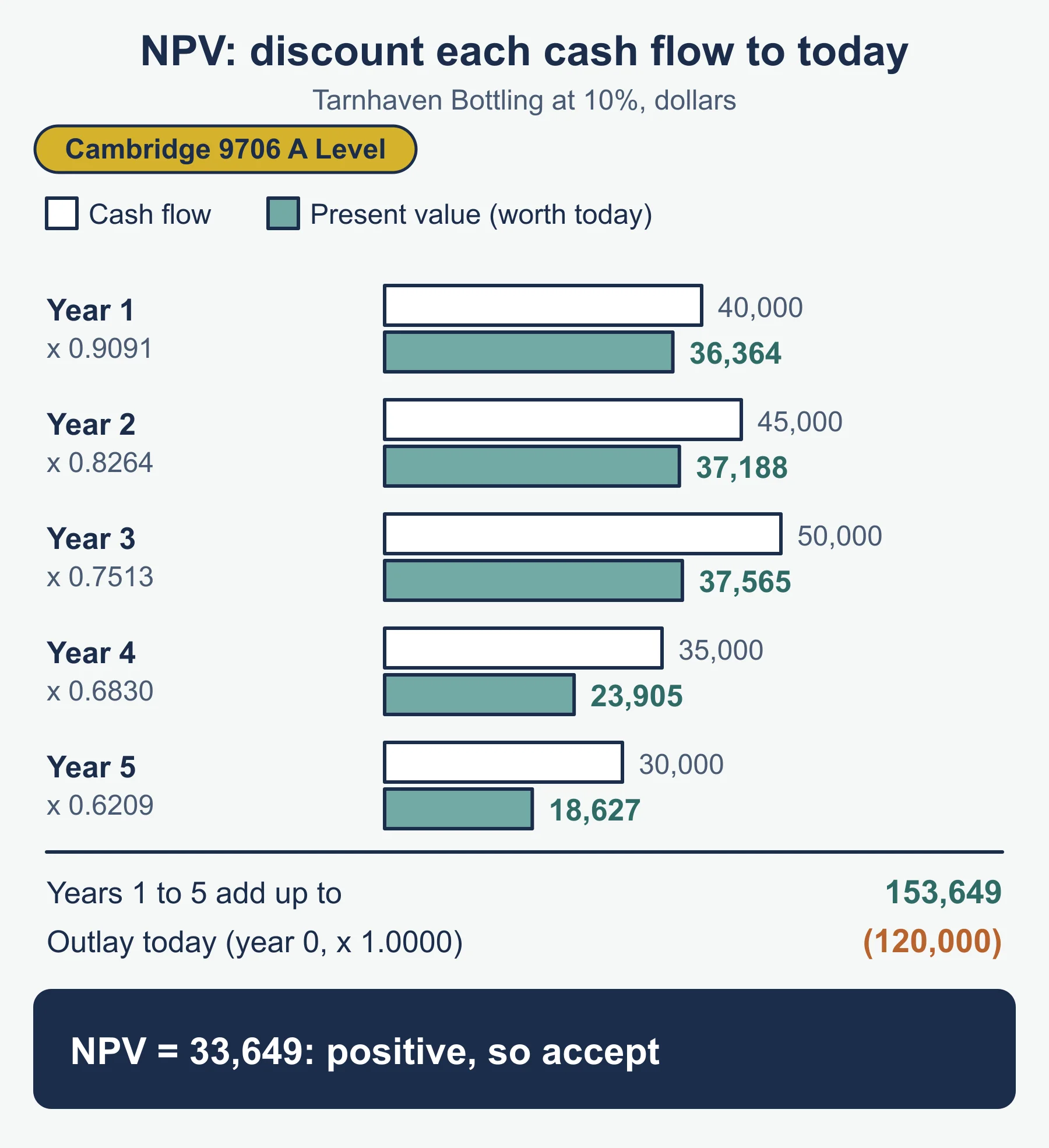
Worked example 3. Tarnhaven discounts at 10%.
| Year | Net cash flow | Factor at 10% | Present value |
|---|---|---|---|
| 0 | (120,000) | 1.0000 | (120,000) |
| 1 | 40,000 | 0.9091 | 36,364 |
| 2 | 45,000 | 0.8264 | 37,188 |
| 3 | 50,000 | 0.7513 | 37,565 |
| 4 | 35,000 | 0.6830 | 23,905 |
| 5 | 30,000 | 0.6209 | 18,627 |
| NPV | 33,649 |
Decision rule: a positive NPV means the project earns more than the required return, so accept. A negative NPV means reject. Among projects that cannot all be done, the higher NPV adds more value.
| Advantages | Disadvantages |
|---|---|
| Recognises the time value of money | Needs an estimated cost of capital |
| Uses all the cash flows | More complex to calculate and explain |
| Gives a dollar value added | Depends on forecasts that may prove wrong |
Internal rate of return (IRR)
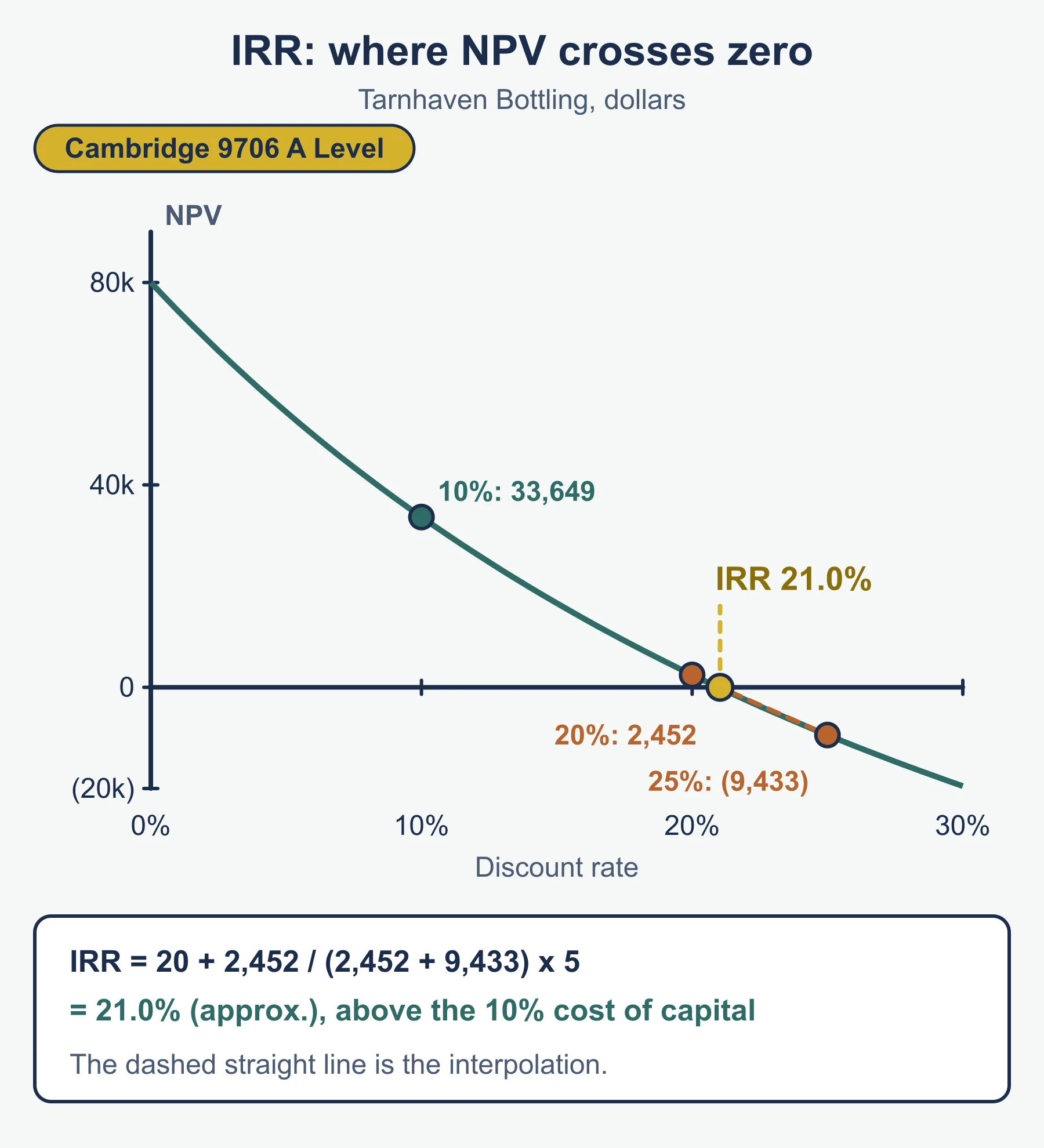
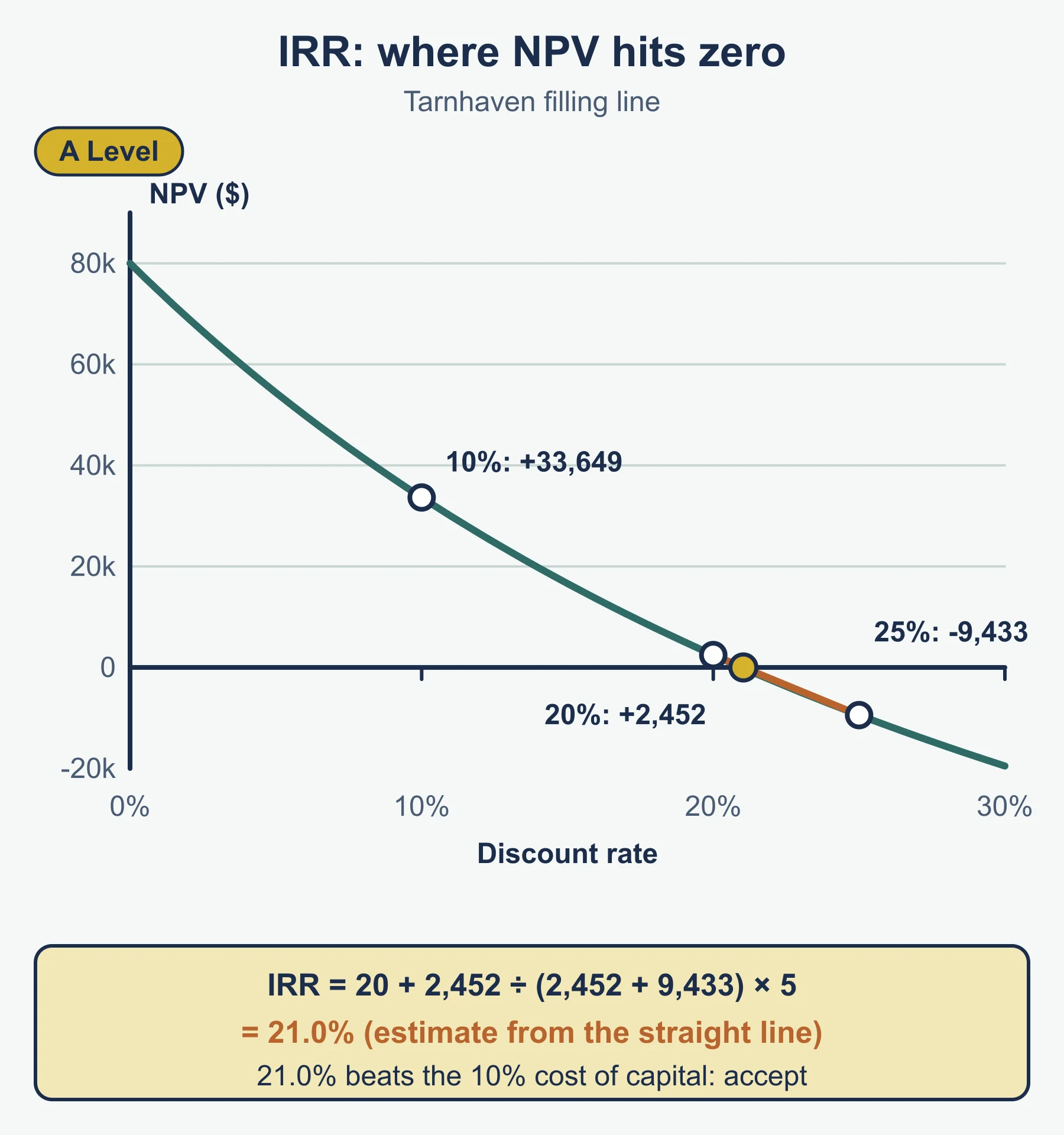
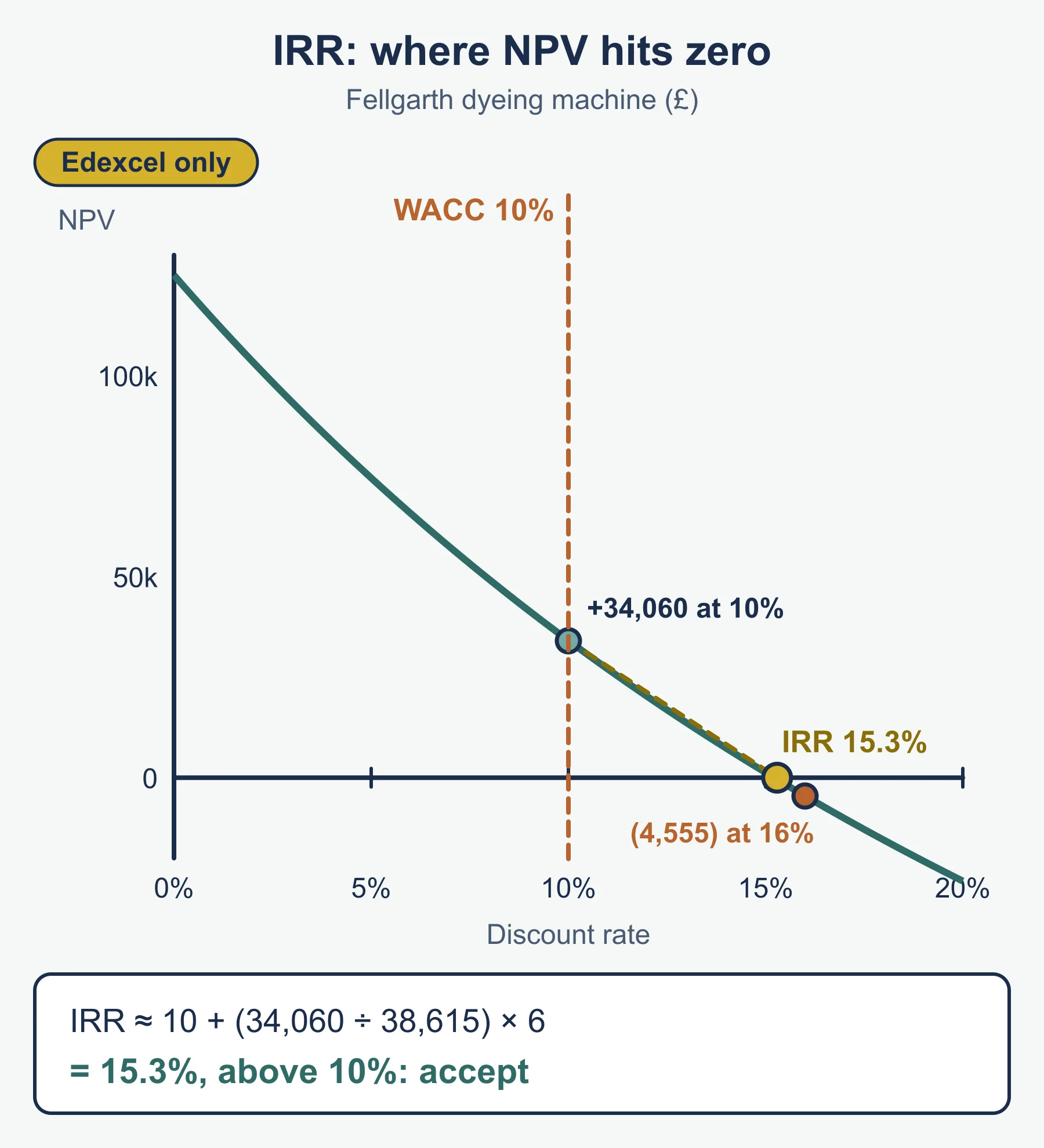
The IRR is the discount rate at which NPV is zero. Calculate NPV at two rates, one giving a positive NPV and one a negative NPV, then interpolate:
IRR = lower rate + [NPV at lower rate / (NPV at lower rate − NPV at higher rate)] × (higher rate − lower rate)
Worked example 4. Using Tarnhaven’s cash flows with factors for 20% (0.8333, 0.6944, 0.5787, 0.4823, 0.4019) and 25% (0.8000, 0.6400, 0.5120, 0.4096, 0.3277), NPV is 2,452 at 20% and (9,433) at 25%.
IRR = 20 + [2,452 / (2,452 + 9,433)] × (25 − 20) = 20 + 1.03 = 21.0% (approximately).
Interpolation assumes NPV falls in a straight line between the two rates, so the answer is an estimate. Choose rates close together for a better one.
Decision rule: accept if the IRR is higher than the cost of capital. Here 21.0% exceeds 10%, which agrees with the positive NPV.
| Advantages | Disadvantages |
|---|---|
| Recognises the time value of money | Interpolation only estimates the rate |
| A percentage compared directly with the cost of capital | Does not show the dollar value added |
| Does not need the cost of capital to be fixed first | Can rank projects differently from NPV |
Making a recommendation
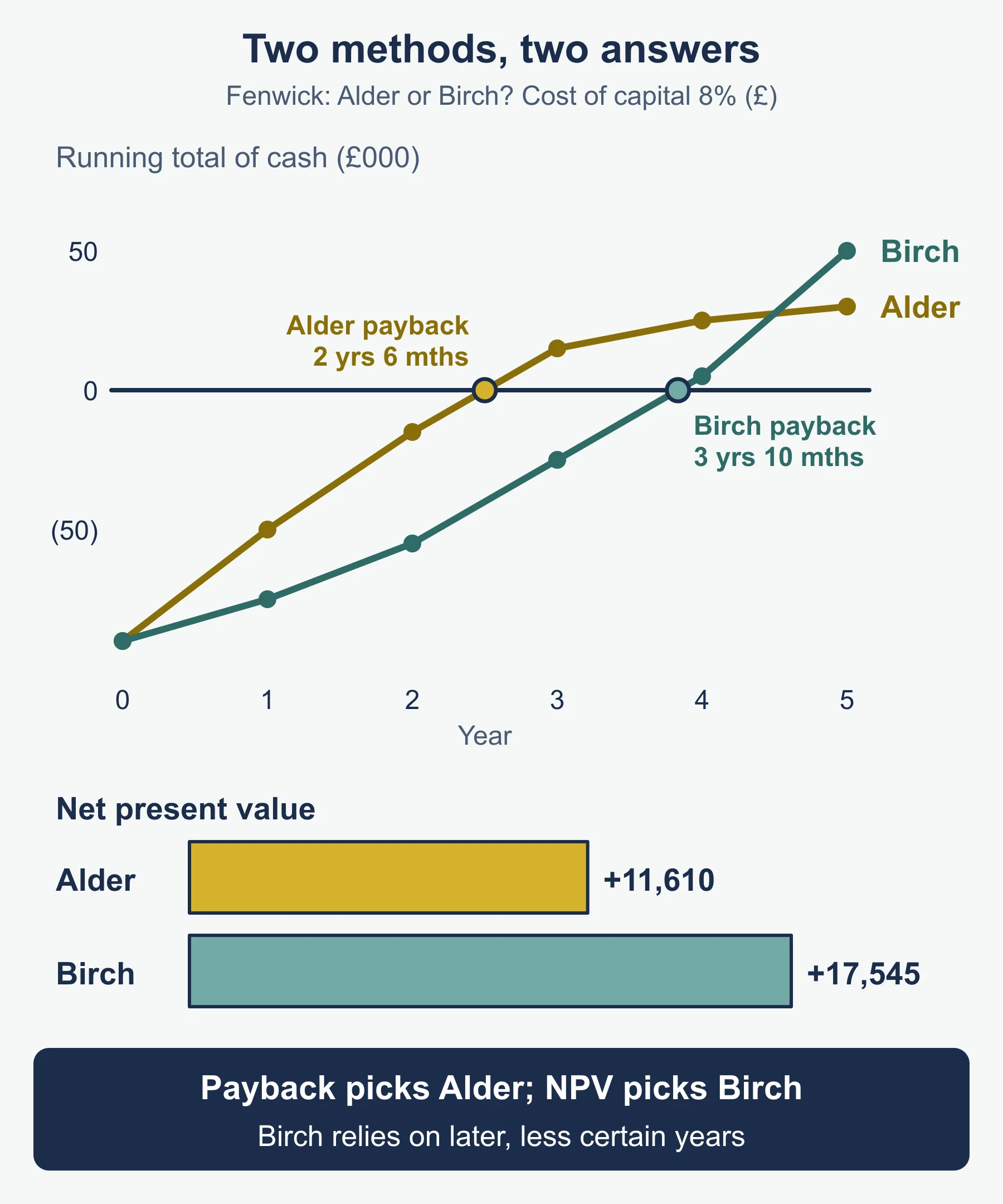
Techniques can disagree, so a recommendation needs a reasoned choice, not one calculation.
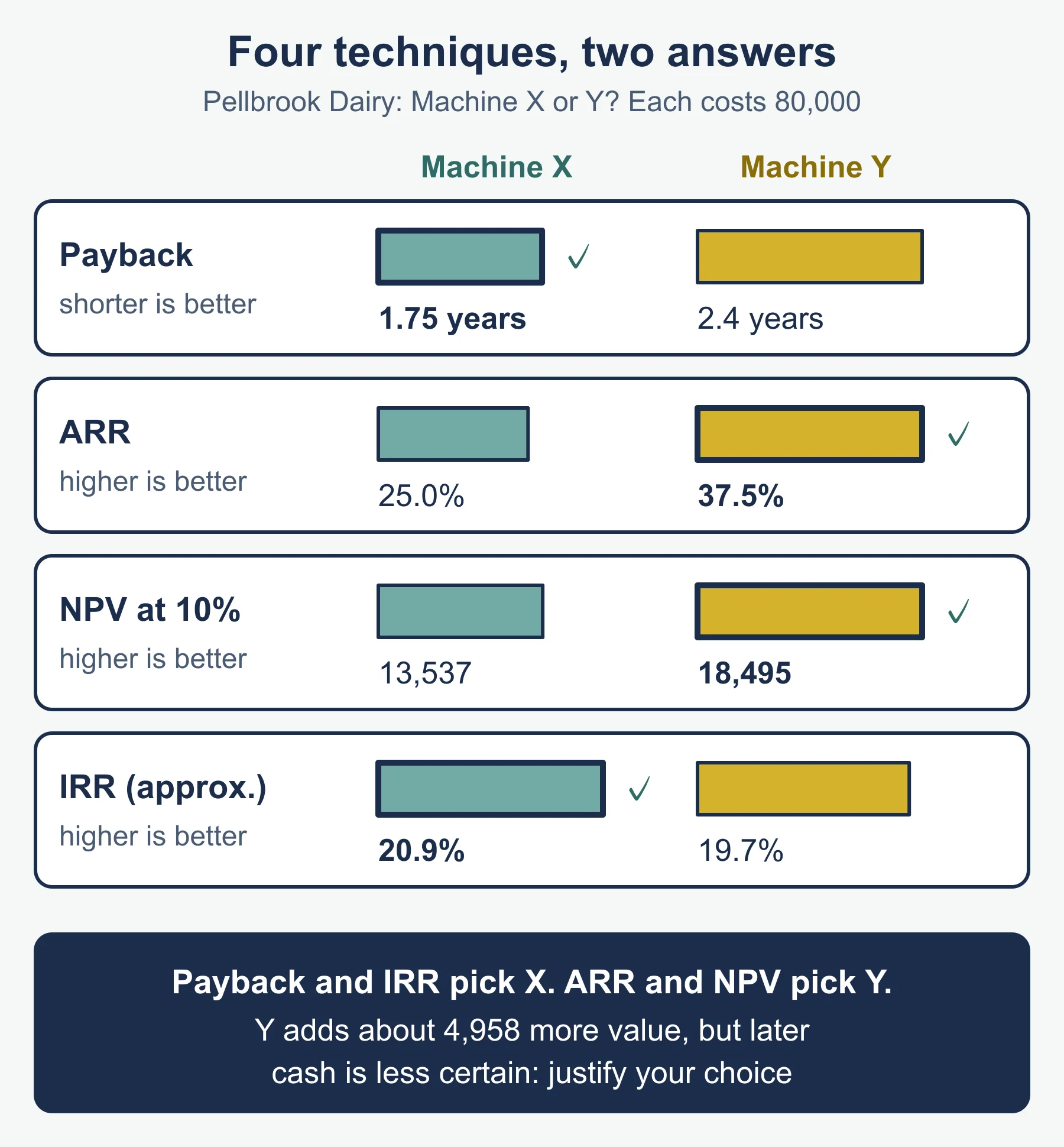
Worked example 5. Pellbrook Dairy must choose one of two machines. Each costs 80,000. Cost of capital is 10%.
| Year | Machine X inflow | Machine Y inflow |
|---|---|---|
| 1 | 50,000 | 10,000 |
| 2 | 40,000 | 40,000 |
| 3 | 20,000 | 75,000 |
| Technique | Machine X | Machine Y | Better |
|---|---|---|---|
| Payback | 1.75 years | 2.4 years | X |
| ARR | 25.0% | 37.5% | Y |
| NPV at 10% | 13,537 | 18,495 | Y |
| IRR (approx.) | 20.9% | 19.7% | X |
X returns cash faster, which suits a business short of liquidity. Y adds about 4,958 more value in present terms and has the higher ARR, but its cash comes later and is less certain. If cash is not tight, Y is the better choice because NPV measures the value added, and both IRRs are well above 10%. A different cash position or a high-risk forecast could justify X.
Non-financial factors
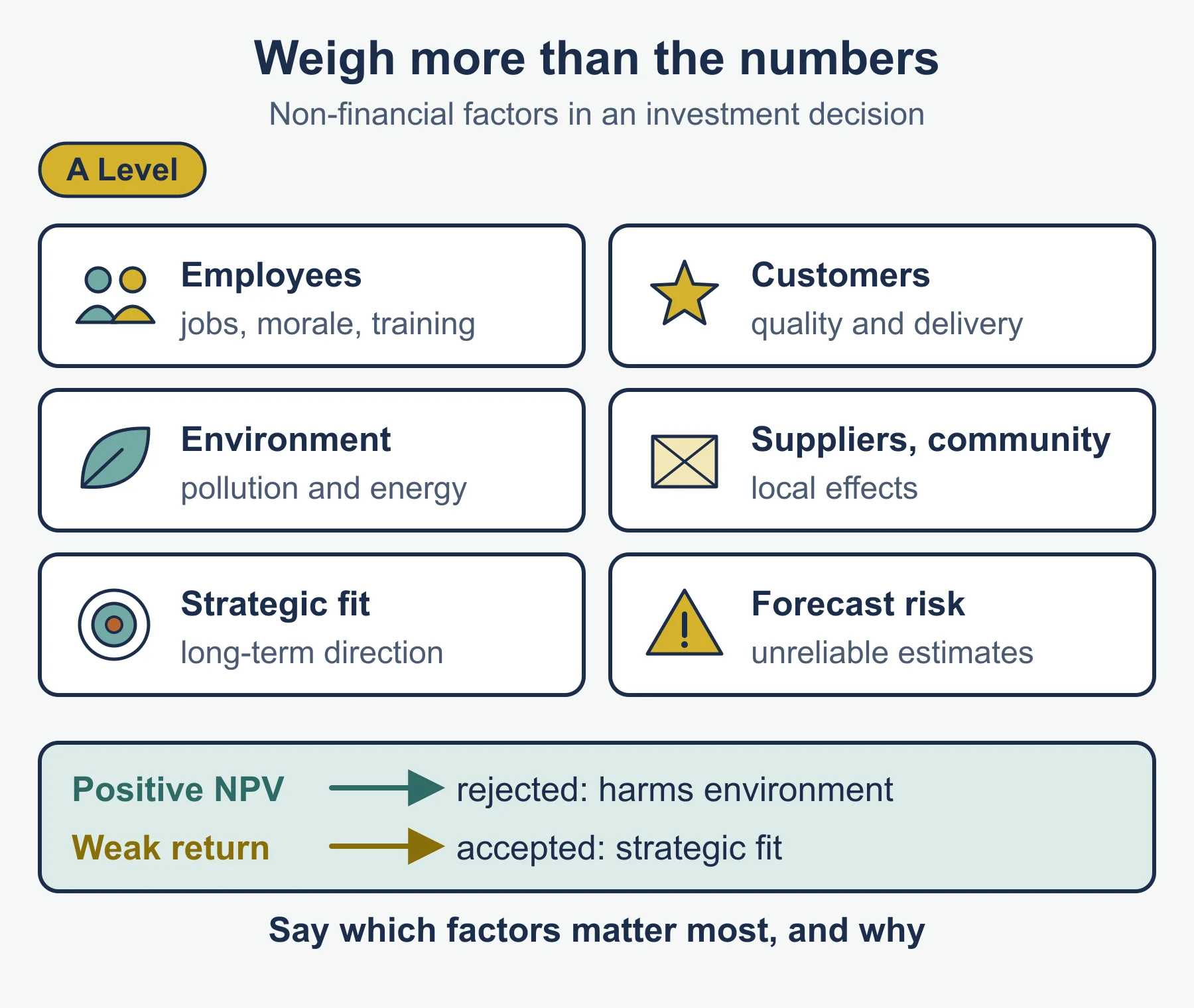
The numbers do not capture everything. Factors to weigh include:
- Employees: redundancies, retraining, morale, or new jobs created.
- Customers: quality, reliability and delivery times.
- Environment: pollution, energy use and sustainability, which can affect reputation and law.
- Suppliers and the local community.
- Strategic fit, such as whether the project supports the long-term direction of the business.
- Reliability of the forecasts, and the risk of changing technology.
A project with a positive NPV may be rejected because of its social or environmental effect. A project with a weak return may be accepted for strategic reasons. A balanced answer says which factors matter most here and why.
Common errors
- Forgetting to add depreciation back when converting profit to cash flow.
- Discounting the year 0 outlay, instead of leaving it at a factor of 1.
- Using profit instead of cash flow in payback, NPV or IRR.
- Dividing ARR by the full cost when the question defines average investment as half the cost.
- Interpolating from two rates that both give positive NPVs.
- Recommending from one technique alone, or giving a decision with no reason.
Frequently asked questions
Which investment appraisal methods are in Cambridge 9706 section 4.4? Section 4.4 covers payback, accounting rate of return (ARR), net present value (NPV) and internal rate of return (IRR), together with non-financial factors. The syllabus states that questions on discounted payback will not be set.
How do you calculate the accounting rate of return? ARR = (average profit ÷ average investment) × 100. Average profit is total profit over the project’s life divided by the number of years, and average investment is (initial investment + value at the end) ÷ 2.
How do you calculate IRR by interpolation? Calculate NPV at two rates, one giving a positive NPV and one negative, then IRR = lower rate + [NPV at lower rate ÷ (NPV at lower rate − NPV at higher rate)] × (higher rate − lower rate). The result is an estimate.
Why does investment appraisal use cash flows instead of profit? Depreciation reduces profit but no cash leaves the business, the asset purchase is a cash outflow at the start, and sunk costs and reallocated existing overheads are not new cash flows. Appraisal asks whether the cash spent now is worth the cash it brings back.
Can a project with a positive NPV be rejected? Yes. Non-financial factors such as effects on employees, customers, the environment, the community and strategic fit, or doubts about the forecasts, can outweigh a positive NPV.
Next, try the practice questions and use the revision notes to consolidate.
Official syllabus
Cambridge International, AS & A Level Accounting 9706 syllabus for 2026, 2027 and 2028, section 4.4 Investment appraisal.
Get free revision emails (optional)
Occasional emails with practice questions, worked explanations and links to free resources for the qualification and subjects you choose. No spam, and you can unsubscribe from any email. The free tools on this site never need an email.
Related resources
-
Study guides
A Level Accounting: Accounting for Non-Current Assets (Cambridge 9706)
Capital versus revenue spending, why assets depreciate depreciation methods, cost and revaluation models and disposals, for Cambridge 9706 Accounting topic 1.3.
Accounting · Cambridge · AS Level
Read guide -
Practice questions
A Level Accounting: Investment appraisal (Cambridge 9706) – Practice Questions
Twelve original questions with worked answers on payback, ARR, NPV, IRR and non-financial factors for Cambridge A Level Accounting 9706 section 4.4.
Accounting · Cambridge · A Level
Try questions -
Revision notes
A Level Accounting: Investment appraisal (Cambridge 9706) – Revision Notes
Condensed revision notes on payback, ARR, NPV, IRR, cash flows and non-financial factors for Cambridge A Level Accounting 9706 section 4.4.
Accounting · Cambridge · A Level
Revise topic
Related articles
-
teaching
A Level tuition in Dubai: Cambridge or Pearson Edexcel International A Level?
Schools in Dubai and Abu Dhabi teach either Cambridge International AS & A Level or Pearson Edexcel International A Level. How the two are structured, why it matters for tuition, and how online classes from Lahore work.
9 October 2026
-
curriculum guides
Choosing subjects at IGCSE and A Level
How subject choices at 14 and 16 affect university options later, and how to keep pathways open without overloading a timetable.
28 July 2026
Studying this with a teacher
Working through Accounting A LEVEL?
This page is free and stays free. If you would rather be taught it, Marlbridge runs Accounting classes one-to-one and in small groups of up to 15, online in your own time zone. The first trial class is free. WhatsApp replies within an hour (8am–11pm Pakistan time, every day); email the same day.
Cambridge Accounting teachers at Marlbridge

