
Revision Notes
A Level Accounting: Investment appraisal (Cambridge 9706) – Revision Notes
Condensed revision notes on payback, ARR, NPV, IRR, cash flows and non-financial factors for Cambridge A Level Accounting 9706 section 4.4.
- Subject
- Accounting
- Level
- A LEVEL
- Topic
- Cost and management accounting
- Author
- Marlbridge Academic Team
- Updated
- Reviewed by
- Zain Ud Din Ahmed (what this means)
Aligned to Cambridge A Level Accounting (9706), 2026-2028. Official specification .
Syllabus page (what it covers and how it is assessed): Cambridge A Level Accounting.
Syllabus points this page covers
9706 (A Level)
- 4.4 Investment appraisal
Found an error? Report a correction.
Need help with this topic? Request a free trial class for A Level Accounting (9706).
These notes condense 4.4 Investment appraisal (4.4.1), A Level content in Topic 4, for the Cambridge International AS & A Level Accounting 9706 syllabus for 2026, 2027 and 2028. For full explanations and worked examples, read the study guide. Then test yourself with the practice questions, the course hub, the checklist and the free diagnostics. All businesses and figures are invented, in dollars.
The syllabus says questions on discounted payback and on a residual value at the end of a project will not be set.
Core definitions
| Term | Meaning |
|---|---|
| Net cash flow | Cash in minus cash out caused by the project in a period |
| Accounting profit | Revenue less expenses on the accruals basis, after depreciation |
| Time value of money | Cash received sooner is worth more than the same cash later |
| Cost of capital | The return the project must earn, used as the discount rate |
| Discount factor | 1 / (1 + r)ⁿ |
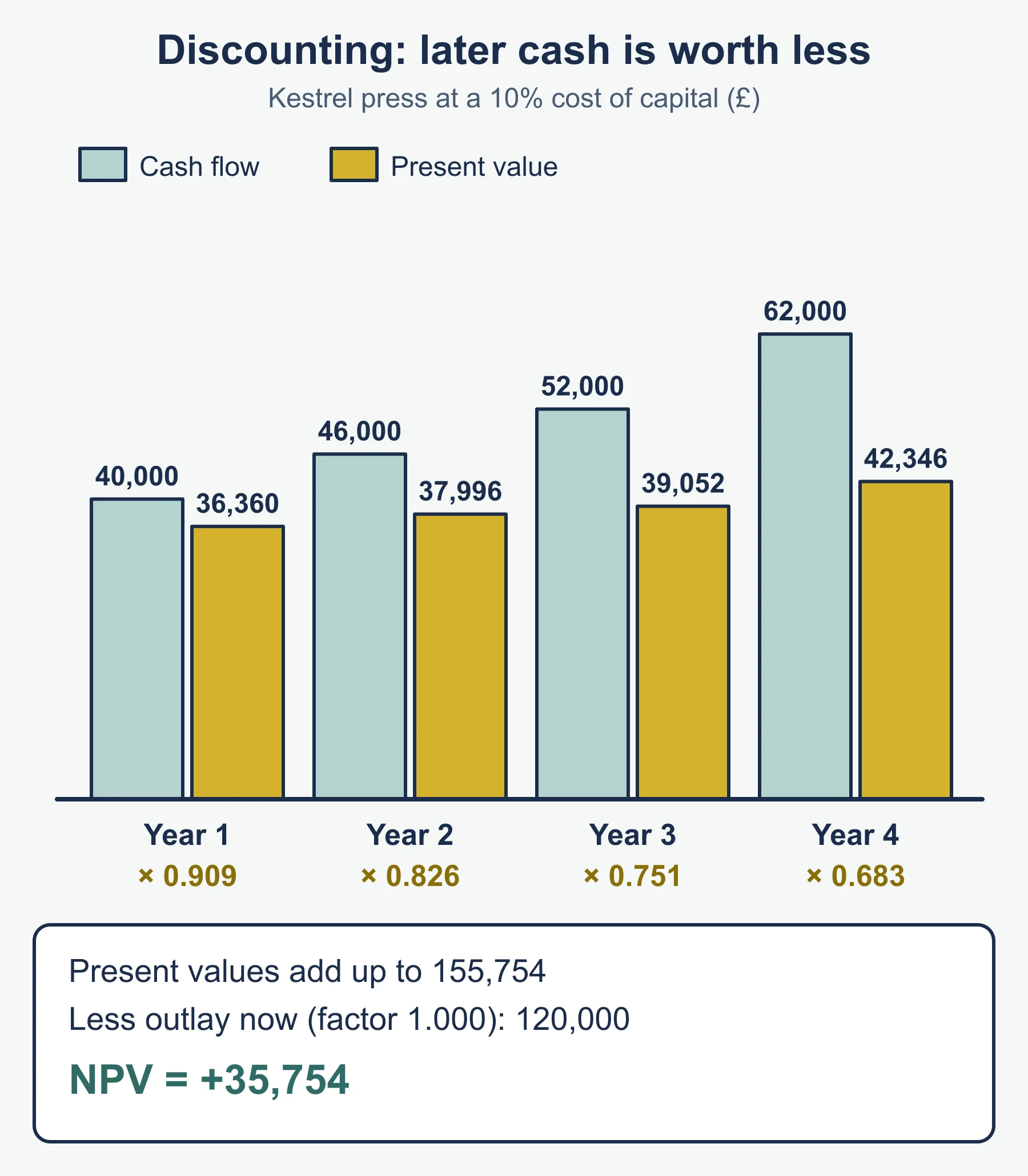
| Present value | Cash flow × discount factor |
| NPV | Sum of present values, outlay negative |
| IRR | Discount rate that gives an NPV of zero |
Formulas and decision rules
| Technique | Calculation | Accept when |
|---|---|---|
| Payback | Years until cumulative net cash inflow equals the outlay | Within the target period |
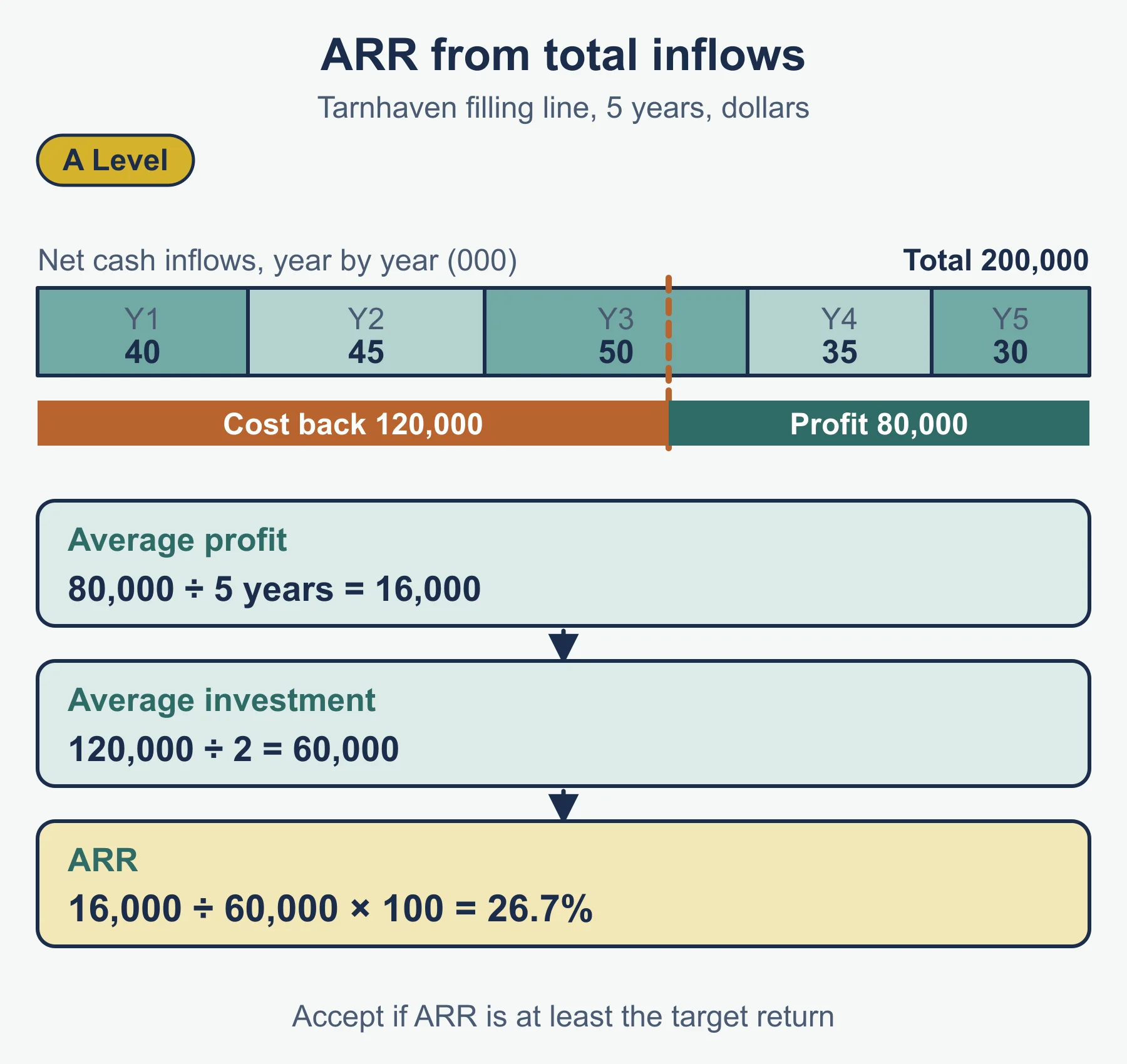
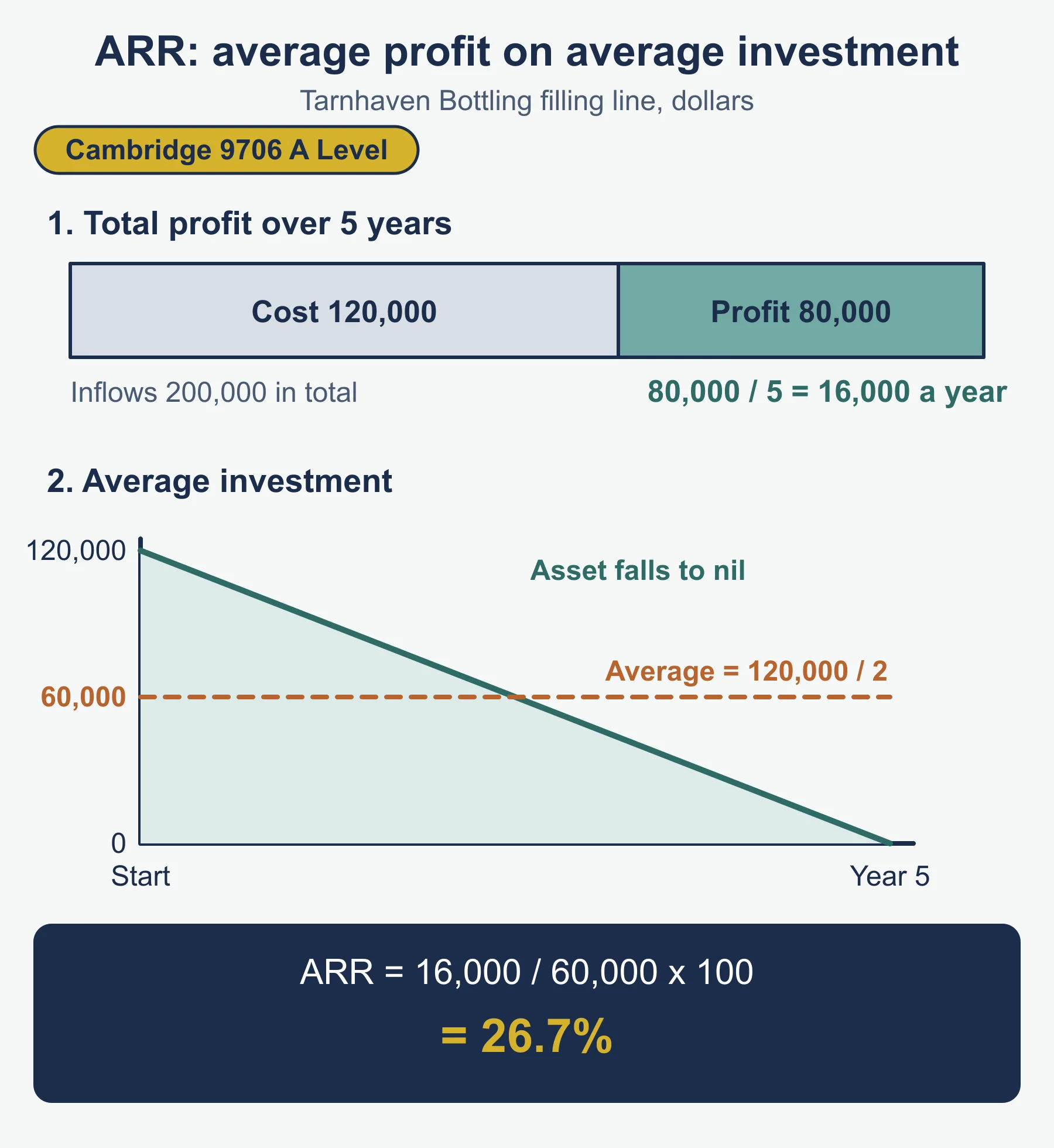
| ARR | (Average profit / average investment) × 100 | At or above the target return |
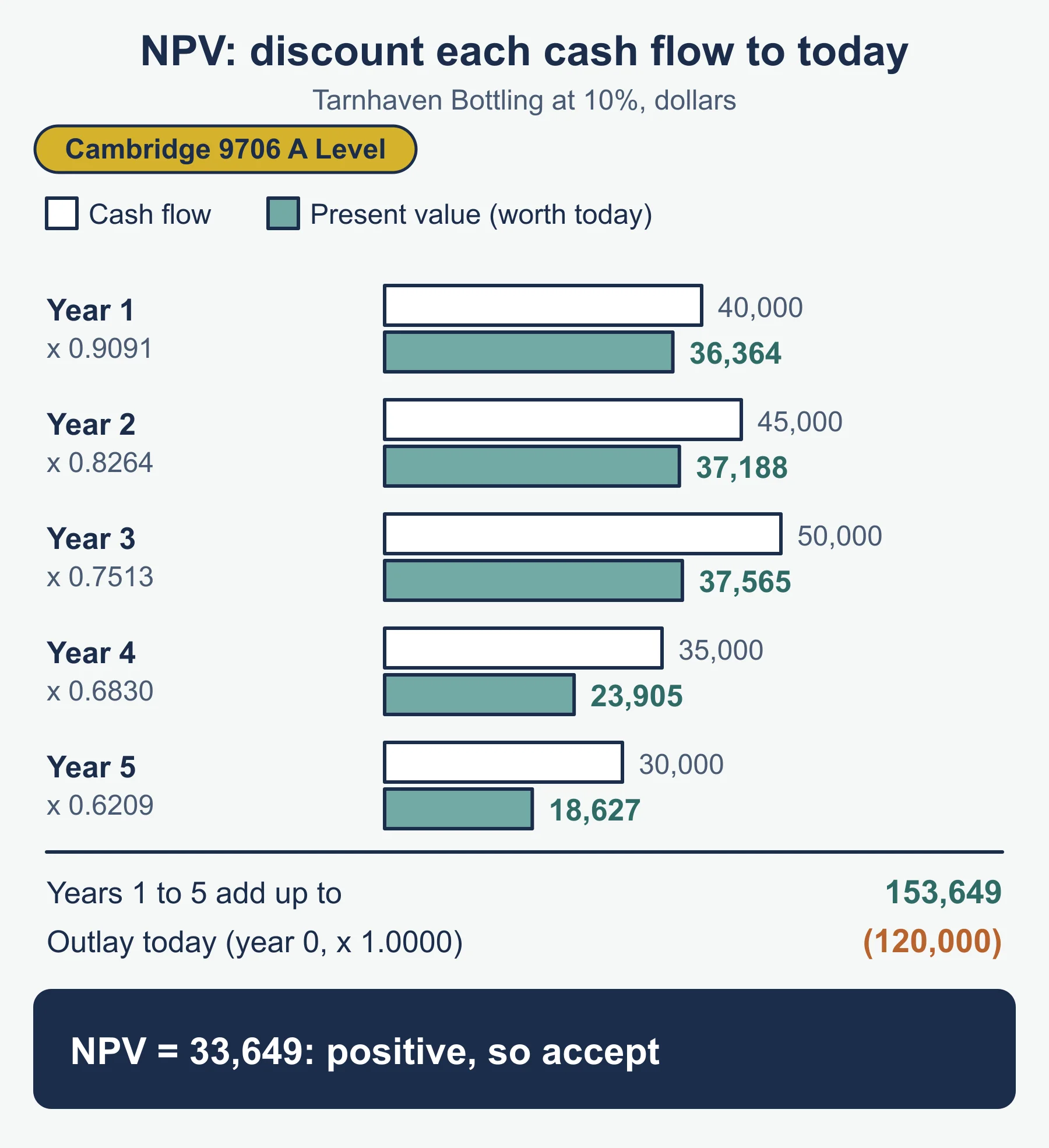
| NPV | Sum of cash flow × discount factor | Positive |
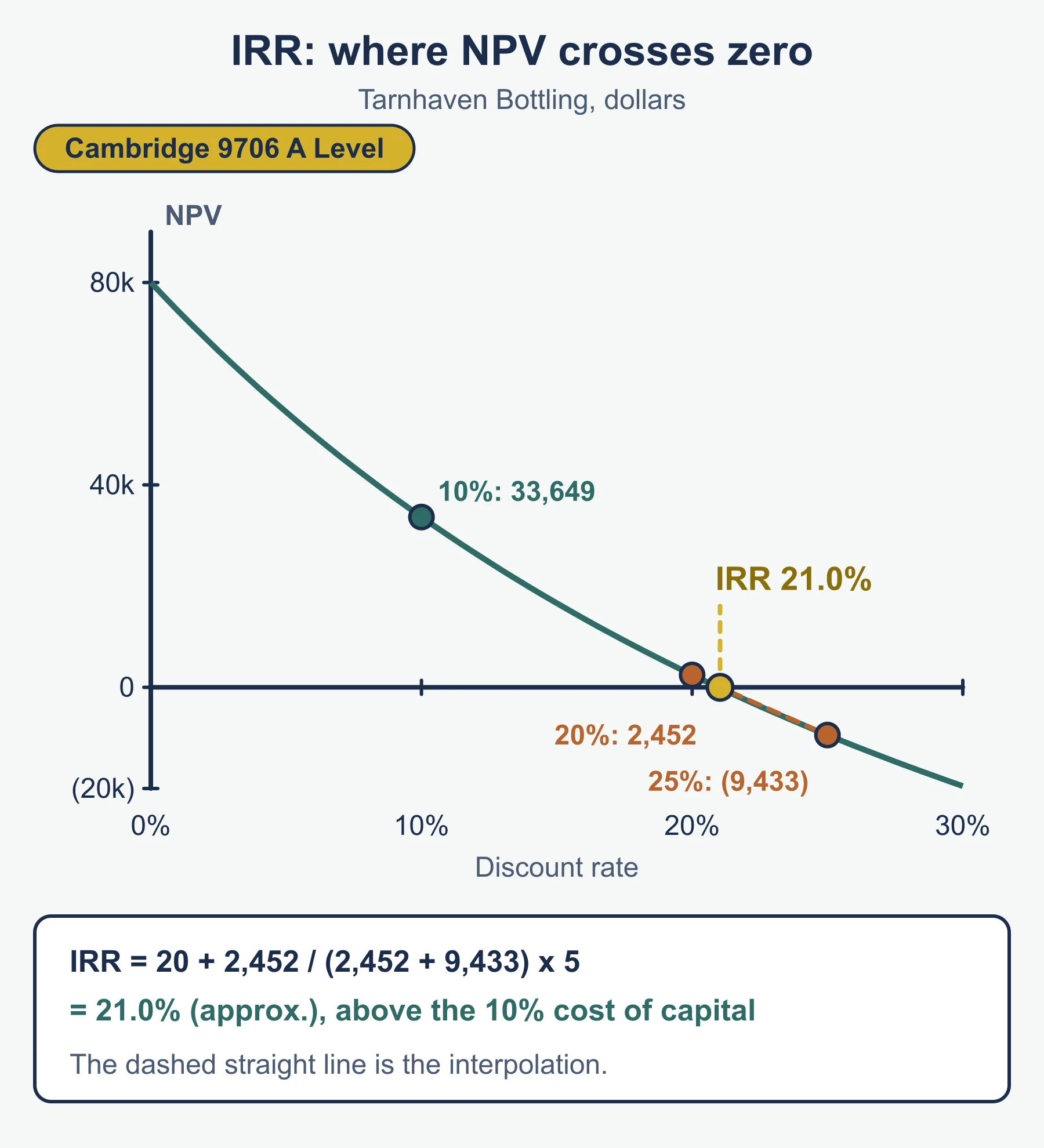
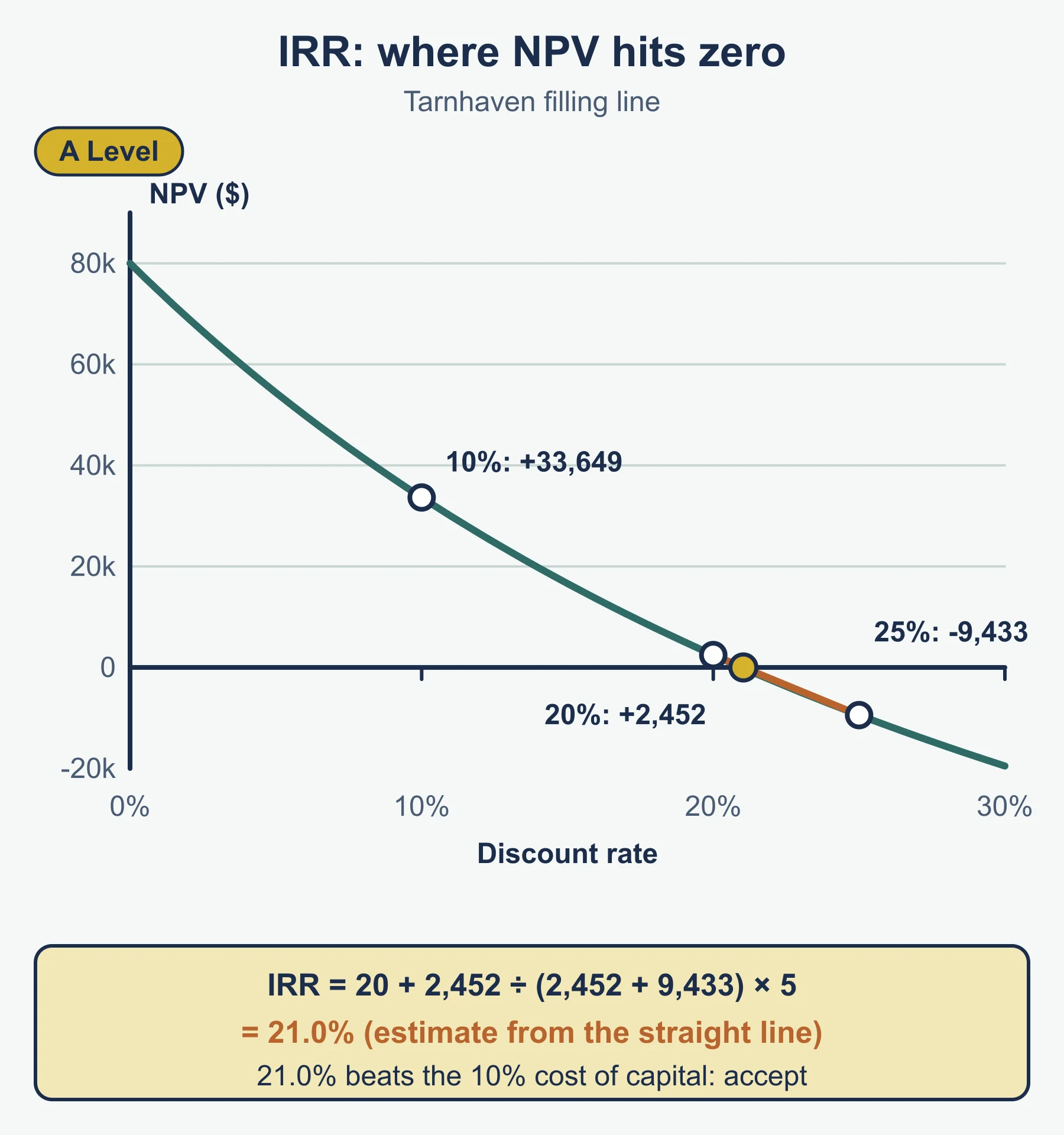
| IRR | Lower rate + [NPV low / (NPV low − NPV high)] × rate gap | Above the cost of capital |
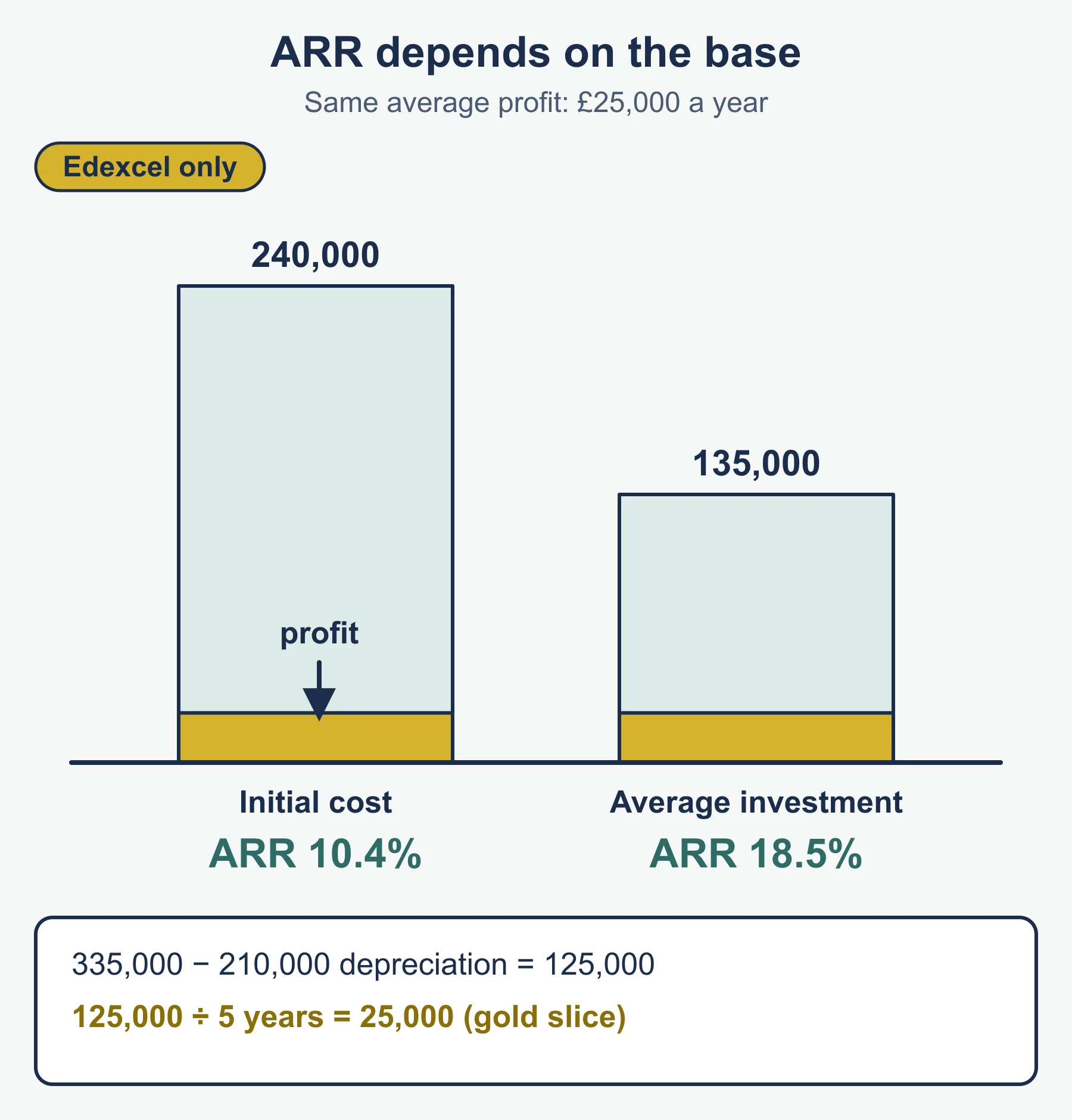
Average profit = (total net cash inflows − cost) / years. Average investment = (initial investment + value at end) / 2, which is half the cost when there is no residual value. Always follow the definition a question gives.
Method boxes
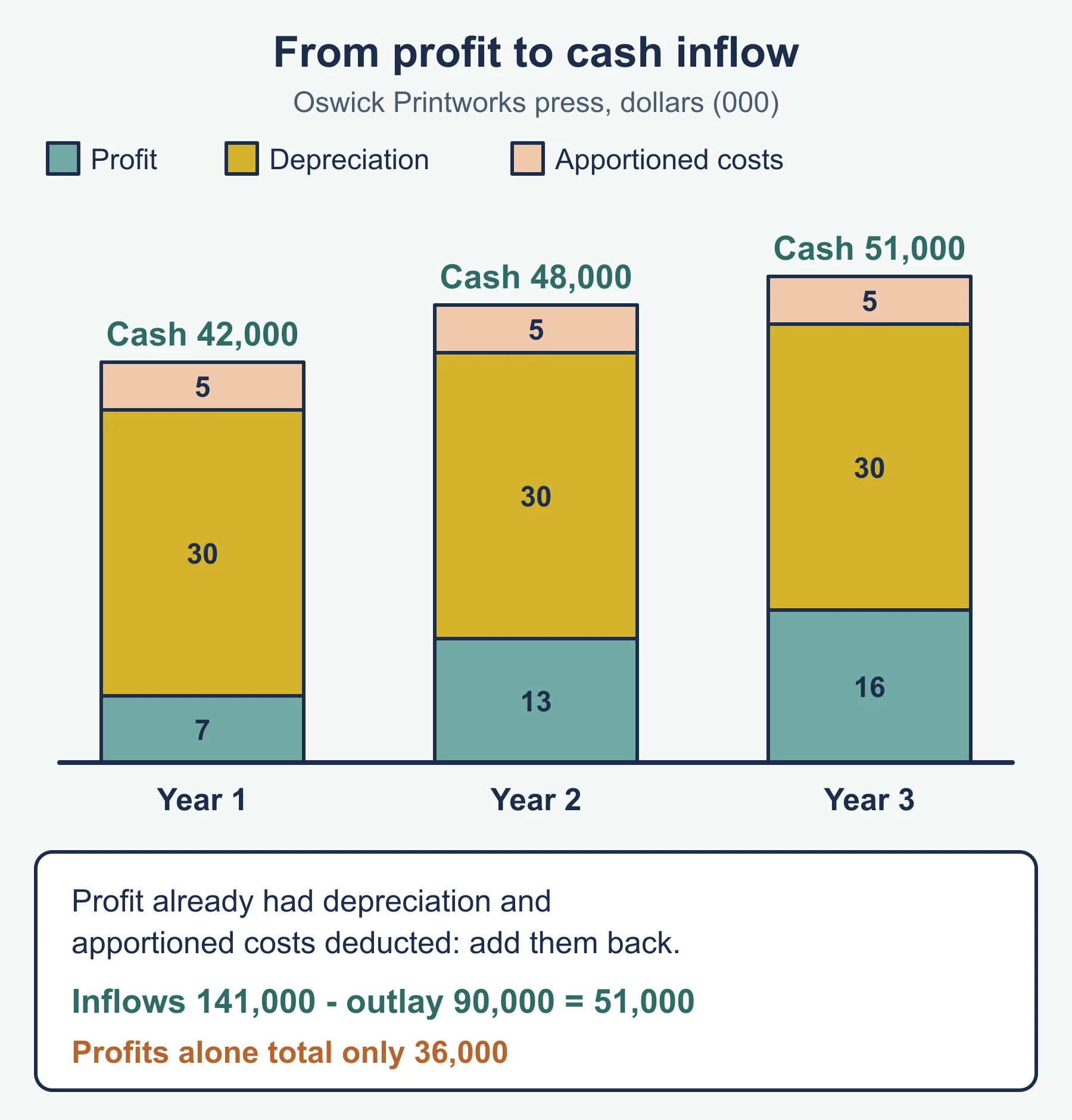
Profit to net cash flow
- Start with the forecast profit for each year.
- Add back depreciation (non-cash).
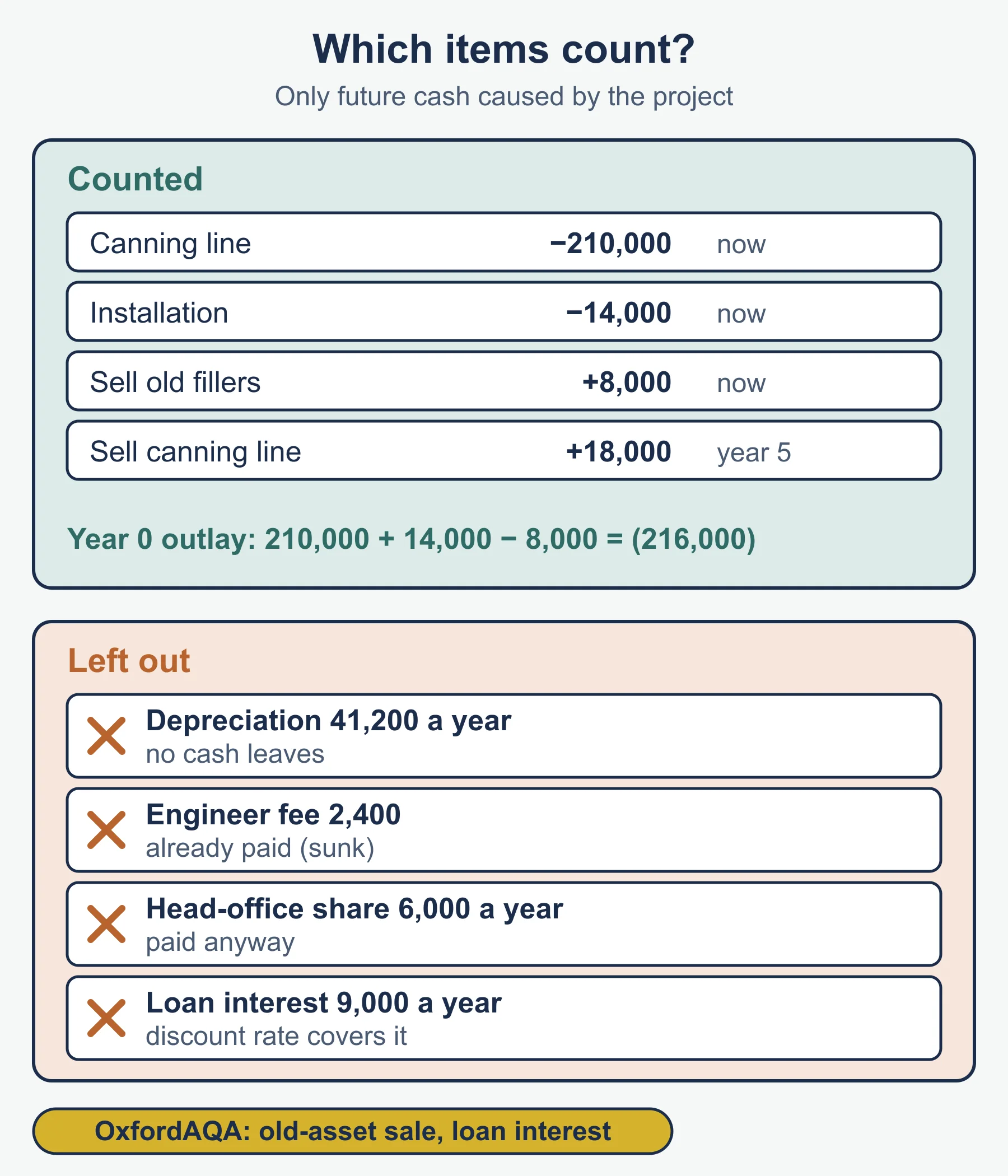
- Add back any apportioned cost that continues whether or not the project goes ahead.
- Leave out costs already paid and that cannot be recovered.
- Show the purchase of the asset as an outflow in year 0.
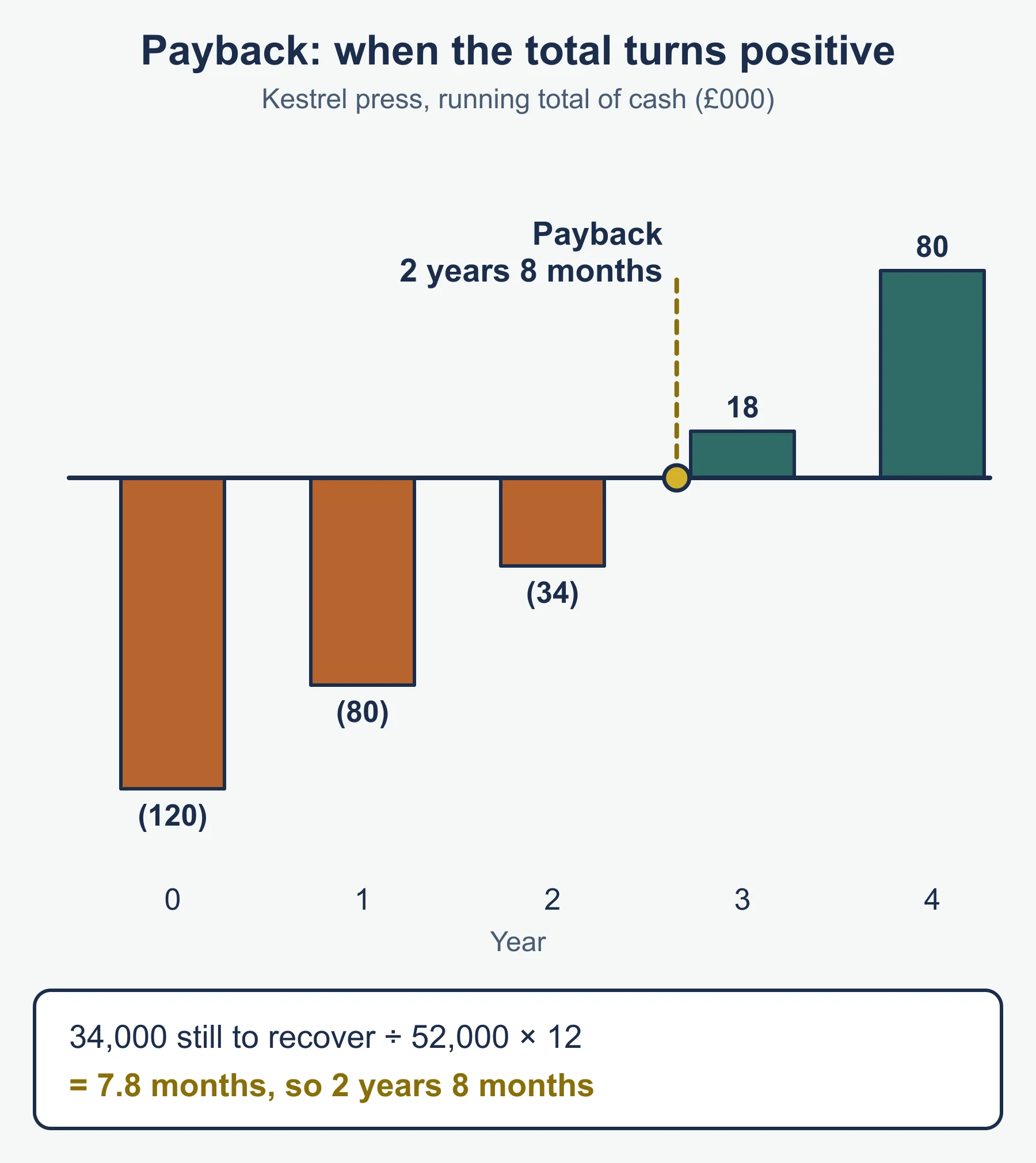
Payback with uneven flows
- Write cumulative cash flow for each year.
- Find the year in which it turns from negative to positive.
- Payback = full years + (amount still needed / that year’s inflow).
- Convert the fraction to months by multiplying by 12.
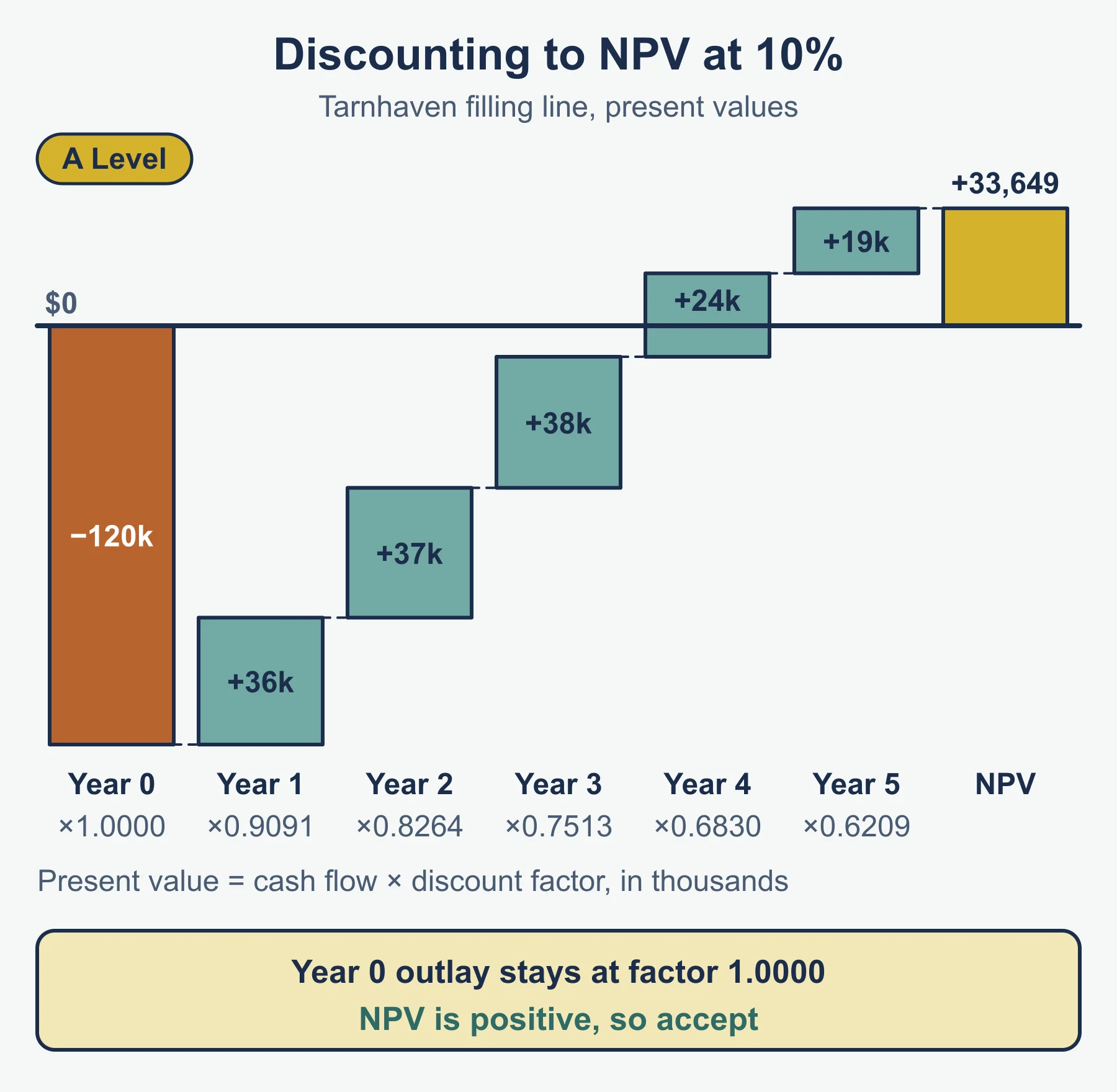
NPV
- List net cash flows, year 0 first.
- Multiply each by the factor for the year (year 0 has a factor of 1).
- Add them. Interpret the sign.
IRR
- Calculate NPV at a rate you choose.
- Choose a second rate, higher if NPV was positive, lower if it was negative, until the signs differ.
- Interpolate with the formula above and say it is an estimate.
- Compare with the cost of capital.
Worked reminder
Quillmore Textiles is considering a loom costing 60,000. Net cash inflows are 30,000, 28,000 and 26,000 over three years. Cost of capital is 12%.
- Payback: cumulative inflow is 30,000 then 58,000, so 2,000 is still needed in year 3. 2 + 2,000 / 26,000 = 2.08 years, about 2 years 1 month.
- ARR: total inflows 84,000 − 60,000 = 24,000 profit. Average profit 8,000. Average investment 30,000. ARR = 26.7%.
- NPV at 12%: (60,000) + 26,787 + 22,322 + 18,507 = 7,616. Accept.
- IRR: NPV is 4,354 at 15% and (512) at 20%. IRR = 15 + [4,354 / (4,354 + 512)] × 5 = 19.5%, above 12%. Accept.
Worked reminder: profit to cash flow
Kelsterne Signs may buy a cutting table for 48,000, depreciated on the straight line over 4 years with no residual value, which is 12,000 a year. Forecast profits after depreciation are 3,000, 6,000, 8,000 and 5,000.
| Year | Profit | Depreciation added back | Net cash inflow | Cumulative |
|---|---|---|---|---|
| 0 | (48,000) | (48,000) | ||
| 1 | 3,000 | 12,000 | 15,000 | (33,000) |
| 2 | 6,000 | 12,000 | 18,000 | (15,000) |
| 3 | 8,000 | 12,000 | 20,000 | 5,000 |
| 4 | 5,000 | 12,000 | 17,000 | 22,000 |
Payback is 2 years plus 15,000 / 20,000, which is 2.75 years (2 years 9 months). Total profit is 22,000, equal to the 70,000 of cash inflows less the 48,000 outlay. At 10% the present values are 13,636, 14,875, 15,026 and 11,611, so NPV = 55,148 − 48,000 = 7,148.
Writing a recommendation
- State each result with its unit: years, percentage or dollars.
- Compare it with the criterion: the target payback, the target ARR, a zero NPV, or the cost of capital.
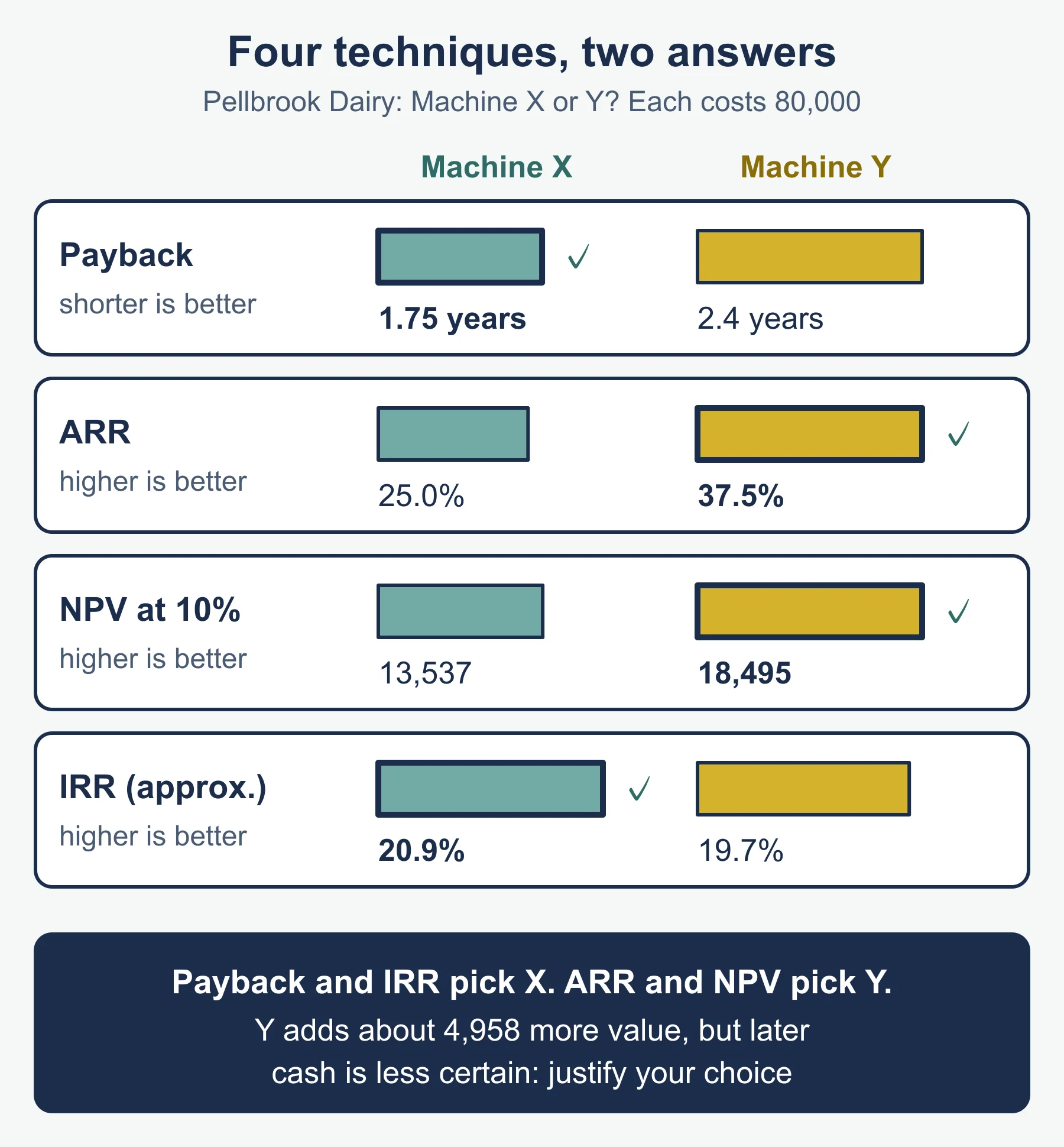
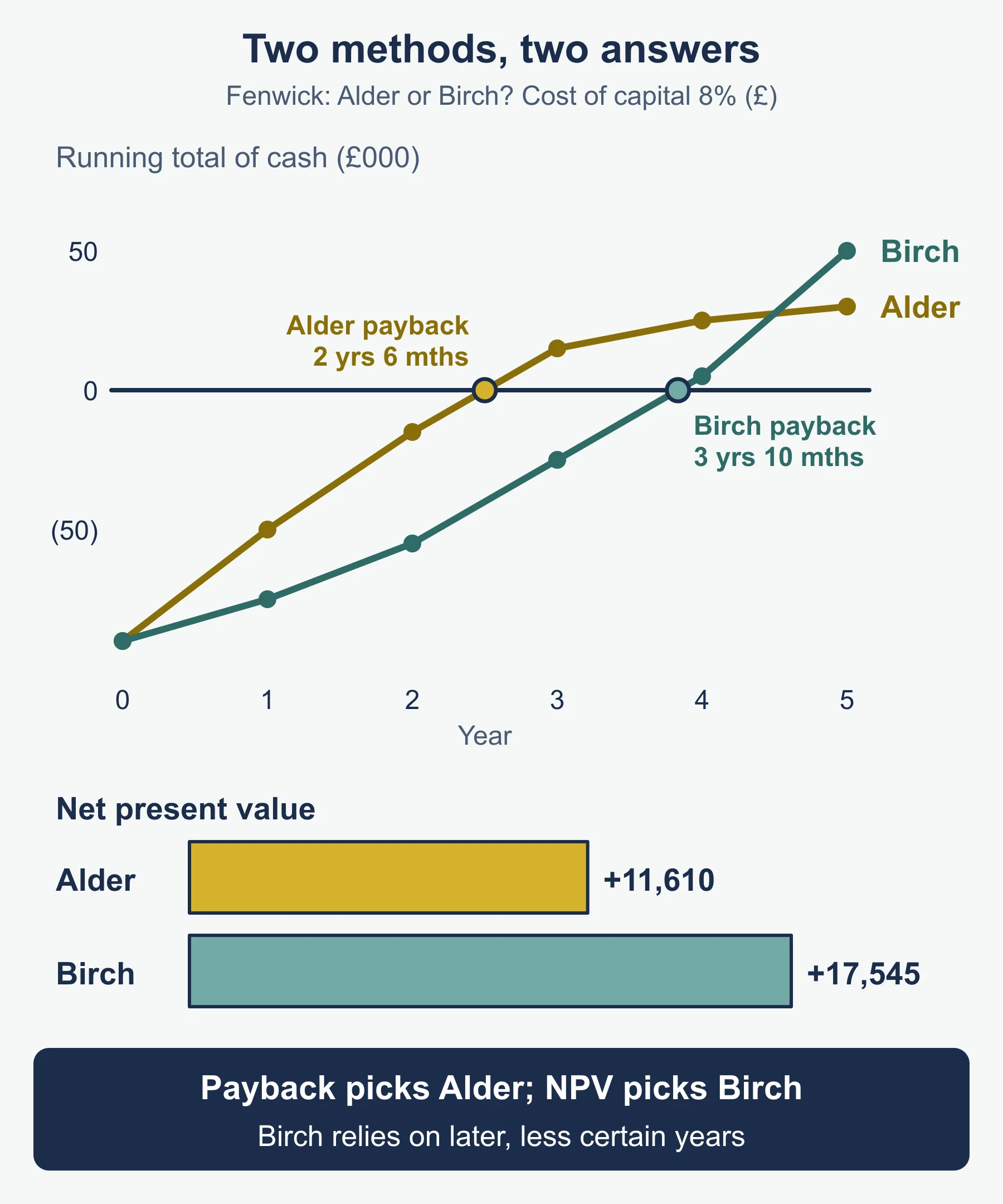
- Say where the techniques agree or disagree, and which you give most weight to. NPV is usually weighted most because it measures value added in present terms.
- Bring in at least one non-financial factor and explain how it could change the decision.
- Finish with a clear decision and one reason for it, plus a reservation, such as the reliability of the forecasts.
Strengths and weaknesses
| Technique | Strengths | Weaknesses |
|---|---|---|
| Payback | Simple; shows how fast cash returns; limits exposure to distant forecasts | Ignores later cash flows and the time value of money; target period is arbitrary |
| ARR | Uses all profits; percentage easy to compare with a target | Uses profit not cash; ignores timing; hides project size |
| NPV | Time value of money; all cash flows; shows value added in dollars | Needs a cost of capital; harder to explain; relies on forecasts |
| IRR | Time value of money; percentage compared with the cost of capital | Interpolation is an estimate; no dollar value; can rank differently from NPV |
Non-financial factors
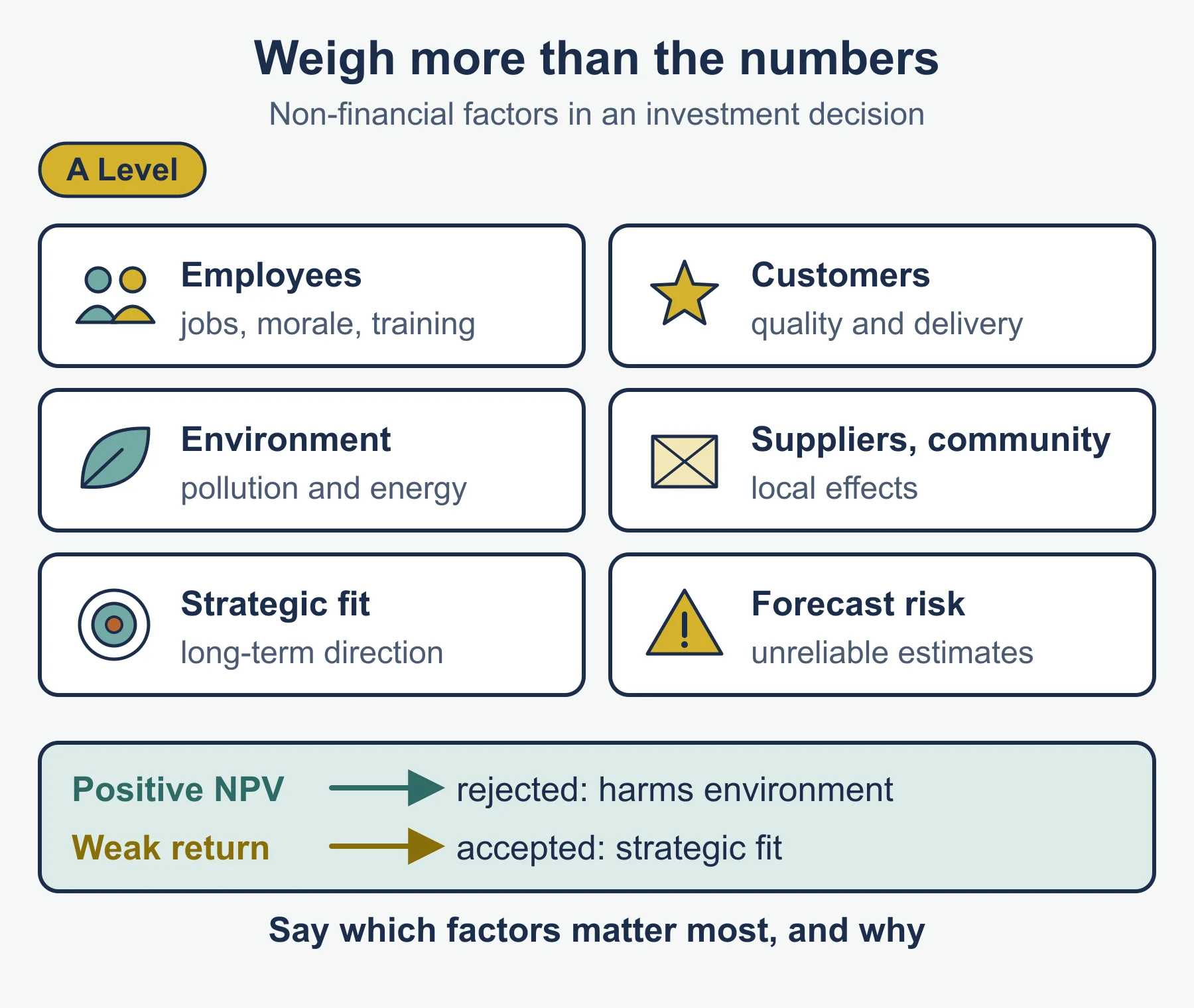
- Employees: jobs, retraining, morale.
- Customers: quality, service and reputation.
- Environment: pollution, energy use, legal compliance.
- Community and suppliers.
- Strategic fit and the risk of changing technology.
- Quality of the forecasts behind the figures.
A good recommendation compares the financial results, then says which non-financial factors could change the decision and why.
Must-know distinctions
- Profit versus cash flow: depreciation is an expense but not a cash flow.
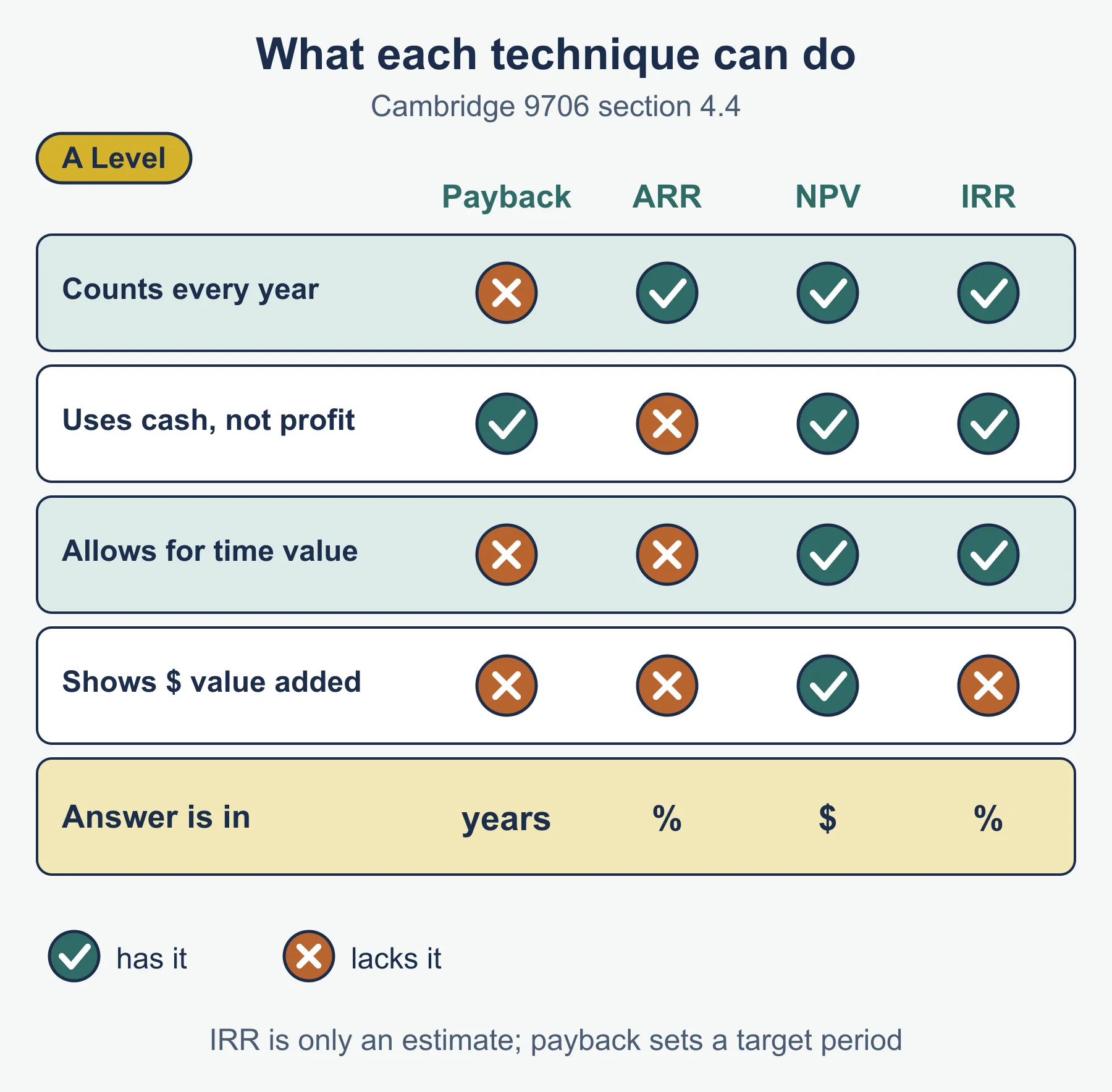
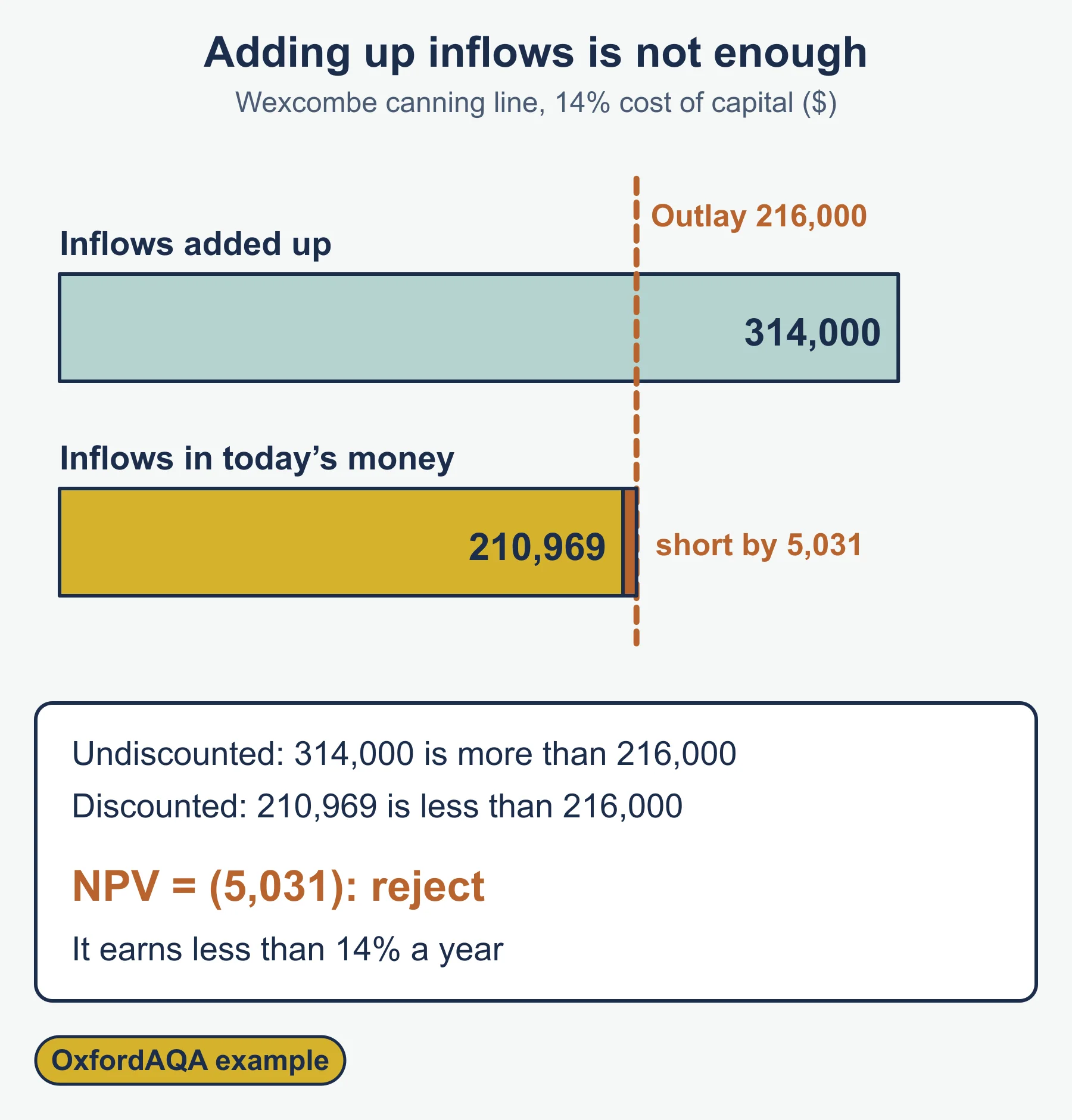
- Payback and ARR ignore the time value of money; NPV and IRR include it.
- NPV is a dollar amount; IRR and ARR are percentages.
- ARR uses profit; the other three use cash flows.
- The cost of capital is an input to NPV, but a comparison point for IRR.
- Payback measures speed of recovery and liquidity; NPV measures the value created. A project can pass one and fail the other.
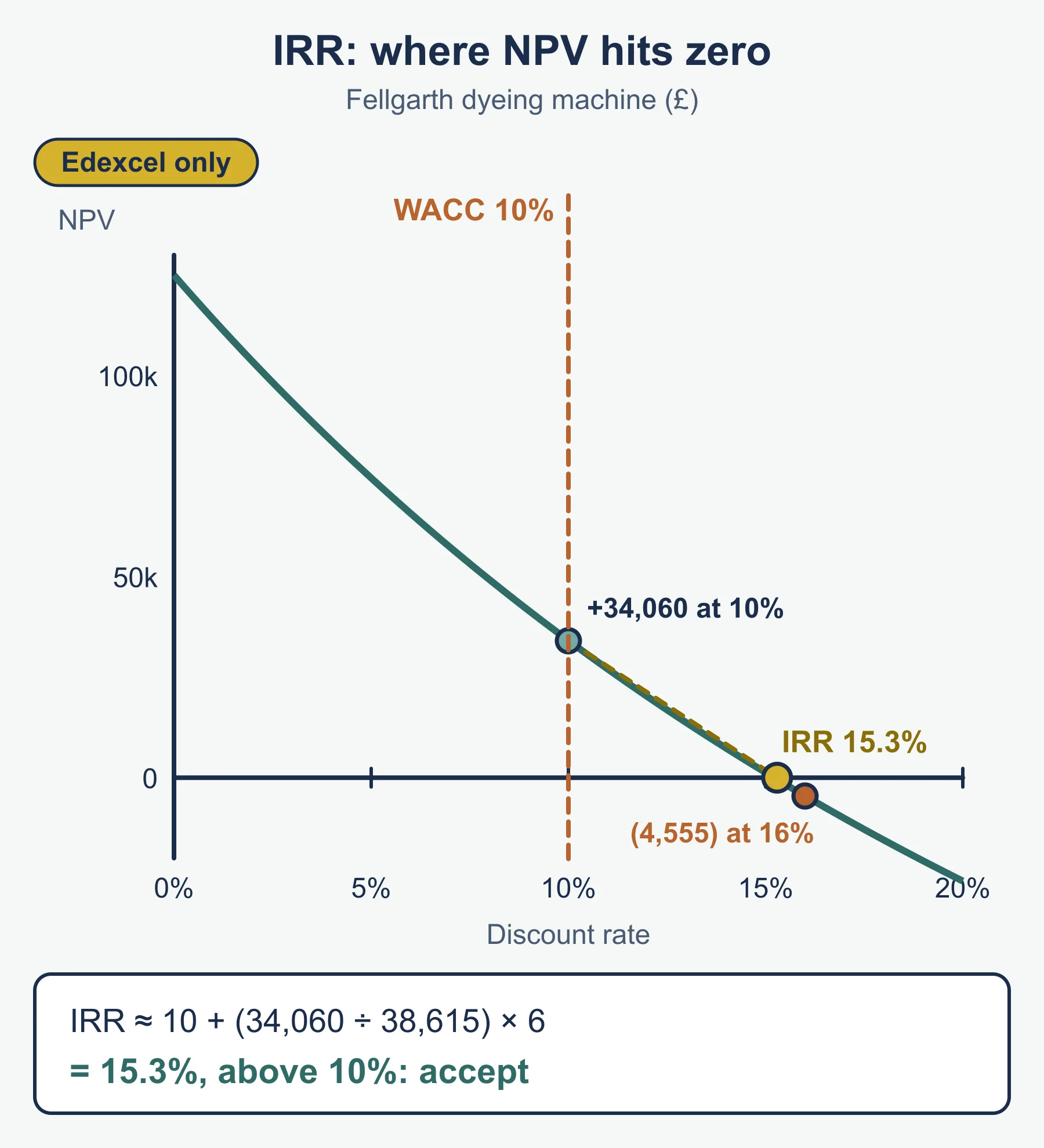
- A higher cost of capital lowers every present value, so NPV falls as the rate rises and IRR is the rate at which it reaches zero.
- Sunk costs and continuing overheads are not relevant cash flows, however they appear in the profit forecast.
Quick self-test
- What is the discount factor for year 3 at 8%, to four decimal places?
- A project has a forecast profit of 9,000 after depreciation of 6,000 and an apportioned overhead of 1,500 that would be paid anyway. What is the net cash inflow?
- A machine costs 36,000 and brings in 9,000 a year. What is the payback?
- A project costs 50,000 and returns 15,000, 20,000, 25,000 and 10,000 in years 1 to 4. What is the payback?
- A project costs 40,000 and lasts 4 years with total net cash inflows of 56,000. Calculate the ARR, assuming no residual value.
- A project costs 30,000 and returns 12,000 a year for 3 years. Factors at 10% are 0.9091, 0.8264 and 0.7513. Calculate the NPV and give the decision.
- NPV is 2,000 at 12% and (1,500) at 16%. Estimate the IRR.
- If the cost of capital is 15%, what should be done with the project in question 7?
- Name two techniques that ignore the time value of money.
- Give one reason why a project with a positive NPV might still be rejected.
Answers
- 0.7938.
- 9,000 + 6,000 + 1,500 = 16,500.
- 36,000 / 9,000 = 4 years.
- Cumulative 15,000, 35,000, 60,000. Needs 15,000 of year 3’s 25,000: 2 + 0.6 = 2.6 years (2 years 7 months).
- Profit 16,000. Average profit 4,000. Average investment 20,000. ARR = 20%.
- 10,909 + 9,917 + 9,016 = 29,842. NPV = 29,842 − 30,000 = (158). Reject.
- 12 + [2,000 / 3,500] × 4 = 14.3% (approximately).
- IRR of 14.3% is below 15%, so reject on this measure.
- Payback and ARR.
- For example, an environmental or employee impact, or unreliable forecasts. Any well-explained non-financial or risk reason.
Where marks are usually lost
- Discounting the year 0 outlay.
- Using profit instead of cash flow in payback, NPV or IRR.
- Not adding depreciation back when converting profit to cash.
- Stopping at the number in payback, ARR, NPV or IRR without a decision.
- Interpolating from two NPVs of the same sign.
- Calling an IRR exact when it is an estimate from interpolation.
- Giving a one-sided recommendation with no reference to non-financial factors.
- Listing strengths and weaknesses of a technique without applying them to the figures.
Frequently asked questions
What is the decision rule for IRR? Accept the project if the IRR is higher than the cost of capital, the business’s required rate of return.
What is the decision rule for NPV? A positive NPV means the project earns more than the required return, so it should be accepted on financial grounds.
Is the year 0 outlay discounted? No. The year 0 outlay has a discount factor of 1, so it is not discounted. Discounting it is a common mistake.
Why is an interpolated IRR only an estimate? Interpolation assumes NPV falls in a straight line between the two discount rates, which it does not exactly, so the IRR should not be described as exact.
Official syllabus
Cambridge International, AS & A Level Accounting 9706 syllabus for 2026, 2027 and 2028, section 4.4 Investment appraisal.
Get free revision emails (optional)
Occasional emails with practice questions, worked explanations and links to free resources for the qualification and subjects you choose. No spam, and you can unsubscribe from any email. The free tools on this site never need an email.
Related resources
-
Study guides
A Level Accounting: Accounting for Non-Current Assets (Cambridge 9706)
Capital versus revenue spending, why assets depreciate depreciation methods, cost and revaluation models and disposals, for Cambridge 9706 Accounting topic 1.3.
Accounting · Cambridge · AS Level
Read guide -
Study guides
A Level Accounting: Standard costing (Cambridge 9706)
A full guide to standard costing and variances for Cambridge A Level Accounting 9706, with one worked example from cost card to profit reconciliation.
Accounting · Cambridge · A Level
Read guide -
Practice questions
A Level Accounting: Standard costing (Cambridge 9706) – Practice Questions
Eleven original questions with full worked answers on standard costing, variances, causes and recommendations, for Cambridge A Level Accounting 9706.
Accounting · Cambridge · A Level
Try questions
Related articles
-
teaching
A Level tuition in Dubai: Cambridge or Pearson Edexcel International A Level?
Schools in Dubai and Abu Dhabi teach either Cambridge International AS & A Level or Pearson Edexcel International A Level. How the two are structured, why it matters for tuition, and how online classes from Lahore work.
9 October 2026
-
curriculum guides
Choosing subjects at IGCSE and A Level
How subject choices at 14 and 16 affect university options later, and how to keep pathways open without overloading a timetable.
28 July 2026
Studying this with a teacher
Working through Accounting A LEVEL?
This page is free and stays free. If you would rather be taught it, Marlbridge runs Accounting classes one-to-one and in small groups of up to 15, online in your own time zone. The first trial class is free. WhatsApp replies within an hour (8am–11pm Pakistan time, every day); email the same day.
Cambridge Accounting teachers at Marlbridge

