
Revision Notes
A Level Accounting: Costs, cost behaviour and traditional costing methods (Cambridge 9706) – Revision Notes
Condensed revision notes on cost behaviour, FIFO and AVCO, absorption and marginal costing, break-even and decisions for Cambridge 9706 AS Accounting.
- Subject
- Accounting
- Level
- AS LEVEL
- Topic
- Cost and management accounting
- Author
- Marlbridge Academic Team
- Updated
- Reviewed by
- Zain Ud Din Ahmed (what this means)
Aligned to Cambridge A Level Accounting (9706), 2026-2028. Official specification .
Syllabus page (what it covers and how it is assessed): Cambridge A Level Accounting.
Syllabus points this page covers
9706 (AS Level)
- 2.1 Costs and cost behaviour
- 2.2 Traditional costing methods
Found an error? Report a correction.
Need help with this topic? Request a free trial class for A Level Accounting (9706).
Full explanations and worked examples are in the study guide. These notes condense sections 2.1 Costs and cost behaviour and 2.2 Traditional costing methods of the Cambridge International AS & A Level Accounting 9706 syllabus for 2026, 2027 and 2028 (AS Level content). All businesses and figures are invented and all amounts are in dollars. Test yourself with the practice questions, tick off the checklist, find the course hub and try the free diagnostics.
Key terms
| Term | Meaning |
|---|---|
| Direct cost | Traceable to a cost unit: direct materials, direct labour, direct expenses |
| Prime cost | Total of direct costs |
| Indirect cost (overhead) | Not traceable to one unit |
| Fixed / variable | Constant / changes in proportion to output |
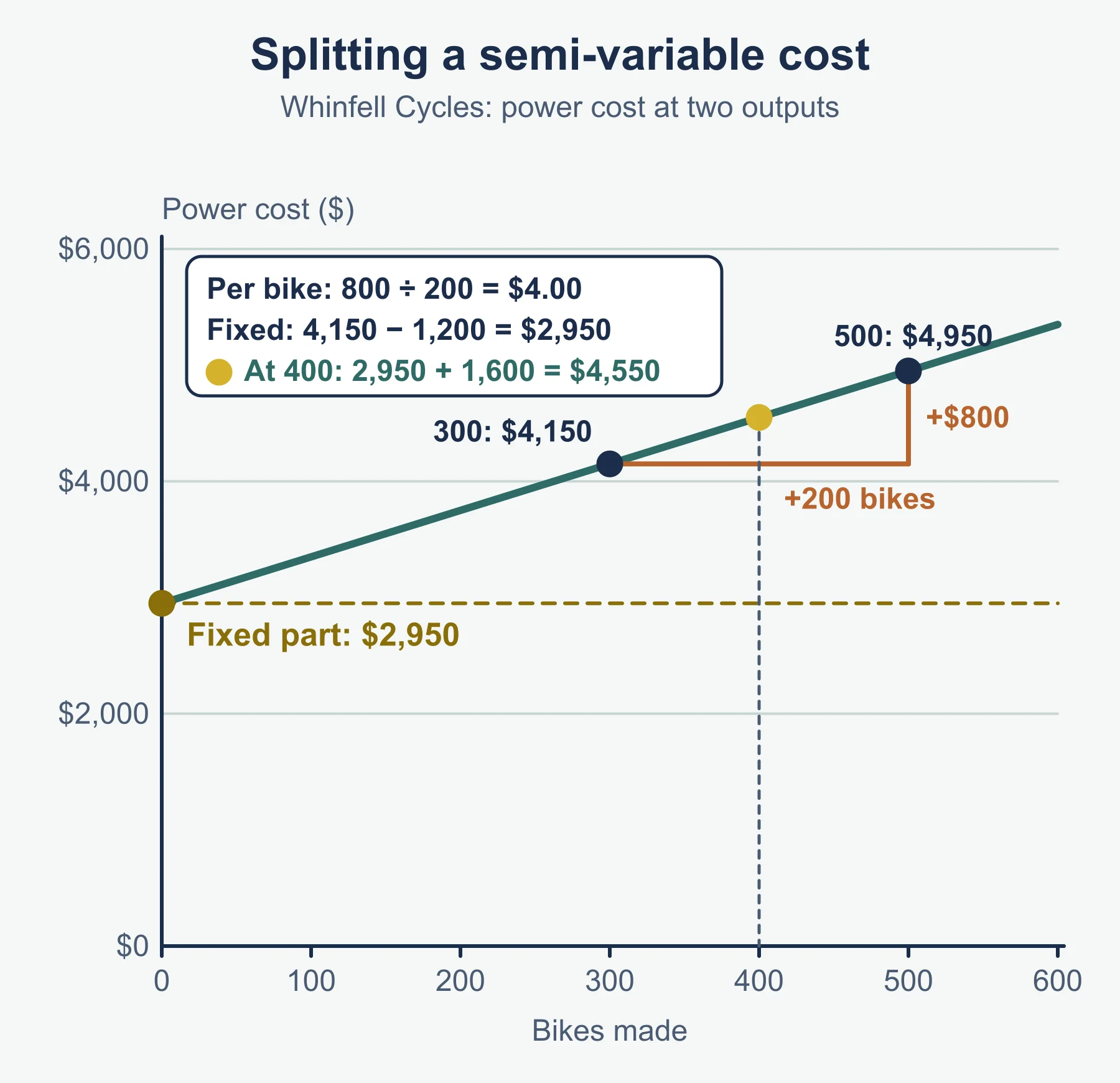
| Semi-variable | Fixed part plus variable part |
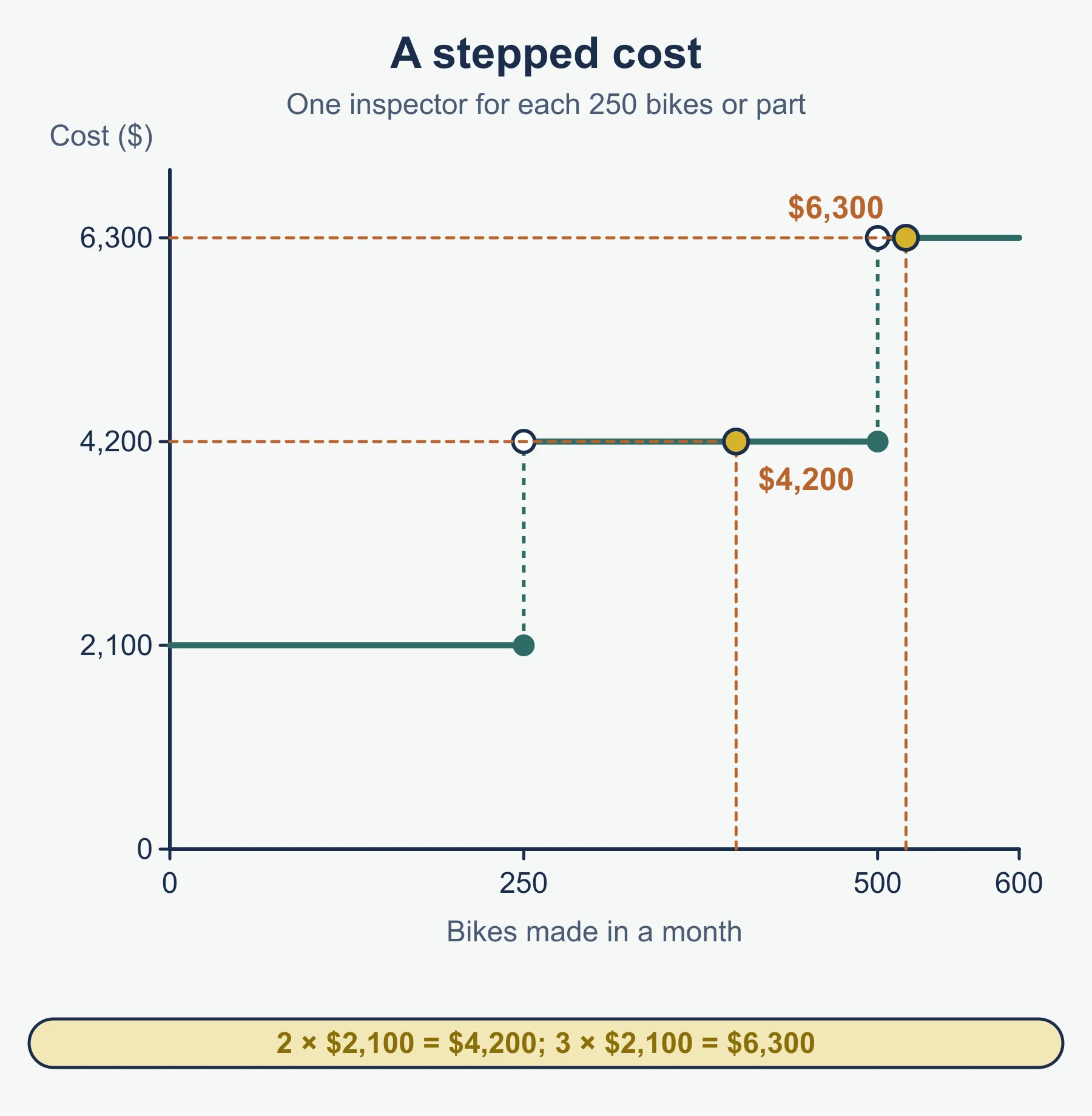
| Stepped | Fixed within a range, jumps at a threshold |
| Cost centre | Department, process or location where costs are collected |
| Cost unit | Unit of product or service costs are charged to |
| Allocate / apportion | Charge a whole overhead to one centre / share it on a fair basis |
| Reapportion | Recharge service department costs to production departments |
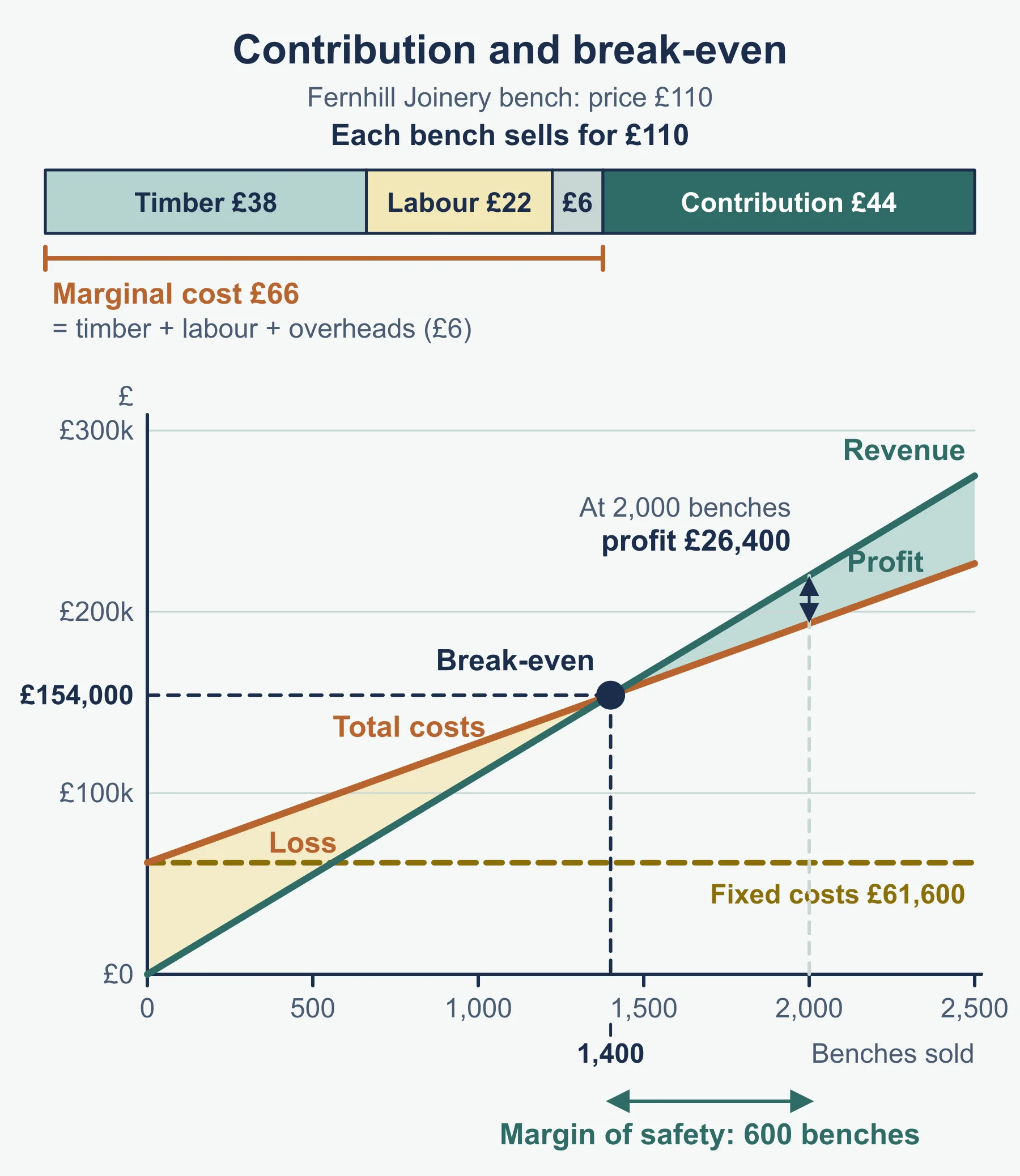
| Contribution | Selling price minus variable cost |
| Margin of safety | Budgeted sales minus break-even sales |
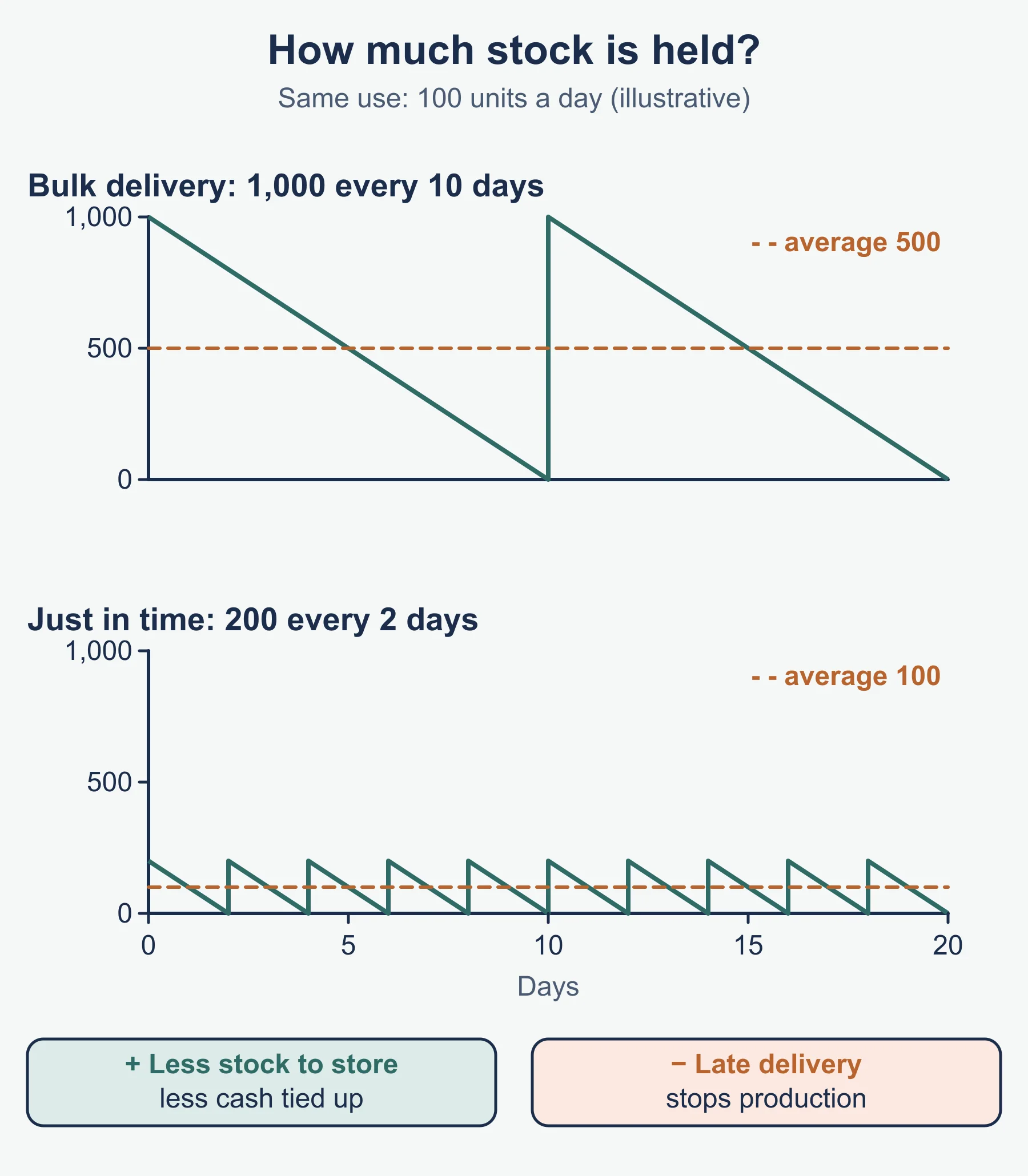
| JIT | Materials arrive when needed, so little inventory is held |
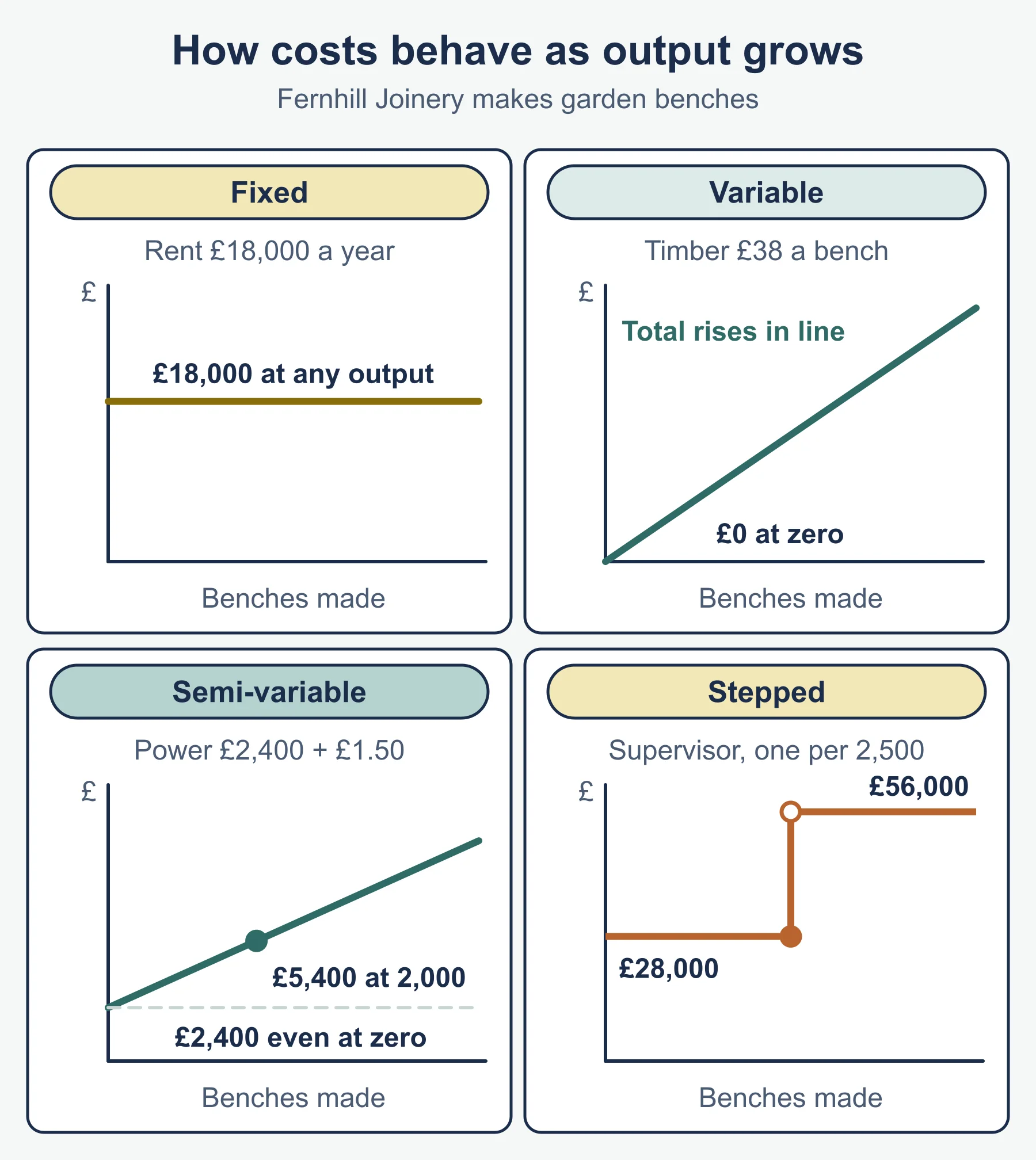
2.1.1 Materials, labour and cost behaviour
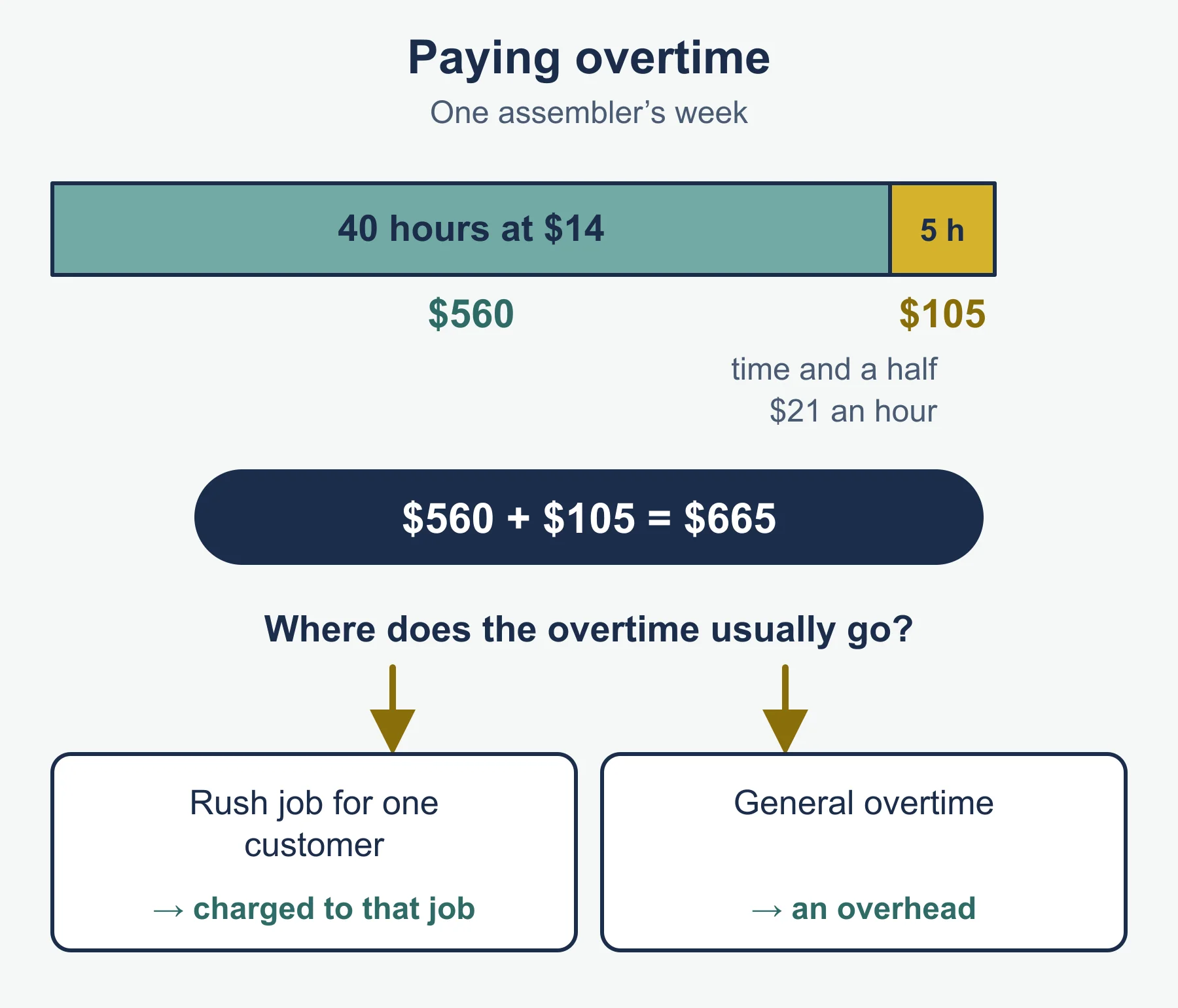
- Split wages into direct labour and indirect labour. Overtime premium is usually an overhead unless one job caused it.
- Issues of materials go to a unit or job (direct) or to overheads (indirect).
- High-low method: variable cost per unit = change in cost / change in output; fixed part = cost minus variable part.
- Stepped cost: round the number of steps up (65 workers at one supervisor per 20 needs 4).
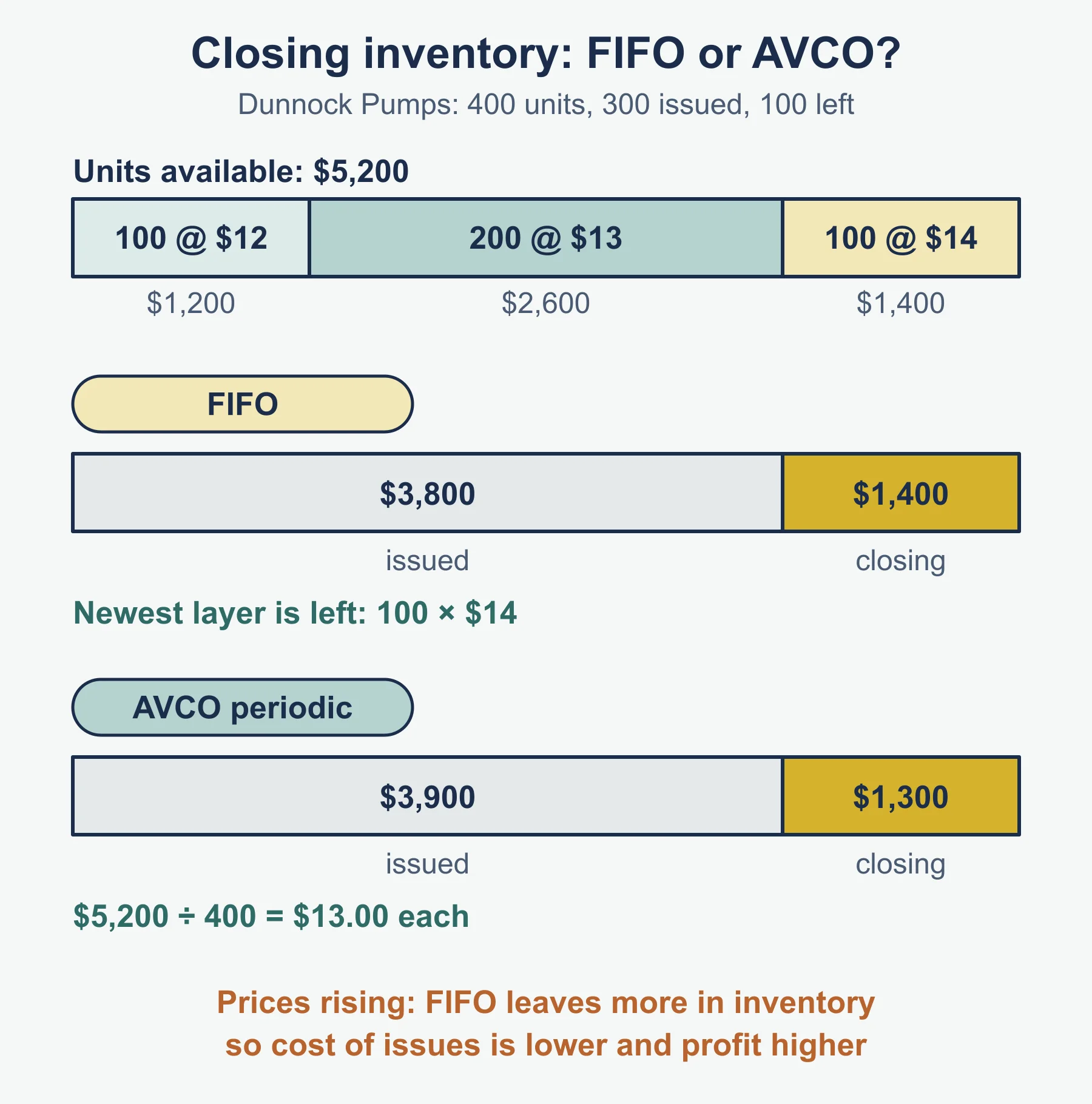
Inventory valuation
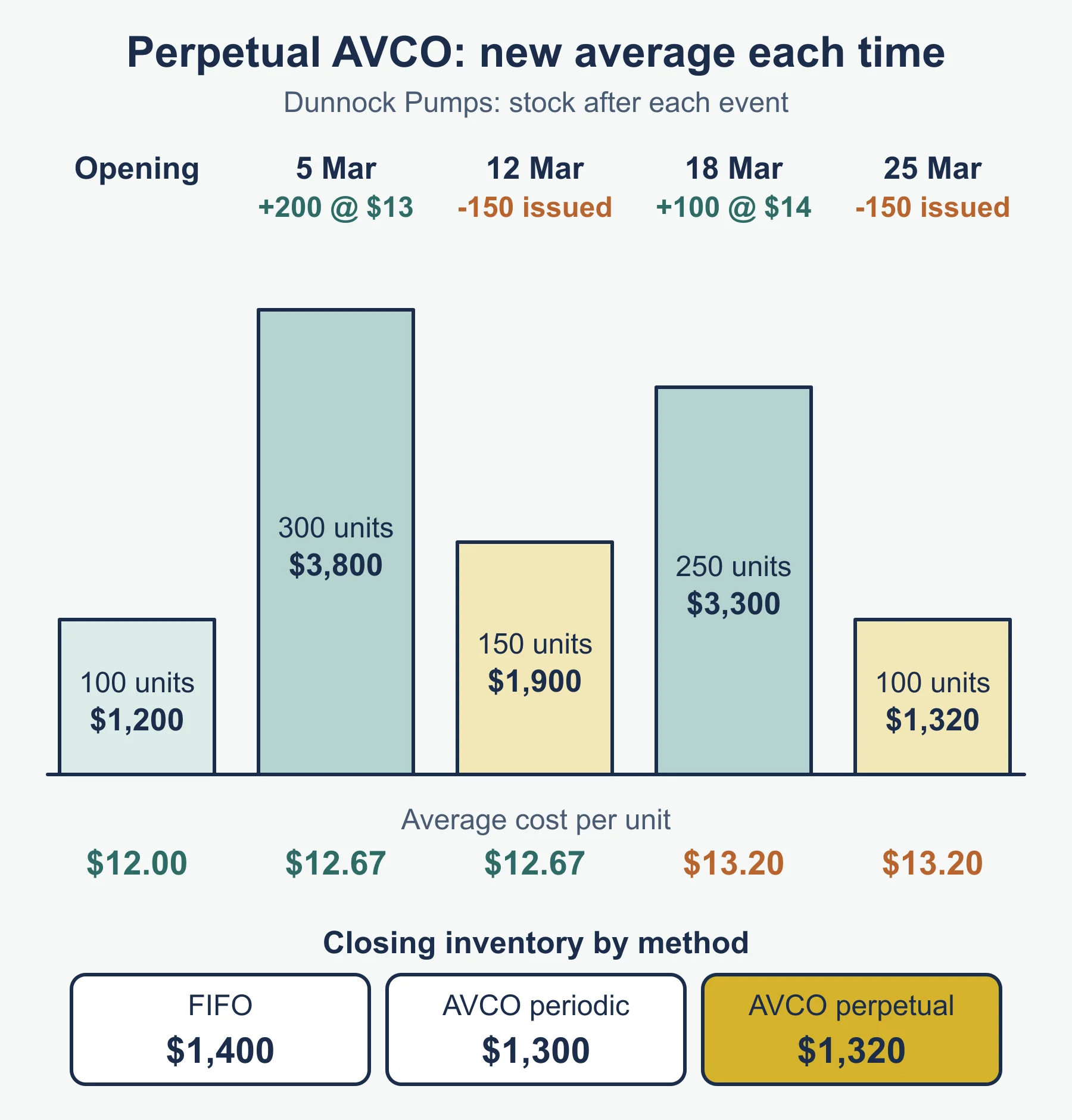
| FIFO | AVCO | |
|---|---|---|
| Issues priced at | Oldest cost first | Weighted average |
| Closing inventory | Latest purchases | Units × average |
| Periodic | Value once at period end | One average for all goods available |
| Perpetual | Update after each movement; gives the same closing value as periodic FIFO | New average after every receipt |
Keldon Bags: opening 50 at 4.00, bought 50 at 5.00, then 60 issued, 40 left. FIFO closing 40 × 5.00 = 200, cost of issues 450 − 200 = 250. AVCO average 450 / 100 = 4.50, closing 180, cost of issues 270. Rising prices: FIFO gives higher closing inventory and higher profit.
JIT
Principles: small frequent deliveries, reliable suppliers, quality built in, planning matched to demand. For: lower storage cost, less cash tied up, less obsolescence. Against: stoppages from late delivery, lost bulk discounts, higher ordering costs. Best when suppliers are reliable and demand is steady.
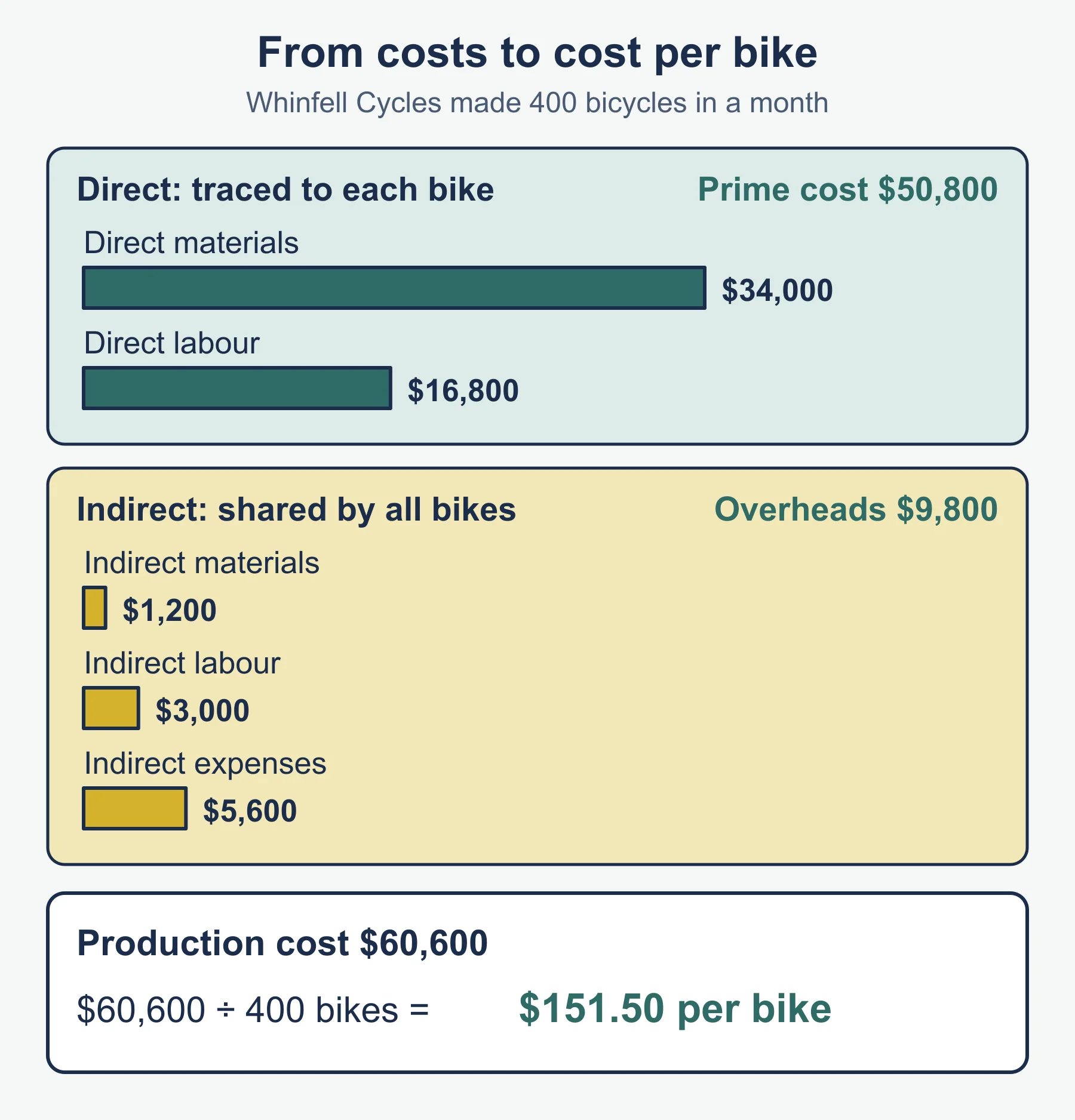
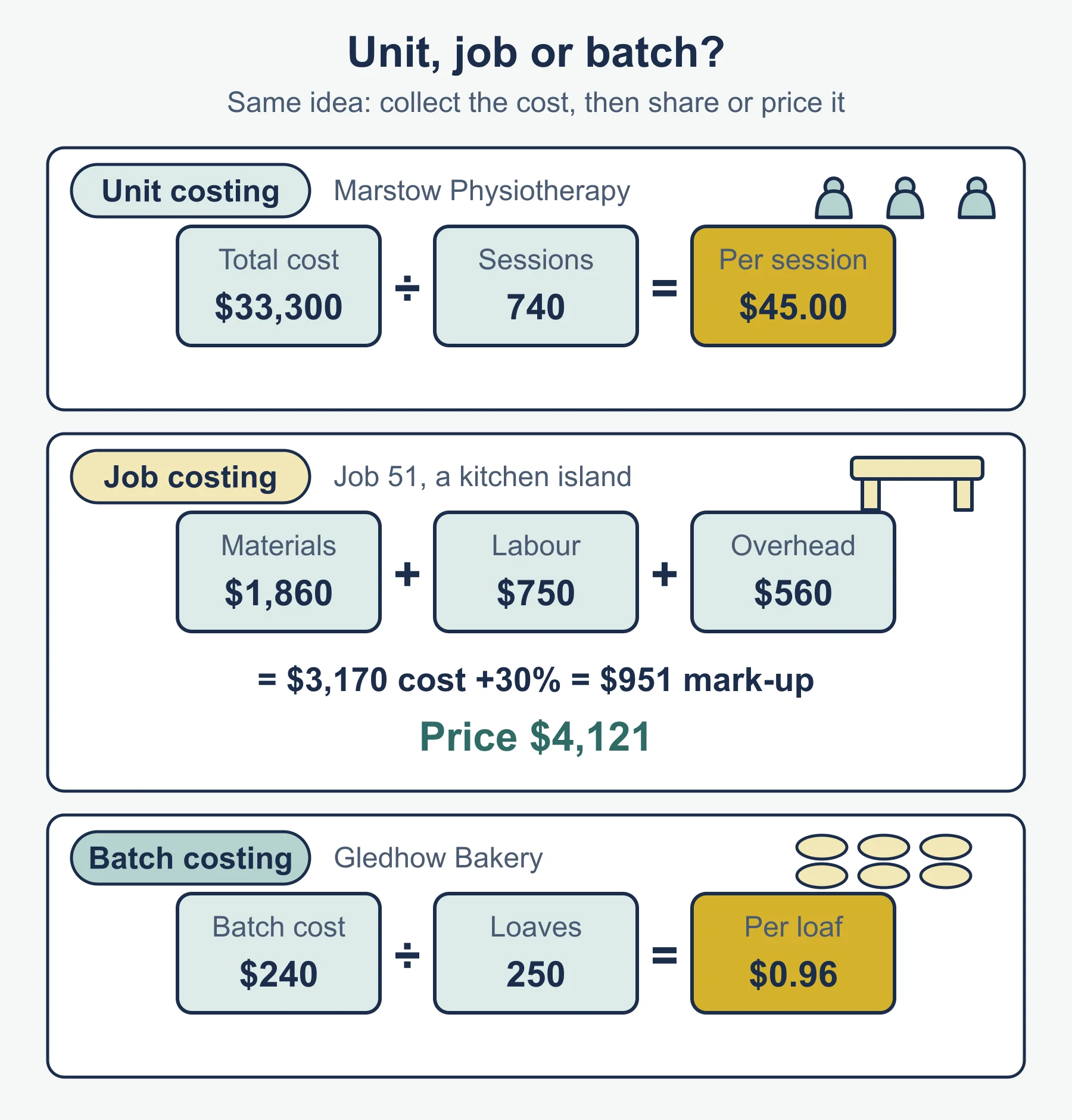
2.2.1 Unit, job and batch costing
| Method | Use | Cost per unit | Example |
|---|---|---|---|
| Unit | Identical output or a repeated service | Total cost / units | Cost per patient visit |
| Job | Work to customer order | Costs collected per job | Custom furniture; an audit assignment |
| Batch | Groups of identical items | Batch cost / items | Bakery batch; laundry load |
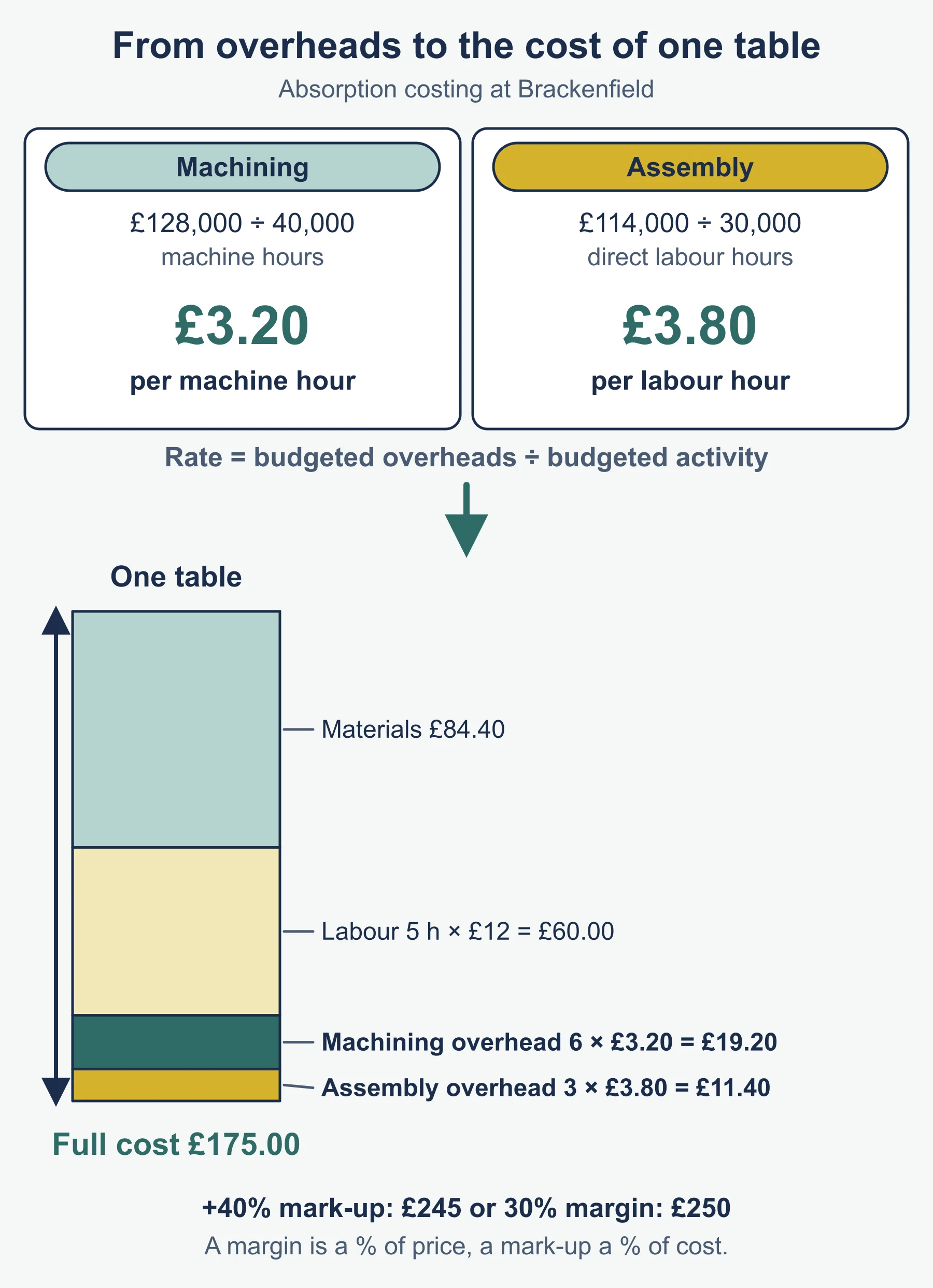
Method in steps for a job or batch statement: direct materials, direct labour, direct expenses, absorbed overhead, total cost, then add mark-up (on cost) or margin (on selling price).
2.2.2 Absorption costing
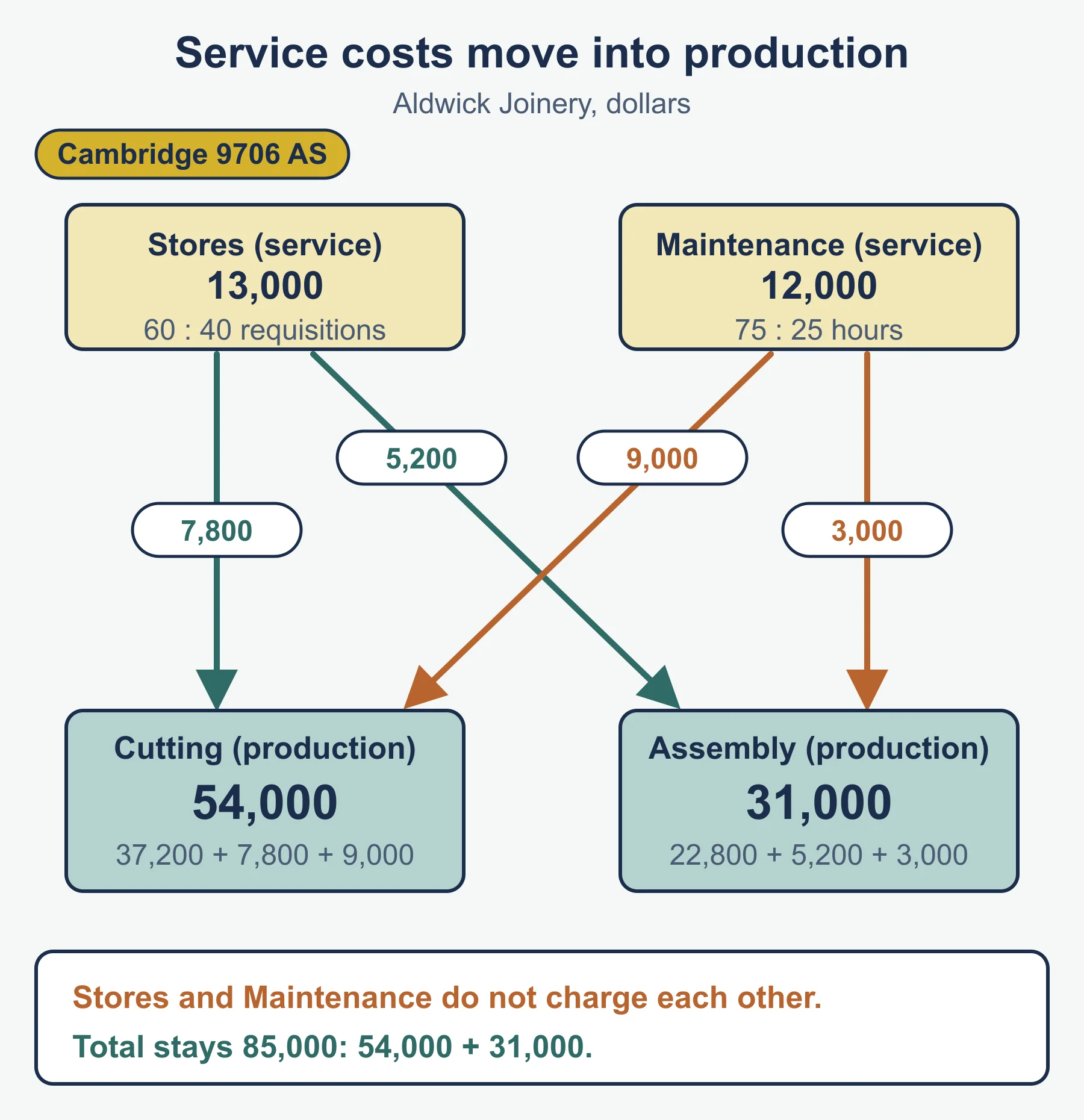
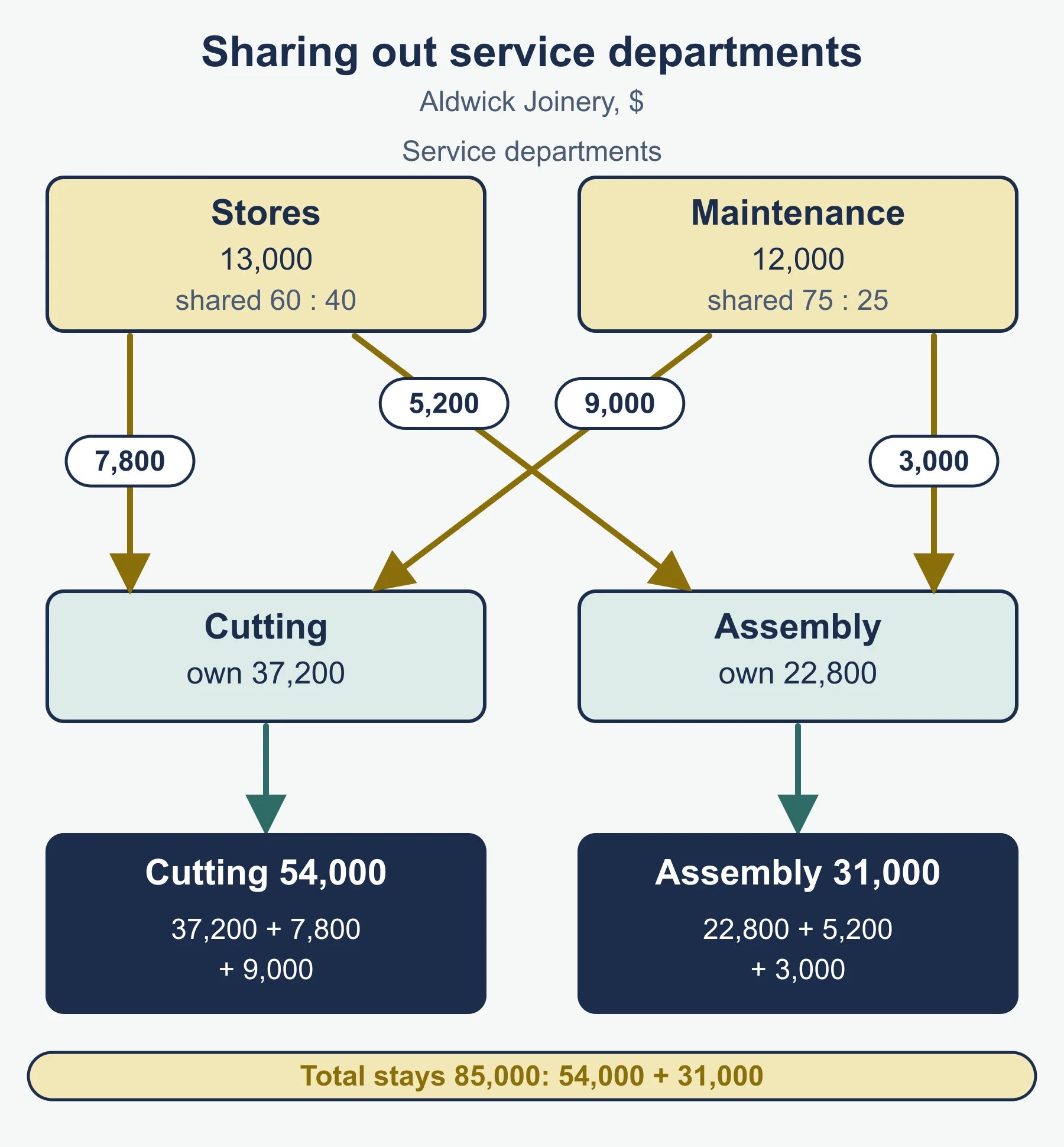
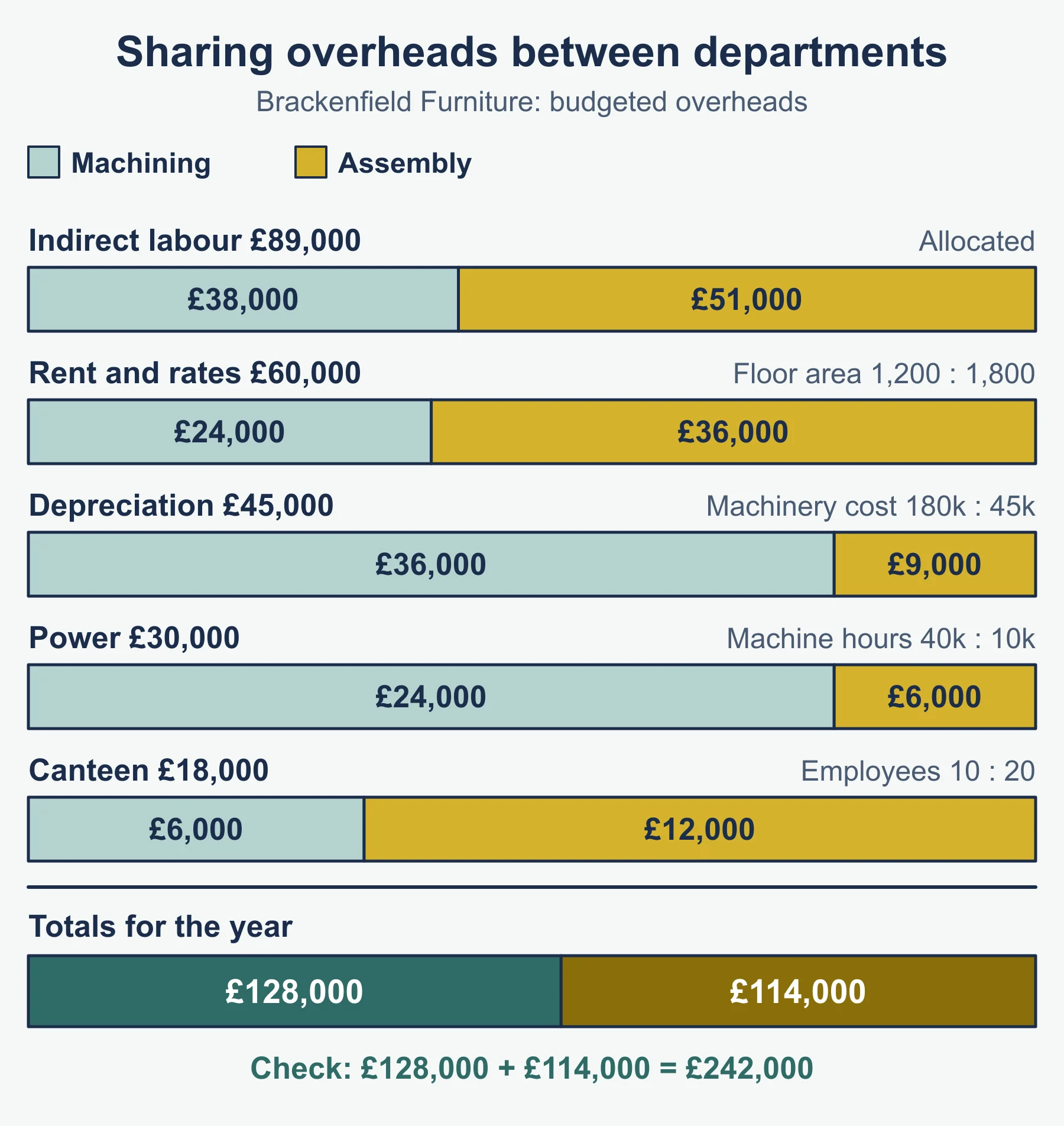
Steps for overhead analysis:
- Allocate overheads belonging wholly to one centre.
- Apportion shared overheads (rent on area, insurance on asset value, power on kWh).
- Reapportion service department totals to production departments.
- OAR = budgeted overhead / budgeted activity (machine hours for machine-led work, labour hours for labour-led work).
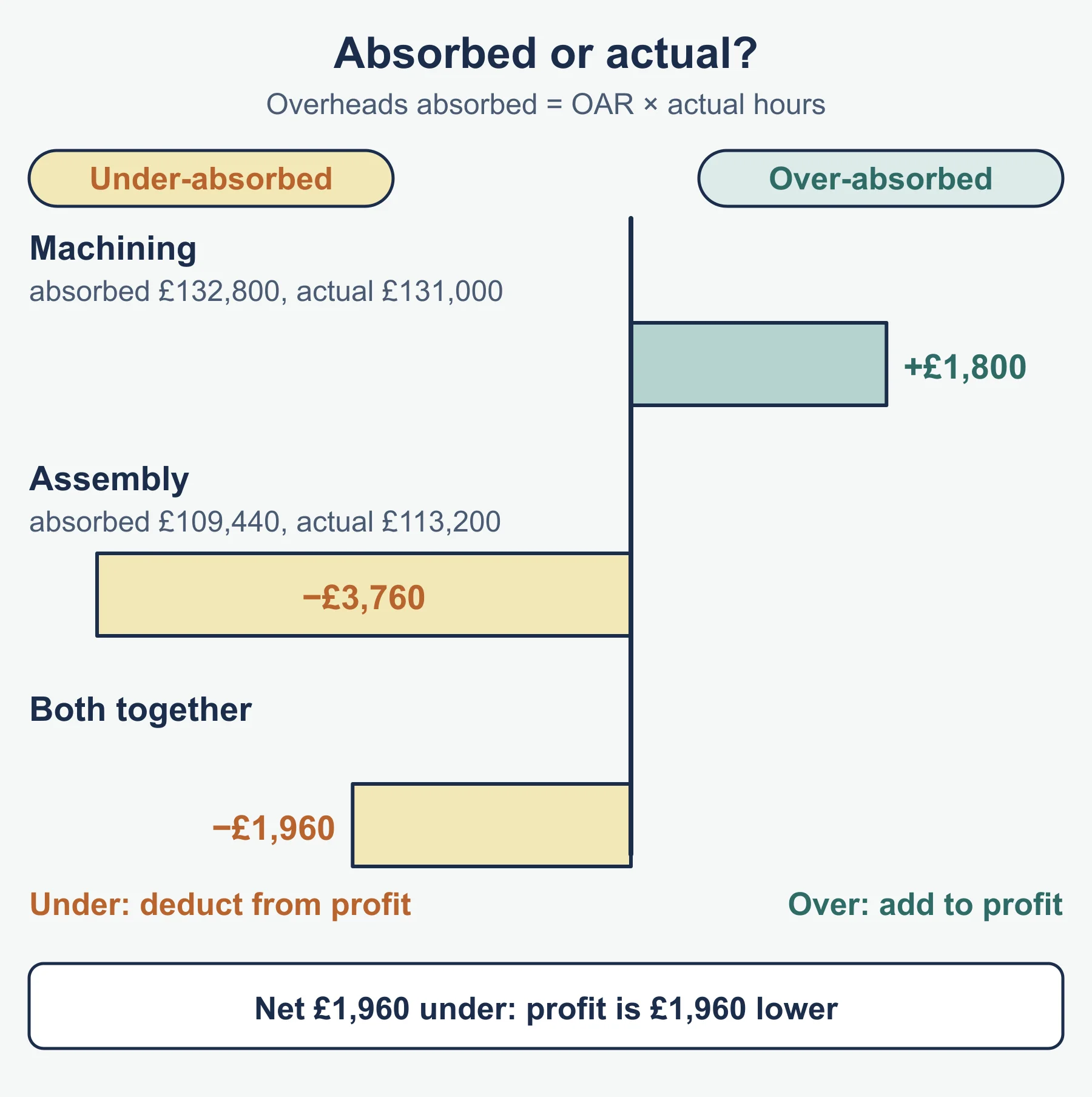
- Absorbed overhead = actual activity × OAR.
Quarnby Fabrics: budget overhead 90,000, budget labour hours 15,000, so OAR 6.00. Actual 14,200 hours and 88,000 overhead. Absorbed 85,200, so under-absorbed by 2,800, which reduces profit. Absorbed above actual means over-absorbed, which raises profit.
Causes: actual activity differs from budget, actual spending differs from budget, or both.
- Uses: full cost for pricing, inventory valuation, product cost comparisons.
- Limitations: subjective bases, fixed costs spread as if variable, profit depends on production level, arbitrary service department splits.
- Decision support: useful for long-run pricing and cost recovery; not enough alone for short-run choices, because fixed costs may not change.
2.2.3 Marginal costing
| Measure | Formula |
|---|---|
| Contribution per unit | Price − variable cost |
| Break-even point (units) | Fixed costs / contribution per unit |
| C/S ratio | Contribution / sales |
| Break-even revenue | Fixed costs / C/S ratio |
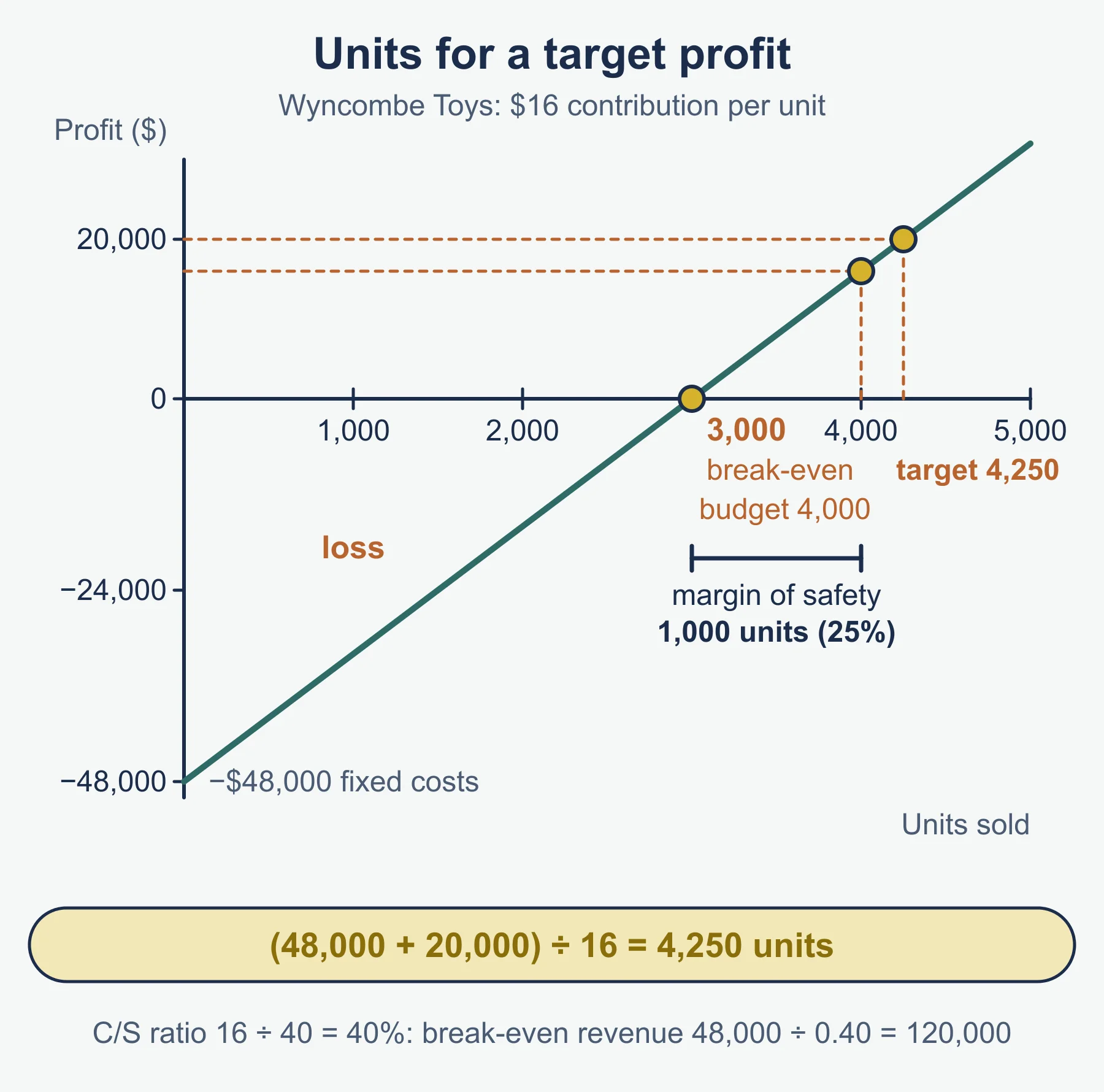
| Target profit units | (Fixed costs + target) / contribution per unit |
| Margin of safety | Budgeted − break-even sales, in units, revenue or % of budget |
Brindley Tools: price 50, variable cost 30, fixed costs 80,000. Contribution 20; break-even 4,000 units (200,000 revenue); C/S ratio 40%; target profit 30,000 needs 110,000 / 20 = 5,500 units; with budget 6,000 units, margin of safety 2,000 units, 33.3% of budget (100,000 revenue).
Break-even chart (reading only, you will not be asked to prepare one). Revenue line from the origin; total cost line from fixed costs; crossing point is break-even; loss to the left, profit to the right; margin of safety is the gap between budget and break-even output.
Break-even limitations: constant price and variable cost, fixed costs fixed, one product or fixed mix, production equals sales, no step changes.
Marginal statement: sales − variable costs = contribution − fixed costs = profit. Inventory is valued at variable cost only.
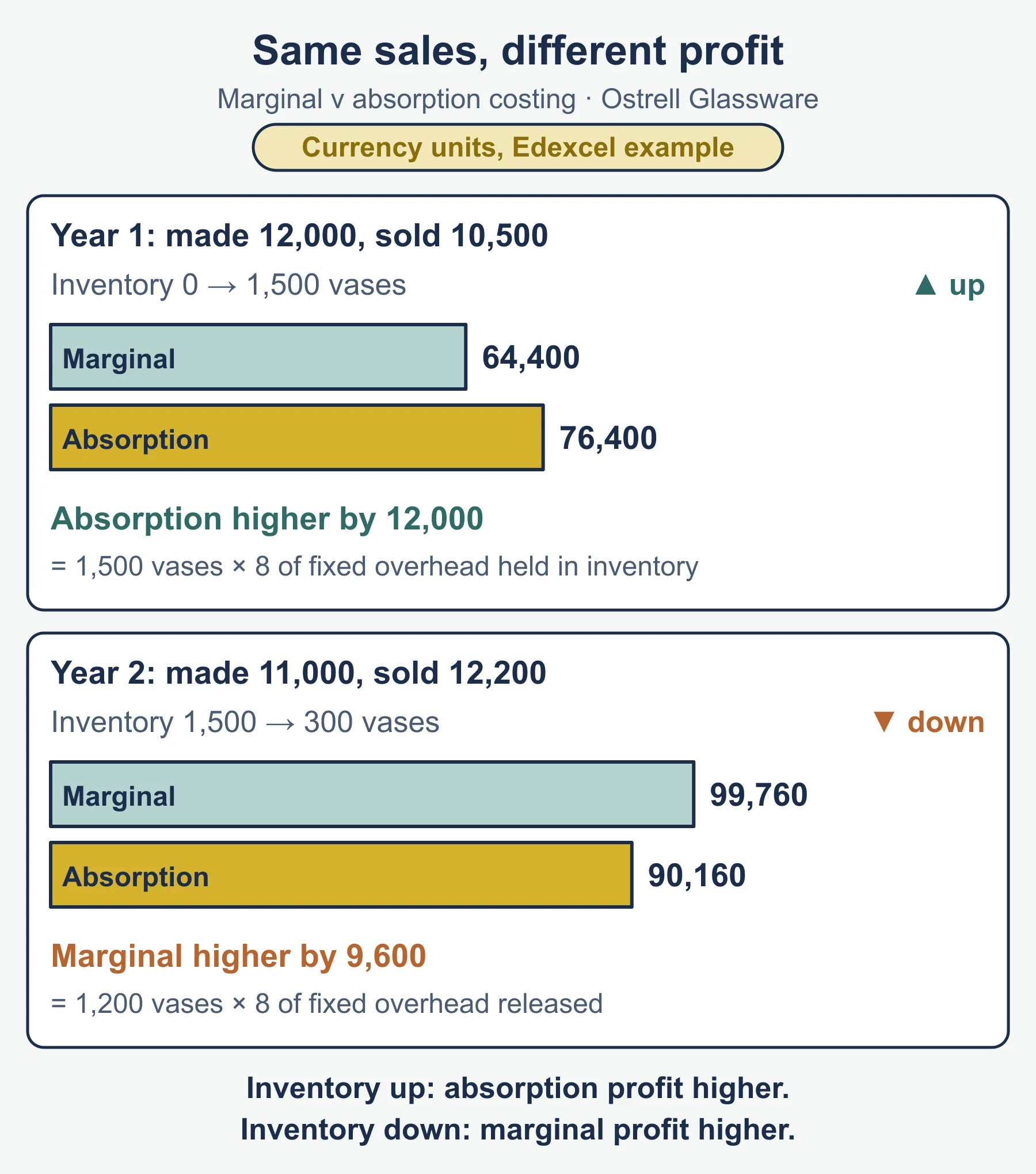
Reconciliation: marginal profit + fixed overhead in closing inventory − fixed overhead in opening inventory = absorption profit. Inventory up: absorption profit higher. Inventory down: marginal profit higher. No change in inventory: equal.
- Uses: contribution by product, short-run decisions, no inventory distortion of profit.
- Limitations: needs a fixed and variable split, long-run prices must still cover fixed costs, not full cost.
Decision rules
| Decision | Method | Small reminder |
|---|---|---|
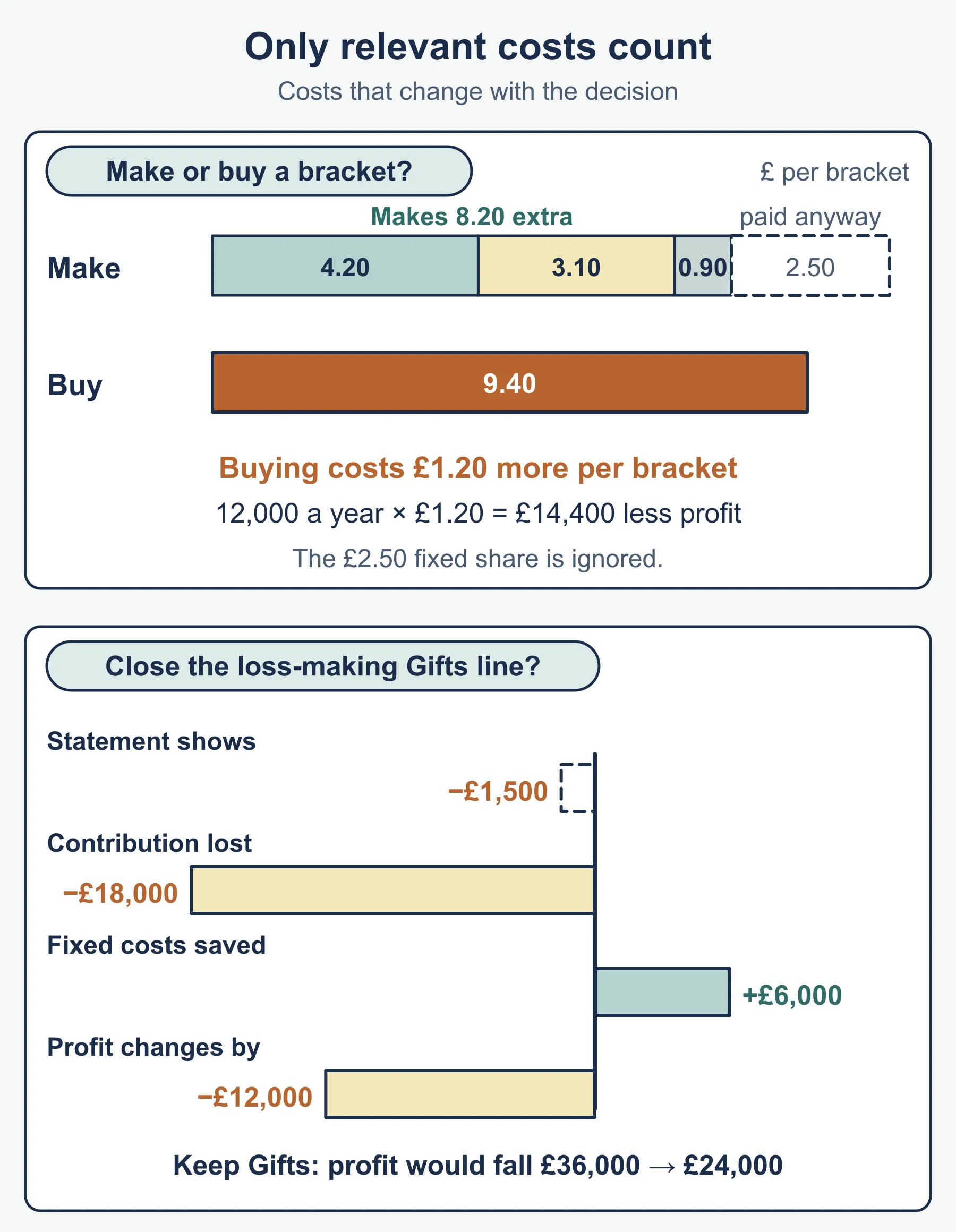
| Make or buy | Make cost = variable cost + avoidable fixed cost, compared with purchase price | 8,000 units: variable 9.00 + avoidable fixed 10,000 / 8,000 = 1.25 gives 10.25, against a quote of 10.50, so make (saves 2,000) |
| Special order | Accept if price > variable cost and spare capacity | 2,000 units at 16.50, variable cost 14.00: extra contribution 5,000 |
| Closure | Compare contribution with avoidable fixed costs; ignore unavoidable shared costs | Contribution 40,000 − avoidable fixed 28,000 = 12,000 benefit, so keep even though allocated head office costs of 20,000 give a reported loss of 8,000 |
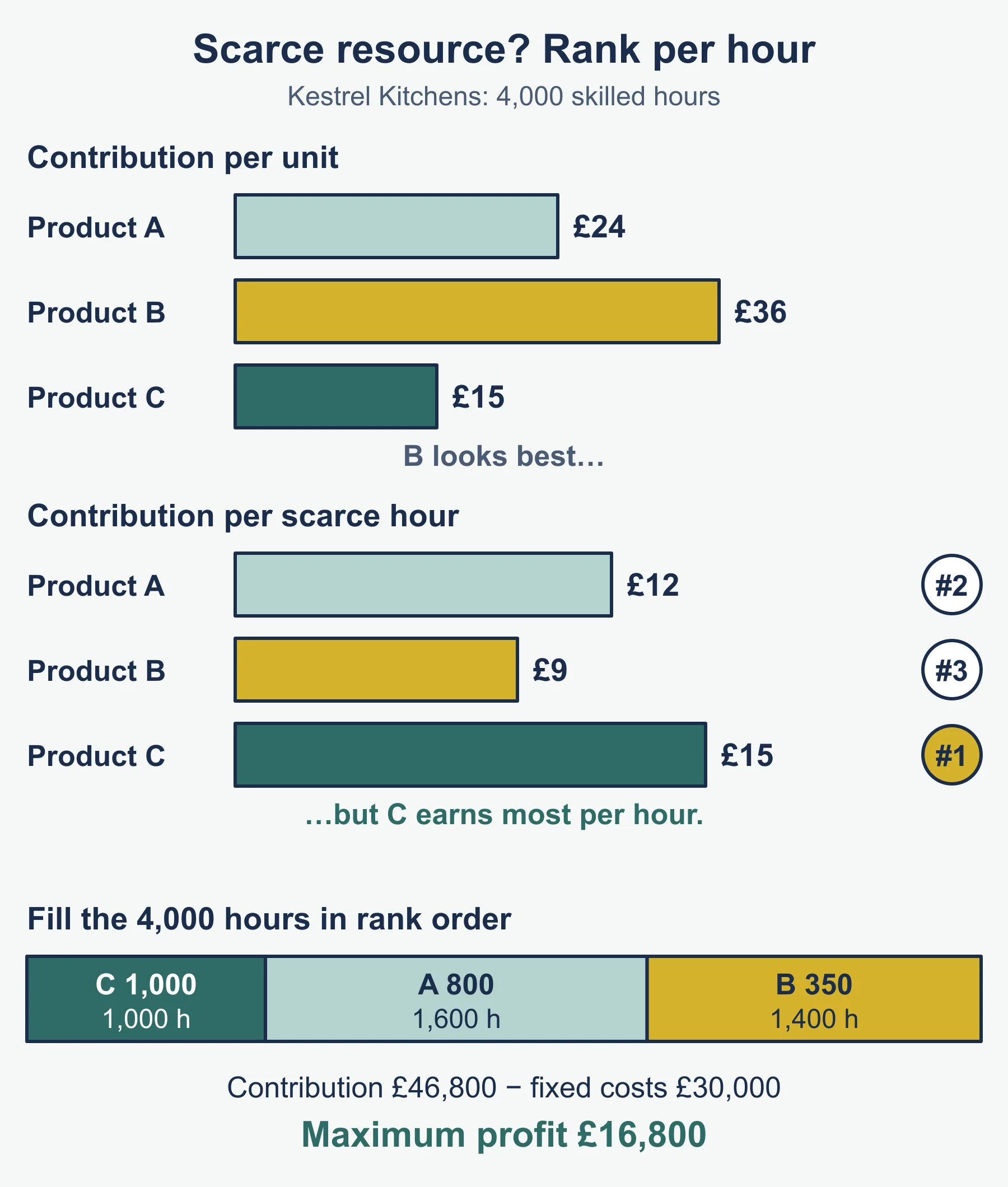
| Limiting factor | Rank by contribution per unit of scarce resource | Fill demand in order of ranking until the resource runs out |
| Target profit | Units needed from the formula above | See table |
If a make-or-buy decision frees capacity, include the contribution the capacity could earn.
Non-financial factors (2.2.2, 2.2.3 and 2.2.4): quality, supplier reliability, customer relationships and reputation, employee morale and job security, environmental impact, available capacity, legal and ethical issues. Give one in context and say how it could change the decision.
CVP analysis. Advantages: quick, shows effects of price, cost and volume changes, supports target profit planning and margin of safety. Limitations: linear assumptions, ignores non-financial factors, short-run in nature, relies on accurate splits of fixed and variable costs.
Must-know distinctions
- Allocate (whole overhead to one centre) versus apportion (share) versus reapportion (service to production).
- Cost centre (where costs collect) versus cost unit (what costs are charged to).
- Direct/indirect (traceability) versus fixed/variable (behaviour): a cost can be both indirect and fixed or both direct and variable.
- Periodic (value once) versus perpetual (continuous record).
- Under-absorbed (absorbed < actual, profit lower) versus over-absorbed (absorbed > actual, profit higher).
- Mark-up (on cost) versus margin (on selling price).
Quick self-test
- Classify a factory supervisor’s salary by traceability and behaviour.
- A cost has a fixed part of 2,000 and variable 3.00 per unit. Find the cost at 1,500 units.
- One supervisor costing 2,500 is needed per 20 workers or part. Find the cost for 65 workers.
- In rising prices, which of FIFO and AVCO gives the higher profit?
- Overhead 72,000 and 9,000 machine hours. Find the OAR.
- Overhead absorbed is 61,000 and actual overhead is 64,500. State the result and its effect on profit.
- Price 18, variable cost 11, fixed costs 21,000. Find the break-even point in units.
- Find the C/S ratio for question 7.
- Budgeted sales 3,600 units and break-even 3,000 units. Find the margin of safety in units and as a percentage.
- Inventory rises by 400 units and fixed overhead is absorbed at 5 per unit. Which profit is higher and by how much?
- State one risk of JIT.
- State two non-financial factors in a make-or-buy decision.
Answers
- Indirect labour; fixed.
- 2,000 + 1,500 × 3 = 6,500.
- 65 / 20 = 3.25, so 4 supervisors = 10,000.
- FIFO.
- 72,000 / 9,000 = 8.00 per machine hour.
- Under-absorbed by 3,500; profit is reduced.
- Contribution 7; 21,000 / 7 = 3,000 units.
- 7 / 18 = 38.9%.
- 600 units; 600 / 3,600 = 16.7%.
- Absorption profit, by 400 × 5 = 2,000.
- A late delivery halts production (or lost bulk discounts).
- Any two from supplier reliability, quality, employee morale, reputation, environmental impact.
Where marks are usually lost
- Calling a cost direct or indirect without a reason tied to traceability.
- Using the wrong activity: absorbing overhead on budgeted rather than actual hours.
- Under or over absorption stated without saying which, or without the effect on profit.
- Dividing fixed costs by price rather than contribution per unit.
- Including unavoidable allocated costs in a closure decision.
- Ranking limiting-factor products by contribution per unit.
- Reconciling the profits with the adjustment in the wrong direction.
- Recommending without a balanced reason or a non-financial factor.
Frequently asked questions
Which sections of Cambridge 9706 cover costs and traditional costing? Sections 2.1 Costs and cost behaviour and 2.2 Traditional costing methods are AS Level content in Cambridge 9706. They cover cost classification, inventory valuation, unit, job and batch costing, absorption costing, marginal costing and break-even analysis.
What is the difference between job and batch costing? Job costing collects costs for work done to a customer’s specification. Batch costing collects costs for a group of identical items made together, and cost per item = batch cost ÷ items in the batch.
Which costs are relevant in a closure decision? Only future costs that change with the decision are relevant. Unavoidable allocated fixed costs continue whether or not the product or department closes, so they should be left out.
How should under or over absorption be reported? State whether overhead is under- or over-absorbed and its effect on profit, as well as the figure. Under-absorption reduces profit and over-absorption increases it.
Official syllabus
Cambridge International, AS & A Level Accounting 9706 syllabus for 2026, 2027 and 2028, sections 2.1 and 2.2.
Get free revision emails (optional)
Occasional emails with practice questions, worked explanations and links to free resources for the qualification and subjects you choose. No spam, and you can unsubscribe from any email. The free tools on this site never need an email.
Related resources
-
Study guides
A Level Accounting: Accounting for Non-Current Assets (Cambridge 9706)
Capital versus revenue spending, why assets depreciate depreciation methods, cost and revaluation models and disposals, for Cambridge 9706 Accounting topic 1.3.
Accounting · Cambridge · AS Level
Read guide -
Study guides
A Level Accounting: Investment appraisal (Cambridge 9706)
Payback, accounting rate of return, NPV and IRR, cash flows versus profits, and non-financial factors, for Cambridge A Level Accounting 9706 section 4.4.
Accounting · Cambridge · A Level
Read guide -
Practice questions
A Level Accounting: Investment appraisal (Cambridge 9706) – Practice Questions
Twelve original questions with worked answers on payback, ARR, NPV, IRR and non-financial factors for Cambridge A Level Accounting 9706 section 4.4.
Accounting · Cambridge · A Level
Try questions
Related articles
-
teaching
A Level tuition in Dubai: Cambridge or Pearson Edexcel International A Level?
Schools in Dubai and Abu Dhabi teach either Cambridge International AS & A Level or Pearson Edexcel International A Level. How the two are structured, why it matters for tuition, and how online classes from Lahore work.
9 October 2026
-
curriculum guides
Choosing subjects at IGCSE and A Level
How subject choices at 14 and 16 affect university options later, and how to keep pathways open without overloading a timetable.
28 July 2026
Studying this with a teacher
Working through Accounting AS LEVEL?
This page is free and stays free. If you would rather be taught it, Marlbridge runs Accounting classes one-to-one and in small groups of up to 15, online in your own time zone. The first trial class is free. WhatsApp replies within an hour (8am–11pm Pakistan time, every day); email the same day.
Cambridge Accounting teachers at Marlbridge

