
Revision Notes
A Level Business: Location and scale (Cambridge 9609) – Revision Notes
Condensed revision notes for 9.1 Location and scale in Cambridge A Level Business 9609, with tables, a self-test and common slips.
- Subject
- Business
- Level
- A LEVEL
- Topic
- Operations management
- Author
- Marlbridge Academic Team
- Updated
- Reviewed by
- Salman Ahmad (what this means)
Aligned to Cambridge A Level Business (9609), For examination in 2026, 2027 and 2028. Official specification .
Syllabus page (what it covers and how it is assessed): Cambridge A Level Business.
Syllabus points this page covers
9609 (A Level)
- 9.1 Location and scale
Found an error? Report a correction.
Need help with this topic? Request a free trial class for A Level Business (9609).
These are condensed notes for section 9.1 Location and scale (9.1.1 Location and 9.1.2 Scale of operations) of the Cambridge International AS & A Level Business 9609 syllabus for examination in 2026, 2027 and 2028. It is A Level content within Topic 9, Operations management. For full explanations and worked examples, use the study guide, then try the practice questions. Related questions are in the Topic 9 practice set. Course links: the Cambridge A Level Business hub, the checklist and the free diagnostics.
9.1.1 Location
Key terms
| Term | Meaning |
|---|---|
| Location | Where a business carries out its operations |
| Relocation | Moving existing operations to a new site |
| Offshoring | Moving operations (production or services) to another country, in the firm’s own site or a supplier’s |
| Reshoring | Bringing offshored operations back to the home country |
| Globalisation | Growing links between countries through trade, investment, finance and communication |
| Quantitative factor | One that can be costed, such as wages or rent |
| Qualitative factor | A judgement that is hard to cost, such as reputation or staff morale |
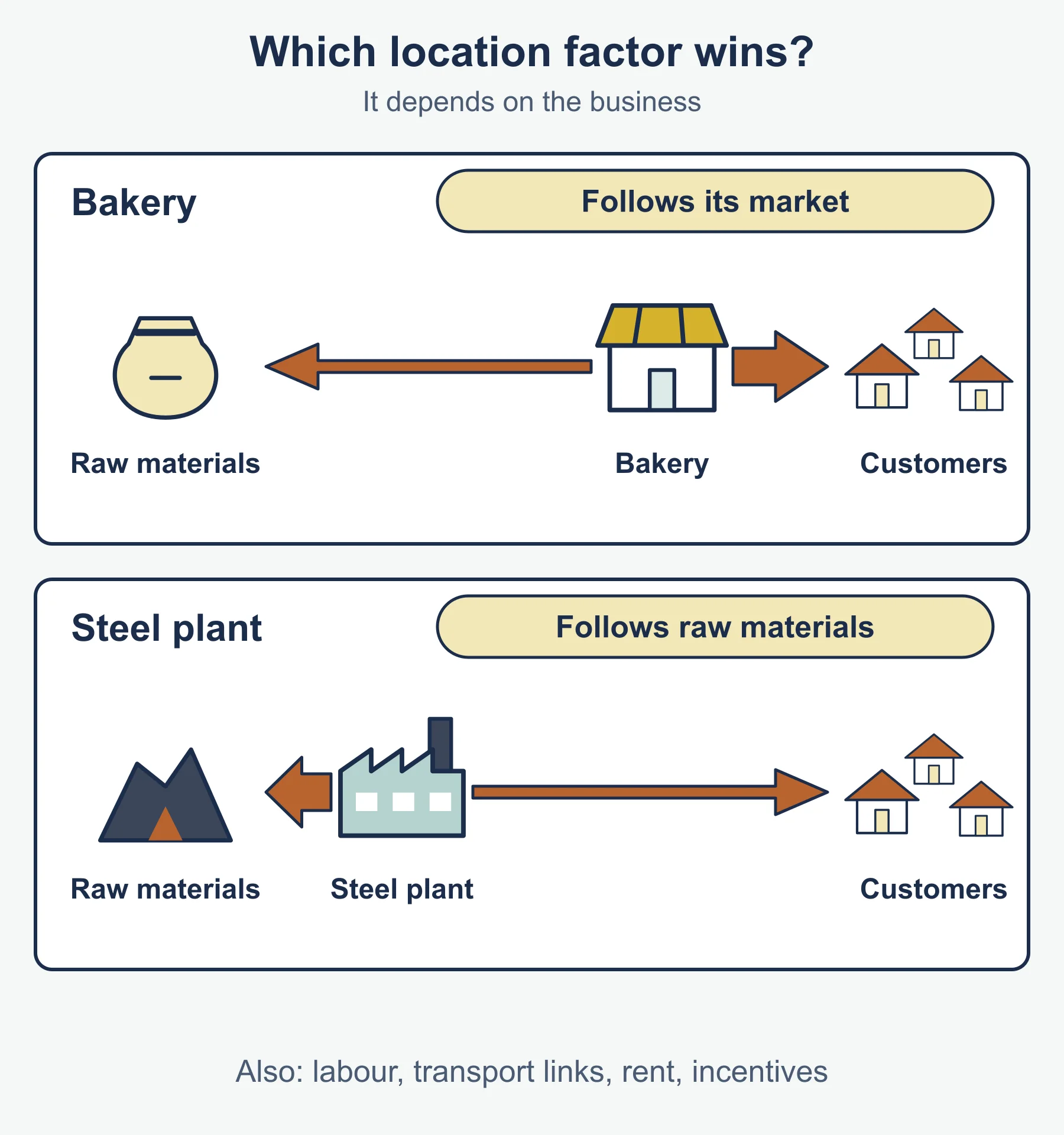
Factors that determine location
| Factor | Quick reminder |
|---|---|
| Market | Closeness to customers; essential for perishable goods and many services |
| Materials | Make near the source if the product loses weight in production |
| Labour | Cost, skills, availability |
| Transport and infrastructure | Roads, ports, power, broadband, freight costs |
| Land and premises | Rent or price, room to expand |
| Government | Grants, taxes, planning, regulation |
| Competitors and clusters | Supplier and skills pool against crowding |
| Owner and image | Personal preference, prestige address |
Why relocate, and what it costs
- Triggers: lease ends; costs rise; new market; no room to grow; congestion; rule changes.
- One-off costs: moving, redundancy, retraining, disruption, lost customers, lost staff.
- Test: do the savings outweigh the costs, and over what period?
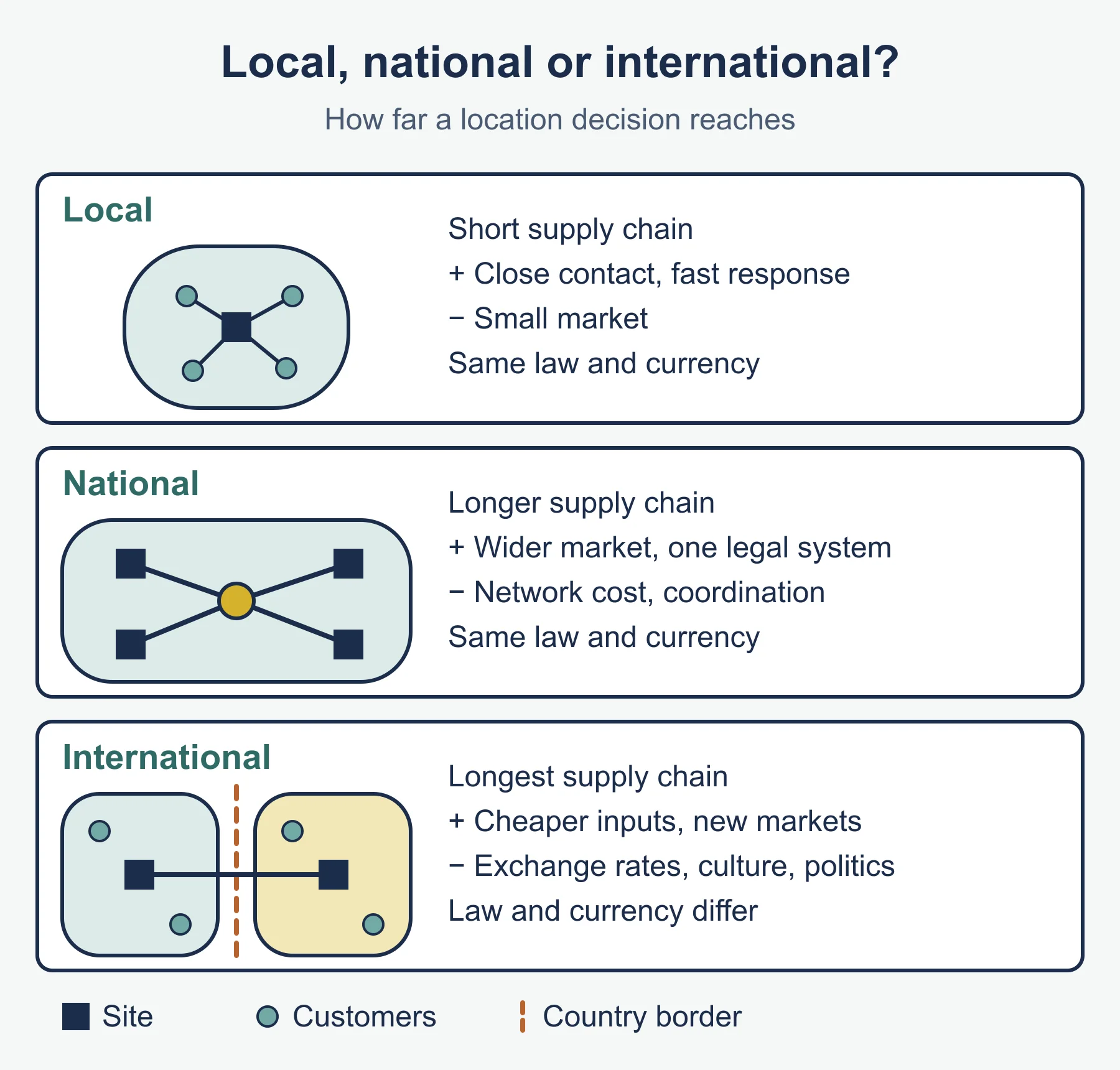
Local, national, international
| Local | National | International | |
|---|---|---|---|
| Scale of network | One district | Whole country | Several countries |
| Law and currency | One | One | Several, so exchange-rate risk |
| Supply chain | Short | Longer | Longest, most disruption risk |
| Main gain | Close contact | Wider market | Cheaper inputs, new markets |
Offshoring and reshoring at a glance
| Offshoring | Reshoring | |
|---|---|---|
| Typical reasons | Lower labour and land cost, skills, nearer new markets, avoid trade barriers, overseas incentives | Rising overseas wages, freight cost, quality problems, long lead times, disruption, automation, “made at home” demand |
| Gains | Lower unit cost, access to new markets | Shorter lead times, control, brand message |
| Costs and risks | Freight and duty, exchange rates, weaker control, long lead times, image if home jobs go | Higher labour cost, new plant cost, loss of overseas know-how |
| Who is affected | Home workers may lose jobs; host economy gains jobs | Home jobs created; overseas workers lose out |
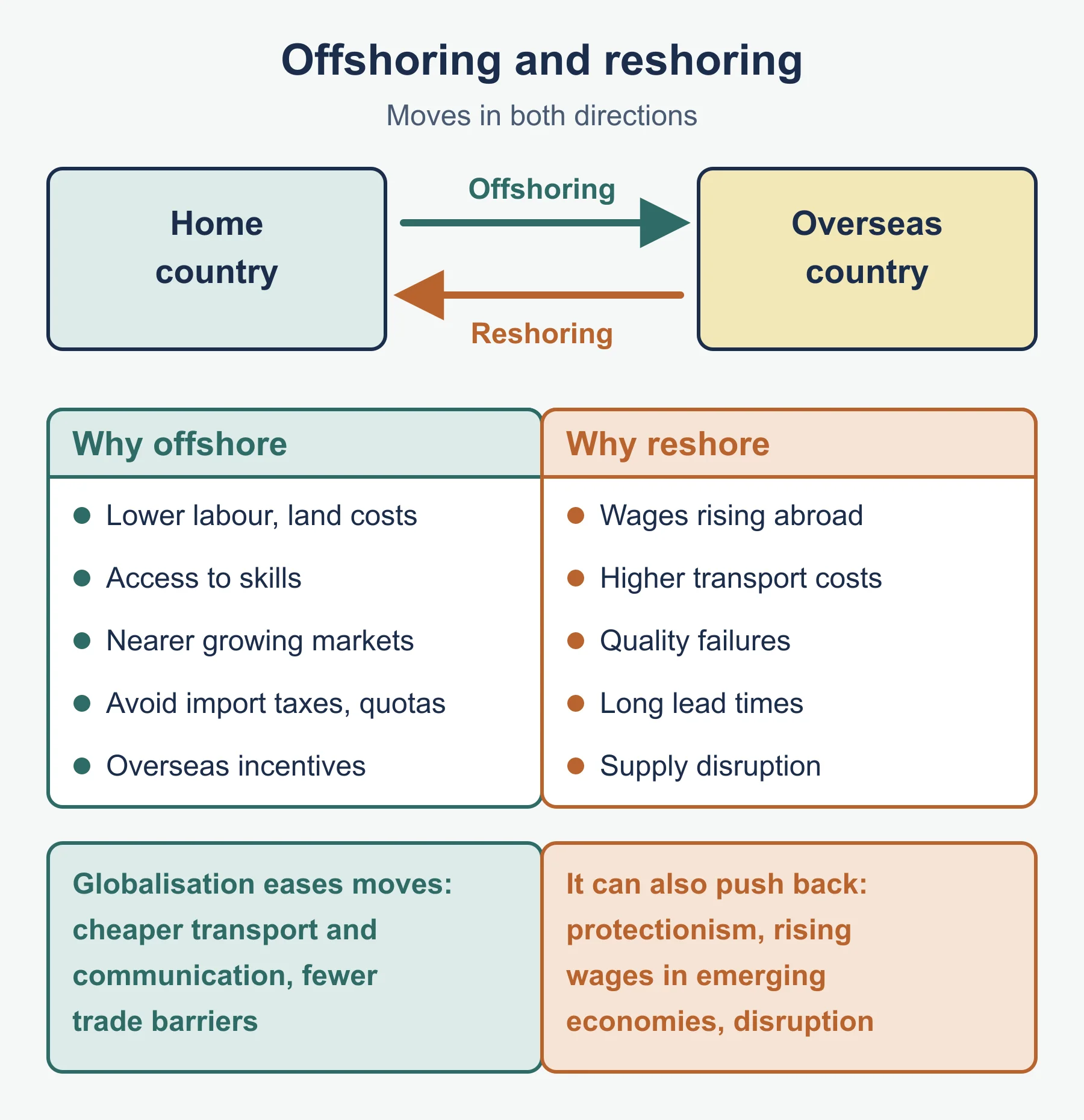
Globalisation and location
- Lower trade barriers and transport costs make distant sites practical.
- Global supply chains: stages of production spread across countries.
- Emerging markets give cheap inputs and new customers.
- Overseas competition pushes costs down, which can force relocation.
- Not one-way: protectionism, rising wages abroad and disruption can reverse the trend.
9.1.2 Scale of operations
Factors that influence scale
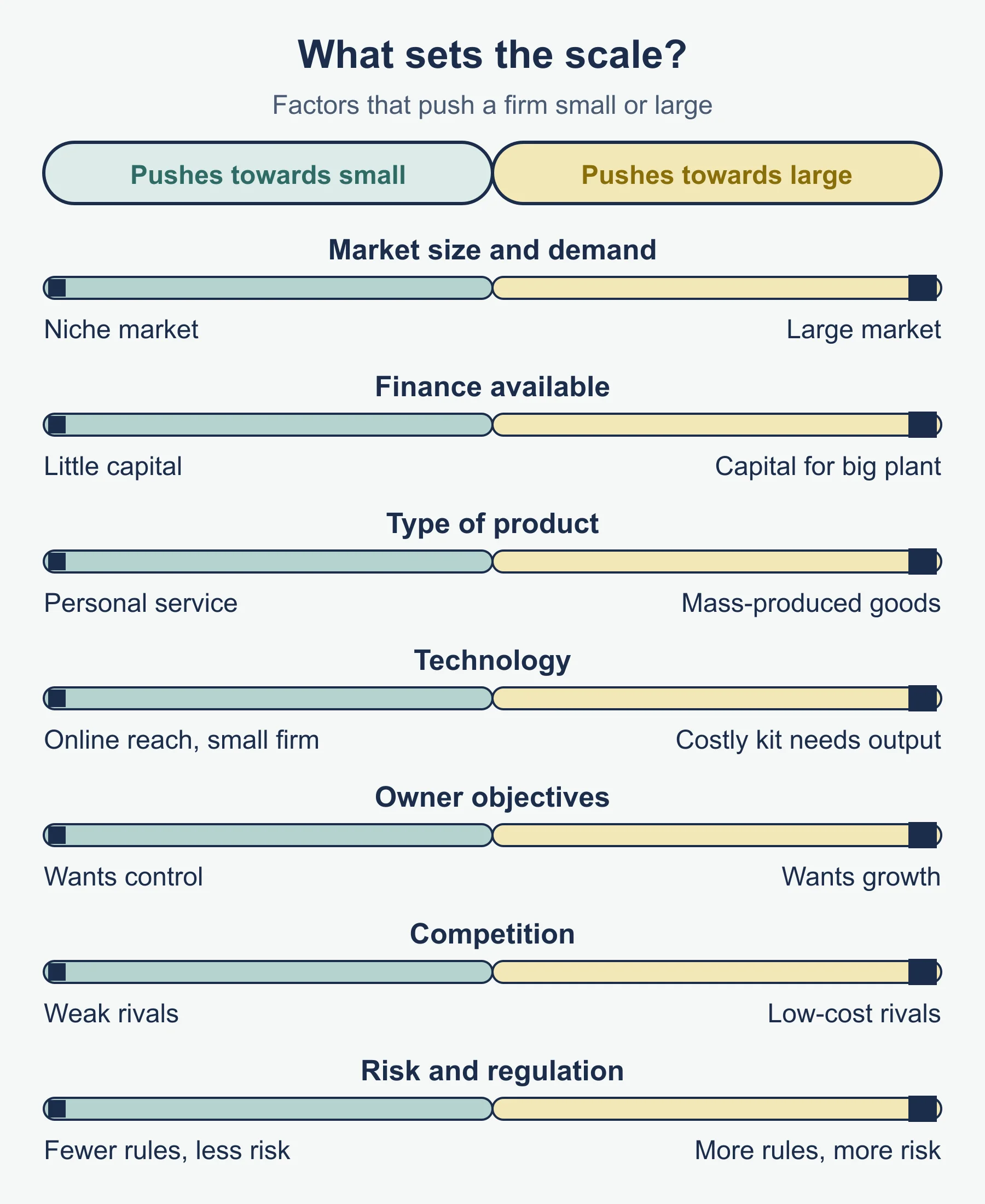
Market size; finance; type of product (mass versus personalised); technology; owner’s objectives; competition; risk and regulation.
Economies and diseconomies
| Internal (from the firm’s own growth) | External (from growth of the industry or area) | |
|---|---|---|
| Economies | Purchasing, technical, financial, marketing, managerial, risk-bearing | Skilled labour pool, supplier cluster, better infrastructure, local training |
| Diseconomies | Communication, coordination, slow decisions, low motivation, duplication | Congestion, wage and land price rises, strained infrastructure, local labour shortage |
Must-know distinctions
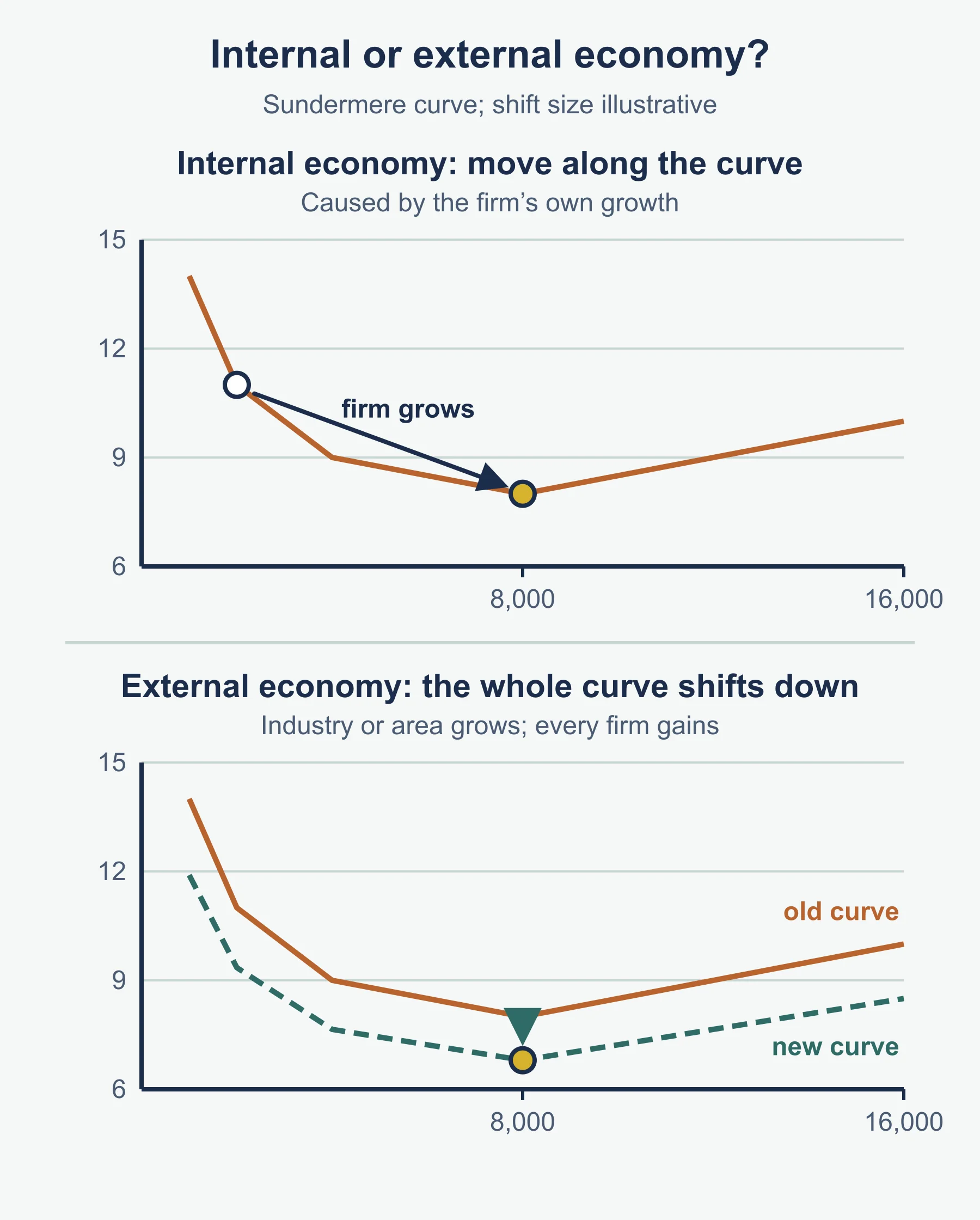
- Internal economy: firm’s own size causes it. External: the industry or area causes it and every firm in it benefits.
- Offshoring is about country. Outsourcing is about who does the work. They can combine.
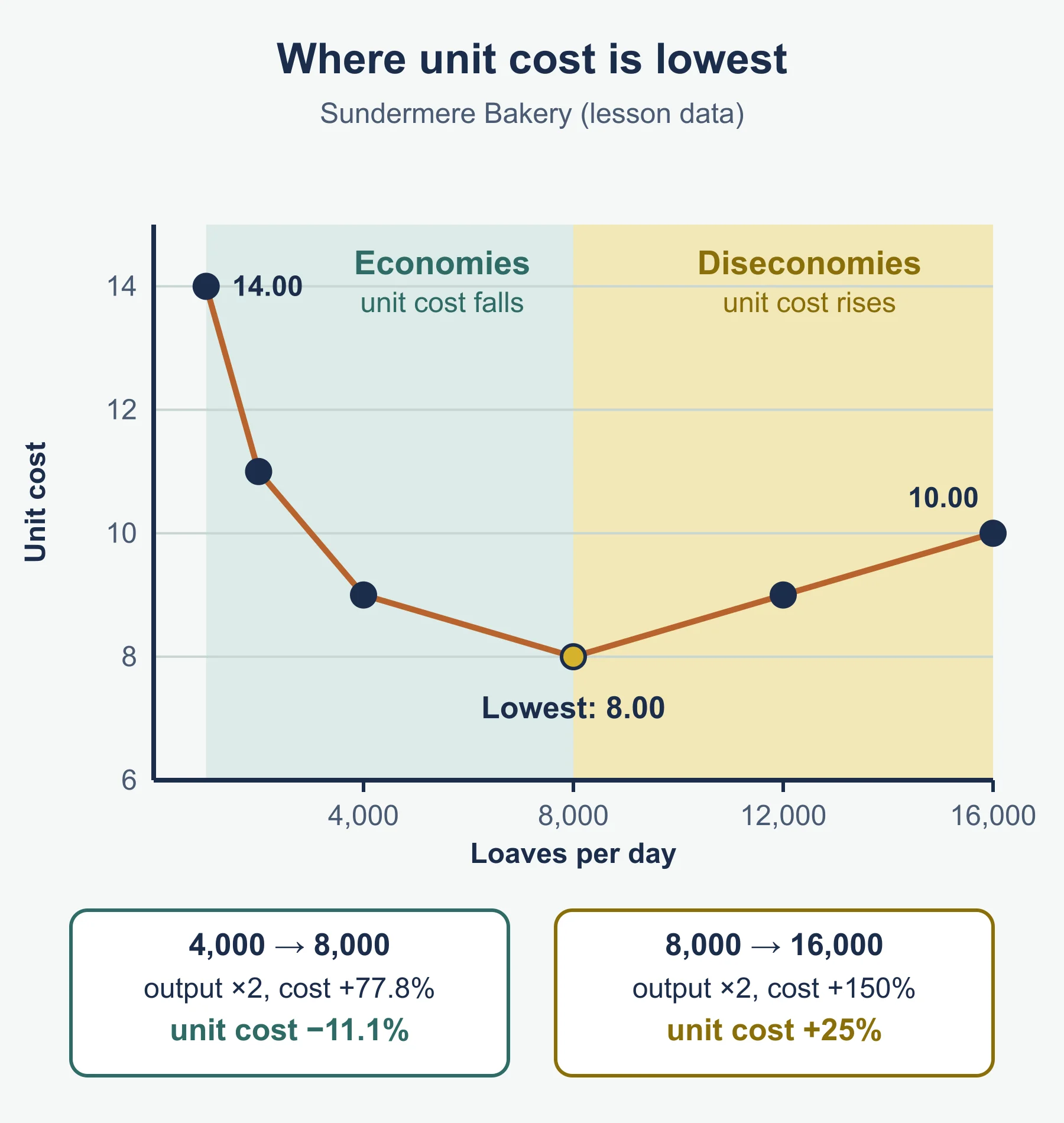
- Economies of scale are falling unit costs as output rises. Diseconomies are rising unit costs. Neither is a “profit” or “loss” in itself.
- Scale (size of output and resources) is not the same as the number of sites or staff, though they are linked.
- Relocation moves existing operations; offshoring moves them to another country. A move across town is relocation but not offshoring.
Unit cost (standard form)
unit (average) cost = total cost ÷ output
Method in steps:
- Find total cost at each output (add fixed and variable costs if given separately).
- Divide by output.
- Compare: falling unit cost points to economies, rising unit cost to diseconomies.
- For percentage change: (new − old) ÷ old × 100.
- Say what could explain the change, using the case.
Worked reminder: Otterburne Tools
Total cost is 380,000 at 40,000 units and 640,000 at 80,000 units. Unit cost: 380,000 ÷ 40,000 = 9.50; 640,000 ÷ 80,000 = 8.00. Change = (8.00 − 9.50) ÷ 9.50 × 100 = −15.8%. Output doubled but total cost rose only 68.4%, so economies of scale were gained.
If Otterburne relocates at a one-off cost of 450,000 and saves 90,000 a year, it takes 450,000 ÷ 90,000 = 5 years to recover the cost (the simple payback form).
Worked reminder: comparing two sites
Another Otterburne plan makes 40,000 units a year. Home site: variable cost 9.00 a unit, fixed costs 210,000. Overseas site: variable cost 5.50 plus 1.20 freight and duty, so 6.70 a unit, fixed costs 260,000.
- Home total cost = 9.00 × 40,000 + 210,000 = 570,000, so unit cost 14.25.
- Overseas total cost = 6.70 × 40,000 + 260,000 = 528,000, so unit cost 13.20.
- Annual saving = 42,000, which is 7.4% of the home cost.
- If moving would cost 126,000 once, simple payback = 126,000 ÷ 42,000 = 3 years.
Evaluation reminders
- Say which factors matter most for this product and why (perishable, bulky, high value, service).
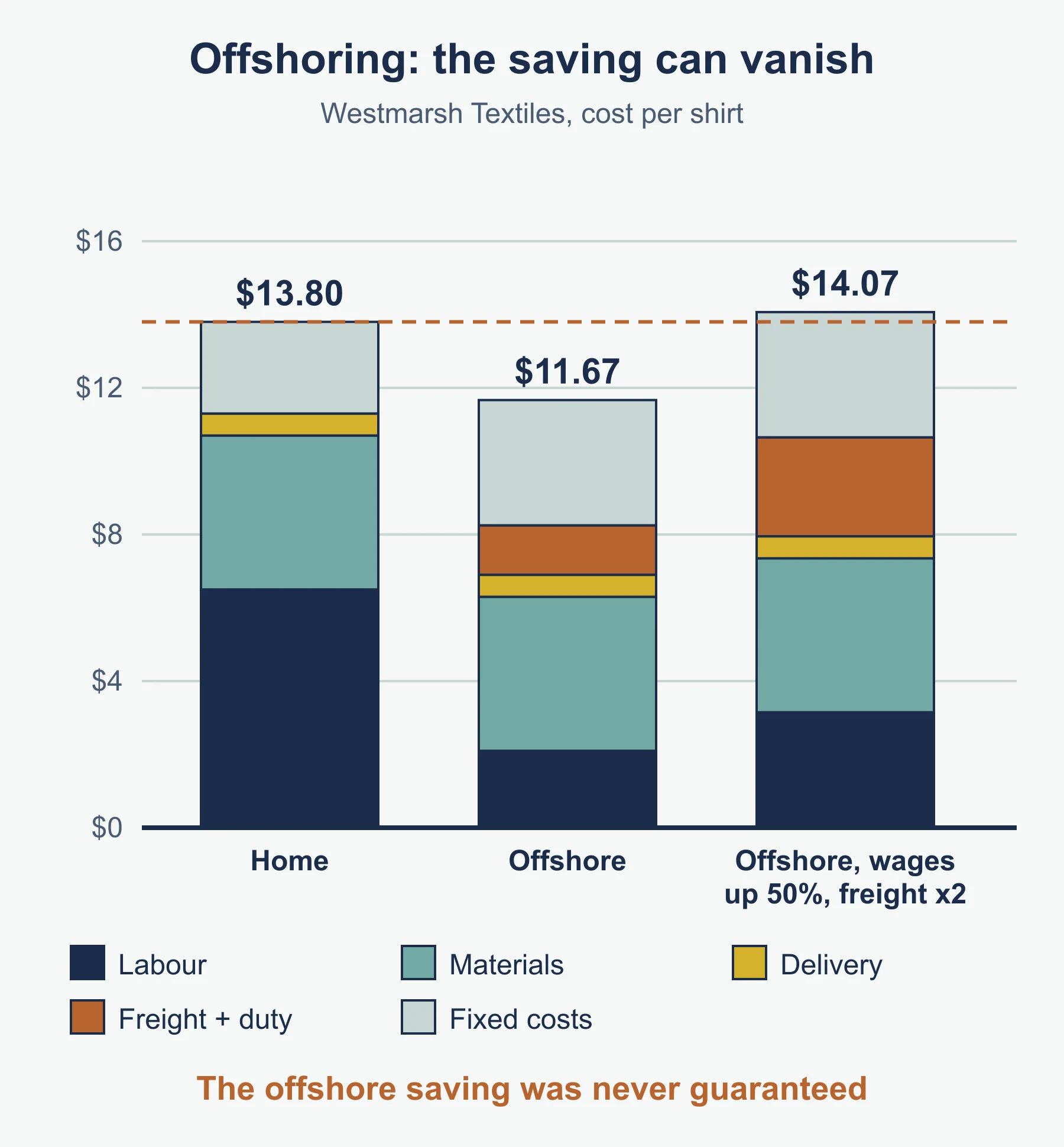
- Check how long the saving may last: wages, freight and exchange rates change, and a saving that vanishes within a few years is a weak reason to move.
- Weigh the one-off cost and the disruption against the annual saving.
- Add non-financial effects: control, speed, image, staff, risk.
- End with a decision and the condition on which it depends.
Quick self-test
- Define offshoring.
- State two qualitative factors that might influence location.
- A relocation costs 450,000 once and saves 90,000 a year. How long to recover the cost?
- Total cost is 380,000 at 40,000 units. Calculate unit cost.
- Unit cost at 80,000 units is 8.00 and at 40,000 units is 9.50. Calculate the percentage change, to 1 d.p.
- A new college opens near a cluster of welding firms and trains welders for all of them. Is this an internal or external economy? Explain.
- Give two internal diseconomies of scale.
- State one difference between a local and an international location decision.
- Give two reasons a business might reshore.
- A firm saves 0.75 per unit on 120,000 units by moving. State the annual saving, and give one reason it may be smaller in practice.
Answers
- Moving some or all operations (production or services) to another country.
- Any two of: quality of life, reputation or image of the area, owner’s preference, staff morale, community relations.
- 450,000 ÷ 90,000 = 5 years.
- 380,000 ÷ 40,000 = 9.50.
- (8.00 − 9.50) ÷ 9.50 × 100 = −15.8% (a fall of 15.8%).
- External: the benefit comes from the industry’s growth in the area, and lowers costs for every firm there.
- Any two of: communication problems, slow decisions, poor coordination, falling motivation, duplicated work.
- For example, international decisions involve different currencies, laws and longer supply chains; local decisions do not.
- Any two of: rising wages abroad, higher freight costs, quality problems, long lead times, supply disruption, automation, demand for locally made goods.
- 0.75 × 120,000 = 90,000. It may be smaller if freight, duty, extra stock or exchange-rate moves add costs, or if wages abroad rise.
Where marks are usually lost
- Listing location factors with no link to the business in the case.
- Comparing wage rates only and ignoring freight, duty, stock and risk.
- Confusing offshoring with outsourcing.
- Giving a reshoring reason that is really an offshoring reason, such as “cheaper labour”.
- Describing economies of scale as “being bigger” without showing unit cost falling.
- Calling an economy “internal” when the cause is the industry or area, or the reverse.
- Quoting a unit cost with no working or no units.
- Dividing a percentage change by the new figure instead of the old one.
- Ending an evaluation with a summary and no judgement about which factor matters most.
- Forgetting that savings can disappear if wages or freight rise, so a decision may not last.
Frequently asked questions
What is the difference between offshoring and outsourcing? Offshoring is about the country: moving operations abroad, either to the firm’s own site or to a supplier. Outsourcing is about who does the work: using another firm. The two can be combined.
What is reshoring? Reshoring is bringing offshored operations back to the home country. Reasons include rising wages abroad, higher freight costs, quality problems and long lead times.
What is the difference between internal and external economies of scale? Internal economies come from the firm’s own growth, such as purchasing or financial economies. External economies come from the growth of the industry or area, such as a skilled labour pool or local suppliers.
What is the difference between quantitative and qualitative location factors? Quantitative factors can be costed, such as wages, rent or freight. Qualitative factors are judgements that are hard to cost, such as reputation, quality of life or staff morale.
Official syllabus
Cambridge International AS & A Level Business 9609 syllabus for examination in 2026, 2027 and 2028, published by Cambridge University Press & Assessment (Cambridge International Education), section 9.1.
Get free revision emails (optional)
Occasional emails with practice questions, worked explanations and links to free resources for the qualification and subjects you choose. No spam, and you can unsubscribe from any email. The free tools on this site never need an email.
Related resources
-
Study guides
A Level Business: Quality management and Operations strategy (Cambridge 9609)
Study guide to 9.2 Quality management and 9.3 Operations strategy in Cambridge A Level Business 9609: TQM, benchmarking, ERP, lean production and CPA.
Business · Cambridge · A Level
Read guide -
Practice questions
A Level Business: Quality management and Operations strategy (Cambridge 9609) – Practice Questions
Original practice questions with worked answers on quality, benchmarking, ERP, lean production and CPA for Cambridge A Level Business 9609.
Business · Cambridge · A Level
Try questions -
Revision notes
A Level Business: Quality management and Operations strategy (Cambridge 9609) – Revision Notes
Condensed revision notes for 9.2 Quality management and 9.3 Operations strategy in Cambridge A Level Business 9609, with a self-test and lost marks.
Business · Cambridge · A Level
Revise topic
Related articles
-
teaching
A Level tuition in Dubai: Cambridge or Pearson Edexcel International A Level?
Schools in Dubai and Abu Dhabi teach either Cambridge International AS & A Level or Pearson Edexcel International A Level. How the two are structured, why it matters for tuition, and how online classes from Lahore work.
9 October 2026
-
curriculum guides
Choosing subjects at IGCSE and A Level
How subject choices at 14 and 16 affect university options later, and how to keep pathways open without overloading a timetable.
28 July 2026
Studying this with a teacher
Working through Business A LEVEL?
This page is free and stays free. If you would rather be taught it, Marlbridge runs Business classes one-to-one and in small groups of up to 15, online in your own time zone. The first trial class is free. WhatsApp replies within an hour (8am–11pm Pakistan time, every day); email the same day.
Cambridge Business teachers at Marlbridge

