
Study Guides
A Level Business: Location and scale (Cambridge 9609)
Study guide to 9.1 Location and scale in Cambridge A Level Business 9609: location, offshoring, reshoring, globalisation, and economies of scale.
- Subject
- Business
- Level
- A LEVEL
- Topic
- Operations management
- Author
- Marlbridge Academic Team
- Updated
- Reviewed by
- Salman Ahmad (what this means)
Aligned to Cambridge A Level Business (9609), For examination in 2026, 2027 and 2028. Official specification .
Syllabus page (what it covers and how it is assessed): Cambridge A Level Business.
Syllabus points this page covers
9609 (A Level)
- 9.1 Location and scale
Found an error? Report a correction.
Need help with this topic? Request a free trial class for A Level Business (9609).
This guide covers section 9.1 Location and scale (9.1.1 Location and 9.1.2 Scale of operations) of the Cambridge International AS & A Level Business 9609 syllabus for examination in 2026, 2027 and 2028. It sits in Topic 9, Operations management, which is part of the A Level content. Use the revision notes for quick recall and the practice questions to test yourself. Related questions on location decisions and diseconomies are in the Topic 9 practice set. Course links: the Cambridge A Level Business hub, the checklist and the free diagnostics.
What the syllabus asks for
| Ref | Content point | Where it is covered |
|---|---|---|
| 9.1.1 | Factors that determine location and relocation | Section 1 |
| 9.1.1 | Differences between local, national and international location decisions | Section 2 |
| 9.1.1 | Reasons for and impact of offshoring and reshoring | Section 3 |
| 9.1.1 | Impact of globalisation on location and relocation decisions | Section 4 |
| 9.1.2 | Factors that influence the scale of a business | Section 5 |
| 9.1.2 | Causes and examples of internal and external economies and diseconomies of scale | Section 6 |
| 9.1.2 | Links between economies and diseconomies of scale and unit costs | Section 7 |
The syllabus gives no formulas for this section. Where this guide uses one (unit cost), it is the standard form. Papers 3 and 4 test A Level content and assume AS knowledge, so be ready to link this section to costs, capacity and strategy.
1. Factors that determine location and relocation
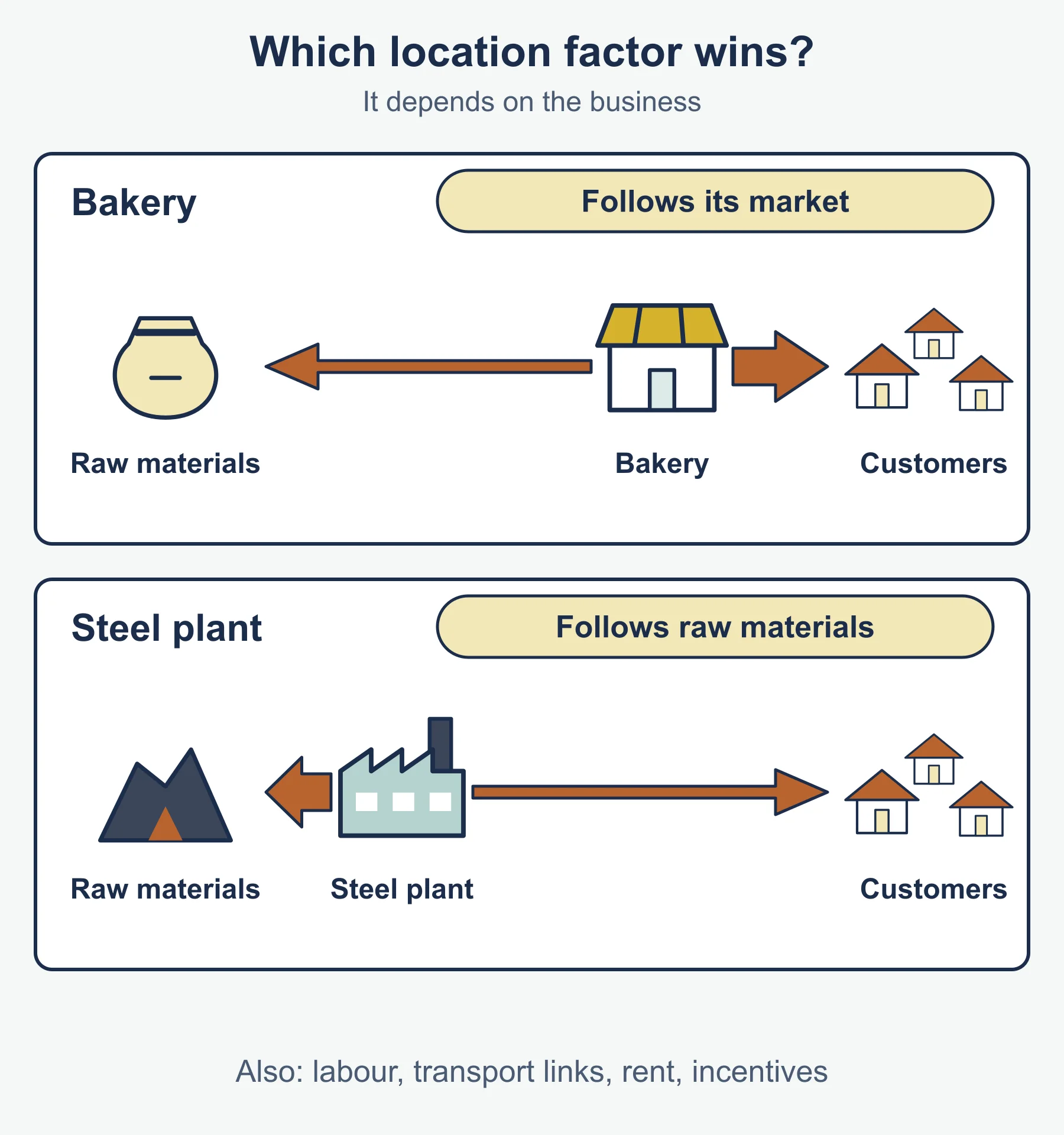
Location is where a business carries out its operations. Most decisions weigh a mix of cost, access and risk.
| Factor | What the business asks |
|---|---|
| Proximity to the market | Are customers close? Vital for services and for bulky or perishable goods |
| Proximity to materials | Does the product lose weight or value in production, so it is cheaper to make near the source? |
| Labour | What do wages cost, are the skills there, and is labour available? |
| Transport and infrastructure | Roads, ports, power, broadband and the cost of moving goods |
| Cost of land and premises | Rent, purchase price, space to expand |
| Government | Grants, tax levels, planning rules, regulation |
| Competitors and clusters | Is there a pool of suppliers and skilled staff, or is the area crowded? |
| Owner preference and image | Where the owner lives, or the status of an address |
Quantitative factors can be costed (wages, rent, freight). Qualitative factors are judgements (quality of life, reputation, staff morale). A good answer uses both.
Relocation means moving existing operations to a new site. Triggers include a lease ending, rising costs, a new market, running out of space, congestion, or a change in regulation. Weigh the one-off costs (moving, redundancy, retraining, disruption, lost customers) against the expected savings. Staff who will not move may be lost, taking their skills with them.
2. Local, national and international decisions
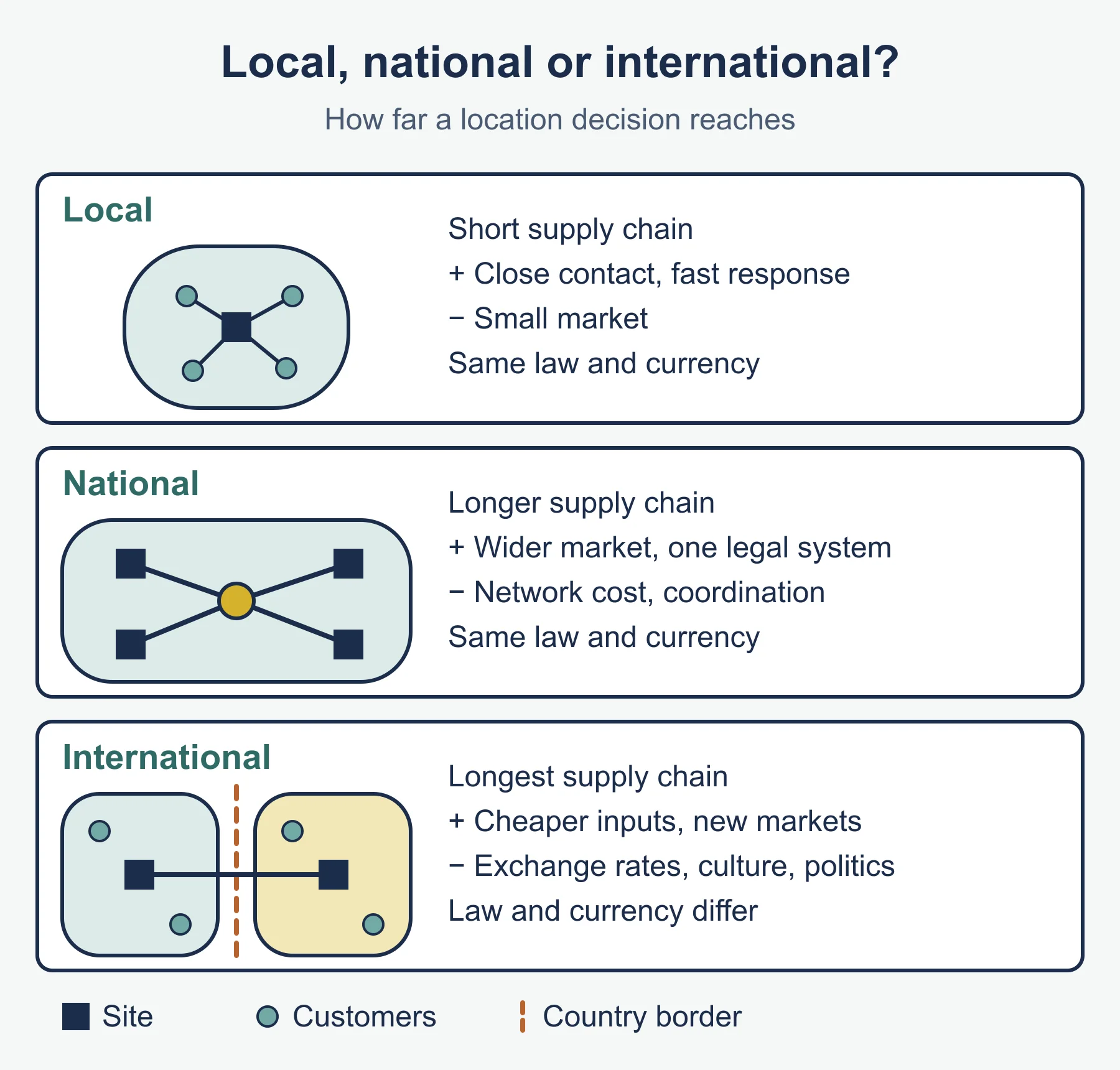
| Local | National | International | |
|---|---|---|---|
| Scope | One town or district | Sites across one country | Sites in more than one country |
| Typical business | Small shop, workshop | Chain, national manufacturer | Multinational, exporter |
| Law, language, currency | Same | Same | Differ: contracts, standards and exchange rates need managing |
| Supply chain | Short, easy to supervise | Longer, needs a distribution network | Longest: customs, delays, disruption risk |
| Main advantage | Close contact, quick response | Wider market, one legal system | Cheaper inputs, new markets, trade-barrier avoidance |
| Main risk | Small market | Cost of network, coordination | Exchange rates, cultural gaps, political risk |
The right level depends on the product, the finance available and the objectives. A bakery serves a local market; a software firm can serve the world from one office.
3. Offshoring and reshoring
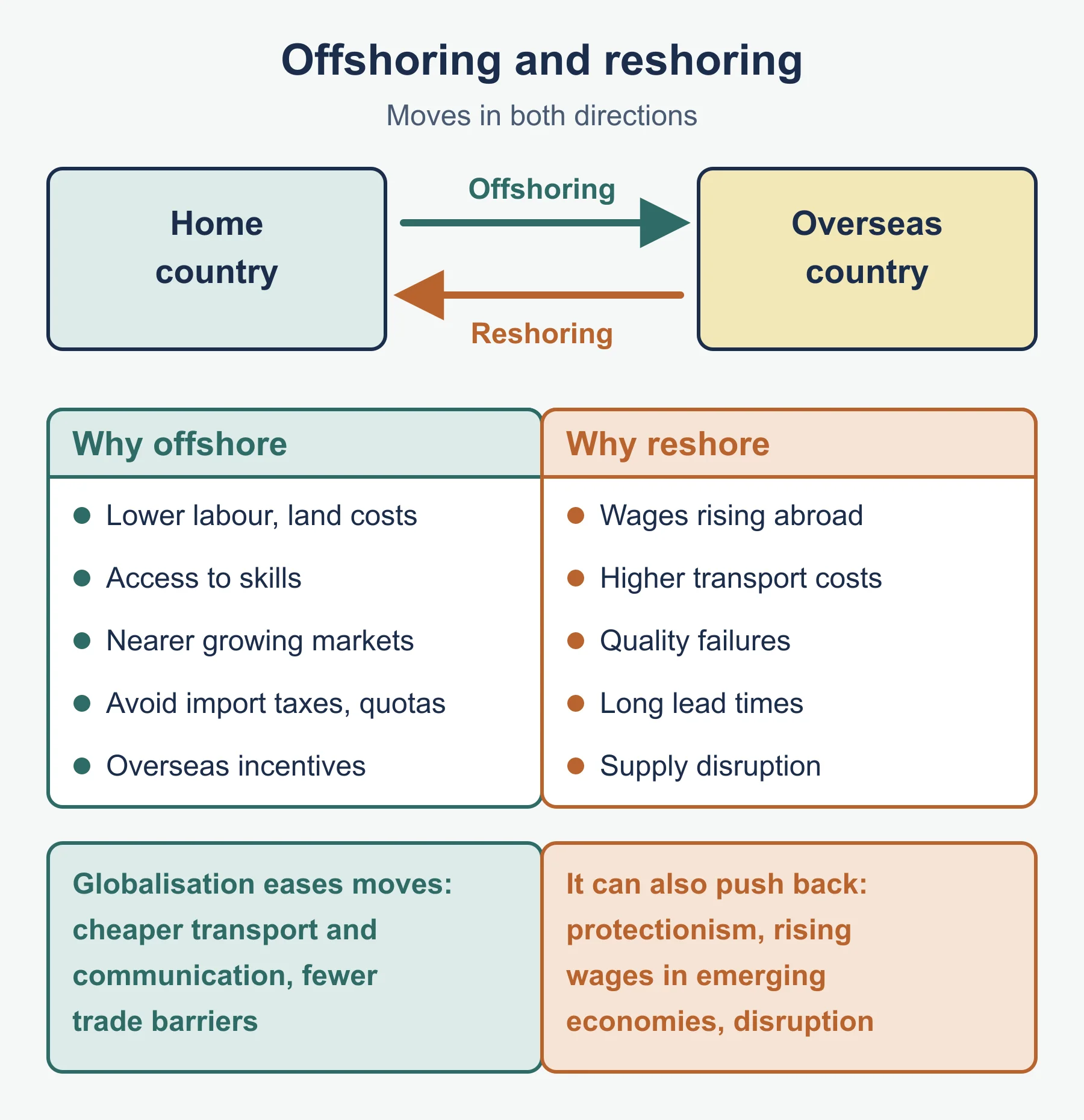
Offshoring is moving some or all of a business’s operations (making a product or providing a service such as a call centre) to another country. It may use the firm’s own overseas site or a supplier abroad. Reshoring is bringing those operations back to the home country.
Reasons for offshoring: lower labour and land costs; access to skills; to be nearer growing markets; to get round import taxes or quotas; government incentives overseas.
Impact of offshoring
- On costs: lower unit costs are likely, but freight, import duties and extra stock held in transit cut the gain.
- On quality and control: harder to supervise; communication and time-zone gaps.
- On flexibility: longer lead times, so slower response to changes in demand.
- On risk: exchange-rate swings, disruption to shipping, political instability.
- On image: possible criticism if the home country loses jobs or overseas conditions are poor.
- On workers: home jobs may be lost; the host country gains employment and skills.
Reasons for reshoring: wages rising abroad; higher transport costs; quality failures; long lead times; supply disruption; automation reducing the labour share of cost; customer preference for locally made goods; protecting intellectual property.
Impact of reshoring: shorter lead times, closer control and a stronger “made at home” message, against possibly higher labour costs, set-up costs for a new plant, and the loss of the overseas supplier’s capacity and know-how.
Worked example: Westmarsh Textiles
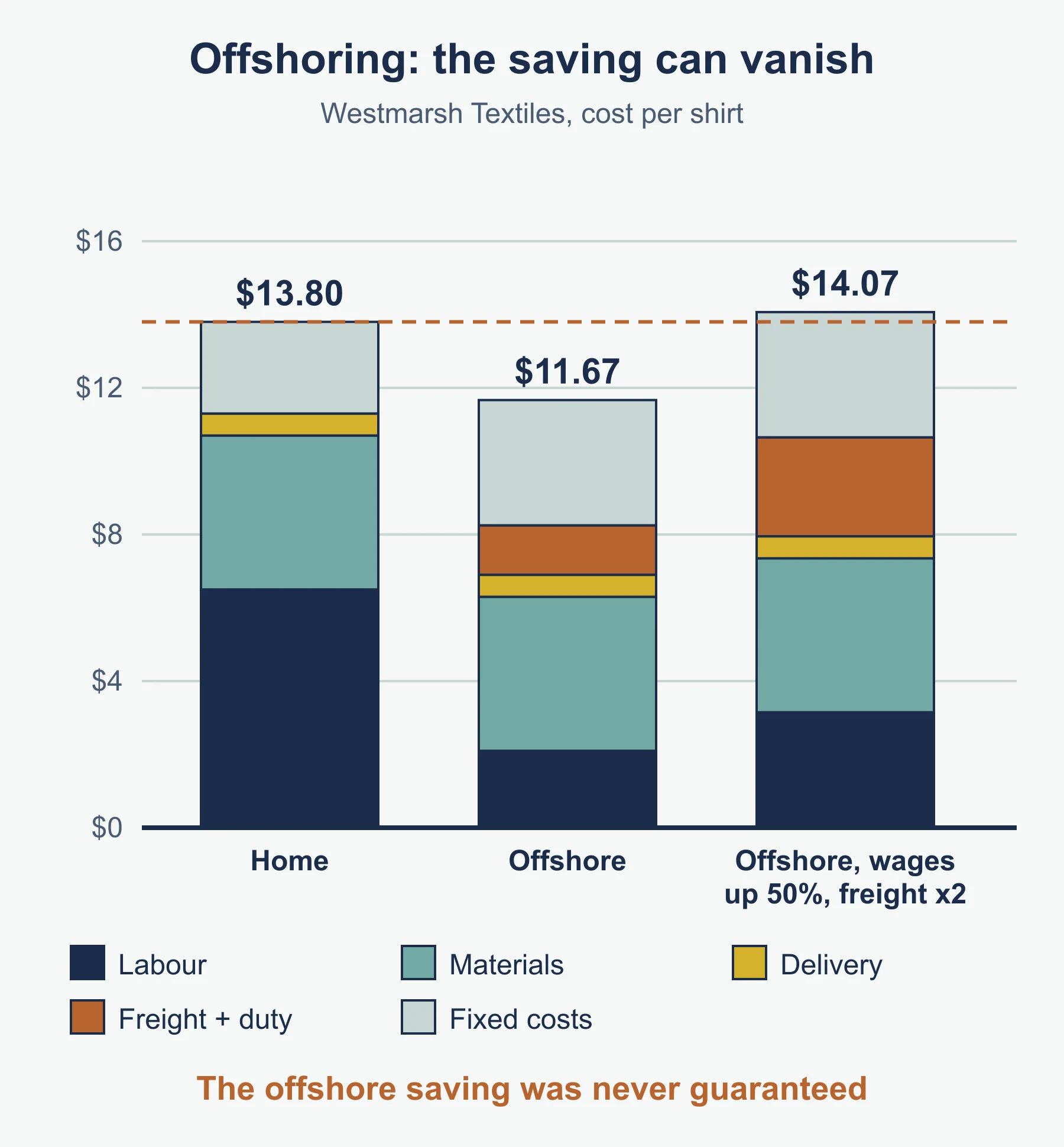
Westmarsh makes 120,000 shirts a year at its home factory. All figures are dollars per shirt unless stated.
| Home factory | Offshore factory | |
|---|---|---|
| Labour | 6.50 | 2.10 |
| Materials | 4.20 | 4.20 |
| Delivery to customers | 0.60 | 0.60 |
| Freight and import duty | 0 | 1.35 |
| Fixed costs per year | 300,000 | 330,000 |
| One-off relocation cost | 0 | 400,000 |
Spread the one-off cost over 5 years: 400,000 ÷ 5 = 80,000 a year, so offshore fixed costs are 410,000 a year.
Home: variable cost = 6.50 + 4.20 + 0.60 = 11.30 per shirt. Total cost = 11.30 × 120,000 + 300,000 = 1,656,000. Unit cost = 1,656,000 ÷ 120,000 = 13.80.
Offshore: variable cost = 2.10 + 4.20 + 0.60 + 1.35 = 8.25. Total cost = 8.25 × 120,000 + 410,000 = 1,400,000. Unit cost = 1,400,000 ÷ 120,000 = 11.67 (2 d.p.).
Offshoring saves 256,000 a year, 15.5% of the home cost.
Test the result. If offshore wages rise 50% (to 3.15) and freight doubles (to 2.70), variable cost becomes 3.15 + 4.20 + 0.60 + 2.70 = 10.65. Total cost = 10.65 × 120,000 + 410,000 = 1,688,000, unit cost 14.07. The home factory (13.80) is now cheaper. This is the pattern behind many reshoring decisions: the saving was never guaranteed.
4. Globalisation and location
Globalisation is the growing links between countries through trade, investment, finance and communication. Its effects on location decisions:
- Falling transport and communication costs and lower trade barriers make distant sites more practical.
- Firms can split production across countries and build global supply chains.
- Emerging markets offer both cheap inputs and new customers, so a site abroad can serve two purposes.
- Competition from overseas firms pushes home producers to cut costs, which can mean relocating.
- Multinationals can choose between many sites, and move again as costs change.
- The effect is not one-way: protectionism, rising wages in emerging economies and supply disruption can push firms to reshore or to produce nearer each market.
5. Factors that influence the scale of a business
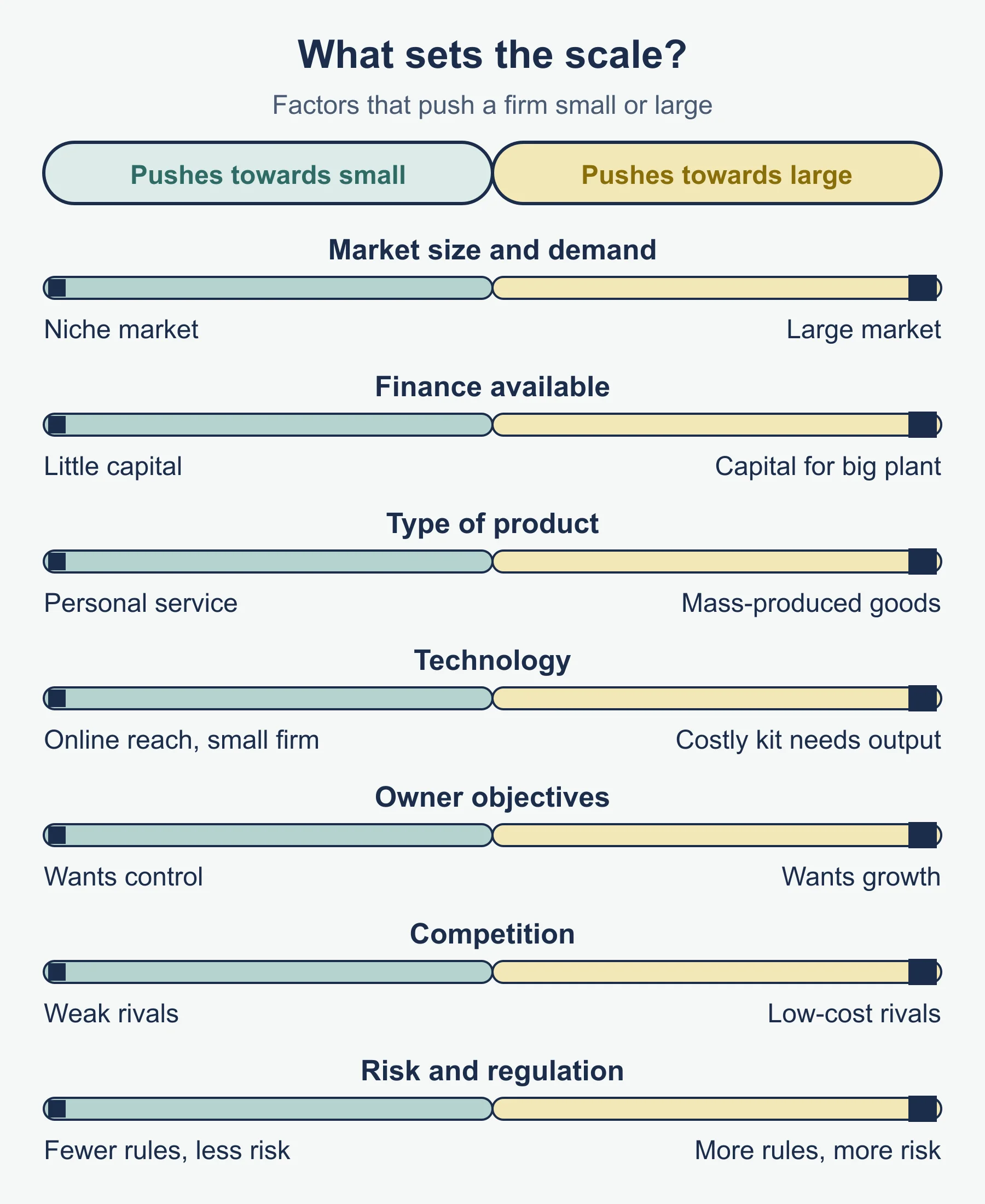
Scale of operations means the size of the resources and output the business uses to supply its market: the volume produced, the size of the plant and the number of sites. Influences:
- Market size and demand: a small, niche market supports only small-scale output.
- Finance available: large plant needs capital; a firm that cannot raise it stays small.
- Type of product or industry: mass-produced goods favour large scale; personalised services (a tailor, a tutor) favour small scale.
- Technology: automation and online selling can let a small firm reach a big market, or force a firm to be large to afford the equipment.
- Owner’s objectives: some owners want control and a quiet life rather than growth.
- Competition: strong rivals with lower costs may force a firm to grow or leave.
- Risk and regulation: larger operations attract more rules and more exposure if demand falls.
6. Economies and diseconomies of scale
Internal economies come from the growth of the firm itself. Examples:
| Type | Cause and example |
|---|---|
| Purchasing | Bulk orders win discounts on materials |
| Technical | Large machines cost less per unit; specialised equipment is fully used |
| Financial | Large firms borrow at lower interest rates |
| Marketing | One advertising campaign spread over more units |
| Managerial | Specialist managers raise efficiency |
| Risk-bearing | Selling many products or in many markets spreads risk |
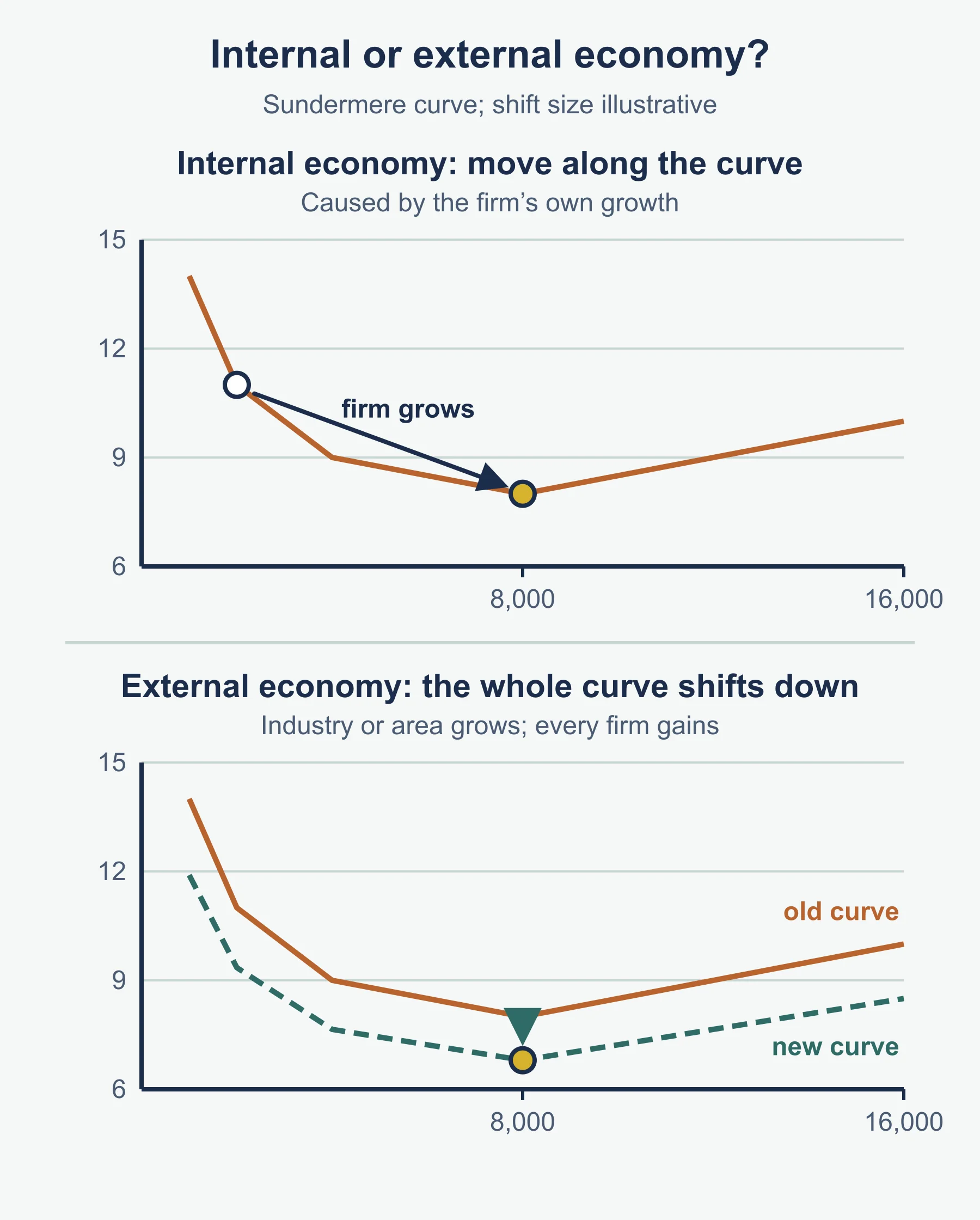
External economies come from the growth of the industry or area, not the single firm. Examples: a skilled labour pool; a cluster of suppliers nearby; better roads or ports built because of the industry; local colleges training the right workers. They lower the costs of every firm in the area.
Internal diseconomies: communication breaks down across many levels; slow decisions; poor coordination between departments or sites; workers feel remote and motivation falls; duplicated tasks and management costs.
External diseconomies: congestion; shortages of local labour pushing wages up; higher land prices; strain on roads and utilities; pollution restrictions.
7. Links to unit costs
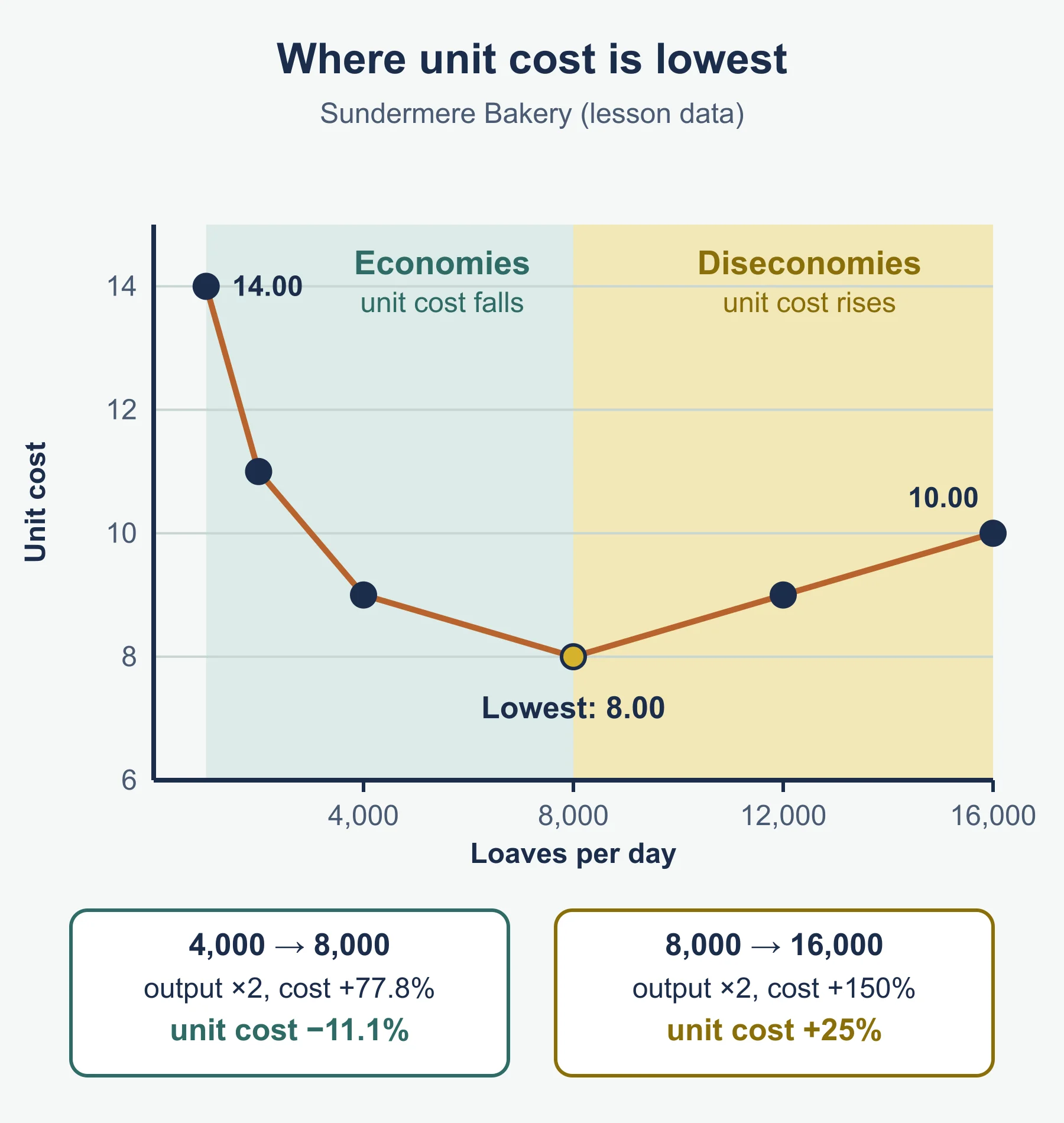
Unit (average) cost = total cost ÷ output (standard form). Economies of scale lower unit cost as output rises; diseconomies raise it.
Worked example: Sundermere Bakery
| Output (loaves per day) | Total cost | Unit cost |
|---|---|---|
| 1,000 | 14,000 | 14.00 |
| 2,000 | 22,000 | 11.00 |
| 4,000 | 36,000 | 9.00 |
| 8,000 | 64,000 | 8.00 |
| 12,000 | 108,000 | 9.00 |
| 16,000 | 160,000 | 10.00 |
From 4,000 to 8,000 loaves, output doubles but total cost rises only 77.8% (28,000 ÷ 36,000), so unit cost falls 11.1%: economies of scale. From 8,000 to 16,000, output doubles but total cost rises 150% (96,000 ÷ 64,000), so unit cost rises 25%: diseconomies. Lowest unit cost is at 8,000 loaves.
In the standard diagram, an internal economy moves the firm along the unit cost curve; an external economy shifts the whole curve down, because every firm benefits.
Common errors
- Mixing up offshoring (moving operations abroad) with outsourcing (using another firm, at home or abroad).
- Treating the cheapest wage as the whole answer. Add freight, duty, stock and risk.
- Confusing internal and external economies: if the firm’s own growth causes it, it is internal.
- Saying a diseconomy is “a loss”. It is a rise in unit cost.
- Listing factors without applying them to the business in the case.
Evaluating in the case study
Judge which factors matter most for this business and why: a perishable product weights market proximity; a high-value, light product weights labour skills. Look at time (savings may fall as wages rise), the size of one-off costs, and risk. Reach a reasoned view.
Frequently asked questions
What factors determine where a business locates? Common factors are closeness to the market and to materials, labour cost and skills, transport and infrastructure, the cost of land and premises, government grants and rules, competitors and clusters, and the owner’s preference or image.
How does globalisation affect location decisions? Falling transport and communication costs and lower trade barriers make distant sites practical, so firms can build global supply chains. The trend can reverse through protectionism, rising wages abroad or disruption.
What factors influence the scale of a business? Market size and demand, finance available, the type of product, technology, the owner’s objectives, competition, and risk and regulation.
Is a diseconomy of scale the same as a loss? No. A diseconomy of scale is a rise in unit cost as the business grows too large, caused for example by poor communication or slow decisions. The business may still be profitable.
Official syllabus
Cambridge International AS & A Level Business 9609 syllabus for examination in 2026, 2027 and 2028, published by Cambridge University Press & Assessment (Cambridge International Education), section 9.1.
Get free revision emails (optional)
Occasional emails with practice questions, worked explanations and links to free resources for the qualification and subjects you choose. No spam, and you can unsubscribe from any email. The free tools on this site never need an email.
Related resources
-
Practice questions
A Level Business: Location and scale (Cambridge 9609) – Practice Questions
Original practice questions with worked answers on 9.1 Location and scale for Cambridge A Level Business 9609, including calculation and case-study items.
Business · Cambridge · A Level
Try questions -
Revision notes
A Level Business: Location and scale (Cambridge 9609) – Revision Notes
Condensed revision notes for 9.1 Location and scale in Cambridge A Level Business 9609, with tables, a self-test and common slips.
Business · Cambridge · A Level
Revise topic -
Study guides
A Level Business: Quality management and Operations strategy (Cambridge 9609)
Study guide to 9.2 Quality management and 9.3 Operations strategy in Cambridge A Level Business 9609: TQM, benchmarking, ERP, lean production and CPA.
Business · Cambridge · A Level
Read guide
Related articles
-
teaching
A Level tuition in Dubai: Cambridge or Pearson Edexcel International A Level?
Schools in Dubai and Abu Dhabi teach either Cambridge International AS & A Level or Pearson Edexcel International A Level. How the two are structured, why it matters for tuition, and how online classes from Lahore work.
9 October 2026
-
curriculum guides
Choosing subjects at IGCSE and A Level
How subject choices at 14 and 16 affect university options later, and how to keep pathways open without overloading a timetable.
28 July 2026
Studying this with a teacher
Working through Business A LEVEL?
This page is free and stays free. If you would rather be taught it, Marlbridge runs Business classes one-to-one and in small groups of up to 15, online in your own time zone. The first trial class is free. WhatsApp replies within an hour (8am–11pm Pakistan time, every day); email the same day.
Cambridge Business teachers at Marlbridge

