
Revision Notes
A Level Business: Capacity utilisation and outsourcing (Cambridge 9609) – Revision Notes
Condensed revision notes for 4.3 Capacity utilisation and outsourcing in Cambridge AS & A Level Business 9609, with a self-test and common slips.
- Subject
- Business
- Level
- AS LEVEL
- Topic
- Operations management
- Author
- Marlbridge Academic Team
- Updated
- Reviewed by
- Salman Ahmad (what this means)
Aligned to Cambridge A Level Business (9609), For examination in 2026, 2027 and 2028. Official specification .
Syllabus page (what it covers and how it is assessed): Cambridge A Level Business.
Syllabus points this page covers
9609 (AS Level)
- 4.3 Capacity utilisation and outsourcing
Found an error? Report a correction.
Need help with this topic? Request a free trial class for A Level Business (9609).
These are condensed notes for section 4.3 Capacity utilisation and outsourcing (4.3.1 and 4.3.2) of the Cambridge International AS & A Level Business 9609 syllabus for examination in 2026, 2027 and 2028. It is an AS Level topic within Topic 4, Operations management. For full explanations and worked examples, use the study guide, then try the practice questions. Related inventory and productivity questions are in the Topic 4 practice set. Course links: the Cambridge A Level Business hub, the checklist and the free diagnostics.
4.3.1 Measuring capacity utilisation
Key terms
| Term | Meaning |
|---|---|
| Capacity | The most a business can produce in a period with its present resources |
| Capacity utilisation | The share of that maximum which is actually being used |
| Spare (excess) capacity | Maximum output minus actual output |
| Over capacity working | Output above the normal maximum, kept up by overtime, extra shifts or skipped maintenance |
| Unit cost | Total cost ÷ output |
Formula (standard form; the syllabus lists the measurement but gives no formula)
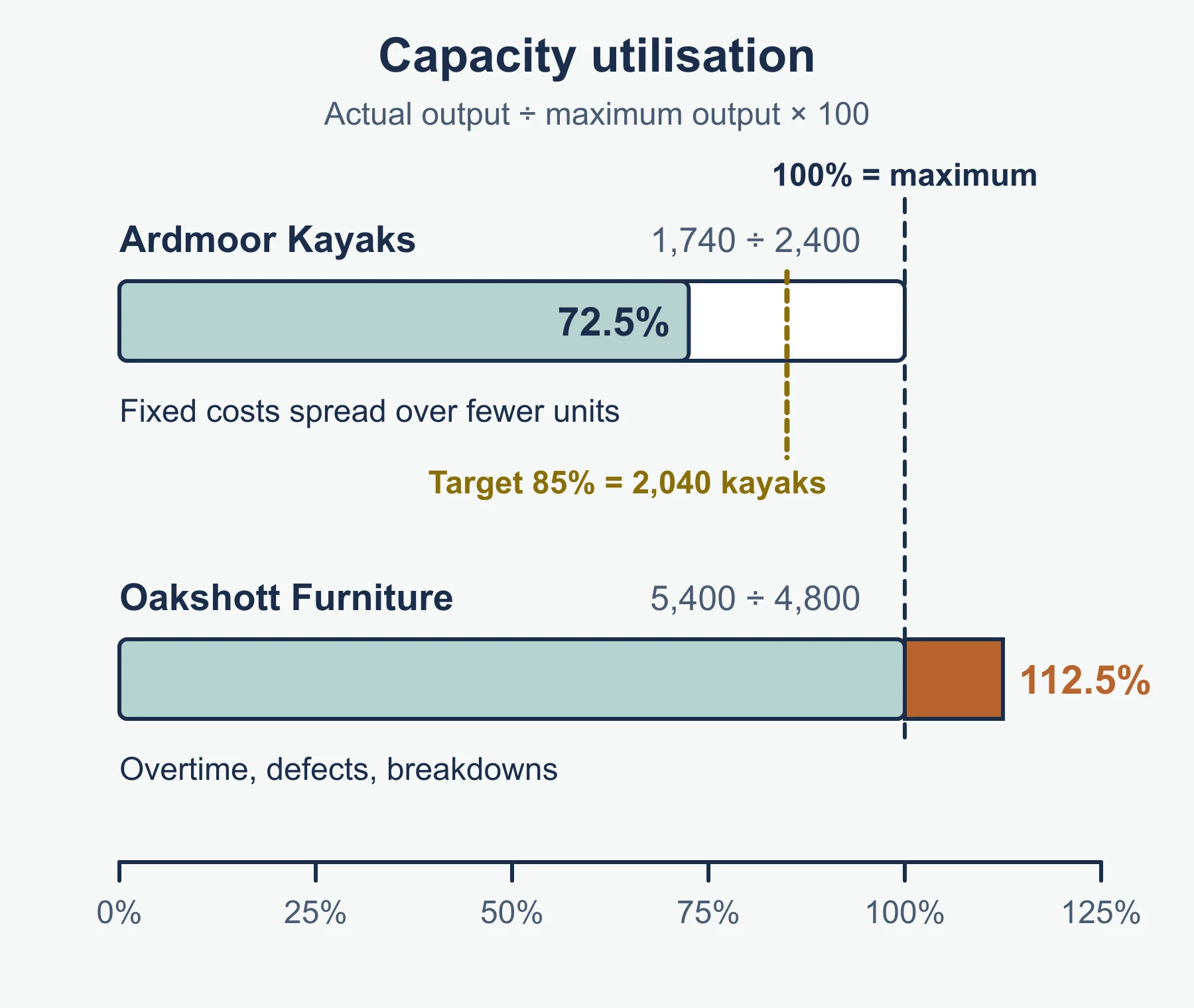
capacity utilisation (%) = actual output ÷ maximum possible output × 100
Rearranged: actual output = utilisation ÷ 100 × maximum; maximum = actual ÷ utilisation × 100.
Method in steps
- Check that both figures use the same period and the same unit.
- Put actual output on top and maximum output underneath.
- Multiply by 100 and show the percentage sign.
- For “how many more units”, subtract current output from required output.
- Comment: compare with a target, last year or a rival.
Worked reminder
A bottling plant fills 3,150 cases a week against a maximum of 4,500. Utilisation = 3,150 ÷ 4,500 × 100 = 70%. At 78% of a 6,000-unit maximum, output is 4,680. Moving from 78% to 90% needs 720 more units.
Impact of operating under or over maximum capacity
| Under capacity | Over capacity | |
|---|---|---|
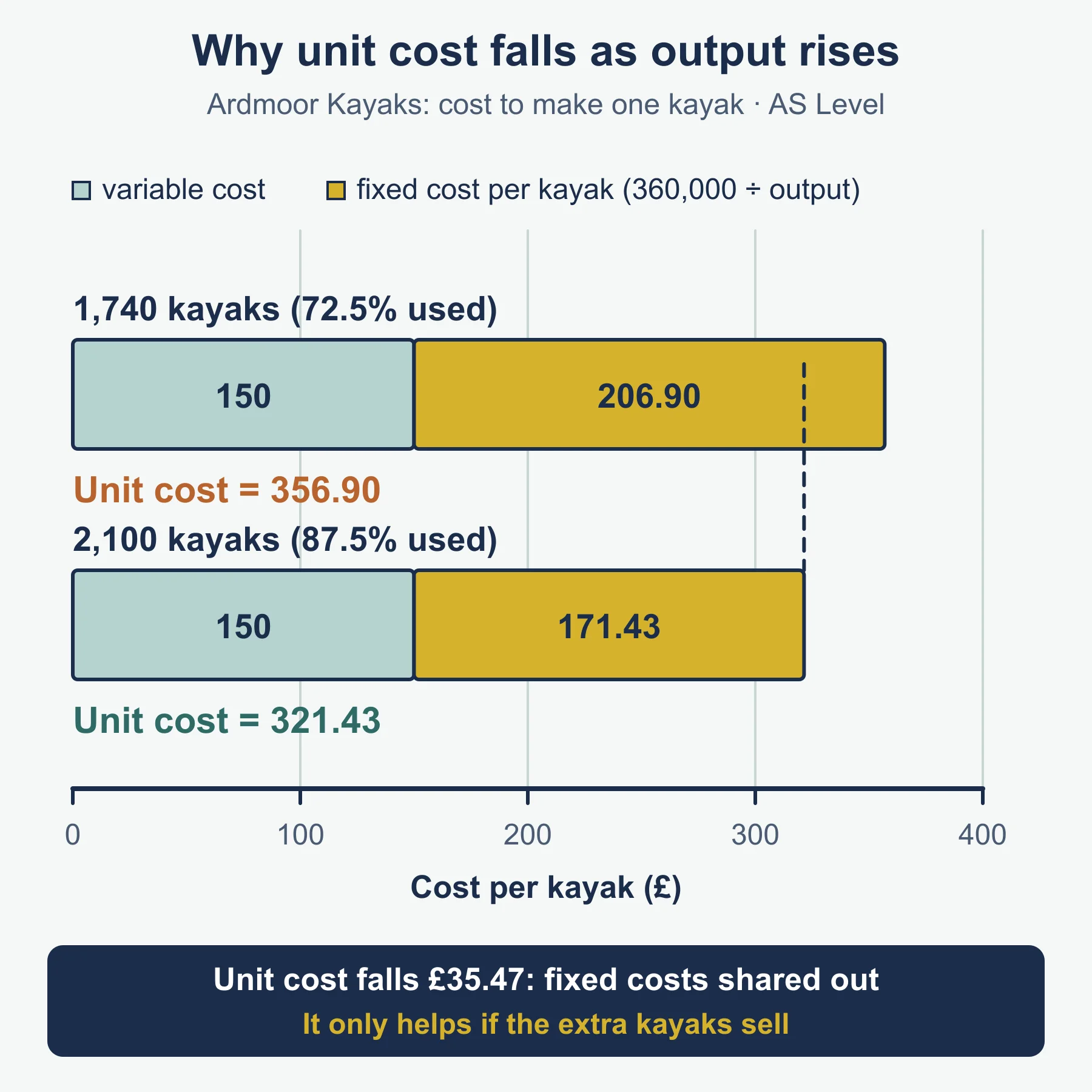
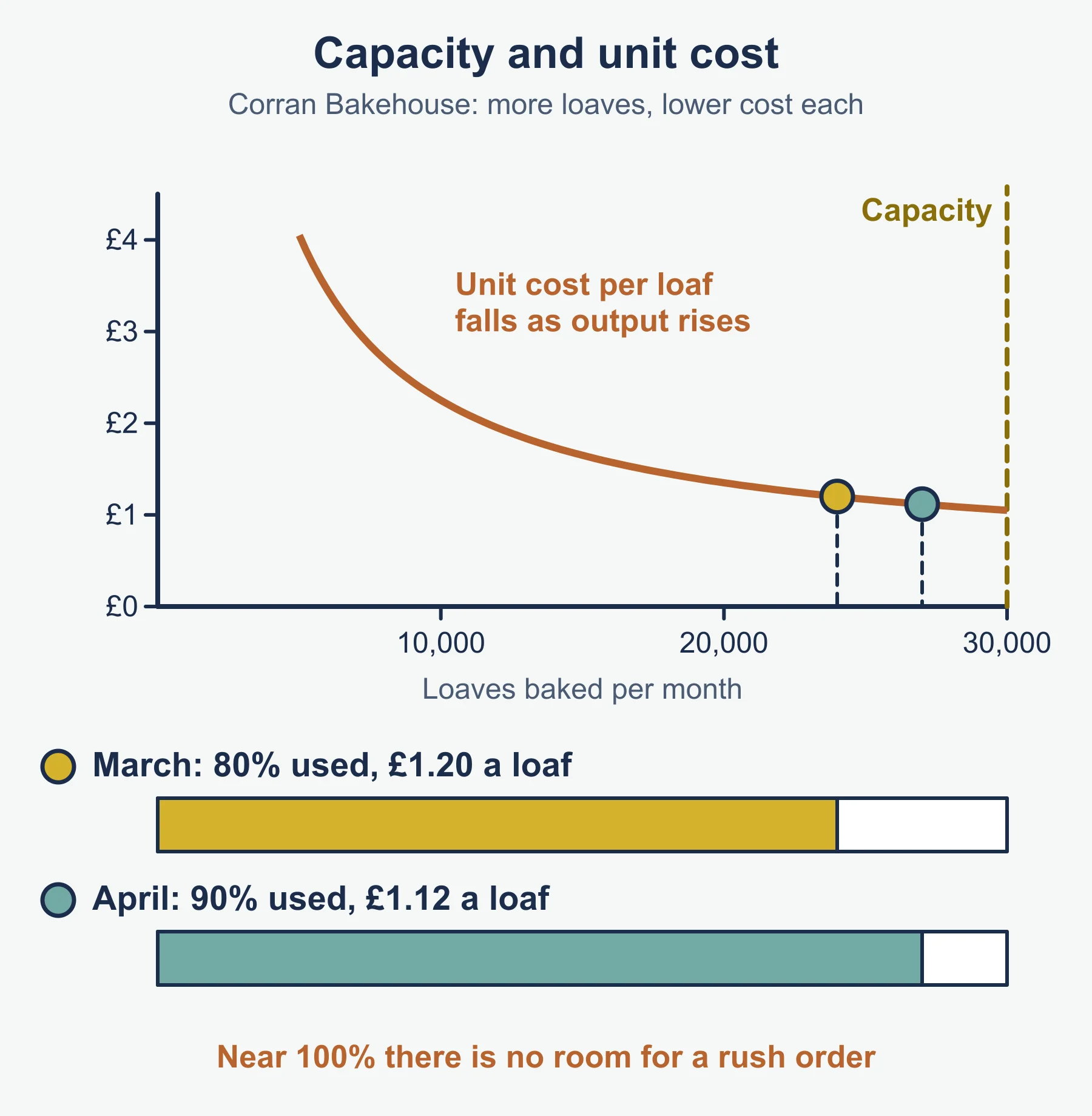
| Unit cost | Higher: fixed costs shared over fewer units | Lower fixed cost per unit, but overtime and repair costs push other costs up |
| Profit | Squeezed | Short-term gain from extra sales, eroded by extra costs |
| Quality | Usually unaffected | Risk of defects, rework and complaints |
| Employees | Underused, risk of redundancy and low morale | Fatigue, stress, absence |
| Equipment | Idle assets | Breakdowns and wear, little time for maintenance |
| Customers | Can respond to a surge | Late delivery or refused orders |
| Risk | Losses and possible closure if prolonged | Loss of reputation if standards slip |
Worked reminder (unit cost). Fixed costs 90,000, variable cost 5 a unit, maximum 30,000 units. At 60% (18,000 units) unit cost = (90,000 + 90,000) ÷ 18,000 = 10.00. At 80% (24,000 units) it is (90,000 + 120,000) ÷ 24,000 = 8.75.
Methods of improving capacity utilisation
The syllabus names the area but no specific methods, so use these standard groups.
| Problem | Approach | Examples | Main drawback |
|---|---|---|---|
| Too low | Raise output | Promotion, new markets or products, off-peak pricing, contract work for others | Demand may not respond; cost of campaign |
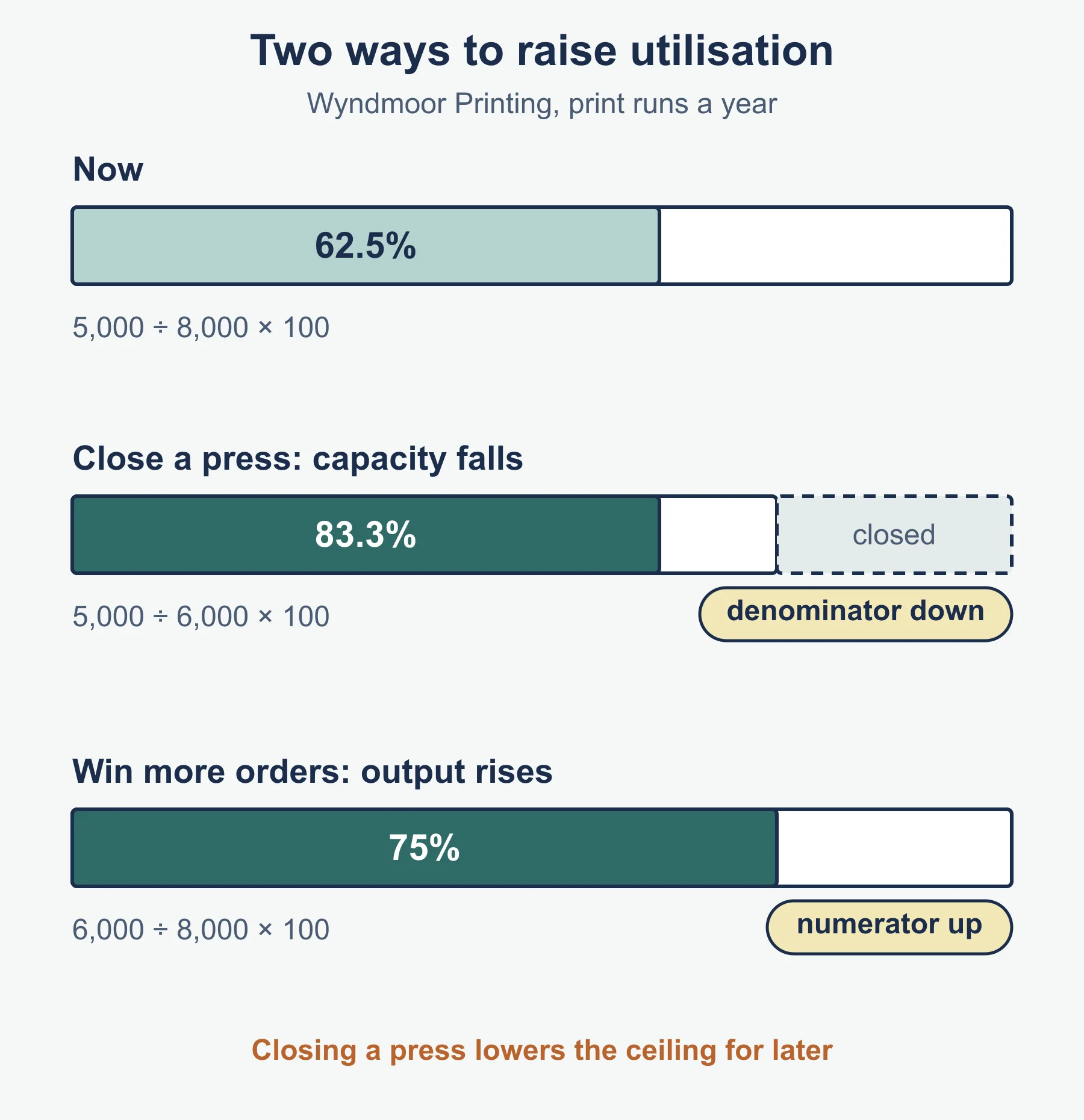
| Too low | Reduce capacity (rationalisation) | Close a line, sell or rent out assets, smaller premises | Redundancy costs; harder to grow later |
| Too low | Make capacity flexible | Part-time or temporary staff, multi-skilled workers | Training cost; lower commitment |
| Too high | Raise capacity | New machines, extra shifts, larger site | Cost and time; may be spare if demand falls |
| Too high | Share the load | Outsource overflow work | Less control |
| Too high | Ration demand | Longer lead times, higher prices | May lose customers |
4.3.2 Outsourcing
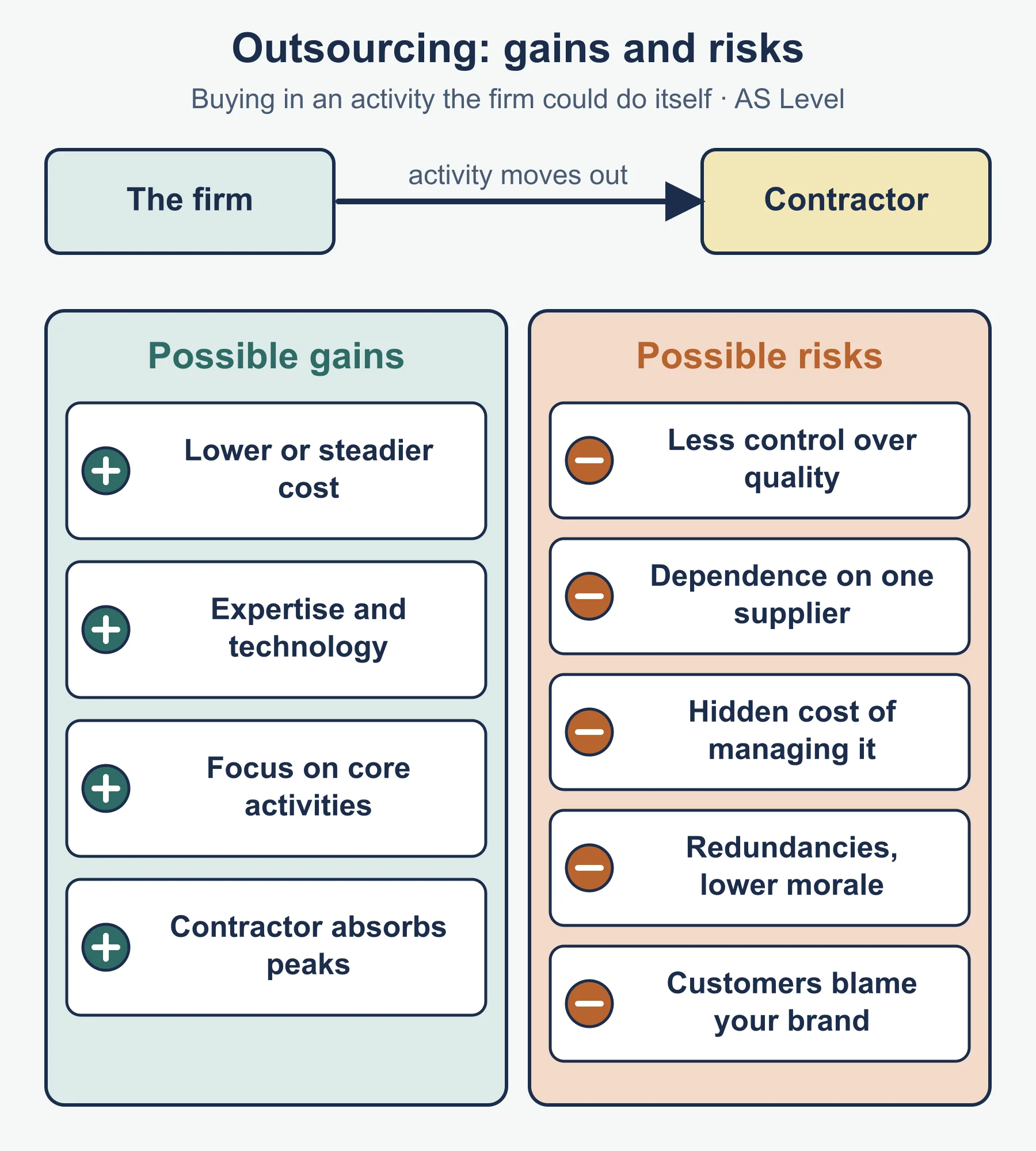
Outsourcing is using another business to carry out an activity or process (for example packaging, payroll or delivery) which the firm could carry out itself. The syllabus does not define the term, so this is the standard meaning.
| Possible benefits | Possible drawbacks |
|---|---|
| Lower or more predictable cost | Less control of quality and timing |
| Specialist skills and technology | Dependence on one supplier |
| Management focus on core activities | Hidden costs of contracts and monitoring |
| Flexibility: the contractor absorbs peaks | Redundancies and morale effects |
| Avoids buying equipment, lifting utilisation of what is owned | Confidentiality risk; brand blamed for contractor errors |
Cost comparison method
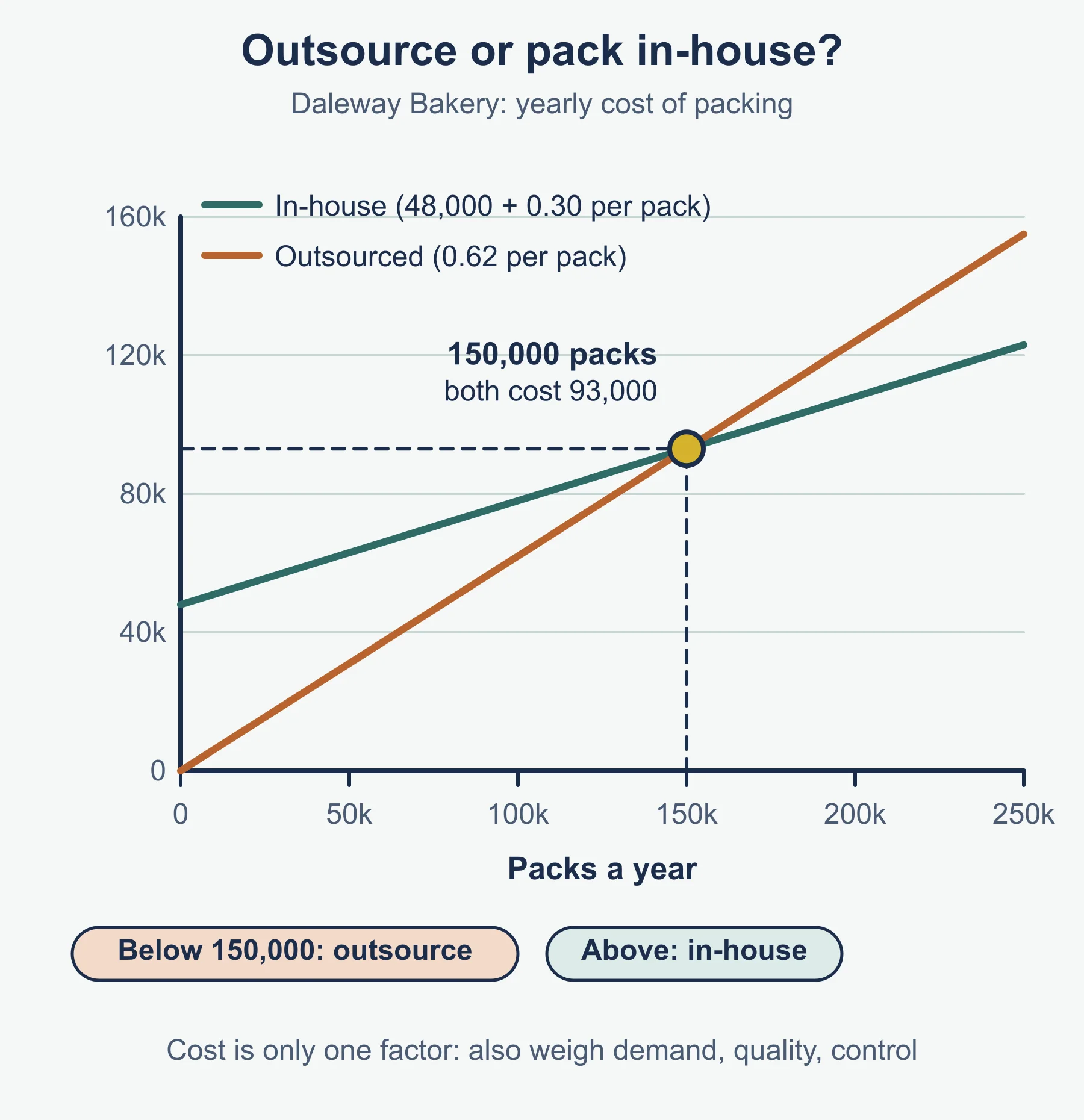
- In-house cost = fixed cost + (variable cost × volume).
- Outsourced cost = price per unit × volume.
- Break-even volume = fixed cost ÷ (outsourced price − in-house variable cost).
- Below break-even, outsourcing is cheaper on cost alone; above it, in-house is cheaper.
Worked reminder. Fixed cost 30,000, in-house variable cost 2, contractor price 5. Break-even = 30,000 ÷ 3 = 10,000 units. At 10,000 units both cost 50,000.
Must-know distinctions
- Capacity utilisation versus productivity: utilisation compares output with maximum output; productivity compares output with inputs such as labour.
- Capacity versus demand: low utilisation may be a demand problem, an operations problem or both.
- Reducing capacity versus raising output: both lift the percentage, one by shrinking the denominator, the other by growing the numerator.
- Outsourcing versus buying materials: outsourcing hands over an activity, not just the supply of inputs.
- 100% is not automatically the goal: some slack gives room to handle surges and maintenance.
Command words for this topic
The syllabus lists these command words and meanings. Here is how each tends to work on 4.3.
| Command word | Syllabus meaning | What it looks like on this topic |
|---|---|---|
| Define | Give precise meaning | Capacity utilisation or outsourcing in one precise sentence |
| Identify | Name, select or recognise | An example activity to outsource, or one method of improving utilisation |
| Calculate | Work out from given facts, figures or information | Utilisation, extra output needed, unit cost, break-even volume |
| Explain | Set out purposes or reasons and make relationships clear, with evidence | Why low utilisation raises unit cost, using the figures given |
| Analyse | Examine in detail to show meaning, identify elements and the relationship between them | A chain such as overtime, fatigue, defects, complaints, lost sales |
| Advise or justify | Suggest a course of action, or support a case with evidence | A recommendation backed by cost figures and one non-cost factor |
| Evaluate | Judge quality, importance, amount or value | Weigh options and give a reasoned decision |
Answer frameworks
Impact question (under, over or outsourcing)
- State one impact in a short phrase.
- Tie it to a fact or figure in the stem.
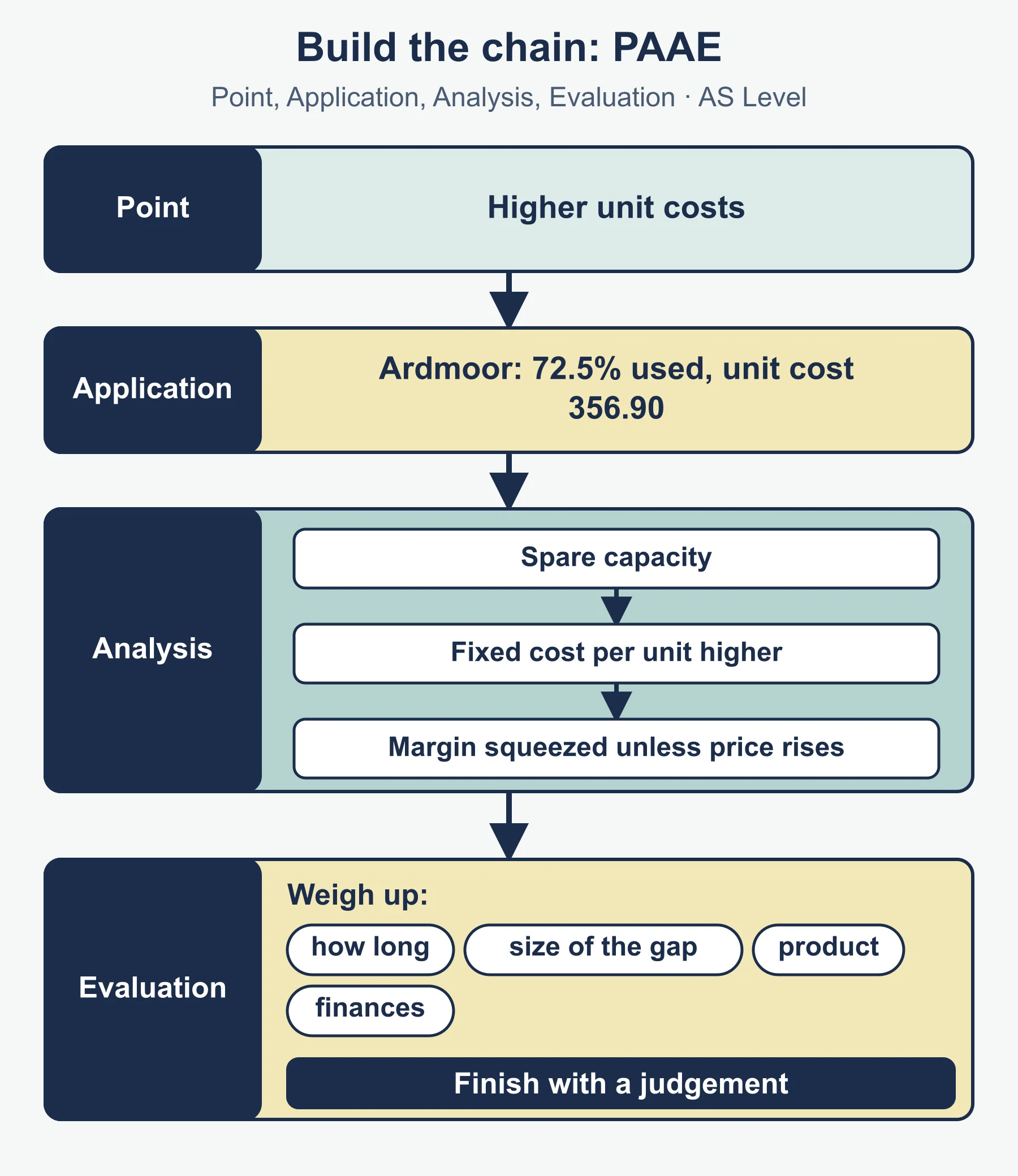
- Take the chain two or three links further (cost, profit, customers).
- Add a limit: it depends on how long, how big or how reliable.
Choose-between-options question
- Calculate what you can for each option.
- Give one risk for each.
- Say which factor decides the matter and why.
- State the decision and the condition that would change it.
Evaluation prompts
Use these to turn description into judgement: how large and how lasting is the problem; what is the nature of the product (perishable, seasonal, custom); how does the firm’s finance limit the options; how reliable is the contractor; is the activity core to the brand; what are the short-run and long-run effects. The syllabus defines evaluate as judging the quality, importance, amount or value of something, so finish with a clear decision.
Quick self-test
- Define capacity utilisation.
- A hotel sells 2,700 room-nights against a maximum of 3,600. Calculate its capacity utilisation.
- A workshop made 1,800 units at 75% utilisation. What is its maximum output?
- Calculate the output at 78% utilisation if maximum capacity is 6,000 units.
- State two ways to improve utilisation when it is too low.
- Explain why unit costs fall as utilisation rises, assuming fixed costs do not change.
- Give two problems of working beyond maximum capacity.
- Define outsourcing.
- In-house fixed cost is 30,000, variable cost is 2 a unit and a contractor charges 5 a unit. At what volume are the costs equal?
- State one drawback of outsourcing and say why it matters.
Answers
- The proportion of a business’s maximum possible output that it actually produces in a period, usually shown as a percentage.
- 2,700 ÷ 3,600 × 100 = 75%.
- 1,800 ÷ 75 × 100 = 2,400 units.
- 0.78 × 6,000 = 4,680 units.
- Any two of: more promotion, new markets or products, contract work for other firms, closing a line or selling spare assets.
- Fixed costs are shared across more units, so fixed cost per unit falls.
- Any two of: overtime and repair costs, more defects, breakdowns, fatigued staff, late deliveries.
- Using another business to carry out an activity or process the firm could do itself.
- 30,000 ÷ (5 − 2) = 10,000 units.
- For example, less control over quality: the firm’s brand is judged on work it does not directly supervise, so complaints or lost customers can follow.
Where marks are usually lost
- Putting maximum output on top of the fraction.
- Forgetting the percentage sign or giving a decimal such as 0.7.
- Using different periods, such as a weekly output and an annual maximum.
- Describing “high unit costs” without saying that fixed costs are the reason.
- Treating under-capacity as the only problem and ignoring over-capacity.
- Writing a list of outsourcing pros and cons with no reference to the business in the question.
- Declaring outsourcing cheaper without a volume comparison.
- Ending an evaluation without a decision.
Frequently asked questions
How do you calculate capacity utilisation? Divide actual output by maximum possible output and multiply by 100. The Cambridge 9609 syllabus lists the measurement but gives no formula, so this is the standard form; check both figures cover the same period.
Is 100% capacity utilisation the goal? No. Some spare capacity gives room to handle surges in demand and to carry out maintenance, so a business running at its limit has no slack.
What is the difference between capacity utilisation and productivity? Capacity utilisation compares actual output with the maximum possible output. Productivity measures output per input, such as output per worker.
How do you find the break-even volume for outsourcing? Divide the in-house fixed cost by the difference between the outsourced price and the in-house variable cost per unit. Below that volume outsourcing is cheaper on cost alone; above it, in-house is cheaper.
Official syllabus
Cambridge International AS & A Level Business 9609 syllabus for examination in 2026, 2027 and 2028, published by Cambridge University Press & Assessment (Cambridge International Education), section 4.3 Capacity utilisation and outsourcing.
Get free revision emails (optional)
Occasional emails with practice questions, worked explanations and links to free resources for the qualification and subjects you choose. No spam, and you can unsubscribe from any email. The free tools on this site never need an email.
Related resources
-
Study guides
A Level Business: Inventory management (Cambridge 9609)
Study guide to 4.2 Inventory management in Cambridge AS & A Level Business 9609: inventory types, costs, re-order level, charts, SCM, JIT and JIC.
Business · Cambridge · AS Level
Read guide -
Practice questions
A Level Business: Inventory management (Cambridge 9609) – Practice Questions
Original practice questions with worked answers on 4.2 Inventory management for Cambridge AS & A Level Business 9609: re-order level, charts and JIT.
Business · Cambridge · AS Level
Try questions -
Revision notes
A Level Business: Inventory management (Cambridge 9609) – Revision Notes
Condensed revision notes for 4.2 Inventory management in Cambridge AS & A Level Business 9609, with formulas, a self-test and common lost marks.
Business · Cambridge · AS Level
Revise topic
Related articles
-
teaching
A Level tuition in Dubai: Cambridge or Pearson Edexcel International A Level?
Schools in Dubai and Abu Dhabi teach either Cambridge International AS & A Level or Pearson Edexcel International A Level. How the two are structured, why it matters for tuition, and how online classes from Lahore work.
9 October 2026
-
curriculum guides
Choosing subjects at IGCSE and A Level
How subject choices at 14 and 16 affect university options later, and how to keep pathways open without overloading a timetable.
28 July 2026
Studying this with a teacher
Working through Business AS LEVEL?
This page is free and stays free. If you would rather be taught it, Marlbridge runs Business classes one-to-one and in small groups of up to 15, online in your own time zone. The first trial class is free. WhatsApp replies within an hour (8am–11pm Pakistan time, every day); email the same day.
Cambridge Business teachers at Marlbridge

