
Study Guides
A Level Business: Inventory management (Cambridge 9609)
Study guide to 4.2 Inventory management in Cambridge AS & A Level Business 9609: inventory types, costs, re-order level, charts, SCM, JIT and JIC.
- Subject
- Business
- Level
- AS LEVEL
- Topic
- Operations management
- Author
- Marlbridge Academic Team
- Updated
- Reviewed by
- Salman Ahmad (what this means)
Aligned to Cambridge A Level Business (9609), For examination in 2026, 2027 and 2028. Official specification .
Syllabus page (what it covers and how it is assessed): Cambridge A Level Business.
Syllabus points this page covers
9609 (AS Level)
- 4.2 Inventory management
Found an error? Report a correction.
Need help with this topic? Request a free trial class for A Level Business (9609).
This guide covers section 4.2 Inventory management (4.2.1 Managing inventory and 4.2.2 Just in Time) of the Cambridge International AS & A Level Business 9609 syllabus for examination in 2026, 2027 and 2028. It is an AS Level topic, so it is assessed through Papers 1 and 2, and knowledge of AS content is assumed in Papers 3 and 4. For quick recall use the revision notes, then try the practice questions. The wider Topic 4 questions are in the operations management practice set. Course links: the Cambridge A Level Business hub, the checklist and the free diagnostics.
What this unit covers
| Syllabus point | What you must be able to do |
|---|---|
| 4.2.1 Purpose of inventory | Explain why a business holds raw materials, work in progress and finished products |
| 4.2.1 Costs and benefits | Weigh what it costs to hold inventory against what it gains |
| 4.2.1 Buffer inventory, re-order level, lead time | Define each term and calculate with them |
| 4.2.1 Inventory control charts | Read a simple chart and draw conclusions from it |
| 4.2.1 Supply Chain Management | Explain why managing the supply chain matters |
| 4.2.2 Purpose of JIT and JIC | Say what each approach is trying to achieve |
| 4.2.2 Impact of JIT | Analyse how adopting JIT affects a business |
The purpose of inventory
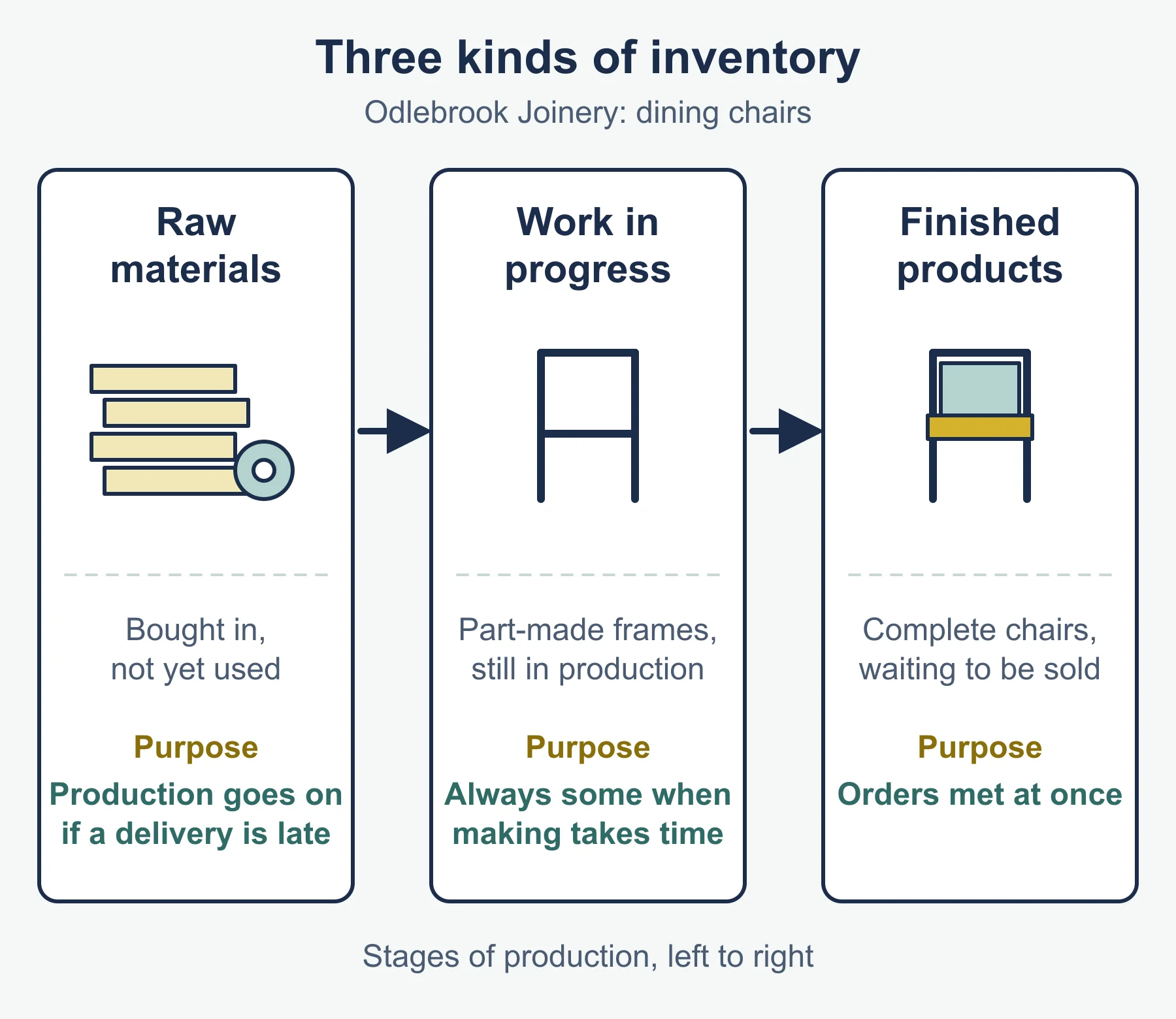
Inventory (also called stock) is the materials and goods a business holds at any moment. The syllabus names three kinds.
| Kind | What it is | Example at Odlebrook Joinery, a maker of dining chairs |
|---|---|---|
| Raw materials | Inputs bought in but not yet used | Planks of ash, glue, fabric |
| Work in progress | Items partly made, still going through production | Frames cut and joined but not yet upholstered |
| Finished products | Completed output waiting to be sold or delivered | Complete chairs in the warehouse |
Each kind has a different purpose.
- Raw materials let production carry on if a delivery is late, and let the business buy in bulk.
- Work in progress is a by-product of any process that takes time. A business that makes things in stages always has some.
- Finished products let the business meet orders at once, smooth out uneven demand and avoid disappointing customers.
A service business may hold little of any of these, but a shop, a restaurant and a factory all depend on getting their inventory right.
The costs and benefits of holding inventory
Benefits
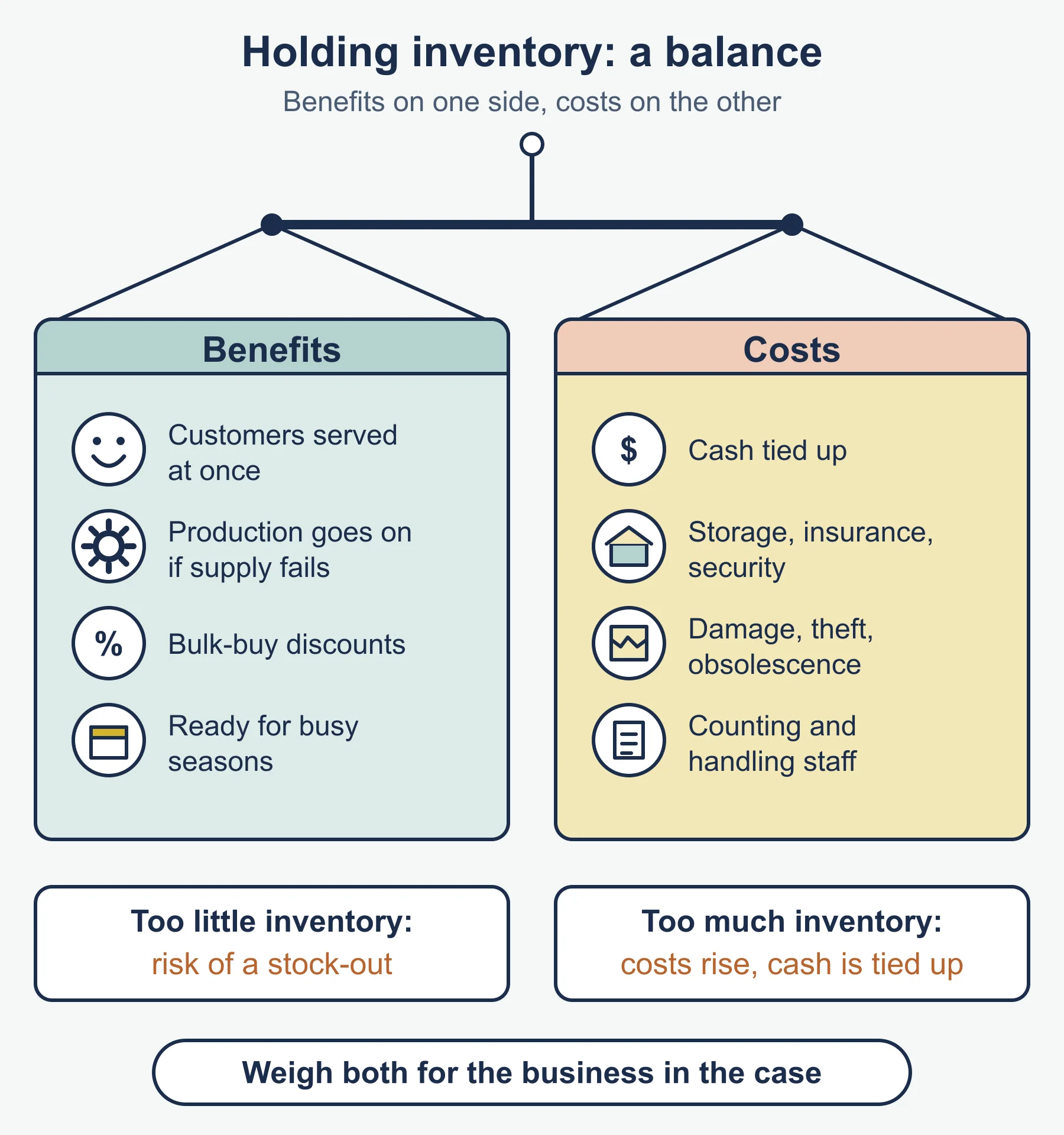
- Customers can be served immediately, which protects sales and reputation.
- Production is not interrupted when a supplier is late or a machine stops.
- The business can buy large quantities and may win a discount from the supplier.
- It can build inventory before a busy season and cope with demand that rises suddenly.
Costs
- Opportunity cost of money: cash spent on inventory cannot be used elsewhere, which can strain cash flow.
- Storage costs: warehouse space, heating or refrigeration, insurance and security.
- Risk of loss: items can be damaged, stolen, go out of date or become obsolete if tastes change.
- Handling and administration: staff time to count, move and record inventory.
The skill is balance. Too much inventory raises costs and ties up cash. Too little risks a stock-out, which means running out and being unable to produce or sell. A good answer to a question on this topic weighs the two risks for the business in the case, rather than listing costs.
Buffer inventory, re-order level and lead time
Three terms must be defined precisely.
- Lead time: the time between placing an order with a supplier and receiving it.
- Buffer inventory: the minimum amount of inventory the business plans never to fall below. It is a safety margin against late deliveries or unexpected demand.
- Re-order level: the amount of inventory at which a new order is placed.
The re-order level has to be high enough that inventory lasts until the delivery arrives. This is the standard form of the calculation (the syllabus names the terms but does not give a formula):
re-order level = (usage per day x lead time in days) + buffer inventoryA related quantity is the maximum inventory level. If each delivery arrives just as inventory reaches the buffer level, then:
maximum inventory = buffer inventory + order quantityWorked example 1: re-order level and the cycle
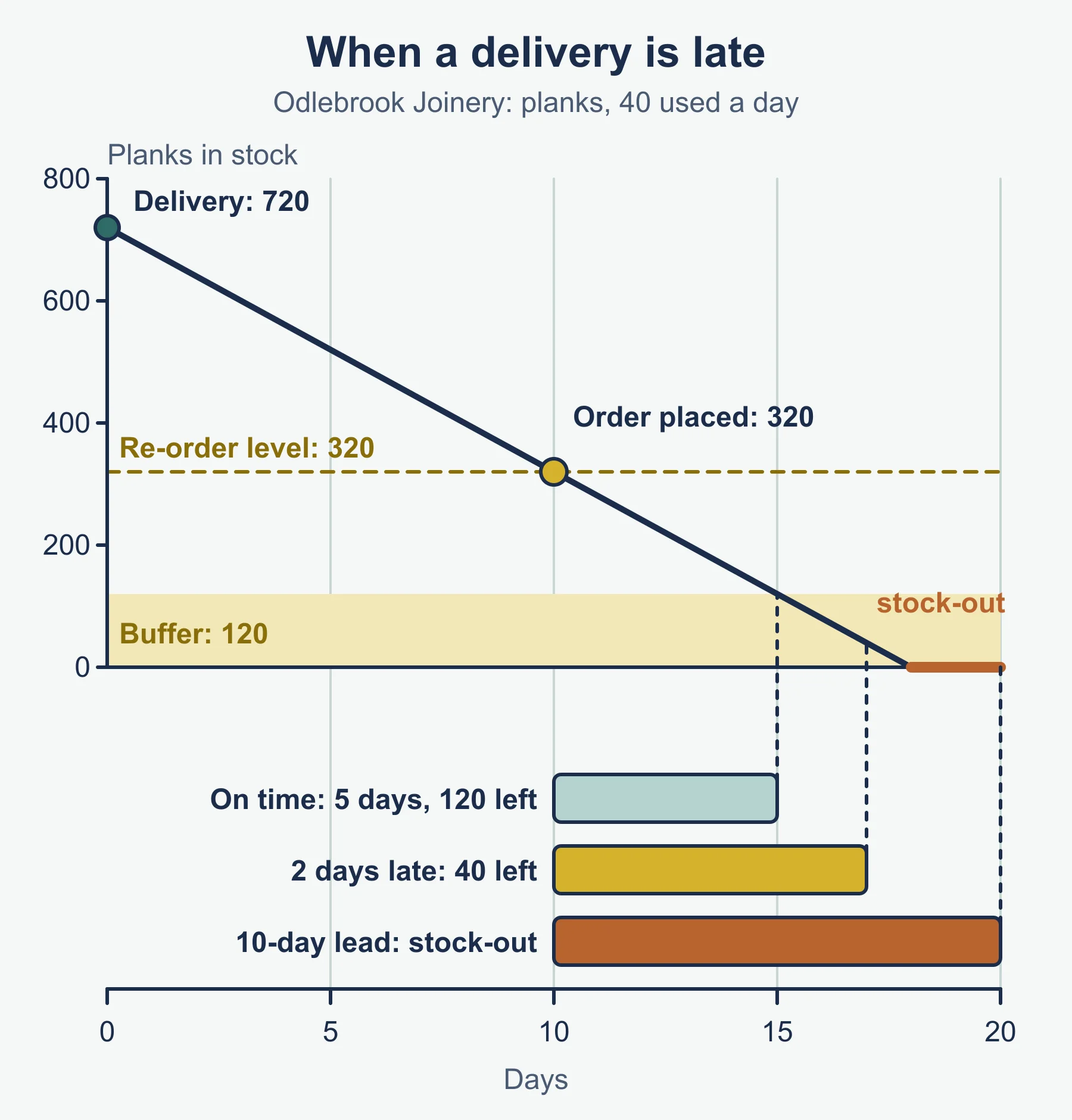
Odlebrook Joinery uses 40 planks a day. The supplier’s lead time is 5 days. The buffer inventory is 120 planks. Each order is for 600 planks.
- Usage during the lead time = 40 x 5 = 200 planks.
- Re-order level = 200 + 120 = 320 planks.
- Maximum inventory = 120 + 600 = 720 planks.
- Inventory falls from 720 to 320 at 40 a day, which takes 400 / 40 = 10 days. The order is placed then.
- Over the next 5 days inventory falls from 320 to 120. The delivery arrives and inventory jumps back to 720.
One full cycle is 10 + 5 = 15 days.
Interpreting simple inventory control charts
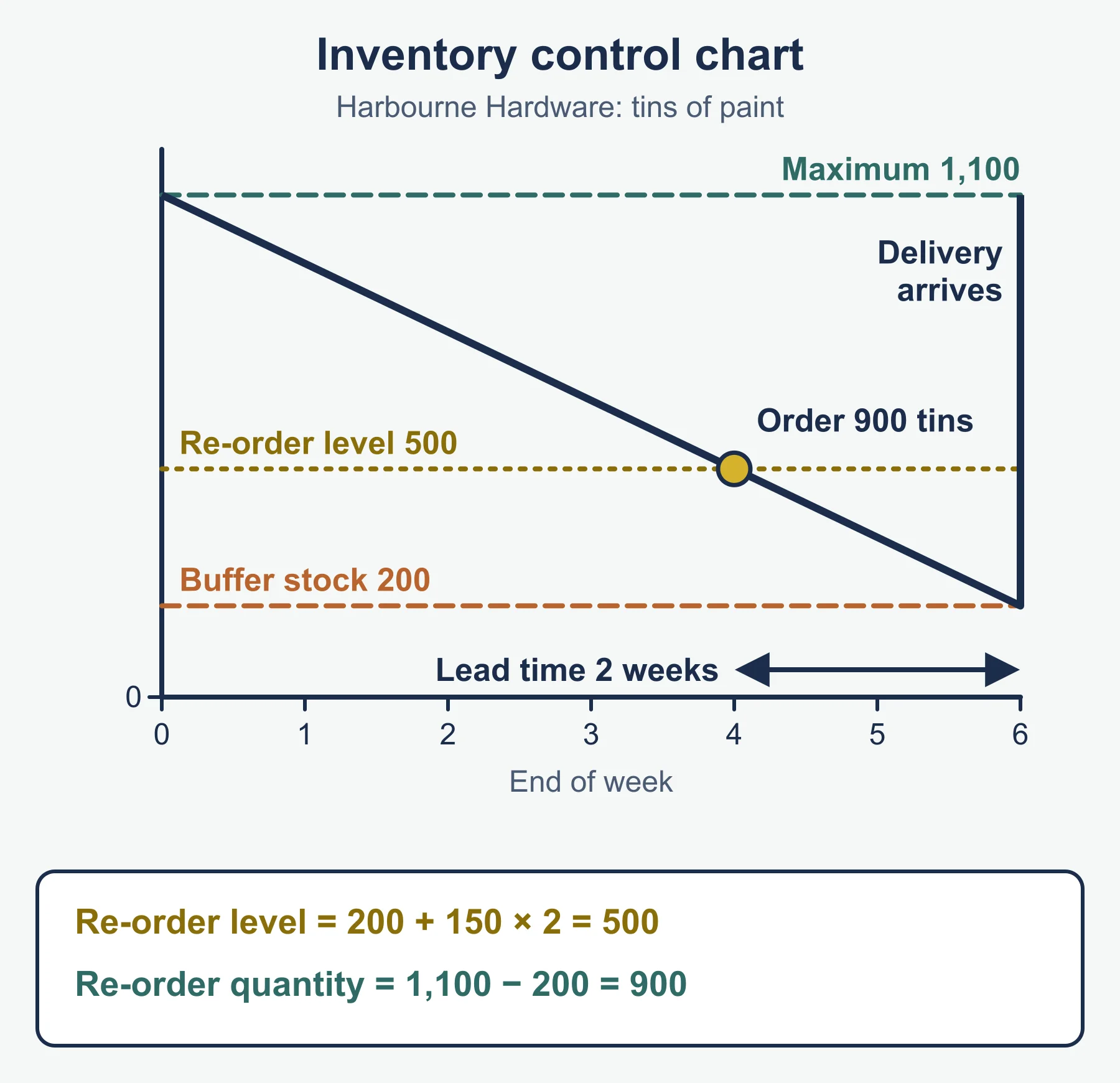
An inventory control chart plots the level of inventory against time. With steady usage and on-time deliveries it looks like a sawtooth: a straight line falling, then a vertical jump when a delivery arrives. Horizontal lines are often drawn for the maximum level, the re-order level and the buffer inventory.
Here are the points for Odlebrook’s chart.
| Day | Inventory (planks) | What is happening |
|---|---|---|
| 0 | 720 | Delivery has just arrived |
| 10 | 320 | Re-order level reached, order placed |
| 15 | 120 | Buffer level reached, delivery arrives |
| 15 (after delivery) | 720 | New cycle begins |
What you can read from a chart:
- Slope of the falling line. This shows the rate of usage. A steeper line means faster usage and a shorter time to the re-order level.
- Length of the flat gap between order and delivery. This is the lead time. A longer lead time means the re-order level must be higher.
- Height of the jump. This is the order quantity.
- Where the line bottoms out. If it reaches the buffer line, the system works as planned. If it falls below, the buffer was used. If it touches zero, there is a stock-out.
Worked example 2: what if things change?
Use the same business and ask three questions.
- Usage rises to 50 planks a day. The re-order level becomes (50 x 5) + 120 = 370. The falling line on the chart is steeper, and the order is placed at a higher level.
- The lead time lengthens to 8 days at the old usage. The re-order level becomes (40 x 8) + 120 = 440.
- A delivery is 2 days late (7 days in all). Inventory on arrival is 320 - (40 x 7) = 40 planks. The buffer of 120 has been used by 80, but there is no stock-out. The buffer did its job.
Now suppose the delivery takes 10 days. Inventory would reach zero after 320 / 40 = 8 days, leaving 2 days of production, 80 planks, unsupplied. That is a stock-out. The business could respond by raising the buffer, finding a second supplier or negotiating a reliable delivery time.
The importance of Supply Chain Management
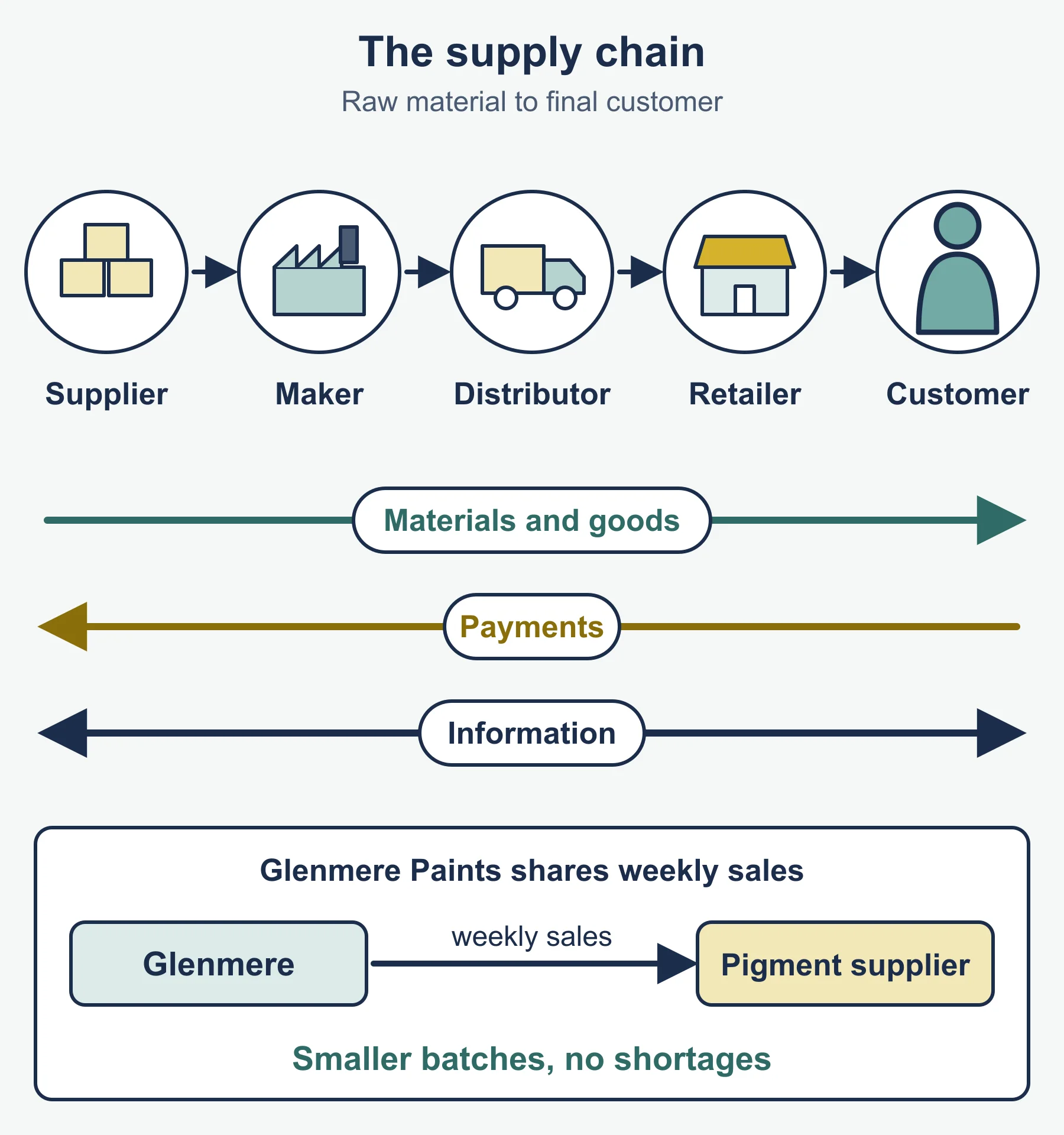
A supply chain is the sequence of businesses and activities that take a product from raw material to final customer: suppliers, manufacturers, distributors and retailers. Supply Chain Management (SCM) is the coordination of that flow of materials, information and payments (this is the standard definition; the syllabus names the topic without defining it).
Why it matters for inventory:
- Reliable suppliers and clear information about demand let a business hold less inventory without running out.
- Shorter, more predictable lead times lower the buffer inventory needed.
- Working closely with suppliers can improve quality and cut waste, so fewer faulty items are held.
- Good coordination can reduce costs and allows quicker delivery to customers, which can be a competitive advantage.
- Problems anywhere in the chain, such as a supplier failing or transport delays, pass down to the business. Managing the chain reduces that risk.
For example, Glenmere Paints shares its weekly sales figures with its pigment supplier. The supplier prepares the right quantities in advance, so Glenmere can order smaller batches without risk of shortages. Be careful, though: SCM costs money and time, and the gains depend on suppliers being willing to cooperate.
Just in Time (JIT) and Just in Case (JIC)
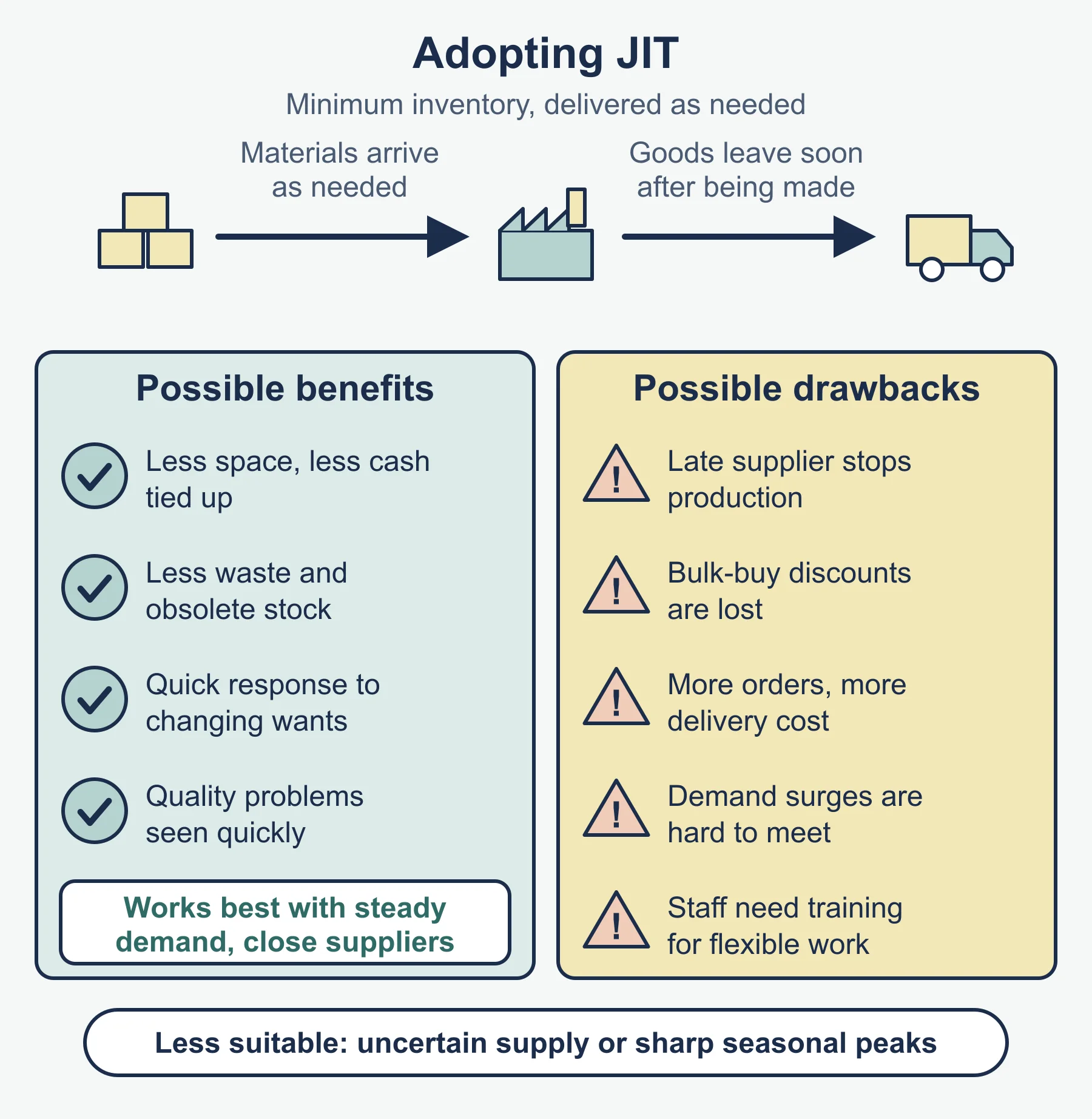
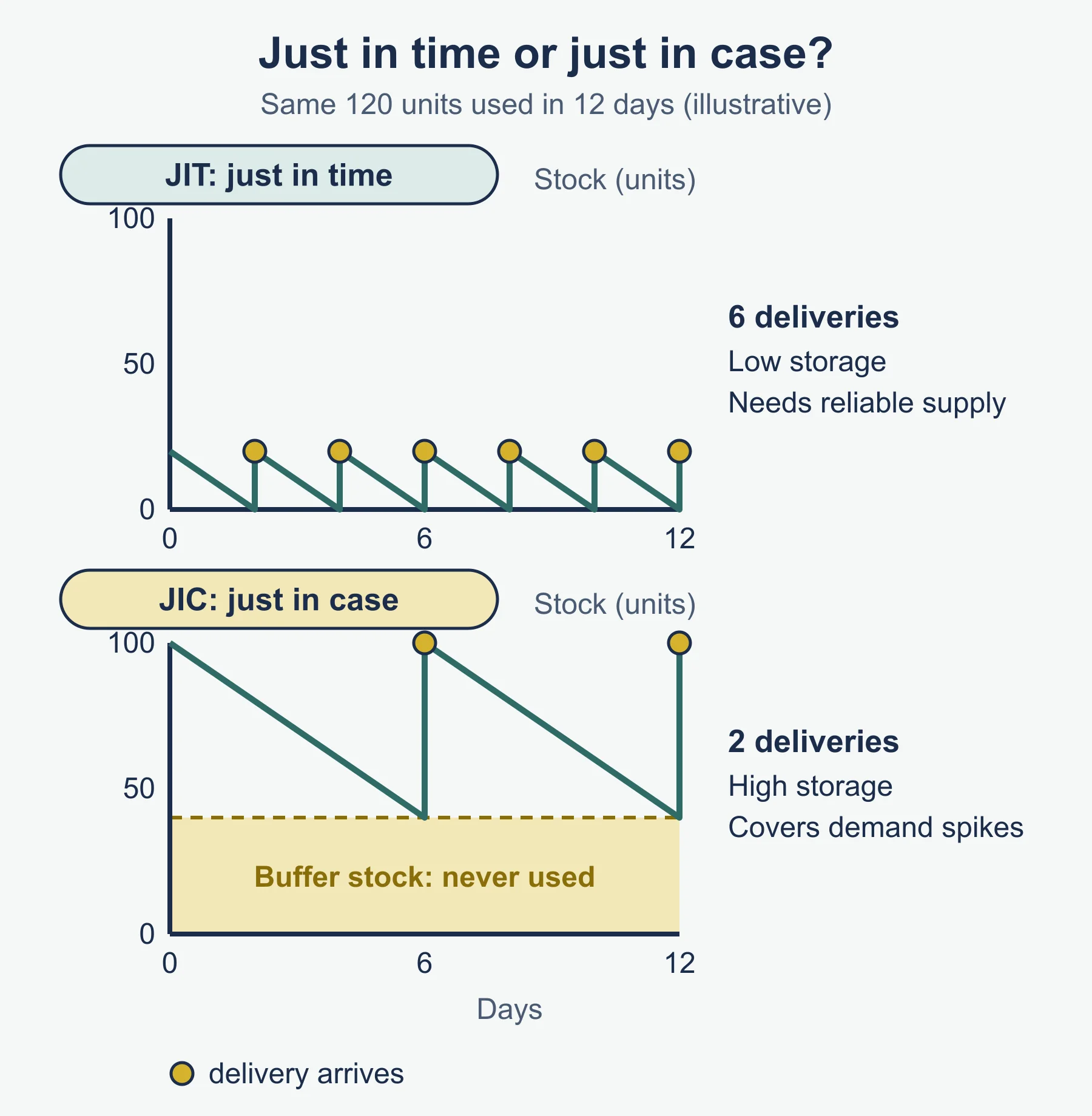
JIT inventory management aims to hold as little inventory as possible. Materials arrive just as they are needed for production, and finished goods go to customers soon after they are made. The purpose is to cut holding costs and waste.
JIC inventory management holds enough inventory, including a substantial buffer, to cope with whatever might happen. The purpose is to make sure the business never runs out, even when deliveries are late or demand jumps.
| JIT | JIC | |
|---|---|---|
| Aim | Minimum inventory, lower costs | Security of supply |
| Buffer inventory | Very small or none | Large |
| Relies on | Reliable suppliers, accurate forecasts | Storage space and available cash |
| Main risk | Stoppage if a delivery fails | High holding costs and obsolescence |
The impact of adopting JIT
Possible benefits
- Lower holding costs: less warehouse space and less cash tied up.
- Less waste from damaged, out-of-date or obsolete items.
- Faster response to changes in customer wants, because less old inventory has to be used up.
- Problems with quality are seen quickly, since defective items cannot be hidden in a large store.
Possible drawbacks
- Production stops if a supplier is late, so supplier reliability is essential.
- The business may lose bulk-buying discounts, because it orders smaller amounts more often.
- Ordering and delivery costs rise because there are more orders.
- It is harder to meet an unexpected surge in demand.
- Staff may need training to work flexibly and to deal with pressure.
JIT works best where demand is fairly predictable and good suppliers are close by. It is less suitable where supply is uncertain or the product is sold in sharply seasonal peaks.
Worked example 3: a cost comparison
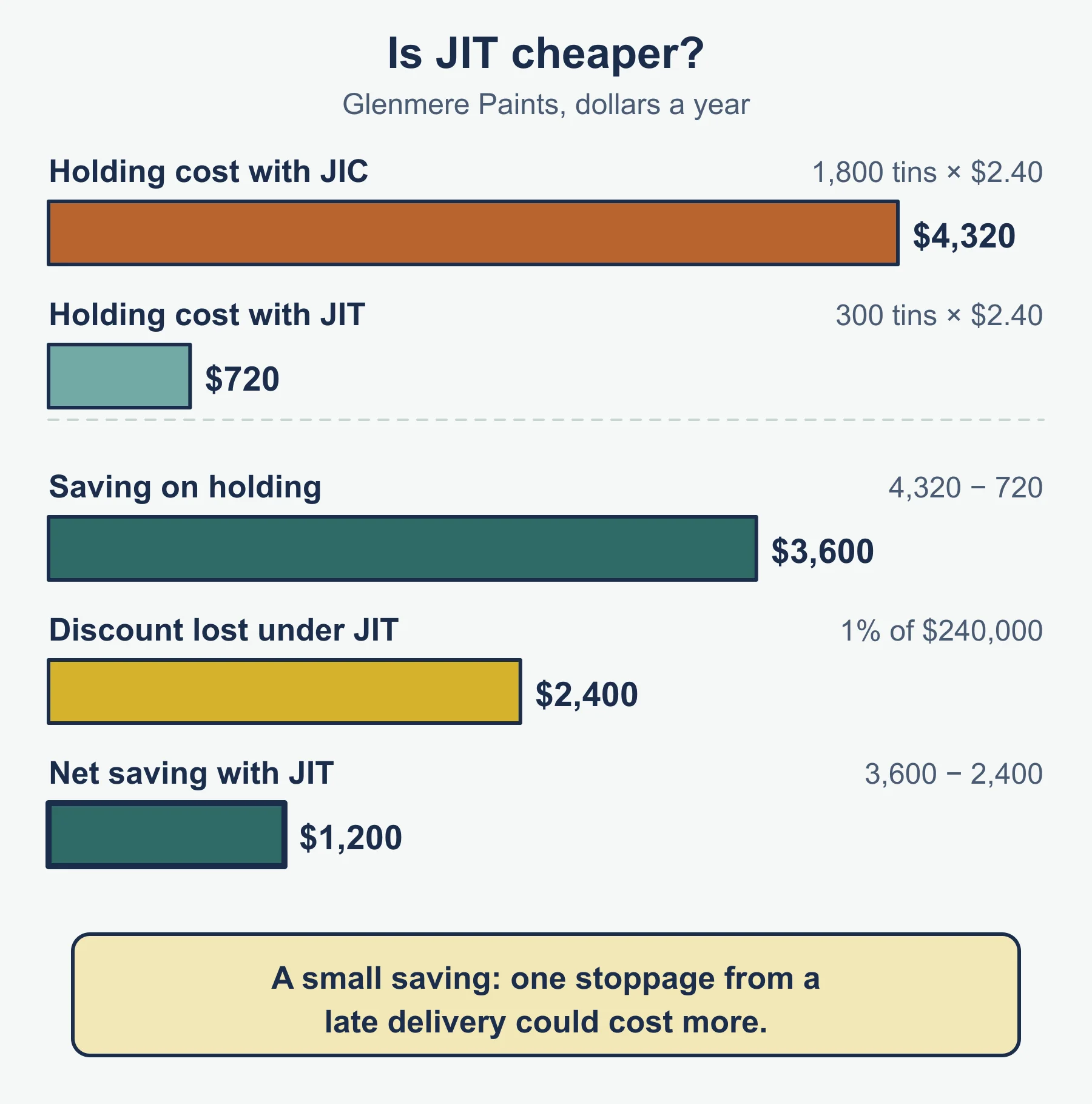
Glenmere Paints (all figures in dollars) buys 240 000 of materials a year. Under JIC it holds an average of 1 800 tins, and holding each tin costs 2.40 a year. Under JIT it would hold an average of 300 tins. Its supplier gives a 1% discount on large orders, which JIT would lose.
- Holding cost under JIC = 1 800 x 2.40 = 4 320.
- Holding cost under JIT = 300 x 2.40 = 720.
- Saving on holding cost = 4 320 - 720 = 3 600.
- Discount lost = 1% of 240 000 = 2 400.
- Net saving = 3 600 - 2 400 = 1 200 a year.
JIT looks better on this measure. But 1 200 is small. A single stoppage caused by a late delivery could cost more. A sound judgement uses the figure and the risk, and says which matters more for this business.
Common errors
- Describing JIT as having no inventory at all. It aims for the minimum, and raw materials are still held briefly.
- Leaving out the buffer inventory when calculating the re-order level.
- Treating inventory only as a cost. Holding it also protects sales.
- Stating that JIT is always cheaper. Lost discounts and stoppage risk can outweigh the saving.
- Reading a chart’s jump as usage. The jump is the delivery; the sloping line is usage.
- Listing advantages and disadvantages without tying them to the business in the case.
Frequently asked questions
Why do businesses hold inventory? Raw materials keep production going and allow bulk buying, work in progress is unavoidable in multi-stage production, and finished products let the business meet orders at once and cope with uneven demand.
What are the costs of holding inventory? Cash tied up that cannot be used elsewhere, storage, insurance and security costs, the risk of damage, theft or obsolescence, and staff time to count, move and record it.
What is Supply Chain Management? Supply Chain Management is coordinating the flow of materials, information and payments along the chain of businesses from raw material to final customer. Good SCM lets a business hold less inventory safely.
When does JIT suit a business? JIT works best where demand is fairly predictable, suppliers are reliable and close by, and materials are bulky, perishable or expensive to store. JIC suits businesses with uncertain supply or long delivery times.
Official syllabus
Cambridge International AS & A Level Business 9609 syllabus for examination in 2026, 2027 and 2028, published by Cambridge University Press & Assessment (Cambridge International Education), section 4.2 Inventory management.
Get free revision emails (optional)
Occasional emails with practice questions, worked explanations and links to free resources for the qualification and subjects you choose. No spam, and you can unsubscribe from any email. The free tools on this site never need an email.
Related resources
-
Practice questions
A Level Business: Inventory management (Cambridge 9609) – Practice Questions
Original practice questions with worked answers on 4.2 Inventory management for Cambridge AS & A Level Business 9609: re-order level, charts and JIT.
Business · Cambridge · AS Level
Try questions -
Revision notes
A Level Business: Inventory management (Cambridge 9609) – Revision Notes
Condensed revision notes for 4.2 Inventory management in Cambridge AS & A Level Business 9609, with formulas, a self-test and common lost marks.
Business · Cambridge · AS Level
Revise topic -
Study guides
A Level Business: Location and scale (Cambridge 9609)
Study guide to 9.1 Location and scale in Cambridge A Level Business 9609: location, offshoring, reshoring, globalisation, and economies of scale.
Business · Cambridge · A Level
Read guide
Related articles
-
teaching
A Level tuition in Dubai: Cambridge or Pearson Edexcel International A Level?
Schools in Dubai and Abu Dhabi teach either Cambridge International AS & A Level or Pearson Edexcel International A Level. How the two are structured, why it matters for tuition, and how online classes from Lahore work.
9 October 2026
-
curriculum guides
Choosing subjects at IGCSE and A Level
How subject choices at 14 and 16 affect university options later, and how to keep pathways open without overloading a timetable.
28 July 2026
Studying this with a teacher
Working through Business AS LEVEL?
This page is free and stays free. If you would rather be taught it, Marlbridge runs Business classes one-to-one and in small groups of up to 15, online in your own time zone. The first trial class is free. WhatsApp replies within an hour (8am–11pm Pakistan time, every day); email the same day.
Cambridge Business teachers at Marlbridge

