
Revision Notes
A Level Business: Inventory management (Cambridge 9609) – Revision Notes
Condensed revision notes for 4.2 Inventory management in Cambridge AS & A Level Business 9609, with formulas, a self-test and common lost marks.
- Subject
- Business
- Level
- AS LEVEL
- Topic
- Operations management
- Author
- Marlbridge Academic Team
- Updated
- Reviewed by
- Salman Ahmad (what this means)
Aligned to Cambridge A Level Business (9609), For examination in 2026, 2027 and 2028. Official specification .
Syllabus page (what it covers and how it is assessed): Cambridge A Level Business.
Syllabus points this page covers
9609 (AS Level)
- 4.2 Inventory management
Found an error? Report a correction.
Need help with this topic? Request a free trial class for A Level Business (9609).
These are condensed notes for section 4.2 Inventory management (4.2.1 and 4.2.2) of the Cambridge International AS & A Level Business 9609 syllabus for examination in 2026, 2027 and 2028. It is an AS Level topic. For explanations and worked examples, use the study guide. Then test yourself with the practice questions. Other Topic 4 questions are in the operations management practice set. Course links: the Cambridge A Level Business hub, the checklist and the free diagnostics.
4.2.1 Managing inventory
Key definitions
| Term | Meaning |
|---|---|
| Inventory | Materials and goods the business is holding at a point in time |
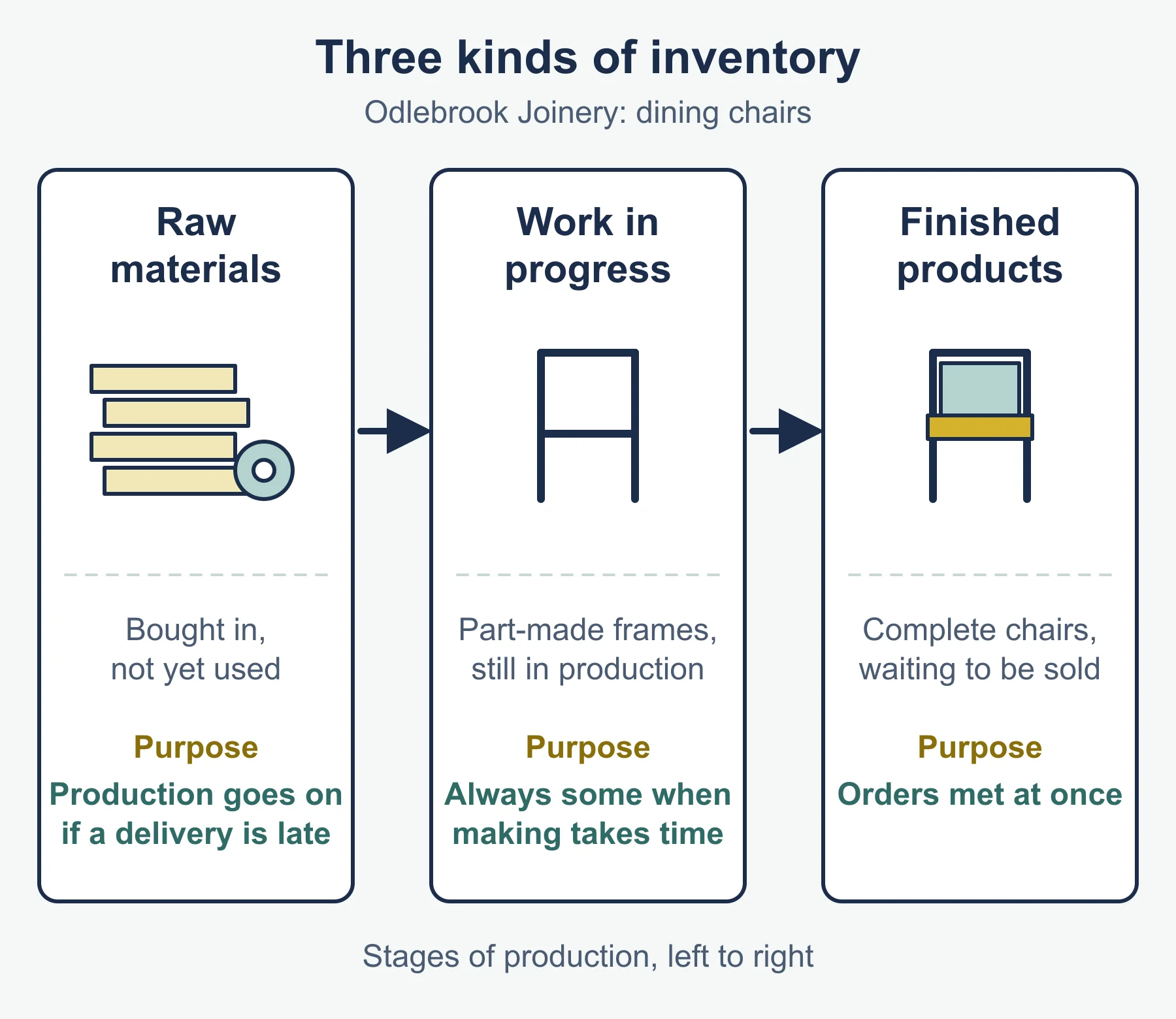
| Raw materials | Inputs bought in, not yet used |
| Work in progress | Part-finished goods still in production |
| Finished products | Completed goods awaiting sale or delivery |
| Lead time | Gap between placing an order and receiving it |
| Buffer inventory | Minimum safety level the business plans not to go below |
| Re-order level | Inventory level that triggers a new order |
| Stock-out | Running out of inventory, so production or sales stop |
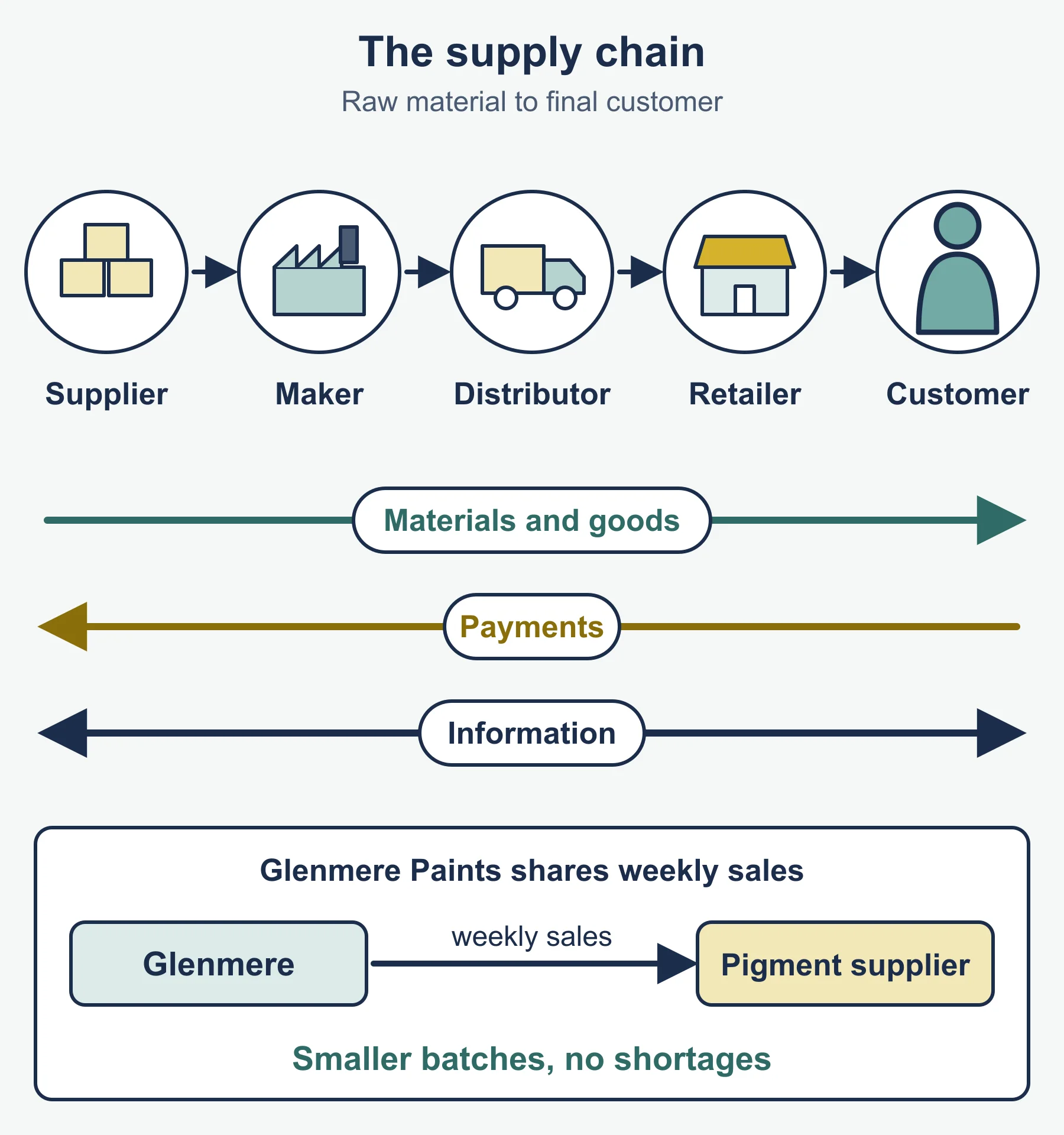
| Supply chain | All the stages and firms from raw material to final customer |
| Supply Chain Management (SCM) | Coordinating the flow of materials, information and payments along that chain |
Why inventory is held
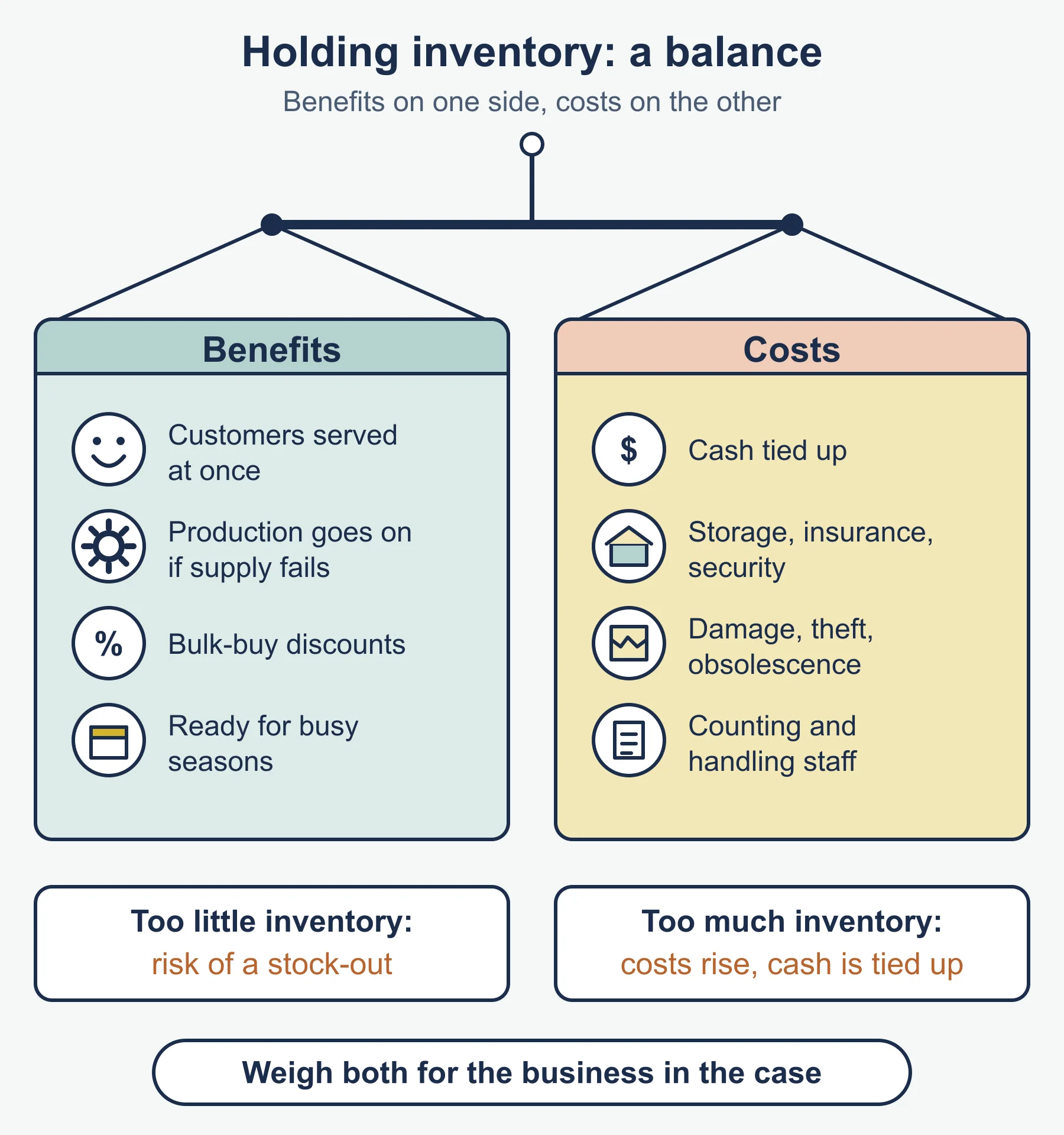
- Raw materials: keep production going, allow bulk buying.
- Work in progress: unavoidable when production takes several stages.
- Finished products: meet orders at once, cope with seasonal or sudden demand.
Costs and benefits of holding inventory
| Benefits | Costs |
|---|---|
| Customers served at once | Cash tied up (opportunity cost, pressure on cash flow) |
| Production continues if supply fails | Storage, insurance, security, refrigeration |
| Bulk-buying discounts possible | Damage, theft, going out of date, obsolescence |
| Demand surges can be met | Handling and record-keeping time |
Link to cash: every unit in the store is money that has been paid out but not yet earned back.
Formulas (standard forms; the syllabus names the terms but gives no formula)
| Quantity | Formula |
|---|---|
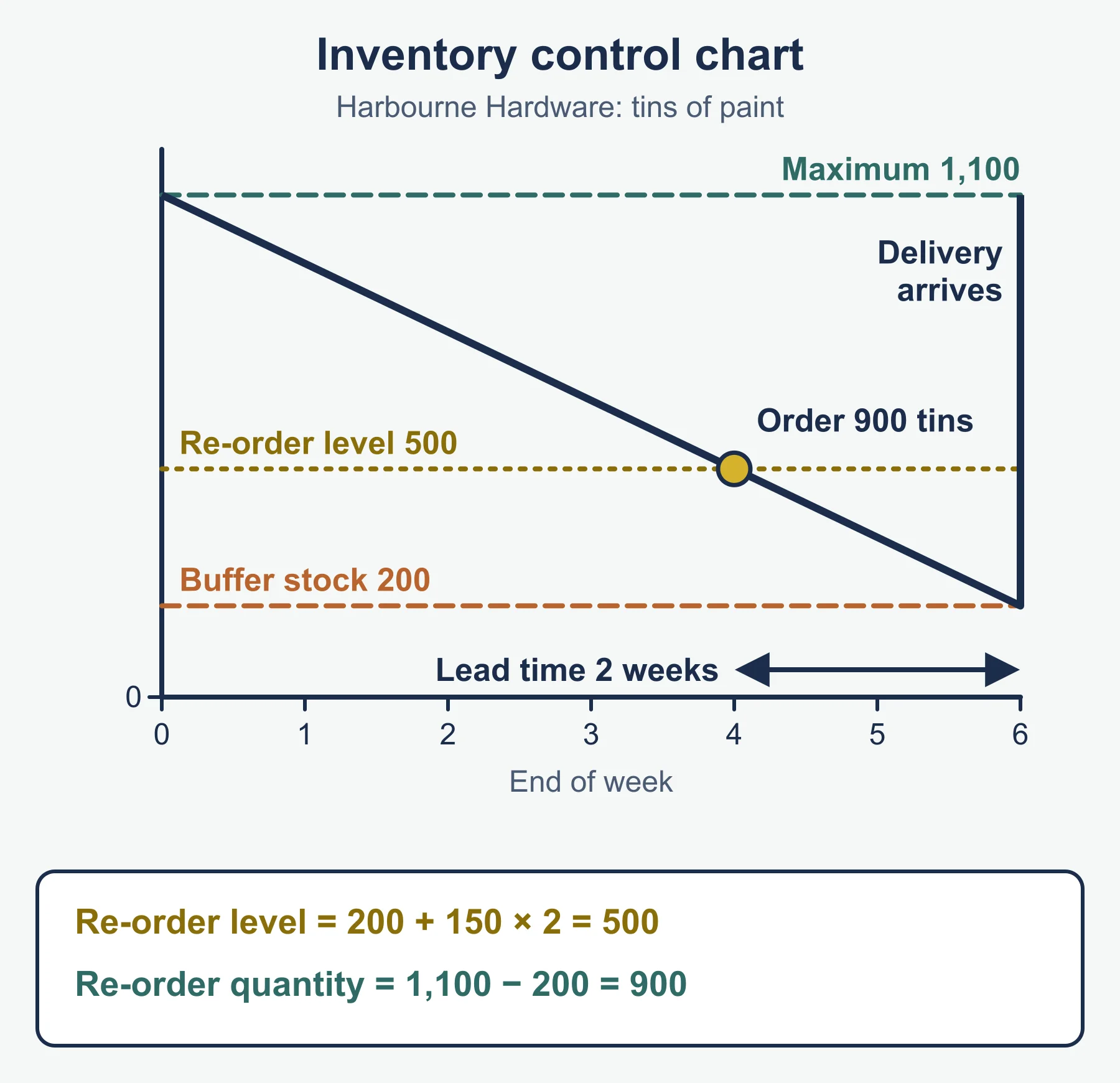
| Re-order level | (usage per day x lead time in days) + buffer inventory |
| Maximum inventory | buffer inventory + order quantity (when delivery arrives as inventory reaches the buffer) |
| Days from maximum to re-order level | (maximum - re-order level) / usage per day |
| Length of one cycle | days to re-order level + lead time |
Method in steps: re-order level questions
- Find usage per day (convert from week or month if needed).
- Multiply by the lead time to get usage while waiting for delivery.
- Add the buffer inventory.
- State the unit and show the working.
Worked reminder
A bakery supplier, Pentlow Mill, delivers flour to a cafe that uses 25 kg a day. The lead time is 4 days, buffer inventory is 60 kg and each order is 300 kg.
- Re-order level = (25 x 4) + 60 = 160 kg.
- Maximum inventory = 60 + 300 = 360 kg.
- Days from 360 to 160 = 200 / 25 = 8 days; with the 4-day lead time, one cycle lasts 12 days.
Reading an inventory control chart
| Feature on the chart | Meaning |
|---|---|
| Downward slope | Rate of usage (steeper = faster) |
| Vertical rise | Delivery; the height is the order quantity |
| Time from order to rise | Lead time |
| Horizontal line, low | Buffer inventory |
| Horizontal line, middle | Re-order level |
| Horizontal line, top | Maximum inventory |
| Line dips below buffer | Buffer is being used; delivery late or demand higher |
| Line reaches zero | Stock-out |
If a chart shows a rise that arrives while the line is still well above the buffer, the supplier delivered early or the order was placed too soon.
What changes the re-order level
| Change | Effect on re-order level |
|---|---|
| Higher daily usage | Higher |
| Longer lead time | Higher |
| Bigger buffer | Higher |
| Lower usage, shorter lead time | Lower (but the buffer is still added) |
Order quantity does not alter the re-order level. It changes the maximum level and how often orders are placed.
Why SCM matters
- Reliable, well-informed suppliers allow less inventory to be held safely.
- Shorter and more predictable lead times reduce the buffer needed.
- Close relationships with suppliers help with quality, costs and speed of delivery.
- Faster, more dependable delivery to customers can be a competitive advantage.
- Weaknesses anywhere in the chain pass to the business, so managing them reduces risk.
- Limits: it takes time and money, and it relies on suppliers cooperating.
4.2.2 Just in Time (JIT)
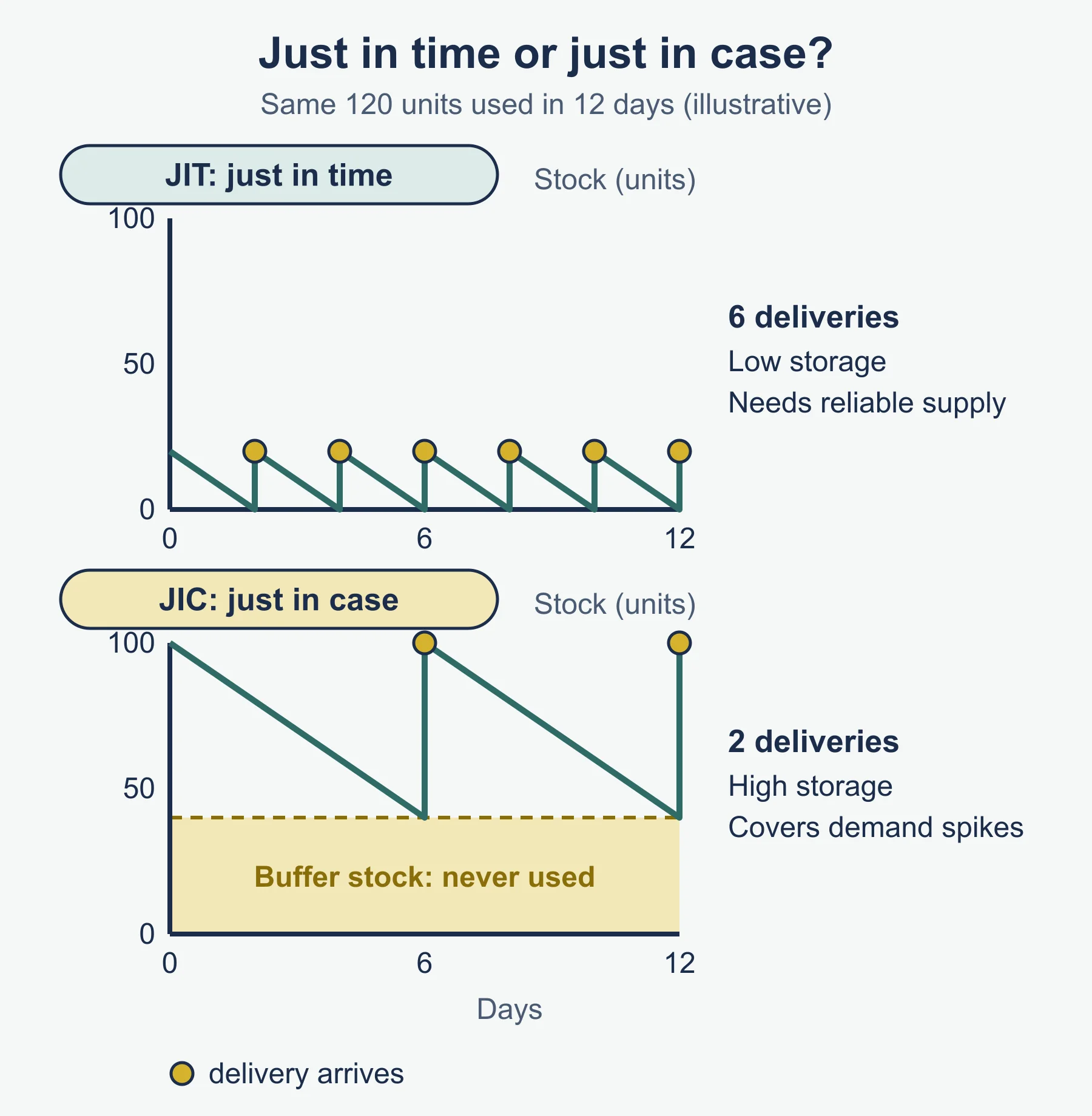
JIT and JIC compared
| JIT | JIC | |
|---|---|---|
| Purpose | Hold minimum inventory, cut costs and waste | Avoid ever running out |
| Buffer | Very small or none | Large |
| Orders | Small and frequent | Larger and less frequent |
| Depends on | Reliable suppliers, accurate forecasts | Space and cash to hold inventory |
| Weakness | Stoppage if a delivery fails | High holding costs, obsolescence |
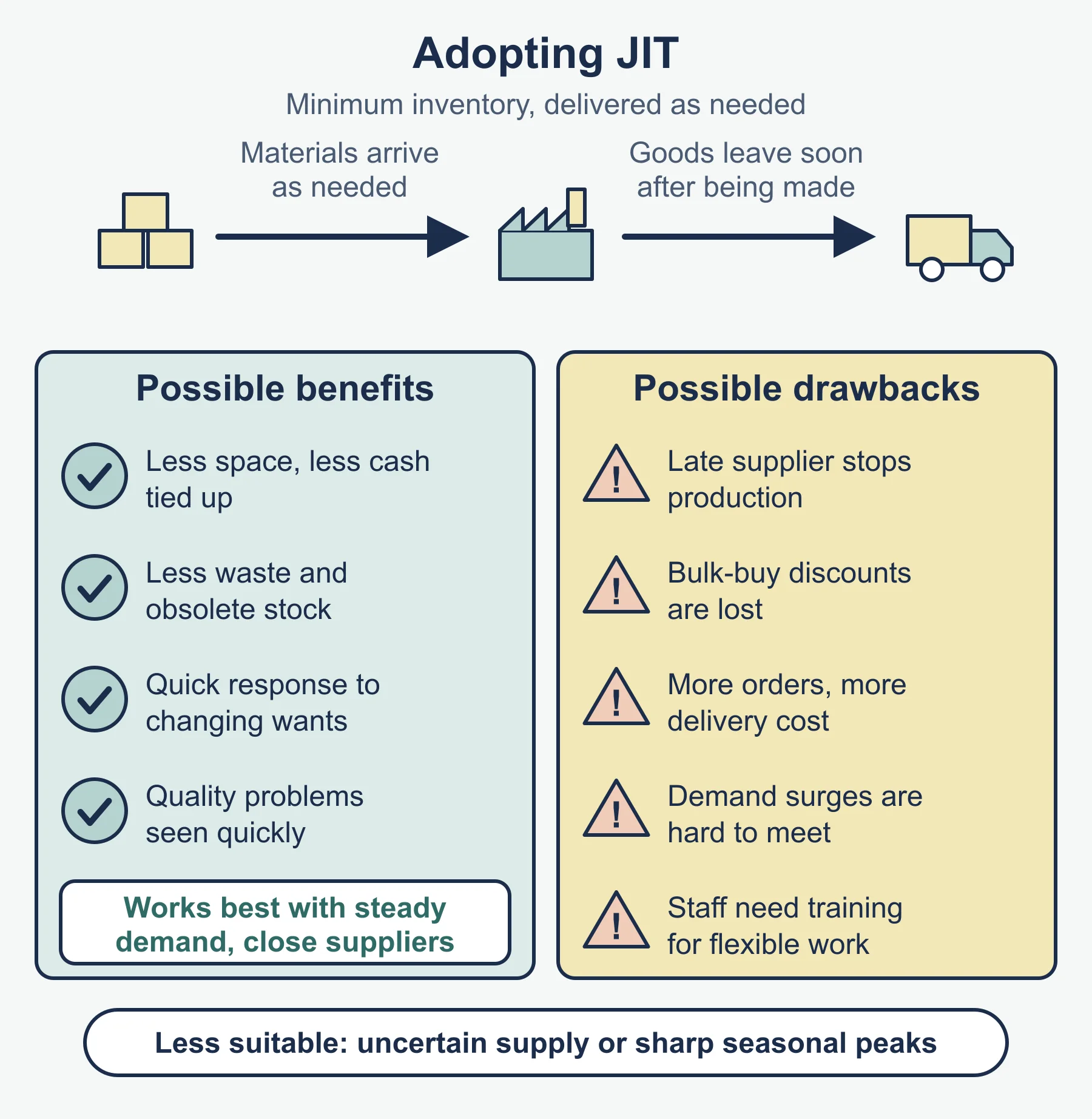
Impact of adopting JIT
| Positive | Negative |
|---|---|
| Lower storage and holding costs | Production stops if a supplier is late |
| Less cash tied up | Bulk discounts may be lost |
| Less waste and damage | More orders, so higher ordering costs |
| Quality faults show up quickly | Hard to meet sudden surges in demand |
| Better response to changing wants | Staff and suppliers need training and commitment |
When JIT is more likely to suit a business
- Demand is steady and forecasts are reliable.
- Suppliers are dependable and close.
- Materials are bulky, perishable or expensive to store.
- Staff can work flexibly.
JIC is more likely to suit a business with uncertain supply, long delivery times or sharp seasonal peaks.
Method in steps: a JIT or JIC judgement
- State what the business is like: stable or uncertain demand, reliable or unreliable suppliers, space and cash available.
- Give the case for the approach, with a cost or benefit taken from the data.
- Give the case against, again from the data, such as a lost discount or the risk of a stoppage.
- Reach a decision and say what it depends on, for example how dependable the main supplier proves to be.
Worked reminder: reading a late delivery
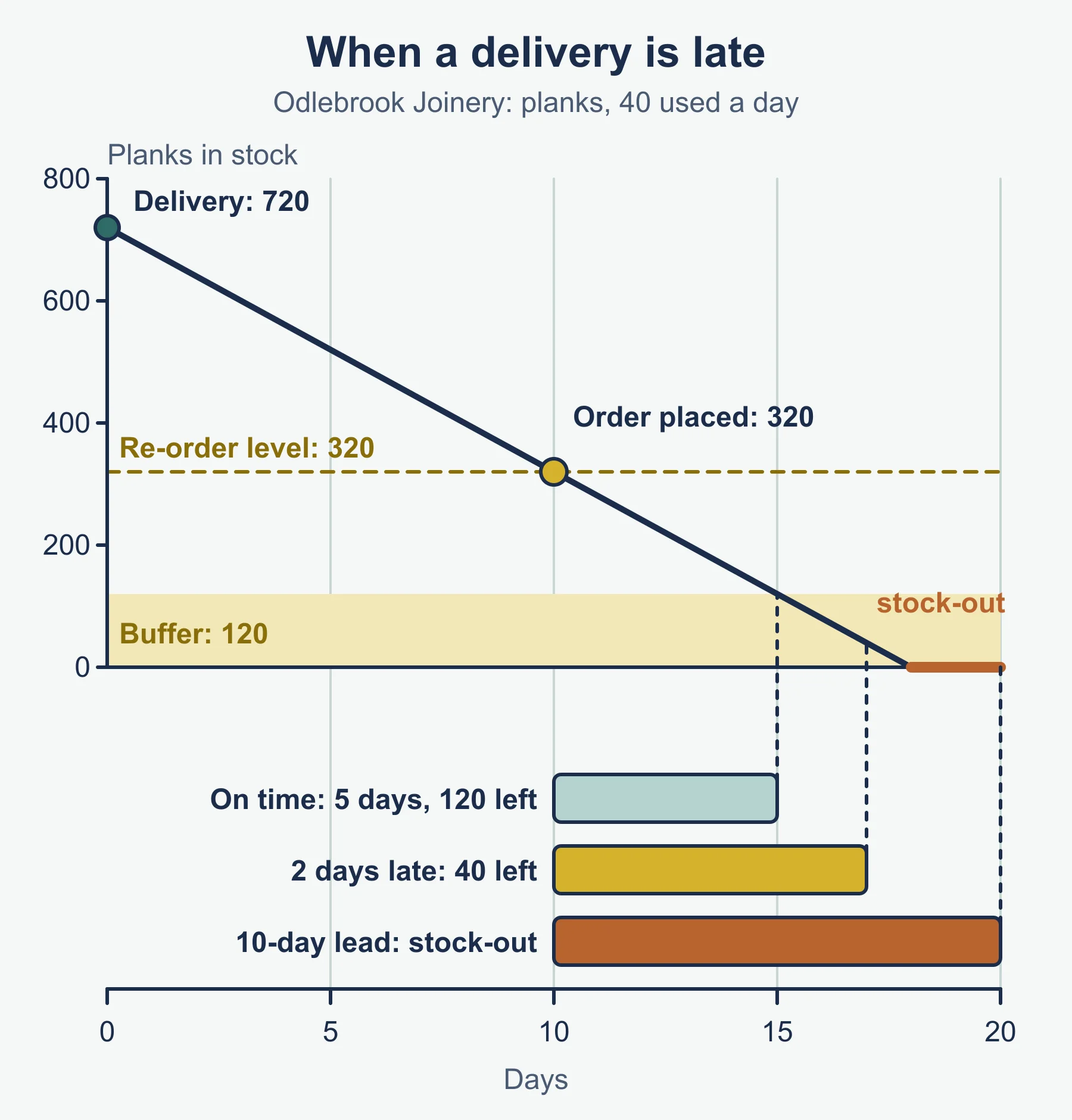
Suppose the cafe above has a chart reading 360 kg at day 0 and 160 kg at day 8, when the order is placed. Usage is 25 kg a day. On time, the delivery arrives on day 12 with 60 kg left. If it arrives 2 days late, the cafe has 60 - (25 x 2) = 10 kg left on day 14. The buffer has almost gone but no stock-out has happened. A delay of 3 days would cause one: 60 / 25 = 2.4 days of cover remain after day 12.
Must-know distinctions
- Buffer inventory is a minimum level; re-order level is a trigger level. The buffer is a part of the re-order level.
- Lead time is time; order quantity is amount.
- Raw materials go in; work in progress is half-way; finished products go out.
- JIT is a method of minimising inventory; JIC is a method of protecting against shortage.
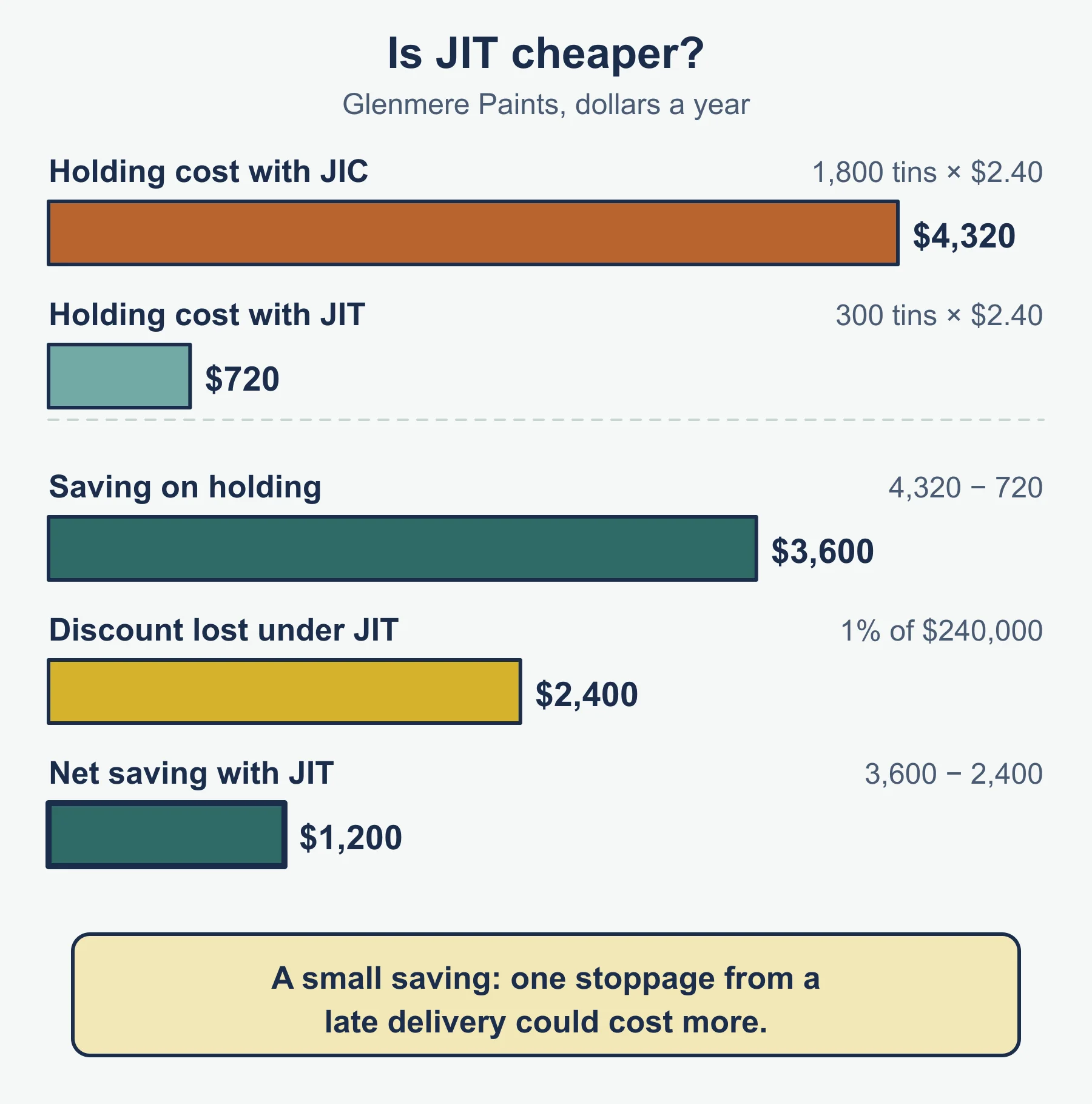
- Holding cost is the cost of keeping items; ordering cost is the cost of placing and receiving orders. JIT lowers the first and raises the second.
Quick self-test
- Name the three types of inventory.
- Define lead time.
- A firm uses 18 units a day, the lead time is 6 days and the buffer inventory is 50 units. Calculate the re-order level.
- A re-order level is 500 units, the lead time is 6 days and the buffer inventory is 140 units. Calculate daily usage.
- A firm has a buffer of 90 units and orders 450 units at a time. Calculate the maximum inventory level, assuming delivery arrives as inventory reaches the buffer.
- State two costs of holding inventory.
- On a chart, what does a steeper falling line show?
- State one reason a business might hold finished products.
- Give one reason why JIT could fail for a business.
- Explain one way good supply chain management could reduce the buffer inventory a business holds.
Answers
- Raw materials, work in progress, finished products.
- The time between placing an order and receiving it.
- (18 x 6) + 50 = 108 + 50 = 158 units.
- Usage in the lead time = 500 - 140 = 360, so daily usage = 360 / 6 = 60 units.
- 90 + 450 = 540 units.
- Any two from: storage space, insurance and security, cash tied up, damage, theft, obsolescence, handling costs.
- A faster rate of usage.
- To meet orders at once, so sales are not lost, or to cope with seasonal demand.
- A supplier delivers late and, with no buffer, production stops.
- Reliable suppliers with short, predictable lead times mean less cover is needed against late deliveries, so a smaller buffer is enough.
Where marks are usually lost
- Omitting the buffer inventory from the re-order level.
- Using the wrong time unit, such as weekly usage with a lead time in days.
- Writing “no inventory” for JIT instead of minimum inventory.
- Treating every cost of holding inventory as a storage cost, and forgetting cash tied up.
- Giving only advantages or only disadvantages of JIT in an evaluative answer.
- Writing general points about JIT with no link to the business in the case.
- Misreading a chart: calling the vertical rise usage, or ignoring the lead time gap.
- Defining supply chain management as just buying from suppliers, rather than coordinating the whole flow.
Frequently asked questions
What are the three types of inventory? Raw materials (inputs not yet used), work in progress (part-finished goods) and finished products (completed goods awaiting sale or delivery).
What is the difference between buffer inventory and the re-order level? Buffer inventory is the minimum safety level the business plans not to go below. The re-order level is the higher level that triggers a new order, so that the delivery arrives before inventory falls below the buffer.
How do you read an inventory control chart? The downward slope shows the rate of usage, the vertical rise shows a delivery and its height is the order quantity, and the gap between ordering and the rise is the lead time.
Does the order quantity change the re-order level? No. The re-order level depends on daily usage, lead time and buffer inventory. The order quantity changes the maximum inventory level and how long each cycle lasts.
Official syllabus
Cambridge International AS & A Level Business 9609 syllabus for examination in 2026, 2027 and 2028, published by Cambridge University Press & Assessment (Cambridge International Education), section 4.2 Inventory management.
Get free revision emails (optional)
Occasional emails with practice questions, worked explanations and links to free resources for the qualification and subjects you choose. No spam, and you can unsubscribe from any email. The free tools on this site never need an email.
Related resources
-
Study guides
A Level Business: Location and scale (Cambridge 9609)
Study guide to 9.1 Location and scale in Cambridge A Level Business 9609: location, offshoring, reshoring, globalisation, and economies of scale.
Business · Cambridge · A Level
Read guide -
Practice questions
A Level Business: Location and scale (Cambridge 9609) – Practice Questions
Original practice questions with worked answers on 9.1 Location and scale for Cambridge A Level Business 9609, including calculation and case-study items.
Business · Cambridge · A Level
Try questions -
Revision notes
A Level Business: Location and scale (Cambridge 9609) – Revision Notes
Condensed revision notes for 9.1 Location and scale in Cambridge A Level Business 9609, with tables, a self-test and common slips.
Business · Cambridge · A Level
Revise topic
Related articles
-
teaching
A Level tuition in Dubai: Cambridge or Pearson Edexcel International A Level?
Schools in Dubai and Abu Dhabi teach either Cambridge International AS & A Level or Pearson Edexcel International A Level. How the two are structured, why it matters for tuition, and how online classes from Lahore work.
9 October 2026
-
curriculum guides
Choosing subjects at IGCSE and A Level
How subject choices at 14 and 16 affect university options later, and how to keep pathways open without overloading a timetable.
28 July 2026
Studying this with a teacher
Working through Business AS LEVEL?
This page is free and stays free. If you would rather be taught it, Marlbridge runs Business classes one-to-one and in small groups of up to 15, online in your own time zone. The first trial class is free. WhatsApp replies within an hour (8am–11pm Pakistan time, every day); email the same day.
Cambridge Business teachers at Marlbridge

