
Study Guides
A Level Business: Capacity utilisation and outsourcing (Cambridge 9609)
Study guide to 4.3 Capacity utilisation and outsourcing for Cambridge AS & A Level Business 9609, with worked calculations, impacts and evaluation.
- Subject
- Business
- Level
- AS LEVEL
- Topic
- Operations management
- Author
- Marlbridge Academic Team
- Updated
- Reviewed by
- Salman Ahmad (what this means)
Aligned to Cambridge A Level Business (9609), For examination in 2026, 2027 and 2028. Official specification .
Syllabus page (what it covers and how it is assessed): Cambridge A Level Business.
Syllabus points this page covers
9609 (AS Level)
- 4.3 Capacity utilisation and outsourcing
Found an error? Report a correction.
Need help with this topic? Request a free trial class for A Level Business (9609).
This guide covers section 4.3 Capacity utilisation and outsourcing (4.3.1 and 4.3.2) of the Cambridge International AS & A Level Business 9609 syllabus for examination in 2026, 2027 and 2028. It sits in Topic 4, Operations management, which is an AS Level topic. The syllabus says AS Level content is assumed knowledge for the A Level papers on decision-making and strategy, so it is worth knowing well even if you go on to the full A Level.
Pick up quick recall in the revision notes and test yourself with the practice questions. For inventory, JIT and productivity, see the existing Topic 4 practice questions. Course links: the Cambridge A Level Business hub, the printable checklist and the free 10-minute diagnostics.
What the syllabus asks for
| Ref | Content point | Where in this guide |
|---|---|---|
| 4.3.1 | The measurement of capacity utilisation | Section 1 |
| 4.3.1 | The impact of operating under or over maximum capacity on a business | Sections 2 and 3 |
| 4.3.1 | Methods of improving capacity utilisation | Section 4 |
| 4.3.2 | The impact of outsourcing on a business | Sections 5 and 6 |
The syllabus gives no formula for this section, so the calculation below is the standard form. The skills the syllabus assesses (knowledge, application, analysis and evaluation) matter here because “impact” questions reward answers tied to the business in the stem.
1. Measuring capacity utilisation
Capacity is the maximum output a business can produce in a given period with its existing resources (premises, machines, labour and time). Capacity utilisation shows how much of that maximum is actually being used. The standard form is:
capacity utilisation (%) = (actual output ÷ maximum possible output) × 100
Both figures must cover the same period and use the same unit, for example kayaks per year or customers per week. You can rearrange the formula:
- actual output = utilisation ÷ 100 × maximum output
- maximum output = actual output ÷ utilisation × 100
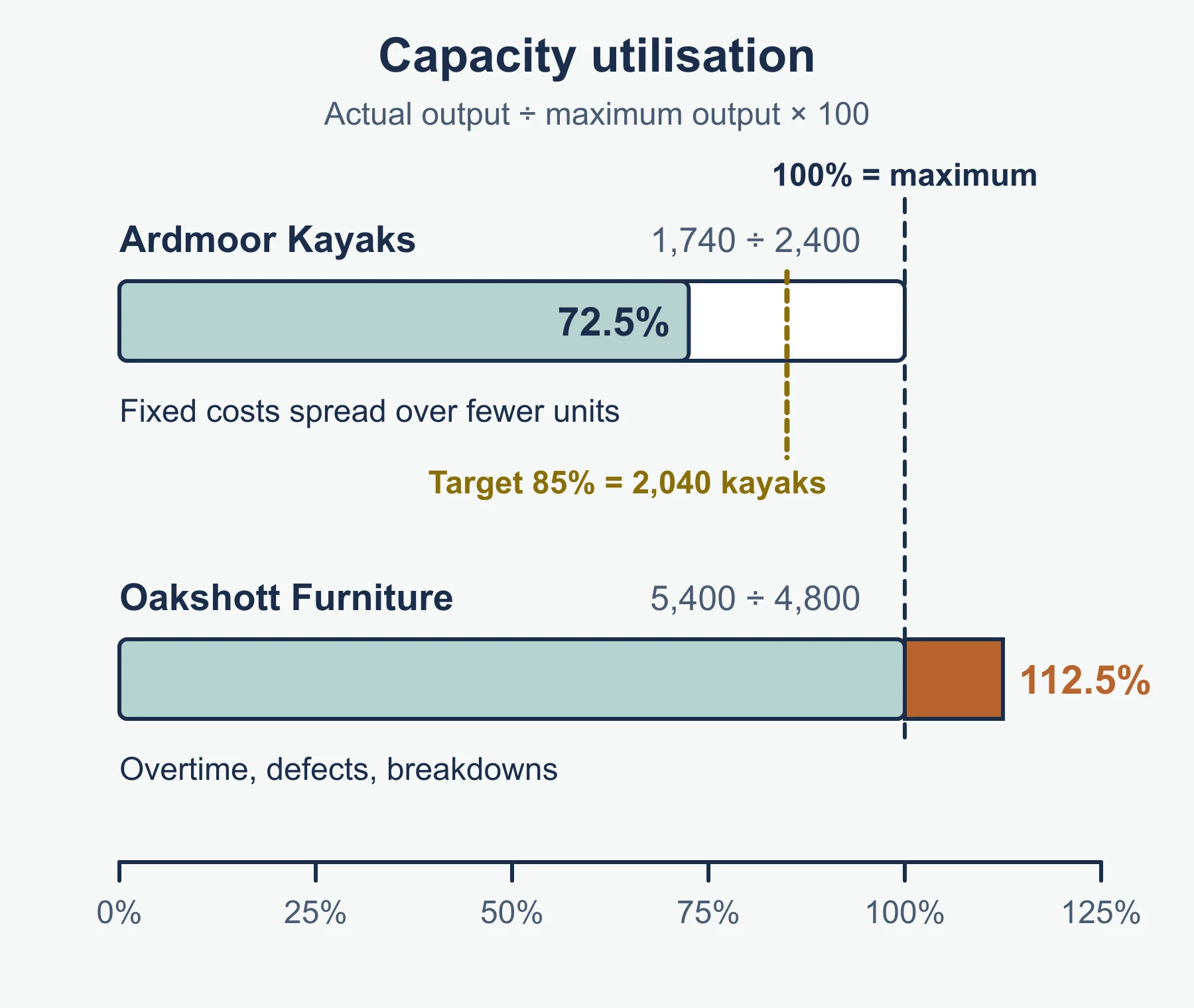
Worked example 1. Ardmoor Kayaks can build 2,400 kayaks a year and built 1,740 last year.
- Utilisation = 1,740 ÷ 2,400 × 100 = 72.5%.
- The owner wants 85%. Required output = 0.85 × 2,400 = 2,040 kayaks, which is 300 more than now.
Utilisation is easiest to judge when compared: with last year, with a target, or with a rival in the same industry. A figure on its own says little. It also describes capacity, not demand: a business can be at 72.5% because customers are not buying, because stock is short, or because a machine is down.
2. Operating under maximum capacity
Running well below capacity means the business pays for resources it does not fully use. Likely impacts:
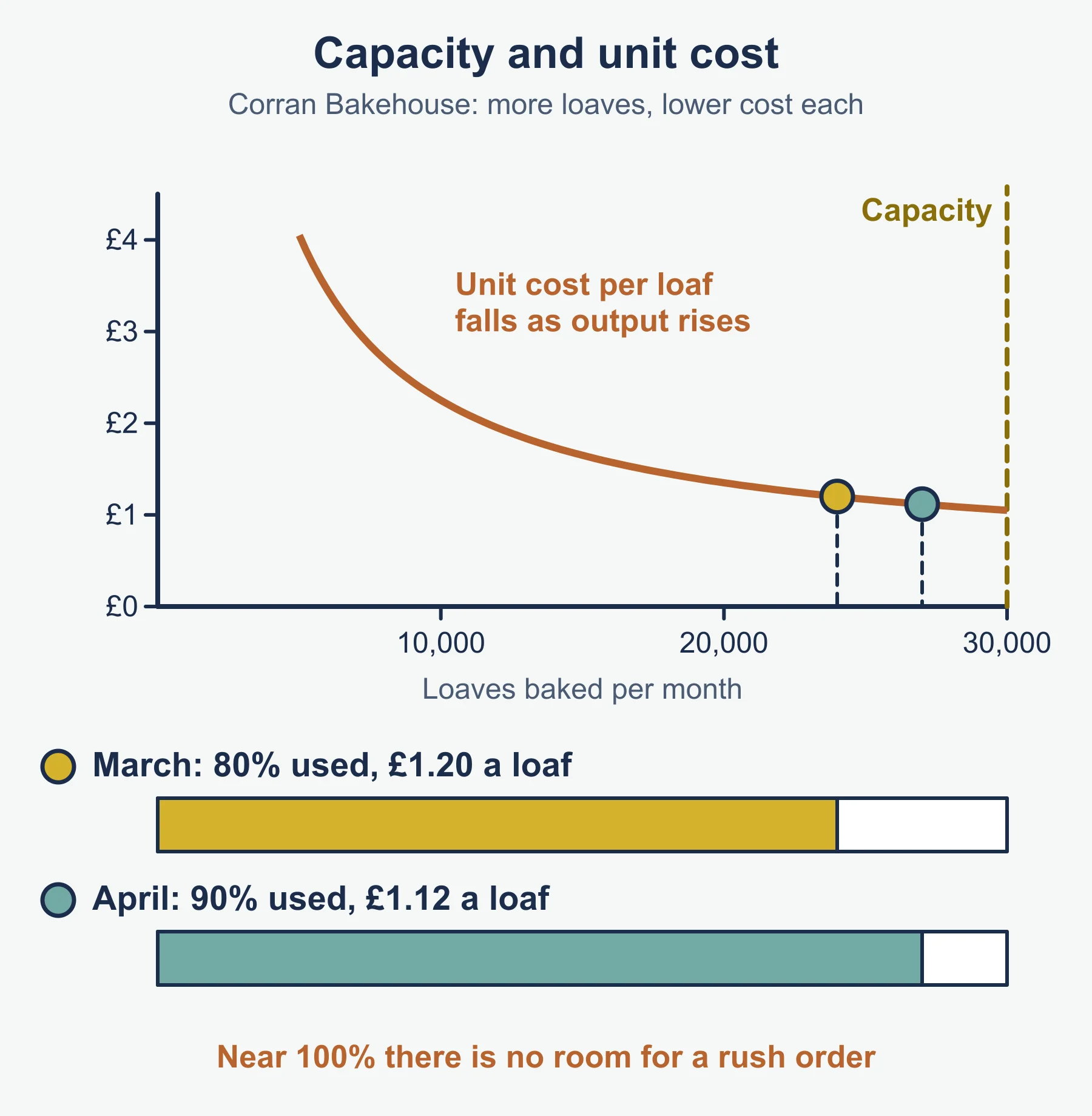
- Higher unit costs. Fixed costs (rent, machinery, salaried staff) are spread over fewer units.
- Lower profit, because the same overheads are covered by less revenue.
- Waste of resources: idle machines, underemployed workers and unused space.
- Risk to survival if the position lasts, because costs may stay above the selling price.
- Possible gains: spare capacity can absorb a sudden rise in orders, and gives time for maintenance and training.
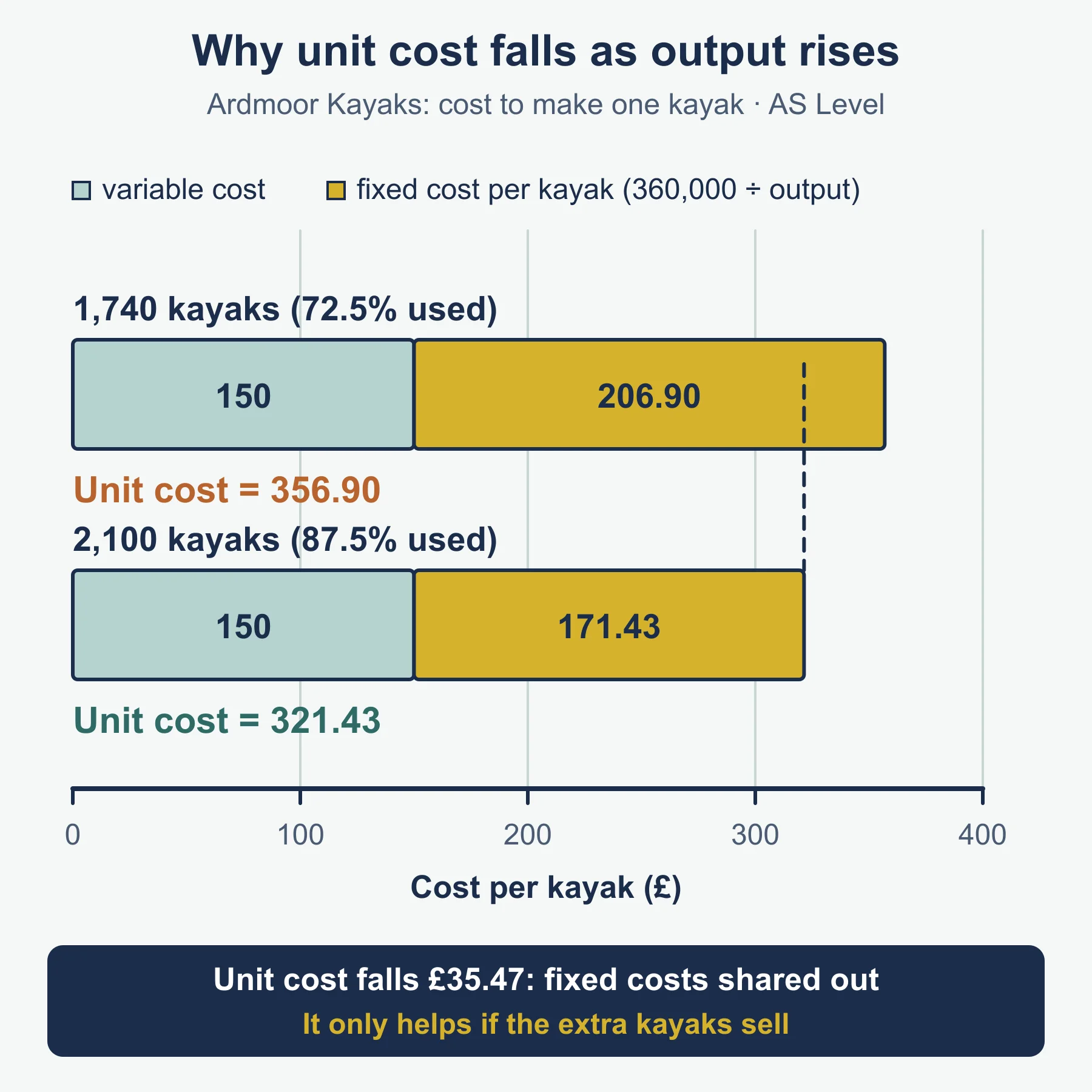
Worked example 2. Ardmoor Kayaks has fixed costs of 360,000 a year and variable costs of 150 a kayak.
| 1,740 kayaks (72.5%) | 2,100 kayaks (87.5%) | |
|---|---|---|
| Fixed cost per kayak | 206.90 | 171.43 |
| Variable cost per kayak | 150.00 | 150.00 |
| Total cost | 621,000 | 675,000 |
| Unit cost | 356.90 | 321.43 |
Total costs rise by 54,000, but each kayak costs 35.47 less to make. That fall comes entirely from fixed costs being shared out. It only helps if the extra kayaks can be sold.
3. Operating over maximum capacity
Output can exceed the planned maximum for a while: overtime, extra shifts, skipped maintenance, faster machine speeds. On the formula this gives utilisation above 100%.
Worked example 3. Oakshott Furniture is designed to make 4,800 chairs a month and has been making 5,400. Utilisation = 5,400 ÷ 4,800 × 100 = 112.5%.
Impacts to consider:
- Costs: overtime premiums, wear and repair bills, and emergency hiring.
- Quality: rushed work raises defects, rework and complaints.
- Reliability: breakdowns become more likely when maintenance is squeezed, so deadlines may be missed.
- Employees: fatigue, stress, absence and resignations.
- Sales: orders may be refused or delayed, risking customer loyalty.
- Gains: extra sales and revenue now, and fixed costs per unit fall further.
Near-full use is often a good sign, but a business at or beyond its limit has no room to cope with a surge or a breakdown. Many firms aim for high but not total use.
4. Methods of improving capacity utilisation
The syllabus does not name specific methods, so the groups below are the usual ones. Which applies depends on whether the problem is spare capacity (under) or excess demand (over).
If utilisation is too low, raise output (the numerator):
- Increase demand through promotion, new markets, new products or off-peak offers.
- Use spare capacity to produce for other businesses, such as own-label or contract work.
- Spread demand more evenly, for example with discounts in quiet seasons.
If utilisation is too low, reduce capacity (the denominator), which is sometimes called rationalisation:
- Close or sell a production line, rent out unused space, or move to smaller premises.
- Move to flexible or part-time contracts, so that labour capacity follows demand.
If utilisation is too high:
- Add capacity through new machines, extra shifts or bigger premises.
- Outsource some work to another business (see section 5).
- Manage demand by lengthening order lead times or raising prices.
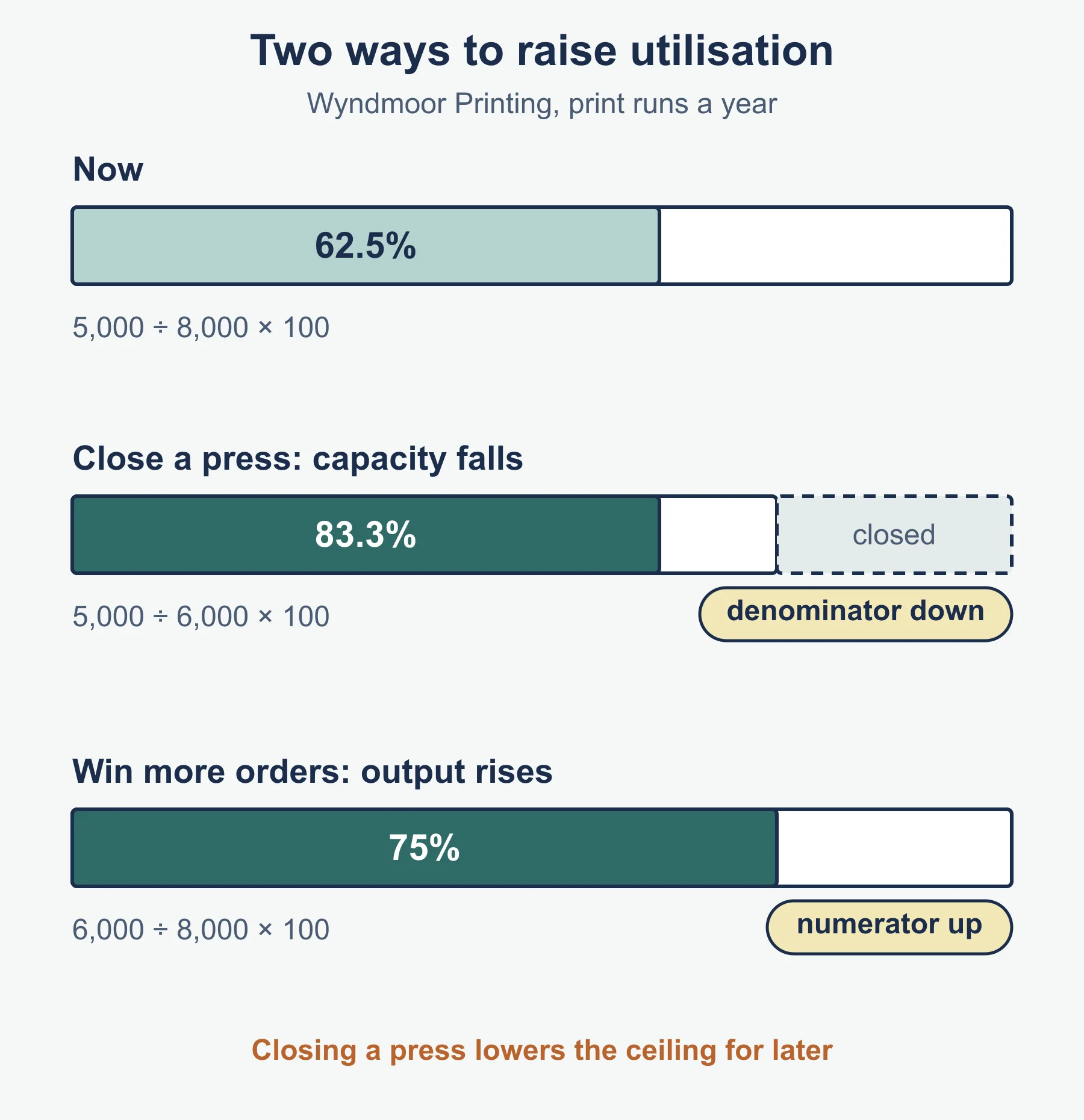
Worked example 4. Wyndmoor Printing can complete 8,000 print runs a year and completes 5,000 (62.5%). It could close one of its presses, cutting maximum capacity to 6,000 runs. Utilisation becomes 5,000 ÷ 6,000 × 100 = 83.3% without selling a single extra run. The cost is redundancy payments and a lower ceiling if demand later recovers. A promotion that lifted output to 6,000 runs would also reach 75%, but only if customers respond.
5. Outsourcing
Outsourcing means using another business to carry out an activity or process that the firm could do itself, such as payroll, packaging, deliveries, IT support or manufacturing a component. It is a decision about what to do in-house and what to buy in. The syllabus does not define the term, so this is the standard meaning.
Possible positive impacts:
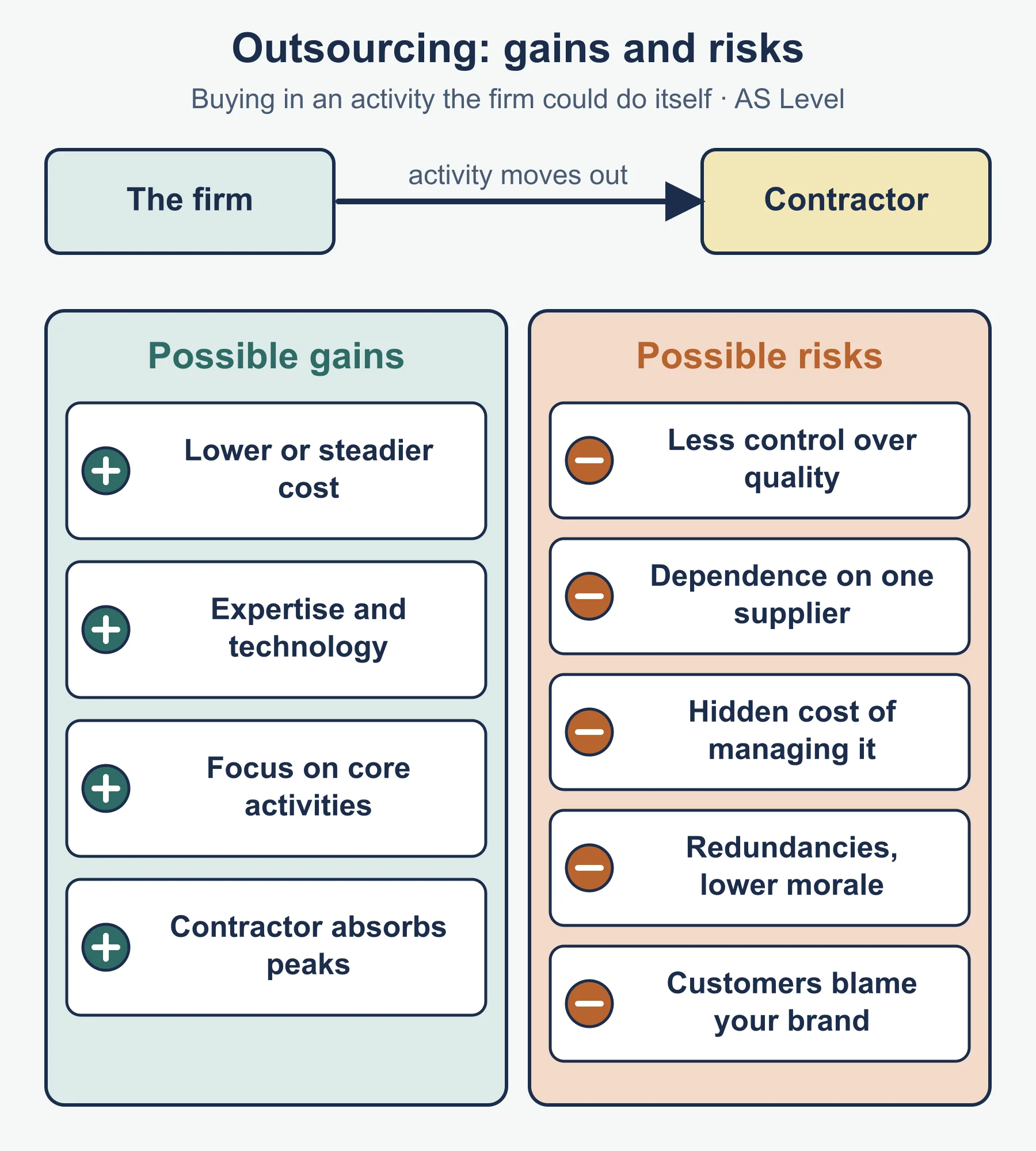
- Lower or more predictable cost, if the specialist works at greater scale or the firm avoids buying equipment.
- Access to expertise and technology the firm lacks.
- Focus on core activities, freeing management time and money.
- Flexibility and capacity: the contractor can absorb peaks, so the firm avoids over-investing in its own capacity and may improve its own utilisation.
Possible negative impacts:
- Less control over quality, speed and confidential information.
- Dependence on a supplier whose failures become the firm’s failures and whose prices may rise at renewal.
- Hidden costs of finding, contracting and monitoring the supplier.
- Employees: redundancies, loss of skills and lower morale among those who stay.
- Reputation: customers blame the brand, not the contractor, when something goes wrong.
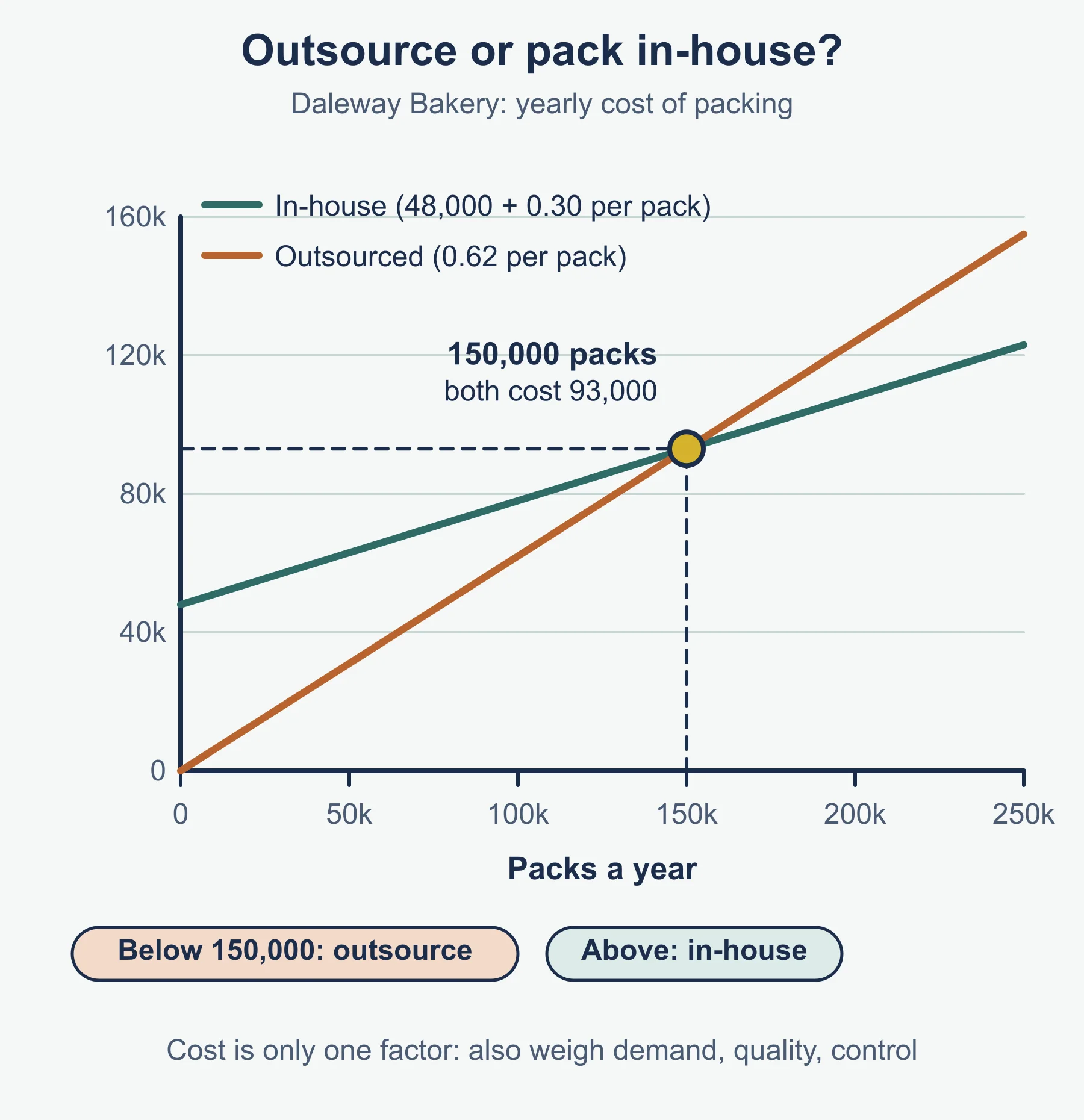
Worked example 5. Daleway Bakery packs its own loaves. In-house packing has fixed costs of 48,000 a year and variable cost of 0.30 a pack. A contractor charges 0.62 a pack.
- Break-even volume = 48,000 ÷ (0.62 − 0.30) = 150,000 packs.
| Packs a year | In-house cost | Outsourced cost | Cheaper option |
|---|---|---|---|
| 120,000 | 84,000 | 74,400 | Outsource |
| 150,000 | 93,000 | 93,000 | Equal |
| 200,000 | 108,000 | 124,000 | In-house |
Cost alone says outsource below 150,000 packs and pack in-house above it. A good answer then adds non-cost factors: Is demand steady? Does the contractor protect freshness and food safety? Is there spare in-house equipment already paid for?
6. Writing impact and evaluation answers
The syllabus lists these command words and meanings: analyse is to examine in detail to show meaning, identify elements and the relationship between them; evaluate is to judge or calculate the quality, importance, amount or value of something; justify is to support a case with evidence or argument. For this section:
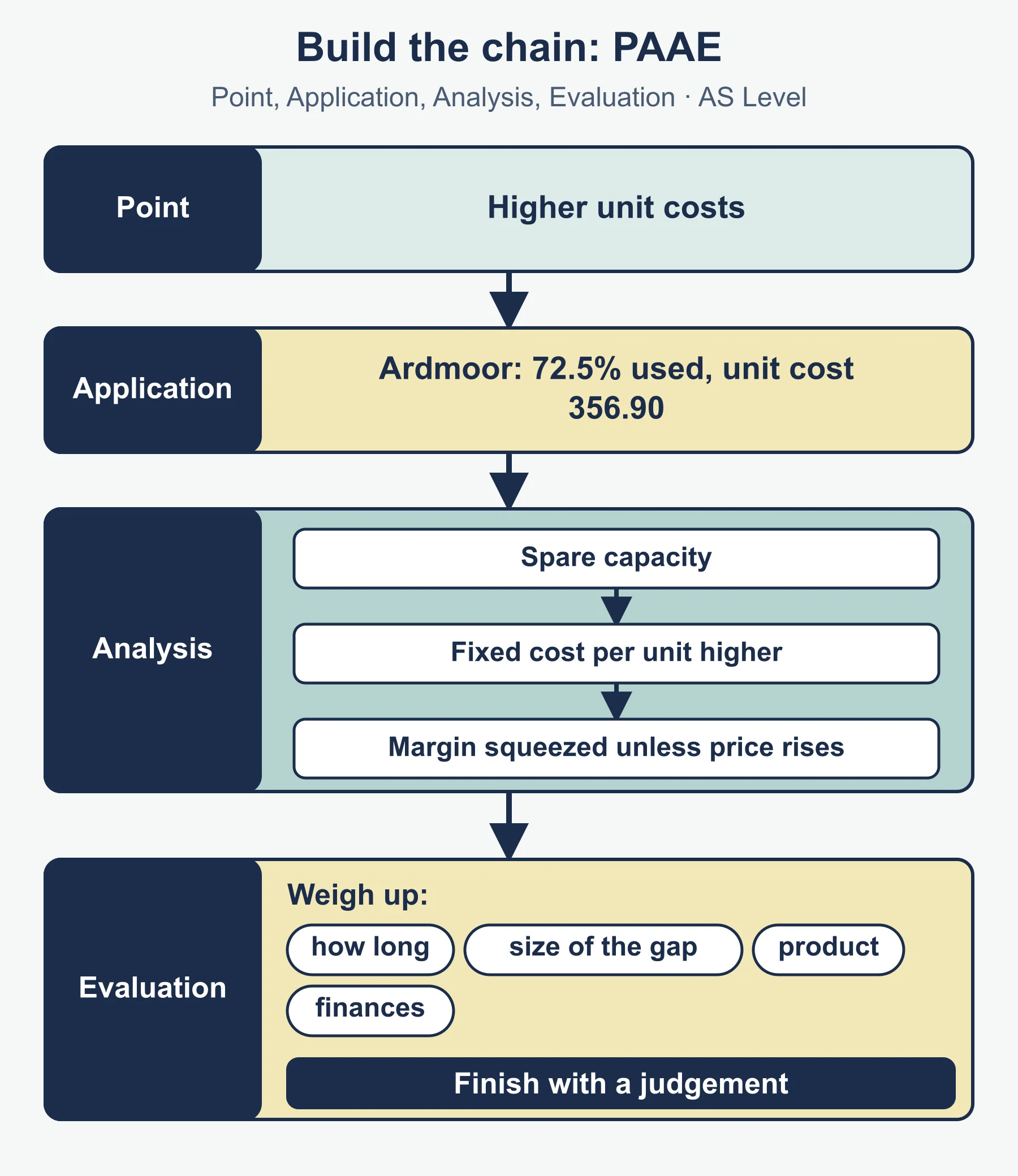
- Point: name the impact (for example, higher unit costs).
- Application: use the figures and facts in the stem.
- Analysis: show the chain (spare capacity, so fixed costs per unit are higher, so profit margins are squeezed unless prices rise).
- Evaluation: weigh it. Useful factors include how long the position lasts, how large the gap is, the nature of the product, the firm’s finances, how reliable the contractor is and whether the activity is core.
End an evaluation with a judgement that answers the question, not a summary.
Common errors
- Dividing maximum output by actual output, which reverses the ratio.
- Mixing periods or units, such as a monthly output against a yearly maximum.
- Saying unit costs fall at higher output without linking this to fixed costs.
- Treating over-capacity as only good news.
- Listing outsourcing advantages with no reference to the business.
- Calling outsourcing “cheaper” without comparing costs at the business’s actual volume.
- Confusing outsourcing with simply buying raw materials.
Next steps
Use the revision notes, then the practice set. Tick off the topic on the checklist and find weak spots with the diagnostics.
Frequently asked questions
Why do unit costs rise when capacity utilisation is low? Fixed costs such as rent, machinery and salaried staff are spread over fewer units, so the fixed cost per unit, and therefore the unit cost, is higher.
How can a business improve low capacity utilisation? It can raise output, for example through promotion, new markets or contract work for other firms, or reduce capacity by closing a line, renting out space or moving to smaller premises (rationalisation).
What is outsourcing in Cambridge AS and A Level Business 9609? Outsourcing means using another business to carry out an activity or process the firm could do itself. It is not the same as simply buying raw materials.
What are the risks of outsourcing? Less control over quality, speed and confidential information, dependence on one supplier, hidden contract and monitoring costs, and damage to the brand when the contractor gets something wrong.
Official syllabus
Cambridge International AS & A Level Business 9609 syllabus for examination in 2026, 2027 and 2028, published by Cambridge University Press & Assessment (Cambridge International Education), section 4.3 Capacity utilisation and outsourcing.
Get free revision emails (optional)
Occasional emails with practice questions, worked explanations and links to free resources for the qualification and subjects you choose. No spam, and you can unsubscribe from any email. The free tools on this site never need an email.
Related resources
-
Practice questions
A Level Business: Capacity utilisation and outsourcing (Cambridge 9609) – Practice Questions
Original practice questions with worked answers on capacity utilisation, under and over capacity, improving utilisation and outsourcing for Cambridge 9609.
Business · Cambridge · AS Level
Try questions -
Revision notes
A Level Business: Capacity utilisation and outsourcing (Cambridge 9609) – Revision Notes
Condensed revision notes for 4.3 Capacity utilisation and outsourcing in Cambridge AS & A Level Business 9609, with a self-test and common slips.
Business · Cambridge · AS Level
Revise topic -
Study guides
A Level Business: Inventory management (Cambridge 9609)
Study guide to 4.2 Inventory management in Cambridge AS & A Level Business 9609: inventory types, costs, re-order level, charts, SCM, JIT and JIC.
Business · Cambridge · AS Level
Read guide
Related articles
-
teaching
A Level tuition in Dubai: Cambridge or Pearson Edexcel International A Level?
Schools in Dubai and Abu Dhabi teach either Cambridge International AS & A Level or Pearson Edexcel International A Level. How the two are structured, why it matters for tuition, and how online classes from Lahore work.
9 October 2026
-
curriculum guides
Choosing subjects at IGCSE and A Level
How subject choices at 14 and 16 affect university options later, and how to keep pathways open without overloading a timetable.
28 July 2026
Studying this with a teacher
Working through Business AS LEVEL?
This page is free and stays free. If you would rather be taught it, Marlbridge runs Business classes one-to-one and in small groups of up to 15, online in your own time zone. The first trial class is free. WhatsApp replies within an hour (8am–11pm Pakistan time, every day); email the same day.
Cambridge Business teachers at Marlbridge

