
Revision Notes
A Level Business: Marketing strategy (Cambridge 9609) – Revision Notes
Condensed revision notes on marketing plans, coordinated strategy, IT and AI, and international marketing for Cambridge A Level Business section 8.2.
- Subject
- Business
- Level
- A LEVEL
- Topic
- Marketing
- Author
- Marlbridge Academic Team
- Updated
- Reviewed by
- Salman Ahmad (what this means)
Aligned to Cambridge A Level Business (9609), For examination in 2026, 2027 and 2028. Official specification .
Syllabus page (what it covers and how it is assessed): Cambridge A Level Business.
Syllabus points this page covers
9609 (A Level)
- 8.2 Marketing strategy
Found an error? Report a correction.
Need help with this topic? Request a free trial class for A Level Business (9609).
These notes condense section 8.2 (Marketing strategy) of the Cambridge International AS & A Level Business 9609 syllabus for examination in 2026, 2027 and 2028. Full explanations and worked examples are in the study guide. Test yourself with the practice questions and the earlier A Level marketing practice set. Also use the course hub, the printable checklist and the free diagnostics.
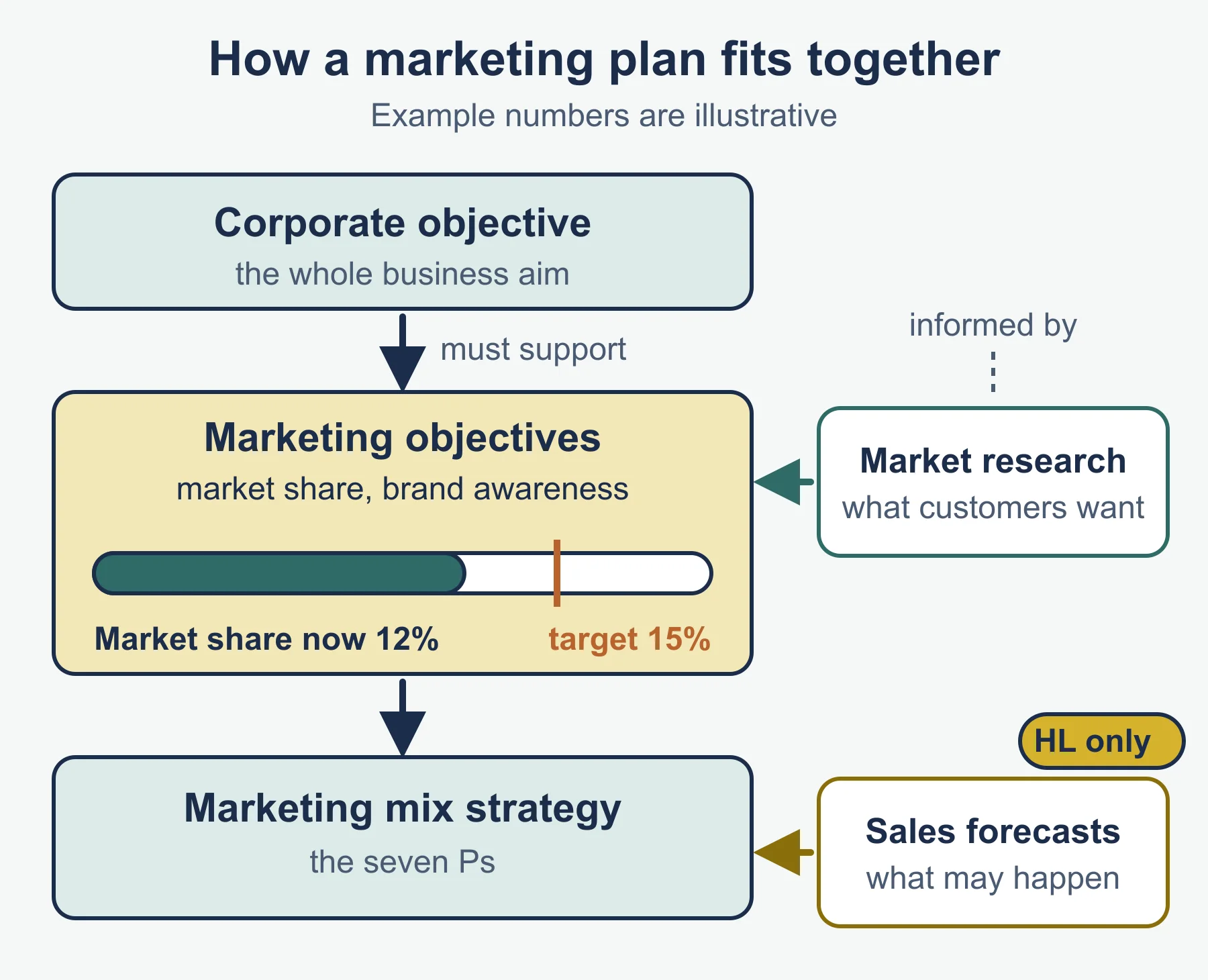
8.2.1 Marketing plan
Definition (own wording): a marketing plan is a written document setting out what the marketing function will do, with what, and why, to meet the business’s objectives.
| Content | Question it answers | Typical detail |
|---|---|---|
| Objectives | What do we want? | Market share, sales revenue, brand awareness, by a date |
| Resources | What can we spend and use? | Budget, staff, skills, equipment |
| Research | What do we know? | Customers, competitors, market size and trends |
| Marketing mix | How will we do it? | Product, price, promotion, place |
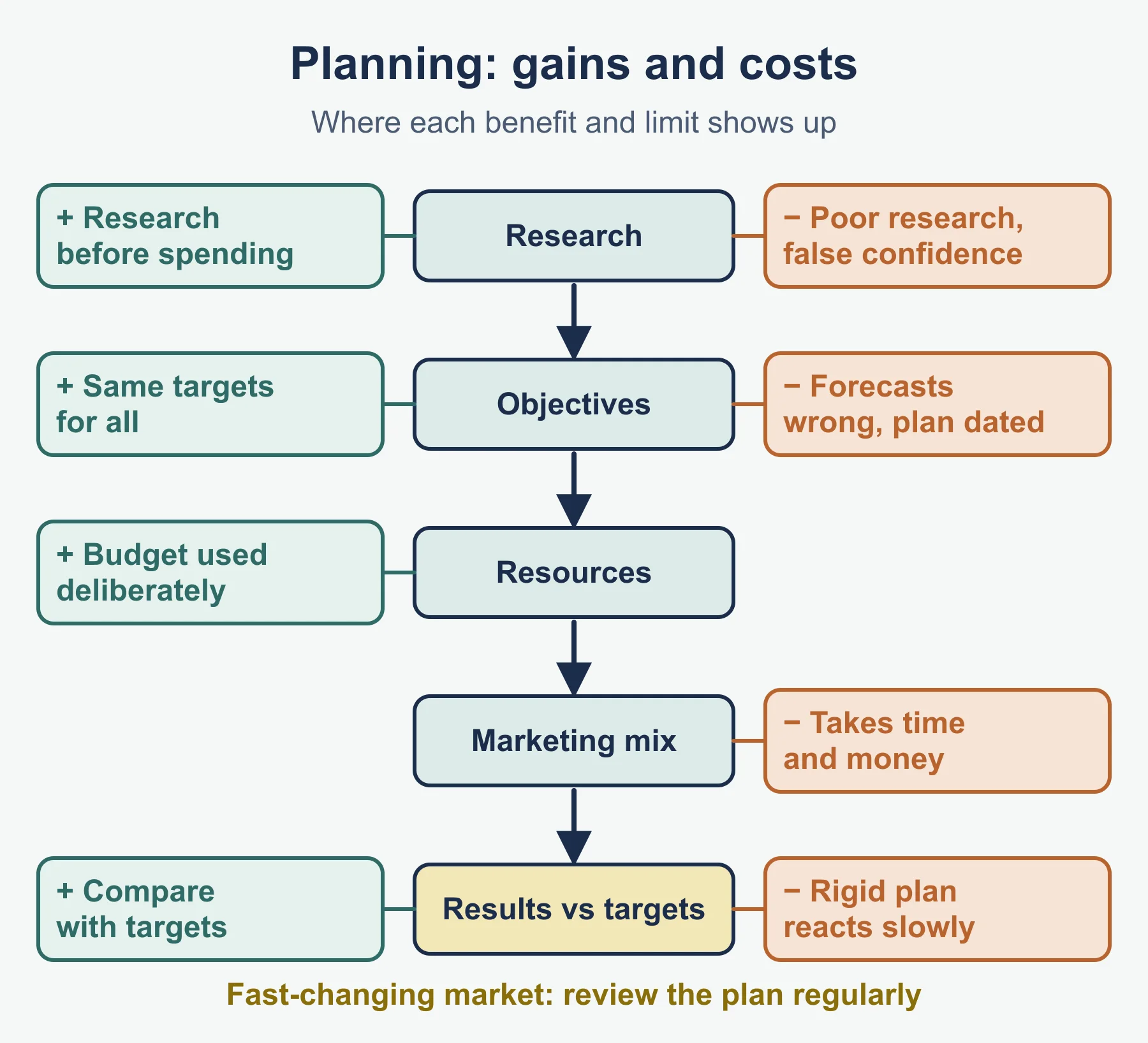
Benefits of planning: shared direction; deliberate use of money; targets to measure against; research before spending. Limitations: time and cost; forecasts may be wrong; rigid plans react slowly; poor research gives a poor plan.
Judgement prompt: how stable is the market, how big is the spend, and how often is the plan reviewed?
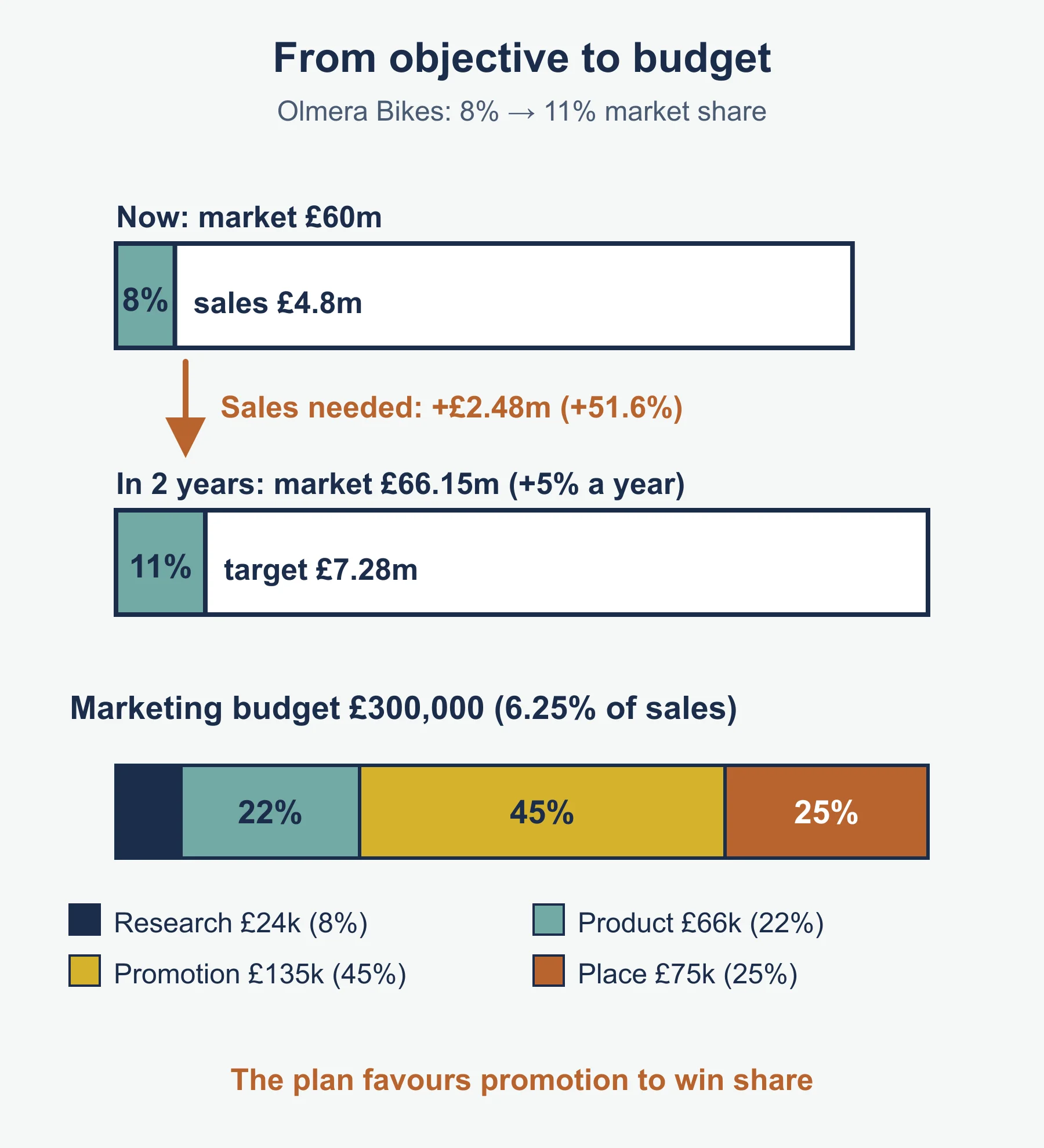
Method: turning a share objective into a sales target
- Current share = business sales ÷ market size.
- Grow the market by the forecast rate.
- Target sales = target share × new market size.
- Increase = target sales − current sales; divide by current sales for the percentage.
Reminder: Cindermere Sports has sales of £2.4m in a £30m market (8%). It wants 10% share after one year with market growth of 4%. New market = 30 × 1.04 = £31.2m. Target sales = 10% × 31.2 = £3.12m. Increase = £0.72m, which is 30% on current sales.
8.2.2 Approaches to marketing strategy
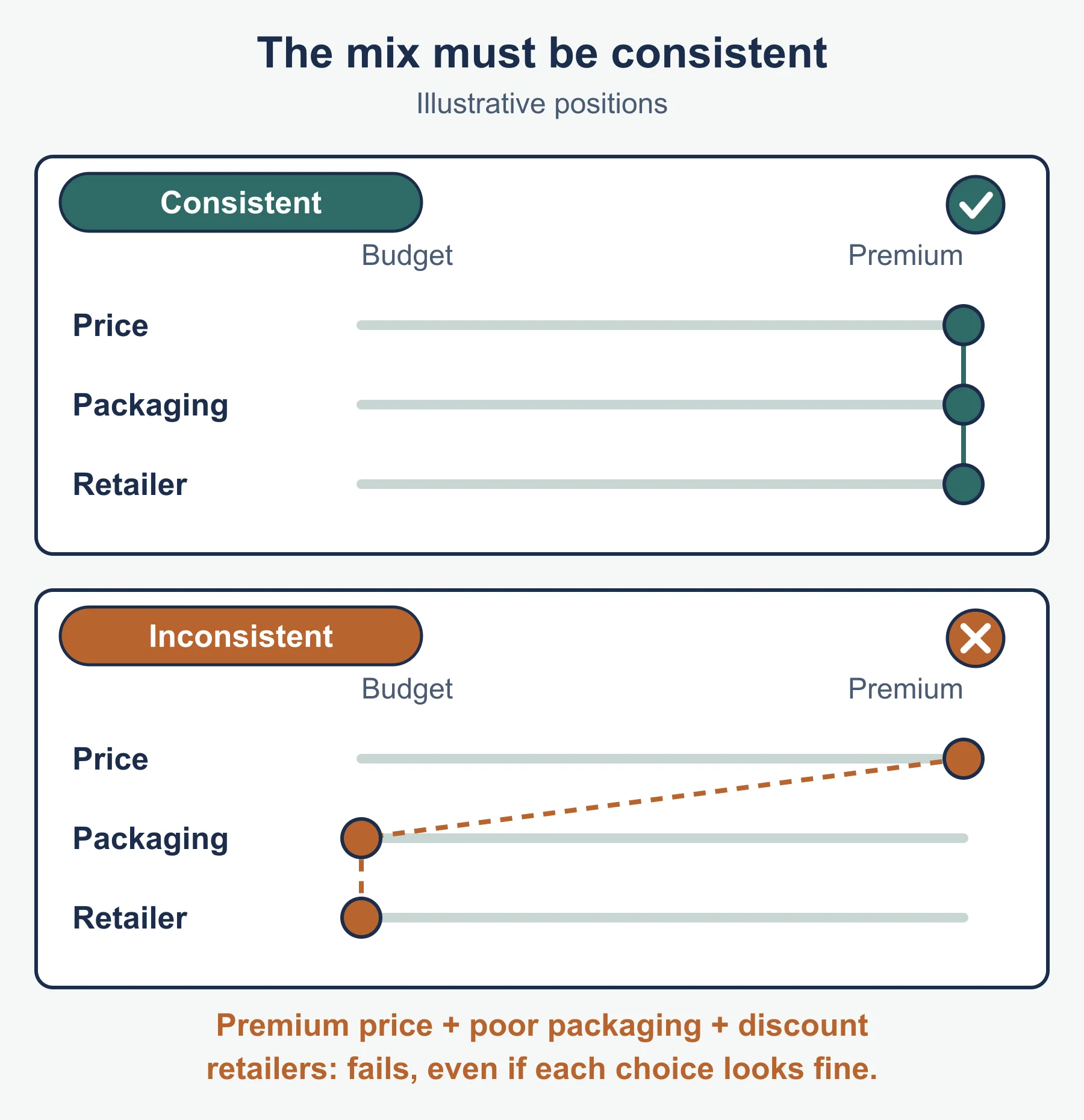
Consistency: three tests
| Test | Ask | Warning sign |
|---|---|---|
| Business | Does it fit the objectives, finance and image? | Plan needs more cash than the firm has |
| Product | Does it suit the product and its life-cycle stage? | Heavy discounting of a luxury item |
| Market | Does it fit the target segment and competitors? | Message aimed at the wrong age group |
Coordination
- All four parts of the mix send one message to one target group.
- Other functions must support it: operations (supply), finance (budget), human resources (trained staff).
- Development path: objective, research, target and position, mix, implement, monitor, adjust.
Objectives and strategies
| Objective | Fitting emphasis |
|---|---|
| Market share growth | Competitive pricing, wide distribution, strong promotion |
| Premium image | High price, selective outlets, quality messages |
| New segment | Segment research, product adaptation, targeted promotion |
| Customer retention | Loyalty schemes, service, relationship marketing |
| Mature product | Extension strategies, new uses |
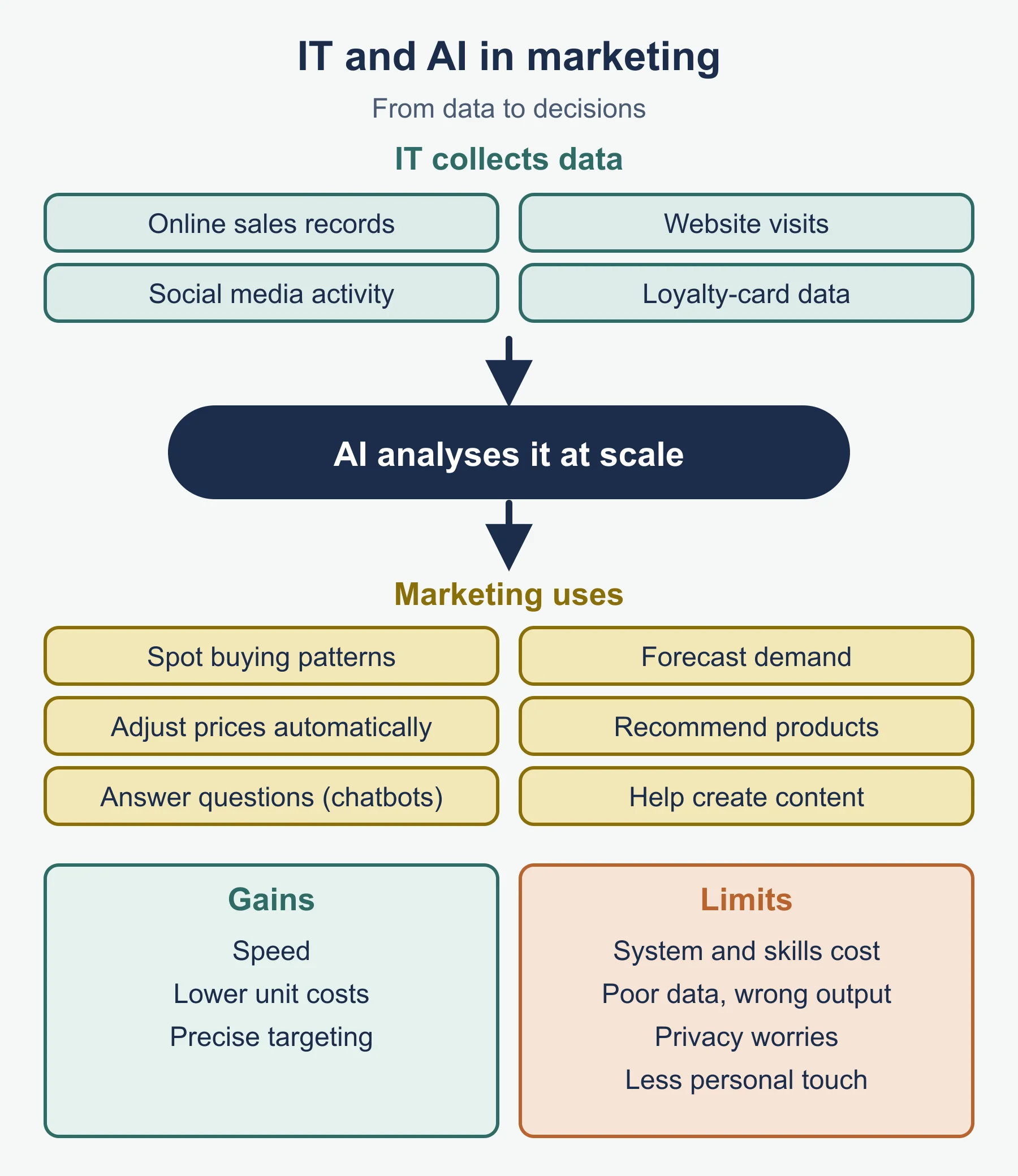
IT and AI
| Area | Role of IT | Role of AI |
|---|---|---|
| Research | Collects data from sales, websites, social media | Finds patterns in large data sets, helps forecast demand |
| Targeting | Databases, email lists | Personal recommendations and offers |
| Price | Online price comparison | Automatic price changes as demand moves |
| Promotion | Online and social media advertising | Chatbots, help creating content |
| Place | E-commerce, online ordering | Stock and delivery planning |
For: speed, precision, lower cost per customer reached. Against: set-up cost and skills, poor data gives poor results, privacy concerns, loss of personal contact. Judgement prompt: the larger and more online the business, the bigger the gain.
8.2.3 International marketing
Key ideas
| Idea | Revise this |
|---|---|
| Globalisation | Growing links between national economies through trade, investment and communication |
| Economic collaboration | Countries agreeing to trade more freely or align rules |
| Opportunities | Bigger markets, risk spread, lower average costs |
| Threats | Foreign competition at home, price comparison, exchange-rate and legal risk |
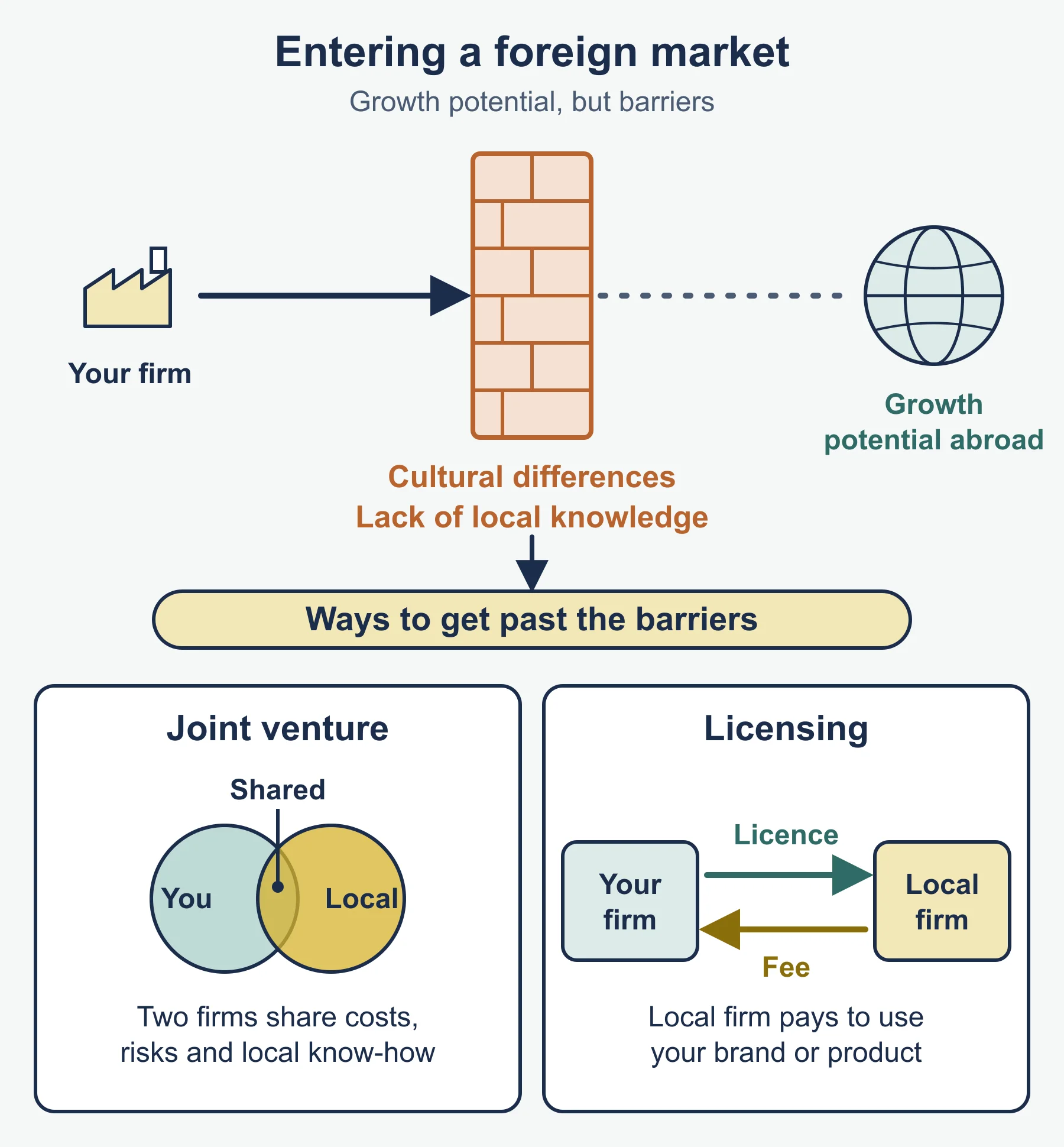
| Why go abroad | Saturated home market, faster growth elsewhere, spread of risk |
Identify, select, enter
- Identify: secondary research on size, income, growth, competition, barriers.
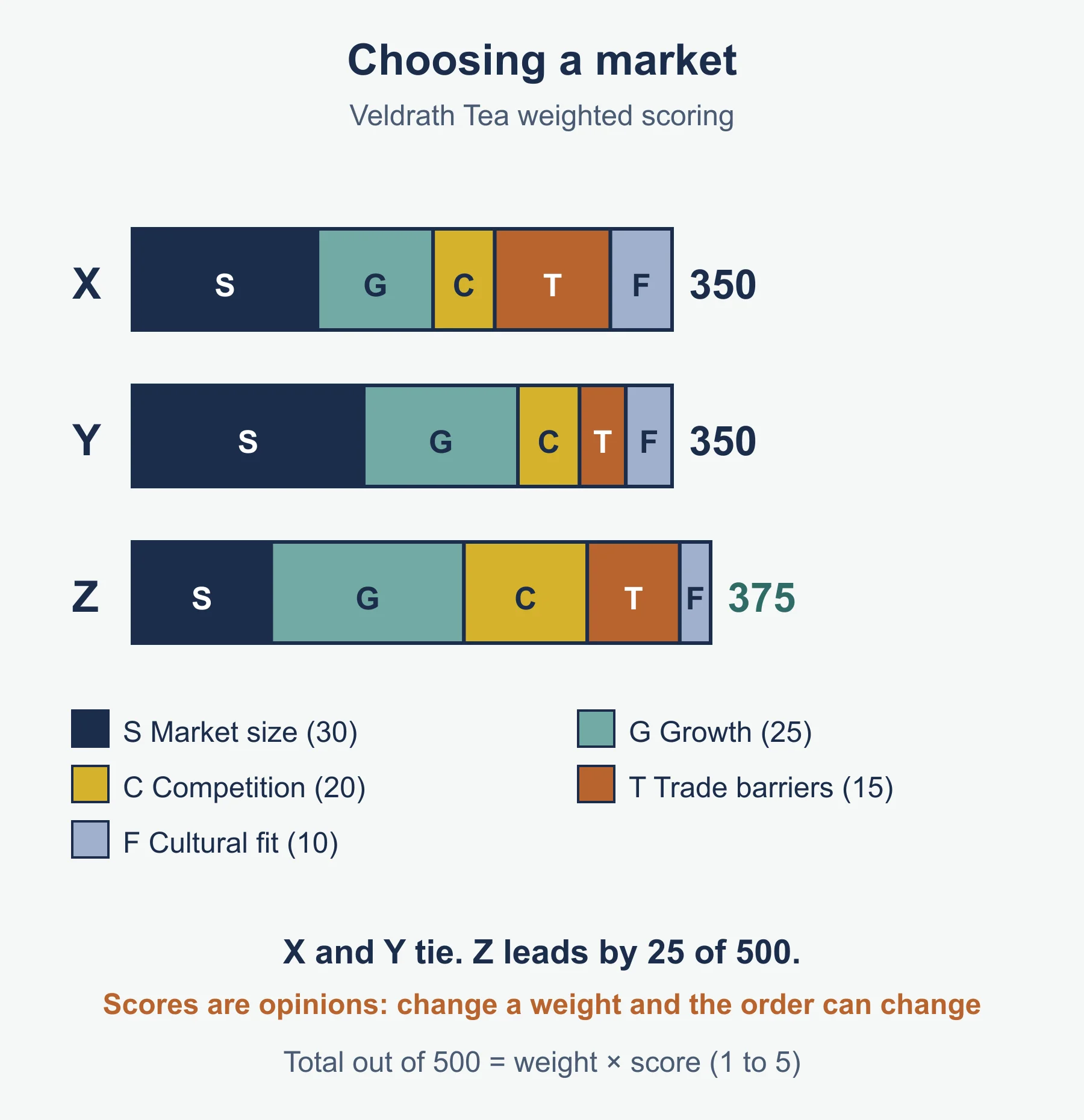
- Select: compare against weighted criteria.
- Enter: choose a method.
Method: weighted scoring
Multiply each score by its weight and add. Example: weights 40, 35, 25 for size, growth and cultural fit. Market A scores 3, 4, 5, so A = 120 + 140 + 125 = 385. Market B scores 5, 3, 2, so B = 200 + 105 + 50 = 355. A wins, but B has the larger market, so a business that values size above all might choose B. State what would change the result.
Pan-global versus local differences
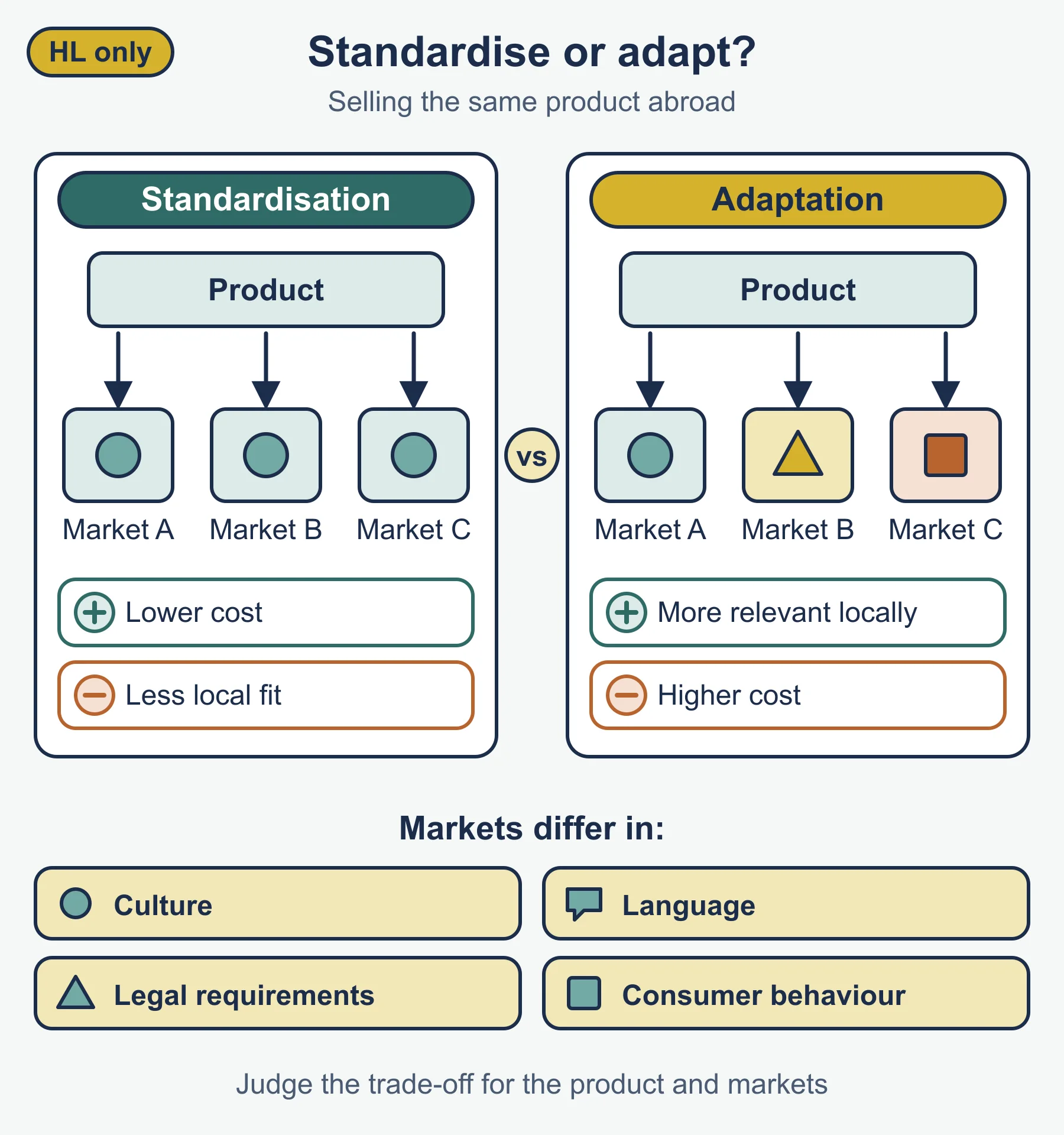
| Pan-global | Local differences | |
|---|---|---|
| Mix | Same worldwide | Adapted per market |
| Pros | Scale economies, consistent brand, cheaper promotion | Better fit, fewer cultural errors |
| Cons | May ignore tastes and rules | Higher cost, weaker global brand |
| Suits | Products with universal appeal | Culture-linked products |
A common middle path: one global brand, with some adaptation of the product or message.
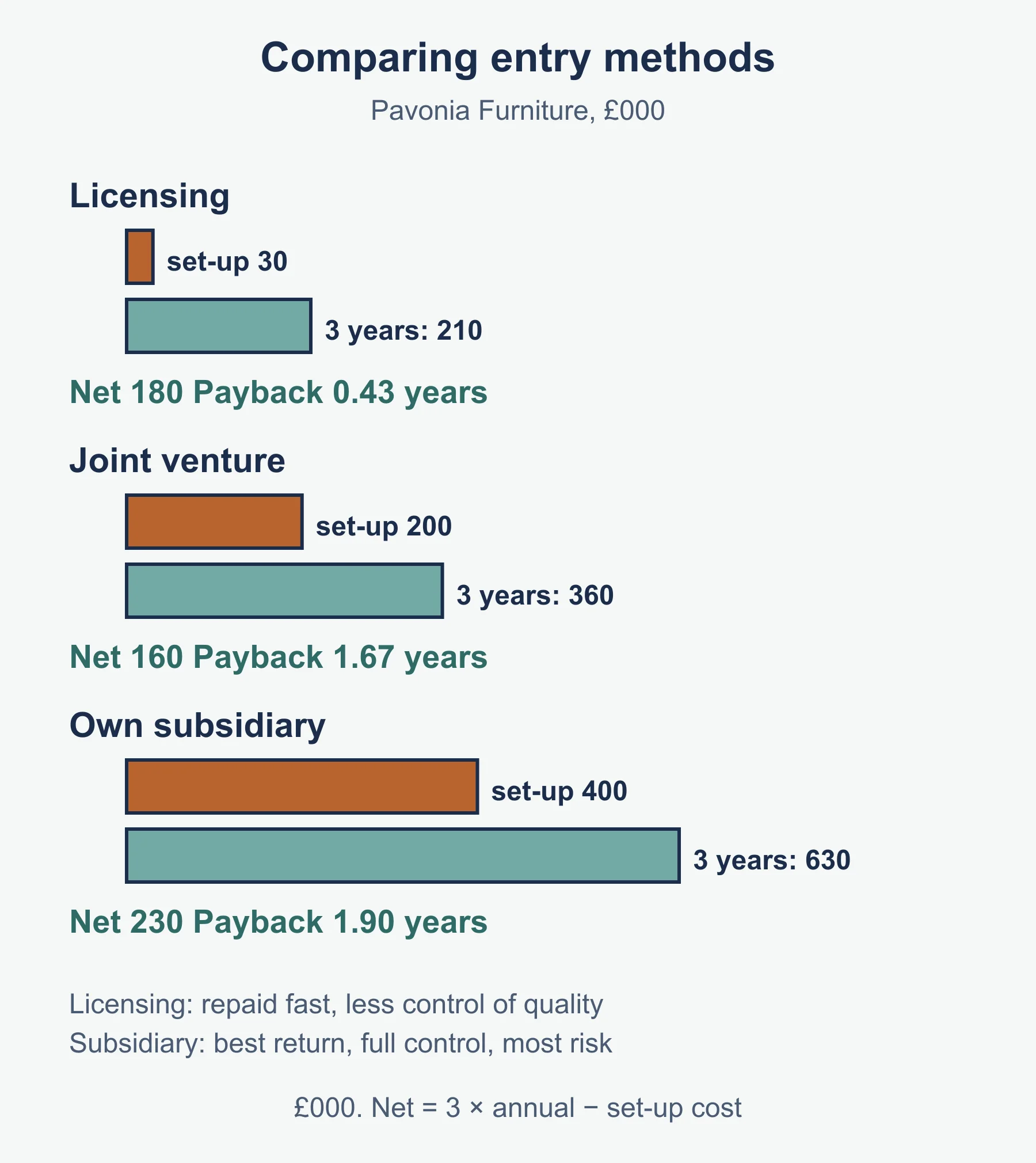
Entry method factors
Cost and finance; control wanted; risk; speed; local knowledge; barriers and legal rules; market size and potential.
| Method | Cost | Control | Risk |
|---|---|---|---|
| Exporting via an agent | Low | Low | Low |
| Licensing or franchising | Low to medium | Low to medium | Low to medium |
| Joint venture | Medium | Shared | Medium |
| Own subsidiary | High | High | High |
These are general patterns, not rules. Check the case study for exceptions.
Method: comparing two options by cost per customer
Cost per new customer = campaign cost ÷ new customers. Option 1: £90 000 for 1 500 customers = £60 each. Option 2: £60 000 for 1 200 customers = £50 each. Option 2 is cheaper per customer, but option 1 reaches more people. Weigh price against reach.
Must-know distinctions
- Marketing plan versus marketing mix. The mix is one part of the plan. The plan also holds objectives, resources and research.
- Strategy versus coordination. A strategy is the chosen route. Coordination is making every mix element, and every department, pull the same way.
- IT versus AI. IT collects, stores and moves data. AI analyses it and acts on it, for example by recommending or pricing automatically.
- Identify versus select. Identifying gives a long list of markets. Selecting narrows it using criteria.
- Selection versus entry. Choosing where to sell is separate from choosing how to get there.
Command words and case-study skills
Use the syllabus meanings. Calculate means work out from the facts given. Analyse means examine in detail and show the links between elements. Evaluate means judge quality, importance or value. Justify means support a case with evidence and argument. The syllabus says the last part of the longer Paper 3 questions, and both Paper 4 essays, should show evaluation.
- Open with the context (the product, market, size, objective).
- Make a point, develop it with a reason, apply it to the case, then weigh it.
- Finish with a judgement tied to the objective and a stated condition (“this is best if…”).
Quick self-test
- List the four contents of a marketing plan.
- Give one limitation of marketing planning.
- A firm has sales of £1.8m in a £24m market. What is its market share?
- The market in question 3 grows 5%. What sales give a 9% share? Give your answer to 3 significant figures in £m.
- Name the three things a marketing strategy must be consistent with.
- Why might a coordinated strategy fail if operations is not involved?
- State one way AI could help a marketing team.
- State one risk of using AI in marketing.
- Define pan-global marketing.
- Give two factors that influence the method of entry into an overseas market.
- A market scores 4, 5, 2 on criteria weighted 50, 30, 20. Calculate the weighted total.
- Why might a food business keep local differences?
Answers
- Objectives, resources, research, marketing mix.
- Any one: costly and time-consuming; forecasts may be wrong; can be rigid; poor research weakens it.
- 1.8 ÷ 24 = 7.5%.
- Market = 24 × 1.05 = £25.2m. Target = 9% × 25.2 = £2.268m, which is £2.27m to 3 significant figures.
- The business, the product and the market.
- The marketing may promise products, volumes or delivery times that operations cannot supply, damaging customer trust.
- For example, analysing customer data to recommend products to individuals, or forecasting demand.
- For example, privacy concerns, errors from poor data, or high set-up cost.
- Using the same product, brand and marketing message in every country.
- Any two from: cost, control, risk, speed, local knowledge, barriers, market size.
- (4 × 50) + (5 × 30) + (2 × 20) = 200 + 150 + 40 = 390.
- Tastes, diets, religion and culture differ between countries, so a standard product may not sell.
Where marks are usually lost
- Listing the marketing mix and calling it the whole plan.
- Giving general benefits of planning with no link to the business in the case.
- Using the wrong base in a percentage: share is sales divided by the market, not by last year’s sales.
- Forgetting to grow the market before applying the target share.
- Praising IT and AI without a limitation, or the reverse.
- Describing pan-global and local approaches without choosing one for the case.
- Calling a weighted-scoring winner “best” with no comment on weights.
- Recommending an entry method without referring to cost, control or risk in the case.
Frequently asked questions
What is the difference between a marketing plan and the marketing mix? The marketing mix is only one part of the plan. A marketing plan also sets out the objectives, the resources available and the research the decisions are based on.
What is the difference between IT and AI in marketing? IT collects, stores and moves data, for example through databases and e-commerce. AI analyses that data and acts on it, for example by making personal recommendations or changing prices automatically as demand moves.
What is pan-global marketing? Pan-global marketing uses the same product, brand and marketing message in every country. It gives economies of scale and a consistent brand but may ignore local tastes and rules.
What factors affect how a business enters an overseas market? Cost and the finance available, the control wanted, risk, speed, local knowledge needed, trade barriers and legal rules, and the size of the market.
Official syllabus
Cambridge International AS & A Level Business 9609 syllabus for examination in 2026, 2027 and 2028, published by Cambridge Assessment International Education: section 8.2 (Marketing strategy).
Get free revision emails (optional)
Occasional emails with practice questions, worked explanations and links to free resources for the qualification and subjects you choose. No spam, and you can unsubscribe from any email. The free tools on this site never need an email.
Related resources
-
Study guides
A Level Business: The marketing mix (Cambridge 9609)
A full study guide to section 3.3 The marketing mix for Cambridge AS & A Level Business 9609: product, portfolio analysis, pricing, promotion and place.
Business · Cambridge · AS Level
Read guide -
Practice questions
A Level Business: The marketing mix (Cambridge 9609) – Practice Questions
Original practice questions with worked answers on 3.3 The marketing mix for Cambridge AS & A Level Business 9609: short answer, calculation, case study.
Business · Cambridge · AS Level
Try questions -
Revision notes
A Level Business: The marketing mix (Cambridge 9609) – Revision Notes
Condensed revision notes for section 3.3 The marketing mix in Cambridge AS & A Level Business 9609, with a quick self-test and common mark losses.
Business · Cambridge · AS Level
Revise topic
Related articles
-
teaching
A Level tuition in Dubai: Cambridge or Pearson Edexcel International A Level?
Schools in Dubai and Abu Dhabi teach either Cambridge International AS & A Level or Pearson Edexcel International A Level. How the two are structured, why it matters for tuition, and how online classes from Lahore work.
9 October 2026
-
curriculum guides
Choosing subjects at IGCSE and A Level
How subject choices at 14 and 16 affect university options later, and how to keep pathways open without overloading a timetable.
28 July 2026
Studying this with a teacher
Working through Business A LEVEL?
This page is free and stays free. If you would rather be taught it, Marlbridge runs Business classes one-to-one and in small groups of up to 15, online in your own time zone. The first trial class is free. WhatsApp replies within an hour (8am–11pm Pakistan time, every day); email the same day.
Cambridge Business teachers at Marlbridge

