
Study Guides
A Level Business: Marketing strategy (Cambridge 9609)
Study guide to marketing plans, coordinated strategy, IT and AI in marketing and international marketing, for Cambridge A Level Business, section 8.2.
- Subject
- Business
- Level
- A LEVEL
- Topic
- Marketing
- Author
- Marlbridge Academic Team
- Updated
- Reviewed by
- Salman Ahmad (what this means)
Aligned to Cambridge A Level Business (9609), For examination in 2026, 2027 and 2028. Official specification .
Syllabus page (what it covers and how it is assessed): Cambridge A Level Business.
Syllabus points this page covers
9609 (A Level)
- 8.2 Marketing strategy
Found an error? Report a correction.
Need help with this topic? Request a free trial class for A Level Business (9609).
This guide covers section 8.2 (Marketing strategy) of the Cambridge International AS & A Level Business 9609 syllabus for examination in 2026, 2027 and 2028. It is A Level content, so it sits under topic 8 (Marketing). The syllabus says the A Level papers that assess it, Paper 3 and Paper 4, are case-study based and that AS content is assumed knowledge. Build on the AS marketing mix first: see the marketing mix guide and the nature of marketing and market research guide. Related pages: revision notes, practice questions, the earlier A Level marketing practice set, the course hub, the printable checklist and the free diagnostics.
What 8.2 covers
| Syllabus point | What you must be able to do |
|---|---|
| 8.2.1 Planning the marketing strategy | Describe the contents of a marketing plan (objectives, resources, research, marketing mix); judge the benefits and limitations of marketing planning |
| 8.2.2 Approaches to marketing strategy | Show why a strategy must be consistent with the business, the product and the market; explain the need for and development of a coordinated strategy; link strategy to specific marketing objectives; assess the changing role of IT and AI |
| 8.2.3 Strategies for international marketing | Explain globalisation and economic collaboration; explain why international marketing matters; identify, select and enter markets; choose between pan-global marketing and local differences; choose a strategy for a global market; judge the factors behind the entry method |
8.2.1 The marketing plan
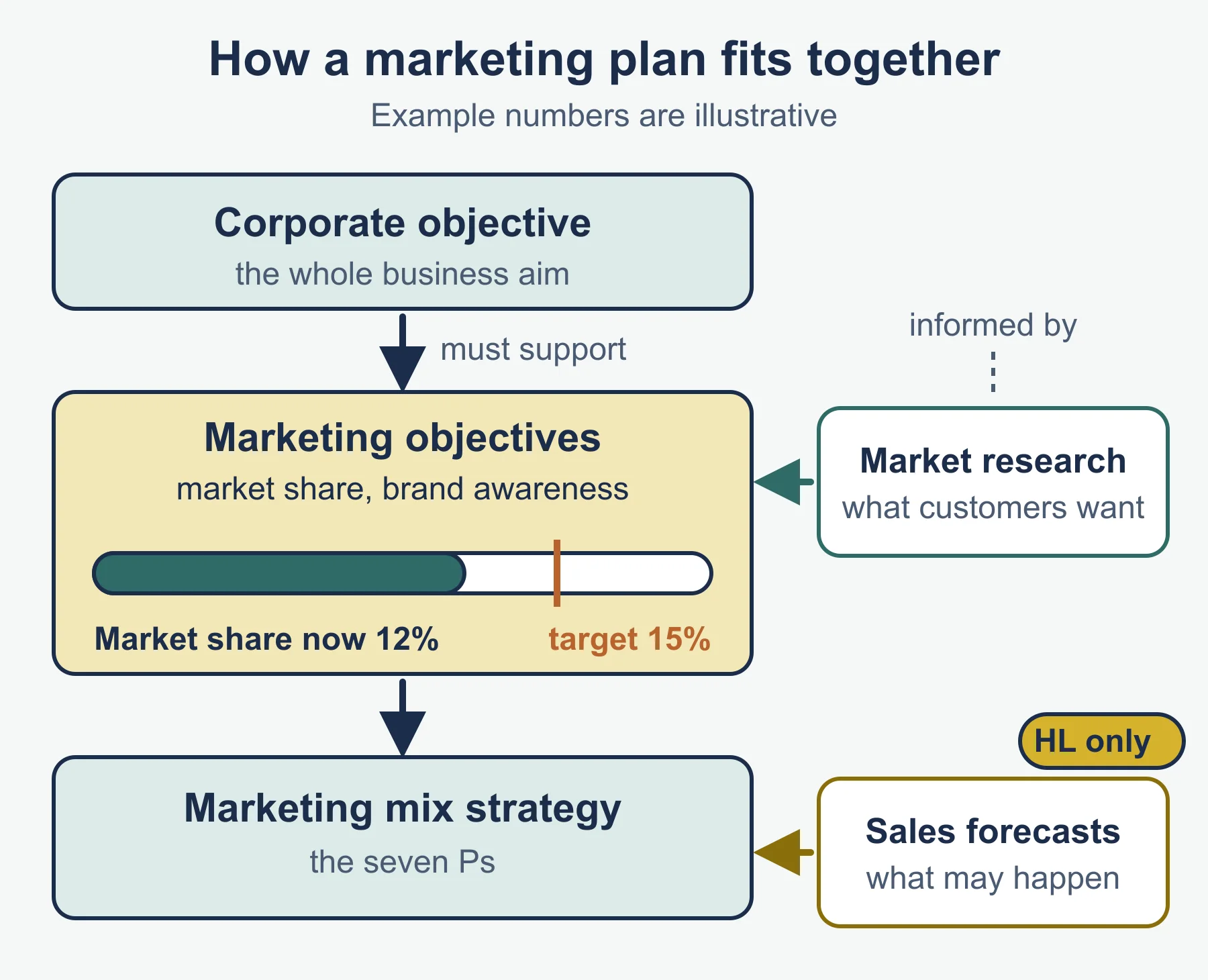
A marketing plan is the written route from where the business is to where it wants its marketing to be. The syllabus describes it as covering the whole process of marketing, not just the marketing mix. It has four listed contents.
- Objectives. Specific, measurable aims that follow from the corporate objectives, such as a target market share by a date.
- Resources. The budget, staff time, equipment and skills available. This stops the plan promising more than the business can pay for.
- Research. Evidence about customers, competitors and the market (primary and secondary research) that justifies the objectives and choices.
- Marketing mix. The product, price, promotion and place decisions that will deliver the objectives within the resources.
The order matters. Research tells you what is realistic, objectives set the target, resources set the limit, and the mix is the action.
Worked example: a plan with a numerical objective
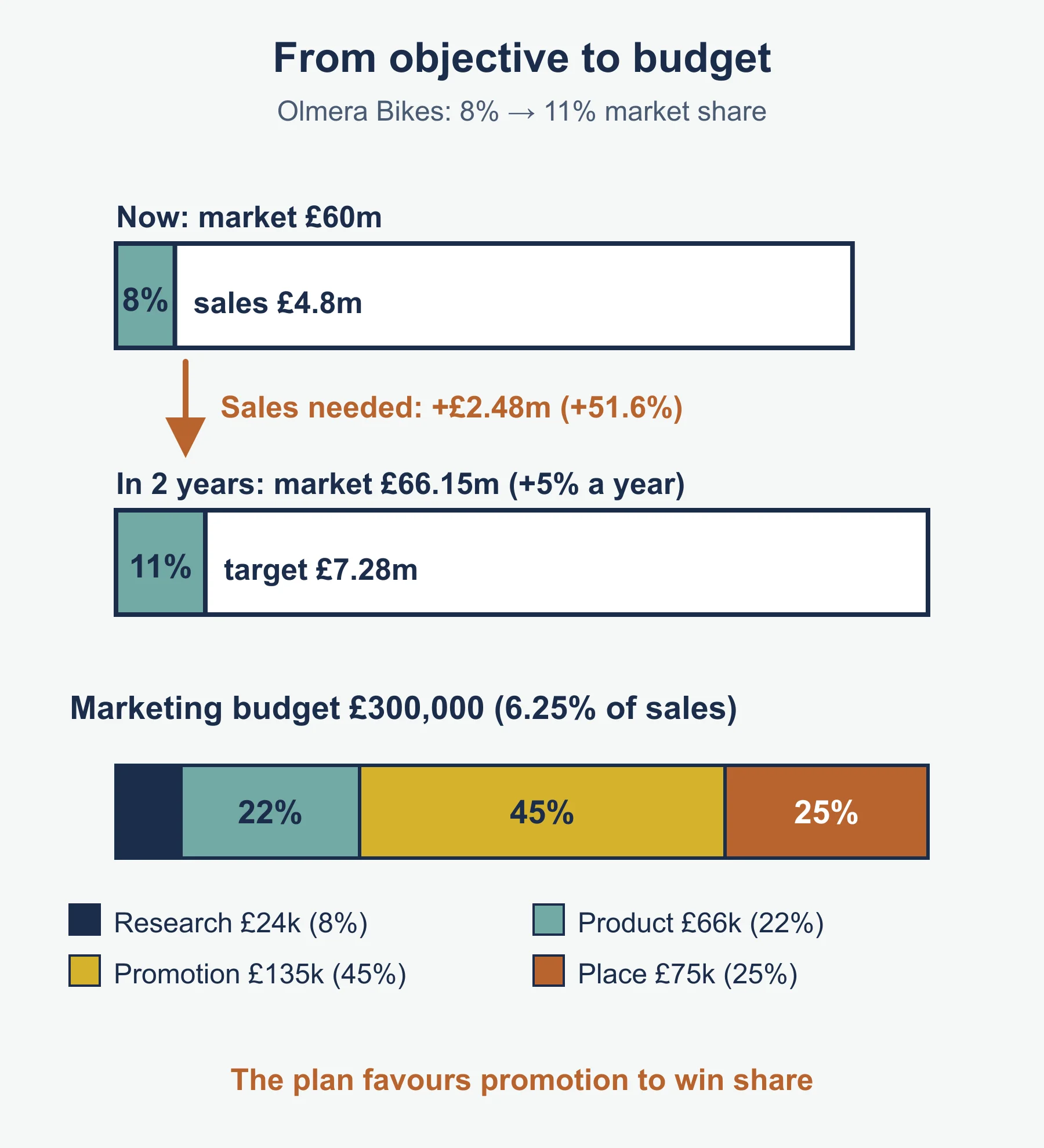
Olmera Bikes has sales revenue of £4.8m in a market worth £60m. Its objective is 11% market share in two years. The market is forecast to grow by 5% a year.
- Current share = 4.8 ÷ 60 = 8%.
- Market in two years = 60 × 1.05 × 1.05 = £66.15m.
- Target sales revenue = 11% × 66.15 = £7.2765m, about £7.28m.
- Increase needed = 7.2765 − 4.8 = £2.4765m, about £2.48m, which is 51.6% above current sales.
Resources: the annual marketing budget is £300 000, which is 6.25% of current sales (300 ÷ 4 800). The plan splits it into research £24 000 (8%), product £66 000 (22%), promotion £135 000 (45%) and place £75 000 (25%). The split shows the plan favouring promotion to win share. A 51.6% rise is a large objective, so an evaluation point is whether a budget of this size can deliver it.
Benefits and limitations of marketing planning
| Benefits | Limitations |
|---|---|
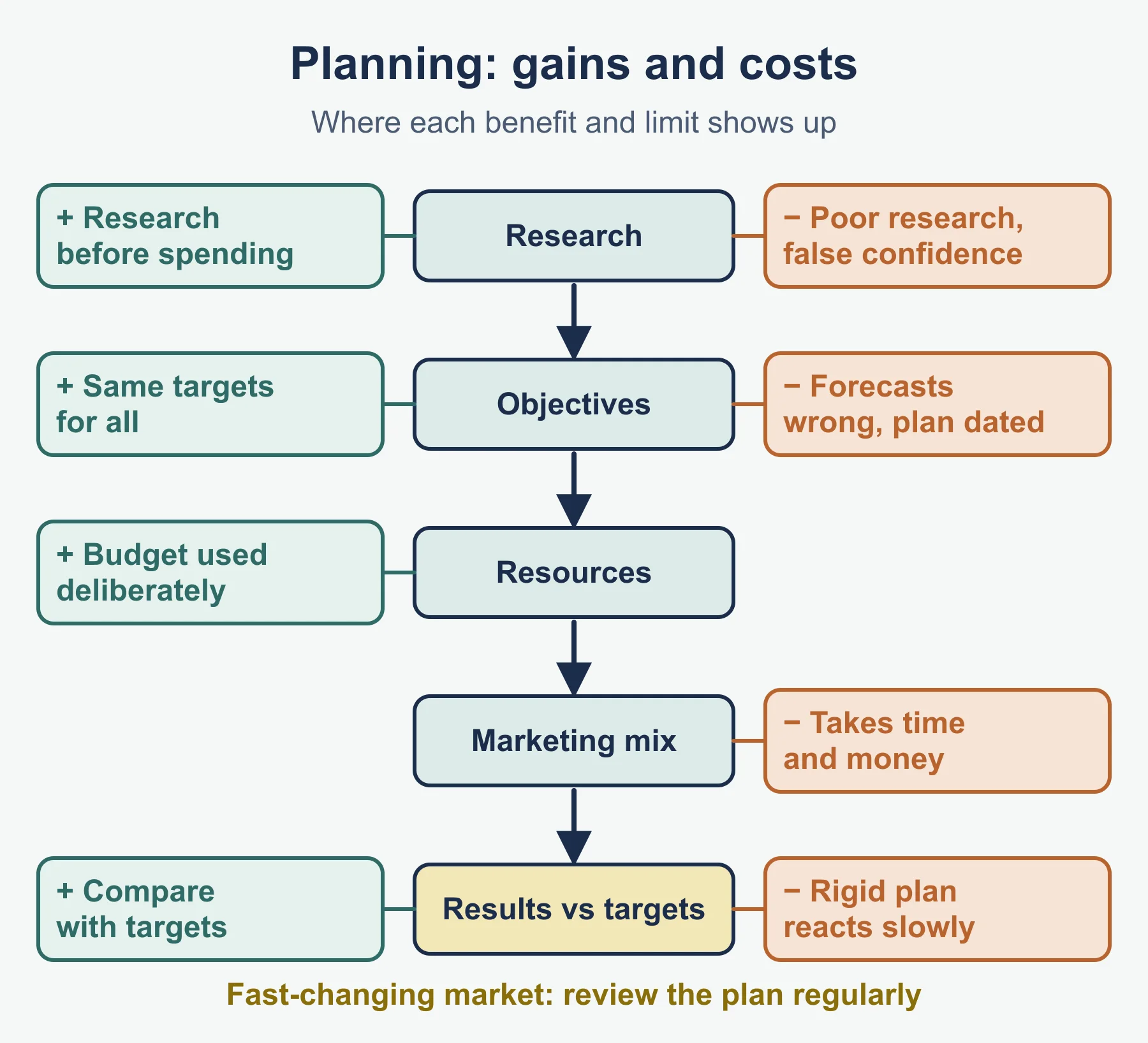
| Gives every department the same targets | Takes time and money to produce |
| Makes the use of the budget deliberate | Forecasts can be wrong, so the plan may be out of date |
| Allows results to be compared with targets | Can make a business slow to react if followed too rigidly |
| Forces the business to research before it spends | A plan built on poor research gives false confidence |
Judgement: planning is most valuable when the market is fairly stable and spending is large. In a fast-changing market the plan needs regular review.
8.2.2 Approaches to marketing strategy
Consistency with the business, the product and the market
A strategy works when three things fit.
- The business. The strategy must match its objectives, size, finance and image. A small business with limited cash cannot copy a national television campaign.
- The product. A luxury product with a high price suits selective distribution and quality-led promotion, not heavy discounting. A product late in its life cycle needs a different approach from a new launch.
- The market. Segments, competitors, customer attitudes and the state of the economy shape what will work.
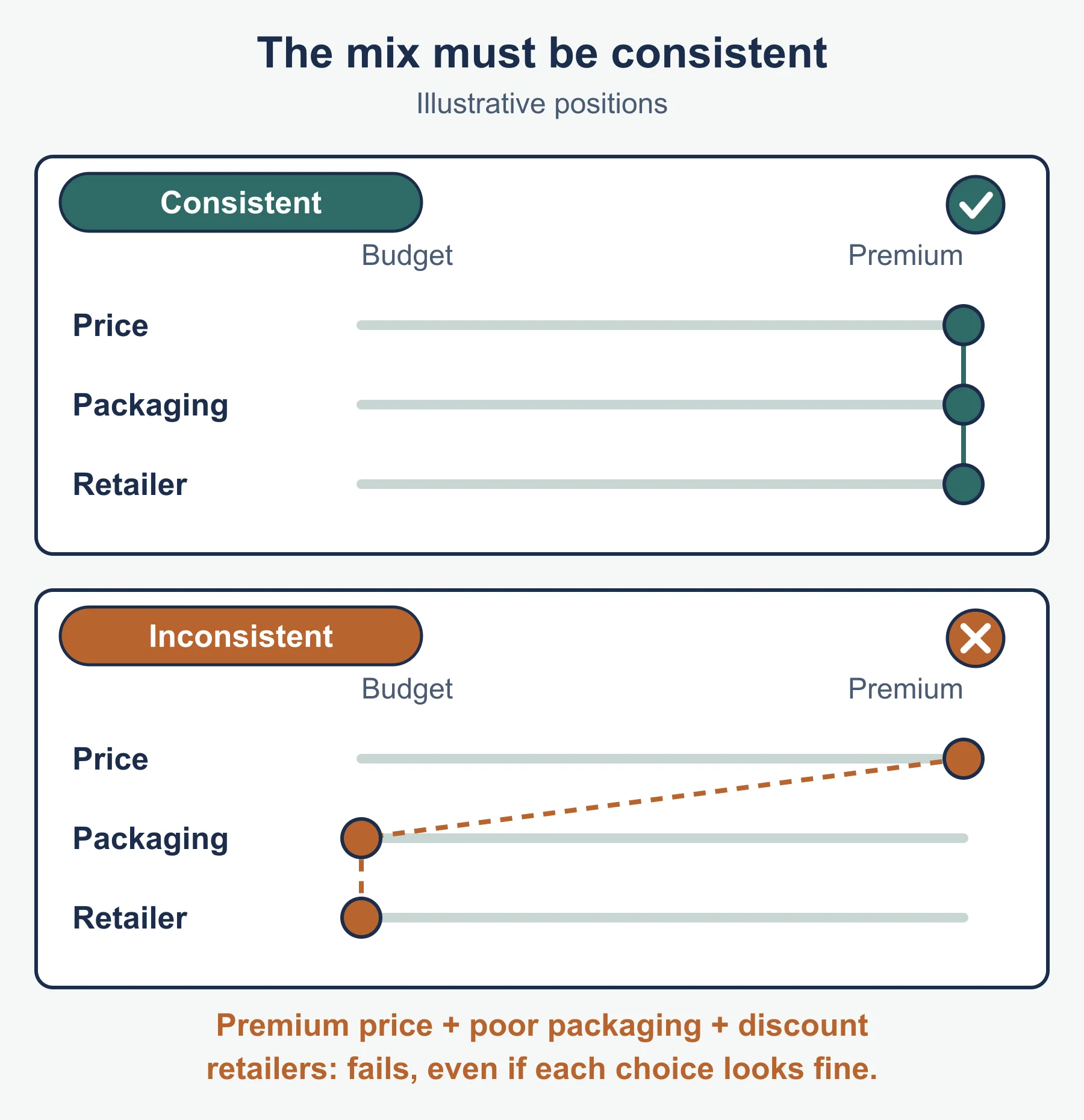
A mismatch shows up as wasted spend. For example, a budget-priced product promoted as exclusive confuses customers.
A coordinated strategy
A coordinated strategy means the four parts of the marketing mix, and the other functions, support one clear message. If the product is premium, the price, packaging, promotion and retailers should all say premium. It needs developing over time: set the objective, research, choose the target segment and position, design the mix, implement, then monitor and adjust. Coordination also covers the other departments. Operations must be able to supply what the campaign promises, finance must release the budget, and human resources must supply trained staff.
Strategies focused on specific marketing objectives
Different objectives call for different emphasis.
| Objective | Strategy likely to fit |
|---|---|
| Raise market share quickly | Penetration pricing, wide distribution, strong promotion |
| Protect a premium image | Selective distribution, high price, quality-based promotion, limited discounting |
| Enter a new segment | Research the segment, adapt the product, targeted promotion |
| Retain customers | Customer relationship marketing, loyalty schemes, after-sales service |
| Increase sales of a mature product | Extension strategies, new uses, new promotional message |
In a case study, quote the objective first, then show which parts of the mix serve it and which do not.
The changing role of IT and AI in marketing
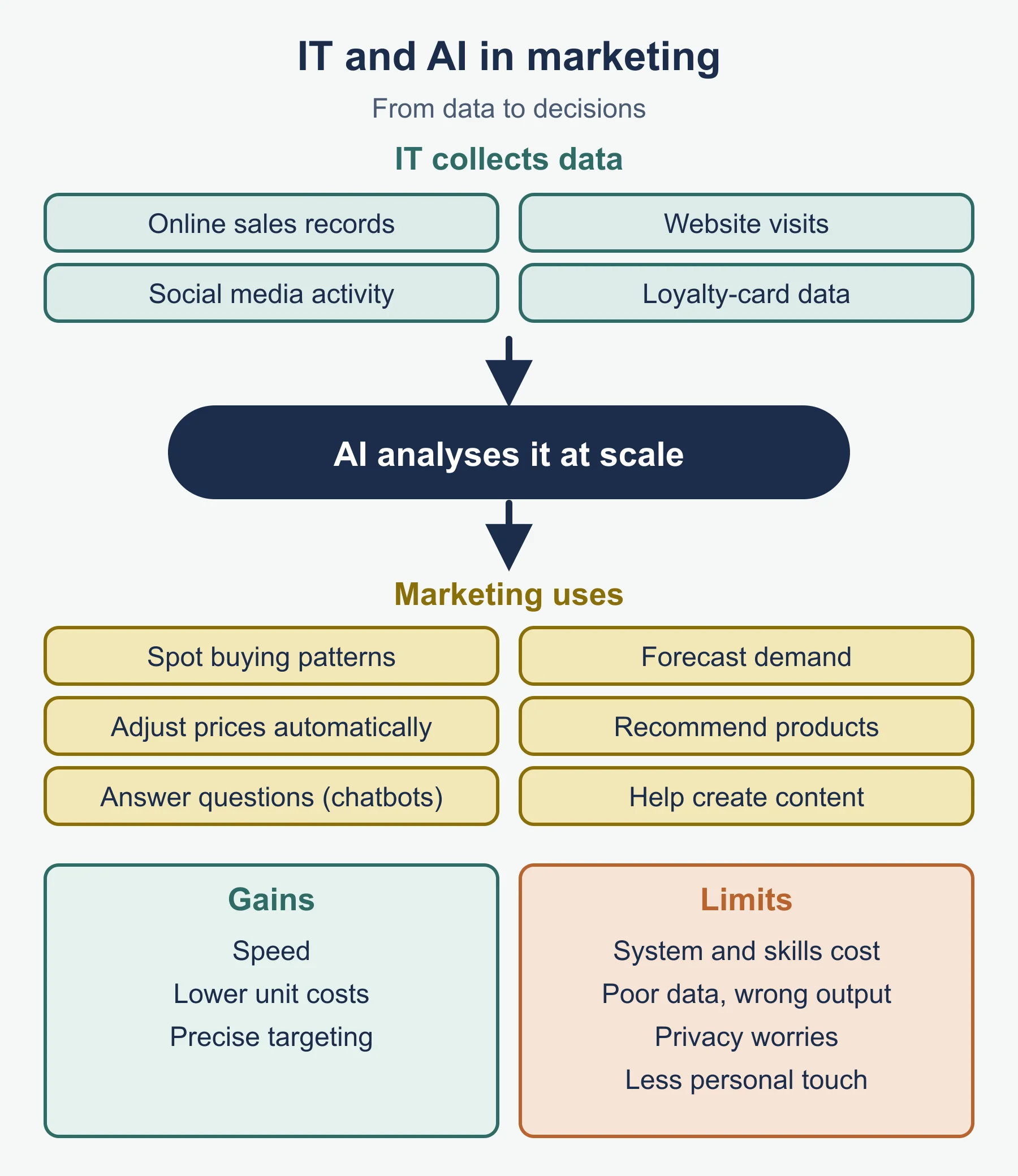
Information technology lets a business gather and use data on a large scale: online sales records, website visits, social media activity, customer databases and loyalty-card data. This supports research, segmentation and personalised promotion, and it makes e-commerce and online distribution possible.
Artificial intelligence goes further. It can analyse large data sets to spot buying patterns, forecast demand, adjust prices automatically, recommend products to individual customers, answer customer questions through chatbots and help to create promotional content. Benefits include speed, lower unit costs and more precise targeting. Limitations include the cost of systems and skills, errors if the data is poor, customer concern about privacy and loss of the personal touch. Evaluate by size and market: a small local business may gain little, whereas an online retailer with millions of transactions may gain a great deal.
8.2.3 International marketing
Globalisation and economic collaboration
Globalisation is the growing connection of national economies through trade, investment, communication and the movement of people. Economic collaboration means countries agreeing to trade more freely, for example by lowering tariffs or aligning rules in a trading group. Implications for marketing:
- Opportunities. Larger potential markets, more suppliers, and the chance to spread risk across countries.
- Threats. Foreign rivals can enter the home market, and customers can compare prices worldwide.
- Decisions. Businesses must research unfamiliar customers, and decide whether to standardise or adapt the mix.
Why international marketing matters
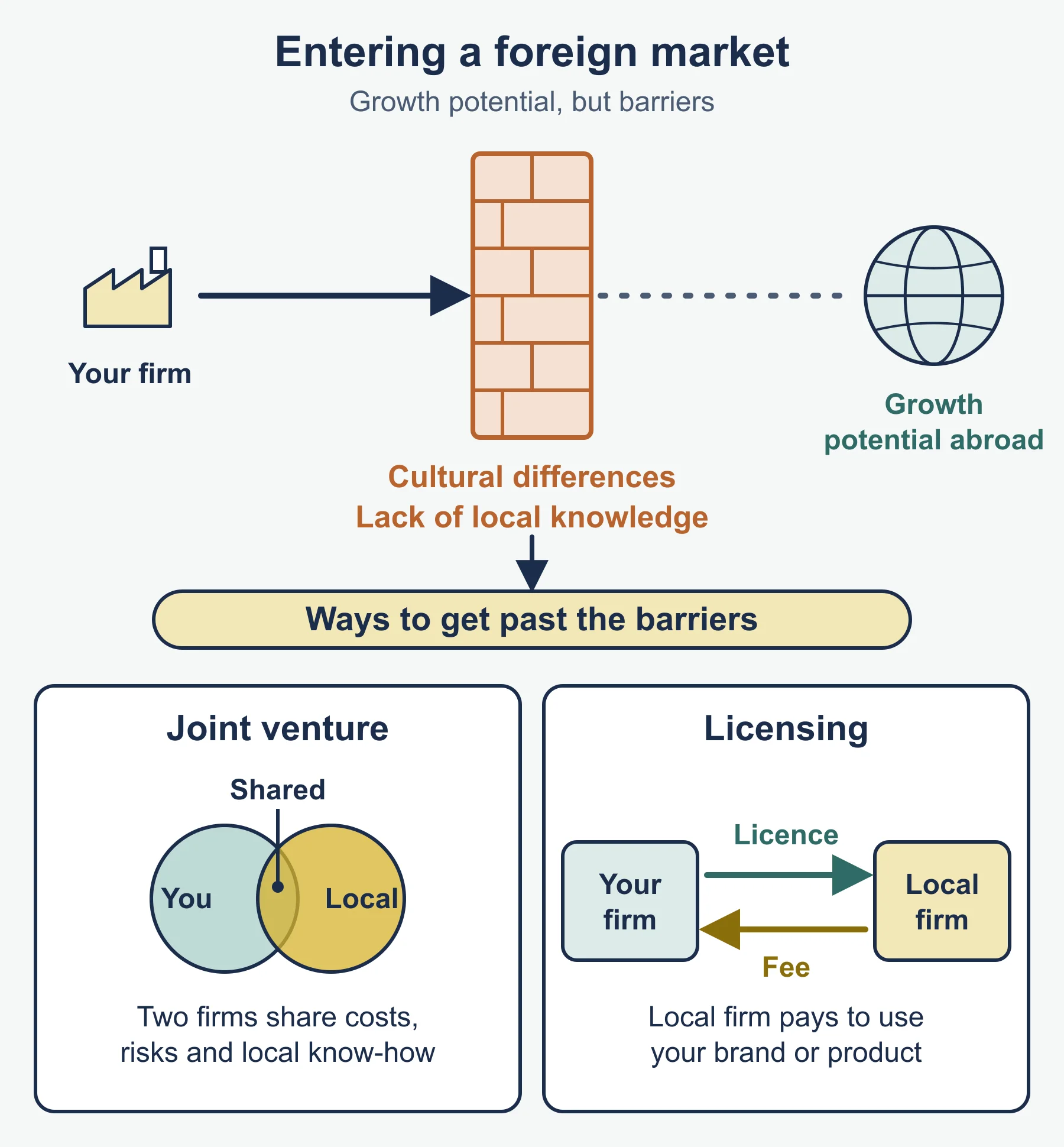
Reasons include: the home market is saturated or small; growth may be faster abroad; spreading sales across markets reduces dependence on one economy; more output can reduce average costs; and a product at the end of its life cycle at home may still be new elsewhere. Risks include exchange-rate changes, unfamiliar regulations, high start-up costs and cultural misjudgement.
Identifying, selecting and entering markets
- Identify possible markets using secondary research on population, income, growth, competition and trade barriers.
- Select by comparing them against criteria. A weighted scoring table makes the judgement visible.
- Enter using a method that suits the business and the market.
Worked example: selecting a market
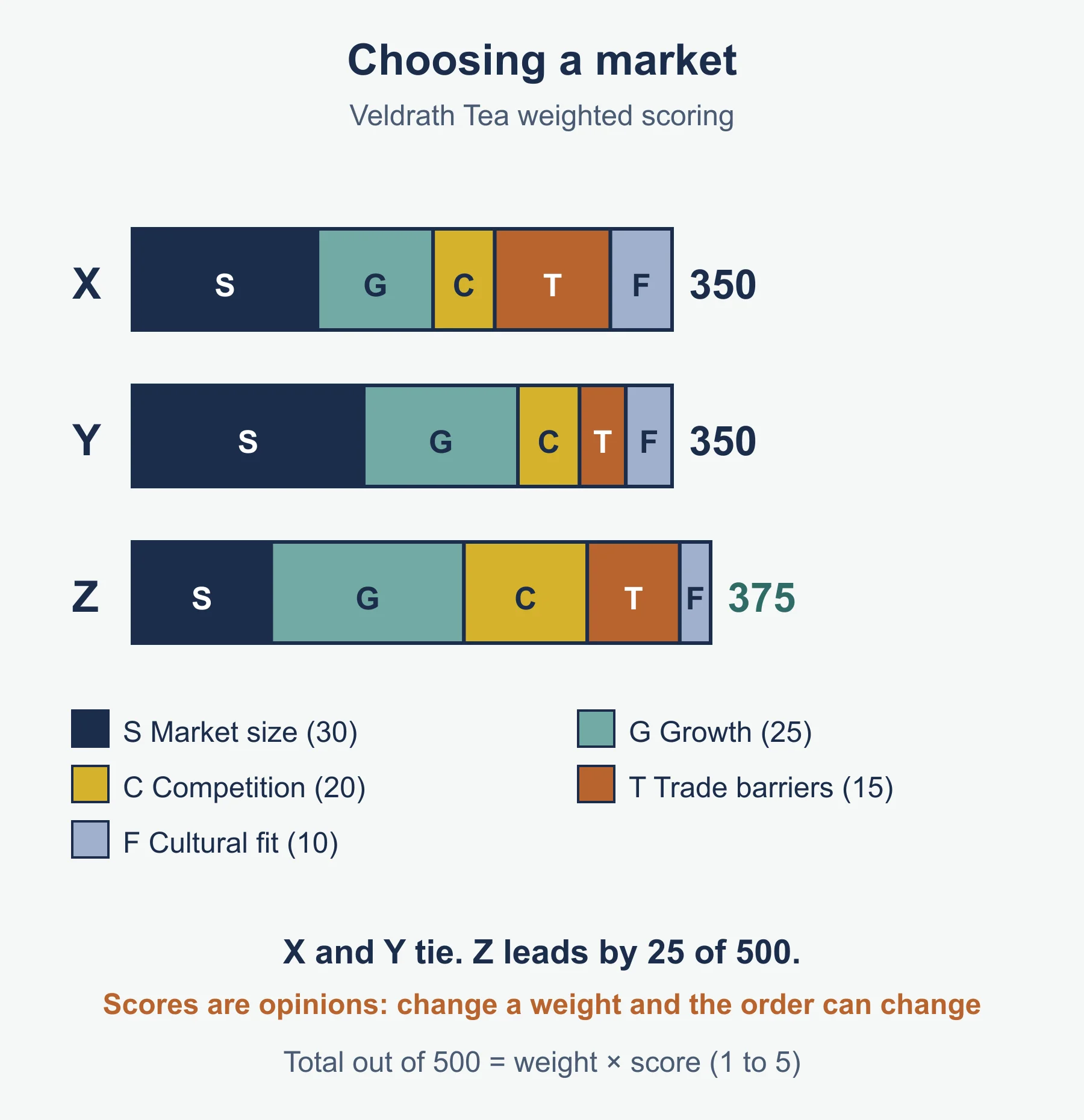
Veldrath Tea compares three markets. Each criterion has a weight out of 100, and each market is scored from 1 (poor) to 5 (excellent). For competition and trade barriers, a high score means weaker competition and fewer barriers.
| Criterion | Weight | Market X | Market Y | Market Z |
|---|---|---|---|---|
| Market size | 30 | 4 | 5 | 3 |
| Growth | 25 | 3 | 4 | 5 |
| Competition | 20 | 2 | 2 | 4 |
| Trade barriers | 15 | 5 | 2 | 4 |
| Cultural fit | 10 | 4 | 3 | 2 |
Weighted totals (out of 500): X = 120 + 75 + 40 + 75 + 40 = 350. Y = 150 + 100 + 40 + 30 + 30 = 350. Z = 90 + 125 + 80 + 60 + 20 = 375. Market Z scores highest. Two markets tie, so a judgement is needed, and Z’s lead depends on the weights and on scores that are themselves opinions. If cultural fit mattered more, Z would fall back. Present the table as an aid to decision, not as proof.
Pan-global marketing or local differences
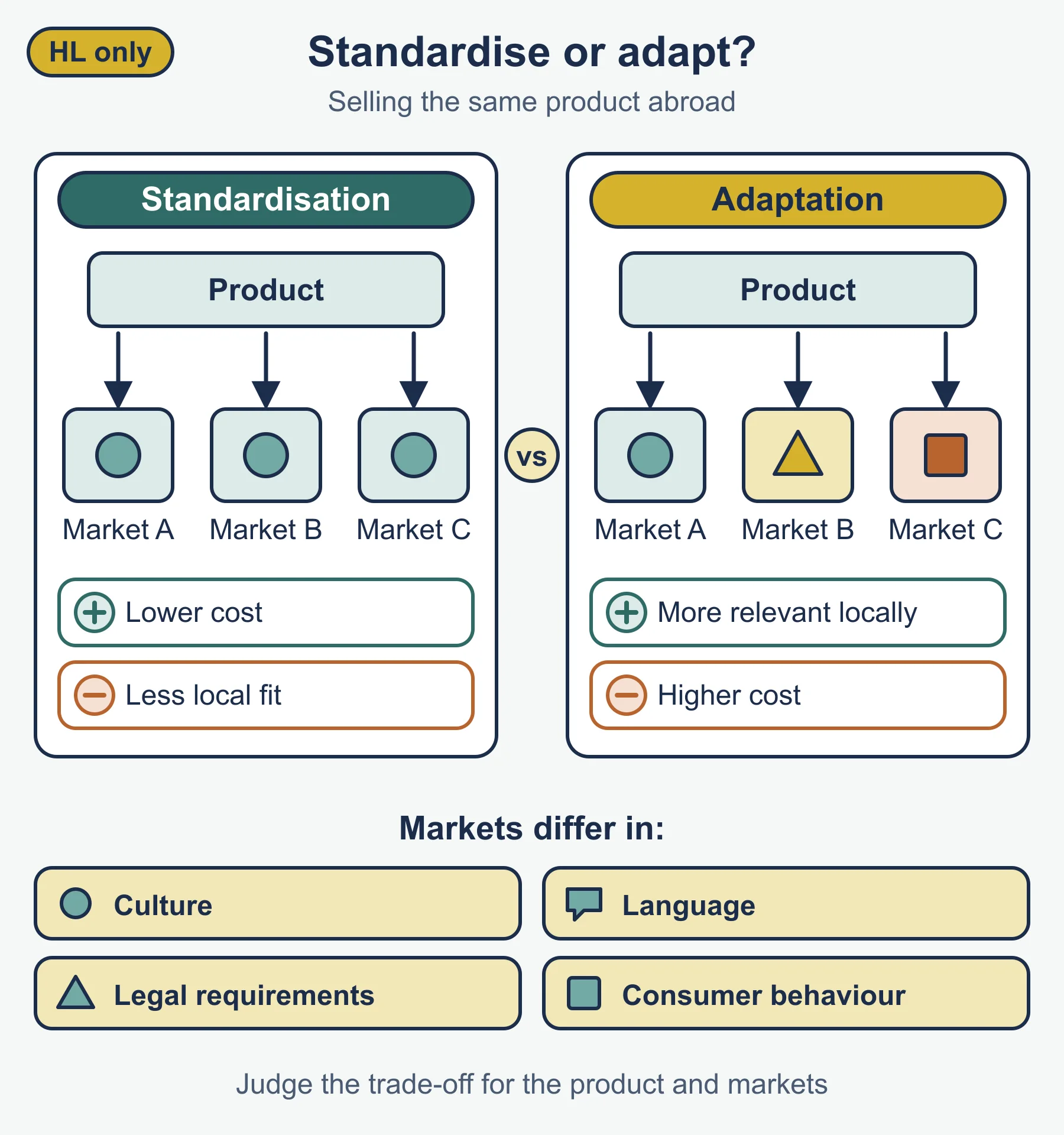
- Pan-global marketing uses one product, brand and message worldwide. Benefits: economies of scale, consistent brand, lower promotion costs. Risk: it may ignore tastes, laws or culture.
- Maintaining local differences adapts the mix to each market. Benefits: closer fit with customers. Costs: higher costs and a possibly weaker global brand.
Choose by looking at the product and the market. Products with universal appeal (such as technology goods) suit a pan-global approach. Food, clothing and services tied to culture often need adaptation. Many businesses keep the brand global and adapt other parts of the mix.
Choosing a strategy to develop a global market and the method of entry
When choosing a strategy, compare the options against the business’s objectives, finance, expertise, the risk it will accept and the speed it needs. Factors influencing the entry method include:
- cost and the finance available;
- the level of control wanted over the brand and quality;
- risk, including political and currency risk;
- speed of entry;
- local knowledge needed;
- trade barriers and legal requirements;
- the size and potential of the market.
Methods you can discuss include exporting through an agent, licensing, franchising, a joint venture and setting up a subsidiary. In general, low-cost methods give less control and lower profit per unit, while high-cost methods give more control and more risk.
Worked example: comparing entry methods
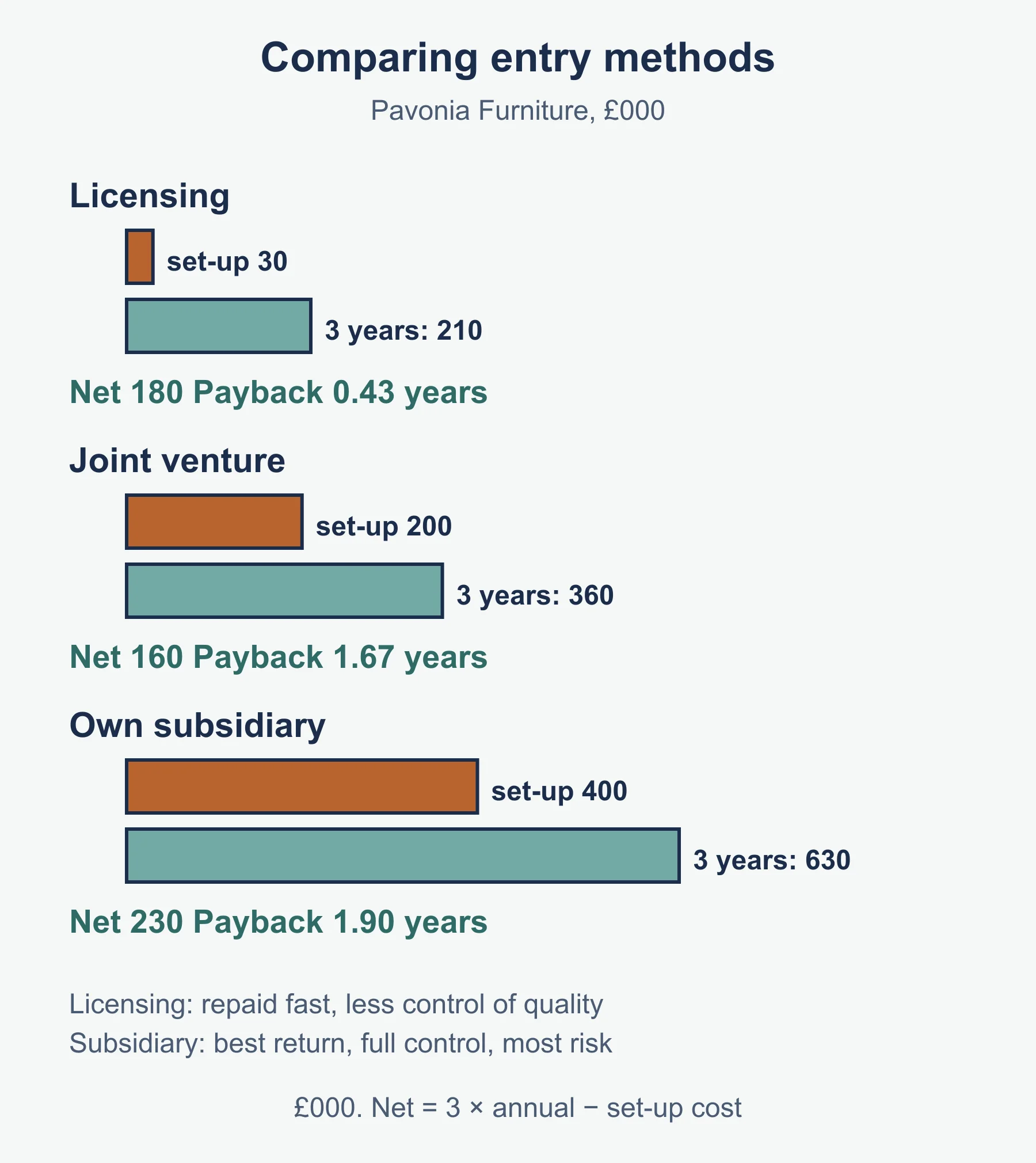
Pavonia Furniture compares three entry methods. Figures are in £000.
| Method | Set-up cost | Annual profit or income | Net over 3 years | Payback |
|---|---|---|---|---|
| Licensing | 30 | 70 | 180 | 0.43 years |
| Joint venture | 200 | 120 | 160 | 1.67 years |
| Own subsidiary | 400 | 210 | 230 | 1.90 years |
Net over 3 years = 3 × annual figure − set-up cost. Payback = set-up cost ÷ annual figure. The subsidiary gives the highest return and full control but ties up the most money and carries the most risk. Licensing repays almost immediately but gives up control of quality. A sound answer weighs these against the owner’s priorities rather than picking the biggest number.
Common errors
- Describing the four Ps and calling it a marketing plan. The plan also needs objectives, resources and research.
- Writing “good communication” as the meaning of coordination. Show how the mix elements support one message.
- Treating AI as automatically beneficial. Weigh cost, data quality and customer trust.
- Treating pan-global and local adaptation as an all-or-nothing choice.
- Recommending a market or entry method without using the figures and context given.
Frequently asked questions
What must a marketing strategy be consistent with? In Cambridge 9609 section 8.2, a strategy must fit the business (its objectives, size, finance and image), the product and its life-cycle stage, and the market it targets.
What is a coordinated marketing strategy? One where the four parts of the marketing mix send one message to one target group, and other functions such as operations, finance and human resources support it.
Why do businesses market internationally? Reasons include a saturated or small home market, faster growth abroad and spreading risk across several markets. Threats include foreign competition and exchange-rate and legal risk.
Is pan-global versus local marketing an all-or-nothing choice? No. A common middle path is one global brand with some adaptation of the product or message for each market, depending on how culture-linked the product is.
Official syllabus
Cambridge International AS & A Level Business 9609 syllabus for examination in 2026, 2027 and 2028, published by Cambridge Assessment International Education: section 8.2 (Marketing strategy).
Get free revision emails (optional)
Occasional emails with practice questions, worked explanations and links to free resources for the qualification and subjects you choose. No spam, and you can unsubscribe from any email. The free tools on this site never need an email.
Related resources
-
Practice questions
A Level Business: Marketing strategy (Cambridge 9609) – Practice Questions
Original practice questions with answers on marketing plans, coordinated strategy, IT and AI and international marketing for Cambridge A Level Business.
Business · Cambridge · A Level
Try questions -
Revision notes
A Level Business: Marketing strategy (Cambridge 9609) – Revision Notes
Condensed revision notes on marketing plans, coordinated strategy, IT and AI, and international marketing for Cambridge A Level Business section 8.2.
Business · Cambridge · A Level
Revise topic -
Study guides
A Level Business: The marketing mix (Cambridge 9609)
A full study guide to section 3.3 The marketing mix for Cambridge AS & A Level Business 9609: product, portfolio analysis, pricing, promotion and place.
Business · Cambridge · AS Level
Read guide
Related articles
-
teaching
A Level tuition in Dubai: Cambridge or Pearson Edexcel International A Level?
Schools in Dubai and Abu Dhabi teach either Cambridge International AS & A Level or Pearson Edexcel International A Level. How the two are structured, why it matters for tuition, and how online classes from Lahore work.
9 October 2026
-
curriculum guides
Choosing subjects at IGCSE and A Level
How subject choices at 14 and 16 affect university options later, and how to keep pathways open without overloading a timetable.
28 July 2026
Studying this with a teacher
Working through Business A LEVEL?
This page is free and stays free. If you would rather be taught it, Marlbridge runs Business classes one-to-one and in small groups of up to 15, online in your own time zone. The first trial class is free. WhatsApp replies within an hour (8am–11pm Pakistan time, every day); email the same day.
Cambridge Business teachers at Marlbridge

