
Study Guides
Cambridge International AS & A Level English Language (9093): Knowledge and understanding
Cambridge 9093 Paper 1 knowledge and understanding: conventions of textual forms, linguistic and literary features, audience, genre, purpose and context.
- Subject
- English
- Level
- AS LEVEL
- Topic
- Paper 1 – Reading
- Author
- Marlbridge Academic Team
- Updated
- Reviewed by
- Ammar Bilal (what this means)
Aligned to Cambridge A Level English (9093), 2024-2026. Official specification .
Syllabus page (what it covers and how it is assessed): Cambridge A Level English Language.
Found an error? Report a correction.
Need help with this topic? Request a free trial class for A Level English Language (9093).
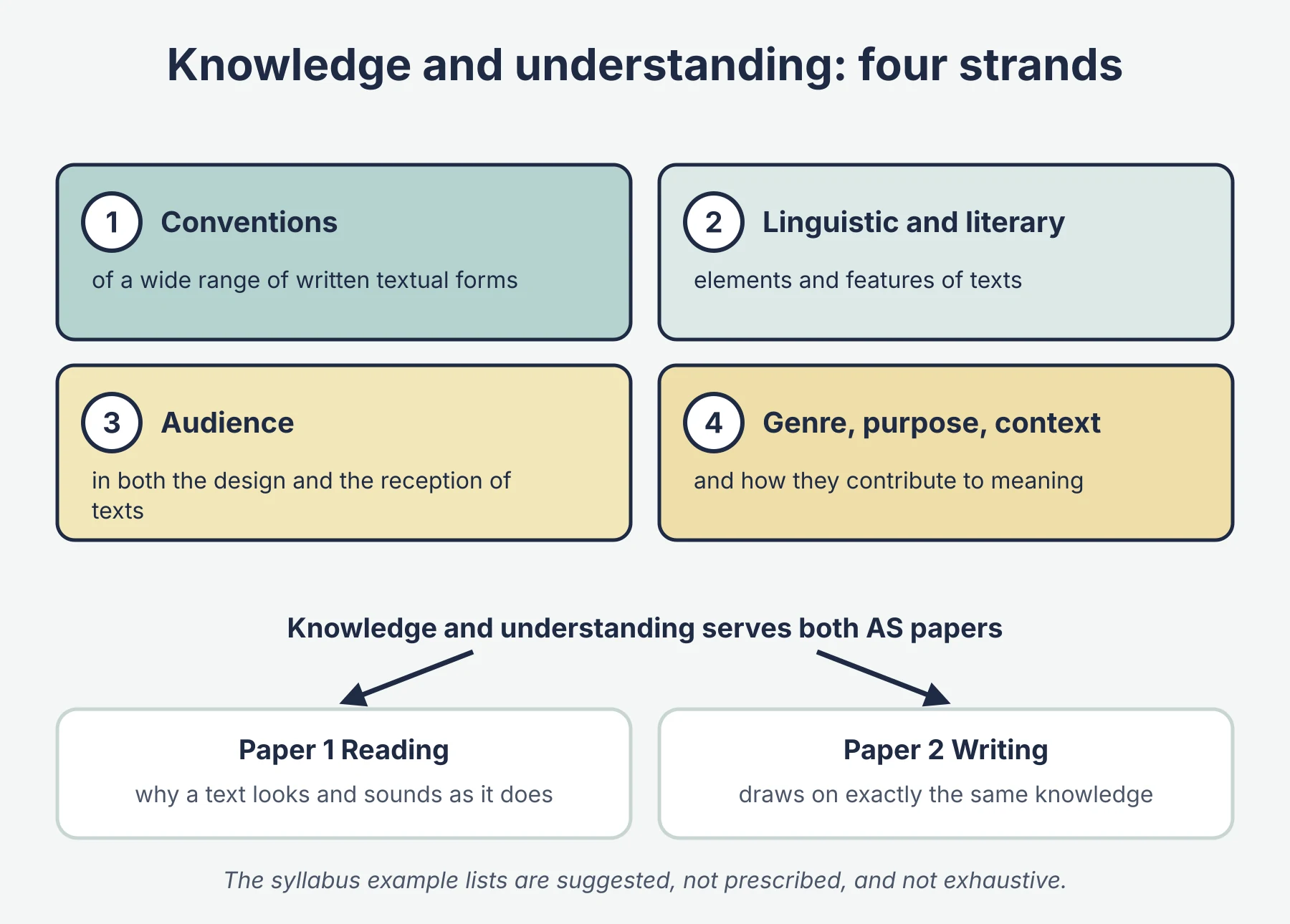
Paper 1 Reading in Cambridge International AS & A Level English Language (9093) lists two kinds of content: the knowledge and understanding you bring to an unseen text, and the skills and techniques you use to write about it. This guide covers the first. It is the body of knowledge that lets you say why a text looks and sounds the way it does. The syllabus states that Paper 2 Writing draws on exactly the same knowledge, so what you learn here serves both AS papers.
The syllabus sets out four strands. You need to show knowledge and understanding of:
- the conventions of a wide range of written textual forms
- the linguistic elements and literary features of texts
- the significance of audience in both the design and the reception of texts
- the ways in which genre, purpose and context contribute to meaning.
The syllabus gives example lists for the first two strands and says these are suggested, not prescribed, and not exhaustive. Treat them as a minimum map, not a checklist to recite.
Strand 1: conventions of textual forms
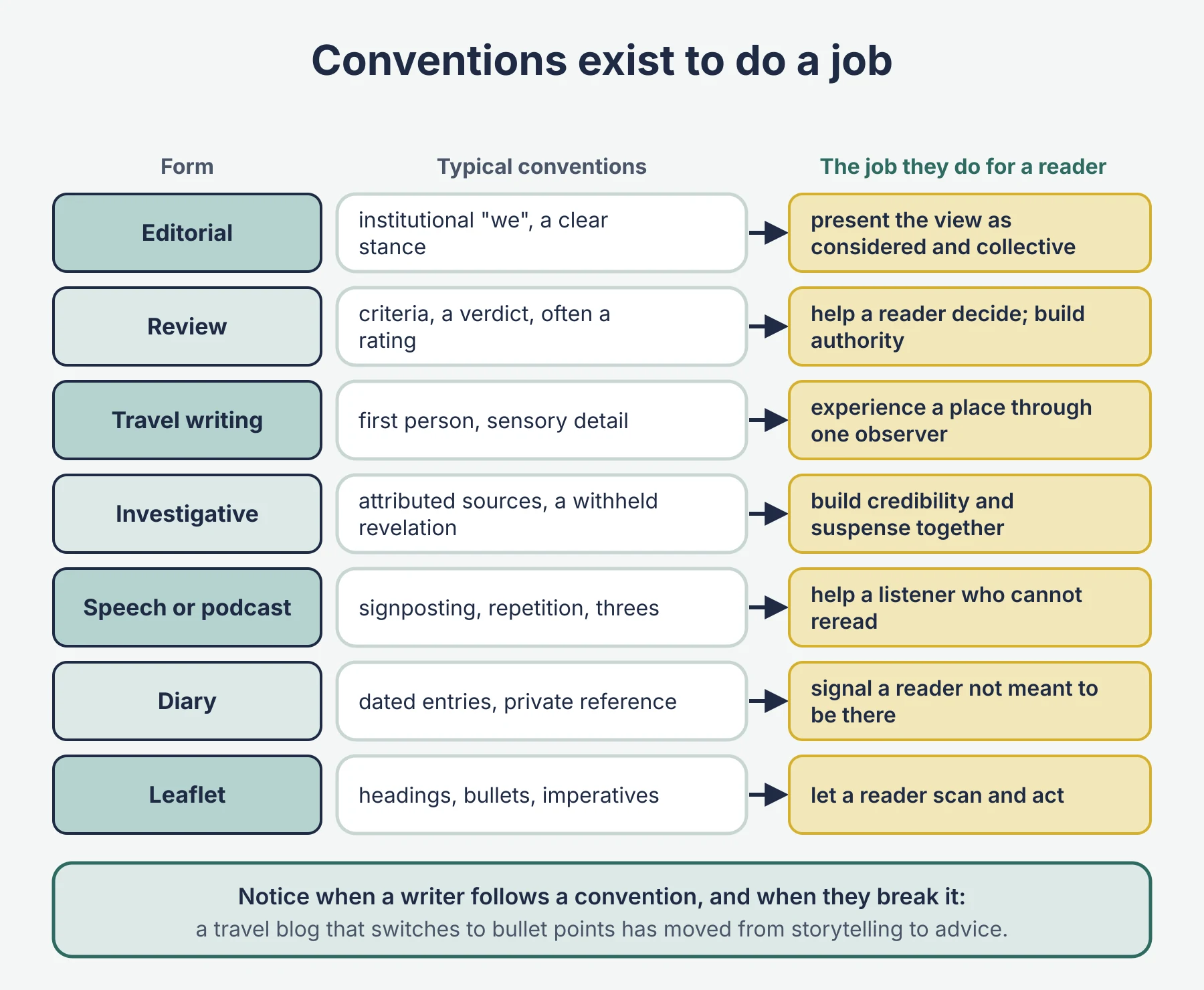
A convention is a feature readers expect of a form. Knowing the conventions lets you notice two things: when a writer follows them (and what that achieves) and when a writer breaks them (which is almost always deliberate). The syllabus example list runs from advertisements and leaflets to investigative journalism, podcasts, diaries, essays and scripted speech. The table groups some of them by what their conventions are designed to do.
| Form | Typical conventions | What the conventions do |
|---|---|---|
| Editorial | Institutional “we”, evaluative lexis, a clear stance, a closing call or judgement | Present the publication’s view as considered and collective |
| Review | Brief context, evaluation against criteria, a verdict, often a rating | Help a reader decide, while building the reviewer’s authority |
| Travel writing | First person, present-tense immersion mixed with past narrative, sensory detail, cultural comparison | Let the reader experience a place through one observer |
| Investigative journalism | Attributed sources, dates and figures, reported speech, a withheld revelation | Build credibility and suspense together |
| Scripted speech or podcast | Direct address, signposting, repetition, patterns of three, a voice that sounds spontaneous though planned | Help a listener who cannot reread |
| Diary | First person, dated entries, ellipsis, private reference the writer does not explain | Signal a reader who is not meant to be there |
| Leaflet or brochure | Headings, bullet points, imperatives, contact details | Let a reader scan and act |
The last column is the point. A convention matters because of the job it does for a reader. If a travel blog suddenly adopts the bullet points of a leaflet, you can explain the shift: the writer has moved from storytelling to advice.
Strand 2: linguistic elements and literary features
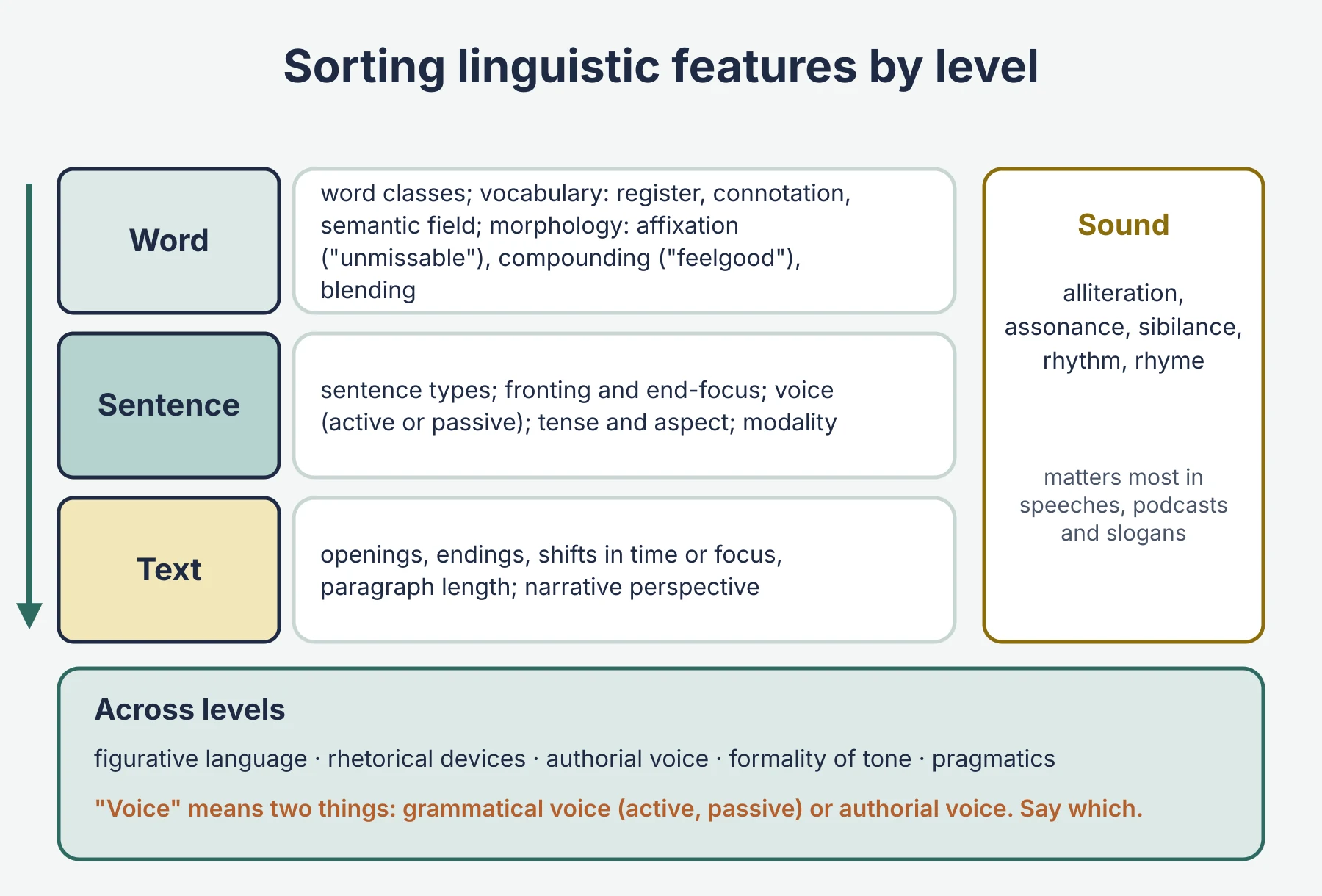
The syllabus example list is long. It is easier to hold if you sort it by level, from the smallest unit to the whole text.
Word level. Parts of speech / word classes (noun, verb, adjective, adverb, pronoun, determiner, preposition, conjunction); vocabulary (register, connotation, semantic field, specialist lexis); morphology, the structure of words. Morphology repays attention in advertising and journalism, where writers coin words by affixation (“unmissable”), compounding (“feelgood”) or blending.
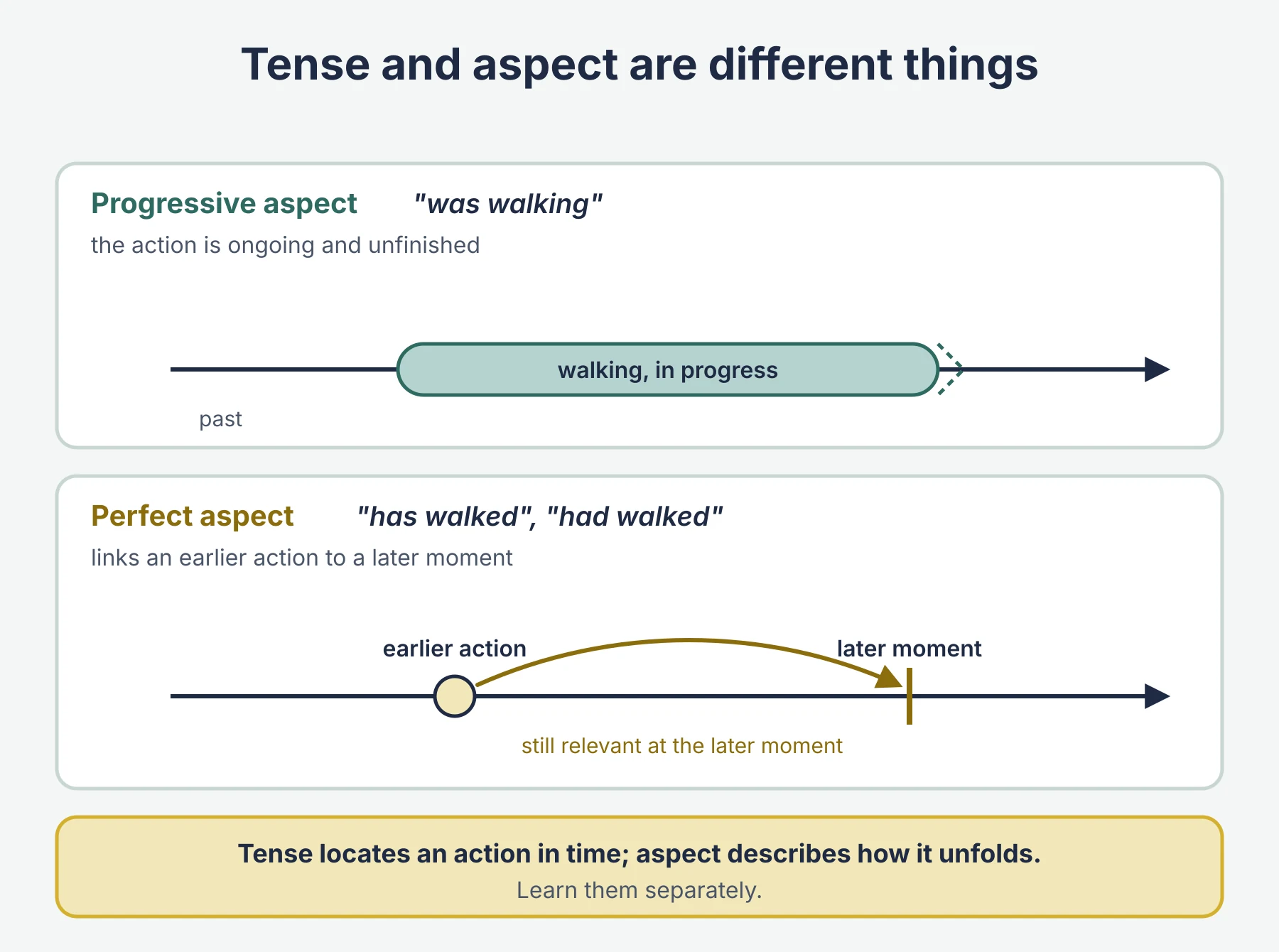
Sentence level. Word ordering and sentence structure covers sentence types (simple, compound, complex, minor) and the order of elements. Fronting moves information to the start for emphasis (“Never again will…”); end-focus places the key idea last, where English sentences naturally carry stress. Voice is active or passive. Tense locates an action in time; aspect describes how the action unfolds. The progressive aspect (“was walking”) presents an action as ongoing and unfinished; the perfect aspect (“has walked”, “had walked”) links an earlier action to a later moment. Students often confuse the two, so learn them separately. Modality expresses certainty, possibility and obligation through modal verbs (“must”, “might”) and other forms (“perhaps”, “it is essential that”).
Text level. Paragraph- and text-level structure covers openings, endings, shifts in time or focus, and paragraph length. Narrative perspective is the position the text is told from: first person, second person, third person, and whether the narrator knows everything or only what one character sees.
Sound. Phonology includes alliteration, assonance, sibilance, rhythm and rhyme. It matters most in texts meant to be heard, such as speeches and podcasts, and in slogans meant to stick.
Across levels. Figurative language (metaphor, simile, personification), rhetorical devices (rhetorical questions, antithesis, anaphora, hyperbole), voice in the sense of the writer’s distinctive presence, formality or informality of tone, and pragmatics, the meaning a reader infers beyond the literal words.
Note that “voice” appears twice in practice: grammatical voice (active and passive) and authorial voice. Make clear which one you mean whenever you use the word.
Strand 3: audience in design and reception
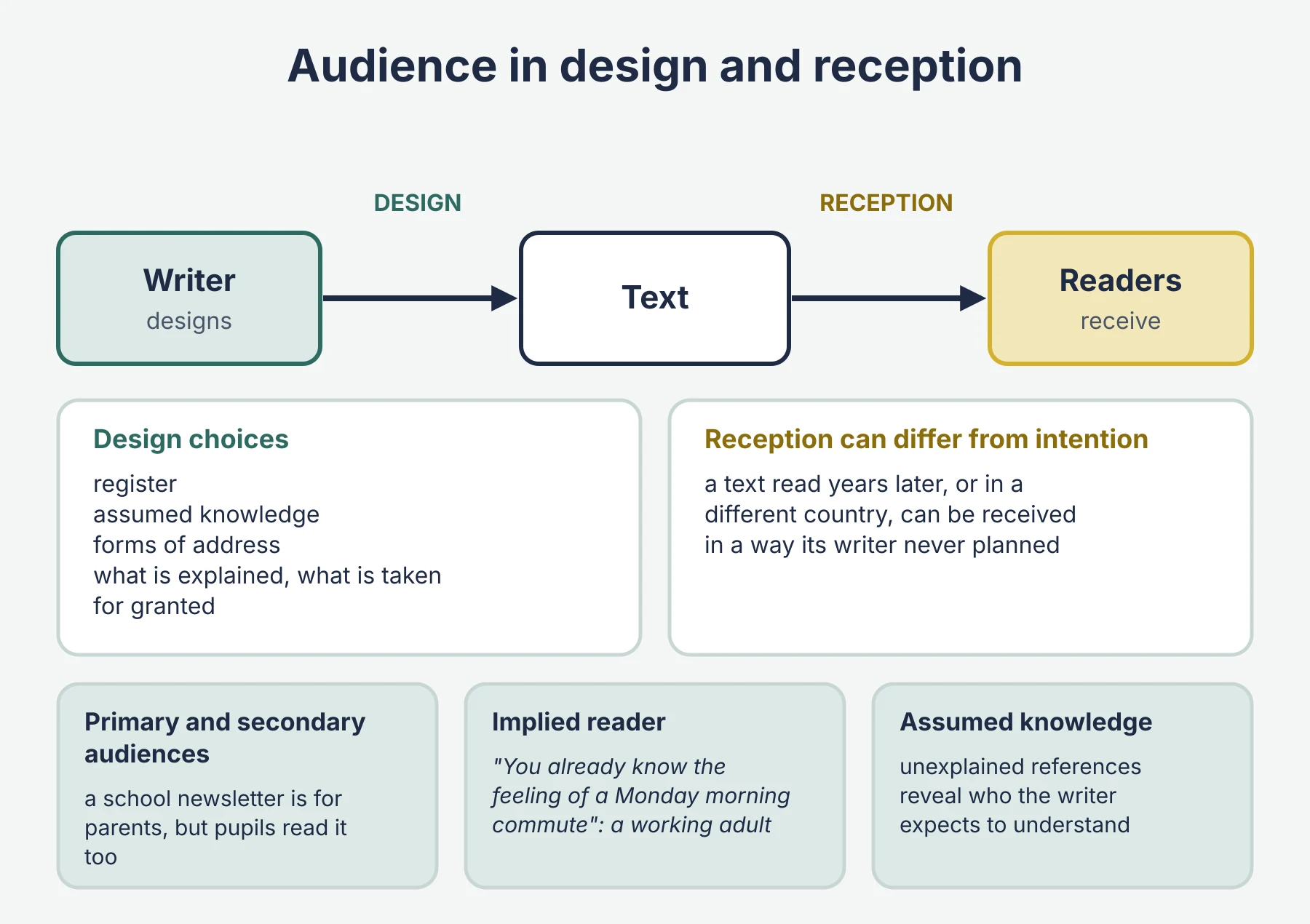
The syllabus wording separates two moments. Design is what the writer does with an audience in mind: choice of register, assumed knowledge, forms of address, what is explained and what is taken for granted. Reception is what actual readers make of the text, which may differ from what the writer intended.
Useful distinctions:
- Primary and secondary audiences. A school newsletter is written for parents but may be read by pupils, so it avoids anything that would embarrass either group.
- Implied reader. Every text constructs a reader. A sentence such as “You already know the feeling of a Monday morning commute” assumes a working adult with a routine.
- Assumed knowledge. Unexplained references and specialist terms reveal who the writer expects to understand.
- Changing reception. A text read years after it was written, or in a different country, can be received in a way its writer never planned.
Strand 4: genre, purpose and context
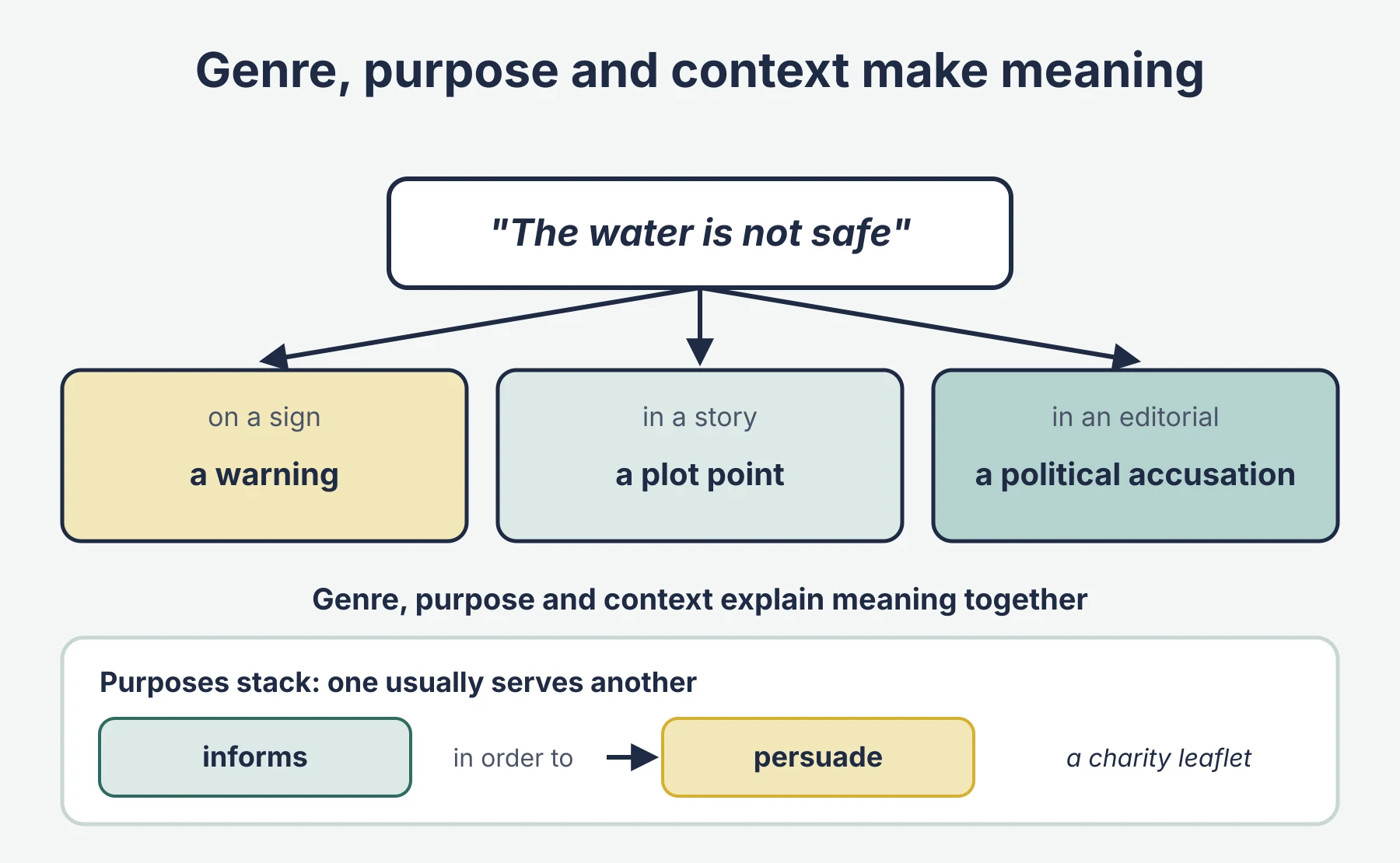
Genre is the type of text, recognised by its conventions. Purpose is what the text sets out to do: inform, persuade, entertain, advise, instruct, describe. Most texts have more than one, and one purpose usually serves another: a charity leaflet informs in order to persuade. Context covers the circumstances of production (who wrote it, when, where, under what constraints) and of reception (where and how it is read).
These three explain meaning together. The same sentence, “The water is not safe”, means a warning on a sign, a plot point in a story and a political accusation in an editorial.
Worked example: knowledge in use
Read this short passage (original, written for this guide):
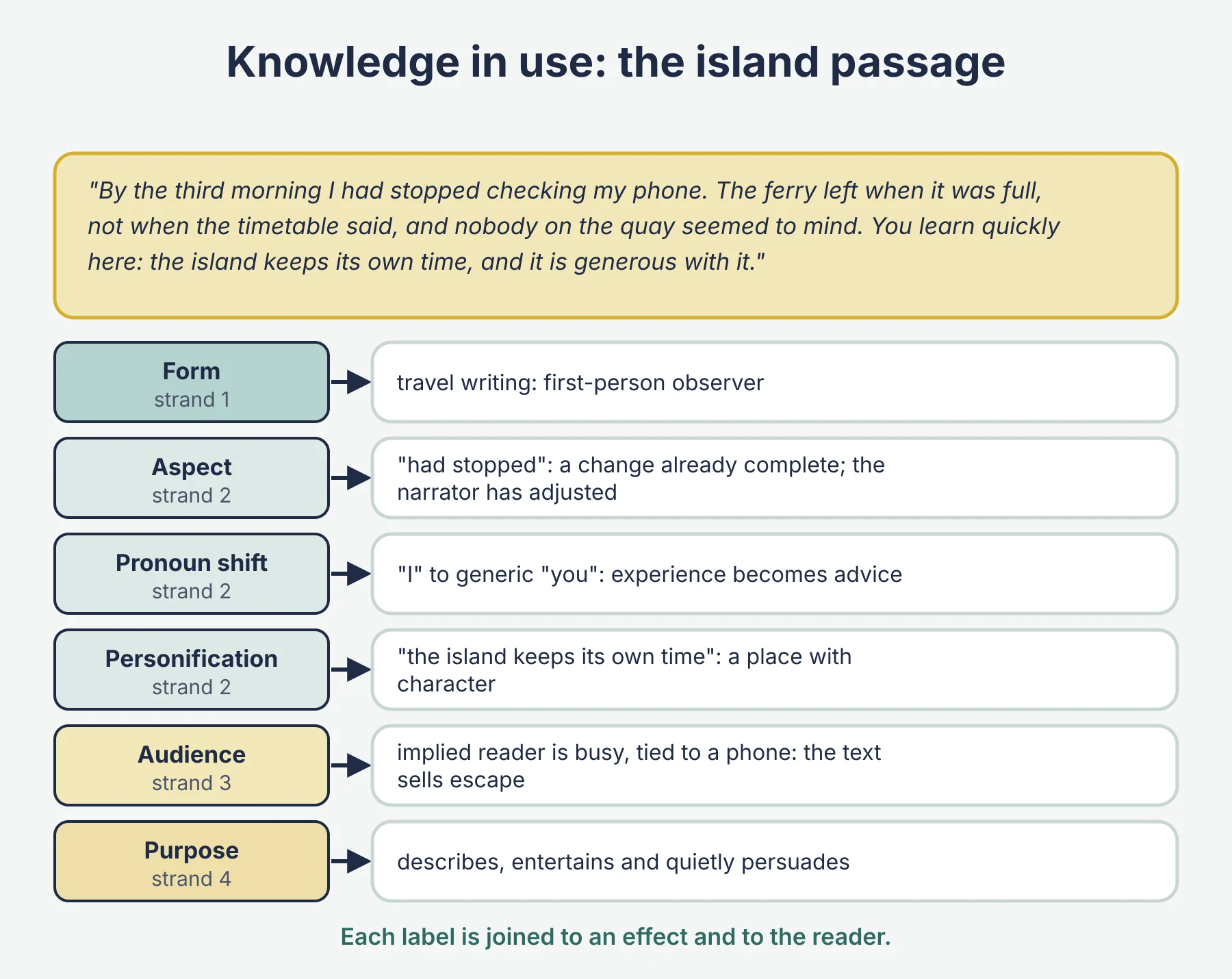
By the third morning I had stopped checking my phone. The ferry left when it was full, not when the timetable said, and nobody on the quay seemed to mind. You learn quickly here: the island keeps its own time, and it is generous with it.
An answer drawing on all four strands might note:
Form (strand 1)     travel writing: first-person observer, a place
                    experienced through one person's routine
Aspect (strand 2)   past perfect "had stopped" marks a change already
                    complete by the third morning: the narrator has
                    adjusted
Pronoun shift       "I" moves to generic "you", turning one person's
                    experience into advice for the reader
Personification     "the island keeps its own time... generous with it"
                    gives the place a character the reader will meet
Audience (strand 3) implied reader is busy, tied to a phone and a
                    timetable: the text sells escape from that life
Purpose (strand 4)  describes, entertains and quietly persuades
Notice that each label is joined to an effect and to the reader. The knowledge is the vocabulary; the answer is what the vocabulary lets you explain.
Common mistakes
- Treating the example lists as compulsory and forcing every feature into an answer.
- Naming a form without saying which of its conventions the text follows or breaks.
- Confusing tense with aspect, or grammatical voice with authorial voice.
- Describing audience only as “the reader” instead of identifying who that reader is assumed to be.
- Giving one purpose when the text clearly combines several.
- Treating context as background facts rather than as something that changes meaning.
Exam technique: using this knowledge with the command words
Cambridge defines analyse as examining in detail to show meaning, identifying elements and the relationship between them; compare as commenting on similarities and differences; and discuss as writing about issues in depth in a structured way. Knowledge and understanding supplies the “elements” in each case.
- In Question 2 (text analysis), open with form, audience, purpose and context in a sentence or two, then use the linguistic terms to analyse how these shape the language.
- In Question 1(b), compare your directed response with the source at the level of conventions and features: which conventions each form requires, and how your choices differ because your audience or purpose differs.
- In Paper 2, the same knowledge underpins your writing and your reflective commentary.
Keep going
- Condensed recall: Knowledge and understanding revision notes
- Test yourself: Knowledge and understanding practice questions
- How to turn this knowledge into written answers: Skills and techniques study guide
- The whole paper: Paper 1 Reading study guide
Related resources
-
Practice questions
Cambridge International AS & A Level English Language (9093): Knowledge and understanding – Practice Questions
Original practice on Cambridge 9093 Paper 1 knowledge and understanding: form conventions, aspect, modality, audience and purpose, with full answers.
English · Cambridge · AS Level
Try questions -
Revision notes
Cambridge International AS & A Level English Language (9093): Knowledge and understanding – Revision Notes
Recall notes for Cambridge 9093 Paper 1 knowledge and understanding: form conventions, word to text-level features, audience, genre, purpose and context.
English · Cambridge · AS Level
Revise topic -
Study guides
Cambridge International AS & A Level English Language (9093): Skills and techniques
Cambridge 9093 Paper 1 skills and techniques: selecting evidence, judging style, building a cohesive argument and writing in the same or a different style.
English · Cambridge · AS Level
Read guide
Get free revision emails (optional)
Occasional emails with practice questions, worked explanations and links to free resources for the qualification and subjects you choose. No spam, and you can unsubscribe from any email. The free tools on this site never need an email.