
Study Guides
Cambridge International AS & A Level English Language (9093): Skills and techniques
Cambridge 9093 Paper 1 skills and techniques: selecting evidence, judging style, building a cohesive argument and writing in the same or a different style.
- Subject
- English
- Level
- AS LEVEL
- Topic
- Paper 1 – Reading
- Author
- Marlbridge Academic Team
- Updated
- Reviewed by
- Ammar Bilal (what this means)
Aligned to Cambridge A Level English (9093), 2024-2026. Official specification .
Syllabus page (what it covers and how it is assessed): Cambridge A Level English Language.
Found an error? Report a correction.
Need help with this topic? Request a free trial class for A Level English Language (9093).
Knowledge tells you what a feature is called. Skills turn that knowledge into marks. The Paper 1 Reading section of the Cambridge International AS & A Level English Language (9093) syllabus lists fourteen skills and techniques. This guide groups them into four families, shows where each is tested, and models the hardest ones: integrating evidence into an argument, and writing in a style that is not your own.
Where the skills are tested
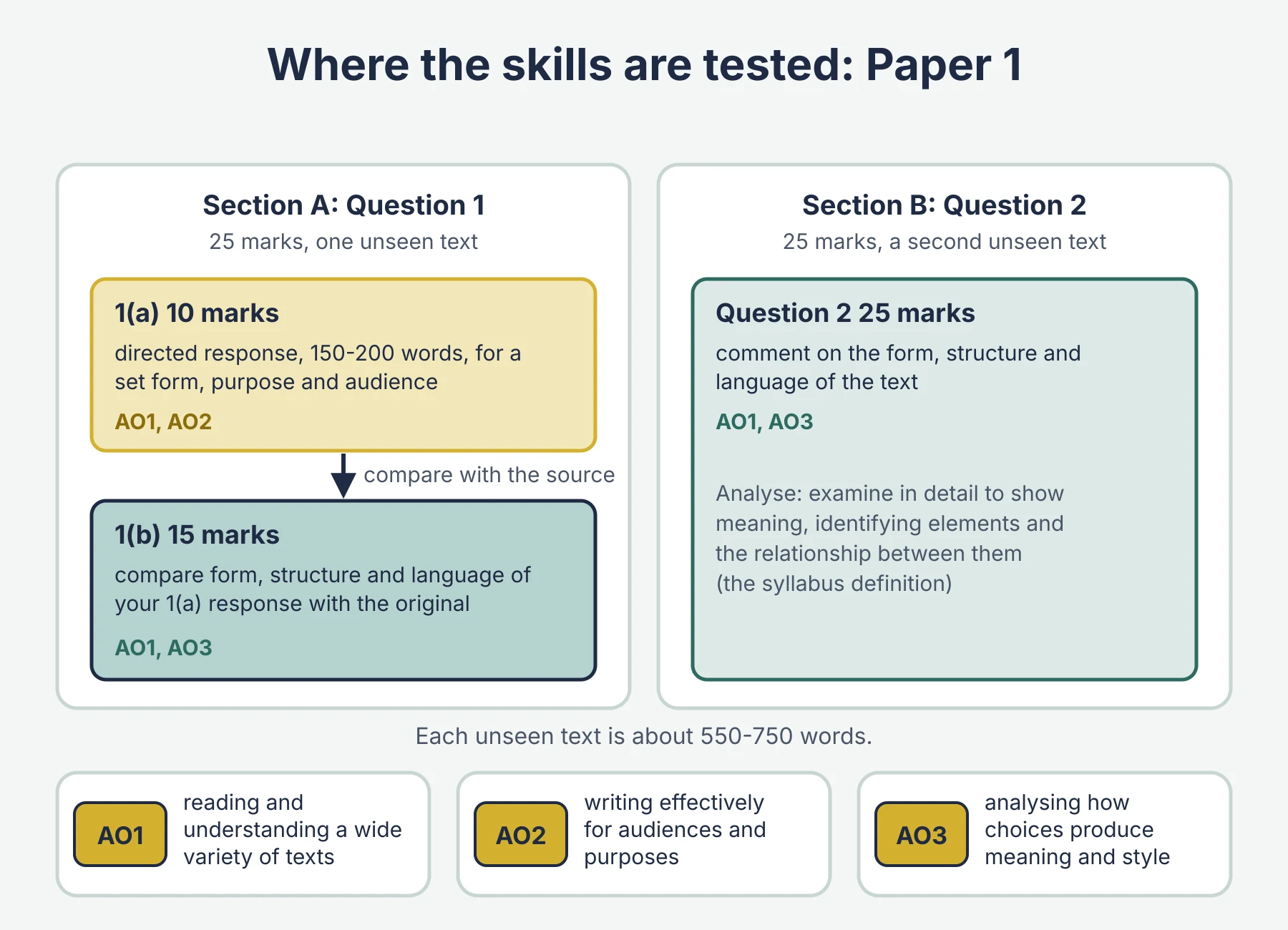
Paper 1 has two sections, each worth 25 marks, and each based on one unseen text of about 550-750 words.
| Task | What you do | Assessment objectives |
|---|---|---|
| Question 1(a), 10 marks | Write a directed response of 150-200 words for a set form, purpose and audience | AO1, AO2 |
| Question 1(b), 15 marks | Compare the form, structure and language of your 1(a) response with the original text | AO1, AO3 |
| Question 2, 25 marks | Comment on the form, structure and language of a second text | AO1, AO3 |
AO1 is reading and understanding a wide variety of texts; AO2 is writing effectively and appropriately for audiences and purposes; AO3 is analysing how writers’ choices of form, structure and language produce meaning and style.
Family 1: reading the unseen text
Skills: reading a range of unseen texts; recognising different non-fiction forms and their conventions.
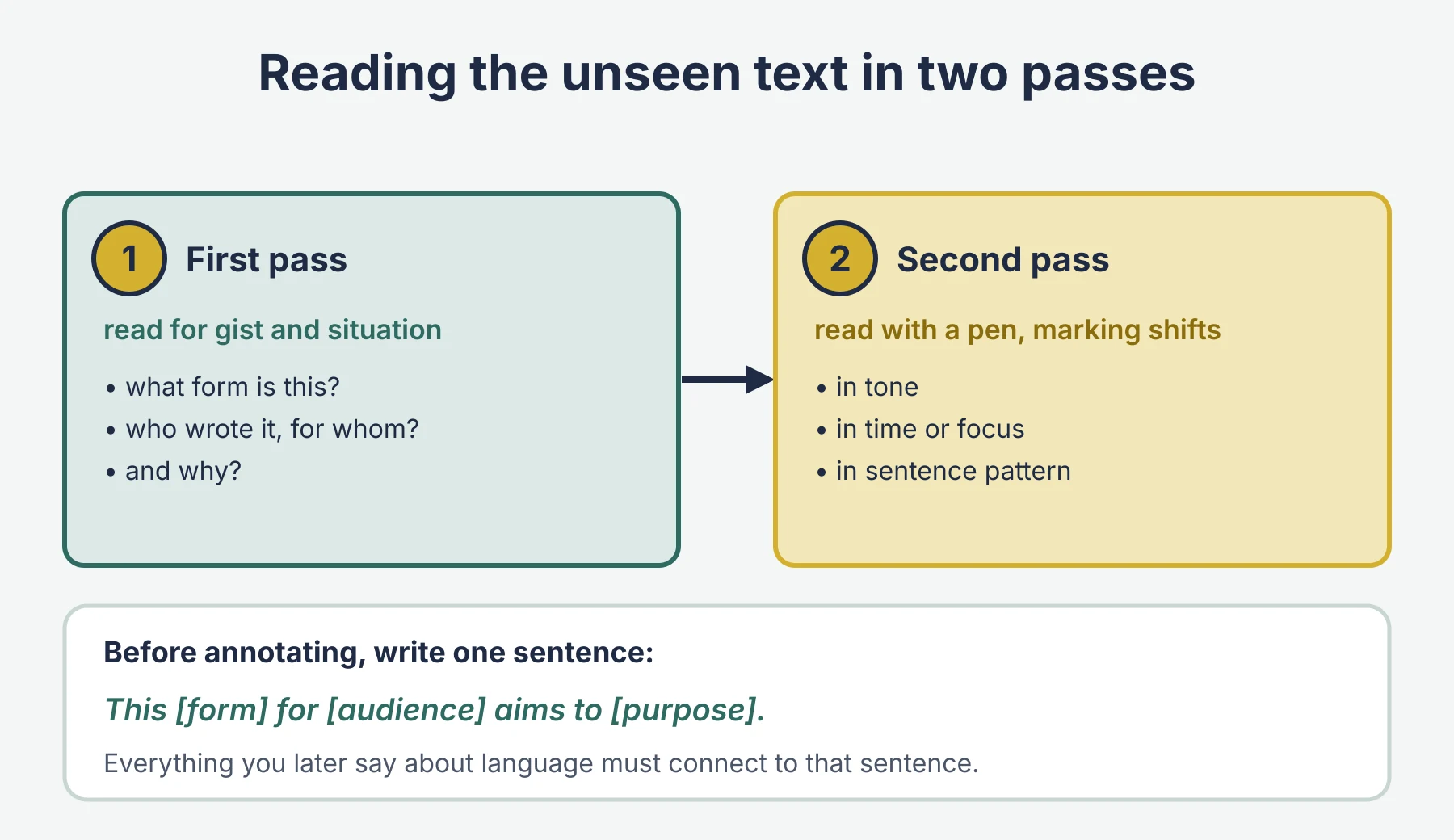
Use a two-pass reading. On the first pass, read for gist and situation: what form is this, who wrote it, for whom, and why? On the second pass, read with a pen, marking shifts (in tone, time, focus or sentence pattern), because shifts are where a writer’s choices are most visible. Do not start annotating features until you can state the text’s form, audience and purpose in one sentence. Everything you later say about language must connect to that sentence.
Family 2: analysing and writing about effects
Skills: analysing how linguistic elements come together to create meaning; writing analytically about the effects of linguistic elements and literary features; recognising and commenting on overall style, exemplifying it through specific instances.
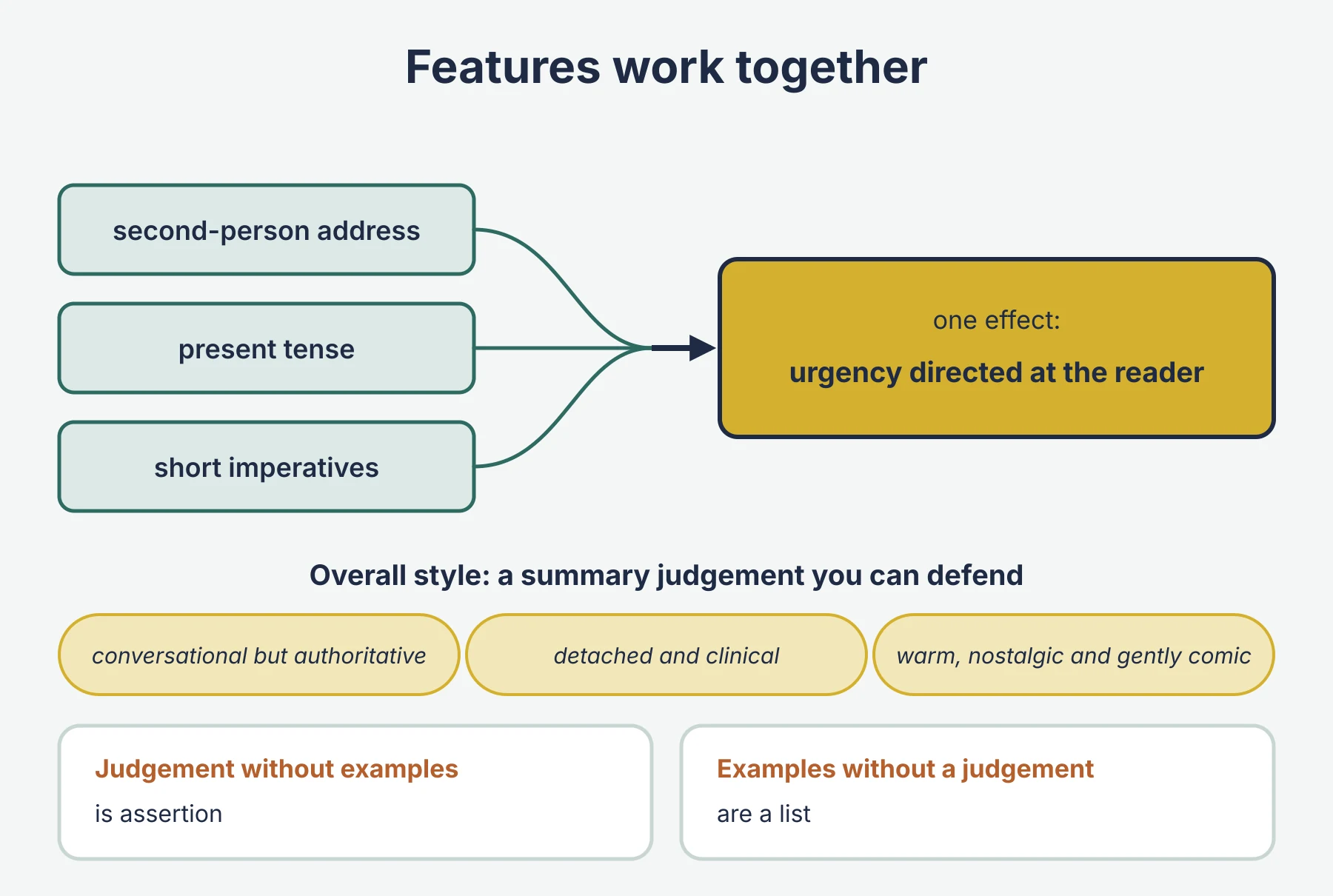
The key phrase is come together. Strong analysis shows features working in combination, not in isolation. If a writer uses second-person address, present tense and short imperatives in the same paragraph, the point is not three separate features but one effect: urgency directed at the reader.
Overall style is a summary judgement you can defend: “conversational but authoritative”, “detached and clinical”, “warm, nostalgic and gently comic”. State it early, then prove it with specific instances. A style judgement without examples is assertion; examples without a style judgement are a list.
Family 3: evidence and argument
Skills: selecting and interpreting words and phrases with care and precision; using quotations and evidence with judgement; using appropriate language to link quotations with explanatory comments; integrating quotations into a cohesive argument; integrating individual points into broader overall responses.
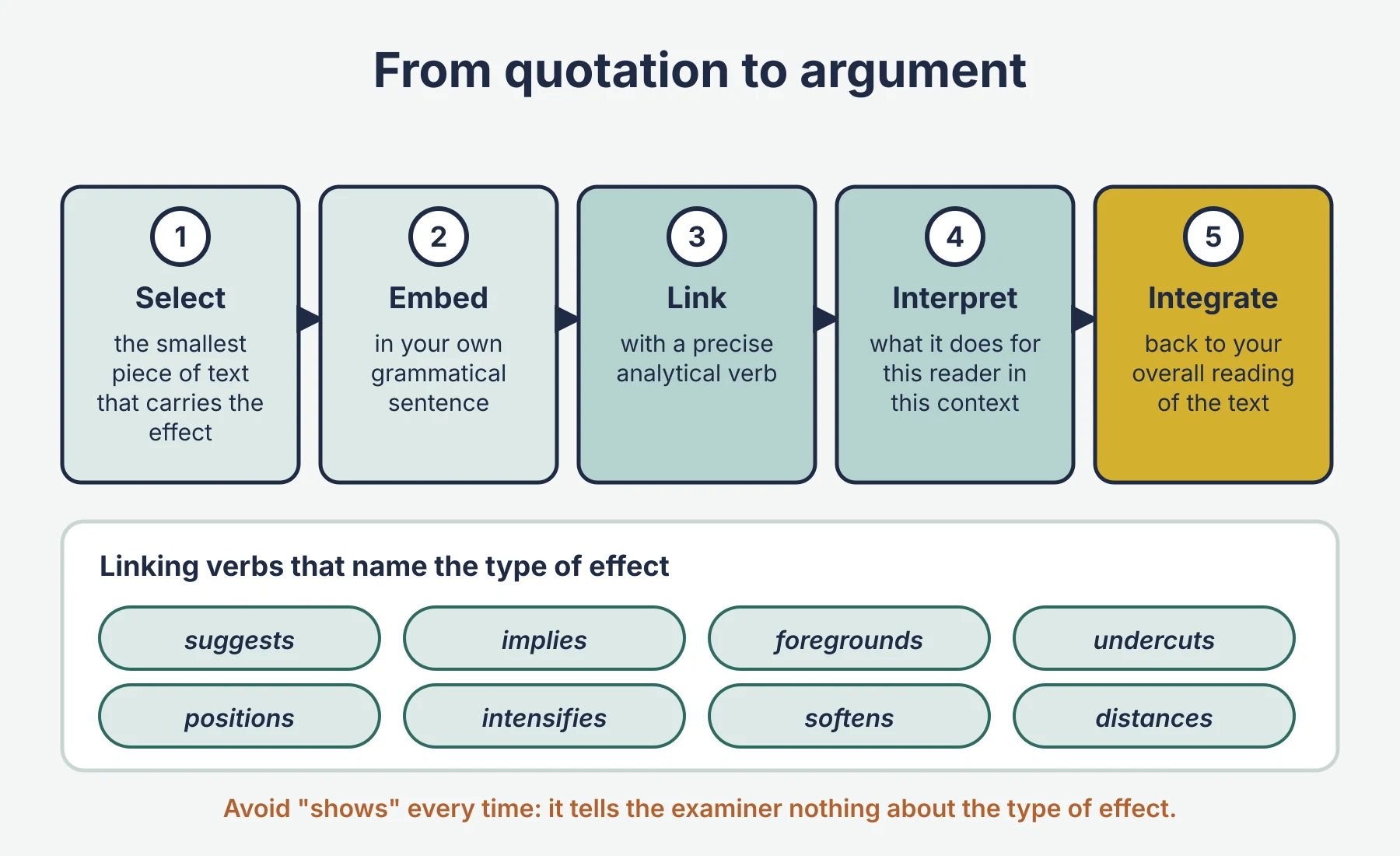
These five skills describe one process.
- Select the smallest piece of text that carries the effect. Often this is one word or a short phrase.
- Embed it in your own sentence so your sentence stays grammatical.
- Link it with precise analytical verbs: suggests, implies, foregrounds, undercuts, positions, intensifies, softens, distances. Avoid “shows” every time; it tells the examiner nothing about the type of effect.
- Interpret: say what the choice does for this reader in this context.
- Integrate: connect the point back to your overall reading of the text, so each paragraph advances one argument.
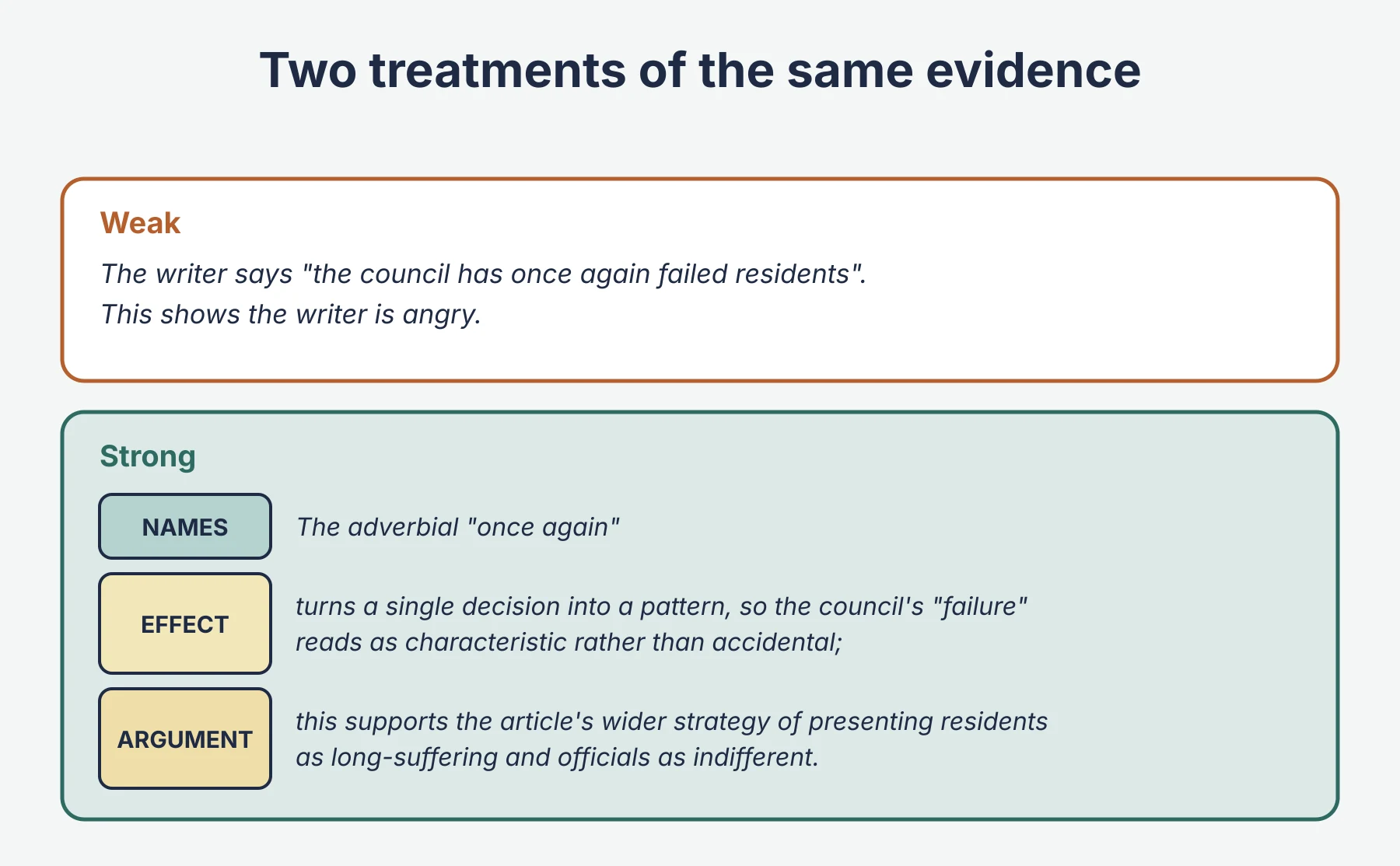
Compare two treatments of the same evidence.
Weak: The writer says “the council has once again failed residents”. This shows the writer is angry.
Strong: The adverbial “once again” turns a single decision into a pattern, so the council’s “failure” reads as characteristic rather than accidental; this supports the article’s wider strategy of presenting residents as long-suffering and officials as indifferent.
The strong version selects two words, names the feature, explains the effect precisely and links it to the argument of the whole answer.
Family 4: directed writing and comparison
Skills: writing short, directed pieces in response to a text; writing in the same style as another text; writing in a different style while reusing the content; comparing the style and linguistic elements of your own writing with those of a given text.
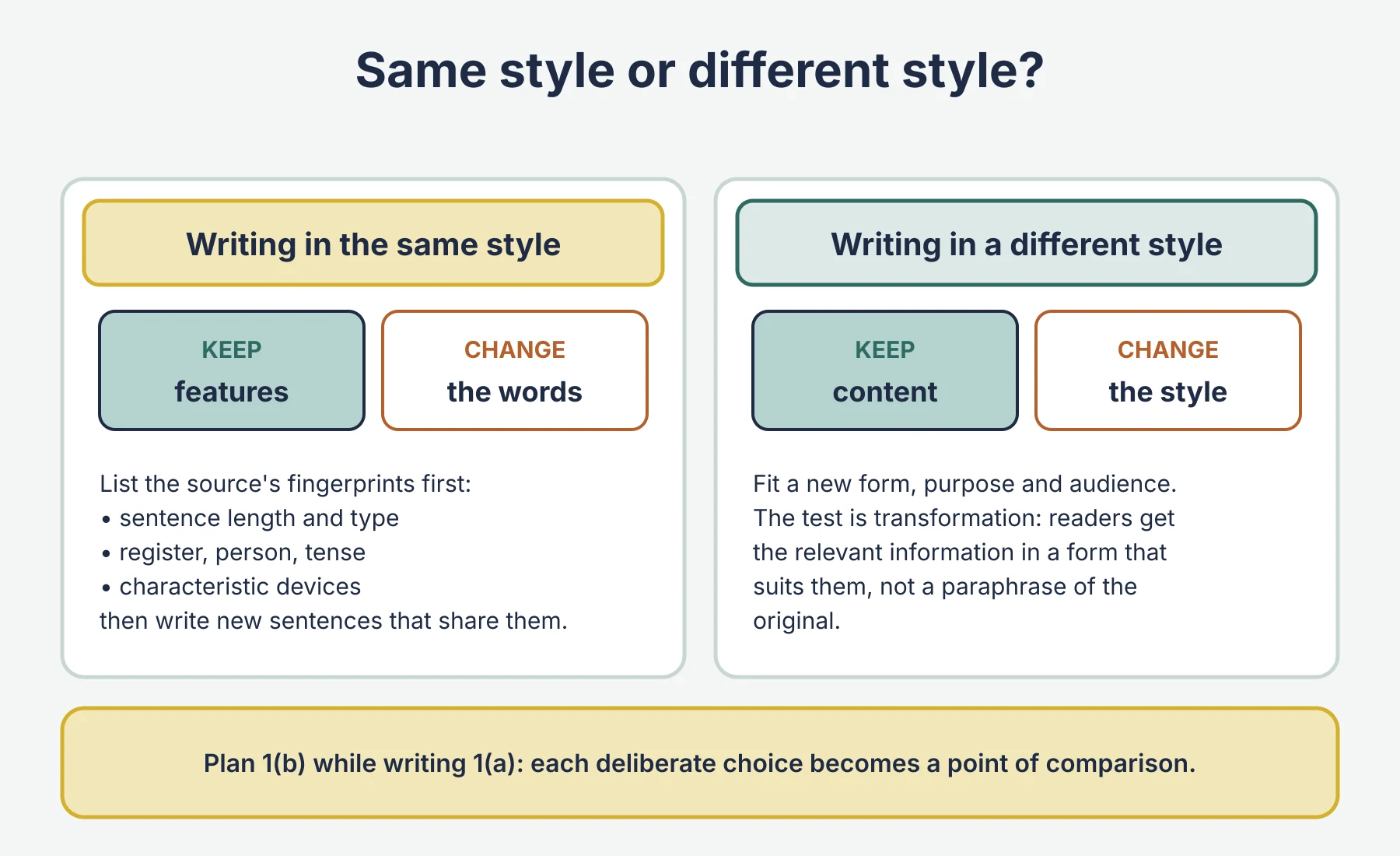
Writing in the same style
Imitating a style means reproducing its features, not its words. Before you write, list the source’s stylistic fingerprints: sentence length and type, register, person, tense, characteristic devices. Then produce new sentences that share them. If the source uses long cumulative sentences with sensory detail and one short sentence per paragraph for emphasis, so should yours.
Writing in a different style
Here you keep the content and change the style to fit a new form, purpose and audience. The test is transformation: a reader of your text should receive the relevant information in a form that suits them, not a paraphrase of the original.
Comparing your writing with the source
Question 1(b) carries more marks than 1(a). It rewards analysing both texts with the same terminology, point by point. Plan it while you write 1(a): each deliberate choice you make (a heading, a shift to second person, a simpler sentence structure) becomes a point of comparison you can later explain.
Worked example: same content, different style
Source extract (original, written for this guide, in the style of a reflective magazine column):
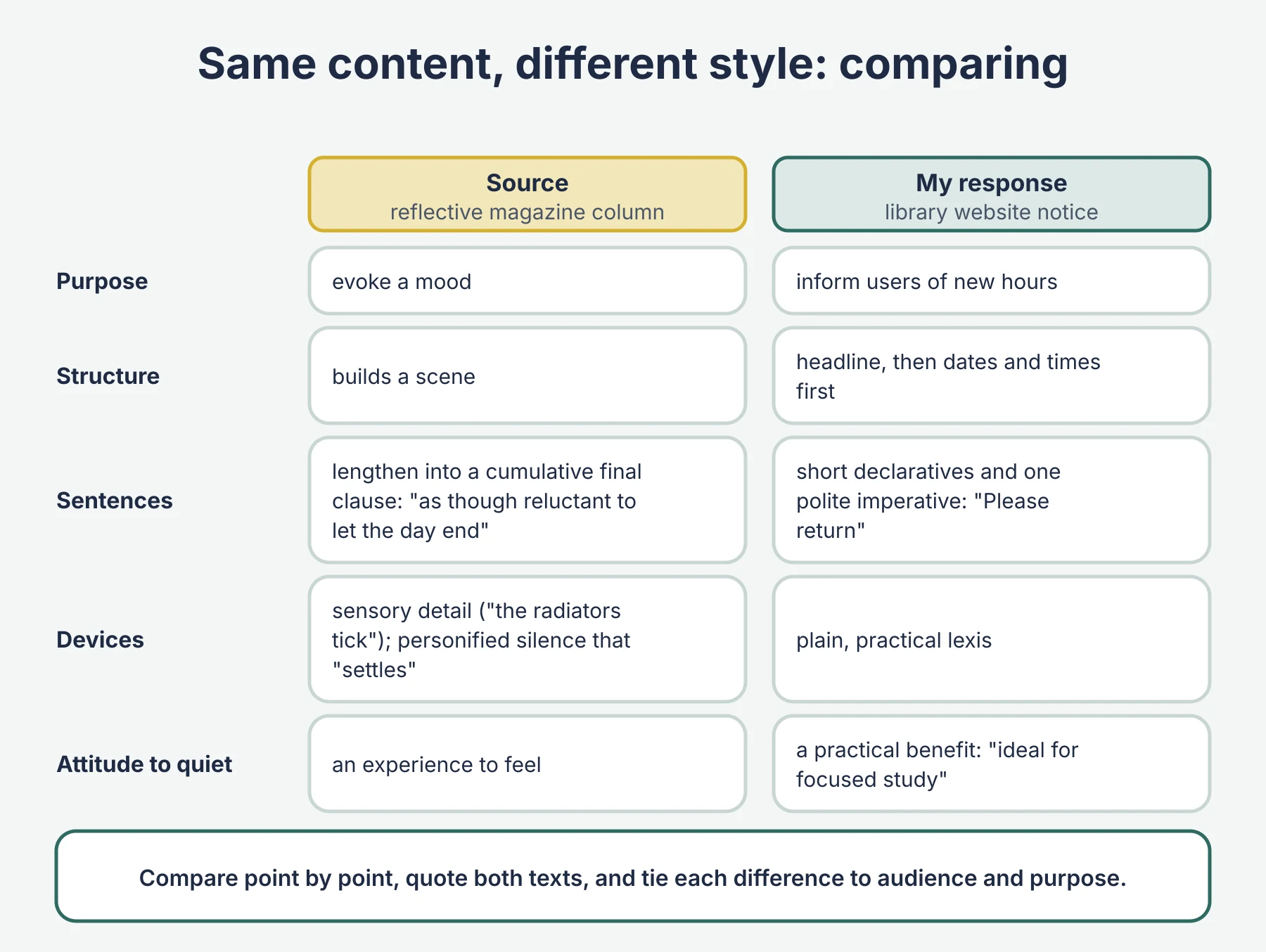
There is a particular silence that settles over a library in the last hour before closing. The radiators tick. A trolley squeaks somewhere among the shelves. And the few readers who remain seem to read more slowly, as though reluctant to let the day end.
Brief: Using the content, write the opening of a short notice for the library’s website informing users of new evening opening hours.
Directed response (extract):
Late opening starts Monday From 3 March, the library will stay open until 9 pm on weekdays. The final hour is our quietest time, ideal for focused study. Please return trolleys and books to the desk by 8.50 pm.
Comparison paragraph for 1(b):
The source is a reflective column whose purpose is to evoke a mood, so it uses sensory detail (“the radiators tick”, “a trolley squeaks”) and personification of the silence that “settles”. My notice reuses the same content, the quiet final hour and the trolleys, but its informative purpose and a general audience of library users require a different structure: a headline that states the news, then dates and times placed first so readers can act on them. Where the source’s sentences lengthen into a cumulative final clause (“as though reluctant to let the day end”), mine are short declaratives and one polite imperative (“Please return”), because a notice is scanned, not savoured. Both texts present the quietness positively, but the source makes it an experience to feel, while my text converts it into a practical benefit: “ideal for focused study”.
The paragraph compares by point (purpose, structure, sentence style, attitude), quotes both texts, and relates each difference to audience and purpose. That is the skill the question names.
Common mistakes
- Annotating features before establishing form, audience and purpose.
- Quoting long stretches instead of selecting the exact words that carry the effect.
- Using “shows” as the only linking verb.
- Writing paragraphs that do not connect to an overall reading of the text.
- In “same style” tasks, reusing the source’s phrases instead of its features.
- In “different style” tasks, paraphrasing the source with a few changes of word.
- Describing your 1(a) response in 1(b) without comparing it with the source.
Exam technique: the command words
The syllabus defines analyse as examining in detail to show meaning, identifying elements and the relationship between them. “Relationship between them” is Family 2’s skill of showing features working together. Compare means commenting on similarities and differences, so 1(b) needs both: do not only list differences. Discuss means writing in depth in a structured way, which is why integration and a cohesive argument matter.
Allocate planning time to Question 1(b) and Question 2 in line with their marks, and read each brief twice: once for form, once for audience and purpose.
Keep going
- Condensed recall: Skills and techniques revision notes
- Test yourself: Skills and techniques practice questions
- The knowledge these skills use: Knowledge and understanding study guide
- The whole paper: Paper 1 Reading study guide
Related resources
-
Practice questions
Cambridge International AS & A Level English Language (9093): Skills and techniques – Practice Questions
Original practice for Cambridge 9093 Paper 1 skills: embedding quotations, judging style, imitating a style and comparing your own writing, with model answers.
English · Cambridge · AS Level
Try questions -
Revision notes
Cambridge International AS & A Level English Language (9093): Skills and techniques – Revision Notes
Recall notes for Cambridge 9093 Paper 1 skills: reading unseen texts, embedding evidence, judging overall style, style imitation and comparing your own writing.
English · Cambridge · AS Level
Revise topic -
Practice questions
A Level English Language: Reading and Analysis — Practice Questions
Original practice with worked answers on discourse, register, lexis, grammar and pragmatics for Cambridge AS & A Level English Language 9093 Paper 1.
English · Cambridge · AS Level
Try questions
Get free revision emails (optional)
Occasional emails with practice questions, worked explanations and links to free resources for the qualification and subjects you choose. No spam, and you can unsubscribe from any email. The free tools on this site never need an email.