
Revision Notes
Cambridge International AS & A Level English Language (9093): Skills and techniques – Revision Notes
Recall notes for Cambridge 9093 Paper 1 skills: reading unseen texts, embedding evidence, judging overall style, style imitation and comparing your own writing.
- Subject
- English
- Level
- AS LEVEL
- Topic
- Paper 1 – Reading
- Author
- Marlbridge Academic Team
- Updated
- Reviewed by
- Ammar Bilal (what this means)
Aligned to Cambridge A Level English (9093), 2024-2026. Official specification .
Syllabus page (what it covers and how it is assessed): Cambridge A Level English Language.
Found an error? Report a correction.
Need help with this topic? Request a free trial class for A Level English Language (9093).
Condensed recall for the skills and techniques strand of Paper 1 Reading. For the full method and a worked comparison paragraph, use the Skills and techniques study guide.
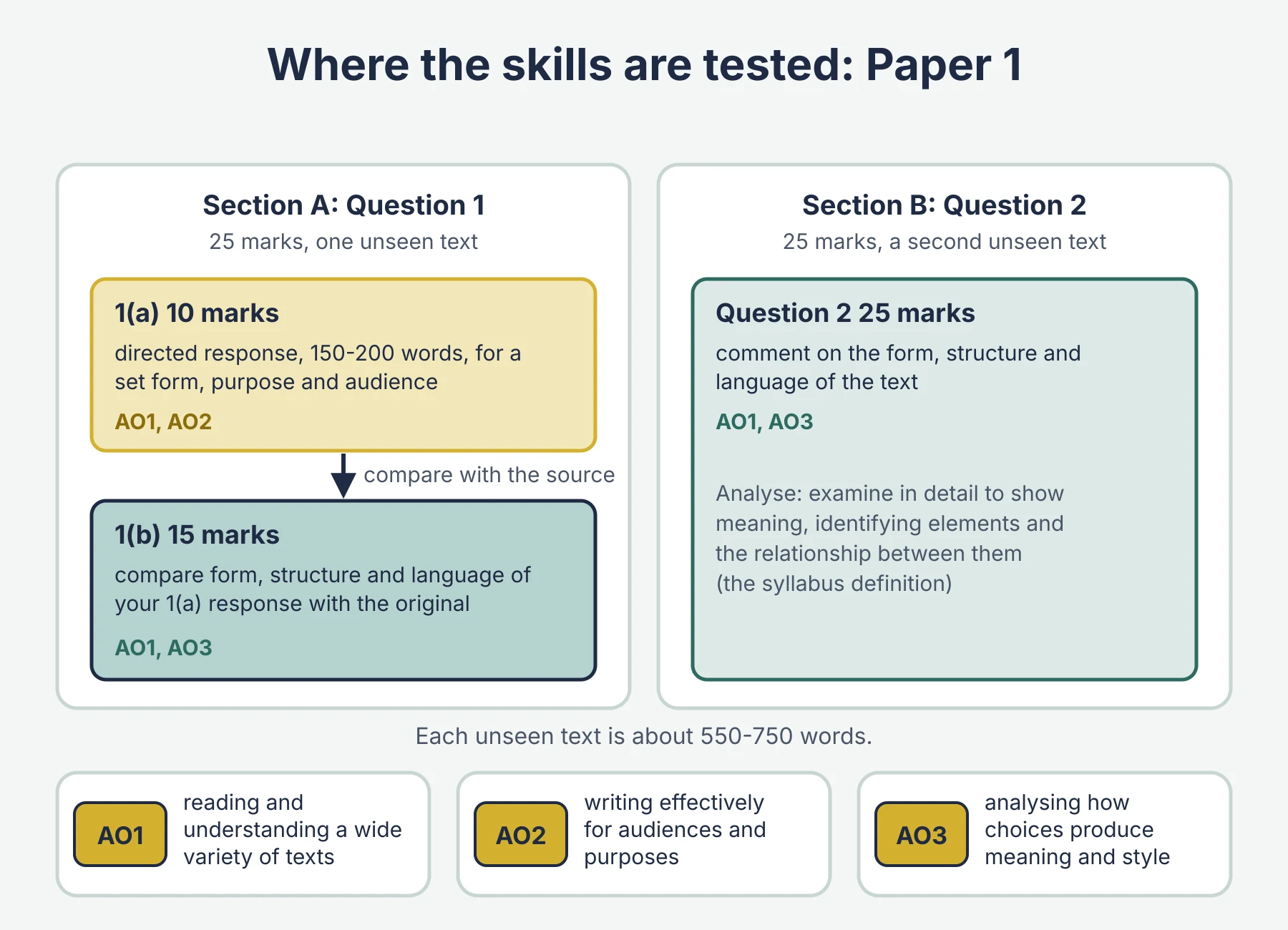
Where each skill is tested
| Task | Marks | Skills it draws on most |
|---|---|---|
| Question 1(a): directed response, 150-200 words | 10 | Writing short directed pieces; same or different style; reusing content |
| Question 1(b): compare your 1(a) with the original | 15 | Comparing your own writing with a given text; analysing effects; integrating evidence |
| Question 2: text analysis of a 550-750 word text | 25 | Reading unseen texts; recognising forms; overall style; evidence and argument |
The four skill families
- Reading: unseen texts; recognising non-fiction forms and their conventions.
- Analysing effects: how elements come together; writing analytically; overall style with specific instances.
- Evidence and argument: selecting with precision; quoting with judgement; linking language; cohesive argument; integrating points into an overall response.
- Directed writing and comparison: short directed pieces; same style; different style reusing content; comparing your own writing with the source.
Reading routine
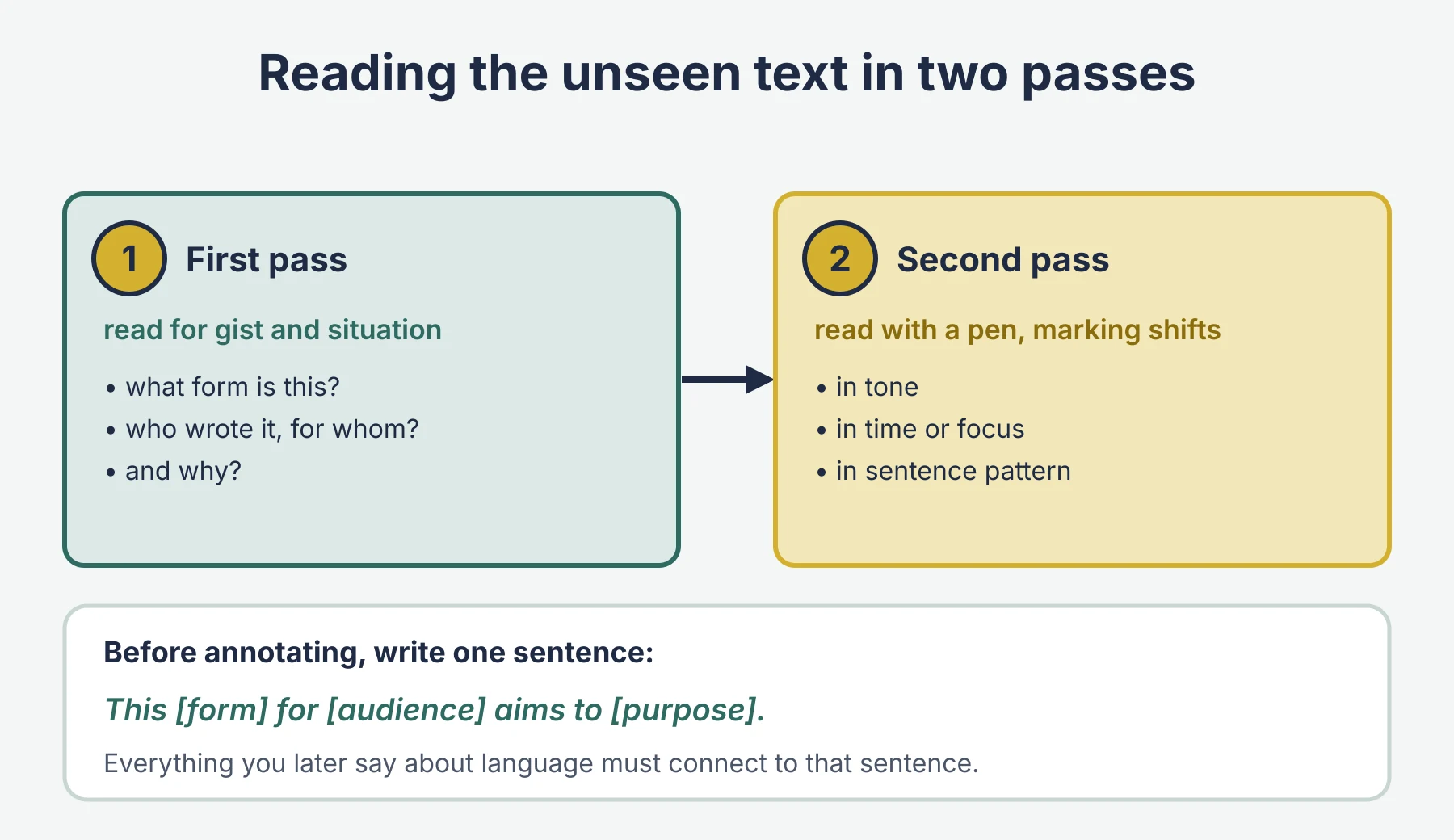
- Pass 1: form, writer, audience, purpose, context. Write one sentence before annotating.
- Pass 2: mark shifts in tone, time, focus, sentence pattern or person. Shifts show choices.
- Pass 3 (brief): choose three to five passages that best prove your overall reading.
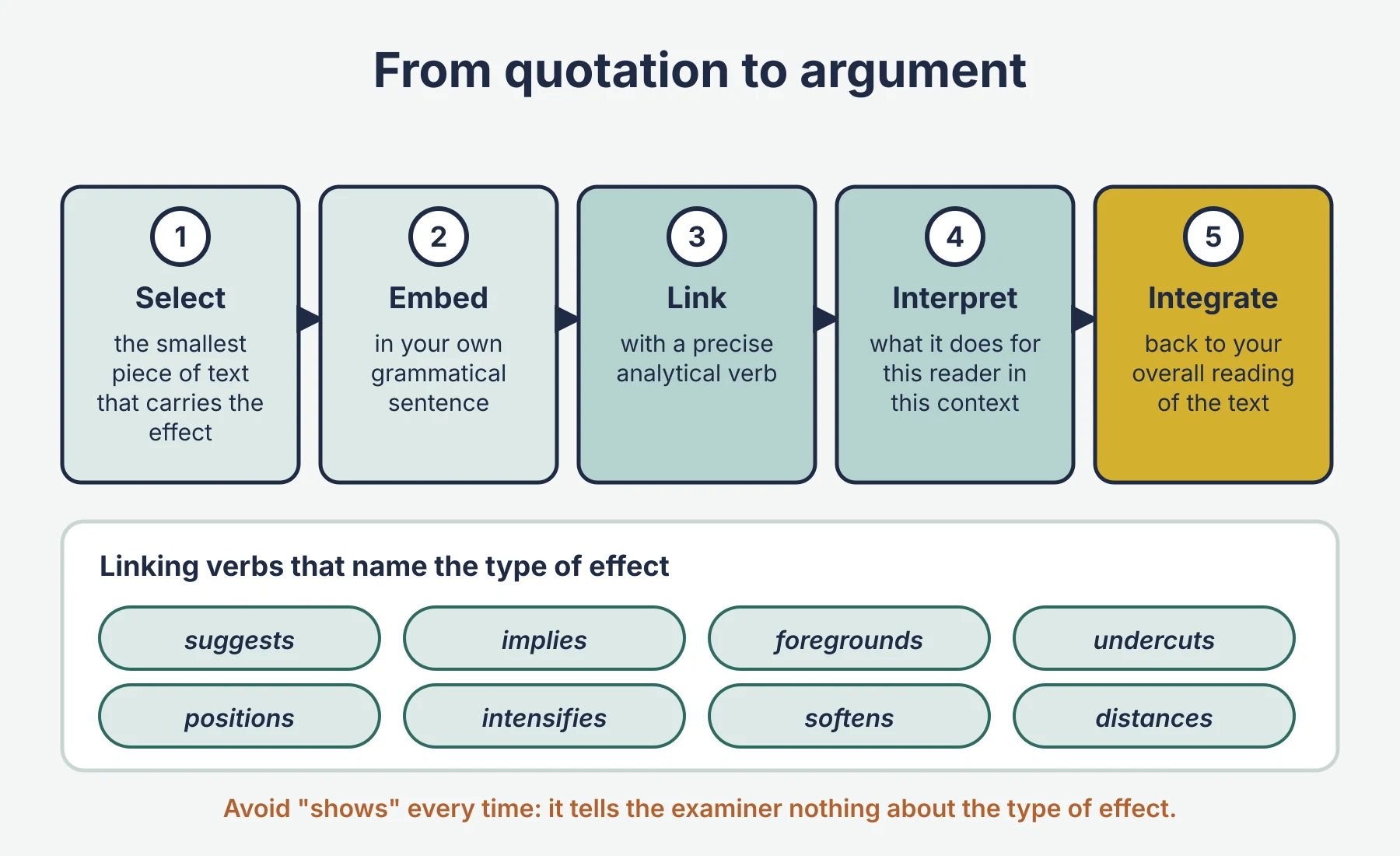
Evidence: select, embed, link, interpret, integrate
- Select the smallest unit that carries the effect.
- Embed it so your sentence stays grammatical: The writer’s “tidy” catastrophe…
- Link with precise verbs: suggests, implies, foregrounds, undercuts, positions, intensifies, softens, distances, frames, juxtaposes.
- Interpret the effect for this reader and purpose.
- Integrate each point into your overall argument about the text.
Overall style
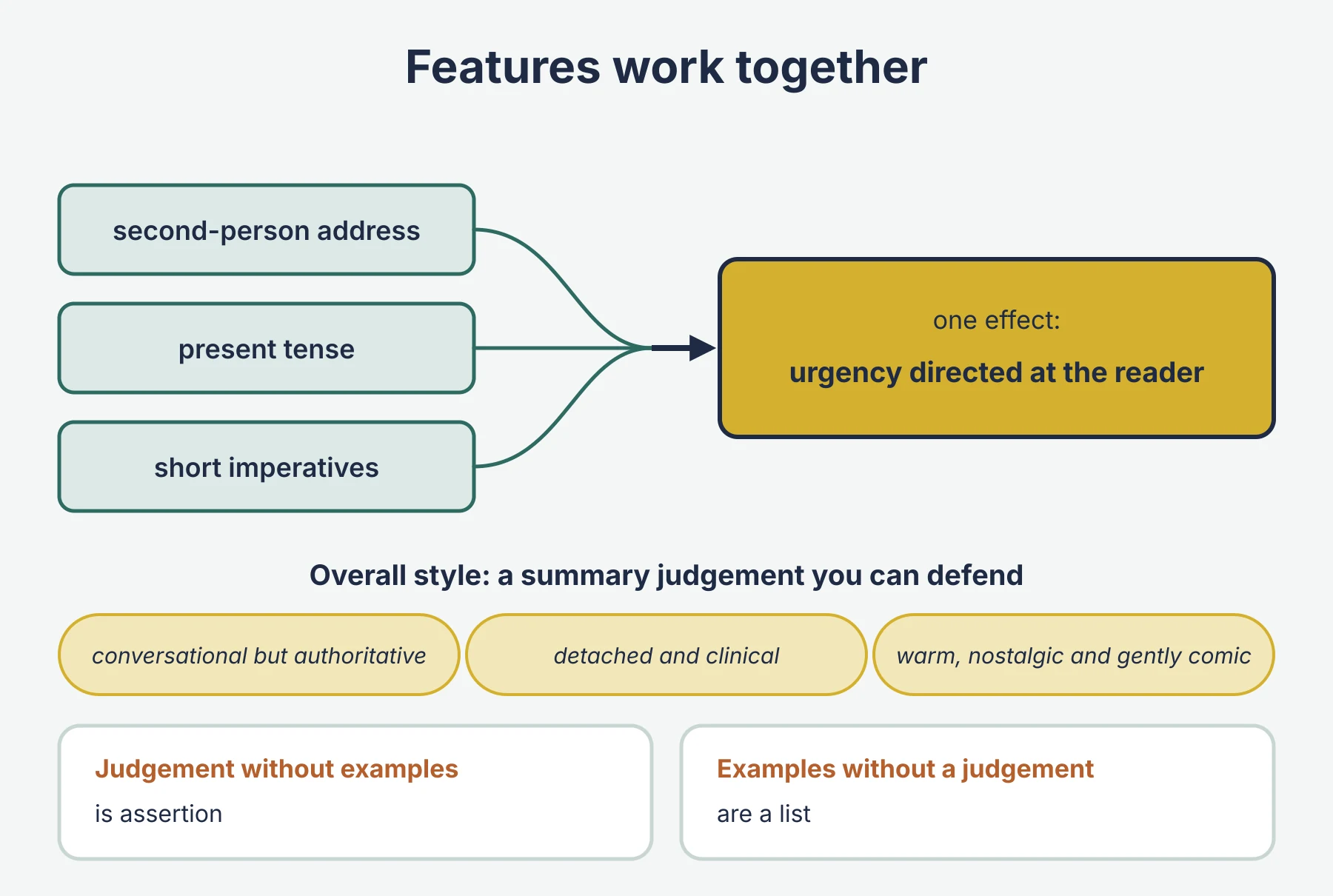
An overall style is a short, defensible label proved by specific instances.
| Style label | Typical evidence |
|---|---|
| Conversational | Contractions, direct address, discourse markers, minor sentences |
| Authoritative | High modality, declaratives, specialist lexis, statistics |
| Detached or clinical | Third person, passive voice, nominalisation, neutral lexis |
| Nostalgic | Past tense, sensory recollection, evaluative adjectives, long cumulative sentences |
| Ironic | Mismatch of register and subject, understatement, inverted commas around terms |
Open your Question 2 answer with the style label and the reasons for it, then prove it.
Writing in the same style
- List the source’s fingerprints: sentence type and length, register, person, tense, devices.
- Reproduce the features, never the phrases.
- Match the ratio of features: if one short sentence ends each paragraph, do the same.
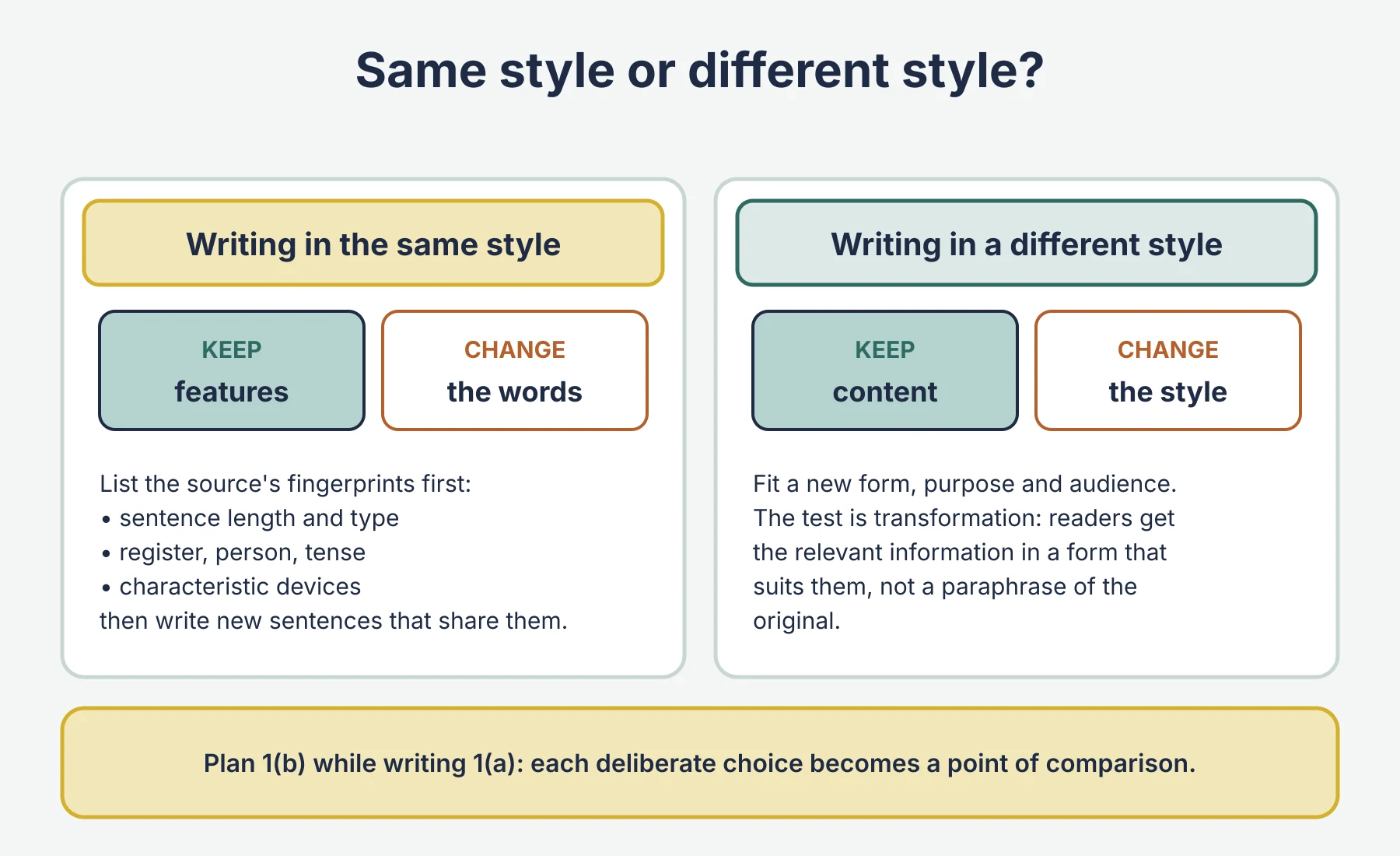
Writing in a different style
- Keep the content; change form, register and structure for the new audience and purpose.
- Select: leave out what the new reader does not need.
- Reorder: put what the new reader needs first.
- Recast: new sentence types, new vocabulary, new address.
Comparing your writing with the source (Question 1(b))
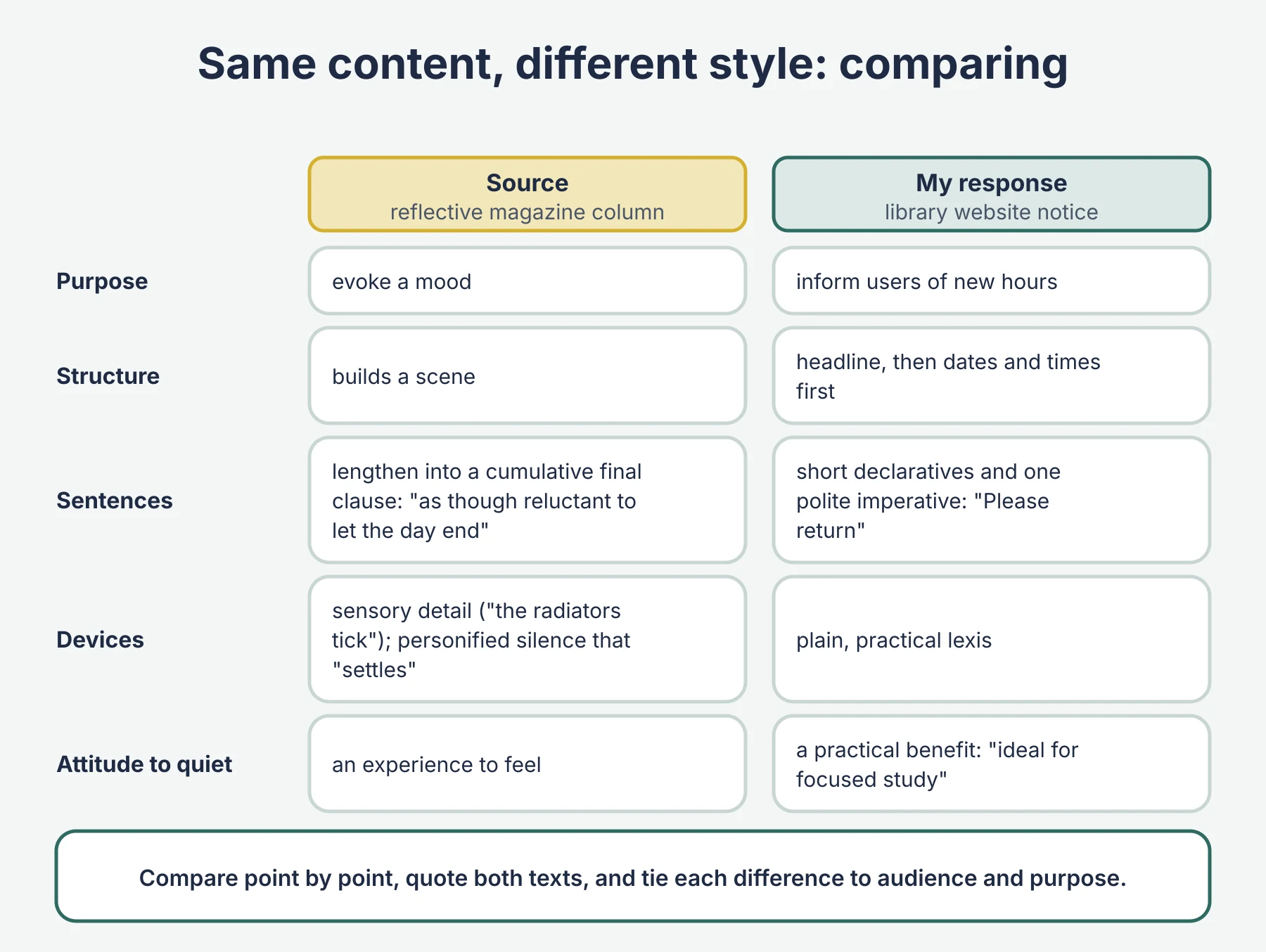
- Compare by point: purpose and audience; form and conventions; structure; sentence-level choices; lexis and tone.
- Quote both texts at each point.
- Explain each difference by the change in audience, purpose or form.
- Note similarities too: compare means similarities and/or differences.
- Plan comparison points while writing 1(a), so your choices are deliberate and explainable.
Linking language bank
- Whereas the source…, my response…
- Both texts…, but…
- This difference reflects the shift from… to…
- The source’s… becomes, in my version,…
- Because my reader…, I replaced… with…
Exam traps
- Annotating before identifying form, audience and purpose.
- Quotations of a full line or more where two words would do.
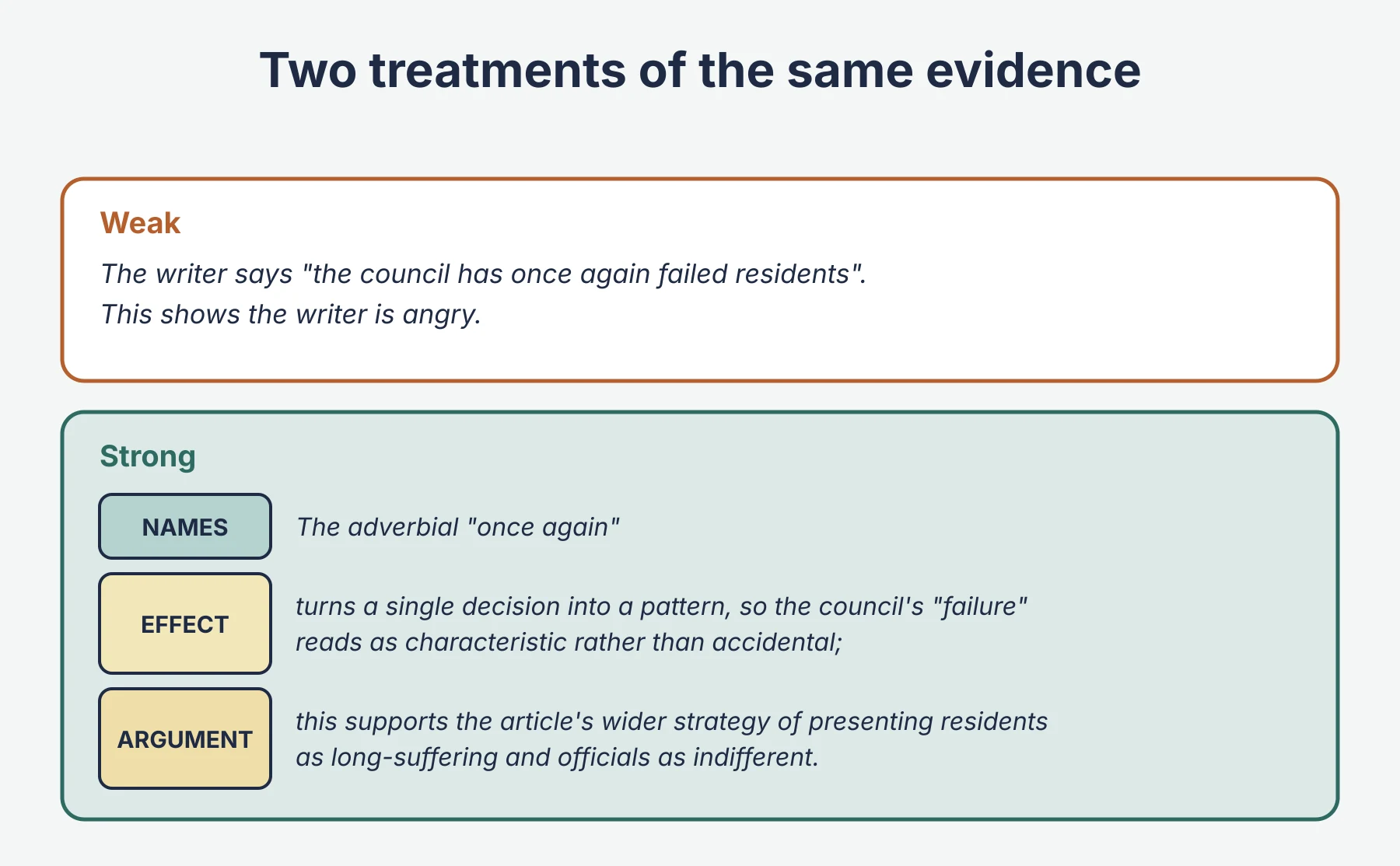
- “This shows…” repeated in every sentence.
- Paragraphs that each make a separate point with no overall argument.
- Copying source phrases in 1(a) instead of transforming them.
- Describing your own text in 1(b) without comparing it with the source.
- Ignoring similarities in a comparison.
- Running over the 150-200 word range in 1(a).
Self-test
- How many marks are Question 1(a) and Question 1(b) worth?
- What does Question 1(b) ask you to compare?
- What should you be able to write before you begin annotating an unseen text?
- Why are shifts in a text worth marking on the second reading?
- What does “elements come together” ask you to show?
- What is an overall style, and how should it be supported?
- Give four precise linking verbs other than “shows”.
- What is the difference between writing in the same style and writing in a different style?
- When imitating a style, what do you reproduce?
- Why should 1(b) be planned while you write 1(a)?
- Which assessment objectives does Question 2 assess?
- Rewrite this weak point: The writer uses the word “crumbling” which shows the building is old.
Answers: 1. 10 and 15. 2. The form, structure and language of your 1(a) response with those of the original text. 3. One sentence stating the text’s form, audience, purpose and context. 4. Shifts in tone, time, focus or sentence pattern are where the writer’s choices are most visible. 5. That features work in combination to create one effect, not separately. 6. A short, defensible summary judgement of the text’s manner, such as “conversational but authoritative”, proved by specific quoted instances. 7. Any four: suggests, implies, foregrounds, undercuts, positions, intensifies, softens, distances, frames, juxtaposes. 8. Same style reproduces the source’s stylistic features in new writing; different style keeps the content but changes the style for a new form, audience and purpose. 9. Its features (sentence types, register, person, tense, devices), not its words. 10. So that each choice in 1(a) is deliberate and can be explained against the source. 11. AO1 and AO3. 12. For example: The present participle “crumbling” presents decay as a continuing process, so the building seems to be failing in front of the reader rather than simply being old.
Work through the Skills and techniques practice questions, and revise the features you will be analysing with the Knowledge and understanding revision notes.
Related resources
-
Practice questions
A Level English Language: Reading and Analysis — Practice Questions
Original practice with worked answers on discourse, register, lexis, grammar and pragmatics for Cambridge AS & A Level English Language 9093 Paper 1.
English · Cambridge · AS Level
Try questions -
Revision notes
A Level English Language: Reading and Analysis — Revision Notes
Condensed recall notes on language frameworks, discourse analysis, register, and directed writing for Cambridge AS & A Level English Language 9093.
English · Cambridge · AS Level
Revise topic -
Study guides
Cambridge A-Level English Language: Paper 1 Reading (9093)
Cambridge International AS & A Level English Language 9093 Paper 1 Reading: textual forms, linguistic features, directed response and text analysis skills.
English · Cambridge · AS Level
Read guide
Get free revision emails (optional)
Occasional emails with practice questions, worked explanations and links to free resources for the qualification and subjects you choose. No spam, and you can unsubscribe from any email. The free tools on this site never need an email.