
Revision Notes
Cambridge International AS & A Level English Language (9093): Knowledge and understanding – Revision Notes
Recall notes for Cambridge 9093 Paper 1 knowledge and understanding: form conventions, word to text-level features, audience, genre, purpose and context.
- Subject
- English
- Level
- AS LEVEL
- Topic
- Paper 1 – Reading
- Author
- Marlbridge Academic Team
- Updated
- Reviewed by
- Ammar Bilal (what this means)
Aligned to Cambridge A Level English (9093), 2024-2026. Official specification .
Syllabus page (what it covers and how it is assessed): Cambridge A Level English Language.
Found an error? Report a correction.
Need help with this topic? Request a free trial class for A Level English Language (9093).
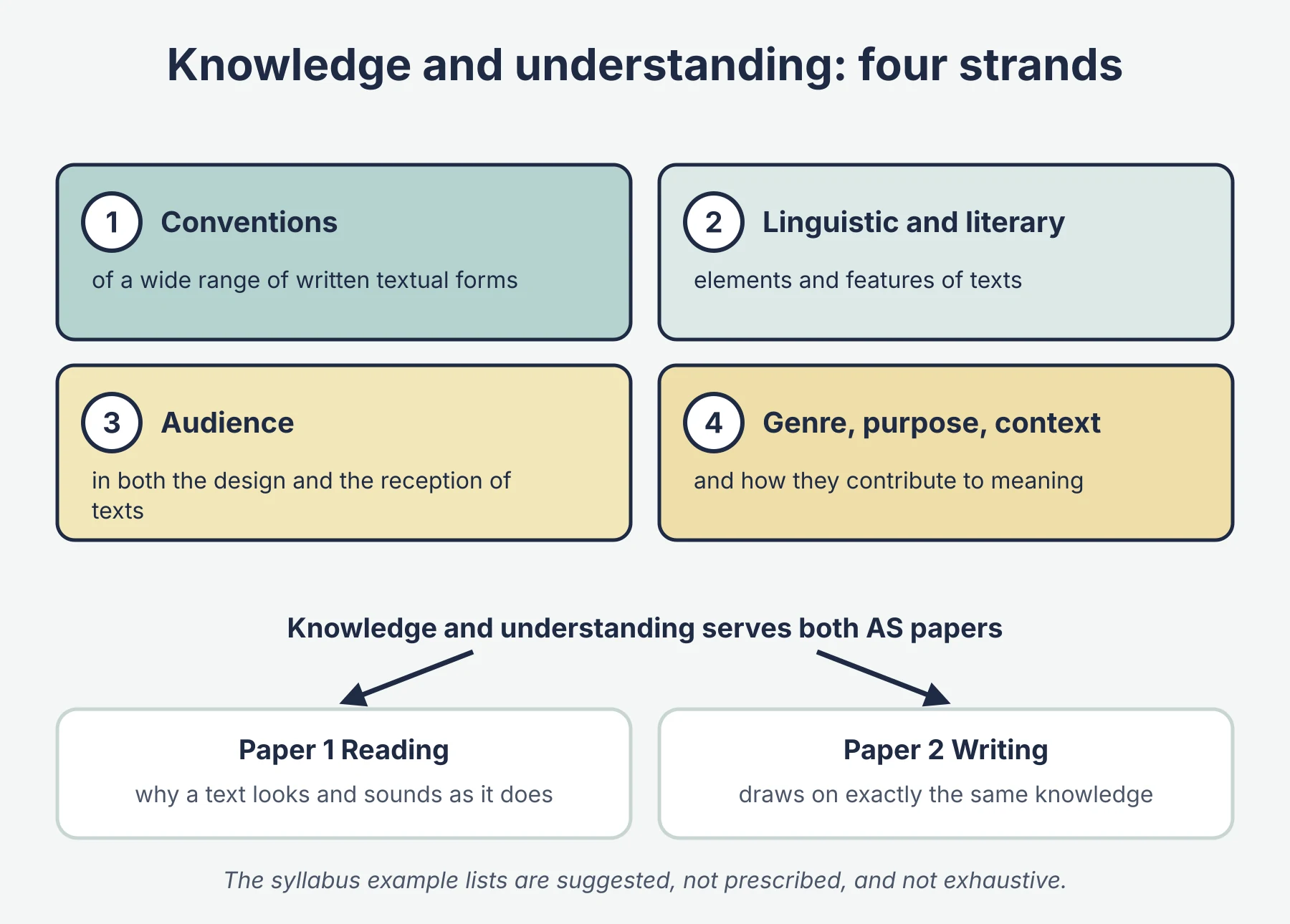
Condensed recall for the knowledge and understanding strand of Paper 1 Reading. The same knowledge is examined in Paper 2 Writing. For full explanations and a worked example, use the Knowledge and understanding study guide.
The four strands in one line each
- Conventions of written textual forms: what readers expect of a form, and what following or breaking that expectation achieves.
- Linguistic elements and literary features: the named features at word, sentence, text and sound level.
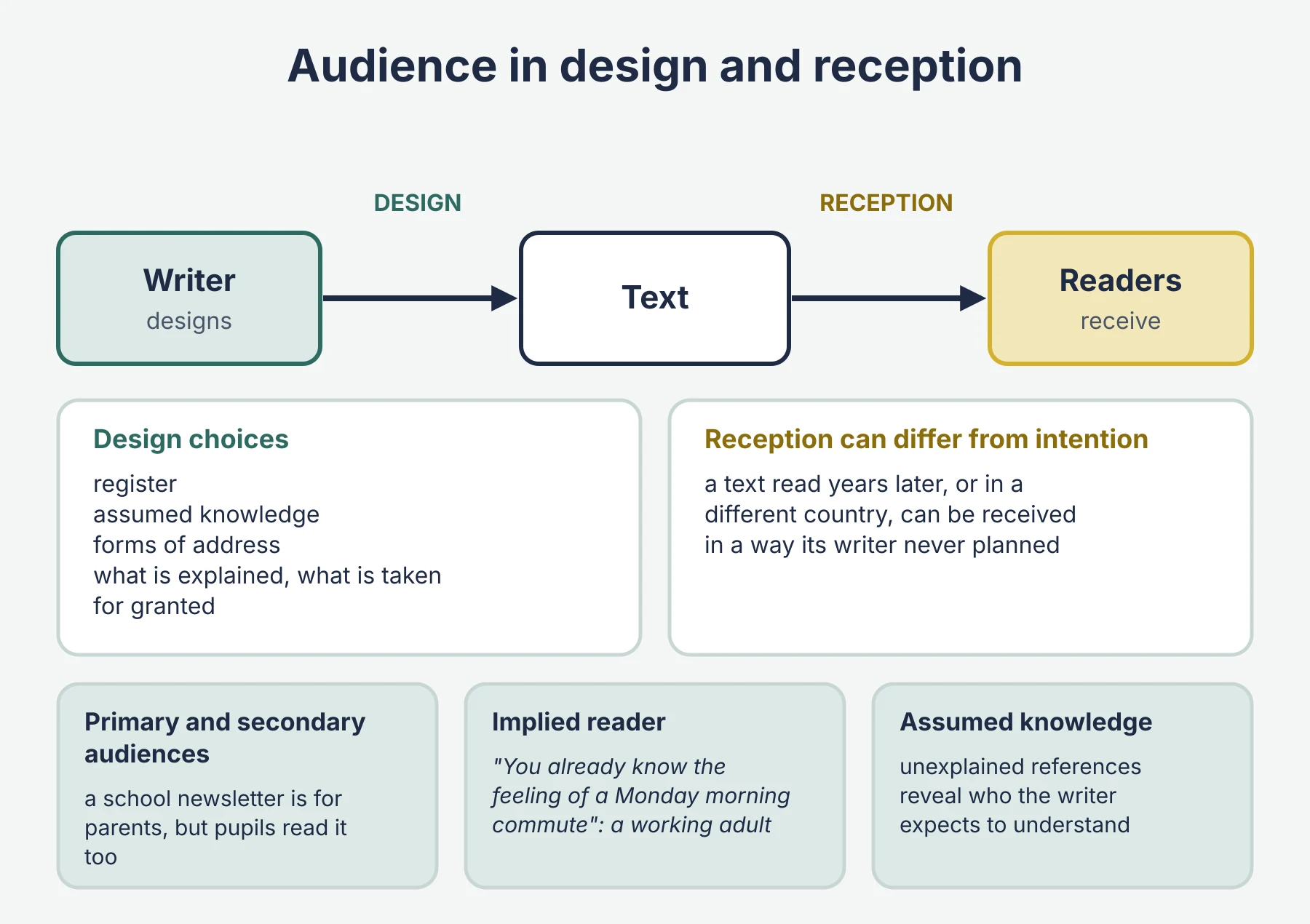
- Audience in design and reception: who the writer designs for, and how real readers receive it.
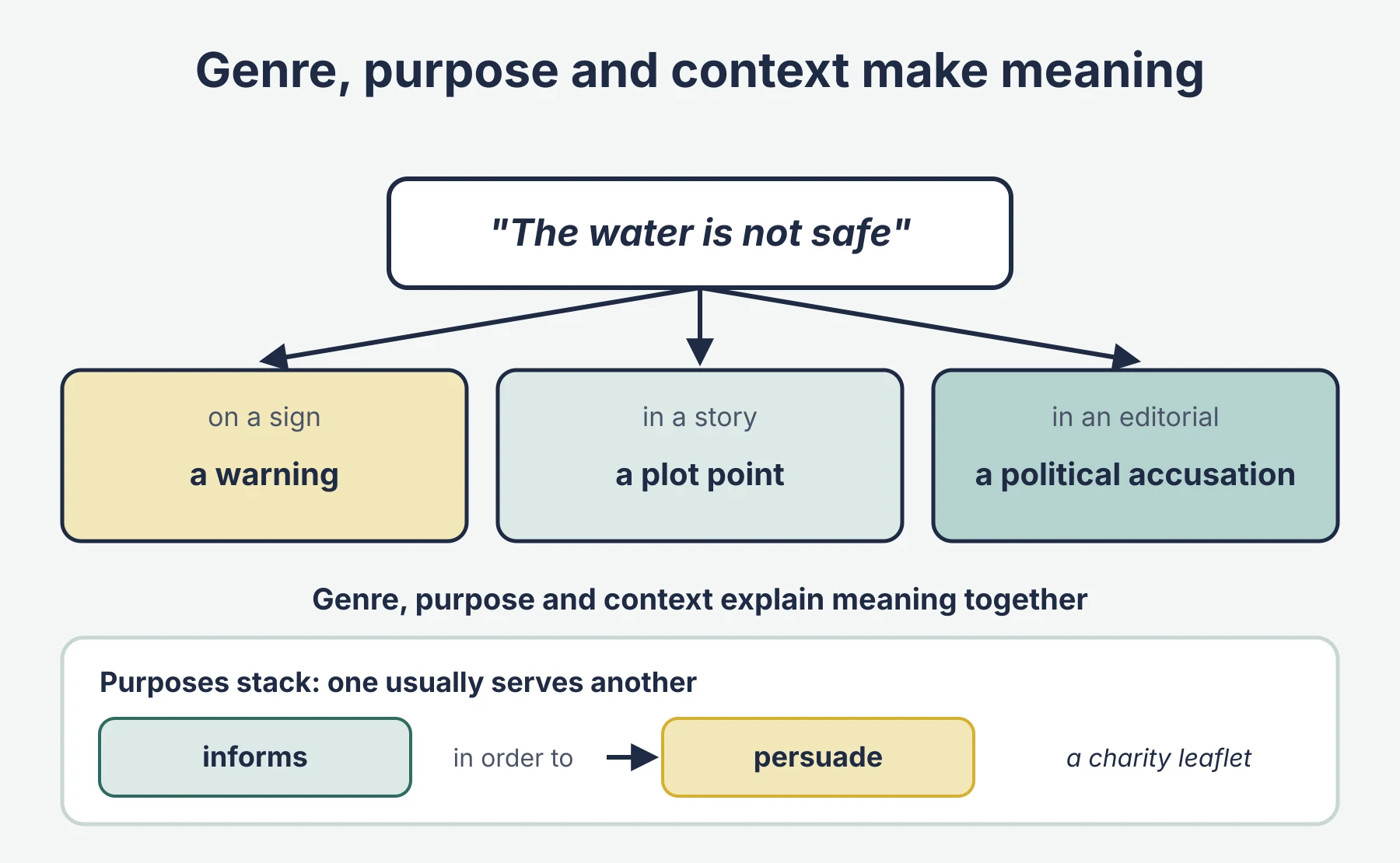
- Genre, purpose and context: how type, aim and circumstances together create meaning.
The syllabus examples are suggestions. You are rewarded for using knowledge accurately, not for covering every item.
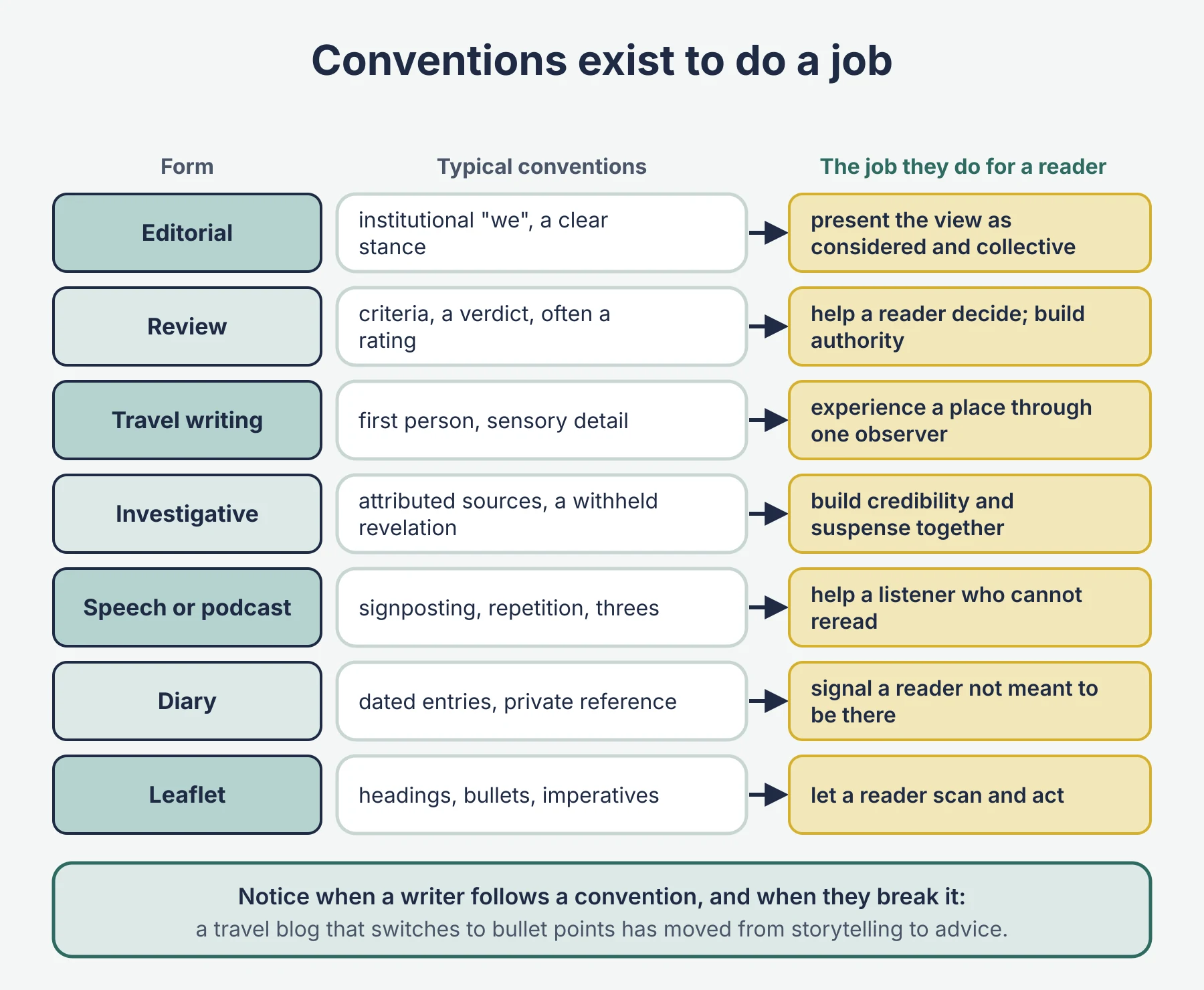
Form conventions: quick bank
- Advertisement: slogan, imperative, direct address, positive evaluative adjectives, brand name repeated.
- Editorial: institutional “we”, stance from the first paragraph, evaluative lexis, closing judgement.
- News story: headline, inverted pyramid (most important first), attributed quotation, past tense reporting.
- Review: context, criteria, evidence, verdict.
- Blog: first person, informal tenor, headings, links or references to readers’ comments.
- Letter: salutation, purpose stated early, sign-off matched to the relationship.
- (Auto)biography: chronology, retrospective narrator, reflection on events.
- Travel writing: first-person observer, sensory detail, comparison with home.
- Diary: date, ellipsis, private reference, present concerns.
- Scripted speech or podcast: greeting, signposting, repetition, rhetorical questions, sign-off.
- Descriptive or narrative writing: sustained imagery, perspective, structural shifts in time or focus.
Key terms
| Term | Meaning | Example |
|---|---|---|
| Word class | Grammatical category of a word | “swiftly” is an adverb |
| Morphology | How words are built from morphemes | “un-forget-able” |
| Affixation | Adding a prefix or suffix | “rebrand”, “brandless” |
| Compounding | Joining two words | “handmade” |
| Fronting | Moving an element to the start for emphasis | “Into the storm they walked.” |
| End-focus | Placing new or key information last | “What we lost was trust.” |
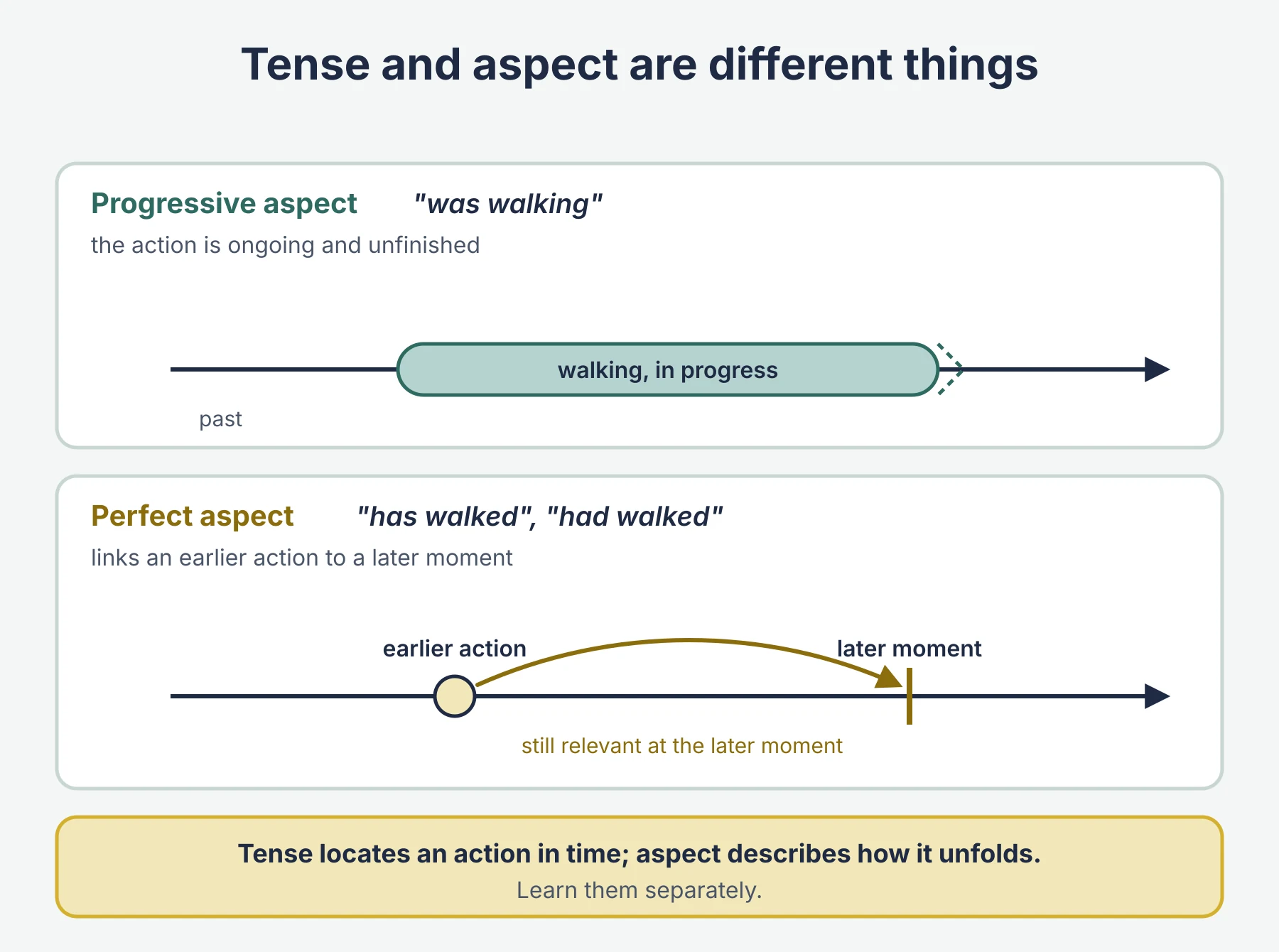
| Tense | Time of an action (past or present in English verb forms) | “walked” / “walks” |
| Aspect | How an action unfolds: progressive or perfect | “was walking”; “had walked” |
| Grammatical voice | Active or passive | “The council closed the road” / “The road was closed” |
| Modality | Degree of certainty or obligation | “must”, “may”, “perhaps” |
| Narrative perspective | Position from which events are told | First-person retrospective narrator |
| Phonology | Sound patterning | Sibilance in “silent, slow, sinking” |
| Rhetorical device | Pattern used to persuade or emphasise | Antithesis: “not a cost but an investment” |
| Pragmatics | Meaning inferred from context | “It’s cold in here” as a request to close a window |
| Implied reader | The reader a text constructs and assumes | “As a busy parent, you…” |
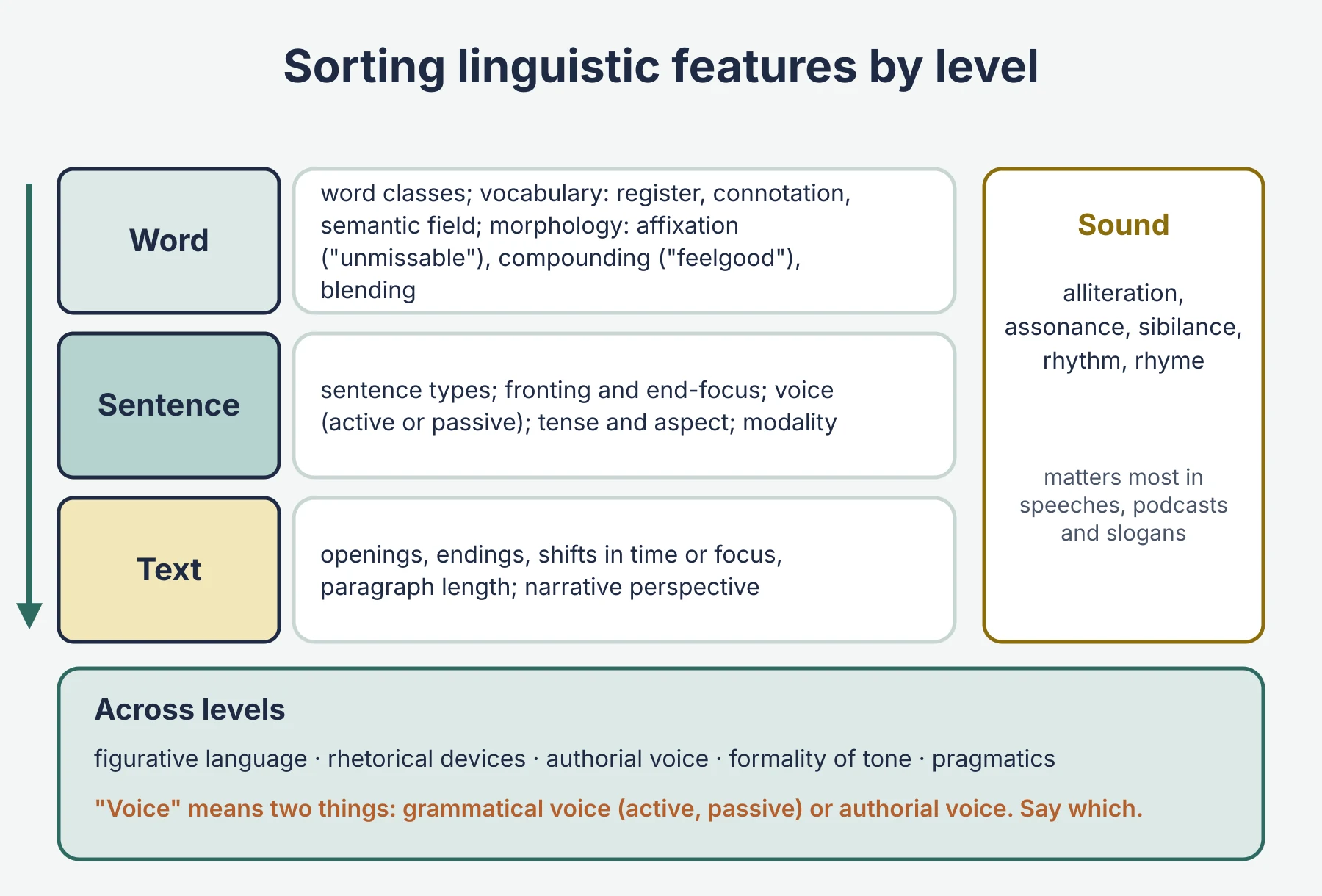
Sentence and text level reminders
- Sentence types: simple, compound, complex, minor (no main verb: “Not again.”).
- Variety matters more than length: a minor sentence after long complex ones is emphatic.
- Text structure: openings (hook, context, in medias res), shifts (time, place, tone), endings (circular, open, call to action).
- Perspective: first person creates intimacy and bias; second person involves the reader; third person can be detached or close to one character.
Audience: design versus reception
- Design: register, assumed knowledge, address forms, what is explained.
- Reception: how actual readers respond, which can differ by age, culture, period or purpose of reading.
- Primary and secondary audience: the reader addressed and others who will also read it.
- Assumed knowledge is evidence: unexplained acronyms point to a specialist audience.
Genre, purpose and context
- Purposes combine: inform to persuade, entertain to advise. Name the main purpose and the one it serves.
- Context of production: writer, date, place, publication, constraints such as word limits.
- Context of reception: where, when and by whom it is read.
- Hybrid genres: a sponsored article mixes journalism and advertising, so its conventions pull in two directions.
Exam traps
- Saying “tense” when you mean aspect, or “voice” without saying which kind.
- Labelling the form and moving on, instead of saying which conventions appear and why.
- Writing “the audience is the reader” rather than identifying an age group, interest or level of knowledge.
- Treating a broken convention as a writer’s mistake rather than a choice.
- Listing purposes without ranking them.
- Forcing every item from the syllabus example list into one answer.
Self-test
- What are the four strands of knowledge and understanding for Paper 1?
- Which other 9093 paper draws on the same knowledge and understanding?
- Define aspect and give one example of each type.
- What is the difference between grammatical voice and authorial voice?
- Give two conventions of a news story.
- What does end-focus mean?
- What is the difference between audience in design and audience in reception?
- Give one piece of linguistic evidence that a text assumes a specialist audience.
- Why is “inform” rarely a full account of a charity leaflet’s purpose?
- Identify the morphological process in “unputdownable”.
- What is a minor sentence?
- What is an implied reader?
Answers: 1. Conventions of written textual forms; linguistic elements and literary features; the significance of audience in design and reception; how genre, purpose and context contribute to meaning. 2. Paper 2 Writing. 3. Aspect is how an action unfolds in time: progressive (“is running”, “was running”) presents it as ongoing; perfect (“has run”, “had run”) links a completed action to a later point. 4. Grammatical voice is active or passive construction; authorial voice is the writer’s distinctive presence and personality in the text. 5. Any two: headline; most important information first; attributed quotations; past-tense reporting; named sources. 6. Placing the most important or new information at the end of a sentence, where it carries natural emphasis. 7. Design is how the writer shapes the text for an intended audience; reception is how actual readers interpret it, which can differ from that intention. 8. Any one: unexplained technical terms or acronyms; references the writer does not explain; specialist abbreviations. 9. It informs in order to persuade: the information is selected to move the reader to give or act. 10. Affixation (prefix “un-” and suffix “-able” around the phrase “put down”). 11. A sentence without a main verb, such as “Not again.” 12. The reader a text constructs and assumes, revealed by its address, assumptions and references.
Try the Knowledge and understanding practice questions, then the Paper 1 Reading revision notes for the whole paper.
Related resources
-
Study guides
Cambridge International AS & A Level English Language (9093): Skills and techniques
Cambridge 9093 Paper 1 skills and techniques: selecting evidence, judging style, building a cohesive argument and writing in the same or a different style.
English · Cambridge · AS Level
Read guide -
Practice questions
Cambridge International AS & A Level English Language (9093): Skills and techniques – Practice Questions
Original practice for Cambridge 9093 Paper 1 skills: embedding quotations, judging style, imitating a style and comparing your own writing, with model answers.
English · Cambridge · AS Level
Try questions -
Revision notes
Cambridge International AS & A Level English Language (9093): Skills and techniques – Revision Notes
Recall notes for Cambridge 9093 Paper 1 skills: reading unseen texts, embedding evidence, judging overall style, style imitation and comparing your own writing.
English · Cambridge · AS Level
Revise topic
Get free revision emails (optional)
Occasional emails with practice questions, worked explanations and links to free resources for the qualification and subjects you choose. No spam, and you can unsubscribe from any email. The free tools on this site never need an email.