
Revision Notes
Cambridge A Level World History (9489): Hitler's Germany, 1929-41 – Revision Notes
Revision notes for Cambridge 9489 Paper 4, Hitler's Germany 1929-41: key terms, election figures, a dated timeline, the key questions condensed and a self-test.
- Subject
- World History
- Level
- A LEVEL
- Topic
- Topic 5: European option: European history, 1919-41
- Author
- Marlbridge Academic Team
- Updated
- Reviewed by
- Azam Siddique (what this means)
Aligned to Cambridge A Level World History (9489), 2027-2029. Official specification .
Syllabus page (what it covers and how it is assessed): Cambridge A Level World History.
Syllabus points this page covers
9489 (A Level)
- 3 Hitler’s Germany, 1929–41
Found an error? Report a correction.
Need help with this topic? Request a free trial class for A Level World History (9489).
These notes condense Hitler’s Germany, 1929-41, the third topic of the Paper 4 European option in Cambridge 9489. For explanation and an annotated plan see the Hitler’s Germany study guide; for essays and short questions see the Hitler’s Germany practice questions.
Syllabus coverage
- 3.1 How did Hitler gain control of Germany?
- 3.2 How effectively did the Nazis govern Germany?
- 3.3 How successful were Nazi economic policies?
- 3.4 How far did the Nazis transform German society?
Key terms
| Term | Meaning |
|---|---|
| Article 48 | Weimar emergency clause letting the president rule by decree |
| Presidential cabinets | Brüning, Papen and Schleicher governments relying on Hindenburg, not the Reichstag |
| Harzburg Front | 1931 alliance of Nazis, DNVP and nationalist groups against the Republic |
| Enabling Act | March 1933 law letting the cabinet make laws without the Reichstag for four years |
| Gleichschaltung | “Co-ordination”: bringing states, unions, parties and organisations under Nazi control |
| SD | Security Service of the SS, under Heydrich |
| Block warden | Party official watching a group of households |
| Mefo bills | Credit notes used from 1934 to fund rearmament off the books |
| New Plan | Schacht’s 1934 controls on imports and foreign exchange through bilateral trade |
| Four Year Plan | Göring’s 1936 plan to prepare the economy for war and achieve autarky |
| DAF | German Labour Front, replacing trade unions in 1933 |
| KdF | Strength through Joy: subsidised leisure for workers |
| Volksgemeinschaft | The “people’s community” the Nazis claimed to build |
| Confessing Church | Protestant church opposing Nazi control of doctrine, from 1934 |
| Edelweiss Pirates | Working-class youth groups who rejected the Hitler Youth |
Reichstag seats to learn
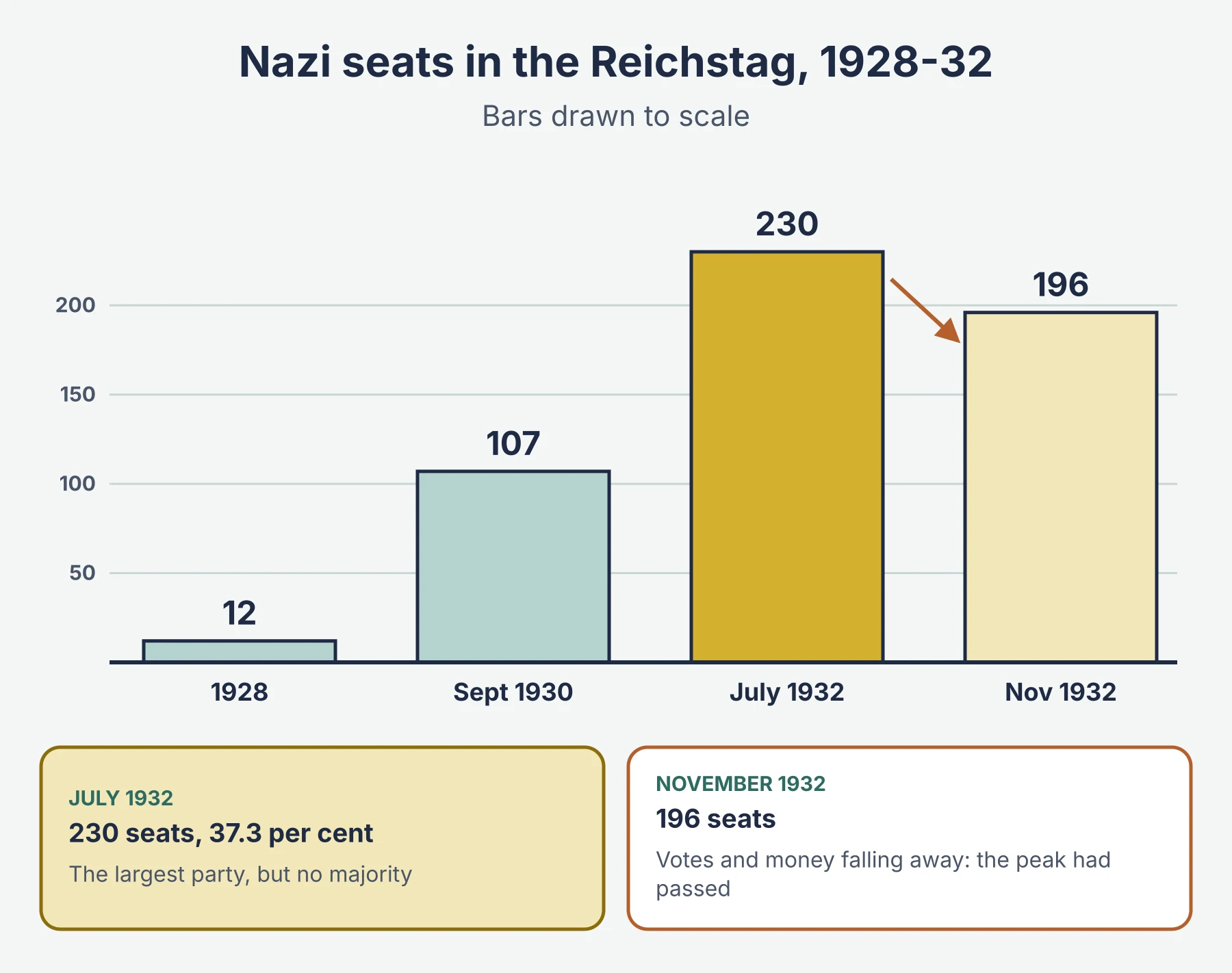
| Election | Nazi seats | Note |
|---|---|---|
| May 1928 | 12 | Before the Depression |
| Sept 1930 | 107 | Breakthrough under Brüning |
| July 1932 | 230 | Largest party, 37.3 per cent |
| Nov 1932 | 196 | First fall; KPD rises to 100 |
| March 1933 | 288 | 43.9 per cent after the Reichstag Fire |
Timeline to learn
| Date | Event |
|---|---|
| Oct 1929 | Wall Street Crash |
| March 1930 | Müller’s coalition falls; Brüning appointed |
| April 1932 | Hindenburg re-elected president, defeating Hitler |
| June-Nov 1932 | Papen’s government; SA ban lifted |
| Dec 1932 | Schleicher becomes chancellor |
| 4 Jan 1933 | Papen meets Hitler in Cologne |
| 30 Jan 1933 | Hitler appointed Chancellor |
| 27-28 Feb 1933 | Reichstag Fire and emergency decree |
| 23 March 1933 | Enabling Act |
| April 1933 | Boycott of Jewish shops; civil service law |
| May-July 1933 | Unions abolished; DAF; parties banned |
| July 1933 | Concordat; sterilisation law |
| Oct 1933 | Germany leaves the League |
| 30 June 1934 | Night of the Long Knives |
| 2 Aug 1934 | Hindenburg dies; army oath to Hitler |
| Sept 1935 | Nuremberg Laws |
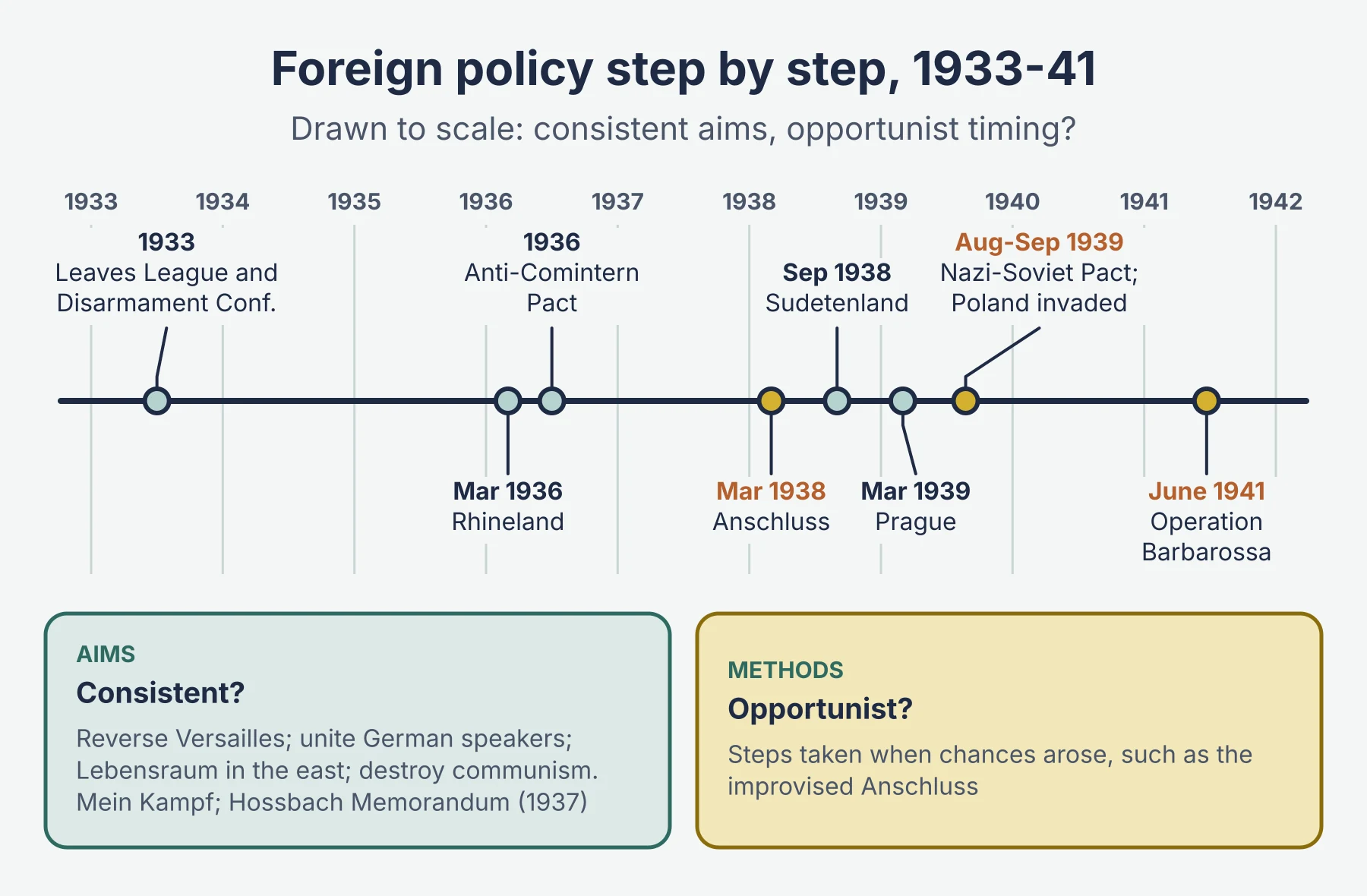
| March 1936 | Rhineland remilitarised |
| Oct 1936 | Four Year Plan |
| March 1938 | Anschluss |
| Nov 1938 | Kristallnacht |
| Aug-Sept 1939 | Nazi-Soviet Pact; invasion of Poland |
| June 1941 | Operation Barbarossa |
| Aug 1941 | Galen’s sermon against euthanasia |
3.1 Gaining control – three layers
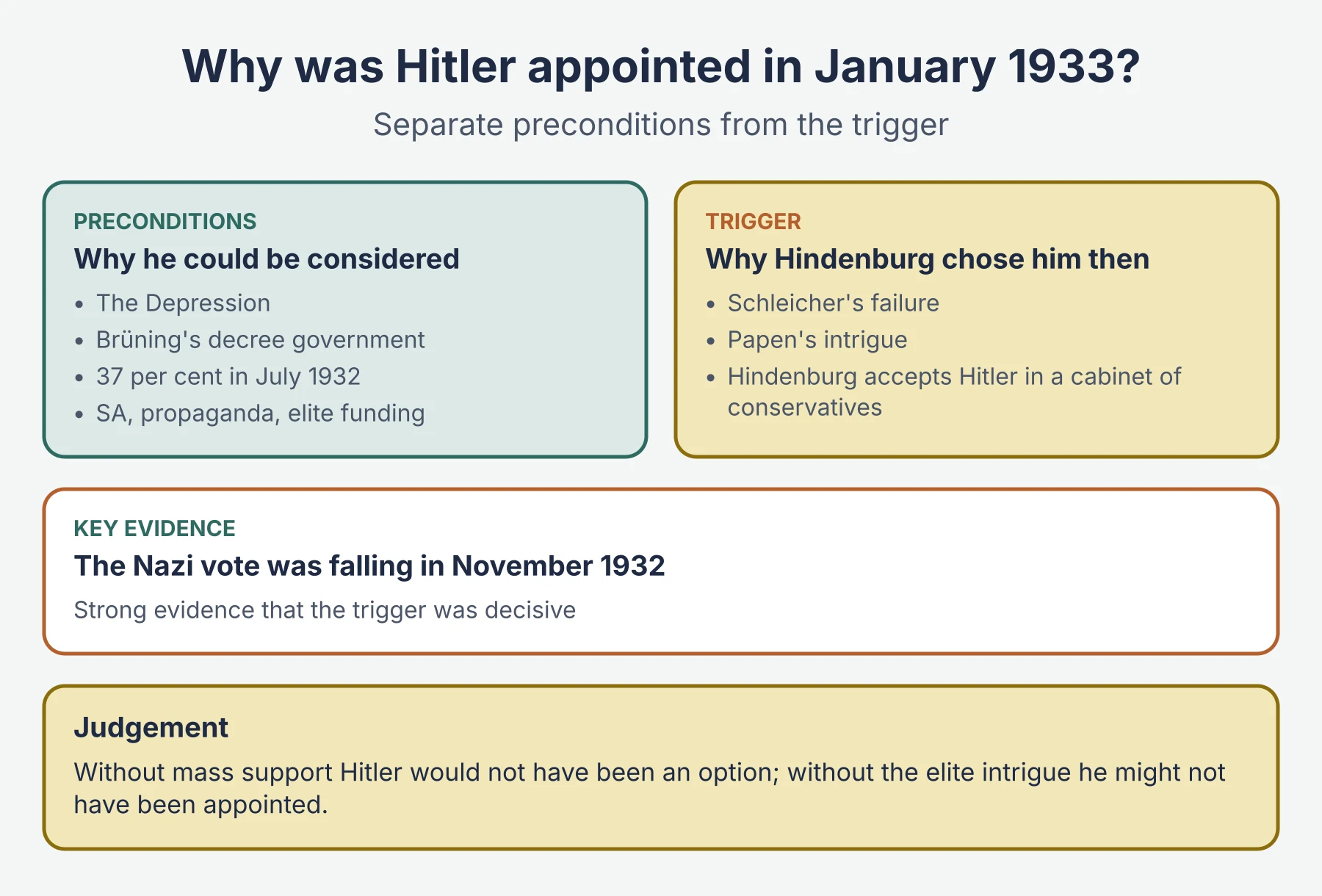
- Crisis: Depression, unemployment, presidential decree government, communist growth.
- Mass support: Hitler’s appeal, SA, Goebbels’ targeted propaganda, elite backing.
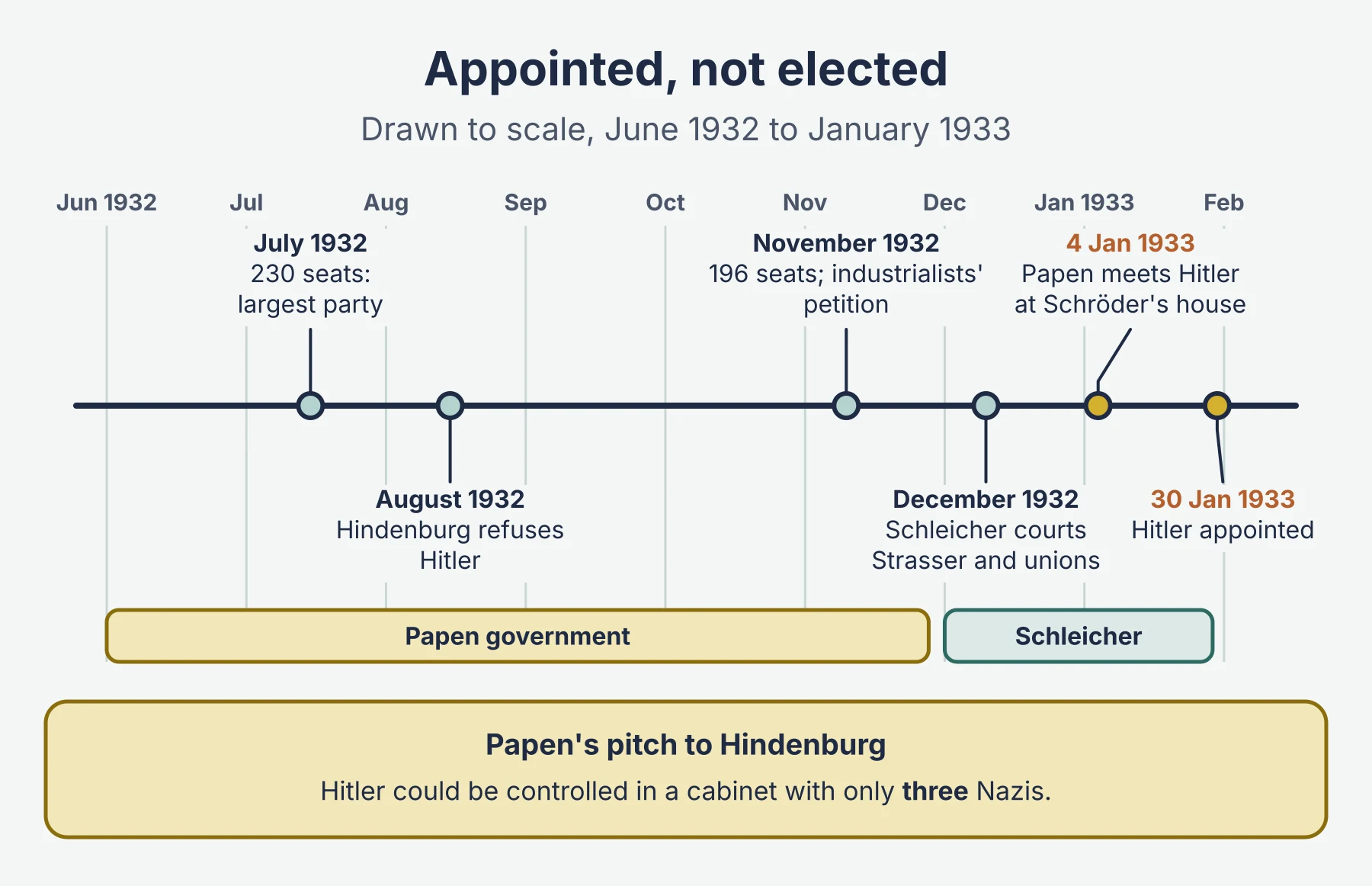
- Intrigue: Papen and Hindenburg’s deal after Schleicher’s failure – the decisive step.
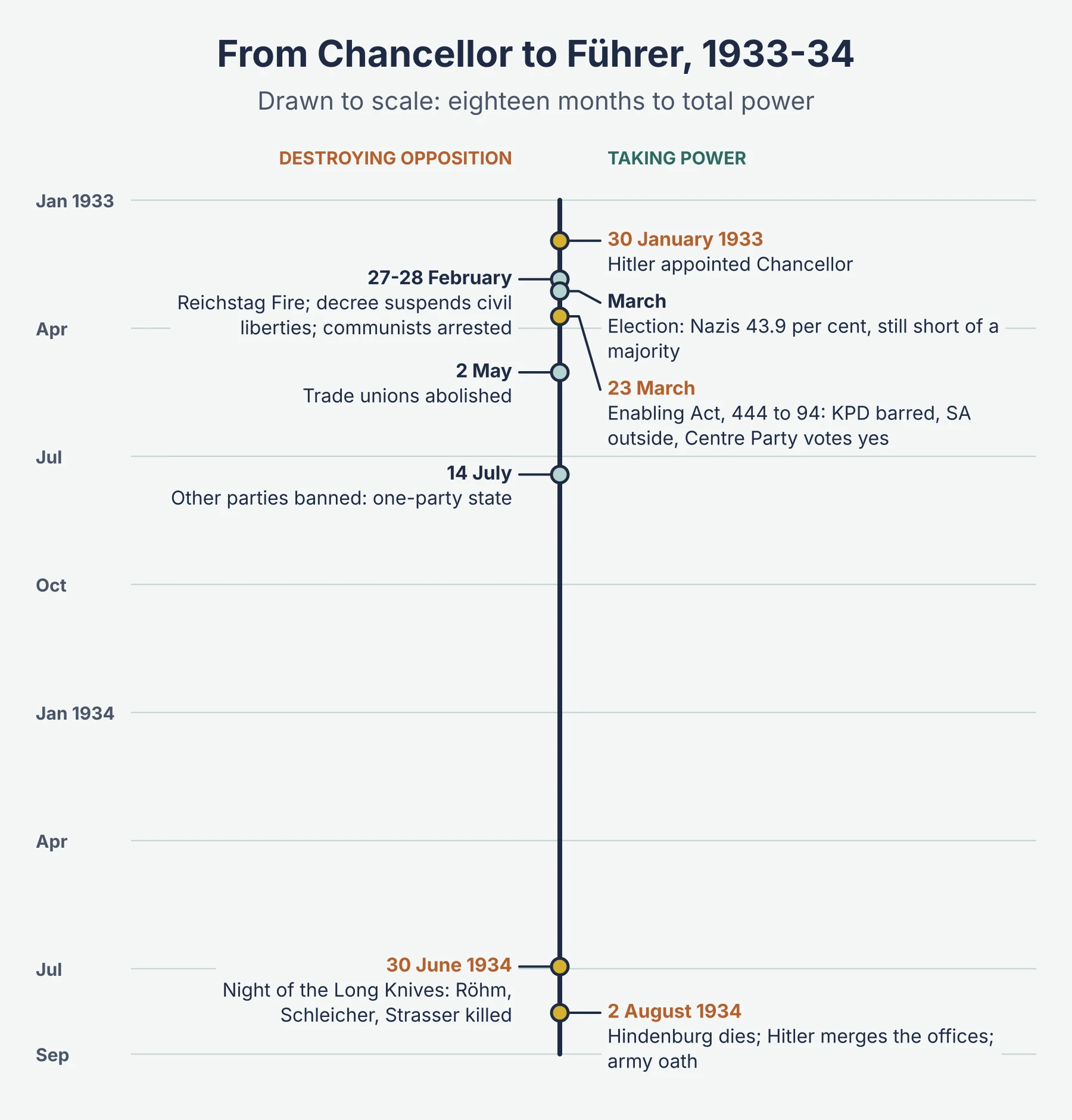
Then consolidation: Fire decree, March election, Enabling Act, Gleichschaltung, Night of the Long Knives, army oath.
3.2 Governing – key points
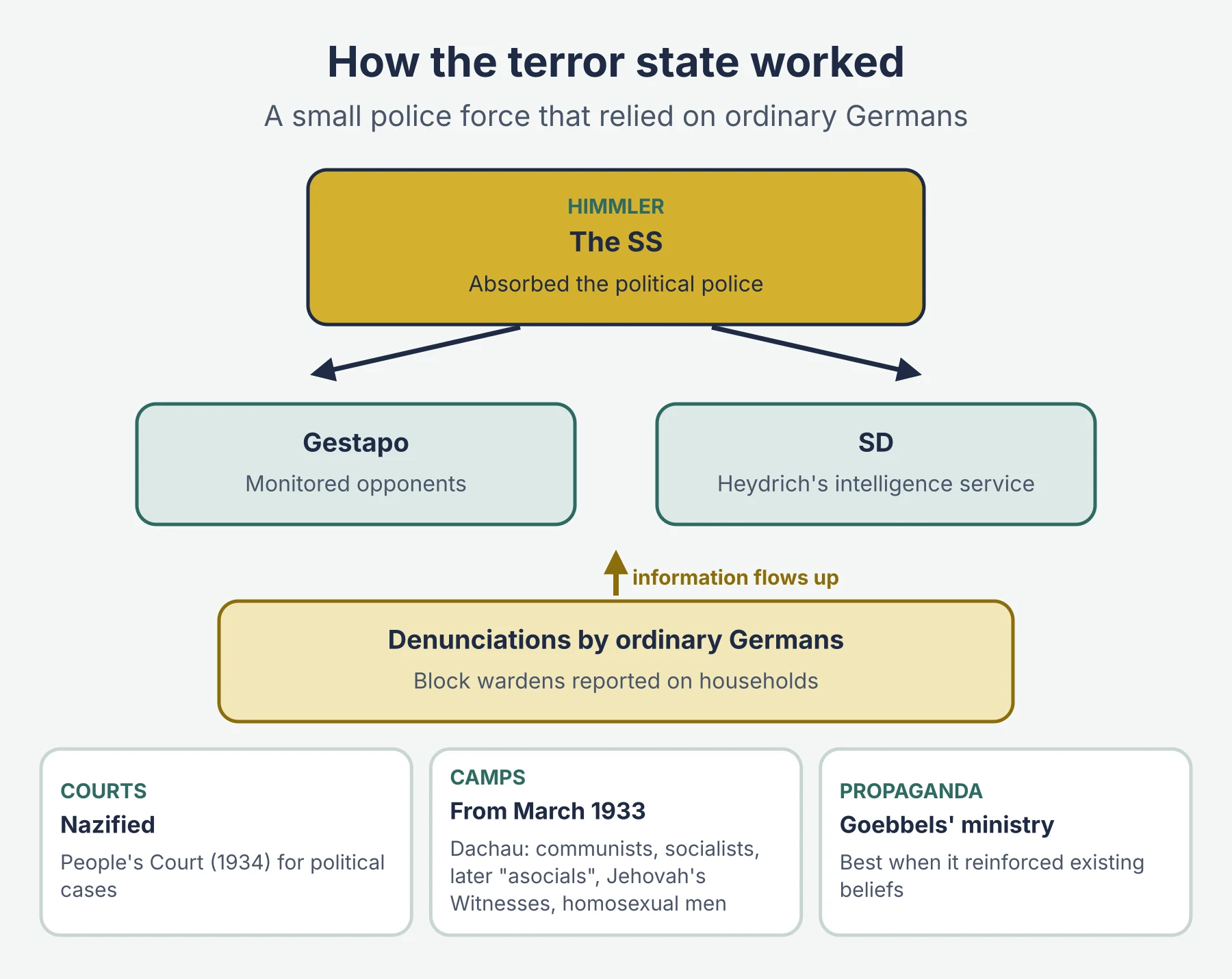
- Terror: SS, Gestapo, SD, block wardens, People’s Court, camps from 1933; denunciations did much of the work.
- Propaganda: Goebbels’ ministry, radio, film, rallies, the 1936 Olympics; strongest when reinforcing existing views.
- Opposition: youth groups, churches (Niemöller, Galen), the underground left, passive non-conformity; none threatened the regime before 1941.
- Foreign policy: aims (Versailles, pan-Germanism, Lebensraum, anti-communism) against methods (bluff, treaties, war); debate on planning versus opportunism.
3.3 Economy – two phases
| Phase | Leader | Features |
|---|---|---|
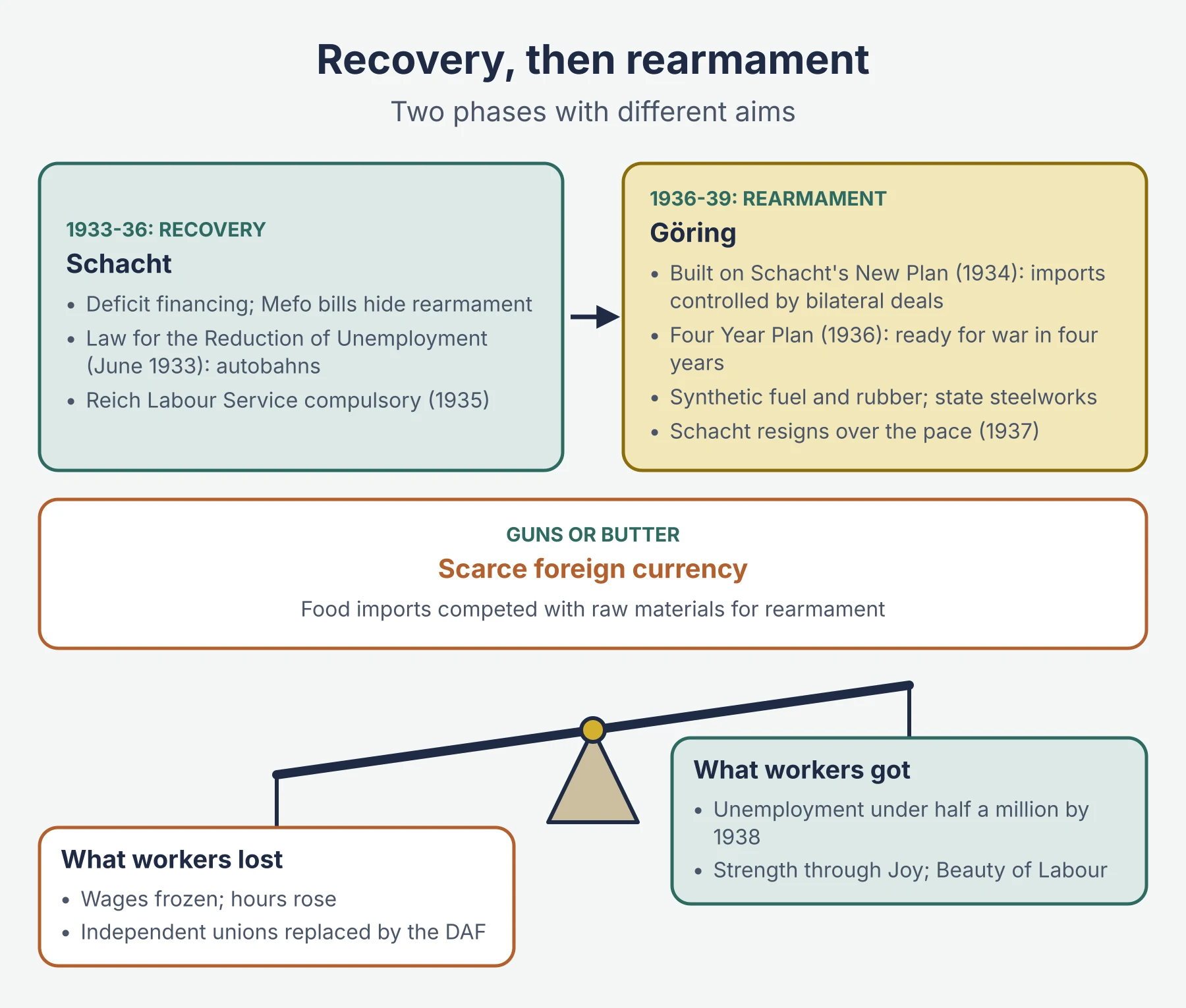
| Recovery, 1933-36 | Schacht | Deficit spending, Mefo bills, public works, Labour Service, New Plan |
| War economy, 1936-39 | Göring | Four Year Plan, synthetic fuel and rubber, state steelworks, autarky |
Living standards: jobs restored, but wages frozen, longer hours, no unions; KdF and Beauty of Labour as compensation.
3.4 Society – checklist
- Women: marriage loans, Mother’s Cross; reversal from 1937 as labour ran short.
- Youth: new syllabus, controlled teachers, elite schools; Hitler Youth and BDM compulsory from 1939.
- Churches: Concordat; Reich Church and German Christians; German Faith Movement.
- Minorities: boycott, Nuremberg Laws, Kristallnacht; sterilisation and T4; Roma, Jehovah’s Witnesses, homosexual men.
Exam traps
- Appointed, not elected: Hitler never won a majority in a free election.
- Legal revolution: each legal step relied on coercion; say how.
- Economic success: distinguish employment from living standards and from war readiness.
- Opposition: define it; non-conformity is not resistance aimed at overthrow.
- Women’s policy: note the change of direction from 1937.
Self-test
- Why did Müller’s coalition collapse in 1930? The SPD and DVP could not agree over unemployment insurance contributions.
- How did Brüning govern? Through presidential decrees under Article 48.
- How many seats did the Nazis win in July 1932? 230.
- Who arranged the deal that made Hitler Chancellor? Papen, with Hindenburg’s agreement, after meeting Hitler in Cologne on 4 January 1933.
- How many Nazis were in Hitler’s first cabinet? Three, including Hitler.
- What did the decree of 28 February 1933 do? It suspended civil liberties after the Reichstag Fire.
- Which party’s votes ensured the Enabling Act’s two-thirds majority? The Centre Party’s.
- What were Mefo bills? Credit notes used to fund rearmament without showing it in the budget.
- What did the Reich Entailed Farm Law do? It made medium-sized farms unsaleable and inheritable by a single heir.
- Who led the Four Year Plan? Hermann Göring.
- Name two youth groups that rejected the Hitler Youth. The Swing movement and the Edelweiss Pirates.
- What happened on 9-10 November 1938? Kristallnacht, the pogrom against Jewish homes, shops and synagogues.
Official syllabus
Cambridge International AS & A Level History (9489) syllabus for 2027, 2028 and 2029 – cambridgeinternational.org (Paper 4, European option, topic 3).
Related resources
-
Study guides
Cambridge A Level World History (9489): Mussolini's Italy, 1919-41
Study guide to Cambridge 9489 Paper 4 topic 1, Mussolini's Italy 1919-41: the rise to power, fascist government, economic battles and how far society changed.
World History · Cambridge · A Level
Read guide -
Practice questions
Cambridge A Level World History (9489): Mussolini's Italy, 1919-41 – Practice Questions
Twelve original practice questions on Cambridge 9489 Mussolini's Italy: short recall items and Paper 4-style 30-mark essays, with mark-scheme style answers.
World History · Cambridge · A Level
Try questions -
Revision notes
Cambridge A Level World History (9489): Mussolini's Italy, 1919-41 – Revision Notes
Revision notes for Cambridge 9489 Paper 4, Mussolini's Italy 1919-41: key terms, a dated timeline, the four key questions in brief, exam traps and a self-test.
World History · Cambridge · A Level
Revise topic
Get free revision emails (optional)
Occasional emails with practice questions, worked explanations and links to free resources for the qualification and subjects you choose. No spam, and you can unsubscribe from any email. The free tools on this site never need an email.