
Revision Notes
Cambridge A Level World History (9489): Mussolini's Italy, 1919-41 – Revision Notes
Revision notes for Cambridge 9489 Paper 4, Mussolini's Italy 1919-41: key terms, a dated timeline, the four key questions in brief, exam traps and a self-test.
- Subject
- World History
- Level
- A LEVEL
- Topic
- Topic 5: European option: European history, 1919-41
- Author
- Marlbridge Academic Team
- Updated
- Reviewed by
- Azam Siddique (what this means)
Aligned to Cambridge A Level World History (9489), 2027-2029. Official specification .
Syllabus page (what it covers and how it is assessed): Cambridge A Level World History.
Syllabus points this page covers
9489 (A Level)
- 1 Mussolini’s Italy, 1919–41
Found an error? Report a correction.
Need help with this topic? Request a free trial class for A Level World History (9489).
These notes condense Mussolini’s Italy, 1919-41, the first topic of the Paper 4 European option in Cambridge 9489, for fast recall. For explanation and an annotated essay plan use the Mussolini’s Italy study guide; for essays and short questions use the Mussolini’s Italy practice questions.
Syllabus coverage
- 1.1 How did Mussolini gain control of Italy?
- 1.2 How effectively did Mussolini govern Italy?
- 1.3 How successful were Mussolini’s economic policies?
- 1.4 How far did Mussolini transform Italian society?
Paper 4 has no rotation: any of the four key questions, or a question crossing two of them, can be set.
Key terms
| Term | Meaning |
|---|---|
| Mutilated victory | Nationalist claim that the Allies cheated Italy of Dalmatia and Fiume in 1919 |
| Biennio Rosso | “Two red years”, 1919-20: strikes, land seizures and factory occupations |
| Squadrismo | Violence by fascist squads against socialists, unions and co-operatives |
| Ras | Provincial fascist bosses who led the squads, such as Balbo and Farinacci |
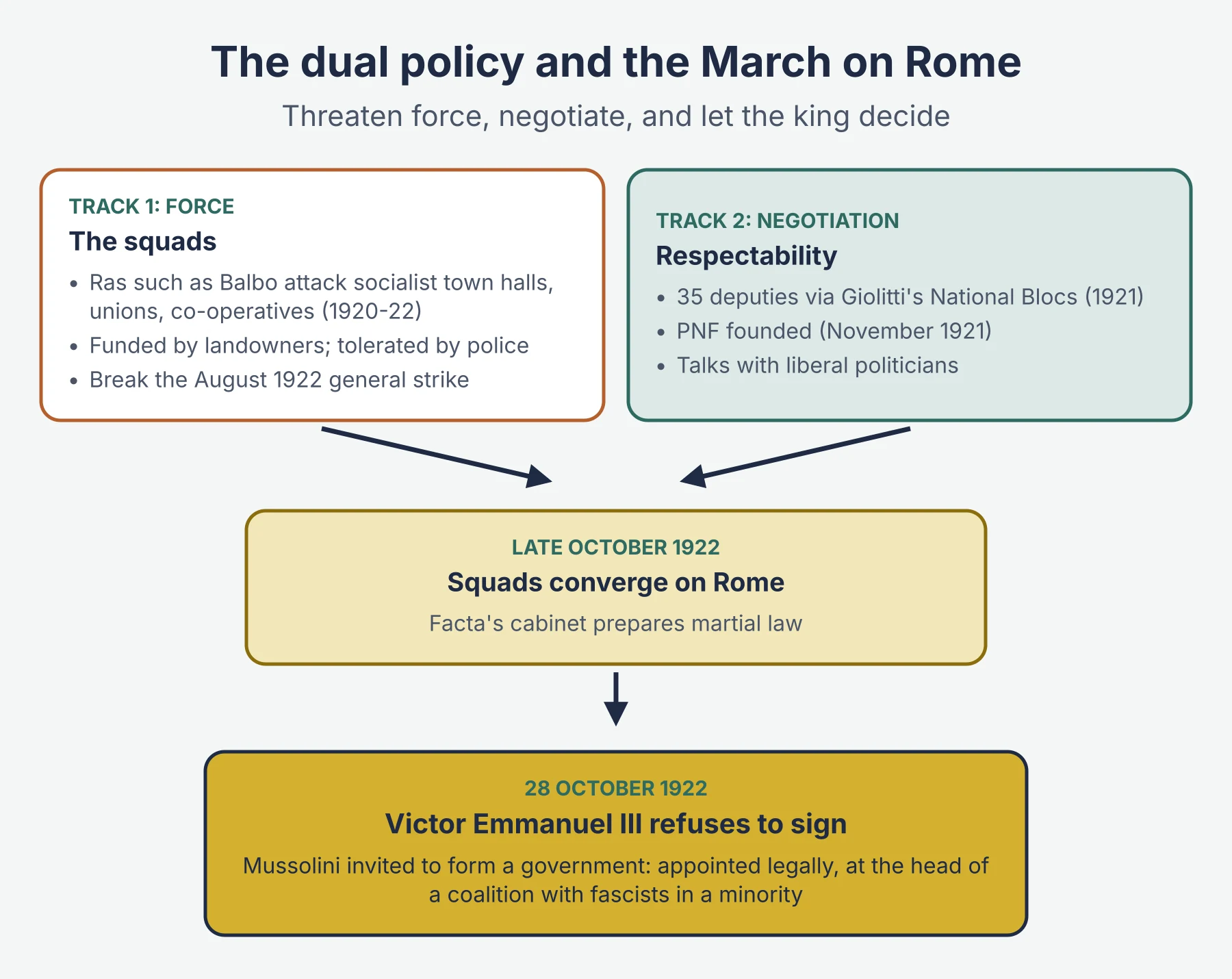
| Dual policy | Mussolini’s mix of threatened violence and parliamentary negotiation, 1921-22 |
| Acerbo Law | 1923: two-thirds of seats to the list with most votes (minimum 25 per cent) |
| Aventine Secession | Withdrawal of opposition deputies from parliament after Matteotti’s murder |
| MVSN | The fascist militia, created 1923 |
| OVRA | Secret police watching anti-fascists from the late 1920s |
| Podestà | Appointed official who replaced elected mayors |
| Quota 90 | Revaluation of the lira at 90 to the pound, 1927 |
| IRI | Institute for Industrial Reconstruction, 1933: state holding company rescuing industry |
| Autarky | Self-sufficiency, pursued hard after the 1935 League sanctions |
| Corporate State | Employers and fascist unions organised into state-supervised corporations |
| ONB / GIL | Fascist youth organisation (1926), absorbed into the GIL in 1937 |
| OND | The Dopolavoro, fascist after-work leisure organisation (1925) |
Timeline to learn
| Date | Event |
|---|---|
| March 1919 | Fasci di Combattimento founded in Milan |
| Sept 1919 | D’Annunzio seizes Fiume (expelled December 1920) |
| Sept 1920 | Factory occupations in the north |
| May 1921 | Fascists win 35 seats in Giolitti’s National Blocs |
| Nov 1921 | Partito Nazionale Fascista (PNF) founded |
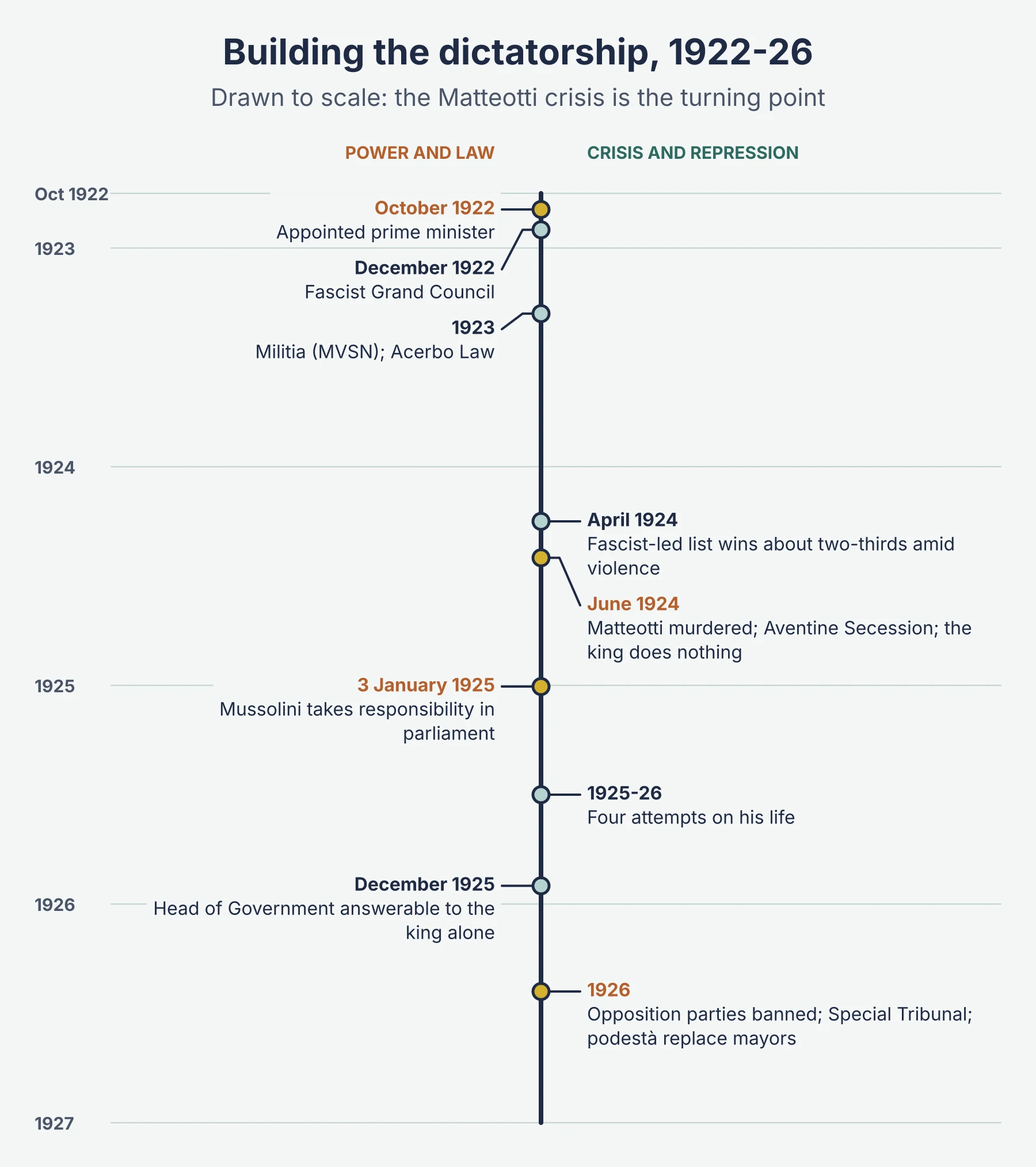
| Oct 1922 | March on Rome; the king refuses martial law and appoints Mussolini |
| Dec 1922-Jan 1923 | Fascist Grand Council and Militia (MVSN) created |
| 1923 | Acerbo Law; Corfu incident |
| April-June 1924 | Fascist-led list wins about two-thirds of the vote; Matteotti murdered |
| Jan 1925 | Mussolini’s speech accepting responsibility; dictatorship begins |
| Oct 1925 | Palazzo Vidoni Pact; Battle for Grain launched that year |
| Dec 1925 | Law on the powers of the Head of Government |
| 1926 | Rocco Law; ONB founded; opposition parties banned; Special Tribunal |
| 1927 | Charter of Labour; Quota 90; Battle for Births speech |
| Feb 1929 | Lateran Treaties |
| 1933 | IRI created |
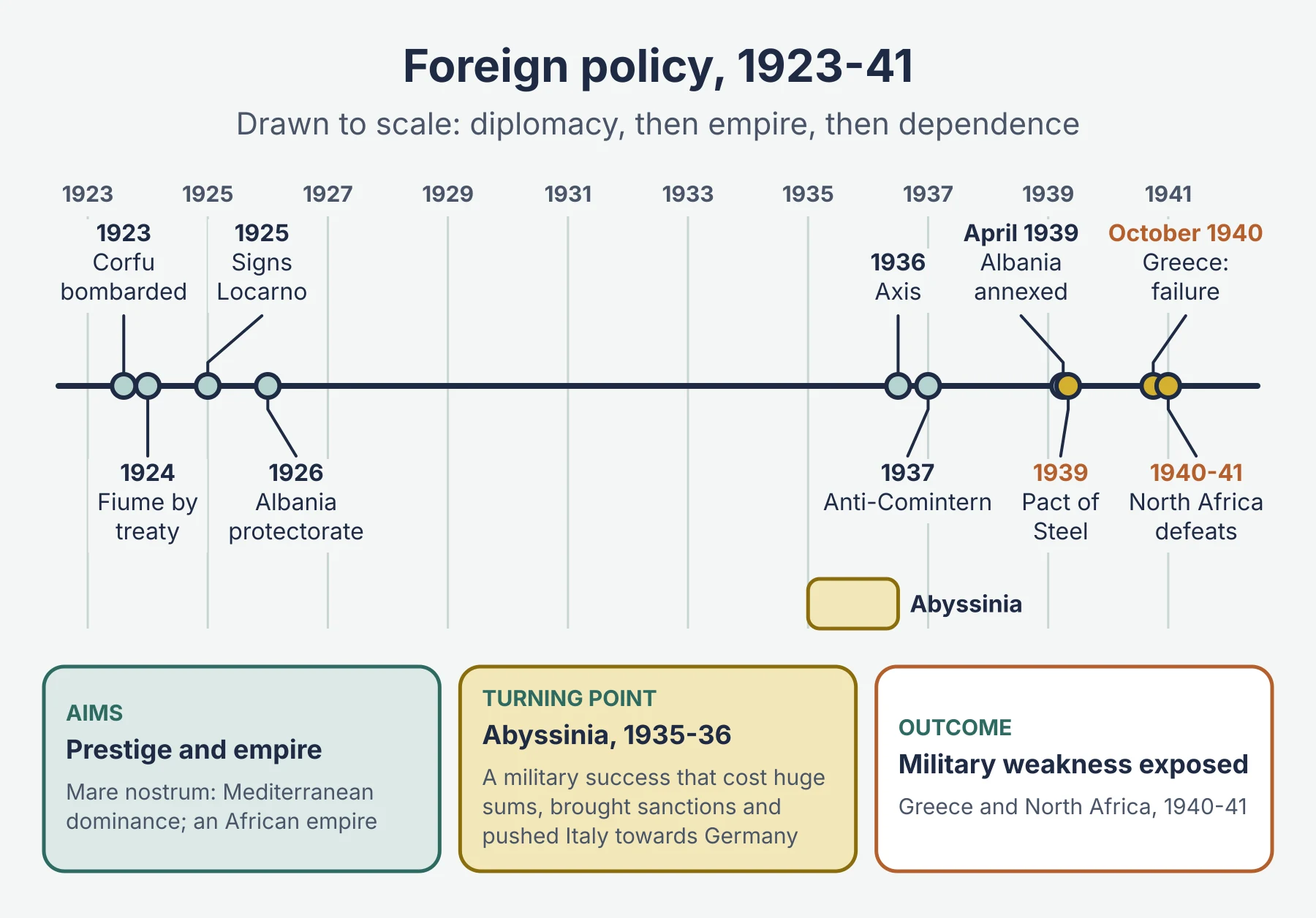
| Oct 1935-May 1936 | Invasion and conquest of Abyssinia; League sanctions |
| 1936-39 | Intervention in the Spanish Civil War; Rome-Berlin Axis (1936) |
| 1937 | Ministry of Popular Culture; Italy leaves the League |
| 1938 | Racial laws; Reform of Customs |
| April-May 1939 | Albania annexed; Pact of Steel |
| June 1940 | Italy enters the war; Greece invaded in October |
1.1 Gaining control – the chain of causes
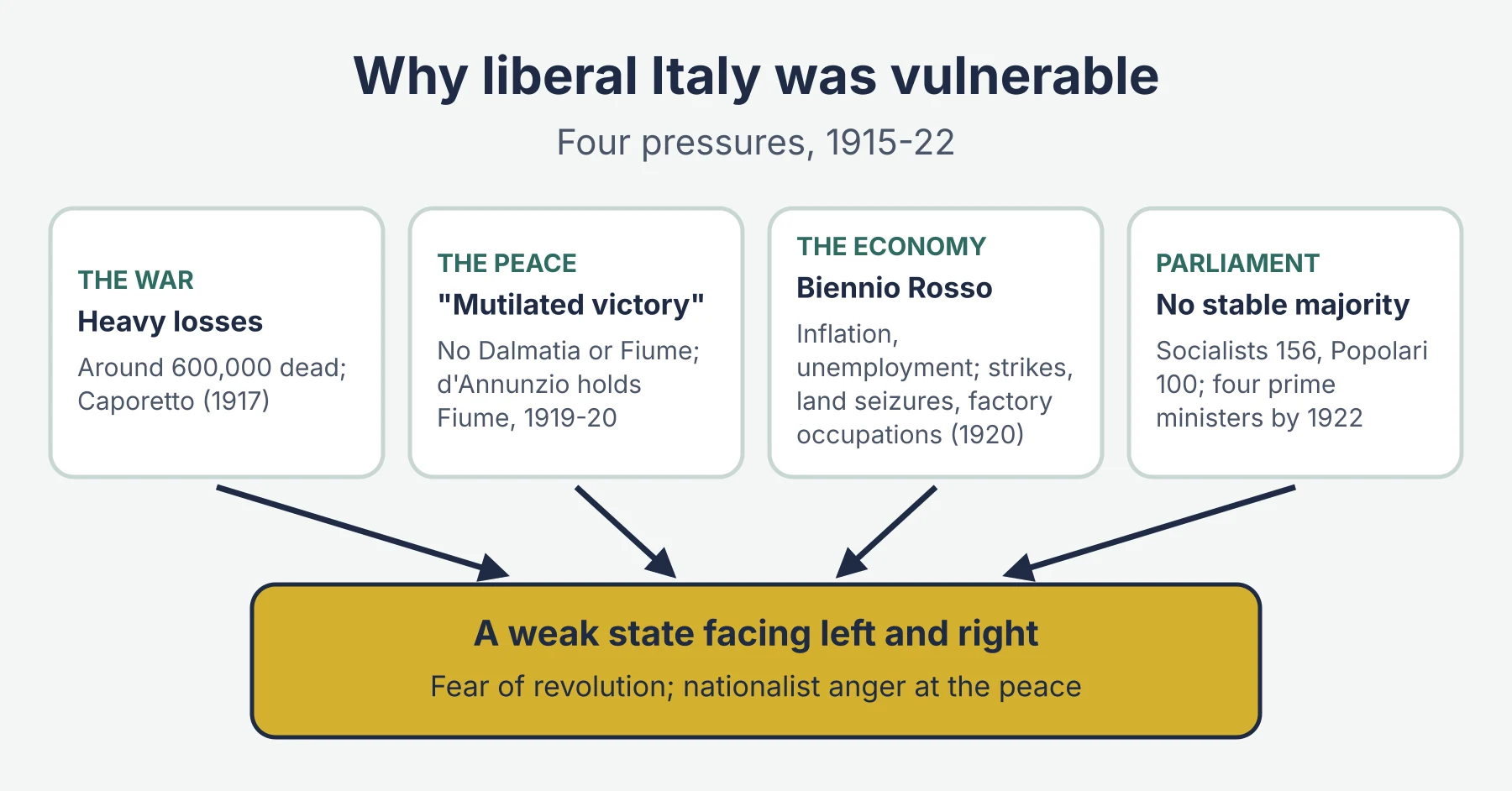
- Preconditions: war losses and debt, the mutilated victory, Fiume, inflation and unemployment.
- Fear of the left: the Biennio Rosso drove landowners, industrialists and the middle class to back the squads.
- Liberal failure: proportional representation fragmented parliament; liberals co-opted fascists in 1921.
- Fascist methods: squadrismo plus the dual policy; breaking the August 1922 strike.
- Decisive moment: Victor Emmanuel III’s refusal to sign martial law, 28 October 1922.
- Consolidation: Acerbo Law, the 1924 election, Matteotti crisis survived, laws of 1925-26.
1.2 Governing – effective, but within limits
- Repression: OVRA, Special Tribunal, confino; relatively few executions.
- Propaganda: cult of the Duce, romanità, LUCE, radio, press control, sport, MinCulPop (1937).
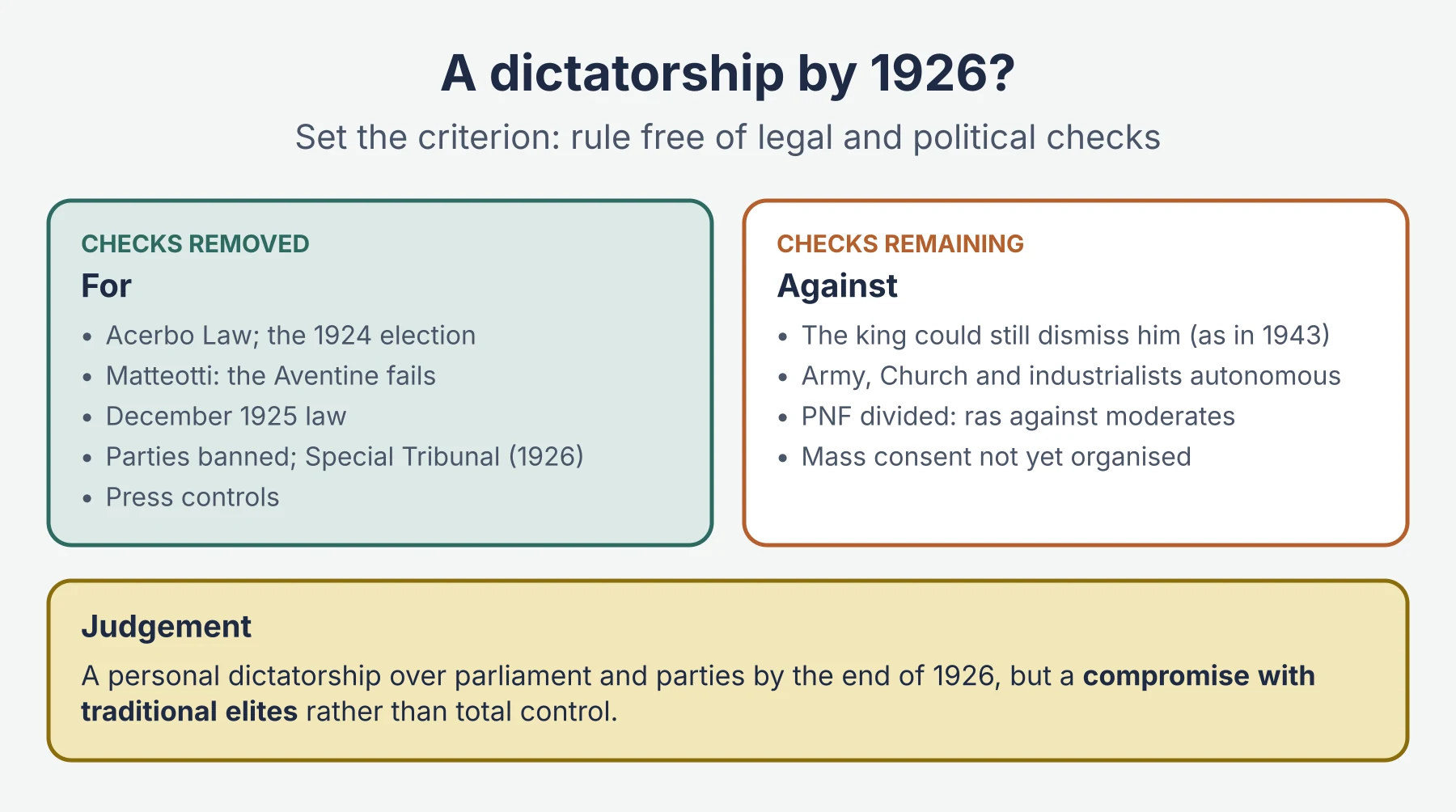
- Institutions: Duce, PNF and Grand Council alongside king, cabinet, parliament, civil service and judiciary; prefects placed above party bosses in 1927.
- Foreign policy scorecard: successes – Fiume (1924), Albanian protectorate (1926), Abyssinia (1936); failures – Corfu climb-down (1923), sanctions and dependence on Germany, Greece (1940), North Africa (1940-41).
1.3 Economy – aims against outcomes
| Policy | Aim | Outcome |
|---|---|---|
| De Stefani, 1922-25 | Balanced budget, business confidence | Growth, but inflation and a falling lira |
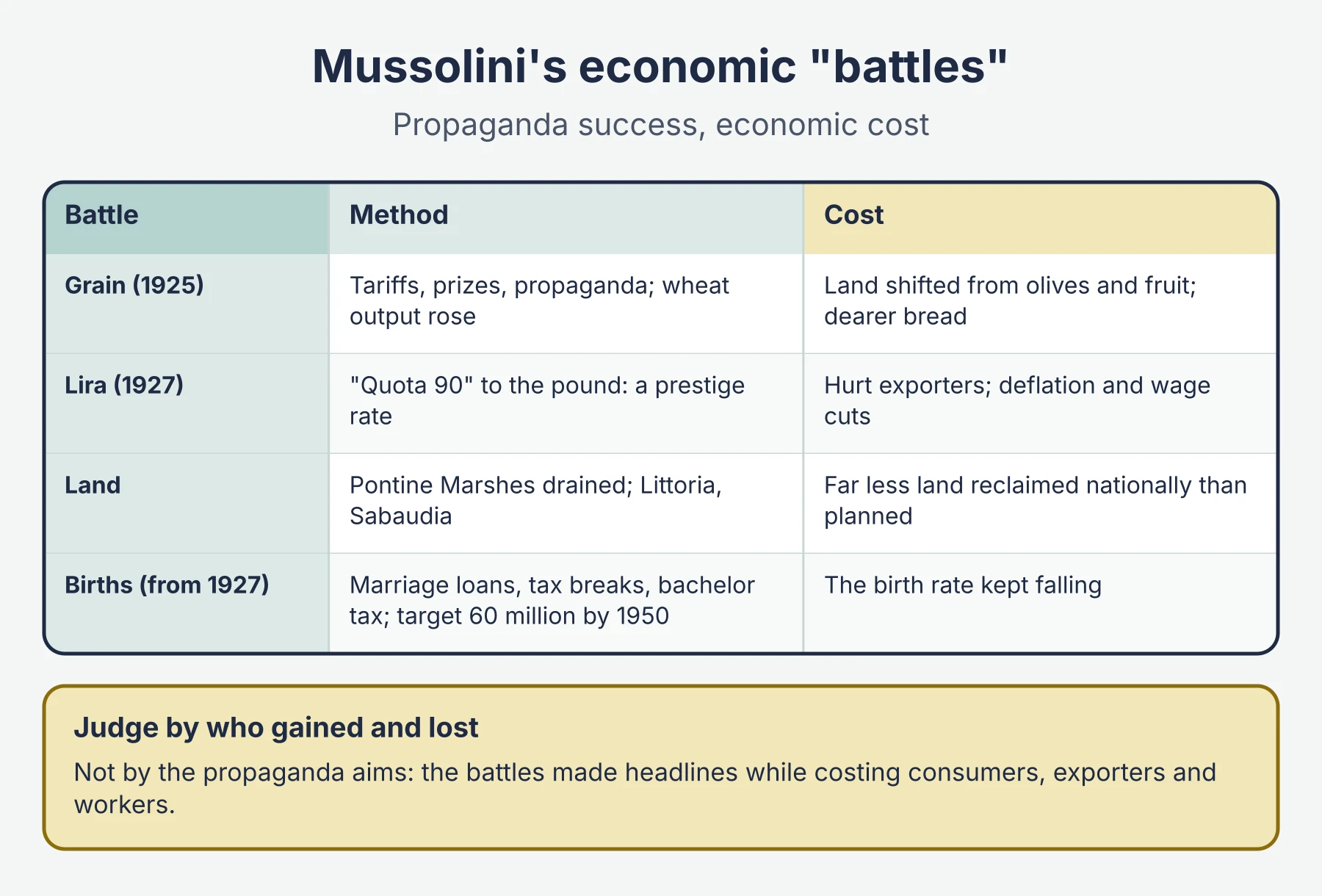
| Battle for Grain | Self-sufficiency in wheat | Output rose; costlier bread, poorer land use |
| Quota 90 | Prestige of the lira | Exports hit, deflation, wage cuts |
| Battle for Land | Reclamation and resettlement | Pontine Marshes drained; national targets missed |
| IMI and IRI | Rescue banks and industry | State became a major industrial owner |
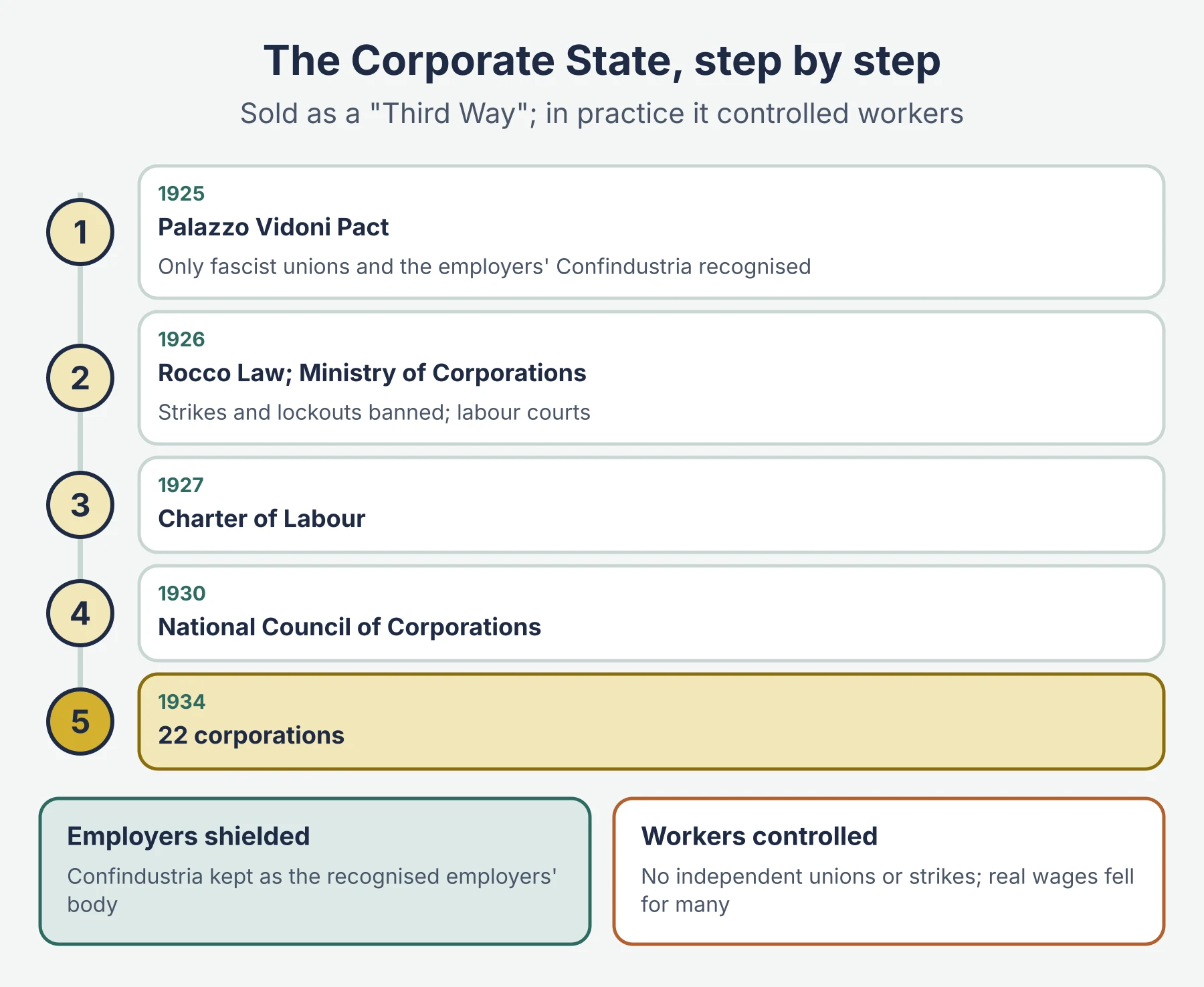
| Corporate State | “Third Way” class harmony | Employers kept power; strikes banned |
| Autarky | Readiness for war | Never achieved; Italy entered war in 1940 short of raw materials |
1.4 Society – the transformation test
- Women: Battle for Births, bachelor tax, employment quotas; the birth rate fell anyway.
- Youth: Gentile reform (1923), single state textbook, teachers’ and professors’ oaths, ONB/GIL; patchy reach in the rural south.
- Church: Lateran Treaties (1929) won Catholic consent; clashes over Catholic Action (1931) and the racial laws (1938).
- Leisure: OND popular; Reform of Customs ridiculed.
- Opposition: Communist underground, Giustizia e Libertà, assassination attempts of 1925-26, non-conformity.
Exam traps
- “Seizure” of power: the March on Rome was a threat that succeeded because the king gave way.
- 1922 versus 1926: Mussolini was a coalition prime minister in 1922; the dictatorship dates from 1925-26.
- Corporate State dates: Vidoni Pact 1925, Rocco Law 1926, Charter of Labour 1927, corporations 1934 – do not compress them into one year.
- Totalitarian claims: always weigh the king, the Church, the army and big business.
- Success questions: define success against the regime’s own aims and against the experience of ordinary Italians.
Self-test
- What did the Acerbo Law provide? Two-thirds of the seats for the list winning most votes, if it gained at least 25 per cent.
- Who refused to sign the martial-law decree in October 1922? King Victor Emmanuel III.
- What was the Aventine Secession? The walk-out of opposition deputies from parliament after Matteotti’s murder in 1924.
- What did the December 1925 law change? It made Mussolini, as Head of Government, responsible to the king alone, not to parliament.
- What was Quota 90? The 1927 revaluation of the lira at 90 to the pound.
- Name the two state agencies that rescued banks and industry in the Depression. IMI (1931) and IRI (1933).
- Which agreement banned strikes and set up labour courts? The Rocco Law of 1926.
- Give the three parts of the Lateran settlement. A treaty creating Vatican City, a Concordat, and a financial convention.
- Over which Catholic body did Church and state clash in 1931? Catholic Action.
- What was the OND? The fascist after-work organisation providing subsidised leisure, sport and excursions.
- Name the exile anti-fascist group founded in Paris in 1929. Giustizia e Libertà.
- Which island did Italy bombard and occupy in 1923? Corfu.
Official syllabus
Cambridge International AS & A Level History (9489) syllabus for 2027, 2028 and 2029 – cambridgeinternational.org (Paper 4, European option, topic 1).
Related resources
-
Study guides
Cambridge A Level World History (9489): Stalin's Russia, 1924-41
Study guide to Cambridge 9489 Paper 4 topic 2, Stalin's Russia 1924-41: the power struggle, Terror and cult, collectivisation, the Five Year Plans and society.
World History · Cambridge · A Level
Read guide -
Practice questions
Cambridge A Level World History (9489): Stalin's Russia, 1924-41 – Practice Questions
Twelve original practice questions on Cambridge 9489 Stalin's Russia, 1924-41: short recall items and Paper 4-style 30-mark essays with mark-scheme answers.
World History · Cambridge · A Level
Try questions -
Revision notes
Cambridge A Level World History (9489): Stalin's Russia, 1924-41 – Revision Notes
Revision notes for Cambridge 9489 Paper 4, Stalin's Russia 1924-41: key terms, a dated timeline, the four key questions condensed, exam traps and a self-test.
World History · Cambridge · A Level
Revise topic
Get free revision emails (optional)
Occasional emails with practice questions, worked explanations and links to free resources for the qualification and subjects you choose. No spam, and you can unsubscribe from any email. The free tools on this site never need an email.