
Study Guides
Cambridge A Level World History (9489): Stalin's Russia, 1924-41
Study guide to Cambridge 9489 Paper 4 topic 2, Stalin's Russia 1924-41: the power struggle, Terror and cult, collectivisation, the Five Year Plans and society.
- Subject
- World History
- Level
- A LEVEL
- Topic
- Topic 5: European option: European history, 1919-41
- Author
- Marlbridge Academic Team
- Updated
- Reviewed by
- Azam Siddique (what this means)
Aligned to Cambridge A Level World History (9489), 2027-2029. Official specification .
Syllabus page (what it covers and how it is assessed): Cambridge A Level World History.
Syllabus points this page covers
9489 (A Level)
- 2 Stalin’s Russia, 1924–41
Found an error? Report a correction.
Need help with this topic? Request a free trial class for A Level World History (9489).
Stalin’s Russia, 1924-41 is the second topic of the Paper 4 European option in Cambridge 9489. Its four key questions ask how Stalin gained control (2.1), how effectively he governed (2.2), how successful his economic policies were (2.3) and how far he transformed Soviet society (2.4). Paper 4 sets two 30-mark essays in 1 hour 45 minutes, marked equally for knowledge (AO1) and analysis and judgement (AO2). This guide adds depth to the European option study guide; use it with the Stalin’s Russia revision notes and the Stalin’s Russia practice questions.
Syllabus coverage
- 2.1 The power vacuum after Lenin (collective leadership, the Testament and funeral); the candidates – Stalin, Trotsky, Bukharin, Kamenev, Rykov, Tomsky and Zinoviev – and Stalin’s party posts; NEP against industrialisation, Socialism in One Country against Permanent Revolution, changing alliances; early cult and repression to 1929.
- 2.2 Terror and Purges (reasons, Kirov, the NKVD, show trials, the Yezhovshchina, gulags, the army purge); the cult; Stalin’s leadership and the 1936 Constitution; foreign policy from Germany and collective security to the Nazi-Soviet Pact.
- 2.3 The Great Turn; collectivisation and dekulakisation; Gosplan and the first three Five Year Plans; Stakhanovism; living standards.
- 2.4 Women and the family, national groups, education, the Cultural Revolution and Socialist Realism, and religion.
2.1 The power struggle: how a “grey blur” won
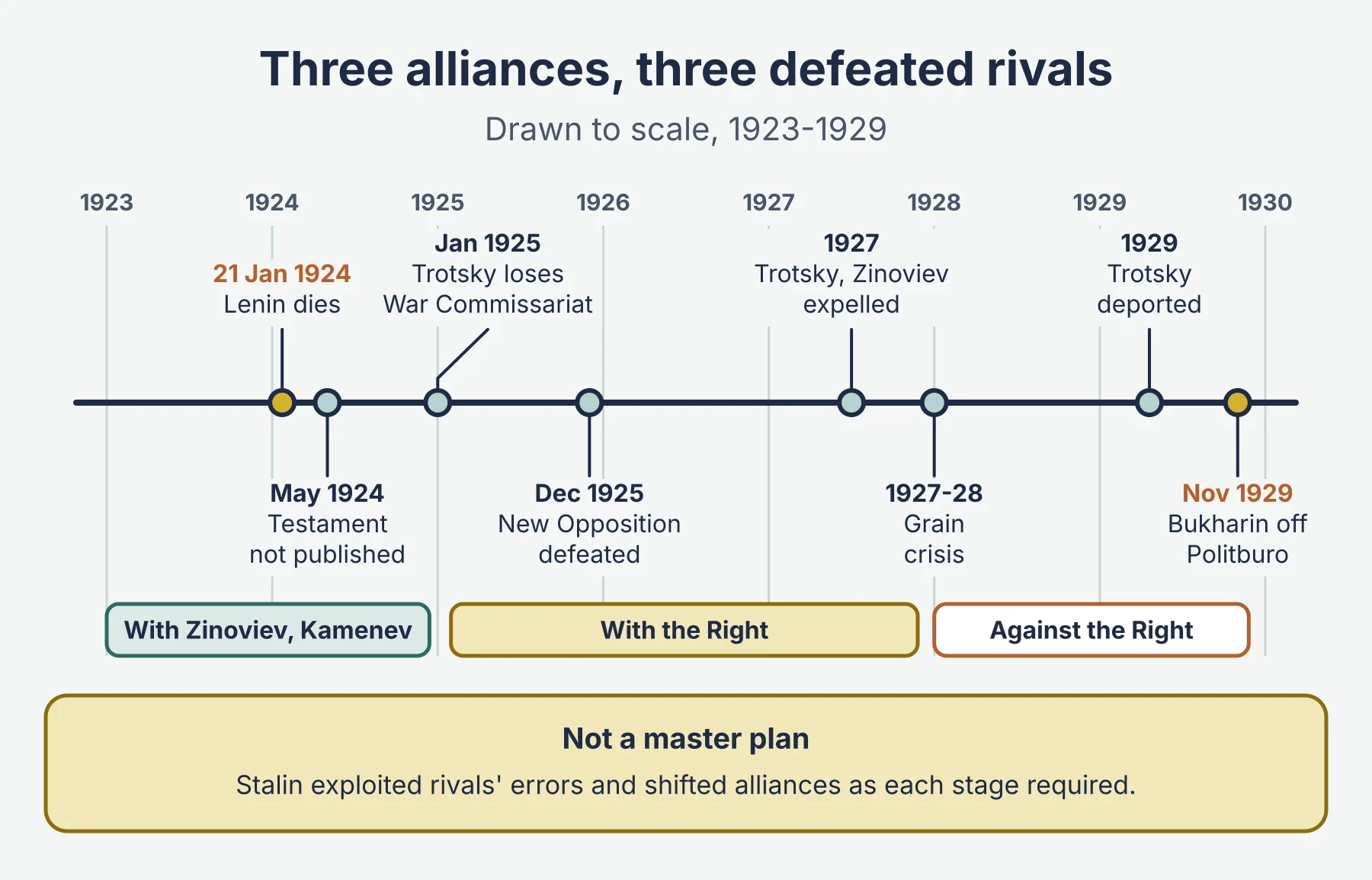
The vacuum. Lenin’s strokes (1922-23) left the Politburo governing collectively. No rules existed for succession, and the 1921 ban on factions meant any challenger could be branded a splitter. Lenin’s Testament criticised every leading figure, and its January 1923 postscript urged Stalin’s removal as General Secretary. After Lenin’s death on 21 January 1924, the Central Committee agreed in May not to publish it, rescued by Zinoviev and Kamenev, who still feared Trotsky more. Trotsky missed the funeral; Stalin delivered a quasi-religious oath of loyalty to Lenin and presented himself as “Lenin’s disciple”.
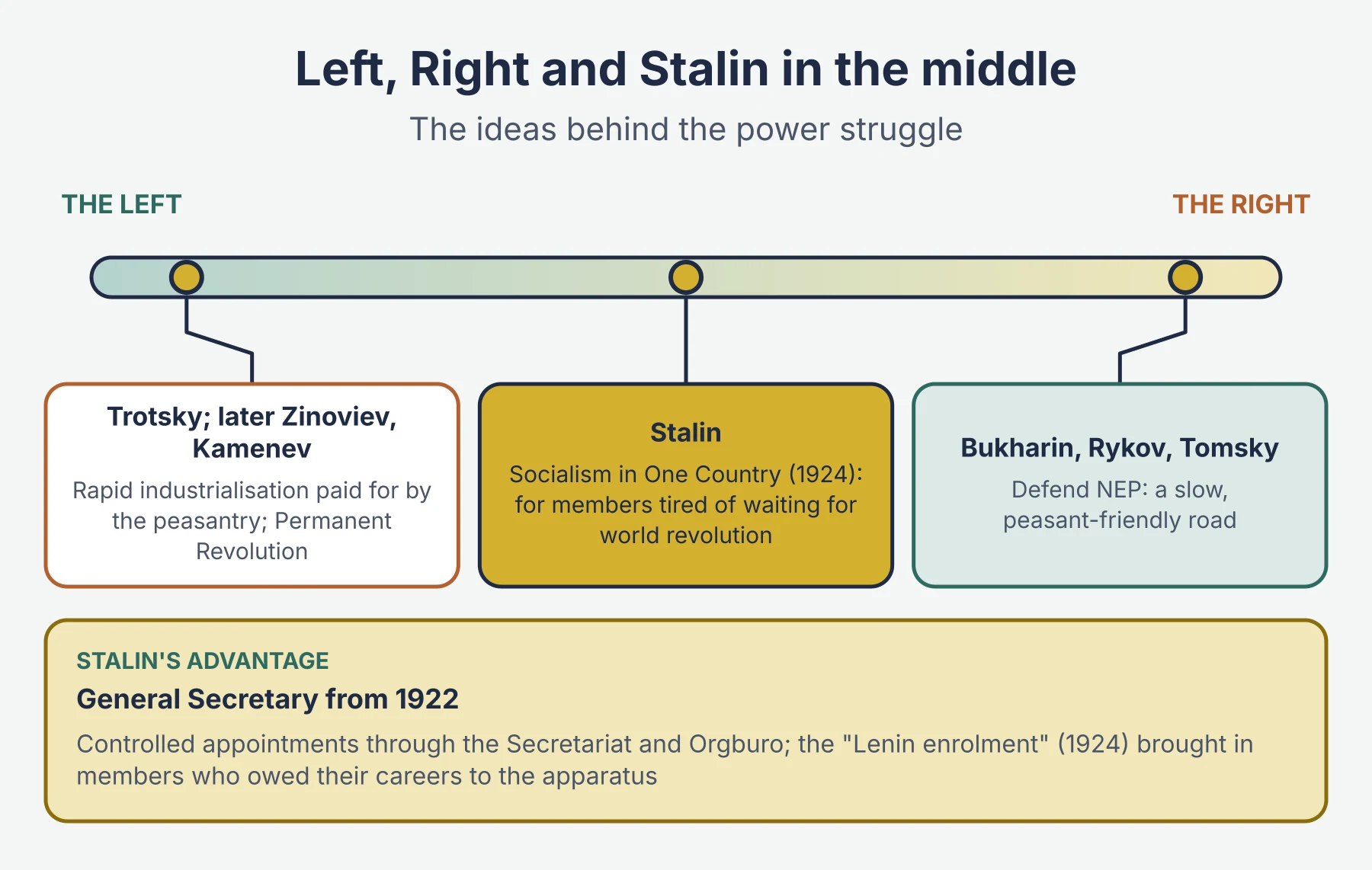
Positions. As General Secretary (from 1922), Stalin controlled appointments through the Secretariat and Orgburo. The “Lenin enrolment” of 1924 brought in hundreds of thousands of new members, many owing their careers to the apparatus, and local secretaries chose congress delegates.
Ideas. The rivals divided over the economy and the revolution abroad. The Left (Trotsky, later Zinoviev and Kamenev) wanted rapid industrialisation financed from the peasantry and backed Permanent Revolution. The Right (Bukharin, Rykov, Tomsky) defended NEP and a slow, peasant-friendly road. Stalin’s Socialism in One Country (1924) appealed to party members tired of waiting for world revolution.
Alliances.
- 1923-25: with Zinoviev and Kamenev against Trotsky, who lost the War Commissariat in January 1925.
- 1925-27: with the Right against the “New Opposition” (defeated at the 14th Congress, December 1925) and then the United Opposition; Trotsky and Zinoviev were expelled from the party in 1927, and Trotsky was deported from the USSR in 1929.
- 1928-29: against the Right, after the grain procurement crisis of 1927-28 led Stalin to use emergency requisitioning; Bukharin was removed from the Politburo in November 1929.
Repression before 1929. The OGPU watched oppositionists, and the 1928 Shakhty trial of engineers accused of sabotage previewed later show trials.
2.2 Governing through terror and cult
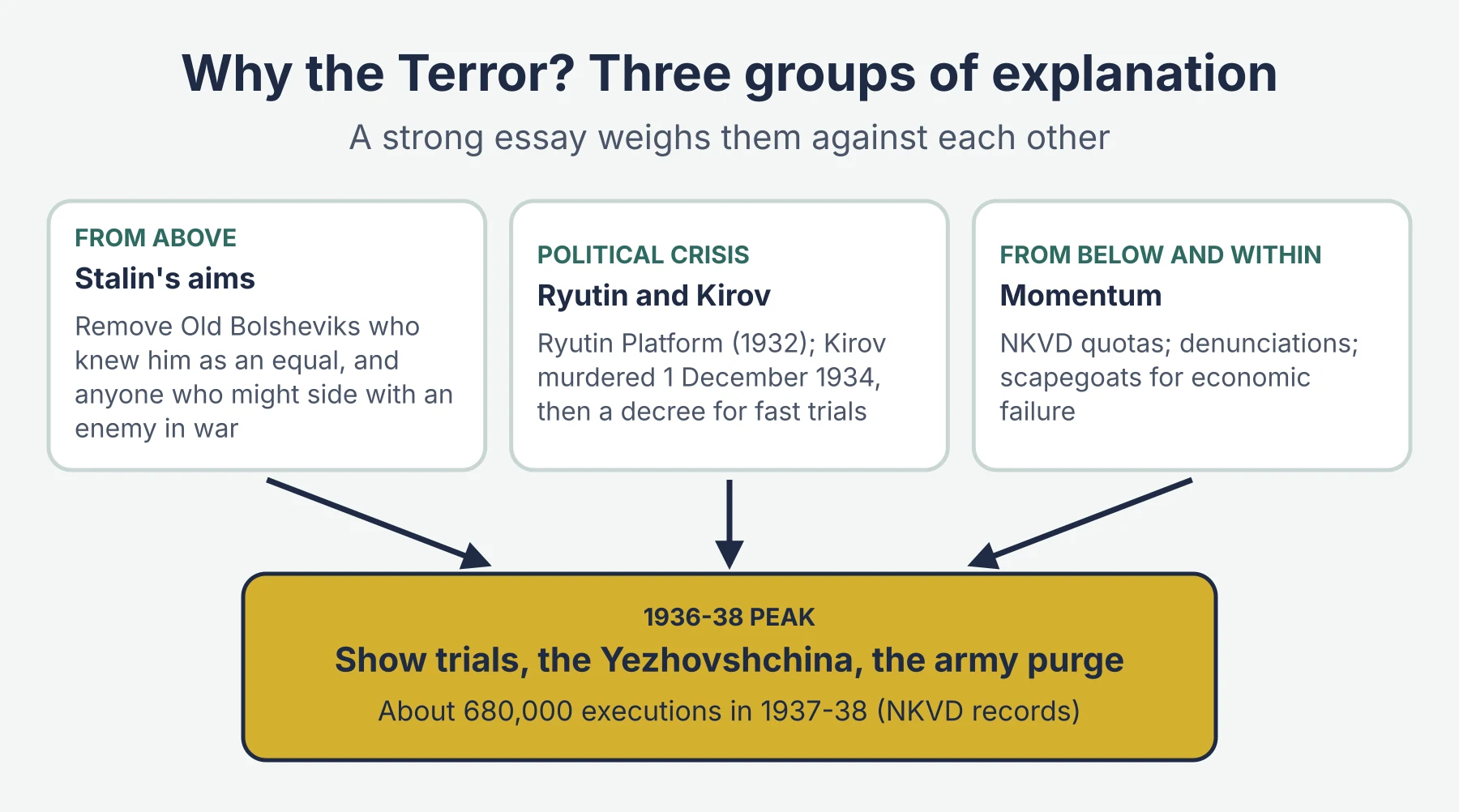
Why the Terror? Explanations fall into three groups, and a strong essay weighs them:
- Stalin’s aims and personality: removing Old Bolsheviks who had known him as an equal, and anyone who might side with an enemy in war.
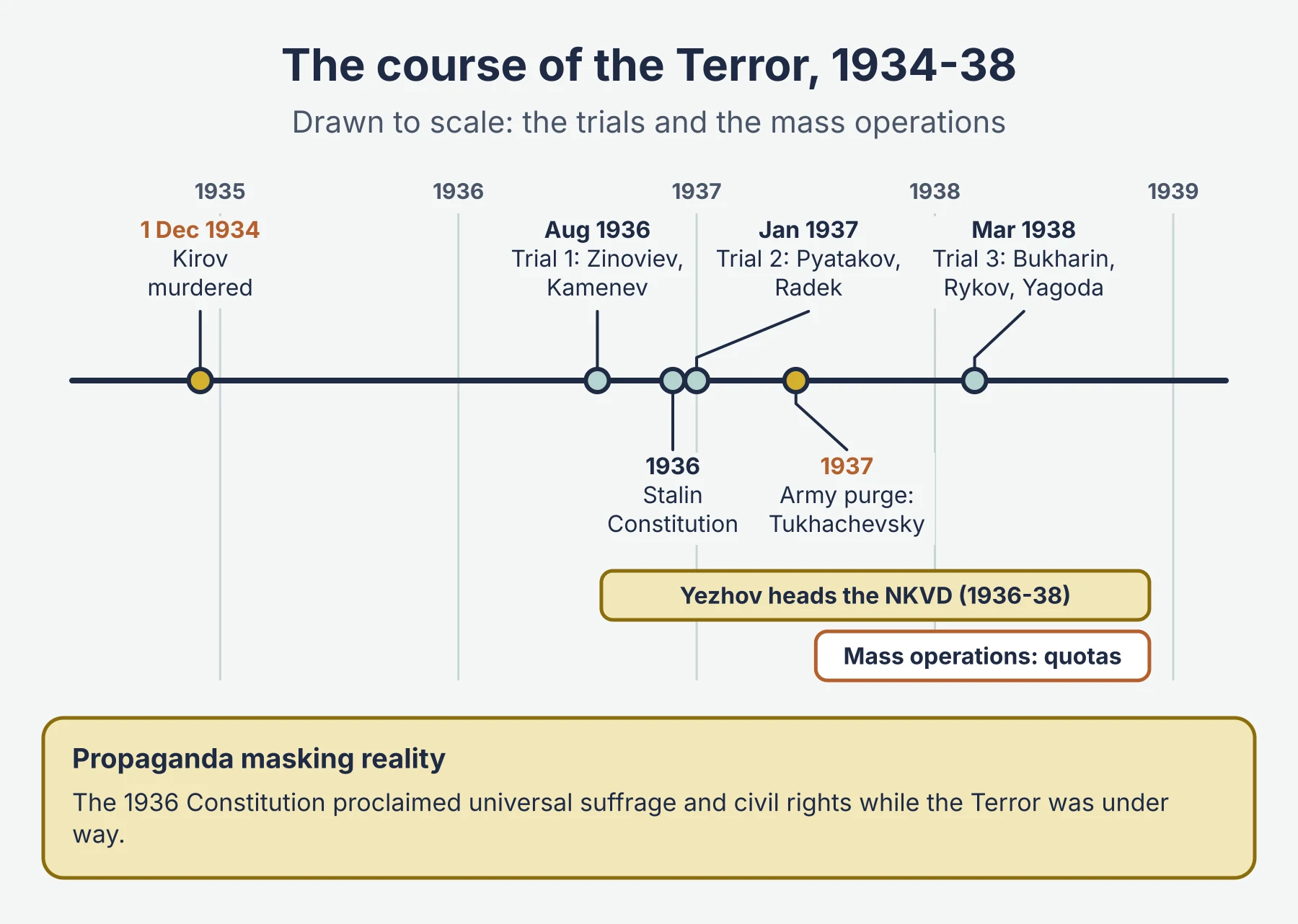
- Political crisis: the Ryutin Platform (1932) calling for his removal, and the murder of Sergei Kirov in Leningrad on 1 December 1934, which was followed at once by a decree allowing fast trials without appeal.
- Momentum from below and within: NKVD quotas, denunciations to settle scores, and the need for scapegoats for economic failure (“wreckers”).
Course. The three Moscow show trials (August 1936: Zinoviev and Kamenev; January 1937: Pyatakov, Radek; March 1938: Bukharin, Rykov, Yagoda) staged confessions. Under Nikolai Yezhov (NKVD chief 1936-38) mass operations from July 1937 set regional quotas for shootings and camp sentences; NKVD records show around 680,000 executions in 1937-38. The army purge of 1937 killed Marshal Tukhachevsky and much of the high command. The Gulag supplied forced labour for projects such as the White Sea-Baltic Canal (1931-33).
Cult and leadership. The cult took off with Stalin’s fiftieth birthday celebrations (December 1929) and was cemented by the Short Course history of the party (1938), posters, cities named after him and his image as father of the peoples. The 1936 Stalin Constitution proclaimed universal suffrage and civil rights while the Terror was under way – a clear example of propaganda masking reality.
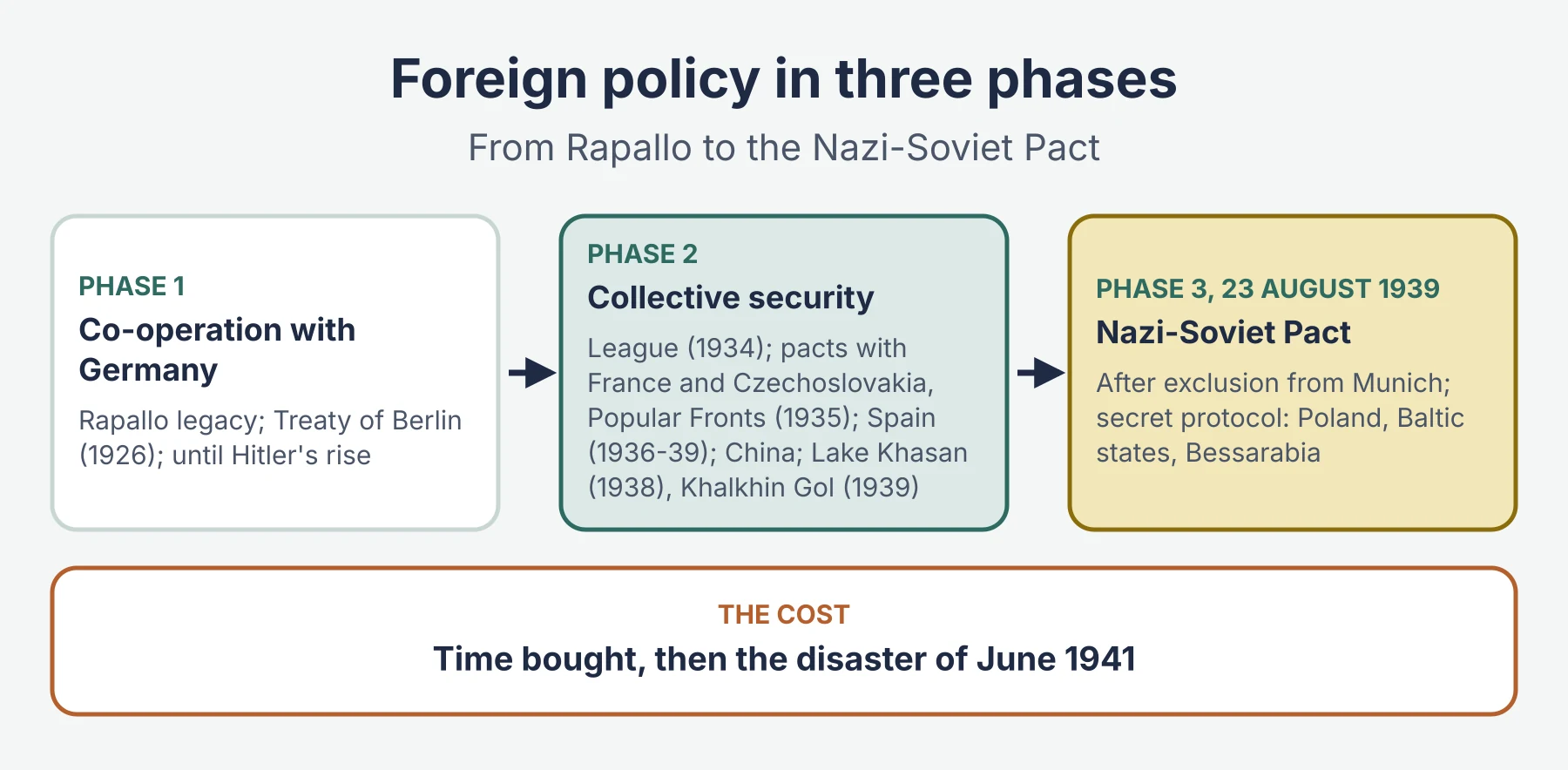
Foreign policy moved through three phases:
- Co-operation with Germany (the Rapallo legacy and the 1926 Treaty of Berlin) until Hitler’s rise.
- Collective security: League membership (1934), pacts with France and Czechoslovakia (1935), Comintern Popular Fronts (1935), aid to the Spanish Republic (1936-39), help to China against Japan, and border fighting with Japan at Lake Khasan (1938) and Khalkhin Gol (1939).
- The Nazi-Soviet Pact (23 August 1939), after exclusion from Munich; its secret protocol allowed Soviet gains in Poland, the Baltic states and Bessarabia. The pact bought time but was followed by the disaster of June 1941.
2.3 The economy: a revolution from above
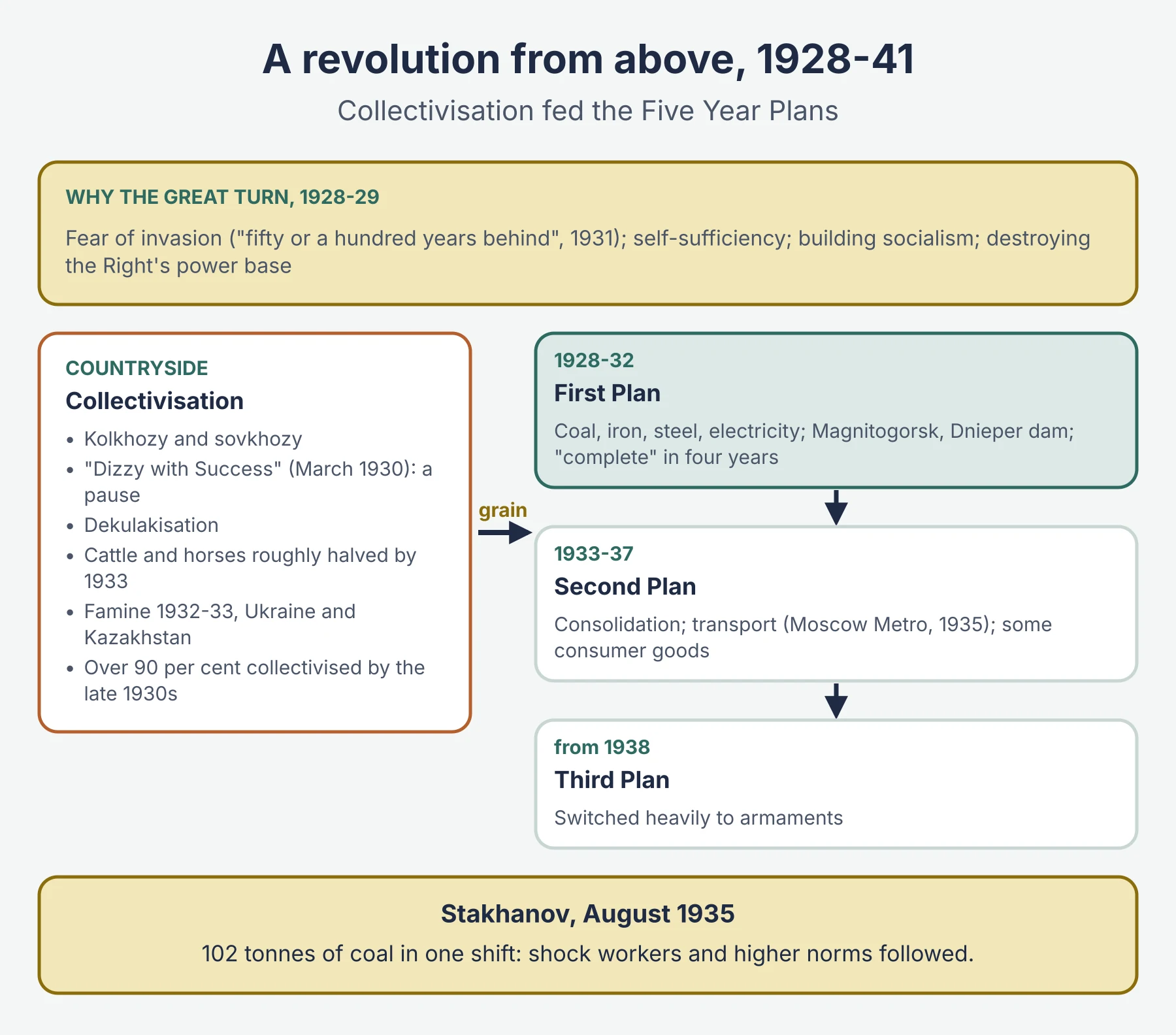
The Great Turn (1928-29). Reasons: fear of invasion (“we are fifty or a hundred years behind the advanced countries”, Stalin said in 1931), self-sufficiency, building socialism, and enhancing Stalin’s own control by destroying the Right’s power base.
Collectivisation. Peasants were pushed into collective farms (kolkhozy) and some state farms (sovkhozy). Stalin’s article “Dizzy with Success” (March 1930) blamed local officials for excesses, and many peasants left the collectives, before pressure resumed. Dekulakisation deported or killed those labelled kulaks. Peasants slaughtered livestock rather than surrender it, and numbers of cattle and horses roughly halved by 1933. The famine of 1932-33, especially in Ukraine and Kazakhstan, killed millions while grain procurement continued. By the late 1930s over 90 per cent of households were collectivised; private plots, allowed from 1935, produced a large share of vegetables, milk and meat.
Industrialisation. Gosplan drafted targets. The first Five Year Plan (1928-32) prioritised heavy industry – coal, iron, steel and electricity – and built new centres such as Magnitogorsk and the Dnieper dam; it was declared complete in four years. The second (1933-37) consolidated, adding transport (the Moscow Metro, 1935) and some consumer goods. The third (from 1938) switched heavily to armaments. Stakhanov’s record of 102 tonnes of coal in one shift (August 1935) launched a movement of shock workers and higher norms.
Living standards. Wage differentials grew after Stalin attacked “equality-mongering” in 1931; managers and Stakhanovites gained better housing and goods. Most urban workers lived in overcrowded communal flats, rationing lasted until 1935, and discipline tightened: labour books (1938) and the 1940 laws punishing lateness and unauthorised job-changing.
2.4 Society: transformation or retreat?
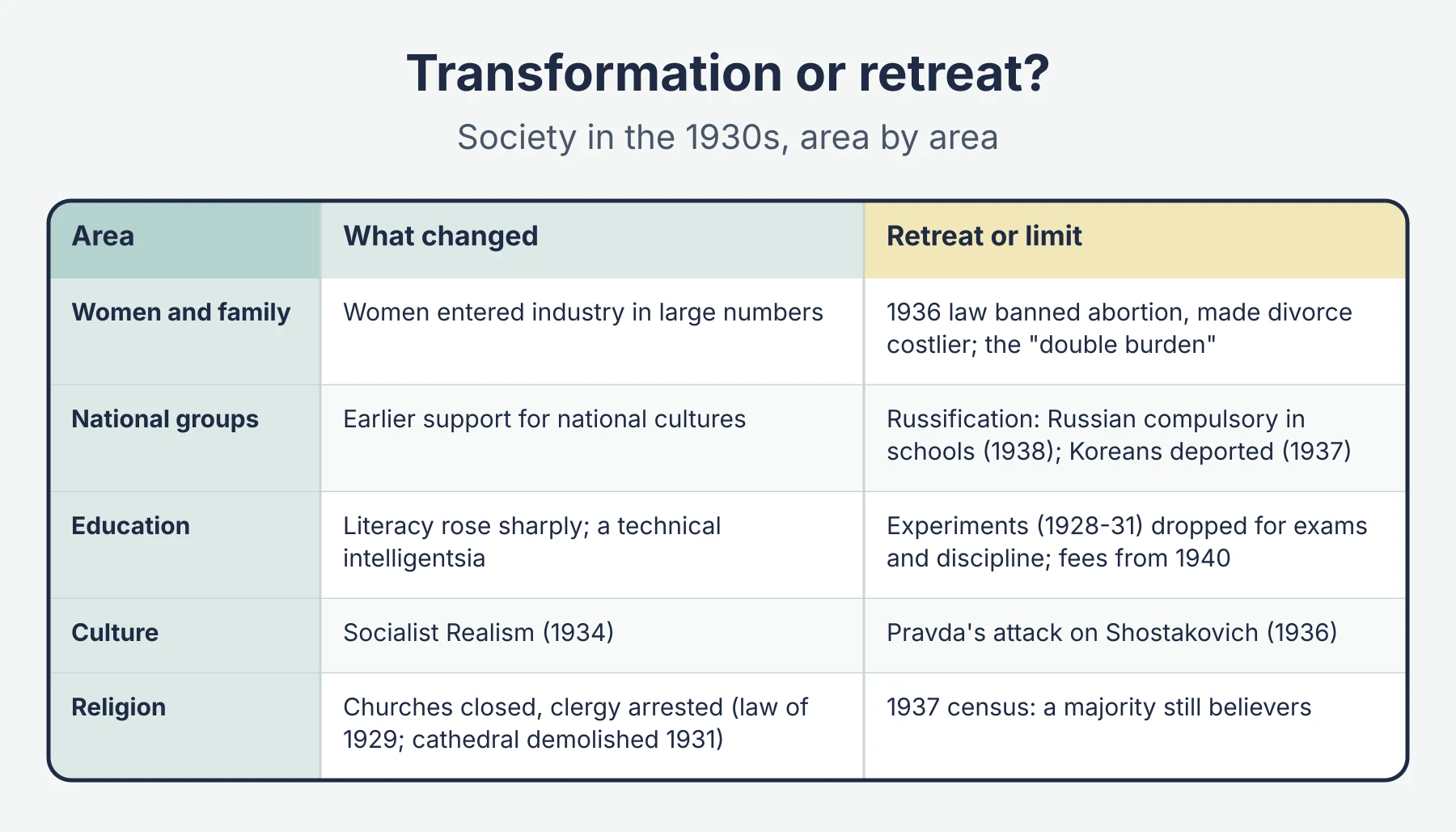
- Women and the family. The 1920s liberal codes were reversed in the “Great Retreat”: the 1936 law banned abortion, made divorce costlier and rewarded large families. Women entered industry in large numbers but carried the “double burden” of paid work and housework, and few reached senior posts.
- National groups. Earlier support for national cultures gave way to Russification; Russian became compulsory in all schools in 1938, and whole peoples such as the Soviet Koreans (1937) were deported.
- Education. The experimental schooling of the Cultural Revolution (1928-31) was abandoned for formal lessons, set textbooks, exams and discipline; fees were introduced for upper secondary and higher education in 1940. Literacy rose sharply, and a new technical intelligentsia was trained.
- Culture. Socialist Realism (adopted at the 1934 Writers’ Congress) required art to show socialist progress; Pravda’s 1936 attack on Shostakovich’s opera showed the risks.
- Religion. The 1929 law on religious associations banned religious activity outside worship; churches were closed, clergy arrested, and the Cathedral of Christ the Saviour demolished (1931). Yet the suppressed 1937 census recorded a majority identifying as believers.
Worked example: an annotated paragraph
“Stalin’s economic policies were a success.” Assess this view. [30]
By the regime’s own criterion – preparing the USSR for war – industrialisation was largely successful. Coal, steel and electricity output multiplied under the first two Plans, and new centres such as Magnitogorsk lay beyond the reach of an invader from the west. [criterion stated, precise evidence] However, success came through waste and coercion: targets were often met by falsified reports and poor-quality output, and the Gulag supplied labour for projects such as the White Sea Canal. [balance inside the paragraph] Measured against living standards, the record is much weaker, because real wages and housing lagged far behind output. [second criterion, leading to a judgement that depends on whose success is measured]
Common mistakes
- Writing Stalin’s rise as the work of a master plan; he exploited rivals’ errors and shifted alliances.
- Using “kulak” as if it described a real class rather than a label applied to opponents of collectivisation.
- Treating the Terror as one event, without distinguishing the 1936-38 peak from earlier repression.
- Ignoring the 1936 “retreat” in social policy when discussing transformation.
Exam technique
Questions often use assess or evaluate with a claim such as “the main reason” or “a success”. State a criterion, show the given factor’s importance first, then weigh alternatives, and reach a judgement about relative importance, not just a list.
Official syllabus
Cambridge International AS & A Level History (9489) syllabus for 2027, 2028 and 2029 – cambridgeinternational.org (Paper 4, European option, topic 2).
Related resources
-
Practice questions
Cambridge A Level World History (9489): Stalin's Russia, 1924-41 – Practice Questions
Twelve original practice questions on Cambridge 9489 Stalin's Russia, 1924-41: short recall items and Paper 4-style 30-mark essays with mark-scheme answers.
World History · Cambridge · A Level
Try questions -
Revision notes
Cambridge A Level World History (9489): Stalin's Russia, 1924-41 – Revision Notes
Revision notes for Cambridge 9489 Paper 4, Stalin's Russia 1924-41: key terms, a dated timeline, the four key questions condensed, exam traps and a self-test.
World History · Cambridge · A Level
Revise topic -
Practice questions
Cambridge A Level World History (9489): European option: European history, 1919-41 – Practice Questions
Original Paper 4-style essays for Cambridge 9489 History on Mussolini, Stalin and Hitler, 1919-41, with indicative content and the AO1/AO2 level descriptors.
World History · Cambridge · A Level
Try questions
Get free revision emails (optional)
Occasional emails with practice questions, worked explanations and links to free resources for the qualification and subjects you choose. No spam, and you can unsubscribe from any email. The free tools on this site never need an email.