
Revision Notes
Cambridge A Level World History (9489): Stalin's Russia, 1924-41 – Revision Notes
Revision notes for Cambridge 9489 Paper 4, Stalin's Russia 1924-41: key terms, a dated timeline, the four key questions condensed, exam traps and a self-test.
- Subject
- World History
- Level
- A LEVEL
- Topic
- Topic 5: European option: European history, 1919-41
- Author
- Marlbridge Academic Team
- Updated
- Reviewed by
- Azam Siddique (what this means)
Aligned to Cambridge A Level World History (9489), 2027-2029. Official specification .
Syllabus page (what it covers and how it is assessed): Cambridge A Level World History.
Syllabus points this page covers
9489 (A Level)
- 2 Stalin’s Russia, 1924–41
Found an error? Report a correction.
Need help with this topic? Request a free trial class for A Level World History (9489).
These notes condense Stalin’s Russia, 1924-41, the second topic of the Paper 4 European option in Cambridge 9489. For fuller explanation and an annotated paragraph see the Stalin’s Russia study guide; for essays and short questions see the Stalin’s Russia practice questions.
Syllabus coverage
- 2.1 How did Stalin gain control of the Soviet Union?
- 2.2 How effectively did Stalin govern the Soviet Union?
- 2.3 How successful were Stalin’s economic policies?
- 2.4 How far did Stalin transform Soviet society?
Key terms
| Term | Meaning |
|---|---|
| Collective leadership | Shared Politburo rule after Lenin’s incapacity and death |
| Lenin’s Testament | Lenin’s notes of 1922-23 assessing his colleagues; the postscript urged Stalin’s removal |
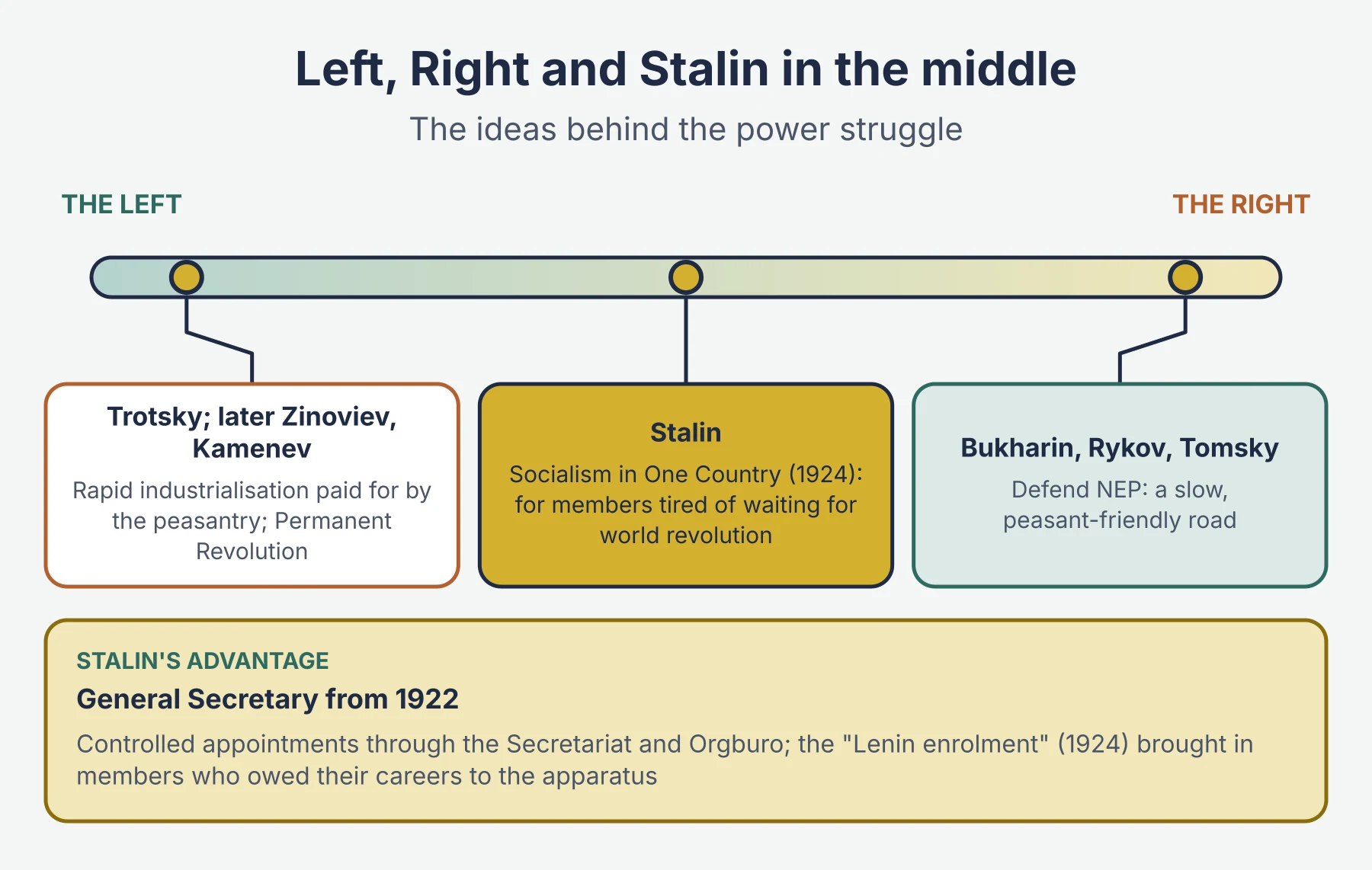
| General Secretary | Head of the party Secretariat, controlling appointments; Stalin from 1922 |
| NEP | New Economic Policy (1921): private trade and peasant markets within a socialist state |
| Socialism in One Country | Stalin’s 1924 doctrine that the USSR could build socialism without world revolution |
| Permanent Revolution | Trotsky’s view that socialism in Russia depended on revolution abroad |
| Great Turn | The 1928-29 shift to forced collectivisation and rapid planned industrialisation |
| Kolkhoz / sovkhoz | Collective farm / state farm with wage-paid labour |
| Dekulakisation | Expropriation, deportation or killing of peasants labelled kulaks |
| Gosplan | State planning agency drafting Five Year Plan targets |
| Stakhanovite | Worker who exceeded norms, after Alexei Stakhanov’s 1935 record |
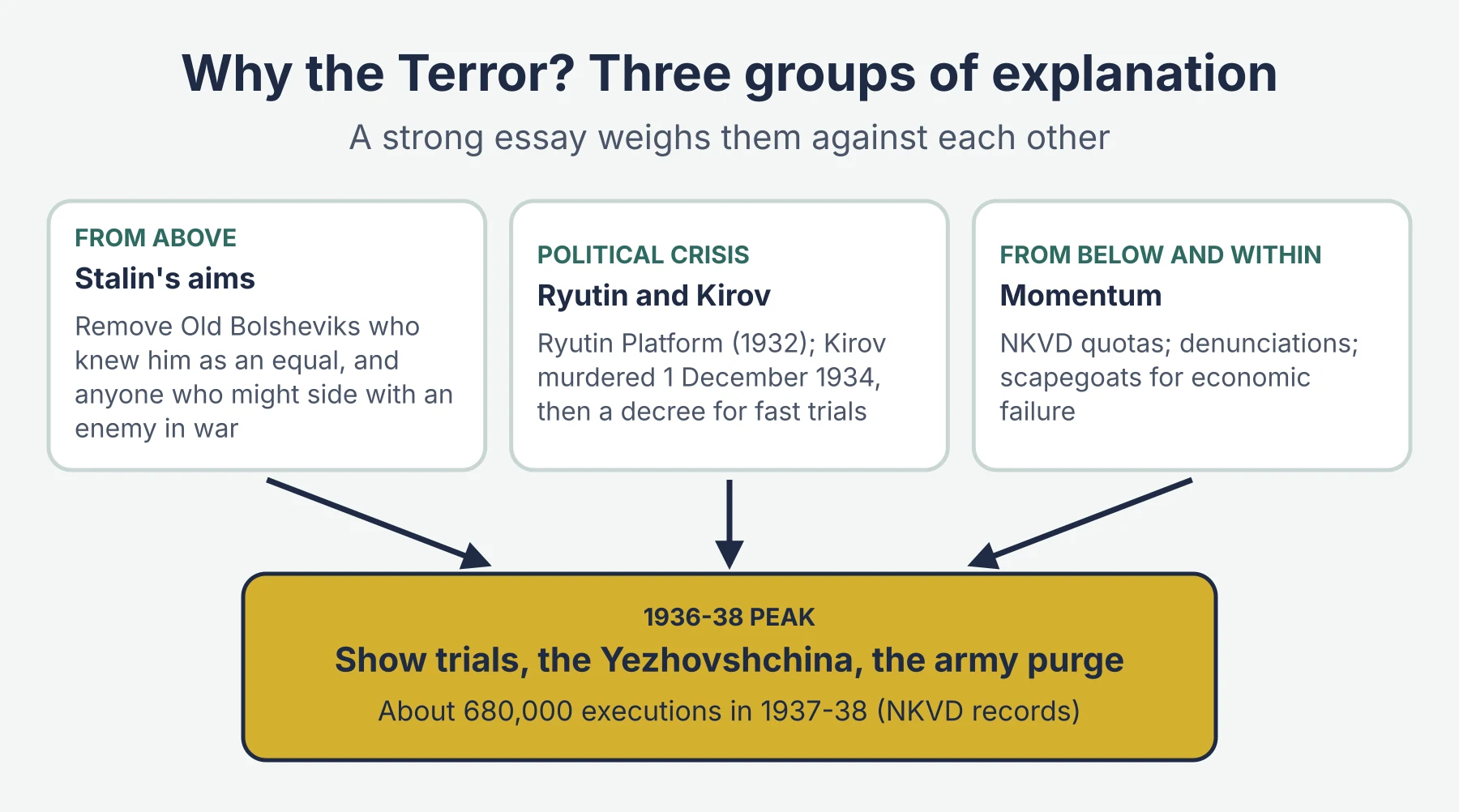
| Yezhovshchina | Peak of the Terror, 1937-38, under NKVD chief Yezhov |
| Gulag | System of forced-labour camps |
| Great Retreat | Return to traditional values in family, school and culture from the mid-1930s |
| Socialist Realism | Official artistic doctrine from 1934: art must show socialist progress |
Timeline to learn
| Date | Event |
|---|---|
| April 1922 | Stalin becomes General Secretary |
| Dec 1922-Jan 1923 | Lenin’s Testament and postscript |
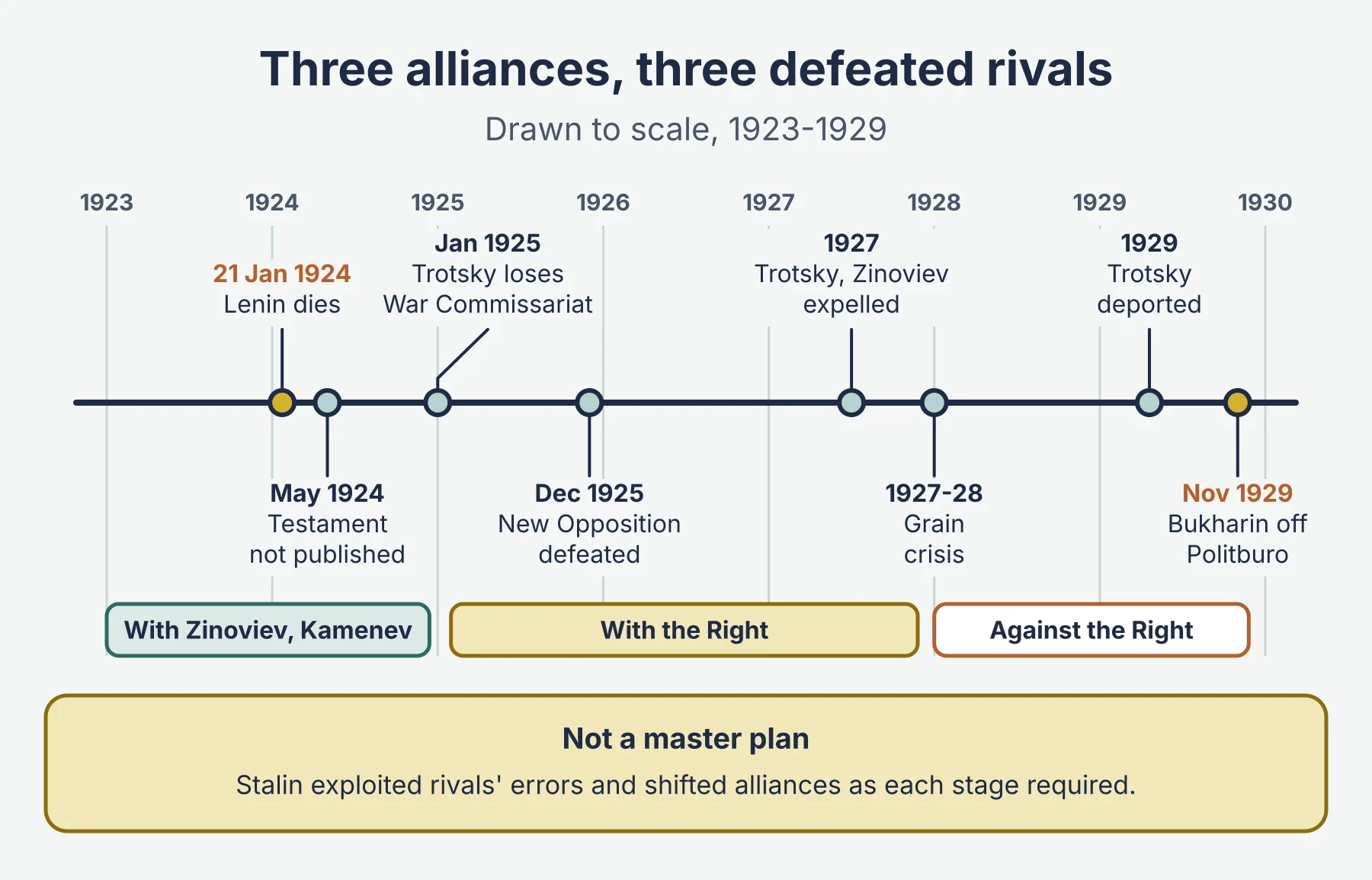
| 21 Jan 1924 | Lenin dies; Stalin leads the funeral oath |
| May 1924 | Central Committee decides not to publish the Testament |
| Jan 1925 | Trotsky loses the War Commissariat |
| Dec 1925 | 14th Congress defeats Zinoviev and Kamenev |
| Nov-Dec 1927 | Trotsky, Zinoviev and Kamenev expelled from the party |
| 1928 | First Five Year Plan begins; Shakhty trial; grain crisis measures |
| Nov 1929 | Bukharin removed from the Politburo; mass collectivisation begins |
| March 1930 | “Dizzy with Success” article |
| 1932-33 | Famine, especially in Ukraine and Kazakhstan |
| Sept 1934 | USSR joins the League of Nations |
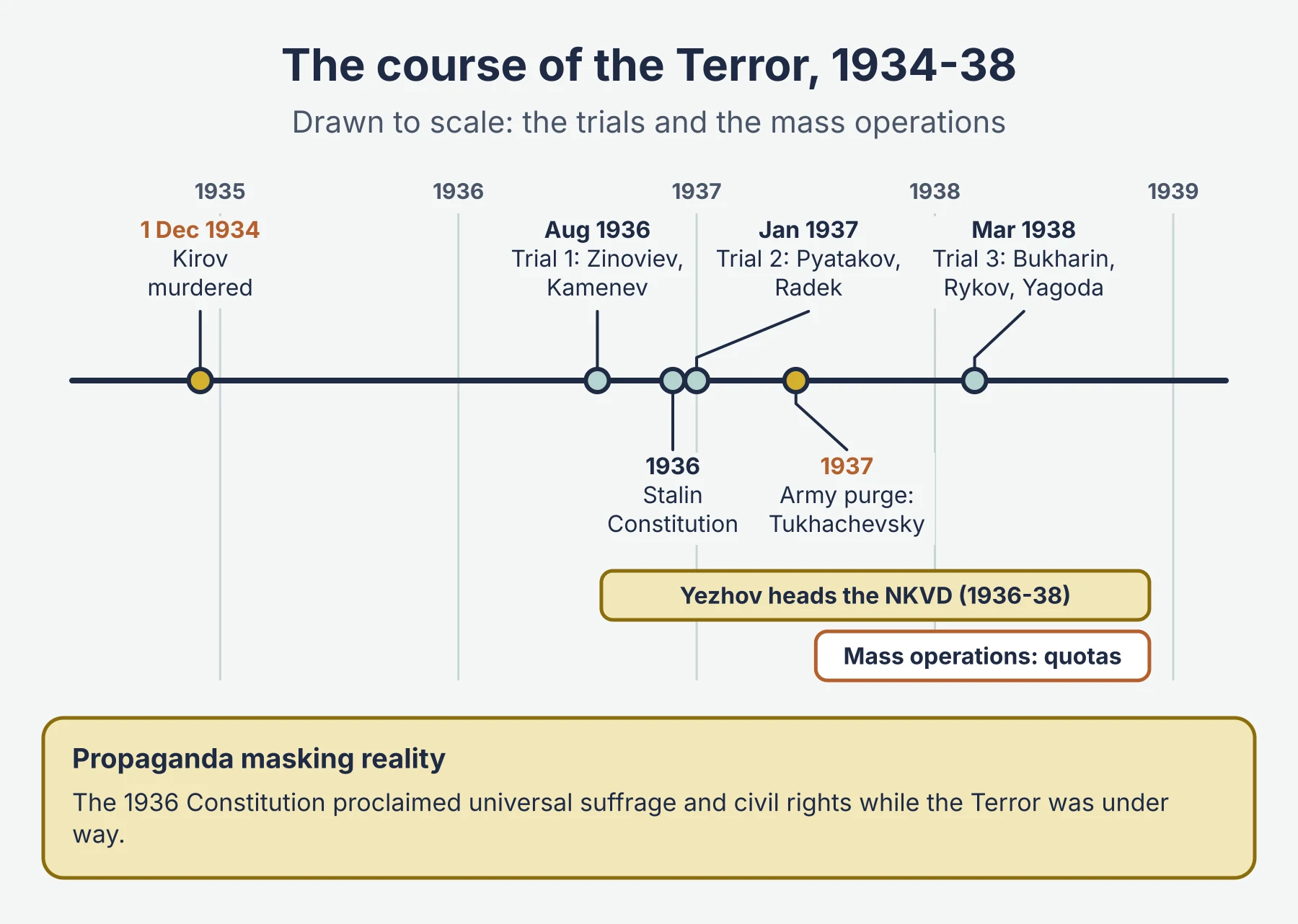
| 1 Dec 1934 | Kirov murdered |
| Aug 1935 | Stakhanov’s record shift |
| 1936 | Family law bans abortion; Stalin Constitution; first show trial |
| 1937-38 | Yezhovshchina; army purge (1937); Bukharin trial (1938) |
| 1938 | Third Five Year Plan; Russian compulsory in all schools |
| 23 Aug 1939 | Nazi-Soviet Pact |
| 22 June 1941 | German invasion |
2.1 Power struggle – four reasons in brief
- Office: General Secretary, Orgburo, appointments, the Lenin enrolment.
- Ideas: Socialism in One Country was patriotic and hopeful; Stalin occupied the centre between Left and Right.
- Rivals’ errors: Trotsky’s arrogance and absence from the funeral; Zinoviev and Kamenev’s opposition to the October 1917 rising; Bukharin’s late resistance.
- Alliances: with Zinoviev-Kamenev (1923-25), with the Right (1925-27), against the Right (1928-29).
2.2 Governing – tools and results
- Terror: Kirov’s murder as trigger; NKVD; show trials 1936-38; mass operations with quotas; gulags; the 1937 purge of the high command.
- Cult: fiftieth birthday (1929), the Short Course (1938), posters and statues, “Father of the Peoples”.
- Constitution 1936: rights on paper; one-party reality.
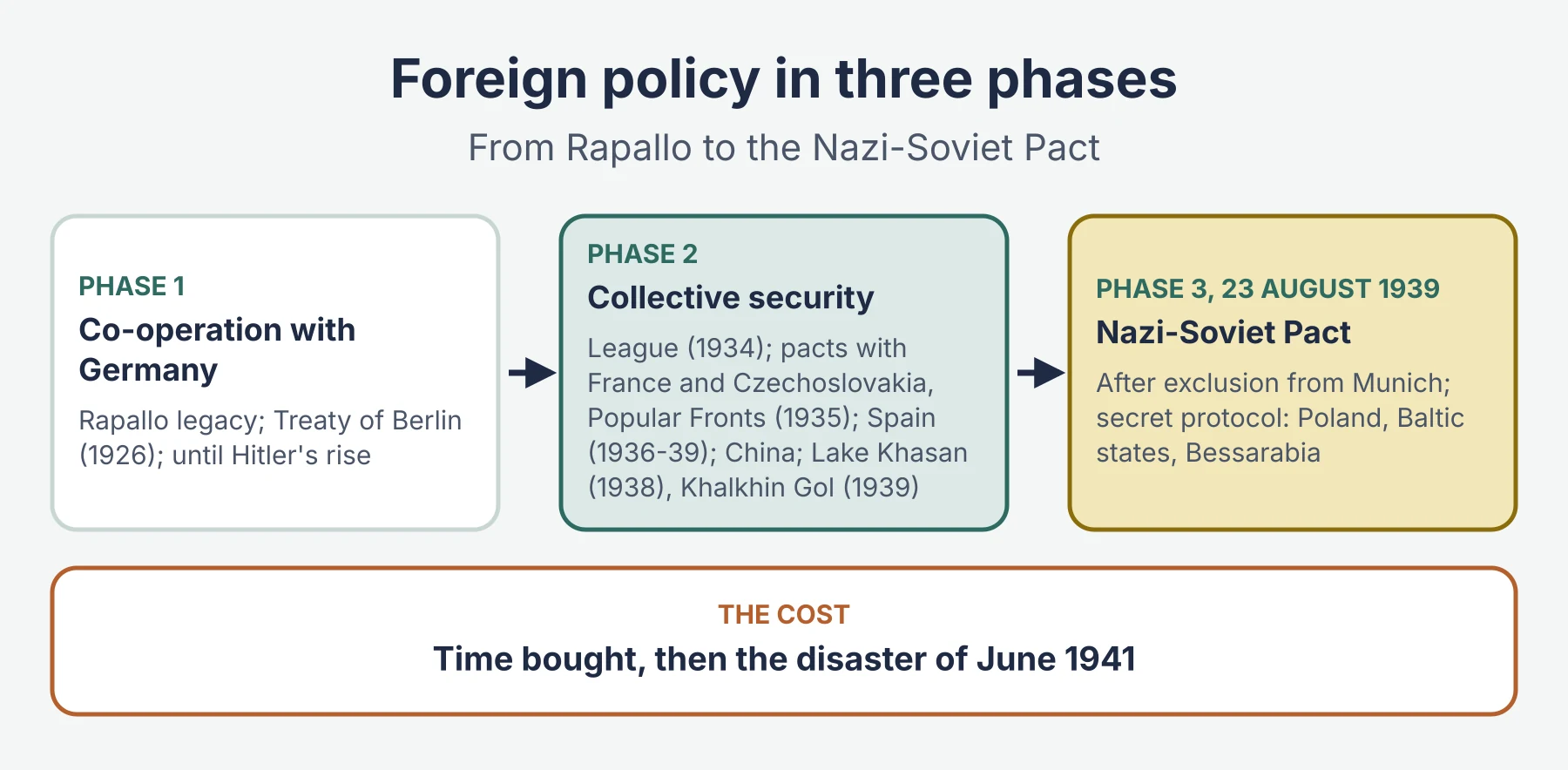
- Foreign policy: Treaty of Berlin (1926) – collective security from 1934 – Spain (1936-39) – clashes with Japan (1938-39) – Nazi-Soviet Pact (1939). Neutrality Pact with Japan, April 1941.
2.3 Economy – balance sheet
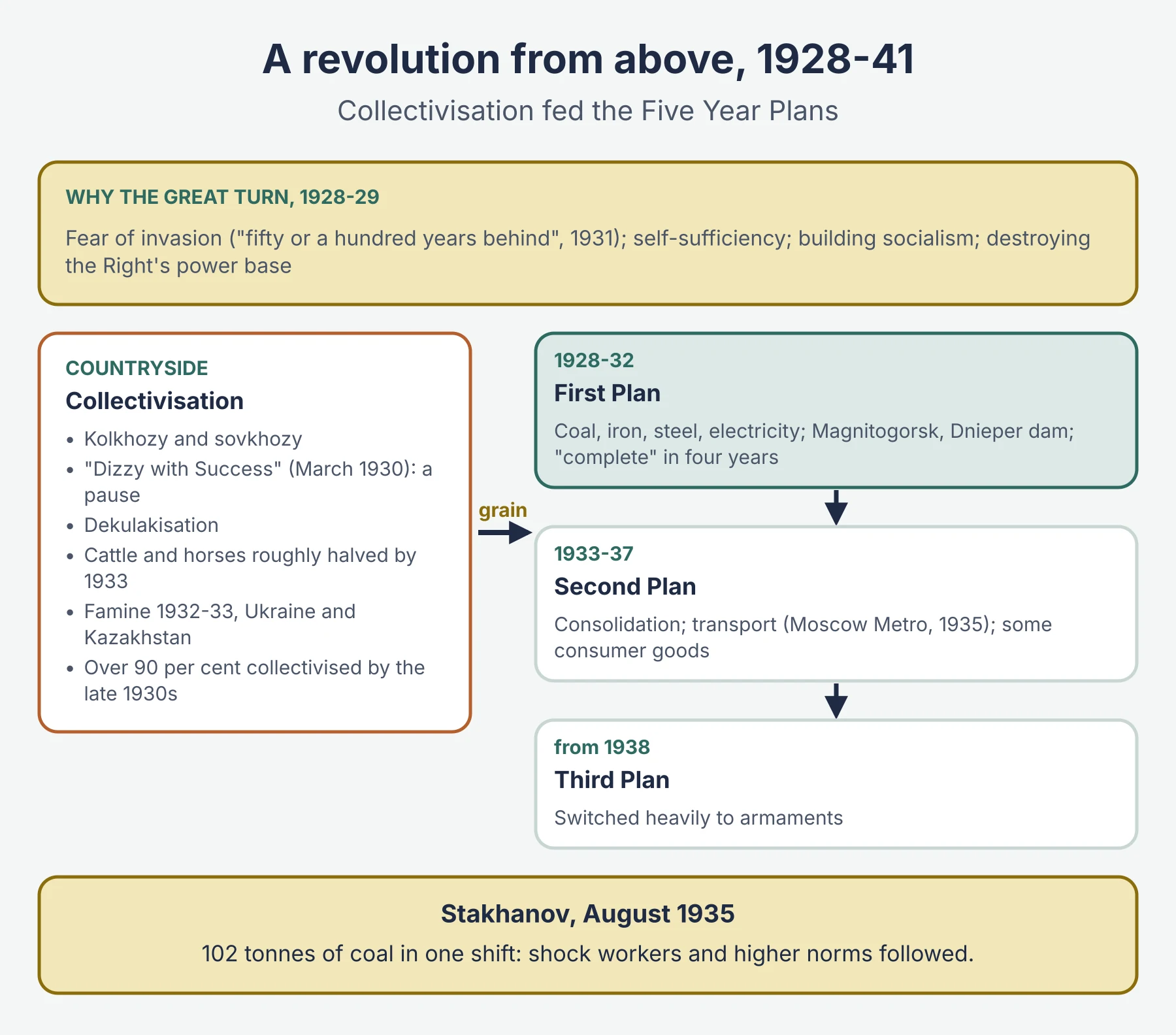
| Area | Gains (regime’s view) | Costs |
|---|---|---|
| Collectivisation | State control of grain; labour freed for industry | Famine of 1932-33; livestock roughly halved; low productivity |
| Plans 1-2 | Heavy industry multiplied; new industrial cities | Waste, falsified figures, poor quality |
| Plan 3 | Armaments production expanded | Consumer goods squeezed |
| Labour | Stakhanovite incentives, technical training | Labour books, harsh discipline laws (1938-40), forced labour |
2.4 Society – change and retreat
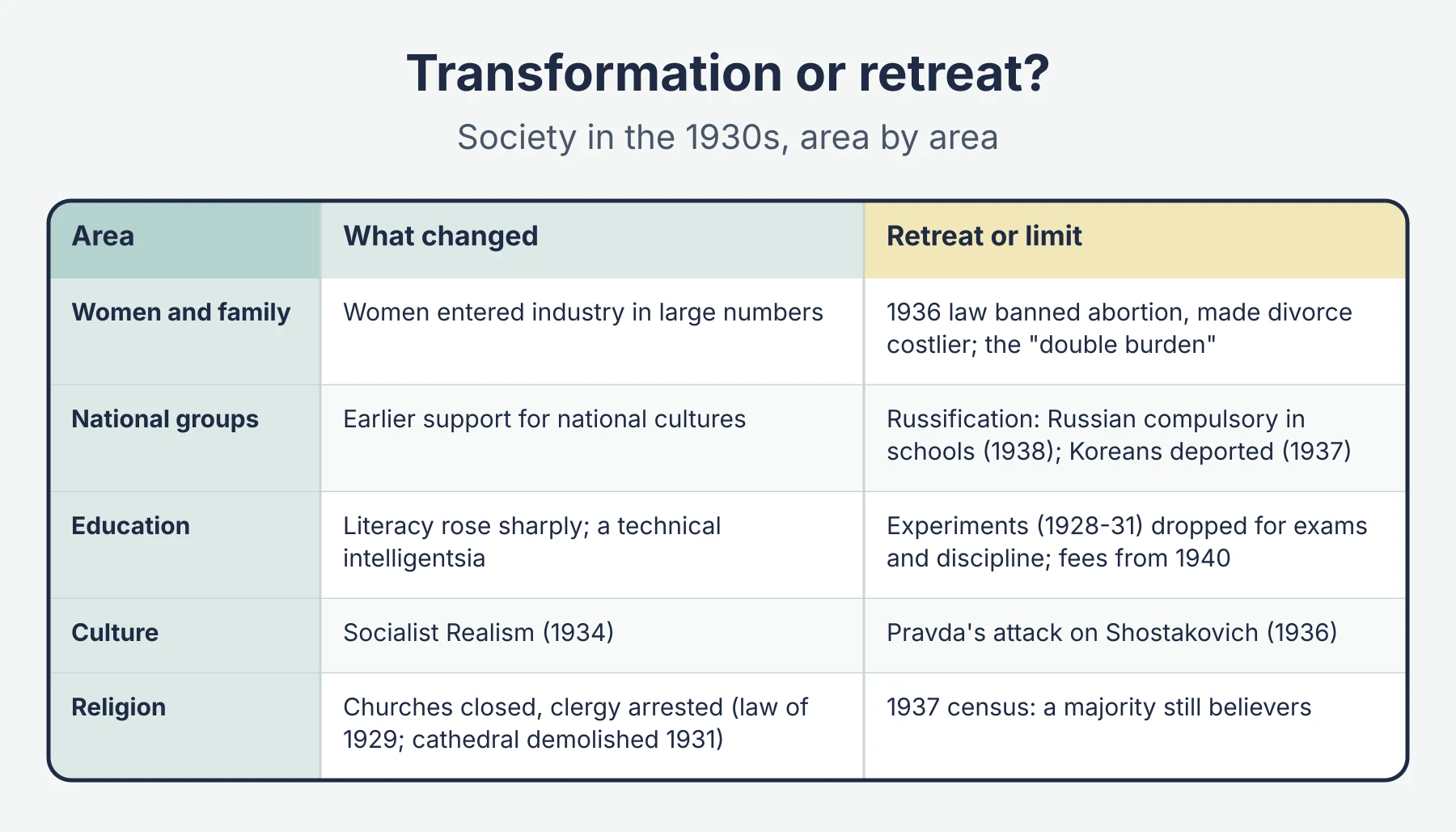
- Women: mass entry into industry; double burden; 1936 abortion ban and harder divorce.
- Nationalities: Russification; deportations of whole peoples; heavy famine losses in Kazakhstan and Ukraine.
- Education: from progressive experiment to traditional schooling; fees from 1940; literacy and technical training expanded.
- Culture: Cultural Revolution (1928-31), then Socialist Realism; artists under pressure.
- Religion: 1929 law, League of the Militant Godless, church closures and arrests; belief persisted.
Exam traps
- Dates of the Plans: first 1928-32 (declared complete early), second 1933-37, third 1938-41 (cut short by war).
- Alliances: Stalin sided with the Right against the Left, then turned on the Right; do not reverse them.
- Terror figures: quote records cautiously and say what they measure.
- “Transform”: set progress (literacy, industrial jobs for women) against reversal (the Great Retreat).
- Foreign policy: the Pact was a response to failed collective security as well as a deal with Hitler.
Self-test
- What did the postscript to Lenin’s Testament recommend? Removing Stalin as General Secretary.
- Which two rivals saved Stalin from the Testament in 1924? Zinoviev and Kamenev.
- What was Permanent Revolution? Trotsky’s view that the Russian revolution must spread abroad to survive.
- Who were the leaders of the Right? Bukharin, Rykov and Tomsky.
- What triggered the Great Turn in 1927-28? The grain procurement crisis, as peasants held back grain from low state prices.
- What did “Dizzy with Success” do? It blamed local officials for excesses and briefly slowed collectivisation.
- Whose murder in December 1934 began the escalation of terror? Sergei Kirov’s.
- Name two defendants at the March 1938 show trial. Bukharin and Rykov (also Yagoda).
- Which senior commander was shot in 1937? Marshal Tukhachevsky.
- What did the 1936 family law do? Banned abortion and made divorce harder and costlier.
- Where was Socialist Realism adopted as official policy? At the First Congress of Soviet Writers, 1934.
- What did the Nazi-Soviet Pact’s secret protocol do? It divided eastern Europe into German and Soviet spheres, including Poland.
Official syllabus
Cambridge International AS & A Level History (9489) syllabus for 2027, 2028 and 2029 – cambridgeinternational.org (Paper 4, European option, topic 2).
Related resources
-
Practice questions
Cambridge A Level World History (9489): European option: European history, 1919-41 – Practice Questions
Original Paper 4-style essays for Cambridge 9489 History on Mussolini, Stalin and Hitler, 1919-41, with indicative content and the AO1/AO2 level descriptors.
World History · Cambridge · A Level
Try questions -
Revision notes
Cambridge A Level World History (9489): European option: European history, 1919-41 – Revision Notes
Paper 4 revision notes for Cambridge 9489 History's European depth study: Mussolini's Italy, Stalin's Russia and Hitler's Germany, key dates and exam traps.
World History · Cambridge · A Level
Revise topic -
Study guides
Cambridge A Level World History (9489): European option: European history, 1919-41 – Study Guide
Study guide to the Cambridge 9489 History Paper 4 European option: Mussolini's Italy, Stalin's Russia and Hitler's Germany, 1919-41, with exam guidance.
World History · Cambridge · A Level
Read guide
Get free revision emails (optional)
Occasional emails with practice questions, worked explanations and links to free resources for the qualification and subjects you choose. No spam, and you can unsubscribe from any email. The free tools on this site never need an email.