
Study Guides
Cambridge A Level World History (9489): Hitler's Germany, 1929-41
Study guide to Cambridge 9489 Paper 4 topic 3, Hitler's Germany 1929-41: the rise to power, the terror state and propaganda, the economy and Nazi social policy.
- Subject
- World History
- Level
- A LEVEL
- Topic
- Topic 5: European option: European history, 1919-41
- Author
- Marlbridge Academic Team
- Updated
- Reviewed by
- Azam Siddique (what this means)
Aligned to Cambridge A Level World History (9489), 2027-2029. Official specification .
Syllabus page (what it covers and how it is assessed): Cambridge A Level World History.
Syllabus points this page covers
9489 (A Level)
- 3 Hitler’s Germany, 1929–41
Found an error? Report a correction.
Need help with this topic? Request a free trial class for A Level World History (9489).
Hitler’s Germany, 1929-41 is the third topic of the Paper 4 European option in Cambridge 9489. The key questions ask how Hitler gained control (3.1), how effectively the Nazis governed (3.2), how successful their economic policies were (3.3) and how far they transformed German society (3.4). You write two 30-mark essays from the option in 1 hour 45 minutes. This guide deepens the European option study guide; pair it with the Hitler’s Germany revision notes and the Hitler’s Germany practice questions.
Syllabus coverage
- 3.1 Weimar’s problems (the Depression, the Müller and Brüning governments, the rise of communism); growth of Nazi support, 1929-32; the 1932 elections, Schleicher, Hindenburg and Papen; consolidation, 1933-34.
- 3.2 The terror state; propaganda; opposition from youth, churches and the left, and passive resistance; foreign policy aims, methods, planning and consistency.
- 3.3 Responses to the Depression; agriculture; rearmament and autarky; living standards.
- 3.4 Women; young people; religion; persecution of Jews and other minorities.
3.1 Gaining control
The Depression and Weimar’s failure. After the Wall Street Crash (October 1929) American loans were recalled, exports and production fell, and registered unemployment reached about six million by early 1932. Hermann Müller’s grand coalition collapsed in March 1930 when the SPD and the DVP could not agree on unemployment insurance contributions. Heinrich Brüning governed through presidential decrees under Article 48, cutting spending and wages to balance the budget and end reparations; critics called him the “hunger chancellor”. Parliamentary government had effectively ended before Hitler arrived. The KPD’s vote also grew, frightening the middle classes and industrialists.
Why Nazi support grew, 1929-32.
- Hitler’s appeal: a strong leader above party squabbles, flown across Germany in the 1932 campaigns.
- The SA: street presence, protection for meetings, battles with communists that projected order and strength.
- Propaganda and promises: Goebbels targeted farmers, the Protestant middle classes, young voters and the unemployed with tailored messages – work and bread, national revival, an end to Versailles.
- Elite support: the Harzburg Front with Hugenberg’s DNVP (1931) gave respectability; some industrialists funded the party and in November 1932 a group petitioned Hindenburg to appoint Hitler.
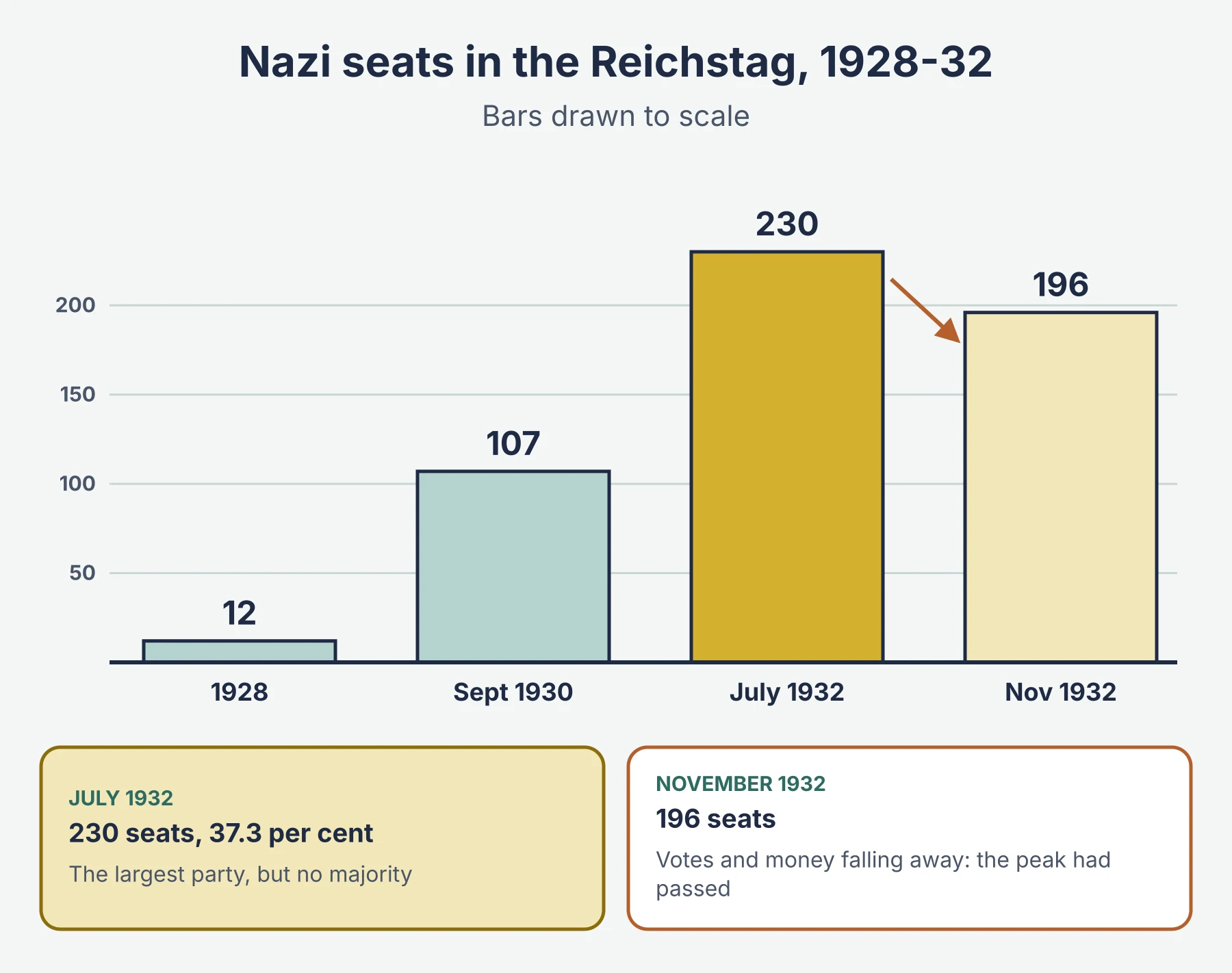
Seats show the trend: 12 in 1928, 107 in September 1930, 230 in July 1932 (37.3 per cent, the largest party), then 196 in November 1932 as votes and money fell away.
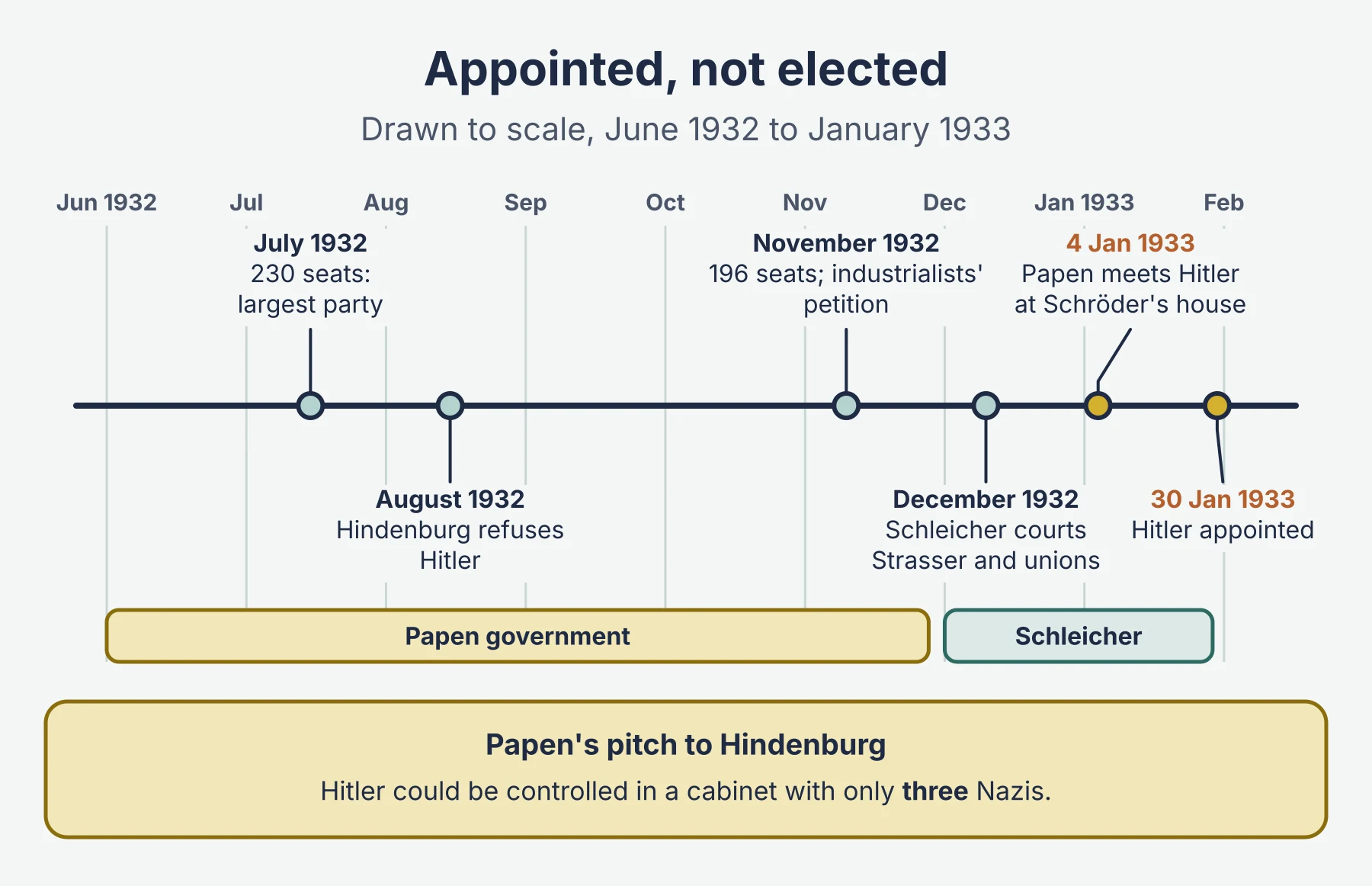
Appointment, January 1933. Hindenburg had refused Hitler the chancellorship in August 1932. Papen governed from June to November 1932 with little Reichstag support; Schleicher replaced him in December and tried to split the Nazis by offering office to Gregor Strasser and to court the unions, alarming landowners and industrialists. Papen, seeking revenge, met Hitler at the banker Schröder’s house in Cologne on 4 January 1933 and persuaded Hindenburg that Hitler could be controlled in a cabinet with only three Nazis. Hitler was appointed on 30 January 1933. This was a backstairs intrigue, not an electoral victory.
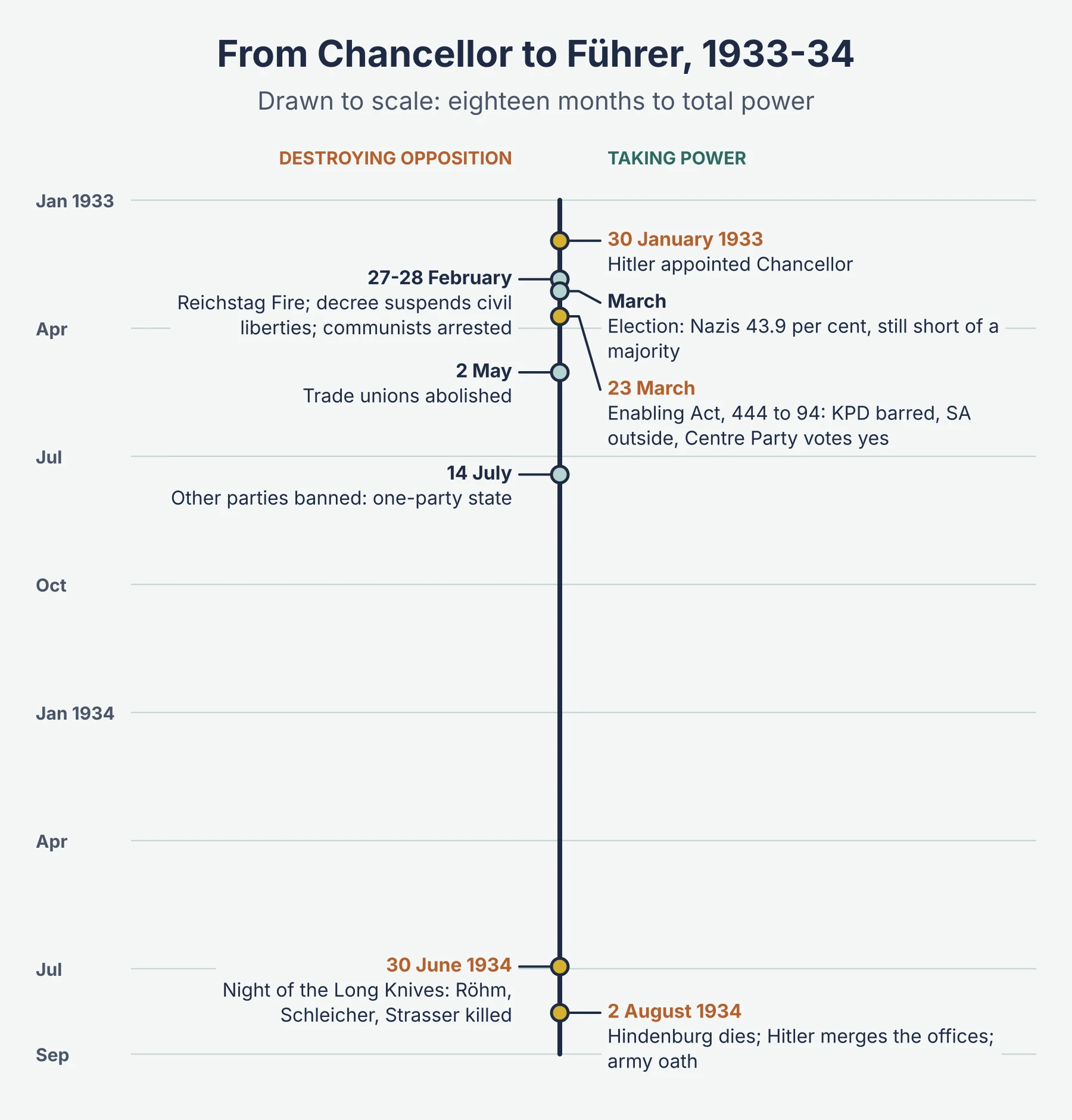
Consolidation, 1933-34. The Reichstag Fire (27 February) led to the decree suspending civil liberties the next day and mass arrests of communists. In the March 1933 election the Nazis won 43.9 per cent, still short of a majority. The Enabling Act (23 March) passed by 444 votes to 94: KPD deputies were barred, the SA surrounded the Kroll Opera House, and the Centre Party voted yes in return for promises on the Church. Gleichschaltung followed – federal states taken over, unions abolished (2 May 1933), other parties banned (14 July 1933). The Night of the Long Knives (30 June 1934) killed Röhm and other SA leaders, as well as Schleicher and Strasser, satisfying the army. When Hindenburg died on 2 August 1934, Hitler merged the offices of chancellor and president, and the army swore an oath of personal loyalty to him.
3.2 Governing: terror, propaganda and opposition
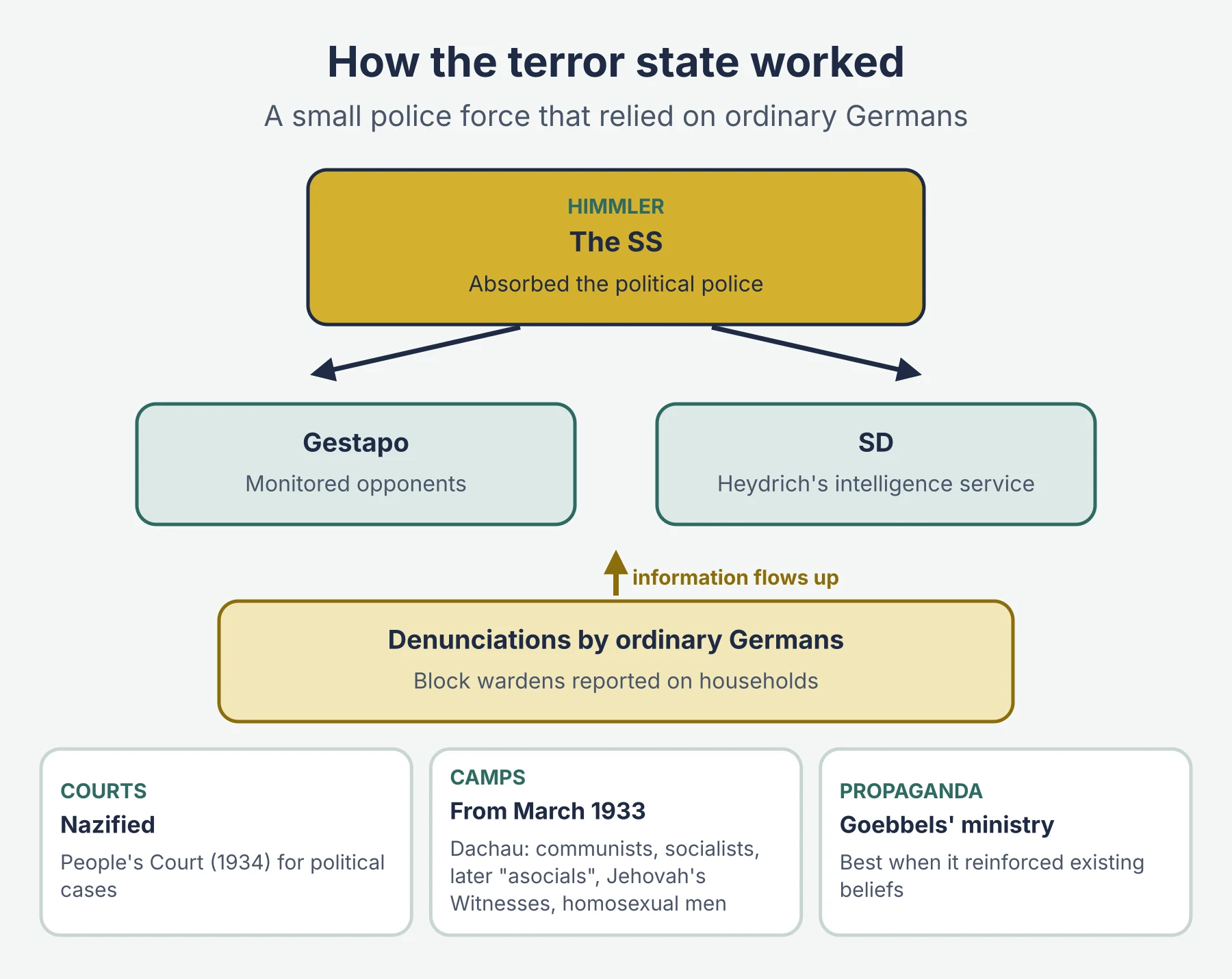
The terror state. Himmler’s SS absorbed the political police; the Gestapo and the SD (Heydrich’s intelligence service) monitored opponents, relying heavily on denunciations by ordinary Germans. Block wardens reported on households. The courts were Nazified and the People’s Court (1934) tried political cases. Concentration camps opened from March 1933 (Dachau) and held communists, socialists, and later “asocials”, Jehovah’s Witnesses and homosexual men.
Propaganda. Goebbels’ Ministry of Propaganda and Enlightenment (March 1933) and the Reich Chamber of Culture controlled press, radio, film, art and music. Cheap “people’s receivers” spread radio. The Nuremberg Rallies and the 1936 Berlin Olympics displayed national revival. Propaganda worked best when it reinforced existing beliefs – anti-communism, anti-Versailles feeling, admiration for Hitler – and less well when it tried to replace religious loyalties.
Opposition.
- Youth: the Swing movement (urban, middle-class, jazz-loving) and the Edelweiss Pirates (working-class gangs who clashed with the Hitler Youth).
- Churches: the Pastors’ Emergency League (1933) and the Confessing Church (Niemöller) resisted Nazi control of Protestantism; Bishop Galen preached against the euthanasia programme in August 1941.
- The left: underground KPD cells and SPD networks reporting to the exiled leadership, heavily penetrated by the Gestapo.
- Passive resistance: grumbling, avoiding the Hitler salute, listening to foreign radio.
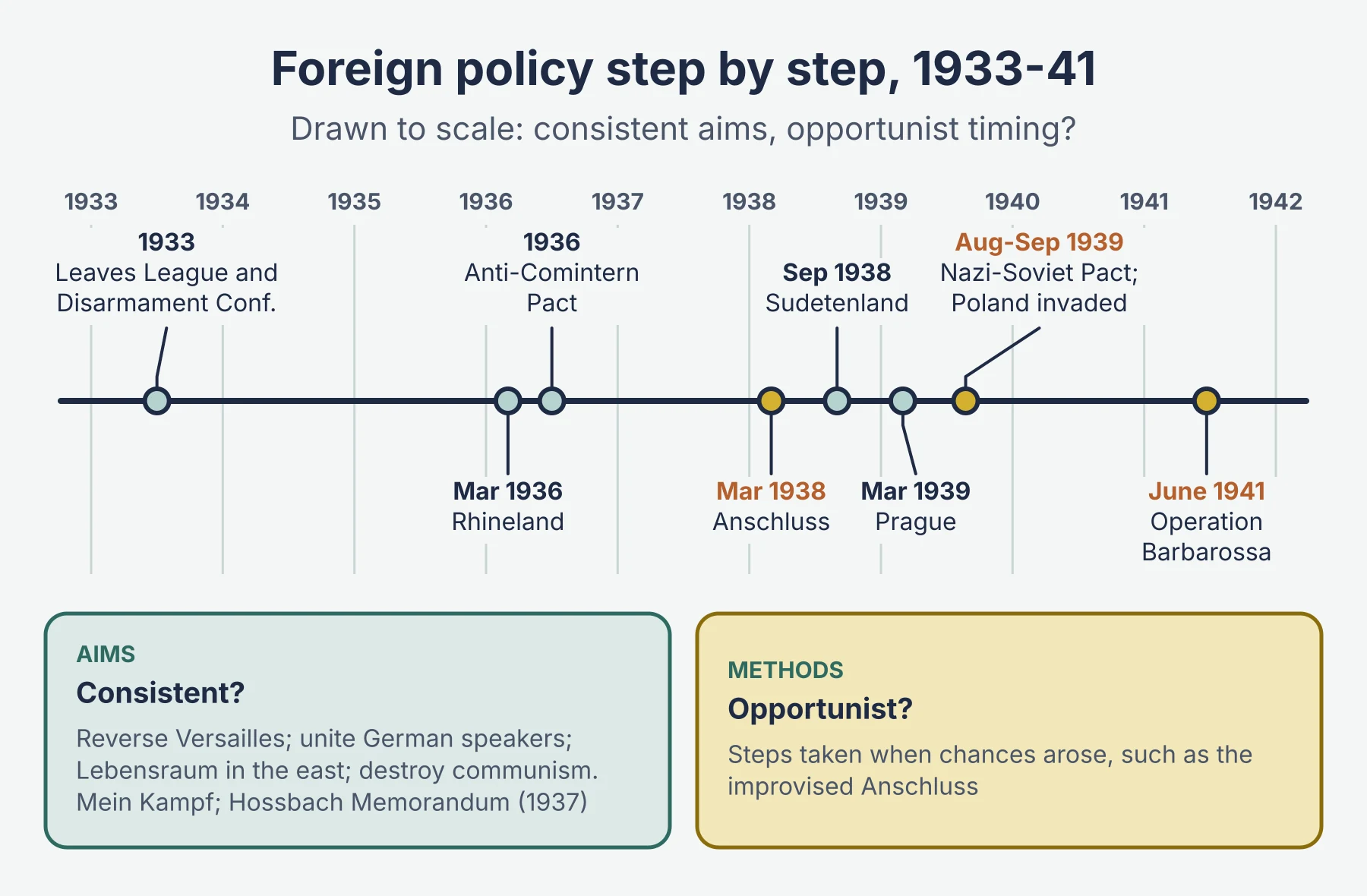
Foreign policy. Aims: reverse Versailles, unite German speakers, win Lebensraum in the east and destroy communism. Steps: leaving the League and Disarmament Conference (1933); the Rhineland (March 1936); the Anti-Comintern Pact (1936); Anschluss (March 1938); the Sudetenland (September 1938) and Prague (March 1939); the Nazi-Soviet Pact and the invasion of Poland (August-September 1939); Operation Barbarossa (June 1941). The debate on planning sets the consistent aims of Mein Kampf and the Hossbach Memorandum (1937) against evidence of opportunism, such as the improvised Anschluss.
3.3 The economy: recovery, then rearmament
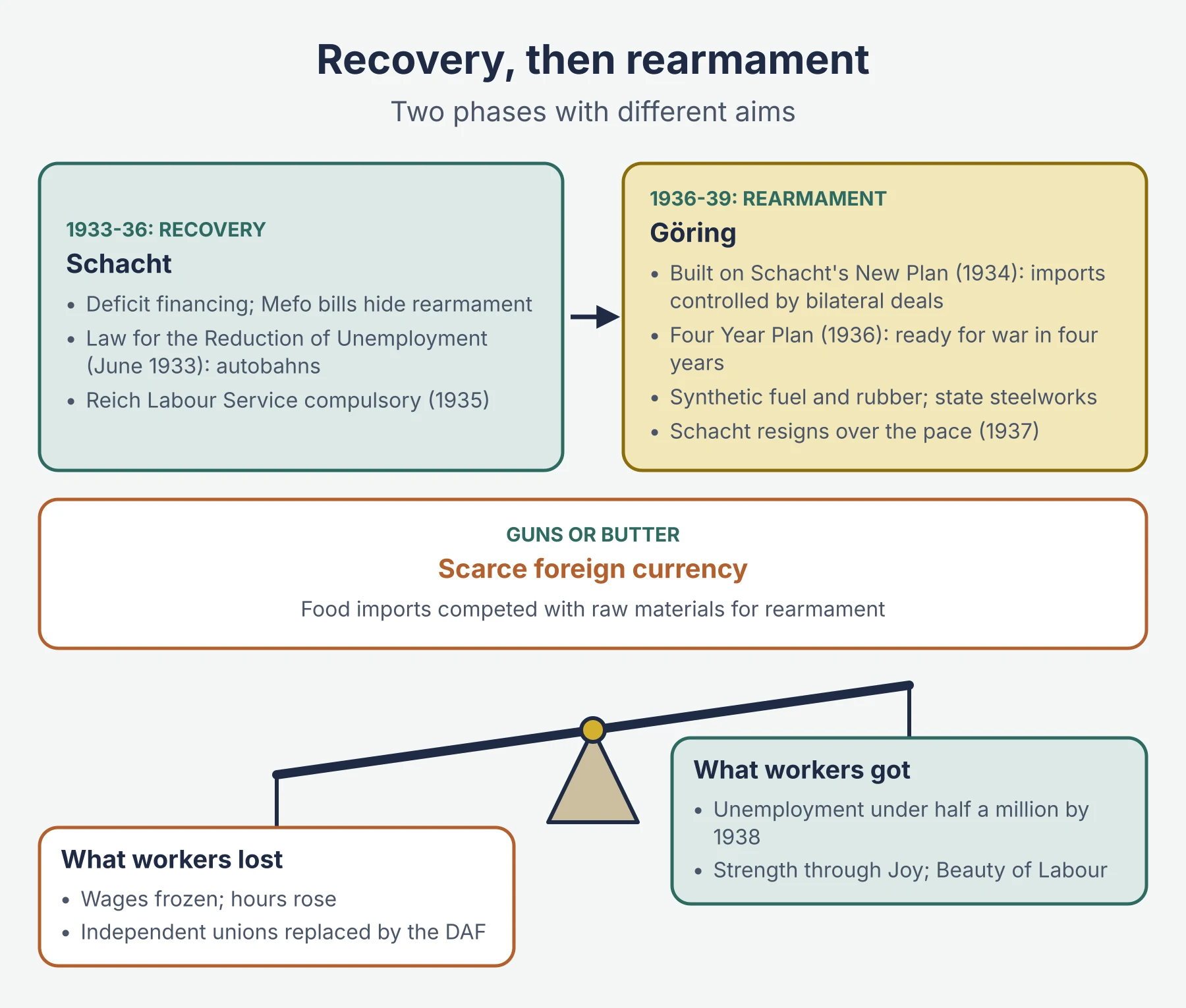
- Depression measures: Schacht at the Reichsbank (1933) and the economics ministry (1934) used deficit financing; Mefo bills concealed rearmament spending; the Law for the Reduction of Unemployment (June 1933) funded public works such as the autobahns; the Reich Labour Service became compulsory for young men in 1935.
- Agriculture: tariffs protected farmers; the Reich Food Estate controlled prices and production; the Reich Entailed Farm Law (1933) made medium-sized farms inheritable only by one heir and unsaleable, which tied sons to the land.
- Rearmament and autarky: Schacht’s New Plan (1934) controlled imports through bilateral deals; Göring’s Four Year Plan (1936) aimed to make the economy ready for war within four years, developing synthetic fuel and rubber and state steelworks. Schacht resigned from the economics ministry in 1937 over the pace of rearmament. Guns or butter: food imports competed with raw materials for scarce foreign currency.
- Living standards: unemployment fell to under half a million by 1938, but wages were frozen, hours rose and independent unions were replaced by the DAF. Strength through Joy offered holidays and concerts, and Beauty of Labour improved workplaces – consolation rather than real gains in pay.
3.4 Society: Volksgemeinschaft in practice
- Women: Kinder, Küche, Kirche; marriage loans (1933), the Mother’s Cross, pressure to leave professions. From 1937 labour shortages brought women back into work, revealing ideology bending to economic need.
- Youth: Nazified syllabuses (race science, history, sport), the NSLB for teachers, elite Napolas and Adolf Hitler Schools; the Hitler Youth and BDM became compulsory in 1939. Attendance fell off among older teenagers.
- Religion: the Concordat (July 1933) promised Catholic freedoms but was broken; the Reich Church under Bishop Müller and the German Christians tried to Nazify Protestantism; the German Faith Movement promoted a pagan alternative with little success.
- Persecution: race theory drew on Social Darwinism and eugenics; scapegoating for 1918 and the Depression. Jews faced the boycott (April 1933), exclusion from the civil service, the Nuremberg Laws (1935) and Kristallnacht (November 1938). The sterilisation law (1933) and the T4 programme from 1939 targeted disabled people; Roma, homosexual men and Jehovah’s Witnesses were persecuted.
Worked example: an annotated plan
Evaluate the reasons why Hitler was appointed Chancellor in January 1933. [30]
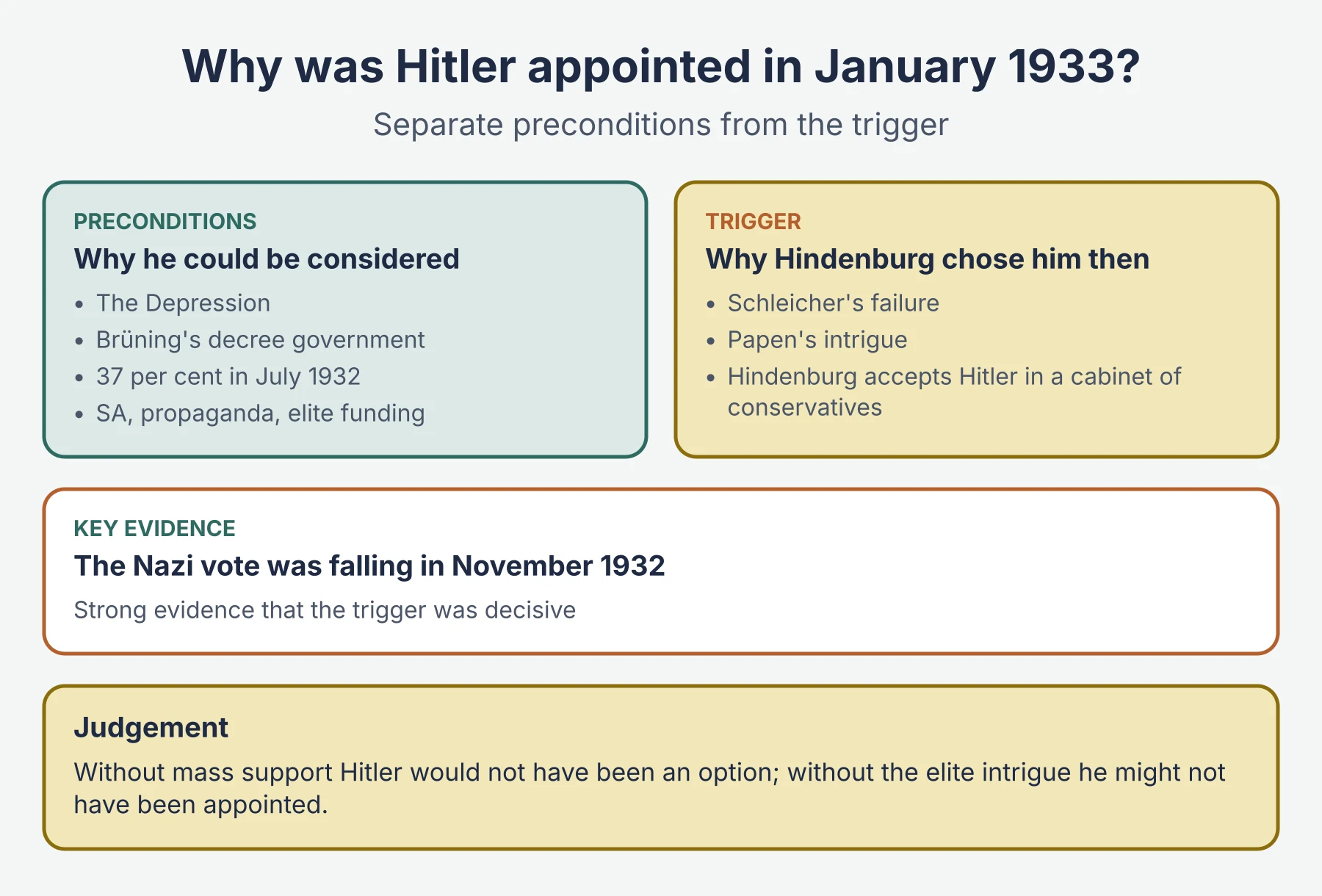
- Criterion: separate preconditions (why the Nazis were strong enough to be considered) from the trigger (why Hindenburg chose Hitler at that moment).
- Preconditions: the Depression; Brüning’s decree government; Nazi support of 37 per cent in July 1932; SA, propaganda, elite funding.
- Trigger: Schleicher’s failure, Papen’s intrigue, Hindenburg’s willingness to accept Hitler in a cabinet of conservatives. Note that the Nazi vote was falling in November 1932 – strong evidence that the trigger was decisive.
- Judgement: without mass support Hitler would not have been an option; without the elite intrigue he might not have been appointed.
Common mistakes
- Saying Hitler was “elected” Chancellor: he was appointed, and the Nazis never won a free majority.
- Treating the Enabling Act as purely legal without noting the coercion around the vote.
- Assuming the Gestapo was huge; it depended on denunciations.
- Calling Nazi economic policy one programme: recovery (1933-36) and rearmament (1936-39) had different aims.
Exam technique
Evaluate questions want a judgement on relative importance or value. Use dates and figures as evidence for that judgement (for example, falling Nazi seats in November 1932), not as narrative.
Official syllabus
Cambridge International AS & A Level History (9489) syllabus for 2027, 2028 and 2029 – cambridgeinternational.org (Paper 4, European option, topic 3).
Related resources
-
Practice questions
Cambridge A Level World History (9489): Hitler's Germany, 1929-41 – Practice Questions
Twelve original practice questions on Cambridge 9489 Hitler's Germany, 1929-41: short recall items and Paper 4-style 30-mark essays with mark-scheme answers.
World History · Cambridge · A Level
Try questions -
Revision notes
Cambridge A Level World History (9489): Hitler's Germany, 1929-41 – Revision Notes
Revision notes for Cambridge 9489 Paper 4, Hitler's Germany 1929-41: key terms, election figures, a dated timeline, the key questions condensed and a self-test.
World History · Cambridge · A Level
Revise topic -
Study guides
Cambridge A Level World History (9489): Mussolini's Italy, 1919-41
Study guide to Cambridge 9489 Paper 4 topic 1, Mussolini's Italy 1919-41: the rise to power, fascist government, economic battles and how far society changed.
World History · Cambridge · A Level
Read guide
Get free revision emails (optional)
Occasional emails with practice questions, worked explanations and links to free resources for the qualification and subjects you choose. No spam, and you can unsubscribe from any email. The free tools on this site never need an email.