
Study Guides
Cambridge A Level World History (9489): Mussolini's Italy, 1919-41
Study guide to Cambridge 9489 Paper 4 topic 1, Mussolini's Italy 1919-41: the rise to power, fascist government, economic battles and how far society changed.
- Subject
- World History
- Level
- A LEVEL
- Topic
- Topic 5: European option: European history, 1919-41
- Author
- Marlbridge Academic Team
- Updated
- Reviewed by
- Azam Siddique (what this means)
Aligned to Cambridge A Level World History (9489), 2027-2029. Official specification .
Syllabus page (what it covers and how it is assessed): Cambridge A Level World History.
Syllabus points this page covers
9489 (A Level)
- 1 Mussolini’s Italy, 1919–41
Found an error? Report a correction.
Need help with this topic? Request a free trial class for A Level World History (9489).
Mussolini’s Italy, 1919-41 is the first topic of the European option on Cambridge 9489 Paper 4, the A Level depth study. It has four key questions: how Mussolini gained control of Italy (1.1), how effectively he governed (1.2), how successful his economic policies were (1.3) and how far he transformed Italian society (1.4). Paper 4 sets two 30-mark essays in 1 hour 45 minutes, and any key question can be asked. This guide goes deeper than the European option study guide; condensed facts are in the Mussolini’s Italy revision notes and essays to try are in the Mussolini’s Italy practice questions.
Syllabus coverage
- 1.1 How did Mussolini gain control of Italy? Post-war problems (the war’s impact, the “mutilated victory”, d’Annunzio at Fiume, unemployment and inflation, unstable governments, the Biennio Rosso); the Fasci di Combattimento, squadrismo, the dual policy and the March on Rome; Victor Emmanuel III and the elites; the dictatorship of 1922-26 and the extent of control by 1926.
- 1.2 How effectively did Mussolini govern Italy? Coercion (OVRA, MVSN, special tribunals, the 1938 antisemitic laws); propaganda and censorship; fascist and state institutions; foreign policy aims, methods and success.
- 1.3 How successful were Mussolini’s economic policies? De Stefani, the “battles”, autarky, the Depression, IMI and IRI, the Corporate State and living standards.
- 1.4 How far did Mussolini transform Italian society? Women and youth, religion, the OND and the Reform of Customs, and opposition.
1.1 From fringe movement to dictatorship
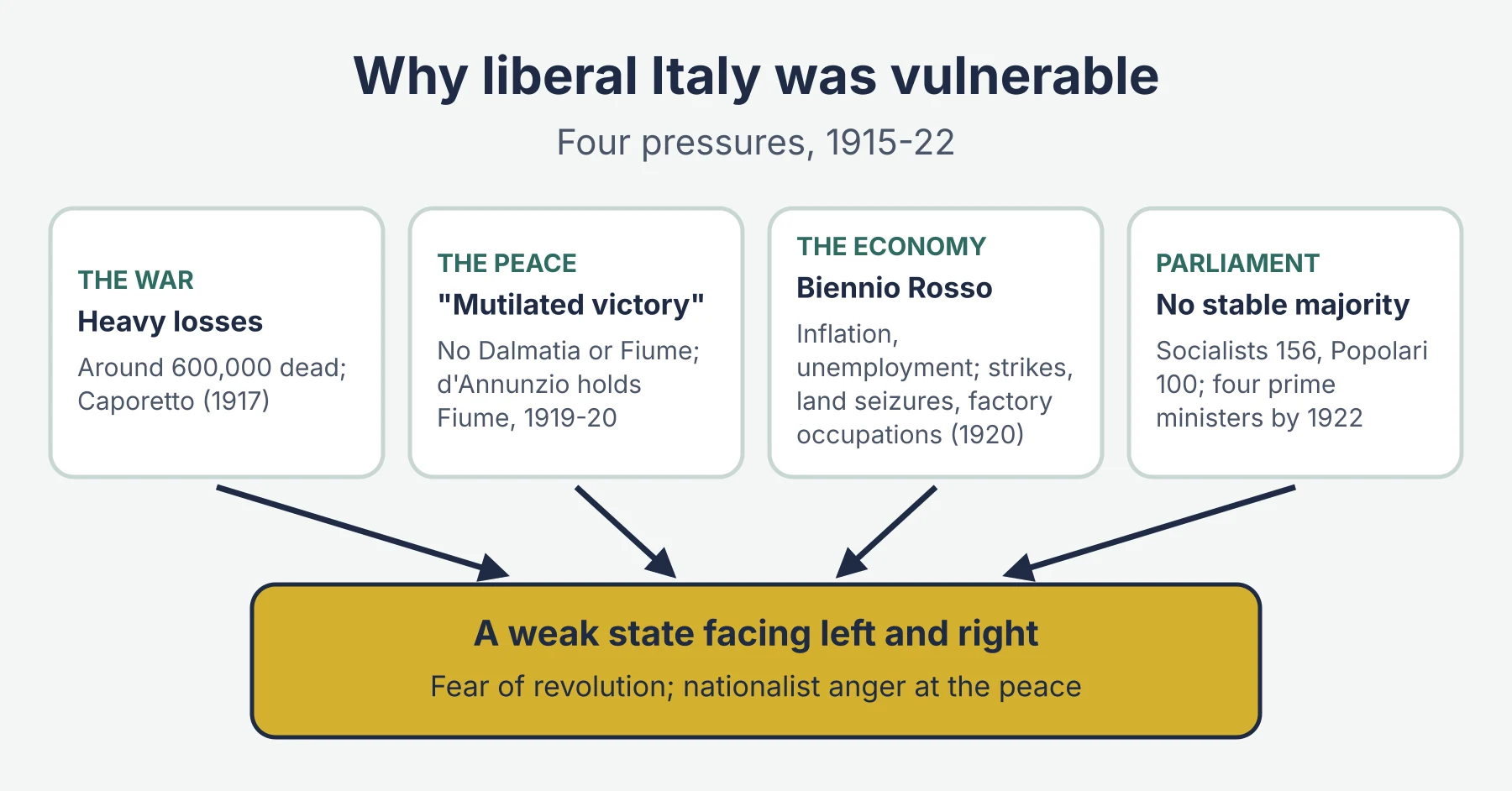
Why liberal Italy was vulnerable. Italy entered the war in 1915 under the secret Treaty of London, lost around 600,000 men and suffered the rout at Caporetto (1917). At Paris it gained the Trentino, South Tyrol and Trieste but not Dalmatia or Fiume, and d’Annunzio’s phrase “mutilated victory” stuck. In September 1919 d’Annunzio seized Fiume with nationalist volunteers and held it until December 1920, exposing the state’s weakness towards the nationalist right. Inflation and unemployment fed the Biennio Rosso (1919-20): strikes, land seizures and factory occupations in Turin and Milan (September 1920). After 1919 the Socialists (156 seats) and Catholic Popolari (100) were the largest parties, neither would work with the liberals, and four prime ministers came and went by 1922.
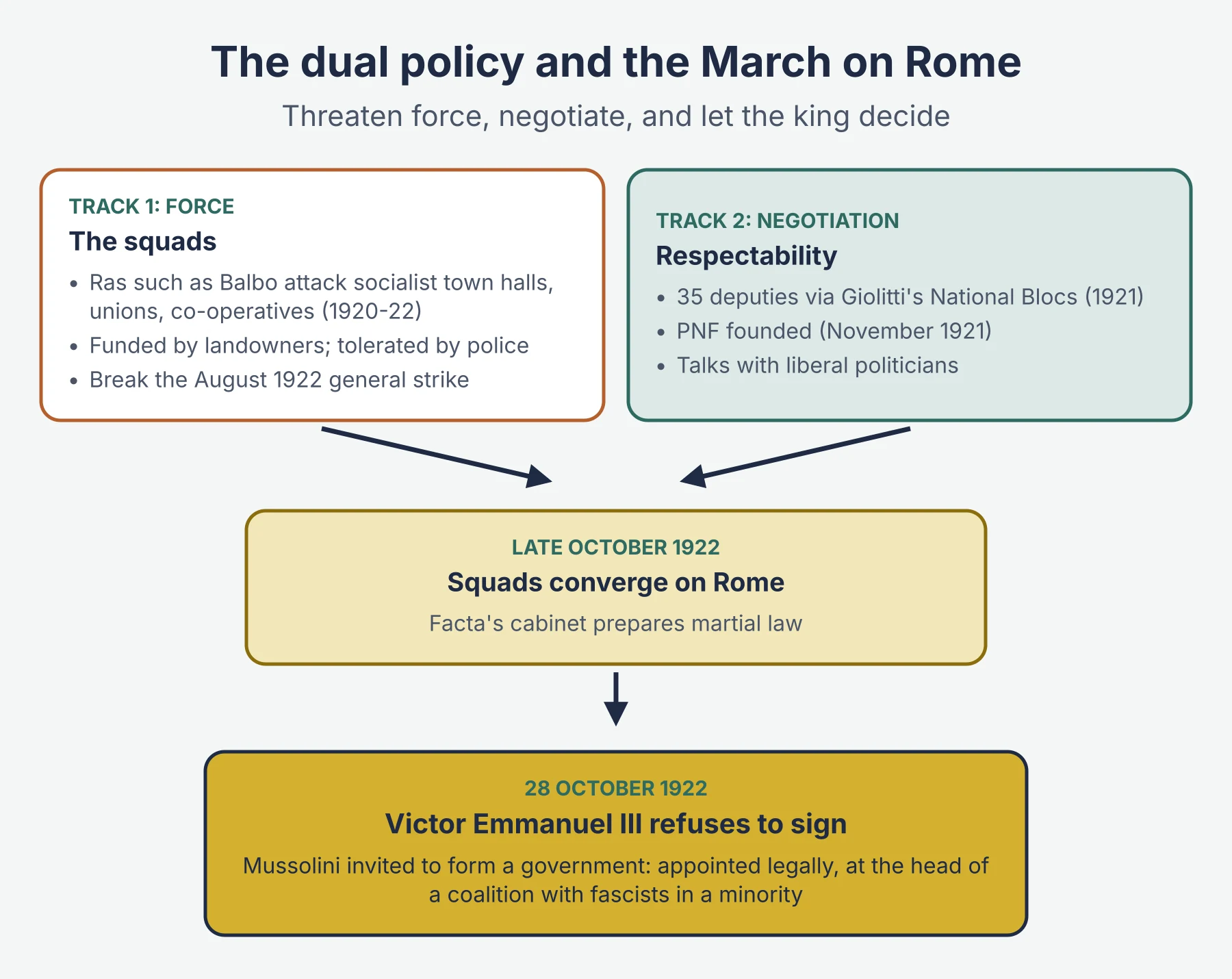
From programme to squads. The Fasci di Combattimento were founded in Milan in March 1919 with a radical, partly republican programme and won no seats that year. Mussolini then dropped most of it. Squads led by local bosses (ras) such as Italo Balbo in Ferrara attacked socialist town halls, unions and co-operatives in the Po Valley in 1920-22, funded by landowners and tolerated by many police and prefects. Giolitti included fascists in his National Blocs in 1921, giving them 35 deputies and respectability. The movement became the PNF in November 1921, after the ras forced Mussolini to drop a truce with the Socialists.
The dual policy and the March on Rome. Mussolini threatened force through the squads while negotiating with liberal politicians. The squads’ breaking of the August 1922 general strike presented fascism as the defender of order. When the squads converged on Rome in late October 1922, Facta’s cabinet prepared martial law, but Victor Emmanuel III refused to sign the decree on 28 October and invited Mussolini to form a government. He may have doubted the army’s loyalty and feared civil war; either way, Mussolini became prime minister legally, leading a coalition in which fascists were a minority.
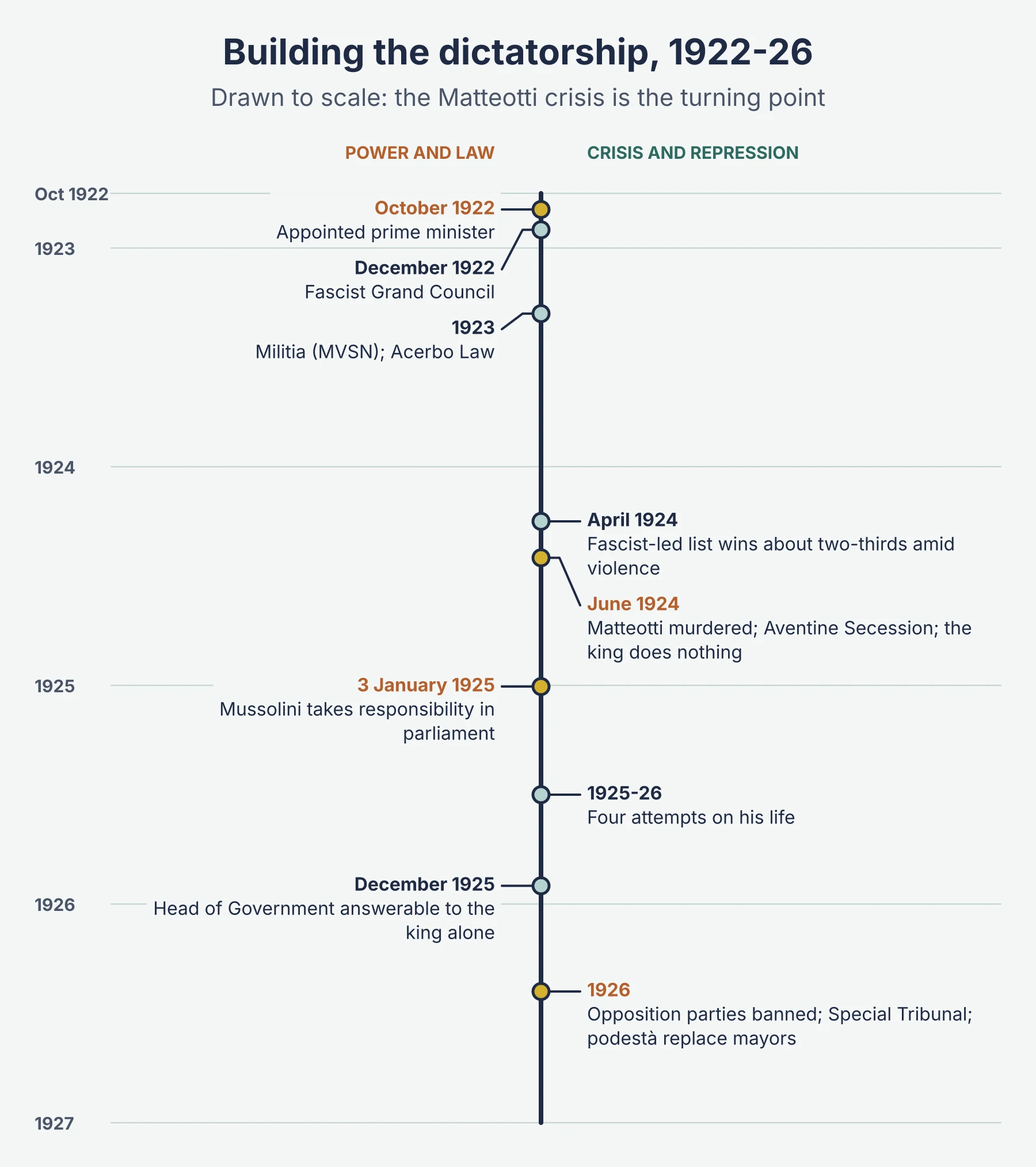
1922-26: building the dictatorship. The Fascist Grand Council (December 1922) and the Militia (MVSN, 1923) gave the party its own institutions. The Acerbo Law (1923) gave two-thirds of the seats to the list that won most votes, provided it took at least 25 per cent; the fascist-led list won about two-thirds of the vote in April 1924 amid violence. The murder of the socialist deputy Giacomo Matteotti in June 1924 nearly broke the regime: opposition deputies left parliament (the Aventine Secession), but the king did nothing. On 3 January 1925 Mussolini took responsibility in parliament for what had happened. The law of December 1925 on the powers of the Head of Government made him answerable to the king alone; after four attempts on his life in 1925-26, opposition parties were banned and a Special Tribunal for the Defence of the State was created in 1926.
How complete was control by 1926? The king, army, Church and big business remained independent centres of power – the key limit on any claim that Italy became “totalitarian”.
1.2 Coercion, consent and the limits of government
- Coercion was real but selective. OVRA, the secret police under Arturo Bocchini, watched opponents; the Special Tribunal tried political cases; thousands were sent into internal exile (confino). Executions were few by Nazi or Soviet standards.
- Propaganda used Ancient Rome (the Roman salute, the fasces, the Via dell’Impero), the cult of the Duce (“Mussolini is always right”), LUCE newsreels, radio, a controlled press, rallies and sporting triumphs such as the World Cups of 1934 and 1938. A Ministry of Popular Culture was created in 1937.
- Party versus state. In 1927 prefects, who were state officials, were made superior to the party in the provinces, and appointed podestà replaced elected mayors from 1926. Mussolini preferred the state machine to party radicals, and the PNF became a job-seeking bureaucracy.
- The 1938 antisemitic laws expelled Jews from schools, universities, the civil service and the party and banned mixed marriages.
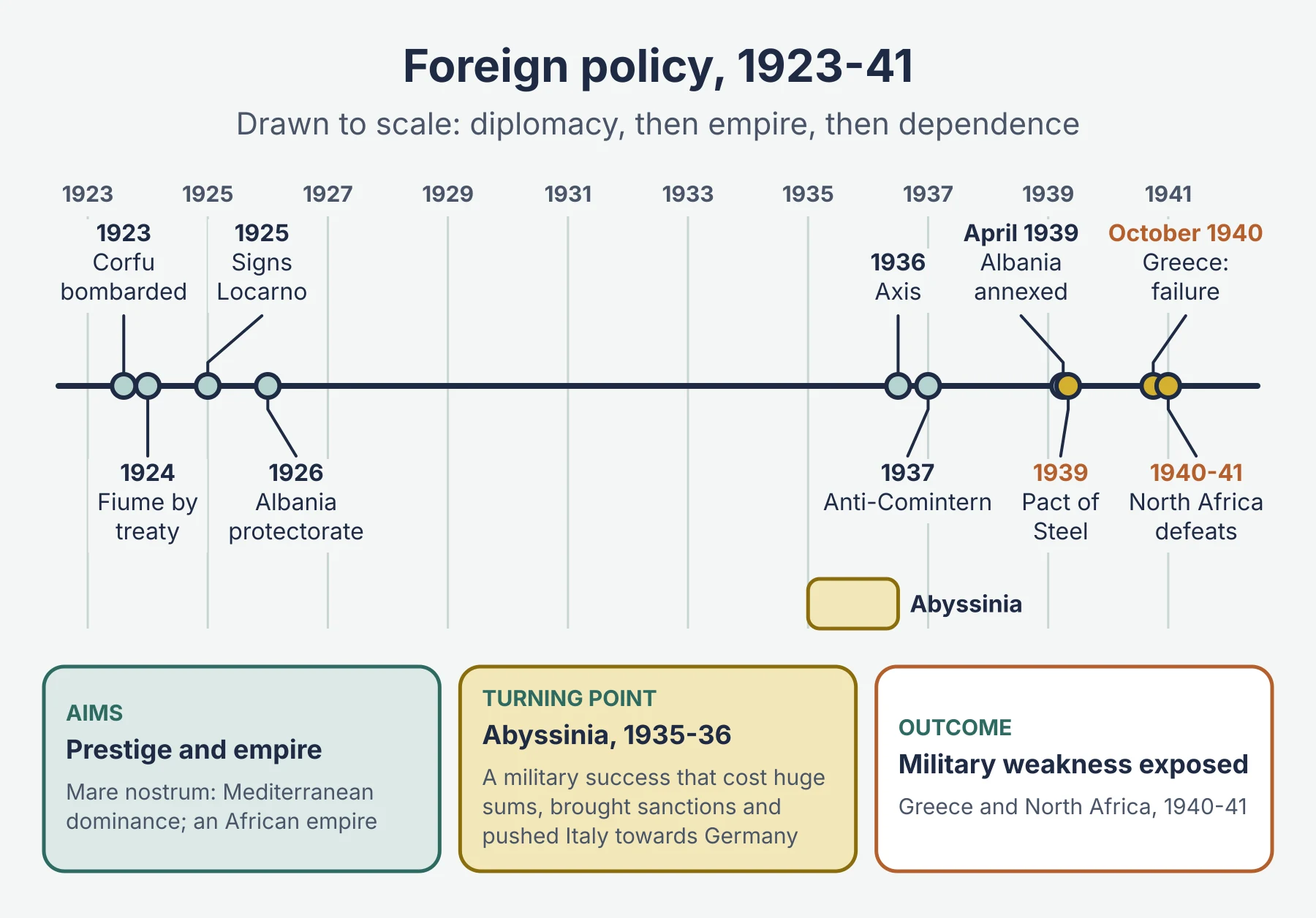
- Foreign policy. Aims: prestige, Mediterranean dominance (mare nostrum) and African empire. Early methods mixed bullying and diplomacy – the bombardment and occupation of Corfu in 1923, the gain of Fiume by treaty with Yugoslavia in 1924, signing Locarno (1925) and a protectorate over Albania from 1926. Abyssinia (1935-36) was a military success but cost huge sums, provoked League sanctions and pushed Italy towards Germany: the Axis (1936), the Anti-Comintern Pact (1937), the Pact of Steel (1939). Albania was annexed in April 1939, but the failed attack on Greece (October 1940) and defeats in North Africa in 1940-41 exposed military weakness.
1.3 The economy: propaganda success, economic cost
Phase one, 1922-25. Alberto De Stefani followed orthodox policies: spending cuts, lower taxes on business and privatisation (for example of the telephone network). Growth returned, but inflation and a falling lira ended his tenure in 1925.
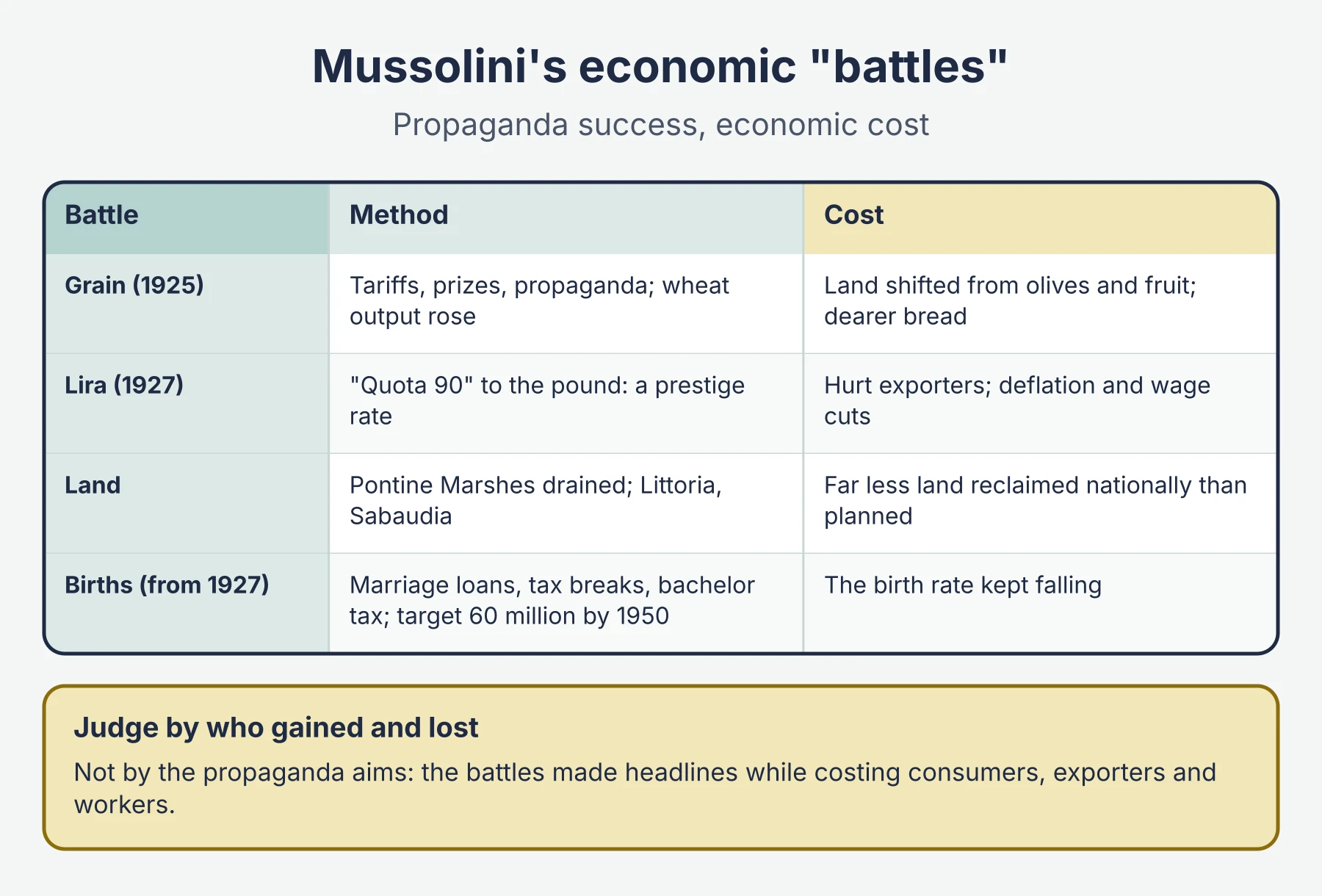
The battles. The Battle for Grain (1925) raised wheat output through tariffs, prizes and propaganda, but shifted land away from more profitable crops such as olives and fruit and raised bread prices. The Battle for the Lira fixed the currency at “Quota 90” to the pound (1927): a prestige rate that hurt exporters and caused deflation and wage cuts. The Battle for Land drained the Pontine Marshes and built new towns such as Littoria and Sabaudia, but far less land was reclaimed nationally than planned.
The Depression and the state. Italy suffered falling exports and rising unemployment after 1929. The state rescued banks and firms through the IMI (1931) and the IRI (1933); by the late 1930s IRI made the Italian state one of Europe’s largest owners of industry outside the USSR. Public works and later rearmament reduced unemployment.
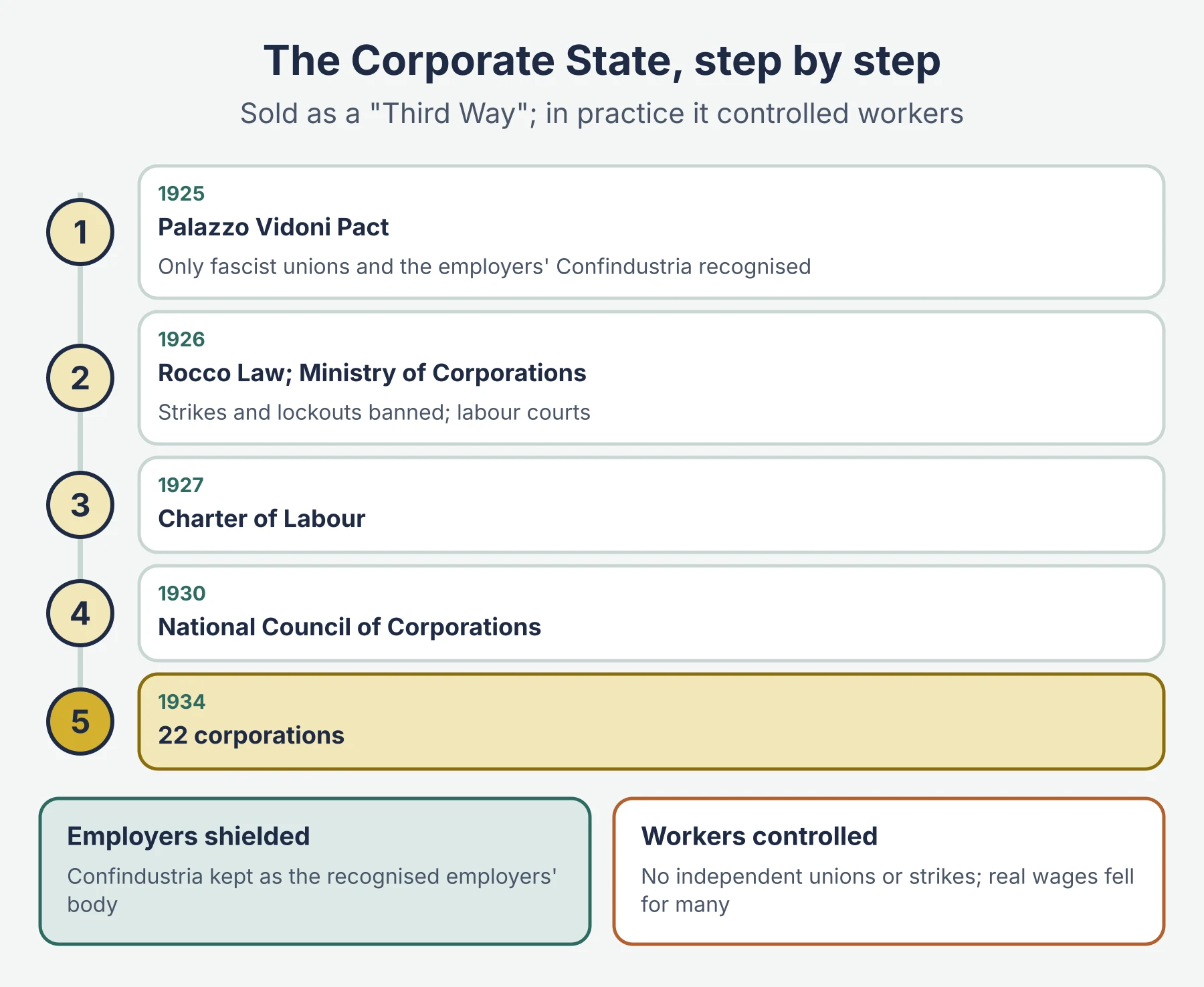
Corporate State. Built step by step: the Palazzo Vidoni Pact (1925) recognised only fascist unions and employers’ Confindustria; the Rocco Law (1926) banned strikes and lockouts and set up labour courts; a Ministry of Corporations (1926), the Charter of Labour (1927), the National Council of Corporations (1930) and 22 corporations (1934) followed. Sold as a “Third Way”, it shielded employers and controlled workers.
Living standards. Welfare grew (the maternity agency ONMI, family allowances, pensions), but real wages fell for many workers in the late 1920s and early 1930s and diets stayed poor by western European standards.
1.4 Society: how deep did fascism reach?
Women. Fascism praised motherhood. The Battle for Births (launched 1927) offered marriage loans and tax breaks, taxed bachelors, banned contraception information and harshened abortion penalties, aiming at 60 million Italians by 1950. The birth rate kept falling. Quotas restricted women’s public employment, yet economic need kept many women working.
Youth. The Gentile reform (1923) was elitist and classical; later the regime imposed a single state textbook for elementary schools (from 1929), a loyalty oath for teachers, and an oath for university professors (1931) that only a handful refused. The ONB (1926), merged into the GIL in 1937, organised sport, drill and indoctrination; membership was far higher in northern towns than the rural south.
Religion. Mussolini moved from early anti-clericalism to the Lateran Treaties (February 1929): an independent Vatican City, a Concordat making Catholicism the state religion with religious teaching in schools, and financial compensation. The Church urged Catholics to vote for the regime in the 1929 plebiscite, but disputes over Catholic Action (1931) and the 1938 racial laws showed the Church kept its own loyalties.
Leisure and customs. The OND (1925) offered subsidised excursions, sport and theatre and was genuinely popular. The 1938 Reform of Customs (Voi for Lei, no handshakes, the passo romano) was widely mocked.
Opposition was weak but persistent: the underground Communist Party, the exile group Giustizia e Libertà (founded 1929, whose founder Carlo Rosselli was murdered in France in 1937), occasional strikes, and everyday non-conformity.
Worked example: an annotated Paper 4 plan
Assess the extent to which Mussolini had established a dictatorship in Italy by 1926. [30]
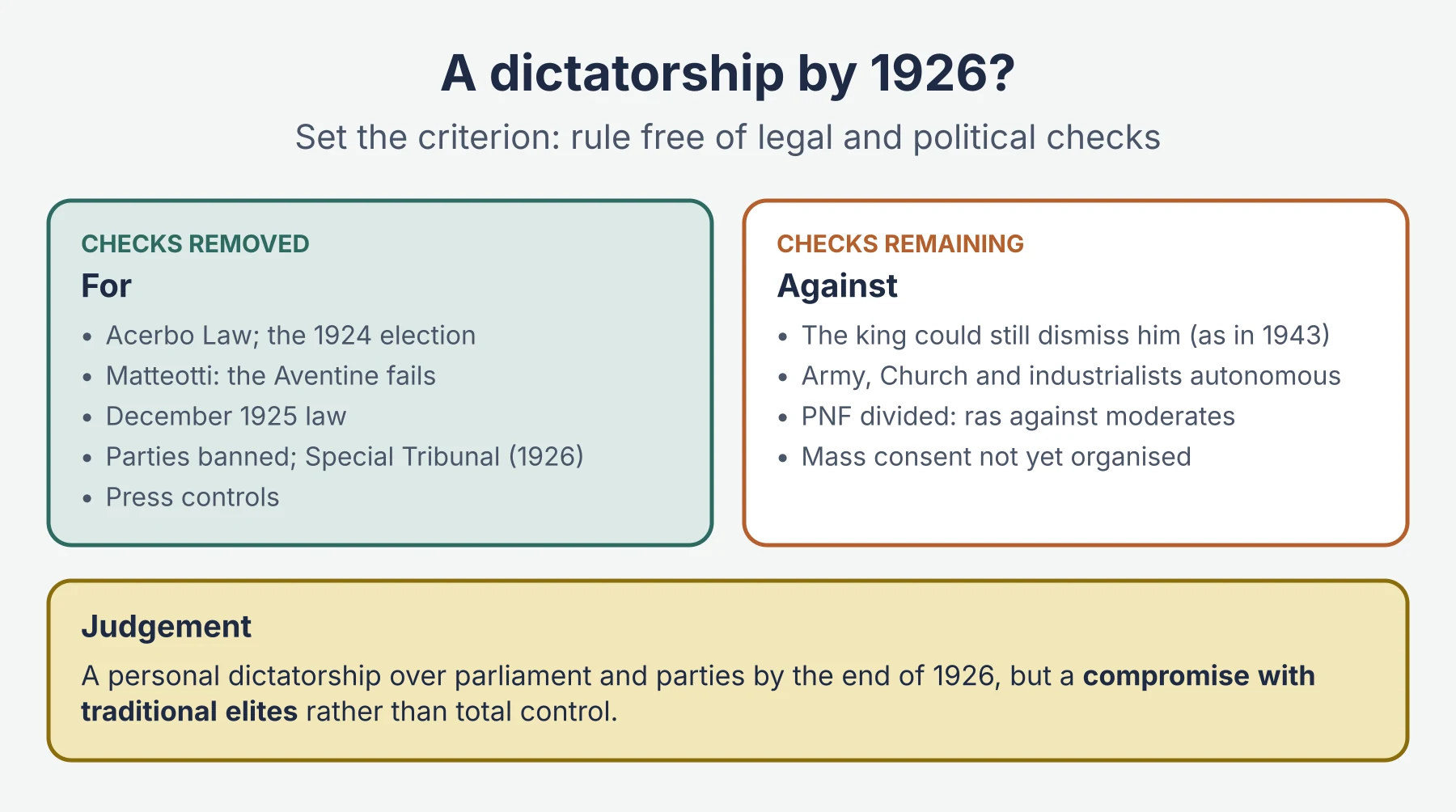
- Criterion. A dictatorship means rule free of legal and political checks. Measure institutions, coercion and remaining centres of power.
- For: the Acerbo Law and the 1924 election; Matteotti and the failure of the Aventine; the December 1925 law; opposition parties banned and the Special Tribunal in 1926; press controls. Each point must show a check removed.
- Against: the king could still dismiss Mussolini (as he did in 1943); the army, Church and industrialists kept autonomy; the PNF itself was divided between ras and moderates; mass consent was not yet organised (the ONB and OND were new).
- Judgement: a personal dictatorship over parliament and parties existed by the end of 1926, but it was a compromise with traditional elites rather than total control.
Common mistakes
- Saying Mussolini “seized” power in 1922: he was appointed after the king refused martial law.
- Treating the Corporate State as working machinery rather than a largely propaganda structure.
- Judging economic policy by its propaganda aims, not by who gained and lost.
Exam technique
Paper 4 uses assess (make an informed judgement) and evaluate (judge the quality, importance or value). Set a criterion, argue both sides with precise evidence, and end each paragraph with a judgement on the question. Credit is split equally between knowledge (AO1) and analysis and judgement (AO2), so you need both.
Official syllabus
Cambridge International AS & A Level History (9489) syllabus for 2027, 2028 and 2029 – cambridgeinternational.org (Paper 4, European option, topic 1).
Related resources
-
Practice questions
Cambridge A Level World History (9489): Mussolini's Italy, 1919-41 – Practice Questions
Twelve original practice questions on Cambridge 9489 Mussolini's Italy: short recall items and Paper 4-style 30-mark essays, with mark-scheme style answers.
World History · Cambridge · A Level
Try questions -
Revision notes
Cambridge A Level World History (9489): Mussolini's Italy, 1919-41 – Revision Notes
Revision notes for Cambridge 9489 Paper 4, Mussolini's Italy 1919-41: key terms, a dated timeline, the four key questions in brief, exam traps and a self-test.
World History · Cambridge · A Level
Revise topic -
Study guides
Cambridge A Level World History (9489): Stalin's Russia, 1924-41
Study guide to Cambridge 9489 Paper 4 topic 2, Stalin's Russia 1924-41: the power struggle, Terror and cult, collectivisation, the Five Year Plans and society.
World History · Cambridge · A Level
Read guide
Get free revision emails (optional)
Occasional emails with practice questions, worked explanations and links to free resources for the qualification and subjects you choose. No spam, and you can unsubscribe from any email. The free tools on this site never need an email.