
Revision Notes
Cambridge A Level World History (9489): The USA, 1974-93 – Revision Notes
Revision notes for Cambridge 9489 Paper 4, the USA 1974-93: key terms, a timeline, Ford to Bush, Carter abroad, détente to Gorbachev, traps and a self-test.
- Subject
- World History
- Level
- A LEVEL
- Topic
- Topic 6: American option: The USA, 1945-93
- Author
- Marlbridge Academic Team
- Updated
- Reviewed by
- Azam Siddique (what this means)
Aligned to Cambridge A Level World History (9489), 2027-2029. Official specification .
Syllabus page (what it covers and how it is assessed): Cambridge A Level World History.
Syllabus points this page covers
9489 (A Level)
- 6 The USA, 1974–93
Found an error? Report a correction.
Need help with this topic? Request a free trial class for A Level World History (9489).
These notes condense The USA, 1974-93, the third topic of the Paper 4 American option in Cambridge 9489. For explanation and a worked judgement paragraph see the 1974-93 study guide; for essays and short questions see the 1974-93 practice questions.
Syllabus coverage
- 6.1 How significant were the problems facing the US in the late 1970s?
- 6.2 How great was the impact of the New Conservatism, 1981-92?
- 6.3 How effective were Carter’s foreign policies, 1977-81?
- 6.4 Why did relations between the US and the USSR change?
Key terms
| Term | Meaning |
|---|---|
| Stagflation | High inflation and high unemployment at the same time |
| Busing | Transporting pupils to other districts to desegregate schools |
| New Right | Coalition of religious conservatives, tax rebels and free-market thinkers |
| Moral Majority | Jerry Falwell’s evangelical political organisation (1979) |
| Supply-side economics | Theory that tax cuts raise output, investment and eventually revenue |
| Reaganomics | Reagan’s tax cuts, domestic spending cuts, deregulation and tight money |
| Keynesian consensus | Post-war acceptance that government spending should manage demand |
| Deregulation | Removing government rules on industries such as airlines and banking |
| Shuttle diplomacy | Kissinger’s travel between Middle East capitals to broker deals, 1973-75 |
| Détente | Easing of Cold War tension, c.1969-79 |
| Second Cold War | Renewed confrontation, c.1979-85 |
| Reagan Doctrine | Support for anti-communist insurgents (“rollback”) |
| SDI | Strategic Defense Initiative, Reagan’s proposed missile shield (1983) |
| INF Treaty | 1987 agreement eliminating intermediate-range nuclear missiles |
Timeline to learn
| Date | Event |
|---|---|
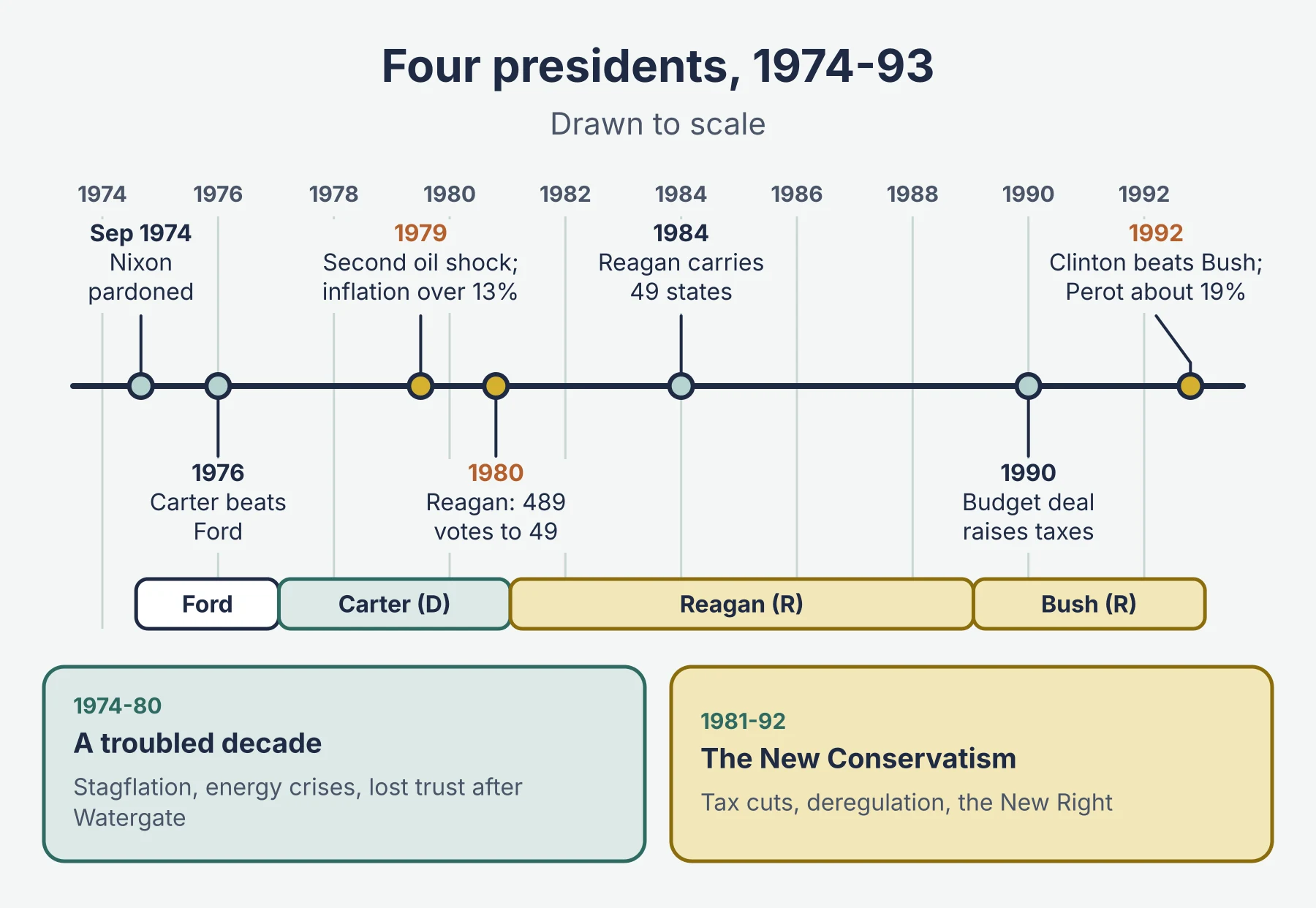
| May 1972 | SALT I signed |
| Aug 1974 | Ford becomes President; Nixon pardoned (Sept) |
| 1974-76 | Boston busing crisis |
| 1975 | Helsinki Accords; Energy Policy and Conservation Act |
| Nov 1976 | Carter defeats Ford |
| 1977 | Department of Energy; Sadat visits Jerusalem (Nov) |
| 1978 | Proposition 13 (June); Camp David Accords (Sept) |
| 1979 | Egypt-Israel treaty (March); SALT II signed (June); “crisis of confidence” speech (July); Somoza falls (July); hostages seized (Nov); Afghanistan invaded (Dec) |
| April 1980 | Failed hostage rescue; Energy Security Act (June) |
| Nov 1980 | Reagan defeats Carter |
| 1981 | Hostages freed (Jan); Economic Recovery Tax Act; PATCO strike (Aug) |
| 1981-82 | Recession; unemployment above 10 per cent |
| March 1983 | “Evil empire” speech; SDI announced |
| Nov 1984 | Reagan re-elected, carrying 49 states |
| March 1985 | Gorbachev becomes Soviet leader |
| 1985-87 | Geneva (1985), Reykjavik (1986), Washington (1987) summits |
| 1986 | Tax Reform Act; Iran-Contra revealed |
| Nov 1988 | Bush elected |
| 1990 | Budget deal raises taxes; Americans with Disabilities Act; Clean Air Act amendments |
| Nov 1992 | Clinton defeats Bush; Perot takes about 19 per cent |
6.1 Late-1970s problems – ranking
- Economic: stagflation, oil shocks (1973, 1979), high interest rates.
- Political: post-Watergate distrust; the Nixon pardon; Carter’s poor relations with Congress.
- Social: busing conflicts; reaction against abortion rights, gay rights and the counter-culture.
- International: Iran and Afghanistan made the USA look weak.
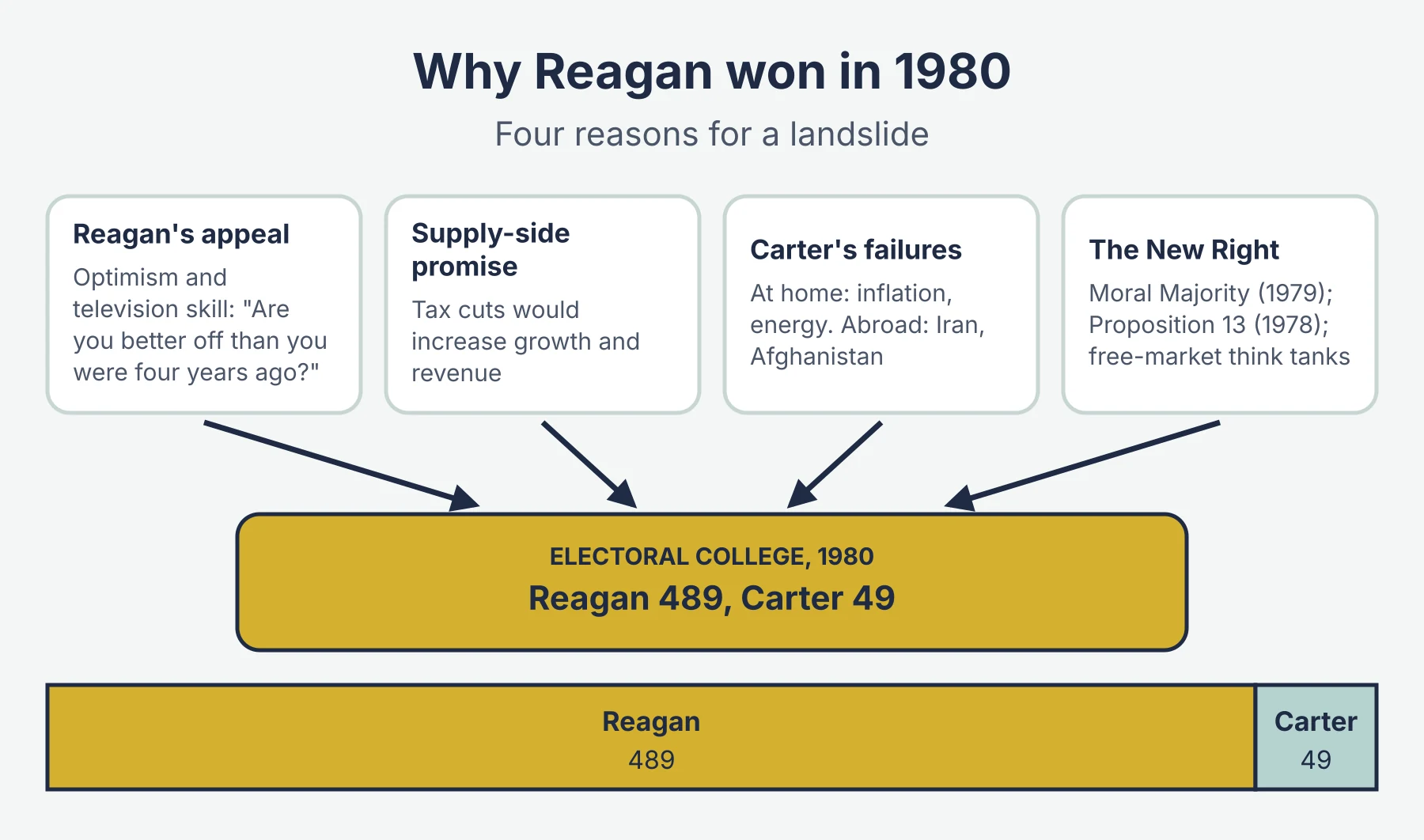
Why Reagan won in 1980: personal appeal, supply-side promises, Carter’s failures, New Right mobilisation.
6.2 New Conservatism – impact checklist
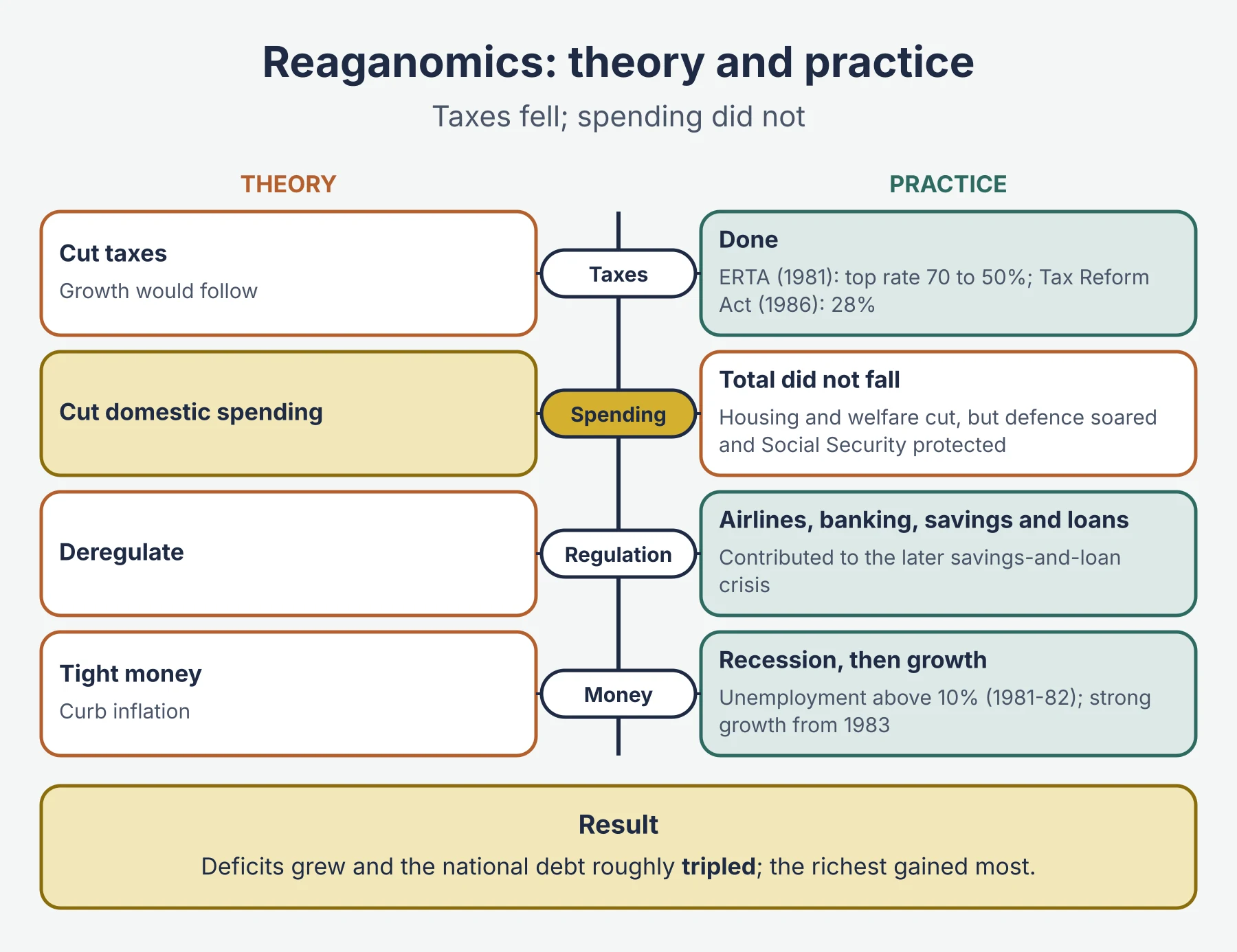
- Taxes: top rate 70 to 50 per cent (1981) to 28 per cent (1986).
- Spending: domestic cuts but defence growth; deficits and debt soared.
- Labour: PATCO controllers dismissed; union power declined.
- Social: opposition to busing and affirmative action; slow response to AIDS; MLK holiday signed.
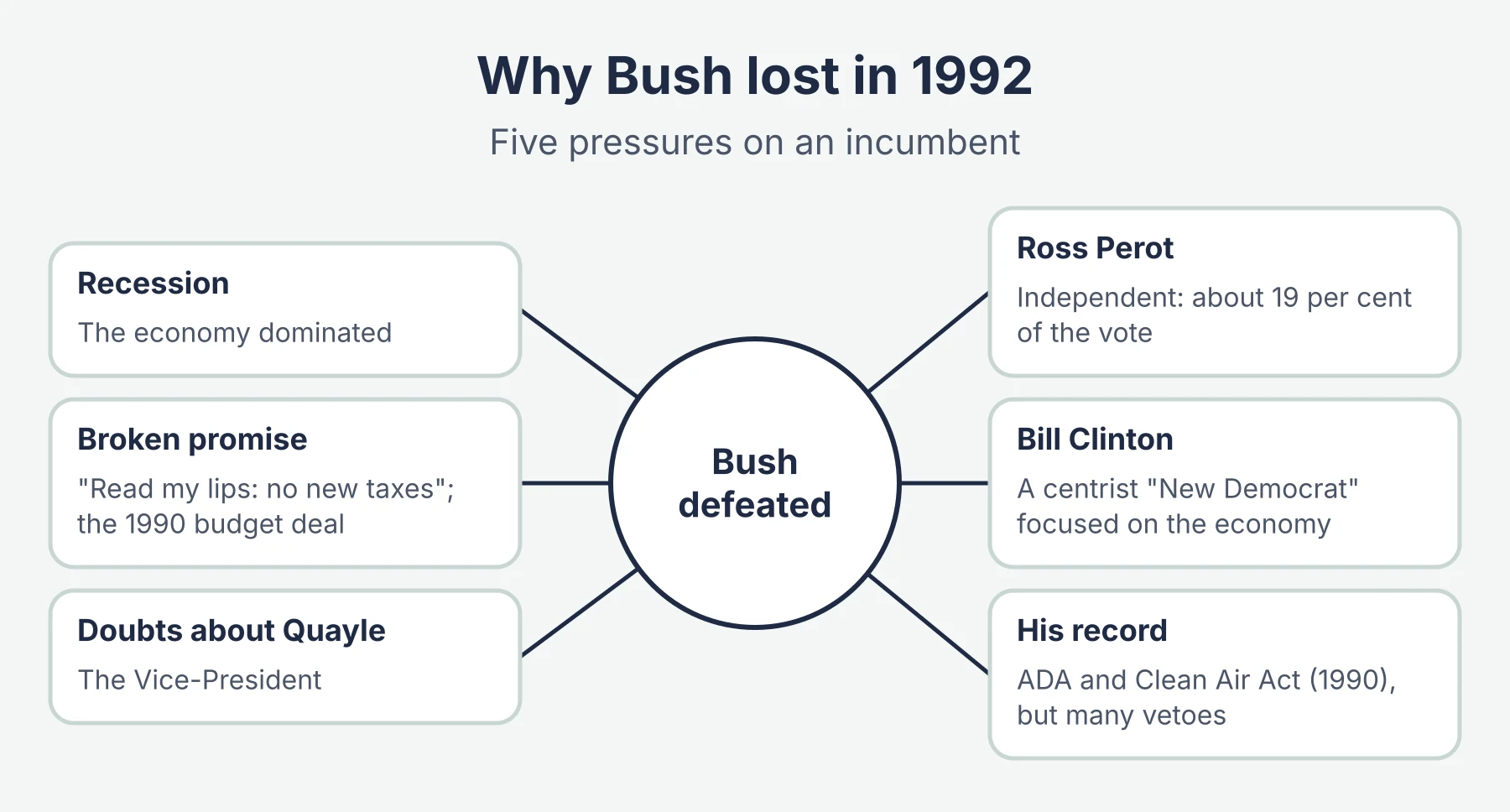
- Bush: tax rise in 1990; ADA and Clean Air amendments; recession; lost in 1992.
- Democrats: 1980 split; Mondale’s tax pledge (1984); loss of the white South; DLC founded (1985).
6.3 Carter’s foreign policy – scorecard
| Area | Success | Failure |
|---|---|---|
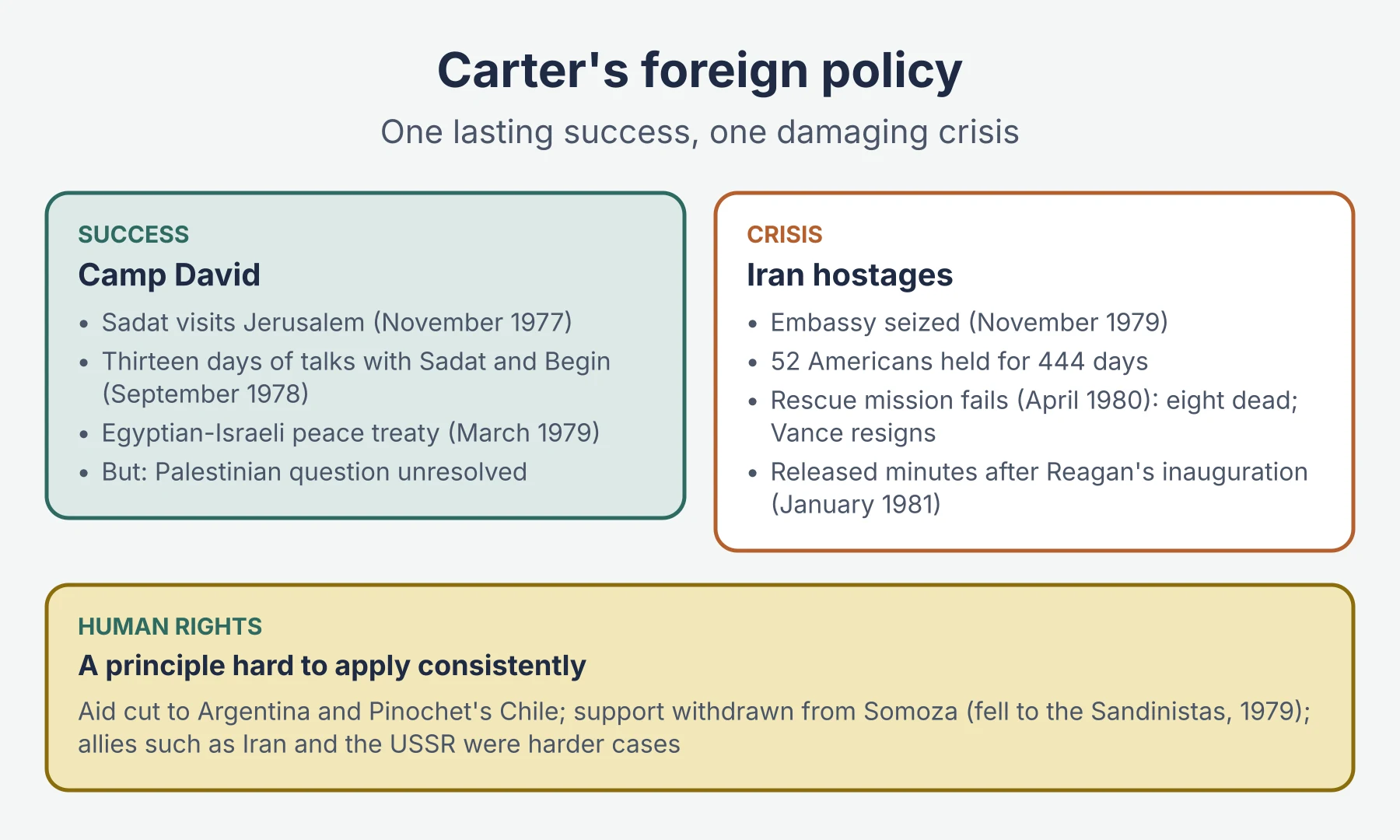
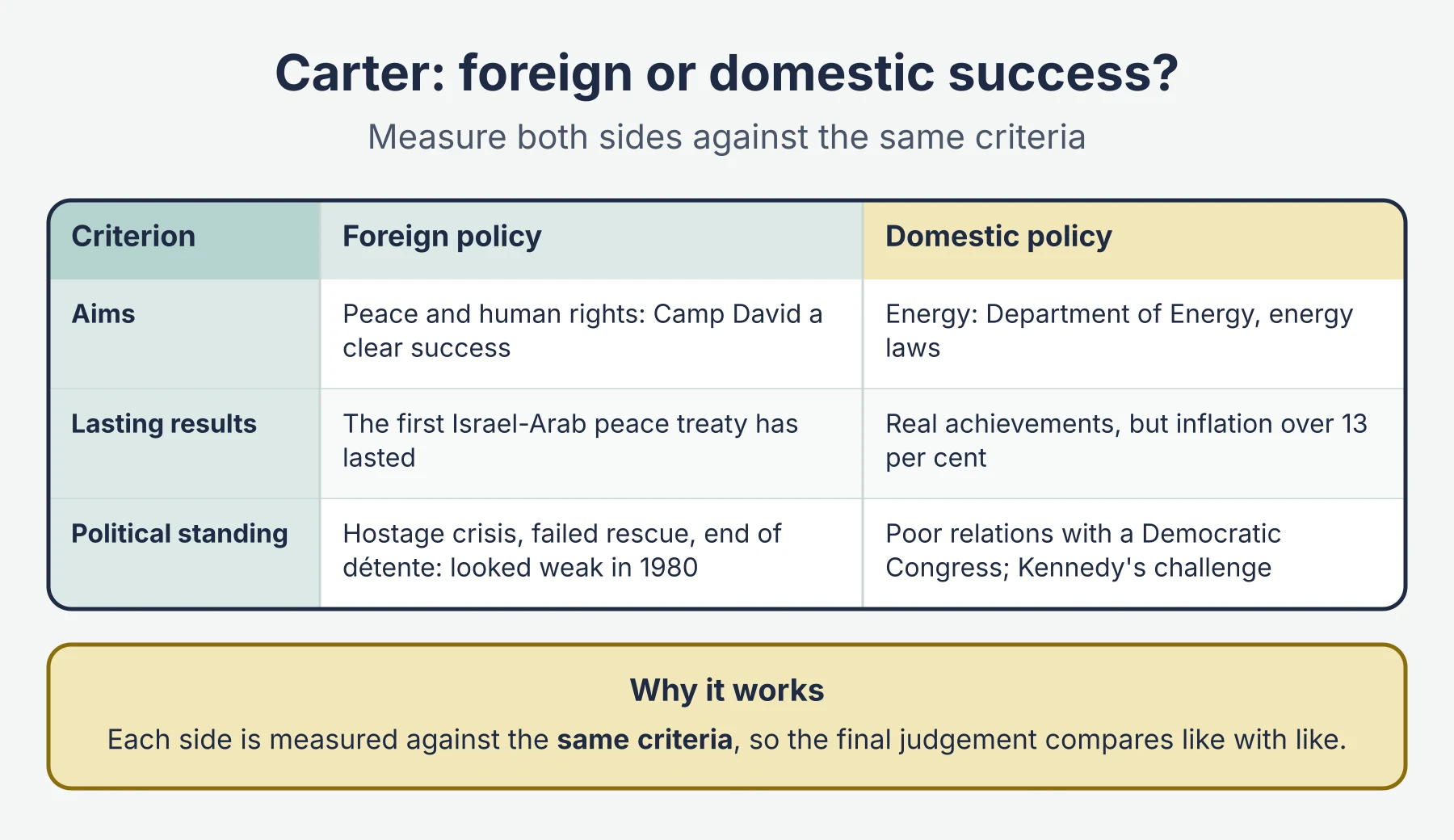
| Human rights | Pressure on Argentina, Chile and other regimes; moral stance | Inconsistent with allies; Nicaragua went to the Sandinistas |
| Middle East | Camp David (1978); Egypt-Israel treaty (1979) | Palestinian issue unresolved; Arab hostility to Egypt |
| Iran | Hostages finally freed alive | 444-day crisis; failed rescue; electoral damage |
| USSR | SALT II signed | Not ratified; détente collapsed after Afghanistan |
6.4 US-Soviet relations – why they changed
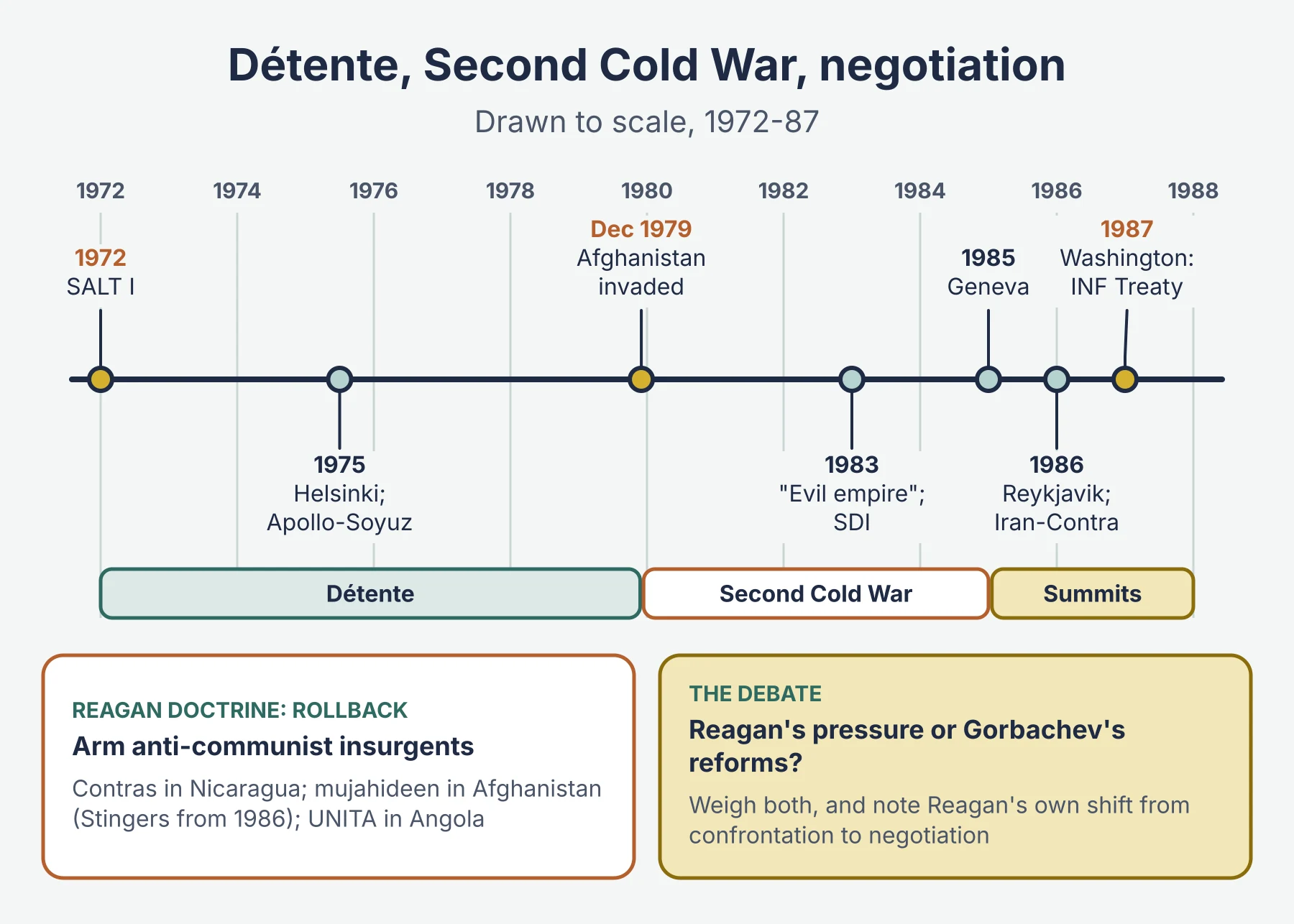
- Détente motives: cost, parity, Vietnam, the Sino-Soviet split.
- Détente collapse: Angola and Ethiopia, Afghanistan, SALT II unratified, ideological revival, Reagan’s election.
- Rollback: Nicaragua (Contras), Afghanistan (mujahideen), Angola (UNITA).
- Thaw: Gorbachev’s reforms and need to cut defence; summits; INF Treaty; Reagan’s turn to negotiation.
Exam traps
- Reagan cut taxes, not total spending.
- Camp David was Egypt-Israel only.
- SALT II was signed in 1979 but never ratified.
- Iran-Contra combined arms sales to Iran with illegal funding of the Contras.
- “Why did relations change?” needs both Soviet and American causes.
Self-test
- What was stagflation? Simultaneous high inflation and high unemployment.
- What damaged Ford’s reputation in September 1974? His pardon of Nixon.
- Which department did Carter create in 1977? The Department of Energy.
- Who founded the Moral Majority? Jerry Falwell.
- What question did Reagan ask voters in the 1980 debate? Whether they were better off than four years earlier.
- What did the 1981 tax act do to the top rate? Cut it from 70 to 50 per cent.
- How did Reagan respond to the 1981 air traffic controllers’ strike? He dismissed more than 11,000 strikers.
- Which two Bush laws of 1990 are on the syllabus? The Americans with Disabilities Act and the Clean Air Act amendments.
- Which two leaders signed the 1979 peace treaty brokered at Camp David? Sadat and Begin.
- How long were the American hostages held in Iran? 444 days.
- What did the Helsinki Accords recognise? Europe’s post-war borders, with commitments on human rights.
- What did the INF Treaty eliminate? Intermediate-range nuclear missiles.
Official syllabus
Cambridge International AS & A Level History (9489) syllabus for 2027, 2028 and 2029 – cambridgeinternational.org (Paper 4, American option, topic 6).
Related resources
-
Study guides
Cambridge A Level World History (9489): A time of challenges: the USA, 1961-74
Study guide to Cambridge 9489 Paper 4 topic 5, the USA 1961-74: Kennedy, Johnson and Nixon, Cuba and Vietnam, civil rights and the challenges to authority.
World History · Cambridge · A Level
Read guide -
Practice questions
Cambridge A Level World History (9489): A time of challenges: the USA, 1961-74 – Practice Questions
Twelve original practice questions on Cambridge 9489 USA 1961-74: recall items and Paper 4-style essays on presidents, Vietnam and civil rights, with answers.
World History · Cambridge · A Level
Try questions -
Revision notes
Cambridge A Level World History (9489): A time of challenges: the USA, 1961-74 – Revision Notes
Revision notes for Cambridge 9489 Paper 4, the USA 1961-74: key terms, a timeline, presidents, Vietnam and civil rights condensed, exam traps and a self-test.
World History · Cambridge · A Level
Revise topic
Get free revision emails (optional)
Occasional emails with practice questions, worked explanations and links to free resources for the qualification and subjects you choose. No spam, and you can unsubscribe from any email. The free tools on this site never need an email.