
Study Guides
Cambridge A Level World History (9489): The USA, 1974-93
Study guide to Cambridge 9489 Paper 4 topic 6, the USA 1974-93: Ford and Carter, the New Right, Reaganomics, Bush, Carter abroad and the end of détente.
- Subject
- World History
- Level
- A LEVEL
- Topic
- Topic 6: American option: The USA, 1945-93
- Author
- Marlbridge Academic Team
- Updated
- Reviewed by
- Azam Siddique (what this means)
Aligned to Cambridge A Level World History (9489), 2027-2029. Official specification .
Syllabus page (what it covers and how it is assessed): Cambridge A Level World History.
Syllabus points this page covers
9489 (A Level)
- 6 The USA, 1974–93
Found an error? Report a correction.
Need help with this topic? Request a free trial class for A Level World History (9489).
The USA, 1974-93 is the third topic of the American option on Cambridge 9489 Paper 4. The key questions ask how significant the problems of the late 1970s were (6.1), how great the impact of the New Conservatism was, 1981-92 (6.2), how effective Carter’s foreign policies were (6.3) and why relations between the USA and the USSR changed (6.4). Paper 4 sets two 30-mark essays from your option in 1 hour 45 minutes. This guide deepens the American option study guide; for recall use the 1974-93 revision notes and for essays the 1974-93 practice questions.
Syllabus coverage
- 6.1 Ford’s responses (stagflation, energy, busing, loss of trust); Carter’s 1976 victory and domestic policies; the rise of the New Right; Reagan’s 1980 victory.
- 6.2 Reaganomics in theory and practice; the impact of Reagan’s domestic policies; Bush’s domestic policies and the 1992 election; the Democrats’ failures in the 1980s.
- 6.3 Human rights; Camp David; Iran and the hostage crisis.
- 6.4 Détente, 1972-79; its failure; the Reagan Doctrine and rollback; Reagan and Gorbachev.
6.1 A troubled decade
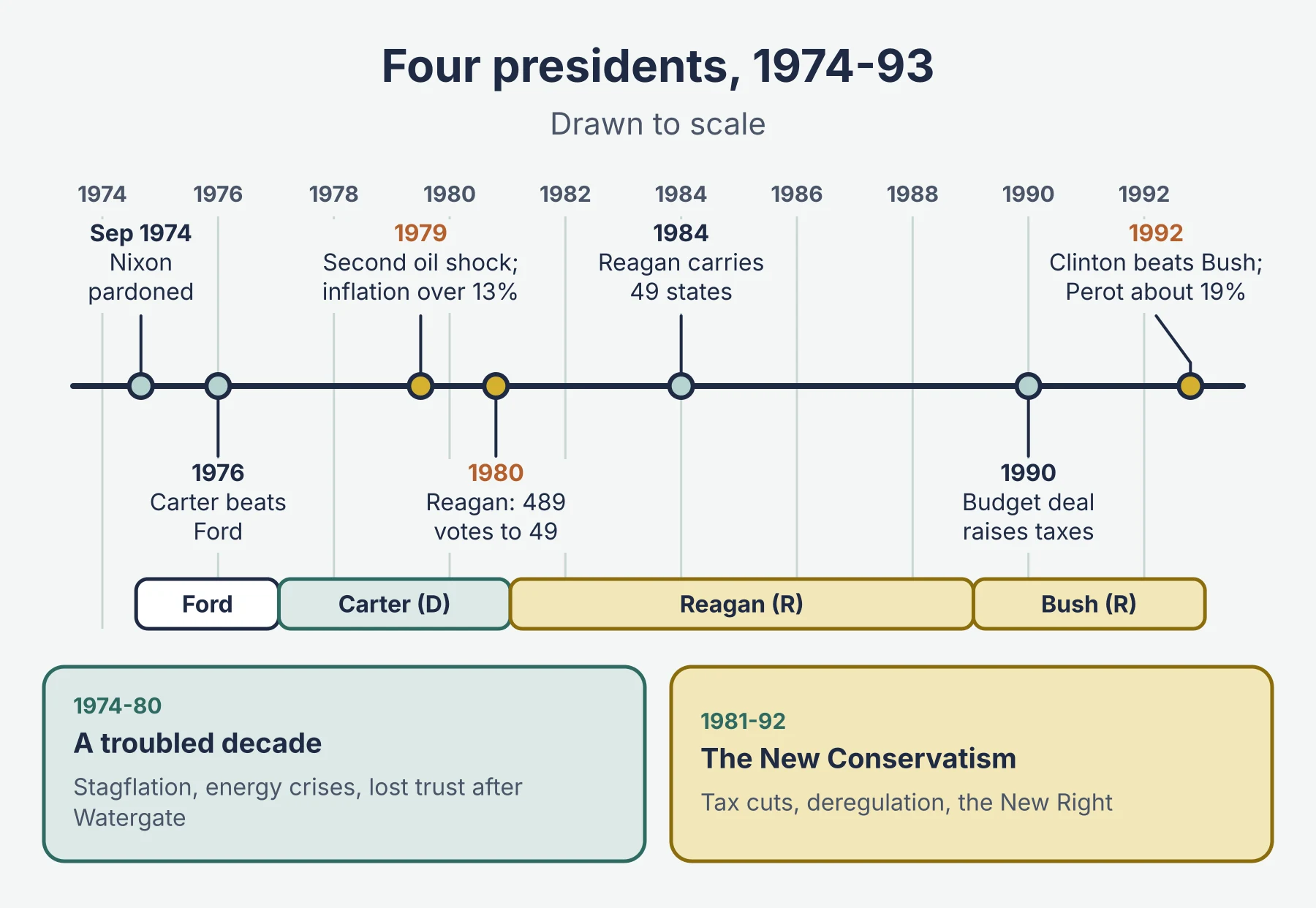
Ford, 1974-77. Gerald Ford became President after Nixon’s resignation, the first never elected as President or Vice-President. His pardon of Nixon (September 1974) destroyed much of his early goodwill. The economy suffered stagflation – high inflation and rising unemployment together – after the 1973 oil embargo. Ford’s voluntary “Whip Inflation Now” campaign was mocked; he then accepted tax cuts in 1975 to fight recession and signed the Energy Policy and Conservation Act (1975), which created the Strategic Petroleum Reserve and fuel-economy standards. Court-ordered busing to desegregate schools, notably in Boston from 1974, produced violent white opposition; Ford criticised busing but enforced the law. Congress, strengthened after Watergate, investigated intelligence abuses and restricted presidential power. Ford narrowly survived Ronald Reagan’s challenge for the 1976 nomination.
Carter, 1977-81. Jimmy Carter won in 1976 as an honest outsider, a born-again Christian and former Georgia governor, promising never to lie to the American people, at a time of disillusion with Washington and the Republicans. In office his presidential style – detailed, moralistic and suspicious of Congress – worked badly even with Democratic majorities. He created the Department of Energy (1977) and called the energy crisis “the moral equivalent of war”; the National Energy Act (1978) and the Energy Security Act (1980), which promoted synthetic fuels and conservation, followed. The second oil shock of 1979 brought queues at petrol stations; his July 1979 “crisis of confidence” speech, remembered as the “malaise” speech, was followed by a cabinet purge that looked like panic. Inflation exceeded 13 per cent in 1979, and the Federal Reserve under Paul Volcker raised interest rates sharply. Edward Kennedy’s challenge for the 1980 nomination divided the party.
The New Right. Evangelical Christians, organised by groups such as Jerry Falwell’s Moral Majority (1979), mobilised against abortion after Roe v. Wade, gay rights, the Equal Rights Amendment (opposed by Phyllis Schlafly) and the counter-culture. Tax revolts such as California’s Proposition 13 (1978) and think tanks promoting free-market ideas ended the post-war consensus that the state should manage the economy.
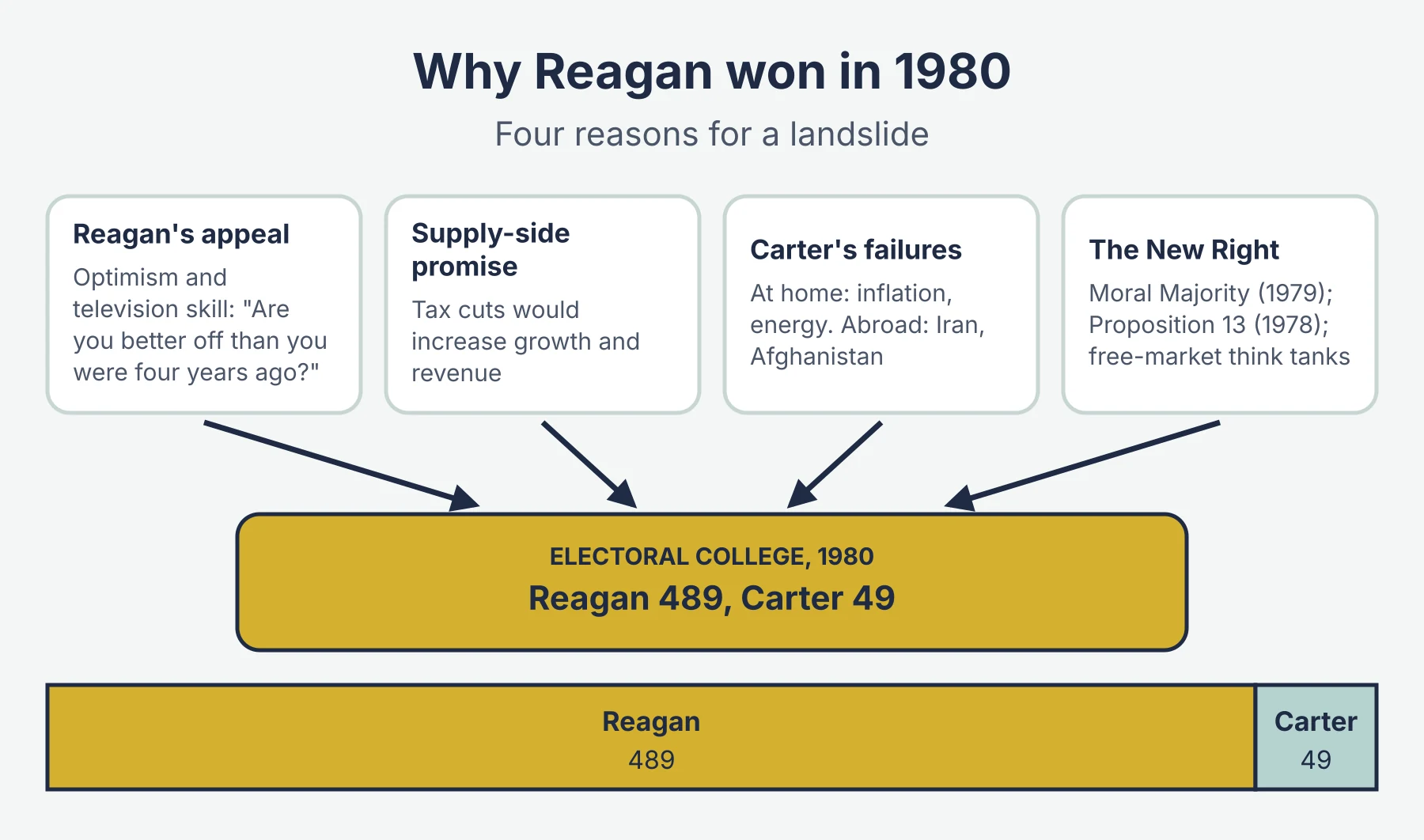
Reagan’s victory, 1980. Reagan won 489 electoral votes to Carter’s 49. Reasons: his optimism and skill on television (“Are you better off than you were four years ago?”); supply-side economics, claiming tax cuts would increase growth and revenue; Carter’s perceived failures at home (inflation, energy) and abroad (Iran, Afghanistan); and the energy of the New Right.
6.2 The New Conservatism, 1981-92
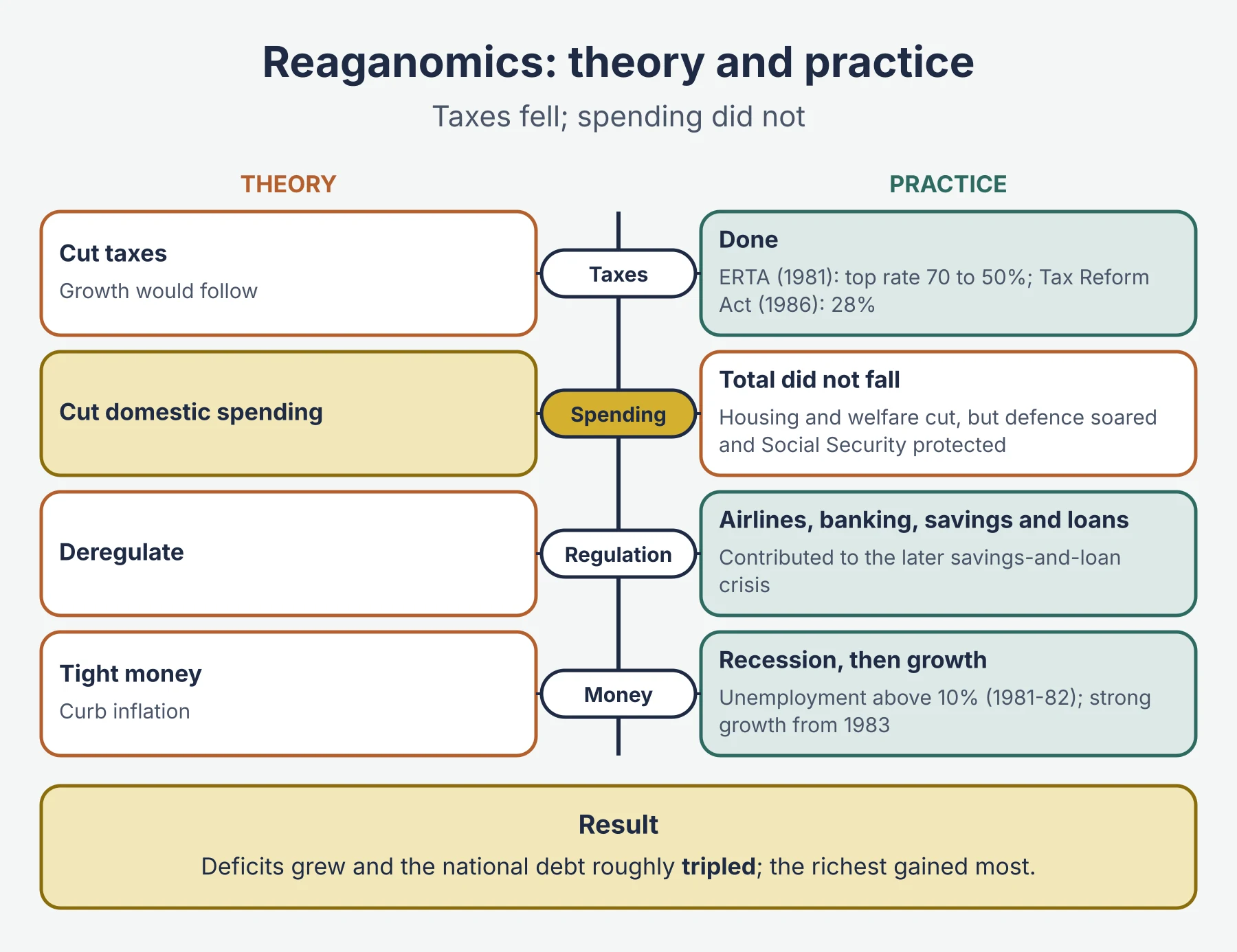
Reaganomics in theory: lower taxes, lower domestic spending, deregulation and tight money to curb inflation, ending the Keynesian approach of managing demand through government spending. In practice: the Economic Recovery Tax Act (1981) cut income tax rates by about a quarter over three years and the top rate from 70 to 50 per cent; the Tax Reform Act (1986) cut it further to 28 per cent. Domestic programmes such as housing and welfare were cut, but defence spending soared and Social Security was largely protected, so federal spending did not fall. Deficits grew and the national debt roughly tripled.
Impact on Americans. A severe recession in 1981-82 pushed unemployment above 10 per cent, followed by strong growth from 1983 and lower inflation. Gains were unequal: the richest gained most from tax cuts while the poor lost benefits. Reagan dismissed more than 11,000 striking air traffic controllers (PATCO) in August 1981, a blow to organised labour. On social issues he opposed busing and affirmative action, signed the law creating the Martin Luther King Jr holiday (1983), and was slow to respond publicly to AIDS. Deregulation of airlines, banking and the savings-and-loan industry contributed to the later savings-and-loan crisis.
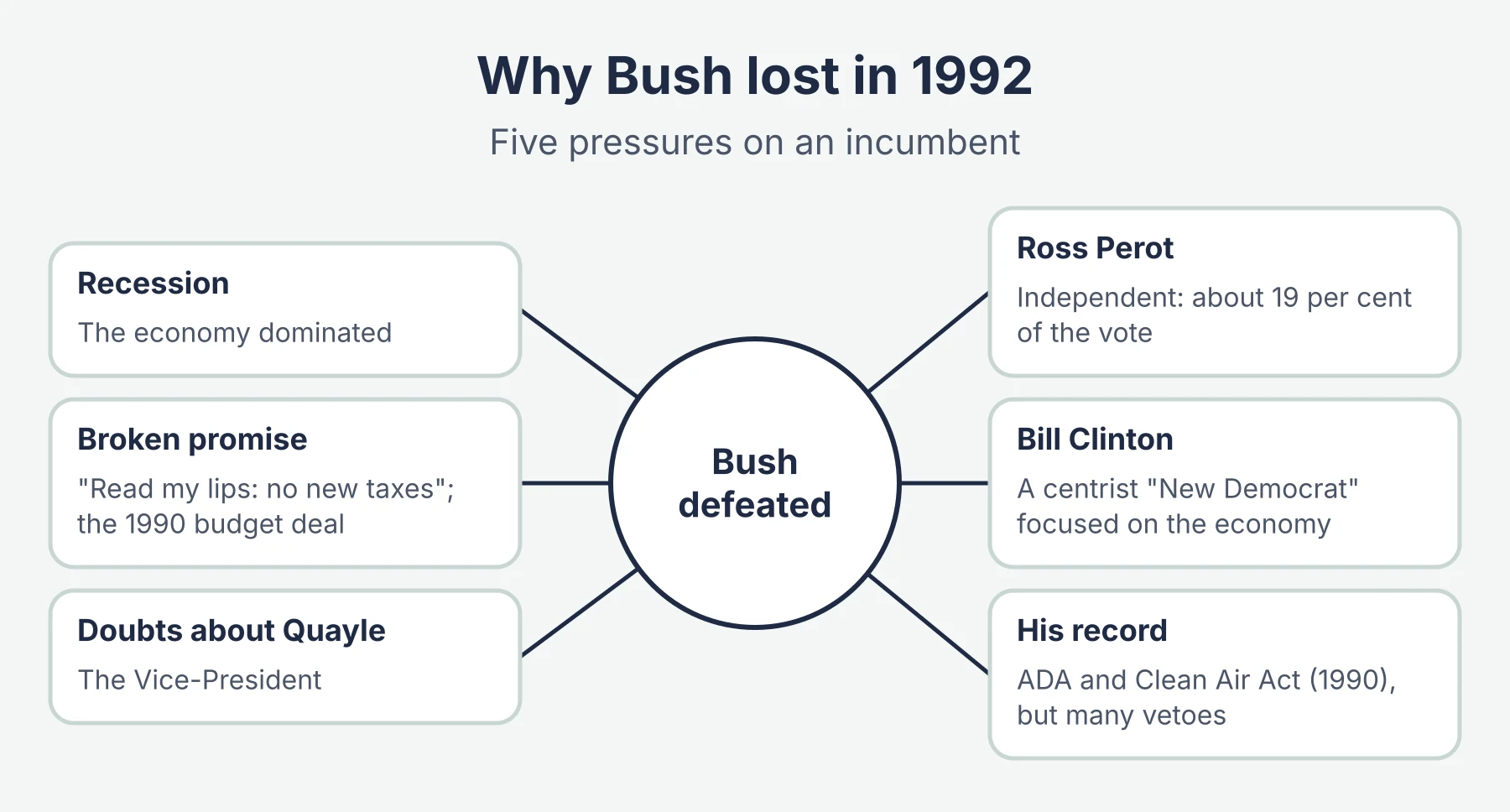
Bush, 1989-93. George H. W. Bush pledged “Read my lips: no new taxes”, but the 1990 budget deal with the Democratic Congress raised taxes to cut the deficit, angering conservatives. He signed the Americans with Disabilities Act and the Clean Air Act amendments (both 1990), but vetoed many bills. In 1992 recession, broken tax promises, Ross Perot’s independent candidacy (about 19 per cent of the vote), doubts about Vice-President Dan Quayle and Bill Clinton’s appeal as a centrist “New Democrat” focused on the economy brought Bush’s defeat.
The Democrats’ failures. Carter and Kennedy fought a bitter “civil war” in 1980. Radicals and moderates divided over taxes, defence and social issues; Walter Mondale’s 1984 promise to raise taxes contributed to a landslide loss (Reagan carried 49 states). The white South moved steadily towards the Republicans. Moderates founded the Democratic Leadership Council (1985), preparing Clinton’s centrist strategy.
6.3 Carter’s foreign policy
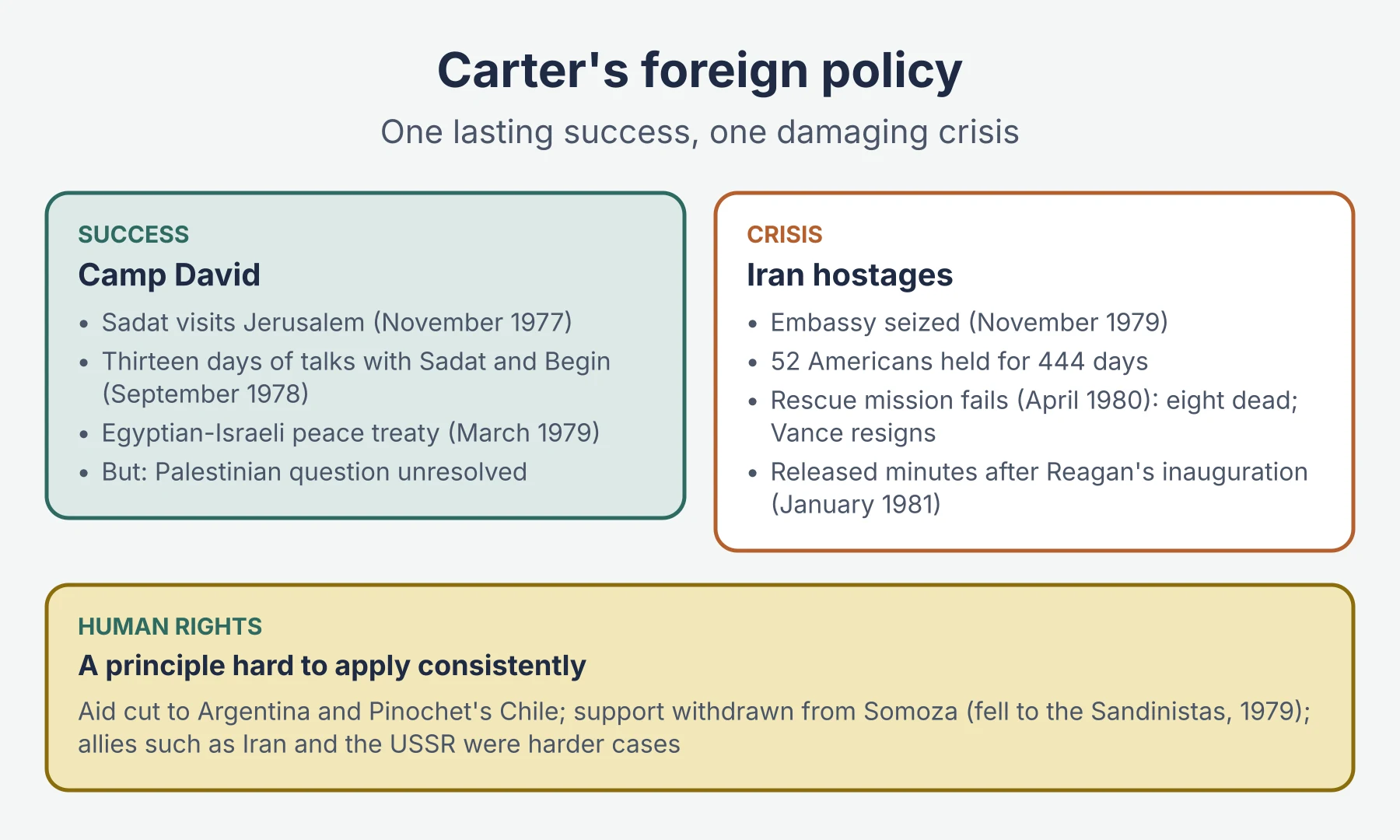
Human rights. Carter made human rights a test of US relations. He cut military aid to Argentina and to the Pinochet regime in Chile; Brazil rejected US military aid in protest. In Nicaragua he withdrew support from the Somoza dictatorship, which fell to the Sandinistas in 1979, and critics argued that this helped a left-wing government into power. Applying the principle consistently to allies such as Iran and to the USSR proved impossible.
Camp David. Kissinger’s step-by-step shuttle diplomacy (1973-75) had produced disengagement agreements. Carter first sought a comprehensive Geneva conference including the USSR; Sadat’s visit to Jerusalem (November 1977) changed the situation. At Camp David (September 1978) Carter mediated thirteen days of talks with Sadat and Begin, leading to the Egyptian-Israeli peace treaty of March 1979. It was his greatest success, though the Palestinian question was left unresolved and other Arab states condemned Egypt.
Iran. The USA had armed the Shah as a regional ally. After the 1979 revolution, the admission of the Shah to the USA for medical treatment led students to seize the US embassy in Tehran (November 1979); 52 Americans were held for 444 days. Negotiations failed, and the rescue mission (April 1980) ended with eight servicemen dead in the desert; Secretary of State Vance resigned. The hostages were released minutes after Reagan’s inauguration in January 1981. The crisis dominated television and badly damaged Carter.
6.4 From détente to the end of the Cold War
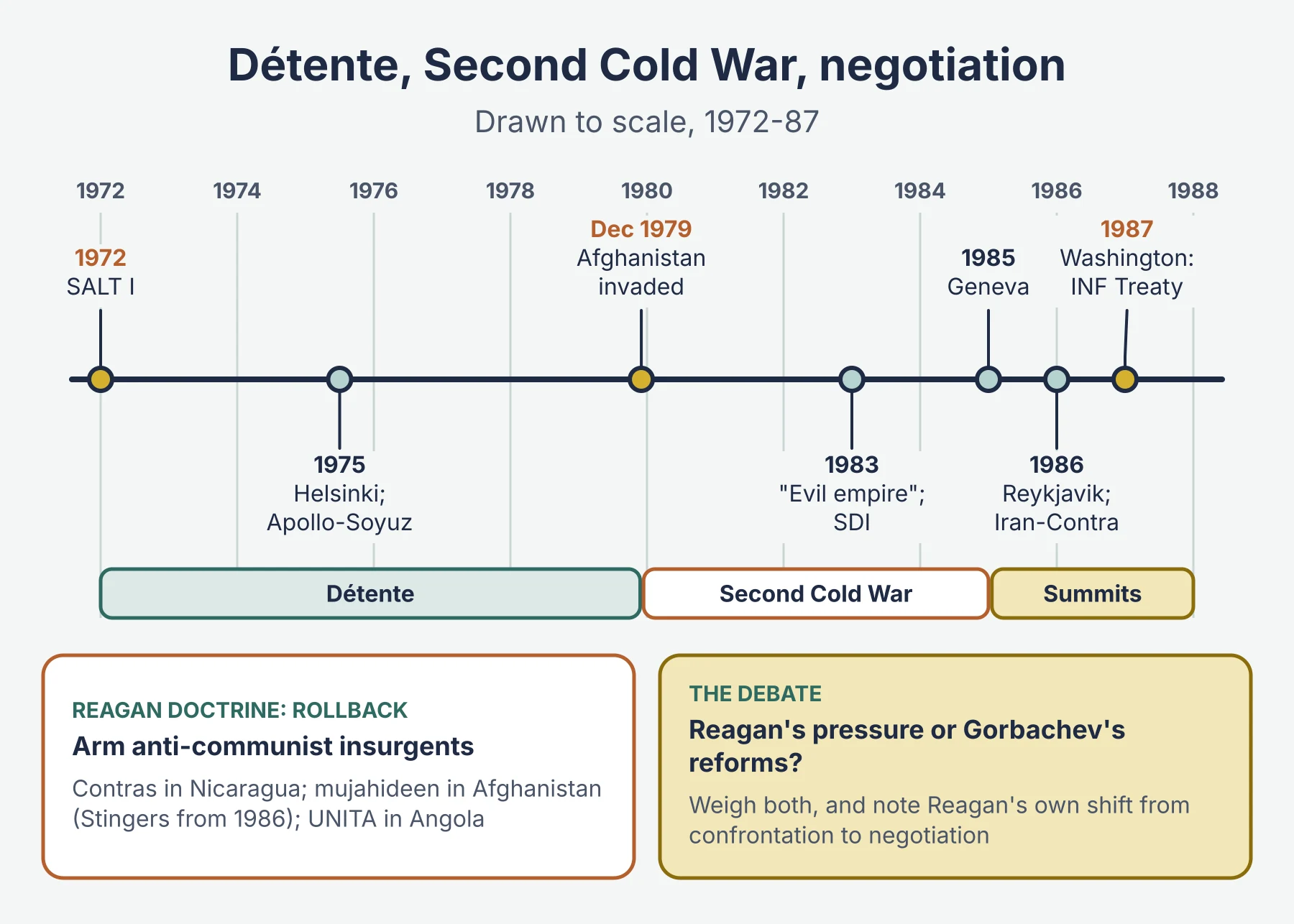
Détente. US motives: the cost of the arms race and Vietnam, nuclear parity, and the opportunity of the Sino-Soviet split. SALT I (1972) limited anti-ballistic missiles and froze some offensive missile numbers; the Helsinki Accords (1975) recognised Europe’s post-war borders in exchange for Soviet human rights commitments; grain sales and joint projects such as the Apollo-Soyuz mission (1975) followed.
Failure. Soviet involvement in Angola and Ethiopia, the invasion of Afghanistan (December 1979), the failure to ratify SALT II, and new ideological hostility – the “Second Cold War” – ended détente. Carter responded with a grain embargo, the Olympic boycott and increased defence spending; Reagan called the USSR an “evil empire” (1983) and launched the Strategic Defense Initiative.
The Reagan Doctrine. Rollback meant supporting anti-communist insurgents: the Contras in Nicaragua, leading to the Iran-Contra scandal (1986) when proceeds from secret arms sales to Iran were diverted to them against congressional bans; the mujahideen in Afghanistan, armed with Stinger missiles from 1986; and UNITA in Angola.
Reagan and Gorbachev. Gorbachev’s need to cut defence spending and his “new thinking” made summits possible: Geneva (1985), Reykjavik (1986) and Washington (1987), where the INF Treaty eliminated a whole class of nuclear missiles. Historians debate whether Reagan’s pressure forced change or Gorbachev’s reforms were the decisive factor; strong answers weigh both and note Reagan’s own shift from confrontation to negotiation.
Worked example: a judgement paragraph
“Carter’s foreign policy was more successful than his domestic policy.” Assess this view. [30]
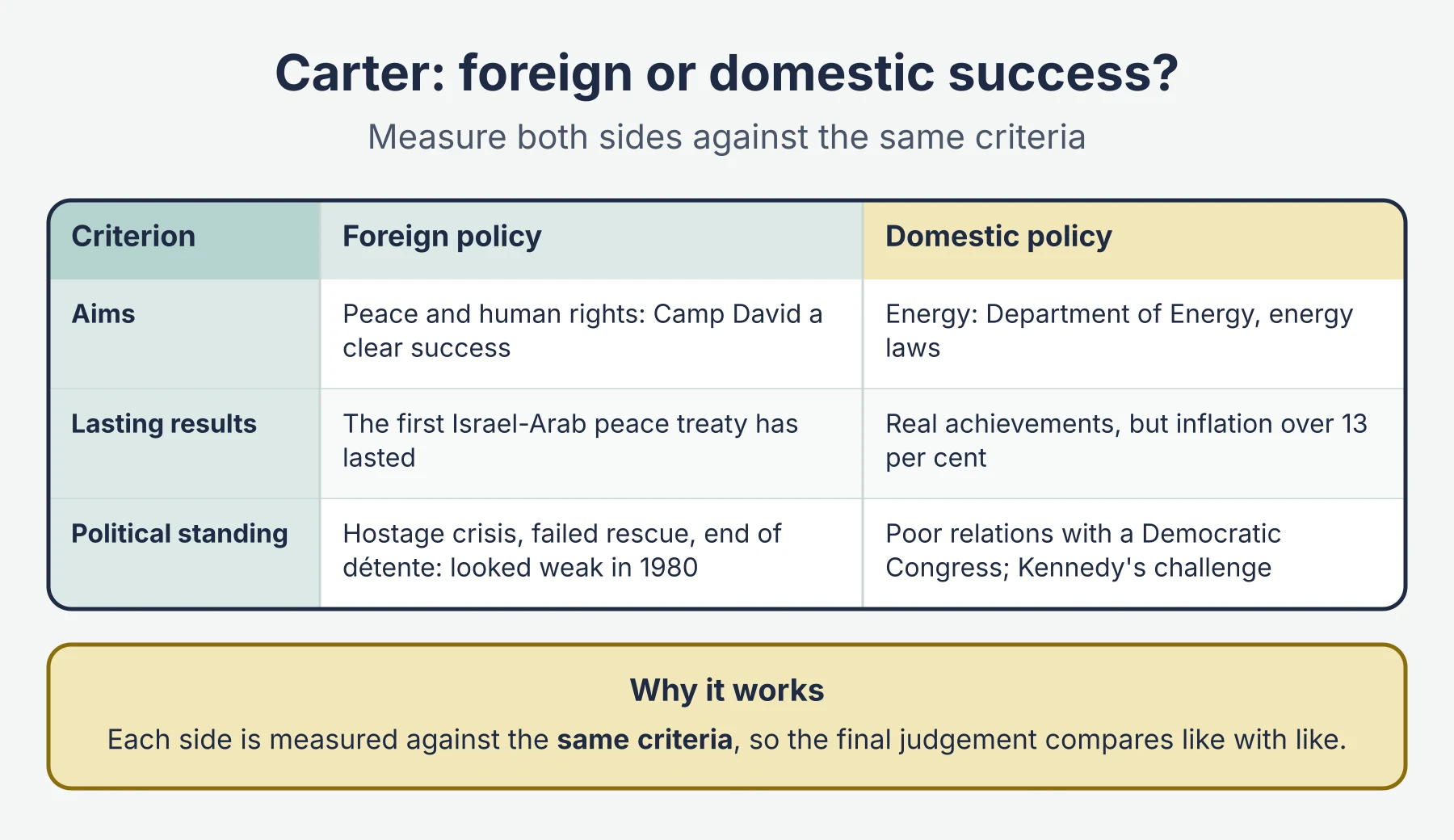
On Carter’s own criterion of promoting peace and human rights, Camp David stands out: it produced the first peace treaty between Israel and an Arab state, which has lasted. Yet the hostage crisis, the failed rescue and the collapse of détente after Afghanistan made his foreign policy look weak to voters in 1980. At home, his energy laws and the Department of Energy were real achievements, but inflation above 13 per cent and poor relations with a Democratic Congress overshadowed them. [Each side is measured against the same criteria – aims, lasting results and political standing – so the final judgement compares like with like.]
Common mistakes
- Treating Reaganomics as cutting total federal spending – defence increased.
- Ignoring Congress when judging Carter’s domestic record.
- Treating Camp David as a comprehensive Middle East peace.
Exam technique
For assess questions on significance or impact, set criteria such as scale, duration and who was affected. For “how effective”, judge against the president’s own aims.
Official syllabus
Cambridge International AS & A Level History (9489) syllabus for 2027, 2028 and 2029 – cambridgeinternational.org (Paper 4, American option, topic 6).
Related resources
-
Practice questions
Cambridge A Level World History (9489): The USA, 1974-93 – Practice Questions
Twelve original practice questions on Cambridge 9489 USA 1974-93: recall items and Paper 4-style essays from Ford to Bush and Carter to Gorbachev, with answers.
World History · Cambridge · A Level
Try questions -
Revision notes
Cambridge A Level World History (9489): The USA, 1974-93 – Revision Notes
Revision notes for Cambridge 9489 Paper 4, the USA 1974-93: key terms, a timeline, Ford to Bush, Carter abroad, détente to Gorbachev, traps and a self-test.
World History · Cambridge · A Level
Revise topic -
Study guides
Cambridge A Level World History (9489): A time of challenges: the USA, 1961-74
Study guide to Cambridge 9489 Paper 4 topic 5, the USA 1961-74: Kennedy, Johnson and Nixon, Cuba and Vietnam, civil rights and the challenges to authority.
World History · Cambridge · A Level
Read guide
Get free revision emails (optional)
Occasional emails with practice questions, worked explanations and links to free resources for the qualification and subjects you choose. No spam, and you can unsubscribe from any email. The free tools on this site never need an email.