
Revision Notes
Cambridge IGCSE Environmental Management (0680): Acid rain – Revision Notes
Recall notes on acid rain formation, impacts, flue-gas desulfurisation, catalytic converters and transport policies, with a self-test, for IGCSE 0680.
- Subject
- Environmental Management
- Level
- IGCSE
- Topic
- Topic 4: The atmosphere and human activities
- Author
- Marlbridge Academic Team
- Updated
- Reviewed by
- Azam Siddique (what this means)
Aligned to Cambridge IGCSE Environmental Management (0680), 2027-2029. Official specification .
Syllabus page (what it covers and how it is assessed): Cambridge IGCSE Environmental Management.
Syllabus points this page covers
0680
- 4.3 Acid rain
Found an error? Report a correction.
Need help with this topic? Request a free trial class for IGCSE Environmental Management (0680).
Condensed notes for sub-topic 4.3 of Cambridge IGCSE Environmental Management (0680). The acid rain study guide explains each point and works through a pH data question.
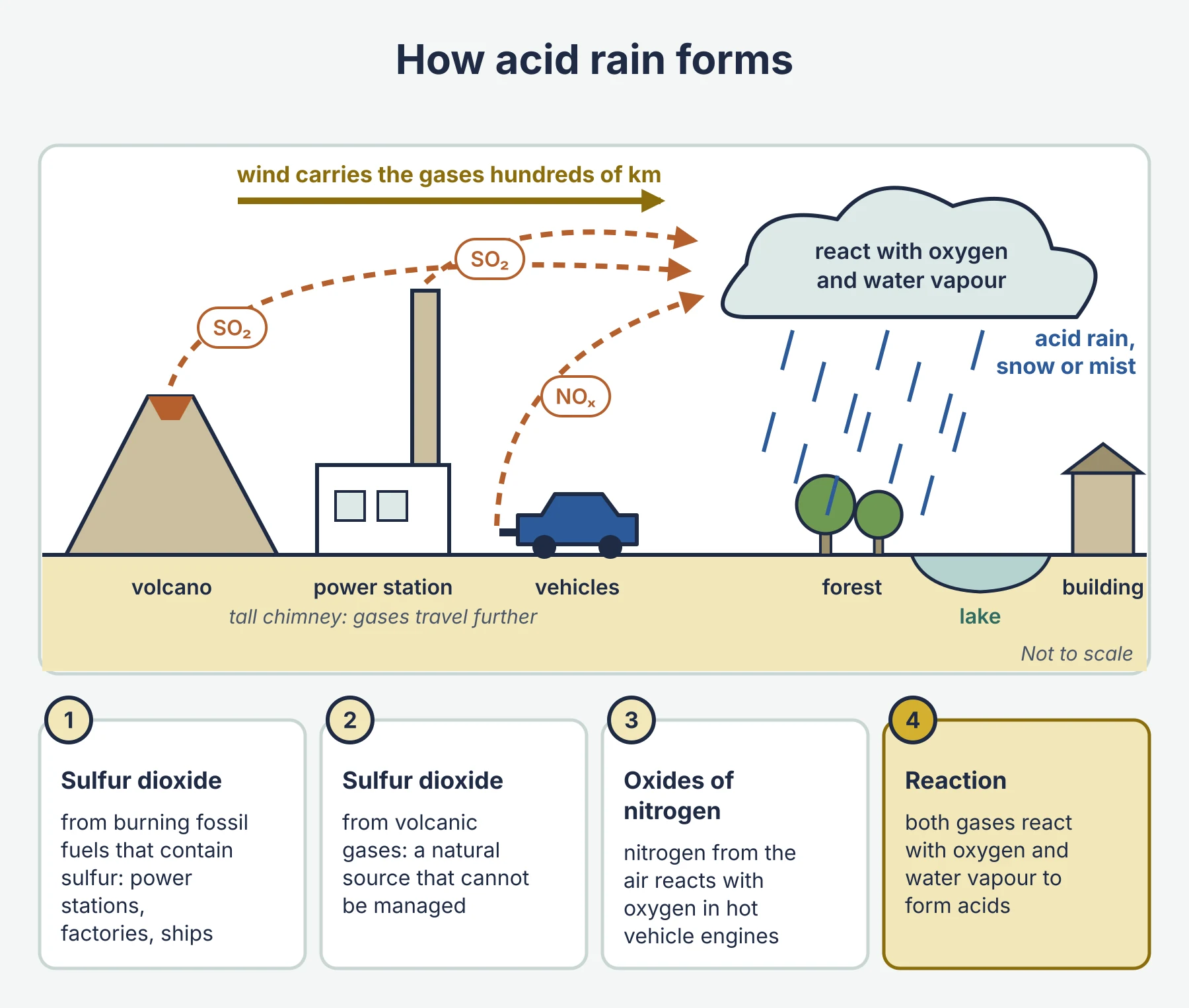
Formation (4.3.1): gas, source, reaction
| Gas | Source | Note |
|---|---|---|
| Sulfur dioxide | Combustion of fossil fuels containing sulfur compounds | Coal-fired power stations, industry, ships |
| Sulfur dioxide | Volcanic gases | Natural; cannot be managed |
| Oxides of nitrogen | Nitrogen from the air reacting with oxygen at the high temperature of vehicle engines | Nitrogen comes from the air, not the fuel |
Final step: sulfur dioxide and oxides of nitrogen react with oxygen and water vapour in the atmosphere to form acid rain.
Context facts:
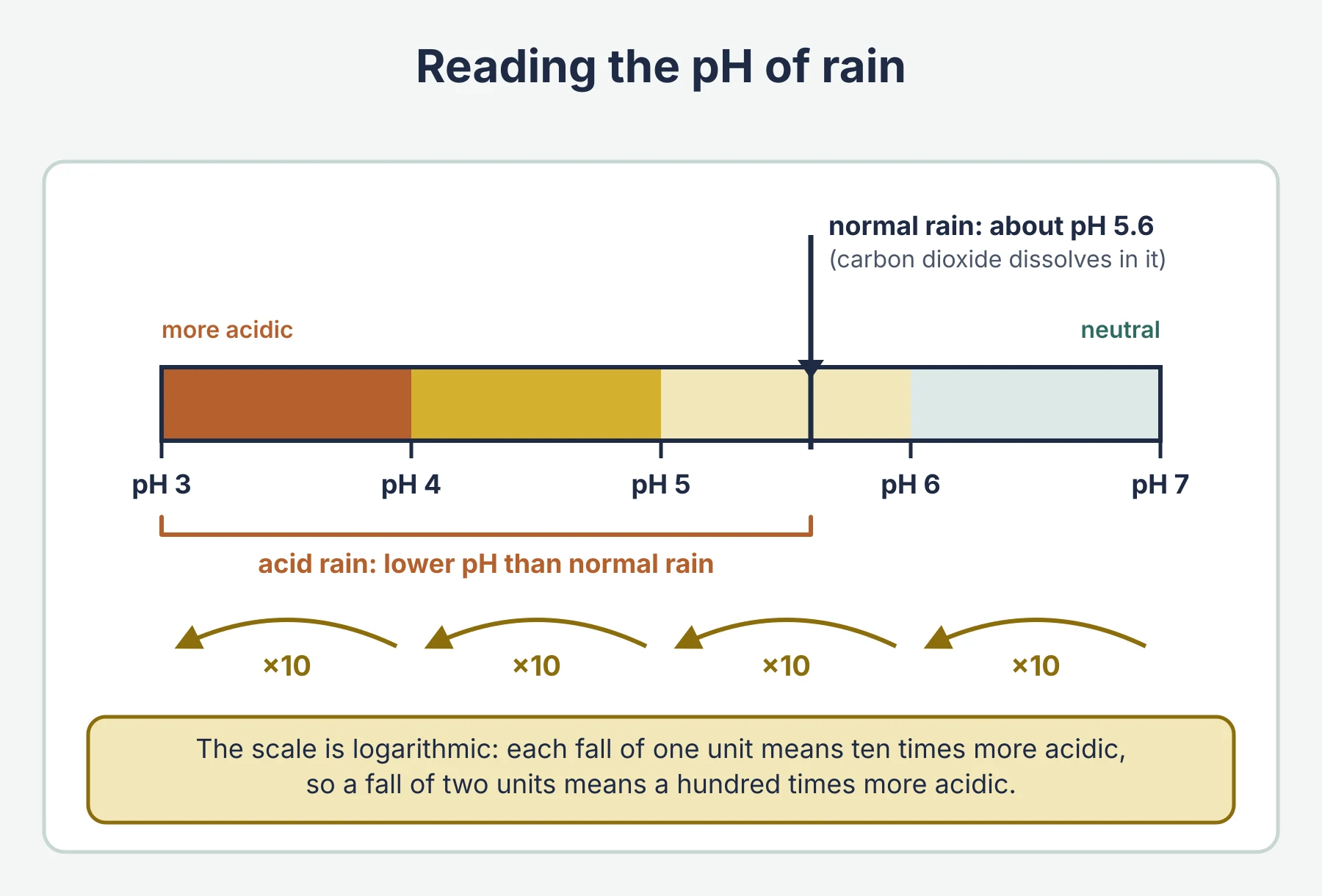
- Normal rain is about pH 5.6 (carbon dioxide dissolves in it); acid rain is lower.
- pH is logarithmic: one unit lower = ten times more acidic; two units = 100 times.
- Wind carries gases far from their source, so acid rain crosses borders.
Impacts (4.3.2): six to learn
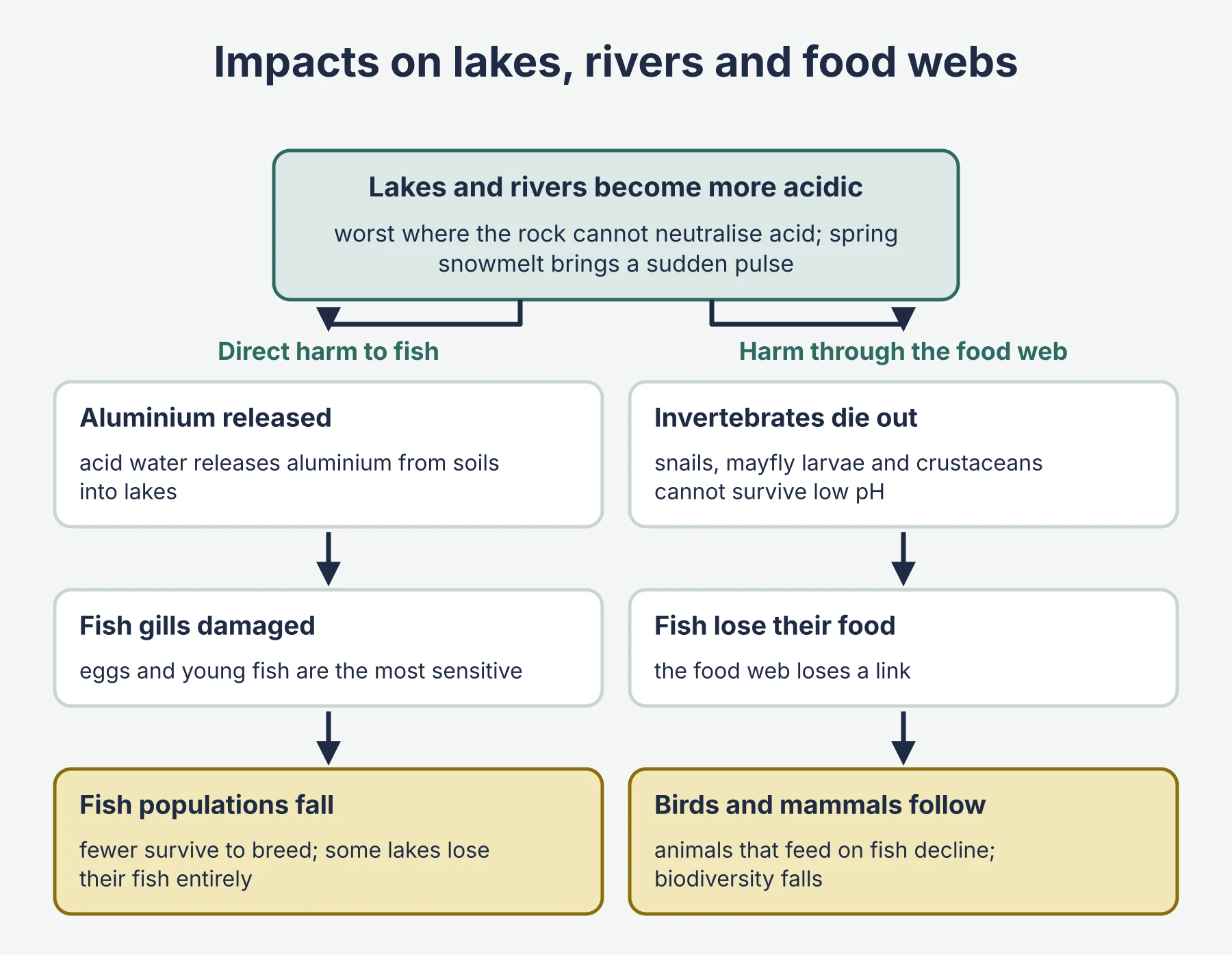
- Acidification of bodies of water: lakes and rivers fall in pH.
- Reduced fish populations: eggs and young fish die; aluminium from soils damages gills.
- Effect on aquatic food webs: invertebrates die → fish lose food → fish-eating birds and mammals decline.
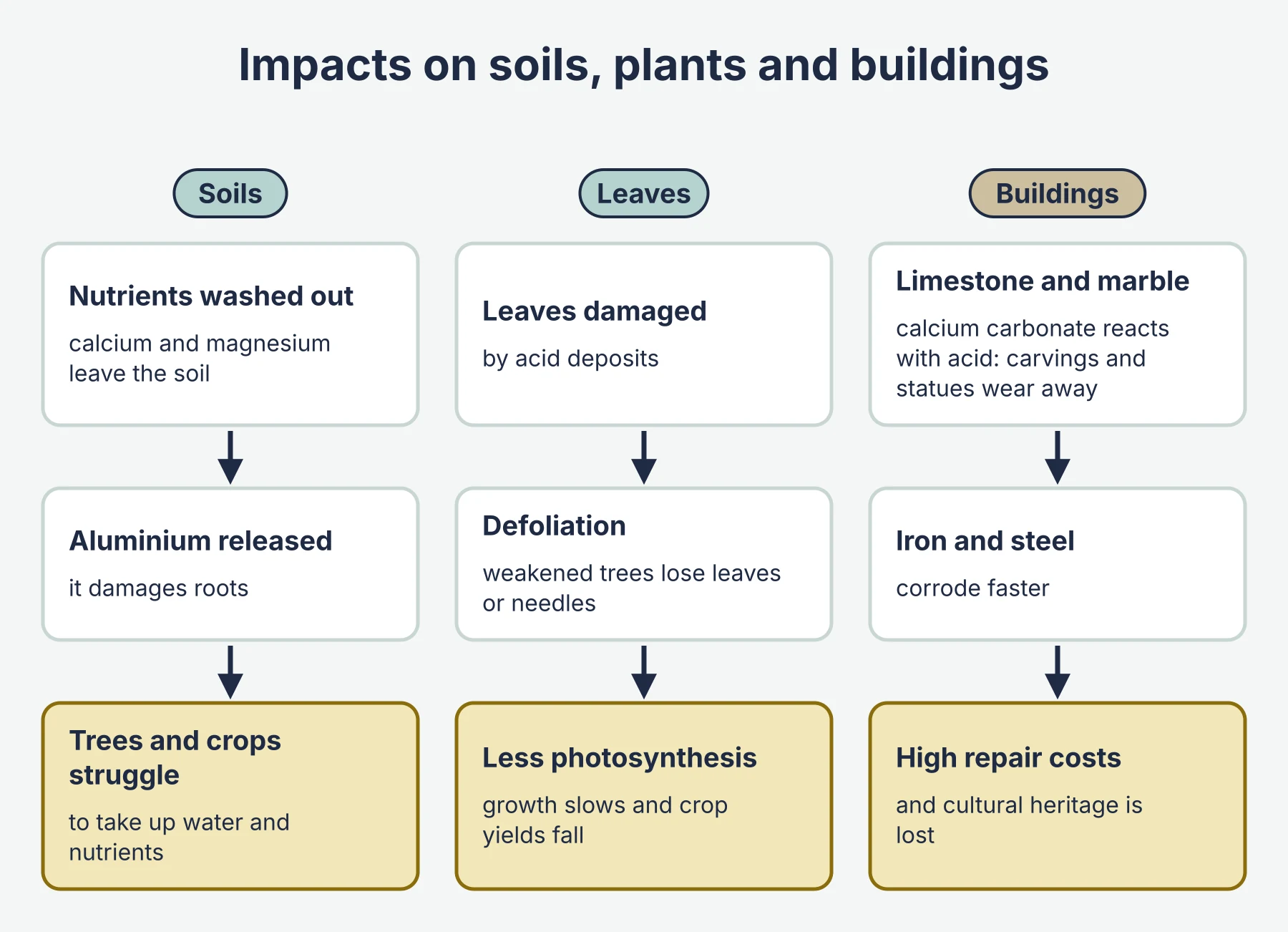
- Acidification of soils: calcium and magnesium leached out; aluminium released, damaging roots.
- Damage to crops and vegetation: plant defoliation and reduced crop yields; less leaf area → less photosynthesis.
- Damage to buildings: limestone and marble (calcium carbonate) dissolve; metals corrode.
Strategies (4.3.3)
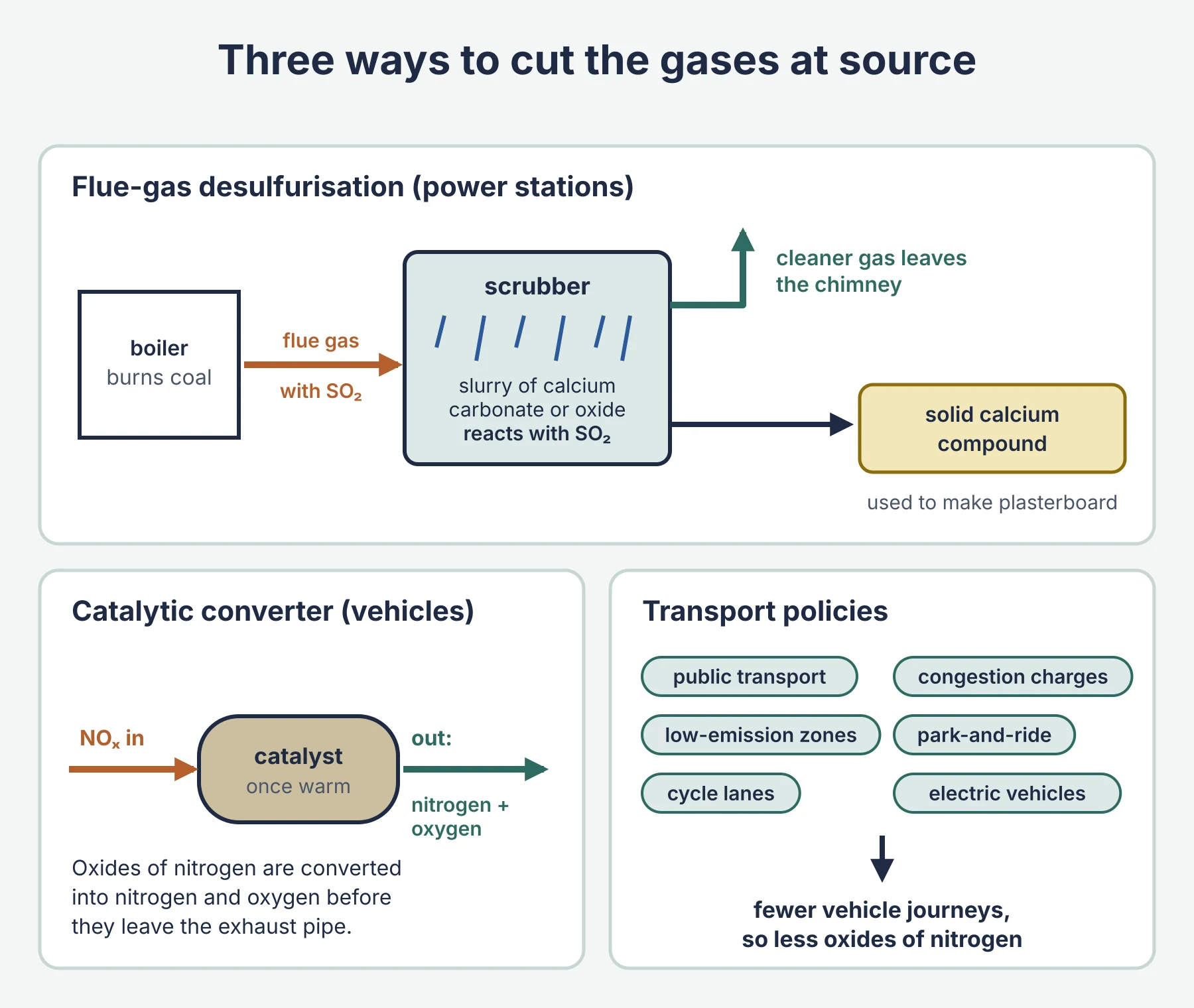
- Flue-gas desulfurisation: removes sulfur dioxide from power station waste gases by reacting it with calcium carbonate or calcium oxide; solid by-product can make plasterboard.
- Catalytic converters: remove oxides of nitrogen from vehicle exhausts, converting them to nitrogen and oxygen.
- Transport policies: public transport, congestion charges, low-emission zones, park and ride, cycle lanes, electric vehicles.
Benefits and limitations (4.3.4)
| Strategy | + | – |
|---|---|---|
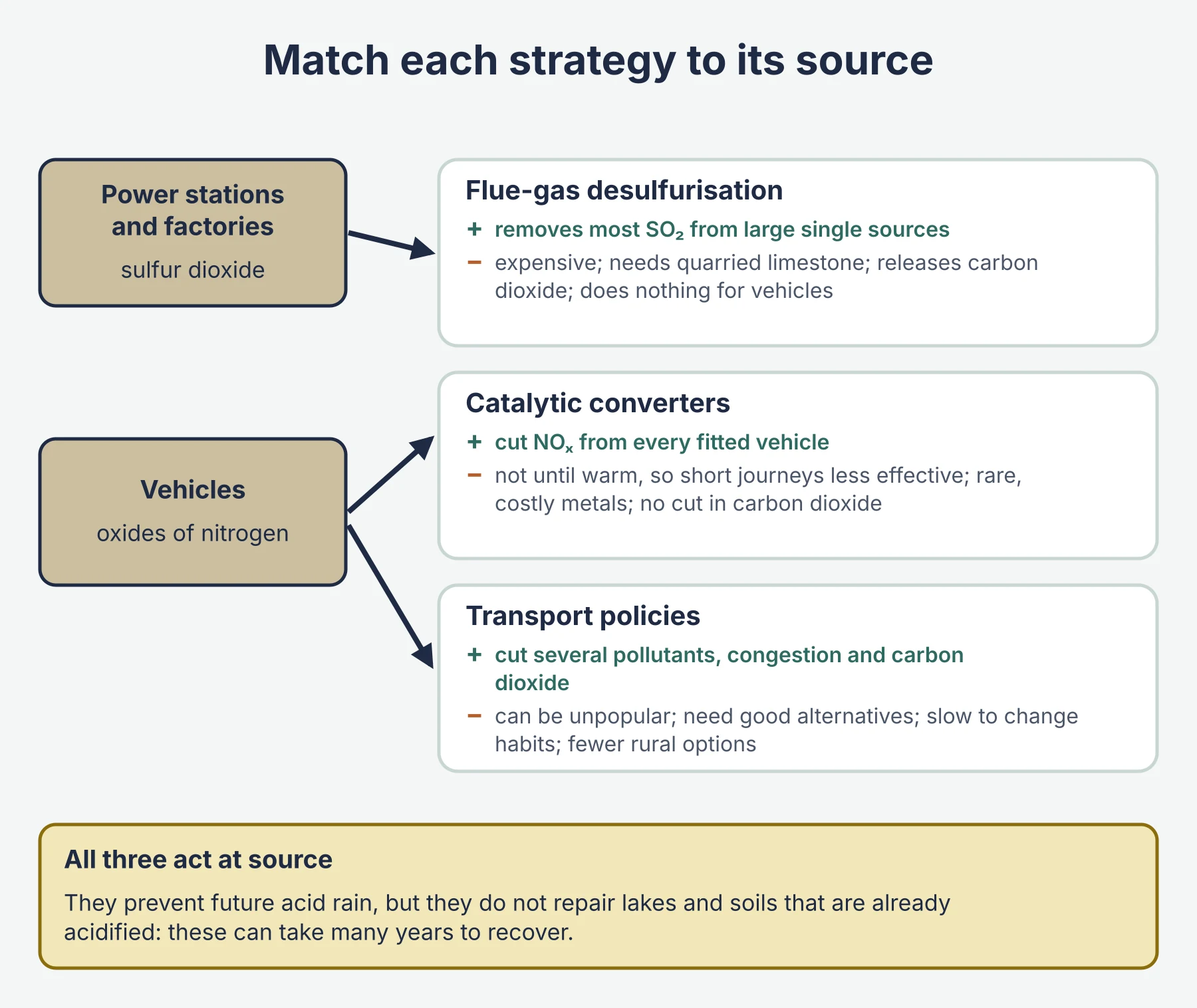
| Flue-gas desulfurisation | Removes most sulfur dioxide at large sources; saleable by-product | Costly; limestone quarrying; releases carbon dioxide; no effect on traffic |
| Catalytic converters | Fitted to every new car; cut oxides of nitrogen | Need to warm up; rare metals; no cut in carbon dioxide; older vehicles lack them |
| Transport policies | Cut several pollutants and congestion | Unpopular; need alternatives; slow; weaker in rural areas |
All three prevent new acid rain. None repairs already acidified lakes and soils, which recover slowly.
Key terms
| Term | Meaning |
|---|---|
| Acid rain | Rain with a lower pH than normal, formed from sulfur dioxide and oxides of nitrogen |
| pH | Scale of acidity; lower numbers are more acidic |
| Sulfur dioxide | Gas from burning sulfur-containing fuels and from volcanoes |
| Oxides of nitrogen | Gases formed when atmospheric nitrogen reacts with oxygen at high temperature |
| Flue gas | Waste gas leaving a chimney |
| Desulfurisation | Removing sulfur compounds |
| Catalytic converter | Exhaust device using a catalyst to remove oxides of nitrogen |
| Defoliation | Loss of leaves or needles |
| Acidification | A fall in pH of water or soil |
| Transboundary pollution | Pollution that crosses national borders |
Data skills
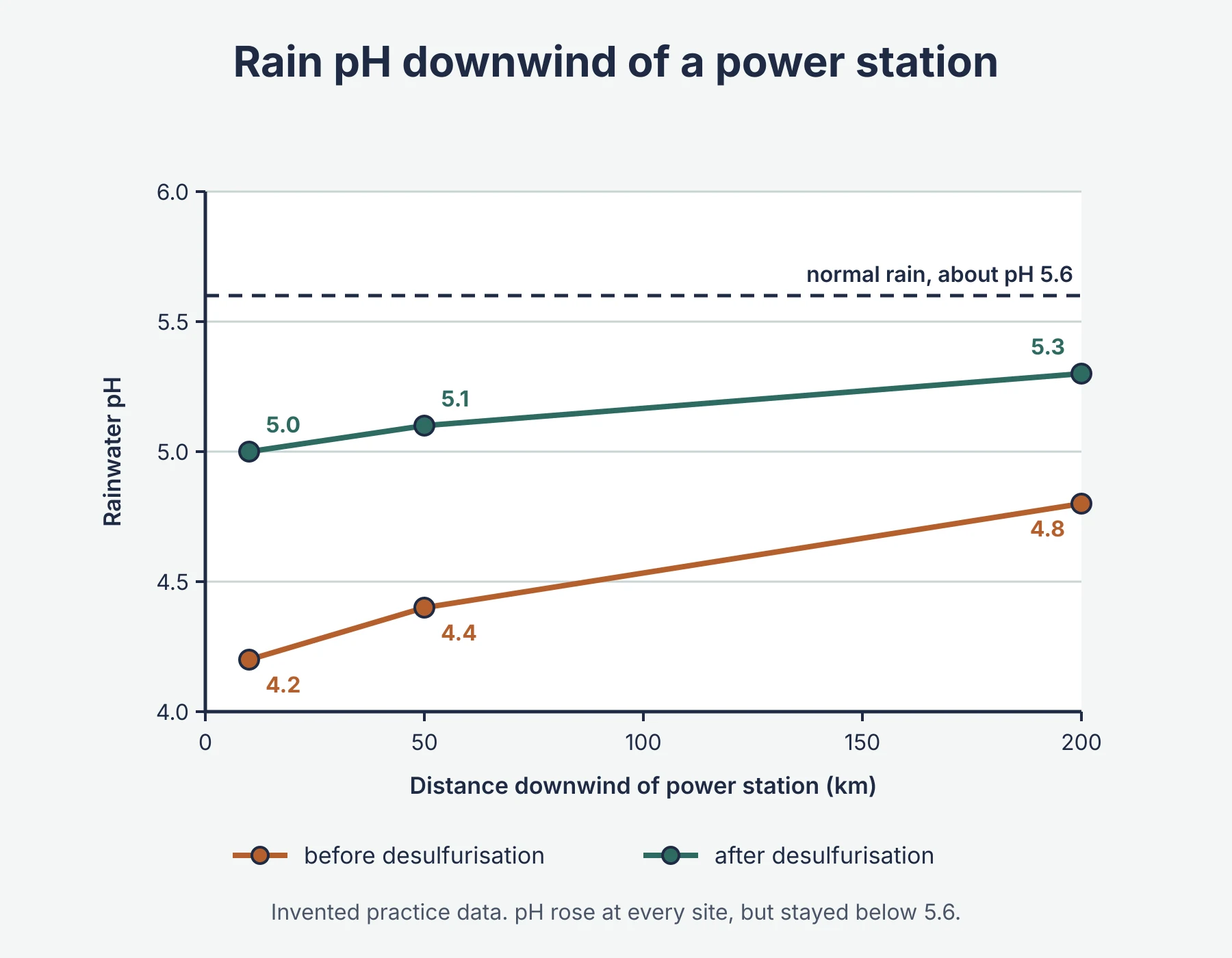
- Compare pH values with the normal-rain value of about 5.6.
- Describe distance patterns: rain is usually most acidic close to, and downwind of, the source.
- Convert pH differences into acidity factors: 5.6 to 3.6 is two units, so 100 times more acidic.
- When asked to explain a pH change after a strategy, name the gas the strategy removes.
Exam traps
- Catalytic converters remove oxides of nitrogen, not sulfur dioxide. Flue-gas desulfurisation removes sulfur dioxide.
- Nitrogen in oxides of nitrogen comes from the air drawn into the engine.
- Do not forget volcanoes; they are a named natural source.
- Acid rain is not caused by carbon dioxide, and it is a different problem from the enhanced greenhouse effect.
- Buildings at risk are limestone and marble (calcium carbonate) and metals; not every stone.
- “Discuss” means match strategy to source: power stations need desulfurisation; traffic needs converters or transport policies.
Self-test
- Name the two gases that form acid rain.
- Give two sources of sulfur dioxide.
- Where does the nitrogen in oxides of nitrogen come from, and what makes it react?
- What do the acid-forming gases react with in the atmosphere?
- What is the approximate pH of normal rain, and why is it slightly acidic?
- How many times more acidic is rain at pH 4.6 than rain at pH 5.6?
- Explain how acid rain reduces fish populations.
- Explain how acid rain reduces crop yields.
- Why are limestone buildings damaged by acid rain?
- What does flue-gas desulfurisation react sulfur dioxide with?
- Give one limitation of catalytic converters.
- Why do strategies to reduce emissions not immediately restore acidified lakes?
Answers
- Sulfur dioxide and oxides of nitrogen.
- Combustion of fossil fuels containing sulfur compounds; volcanic gases.
- From the air; the high temperature in vehicle engines makes it react with oxygen.
- Oxygen and water vapour.
- About 5.6; carbon dioxide dissolves in it.
- Ten times.
- Eggs and young fish die in acidic water, and aluminium released from soils damages fish gills, so fewer survive to breed.
- Acid damages leaves and causes defoliation, and acidified soil loses nutrients, so plants photosynthesise and grow less.
- Limestone is calcium carbonate, which reacts with acid and wears away.
- Calcium carbonate or calcium oxide.
- Any one: do not work until warm; use rare, costly metals; do not reduce carbon dioxide; not fitted to older vehicles.
- They prevent new acid, but acid and aluminium already in soils and water take many years to be neutralised and washed out.
Linked pages
Practise with the acid rain practice questions. For the rest of Topic 4, use the atmosphere and human activities revision notes.
Related resources
-
Revision notes
Cambridge IGCSE Environmental Management: Land — Revision Notes
Recall notes on soils and crop growth, food production and soil erosion for Topic 2 Land of Cambridge IGCSE Environmental Management 0680, 2027-2029 series.
Environmental Management · Cambridge · IGCSE
Revise topic -
Study guides
Cambridge IGCSE Environmental Management (0680): Climate change
Greenhouse gases, the enhanced greenhouse effect, climate change impacts, carbon footprint strategies and adaptation for Cambridge IGCSE 0680.
Environmental Management · Cambridge · IGCSE
Read guide -
Practice questions
Cambridge IGCSE Environmental Management (0680): Climate change – Practice Questions
Original practice questions with answers on greenhouse gases, climate change impacts, carbon footprints and adaptation for Cambridge IGCSE 0680.
Environmental Management · Cambridge · IGCSE
Try questions
Get free revision emails (optional)
Occasional emails with practice questions, worked explanations and links to free resources for the qualification and subjects you choose. No spam, and you can unsubscribe from any email. The free tools on this site never need an email.