
Study Guides
Cambridge IGCSE Environmental Management (0680): Acid rain
How acid rain forms, its impacts on water, soils, crops and buildings, and the benefits and limitations of management strategies for Cambridge IGCSE 0680.
- Subject
- Environmental Management
- Level
- IGCSE
- Topic
- Topic 4: The atmosphere and human activities
- Author
- Marlbridge Academic Team
- Updated
- Reviewed by
- Azam Siddique (what this means)
Aligned to Cambridge IGCSE Environmental Management (0680), 2027-2029. Official specification .
Syllabus page (what it covers and how it is assessed): Cambridge IGCSE Environmental Management.
Syllabus points this page covers
0680
- 4.3 Acid rain
Found an error? Report a correction.
Need help with this topic? Request a free trial class for IGCSE Environmental Management (0680).
Sub-topic 4.3 of Cambridge IGCSE Environmental Management (0680) has four parts: describe how acid rain forms (four named points), describe its impacts (six named points), describe three management strategies, and discuss their benefits and limitations. The lists are short, so marks depend on explaining each step clearly and on judging the strategies in context. The atmosphere and human activities study guide introduces acid rain alongside the rest of Topic 4; this page goes deeper.
Formation (4.3.1)
The syllabus names three sources of acid-forming gases and one reaction step.
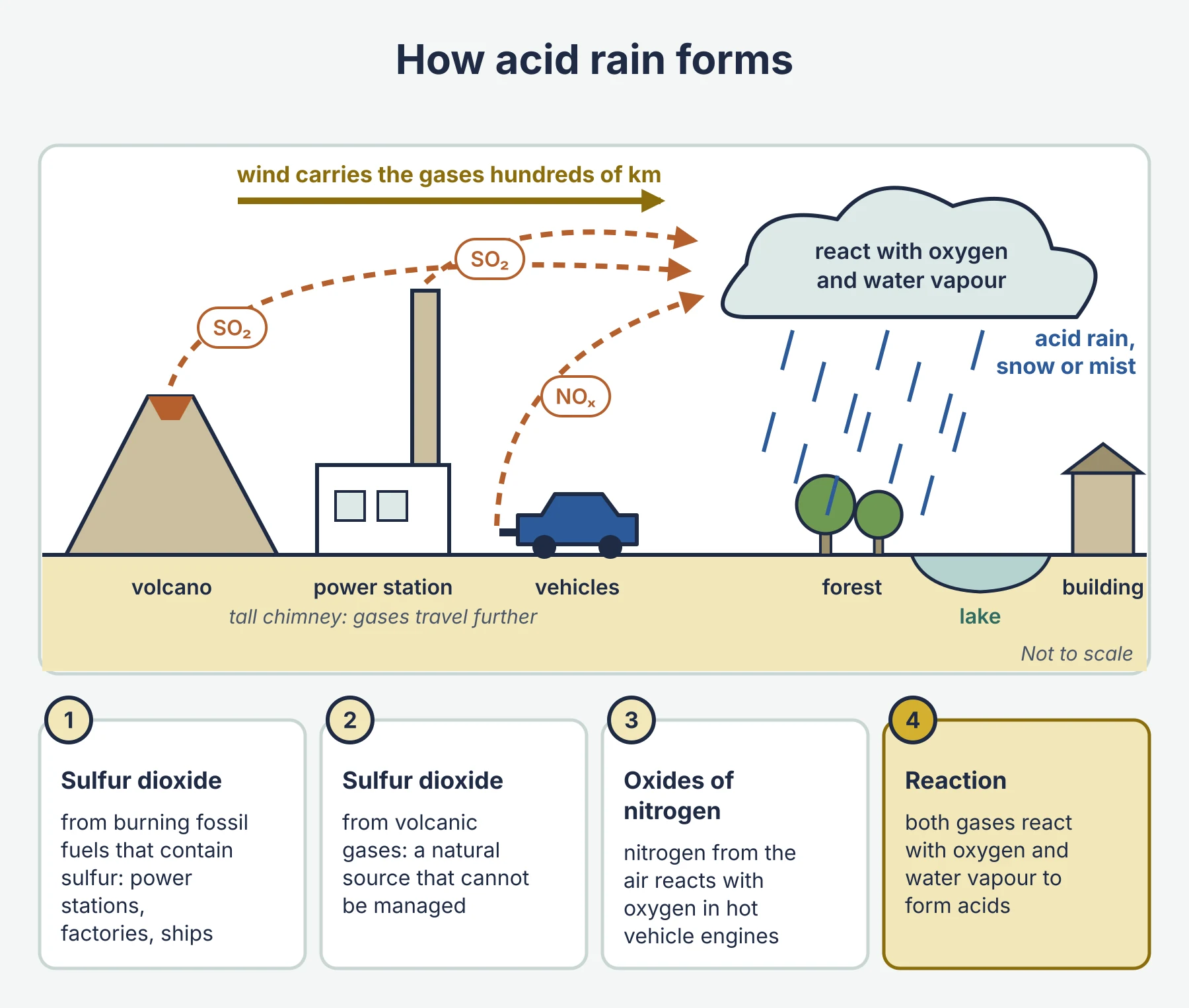
- Sulfur dioxide from combustion of fossil fuels which contain sulfur compounds. Coal and some oils contain sulfur. When they burn in power stations, factories and ships, the sulfur combines with oxygen to form sulfur dioxide.
- Sulfur dioxide from volcanic gases. Eruptions and volcanic vents release sulfur dioxide naturally. This source cannot be managed, but it explains acid rain in volcanic regions far from industry.
- Oxides of nitrogen when nitrogen from the atmosphere reacts with oxygen in the high temperature of vehicle engines. The nitrogen does not come from the fuel; it comes from the air drawn into the engine. The heat of combustion makes nitrogen, normally unreactive, combine with oxygen.
- Sulfur dioxide and oxides of nitrogen react with oxygen and water vapour in the atmosphere to form acid rain. The products are acids dissolved in cloud droplets, which fall as rain, snow or mist.
Two features make acid rain an international issue. Winds carry the gases hundreds of kilometres before they fall, so the country that suffers may not be the one that polluted. And tall chimneys, built to protect local air, push the gases higher, where they travel further.
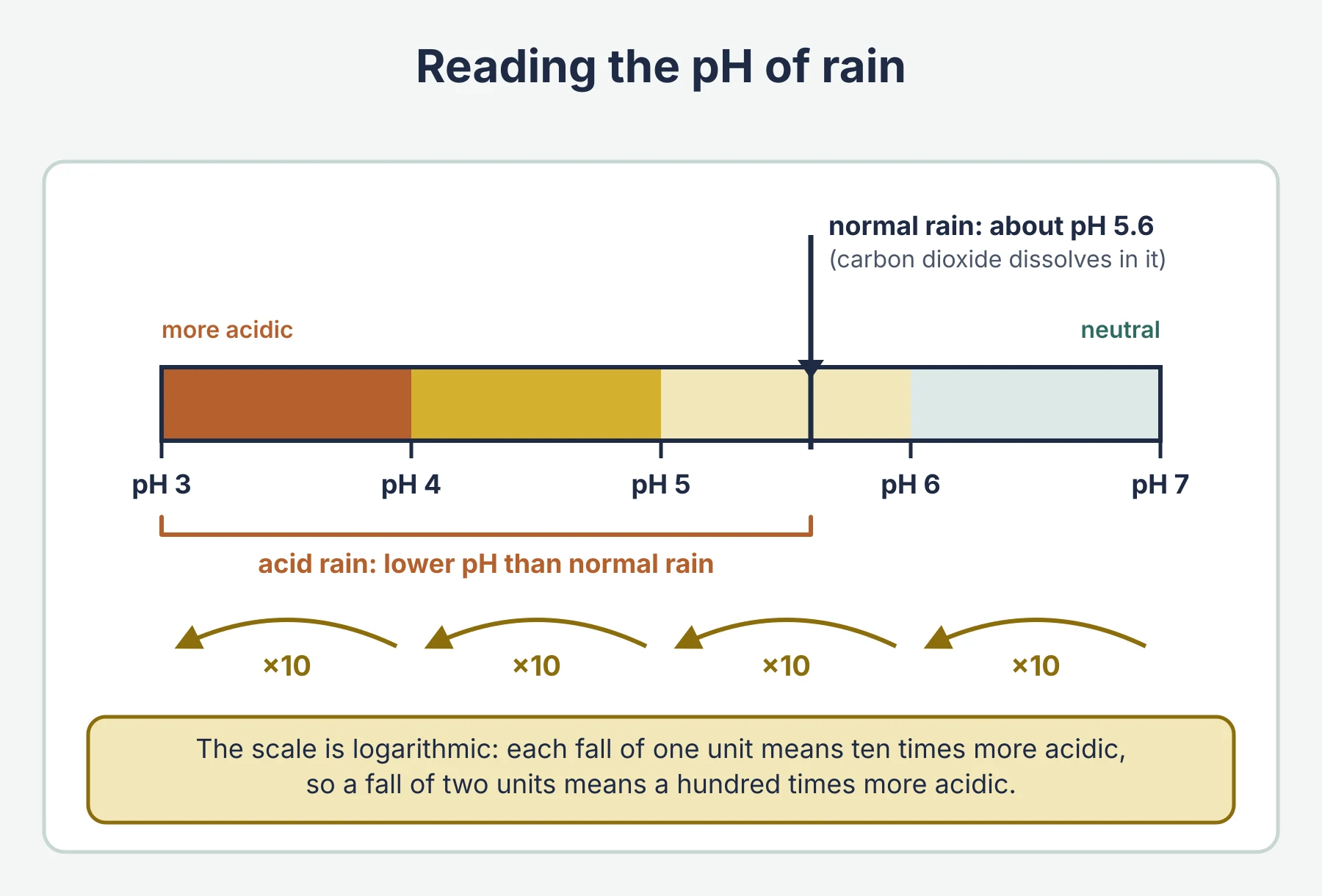
Normal rain is already slightly acidic, at about pH 5.6, because carbon dioxide dissolves in it. Acid rain has a lower pH. Remember that the pH scale is logarithmic: each fall of one unit means ten times more acidic.
Impacts (4.3.2)
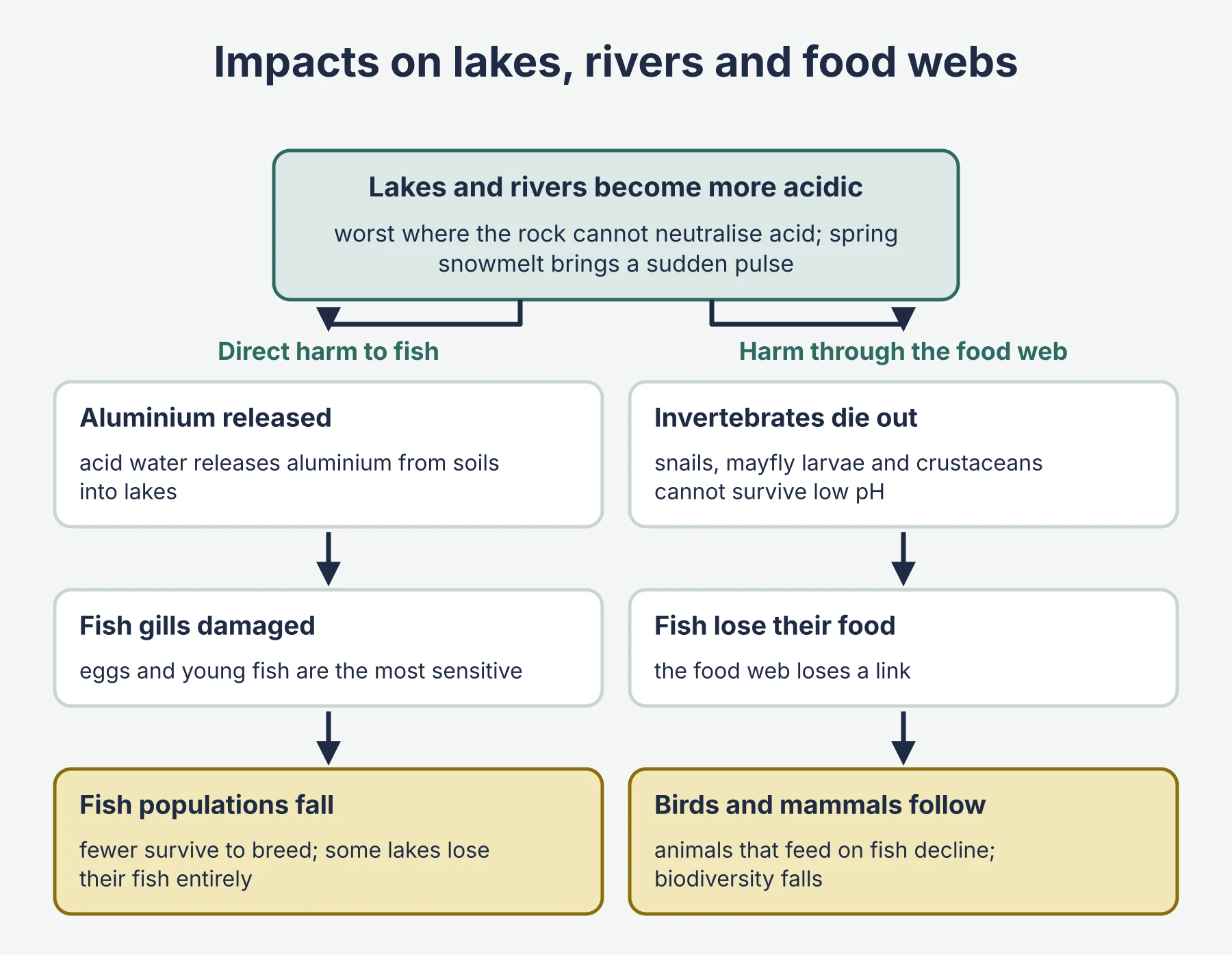
Acidification of bodies of water. Lakes and rivers become more acidic, especially where the underlying rock cannot neutralise the acid. Snowmelt in spring can deliver a sudden pulse of acid.
Reduced fish populations. Fish eggs and young fish are the most sensitive. Acid water also releases aluminium from soils into lakes, and aluminium damages fish gills. Fewer fish survive to breed, so populations fall, and some lakes lose their fish entirely.
Effect on aquatic food webs. Invertebrates such as snails, mayfly larvae and crustaceans die out at low pH. Fish that feed on them lose food, and birds and mammals that feed on fish follow. Biodiversity in the lake falls.
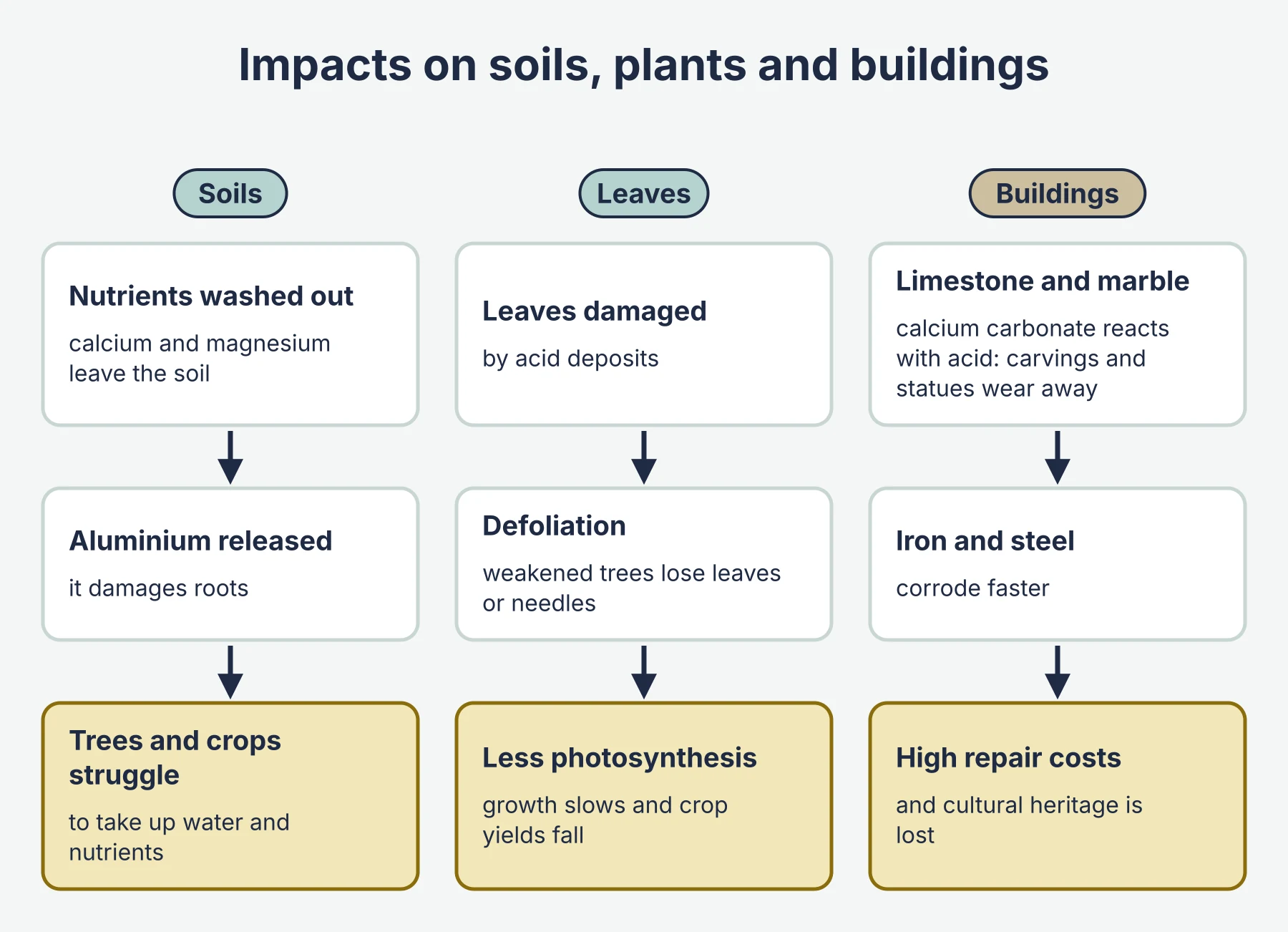
Acidification of soils. Acid rain washes nutrients such as calcium and magnesium out of the soil and releases aluminium, which damages roots. Trees and crops then struggle to take up water and nutrients.
Damage to crops and vegetation: plant defoliation and reduced crop yields. Acid deposits damage leaves directly, and weakened trees lose their leaves or needles (defoliation). Less leaf area means less photosynthesis, so growth slows and crop yields fall.
Damage to buildings. Acid reacts with limestone and marble, which are forms of calcium carbonate, so carvings and statues wear away. Metals such as iron and steel corrode faster. Repair costs are high and cultural heritage is lost.
Management strategies (4.3.3)
Flue-gas desulfurisation
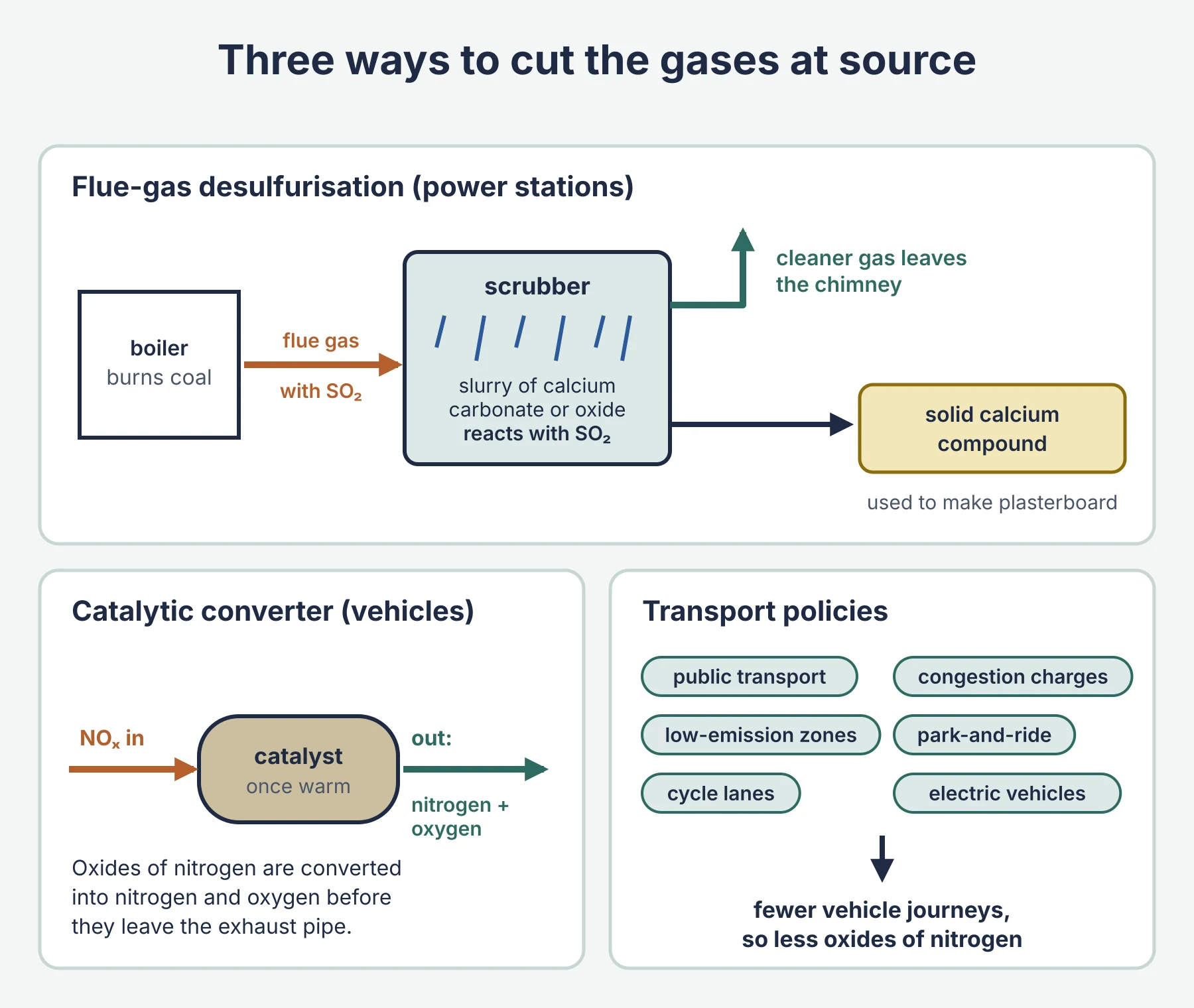
Flue gases are the waste gases leaving a power station chimney. In flue-gas desulfurisation, sulfur dioxide is removed by reacting it with calcium carbonate or calcium oxide, usually sprayed as a wet slurry into the gases before they reach the chimney. The sulfur ends up in a solid calcium compound, which can be used to make plasterboard.
Catalytic converters
A catalytic converter in a vehicle exhaust uses a catalyst to remove oxides of nitrogen, converting them into nitrogen and oxygen before they leave the exhaust pipe. It works only once it has warmed up.
Transport policies
Policies that cut the number of vehicle journeys reduce oxides of nitrogen: investment in public transport, congestion charges, low-emission zones, park-and-ride schemes, cycle lanes and support for electric vehicles.
Benefits and limitations (4.3.4)
| Strategy | Benefits | Limitations |
|---|---|---|
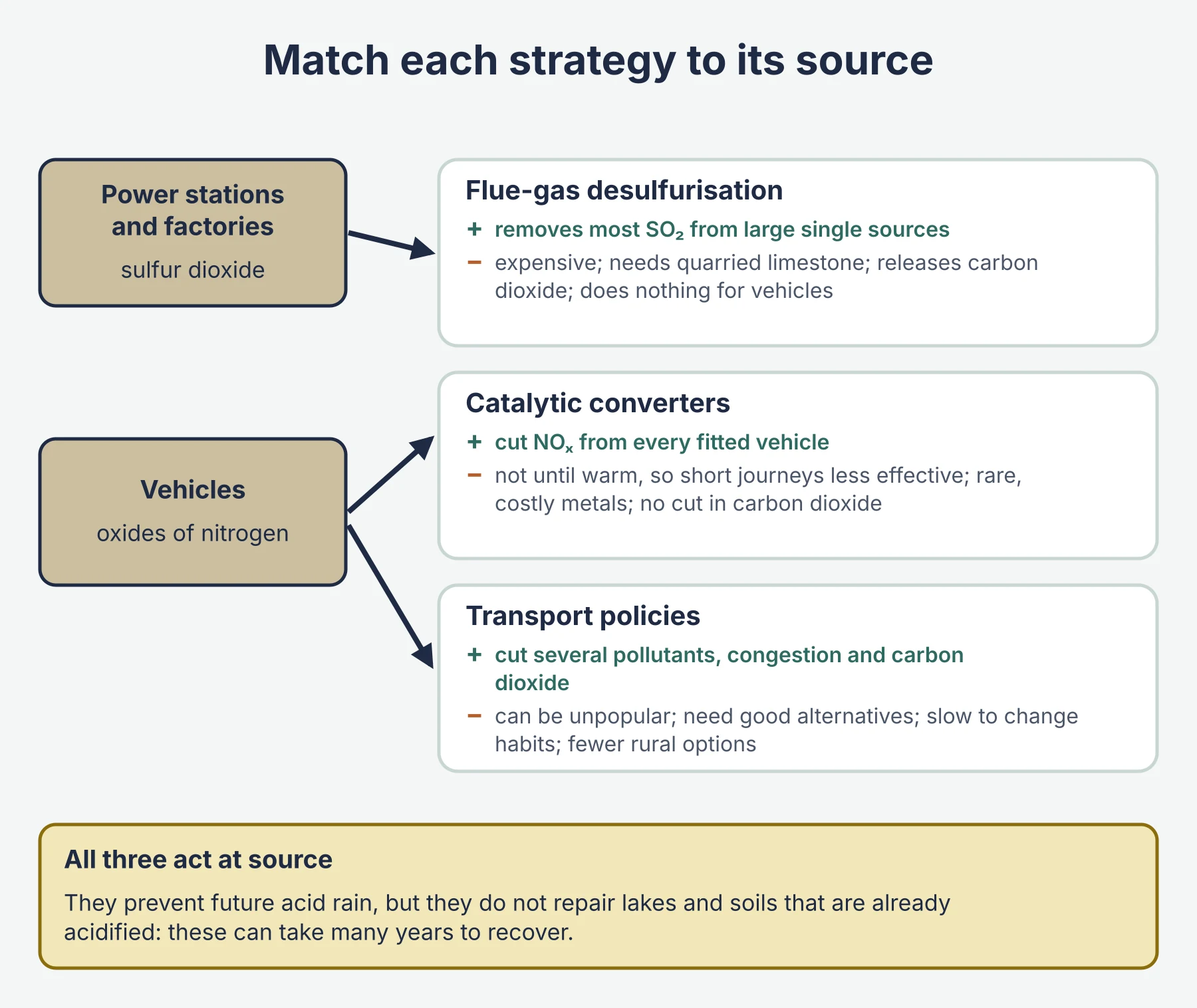
| Flue-gas desulfurisation | Removes most sulfur dioxide from large sources; by-product can be sold | Expensive to fit and run; limestone must be quarried, damaging landscapes; reaction with calcium carbonate releases carbon dioxide; does nothing for vehicles |
| Catalytic converters | Cut oxides of nitrogen from every fitted vehicle | Do not work until warm, so short journeys are less effective; use rare, costly metals; do not reduce carbon dioxide; older vehicles may lack them |
| Transport policies | Reduce several pollutants at once, plus congestion and carbon dioxide | Can be unpopular; need good alternatives; slow to change habits; rural areas have fewer options |
The most important limitation to understand is that all three act at source. They prevent future acid rain but do not repair lakes and soils that are already acidified, which can take many years to recover.
Worked example 1: interpreting pH data
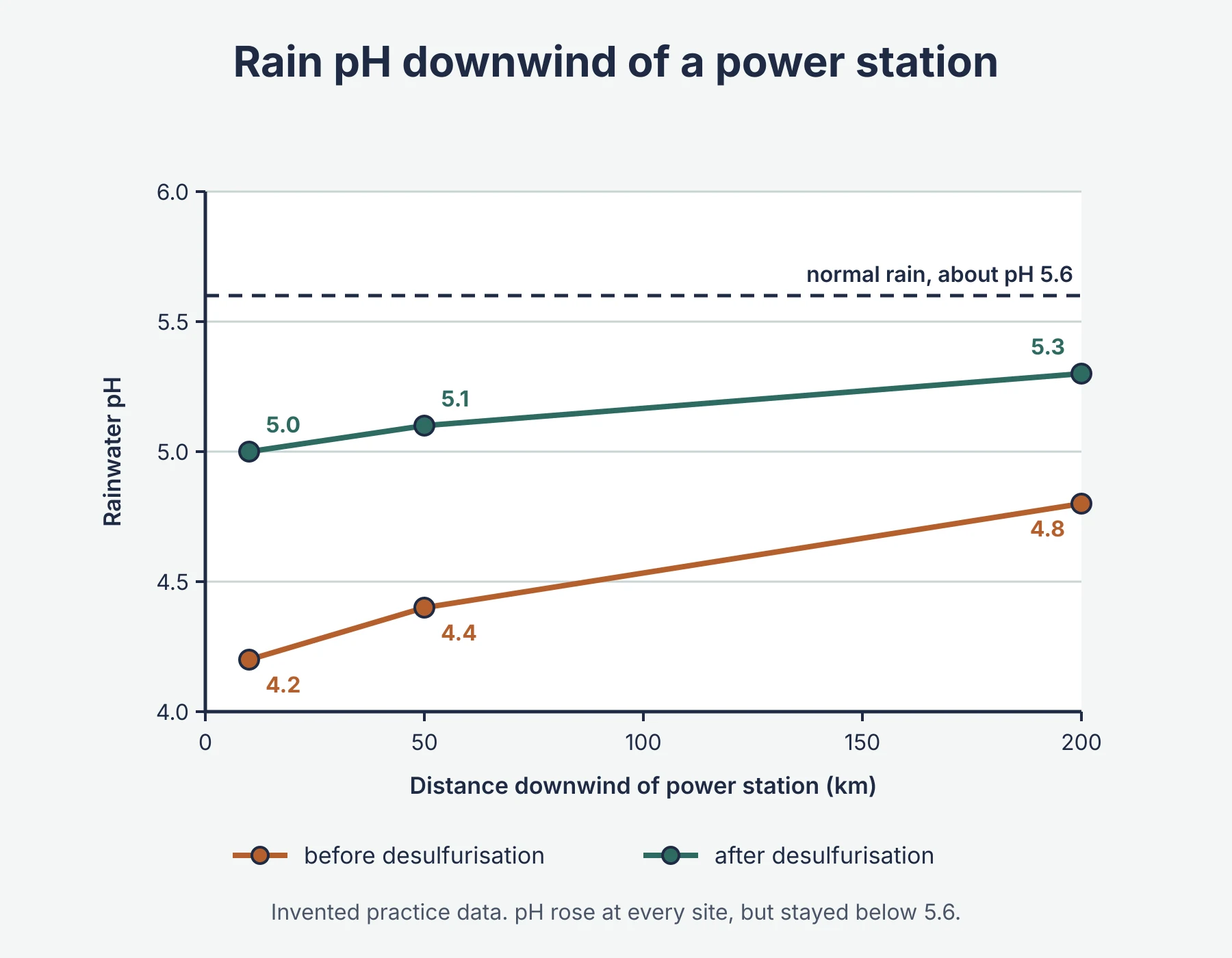
The data are invented for practice. Rainwater pH was measured at sites downwind of a coal-fired power station before and after flue-gas desulfurisation was fitted.
| Distance downwind (km) | pH before | pH after |
|---|---|---|
| 10 | 4.2 | 5.0 |
| 50 | 4.4 | 5.1 |
| 200 | 4.8 | 5.3 |
Question: describe and explain the patterns.
- Before the change, rain was most acidic close to the station (pH 4.2 at 10 km) and less acidic further away (pH 4.8 at 200 km), because the gases are diluted and some fall out as they travel.
- After desulfurisation, pH rose at every site, for example from 4.2 to 5.0 at 10 km, because less sulfur dioxide was released.
- Even at 200 km, rain before the change was below the normal pH of about 5.6, showing that acid rain affects areas far from the source.
- After the change, rain at all sites was still below pH 5.6. A suggested reason: oxides of nitrogen from vehicles are not removed by desulfurisation.
A rise from pH 4.2 to 5.0 is 0.8 of a unit; because the scale is logarithmic, the rain became several times less acidic, not 0.8 times.
Worked example 2: an annotated “discuss” answer
Question: a country’s lakes are acidified by emissions from coal-fired power stations and heavy traffic in its cities. Discuss the benefits and limitations of flue-gas desulfurisation and catalytic converters. [6]
Flue-gas desulfurisation removes most of the sulfur dioxide from the power stations, which are large single sources, so one investment makes a big difference (benefit). The solid by-product can be sold for plasterboard (benefit). However, it is expensive, needs large amounts of quarried limestone and releases carbon dioxide (limitation).
Catalytic converters remove oxides of nitrogen from the city traffic (benefit). But they only work when warm, so short city journeys are less effective, and they do not reduce the number of vehicles (limitation).
Because the country has both sources, it needs both strategies, ideally with transport policies to cut traffic; even then, the lakes will take years to recover (judgement).
Why it scores: each strategy is matched to the source named in the question, with explained benefits, limitations and a judgement.
Common mistakes
- Saying the nitrogen in oxides of nitrogen comes from the fuel. It comes from the air.
- Writing that catalytic converters remove sulfur dioxide. They remove oxides of nitrogen.
- Forgetting the natural source: volcanic sulfur dioxide.
- Treating a fall of one pH unit as a small change. It is a tenfold increase in acidity.
- Confusing acid rain with the enhanced greenhouse effect. Different gases, different impacts.
Exam technique
Describe the formation questions are marked by the four syllabus steps: name the gas, its source and the reaction with oxygen and water vapour. Describe impacts questions reward the impact plus a reason. In discuss questions, match each strategy to the source in the scenario (power stations, traffic or both), give benefits and limitations, and reach a judgement.
Condense this with the acid rain revision notes and practise with the acid rain practice questions. The effect of acid rain on river and lake organisms also appears in the water pollution study guide.
Related resources
-
Revision notes
Cambridge IGCSE Environmental Management: Land — Revision Notes
Recall notes on soils and crop growth, food production and soil erosion for Topic 2 Land of Cambridge IGCSE Environmental Management 0680, 2027-2029 series.
Environmental Management · Cambridge · IGCSE
Revise topic -
Practice questions
Cambridge IGCSE Environmental Management (0680): Acid rain – Practice Questions
Original practice questions with mark-scheme answers on acid rain formation, impacts, pH data and management strategies for Cambridge IGCSE 0680.
Environmental Management · Cambridge · IGCSE
Try questions -
Revision notes
Cambridge IGCSE Environmental Management (0680): Acid rain – Revision Notes
Recall notes on acid rain formation, impacts, flue-gas desulfurisation, catalytic converters and transport policies, with a self-test, for IGCSE 0680.
Environmental Management · Cambridge · IGCSE
Revise topic
Get free revision emails (optional)
Occasional emails with practice questions, worked explanations and links to free resources for the qualification and subjects you choose. No spam, and you can unsubscribe from any email. The free tools on this site never need an email.