
Study Guides
Cambridge IGCSE Environmental Management (0680): Ozone depletion
CFCs and ozone depletion, impacts of higher ultraviolet radiation, and the benefits and limitations of international agreements and CFC bans for IGCSE 0680.
- Subject
- Environmental Management
- Level
- IGCSE
- Topic
- Topic 4: The atmosphere and human activities
- Author
- Marlbridge Academic Team
- Updated
- Reviewed by
- Azam Siddique (what this means)
Aligned to Cambridge IGCSE Environmental Management (0680), 2027-2029. Official specification .
Syllabus page (what it covers and how it is assessed): Cambridge IGCSE Environmental Management.
Syllabus points this page covers
0680
- 4.4 Ozone depletion
Found an error? Report a correction.
Need help with this topic? Request a free trial class for IGCSE Environmental Management (0680).
Sub-topic 4.4 of Cambridge IGCSE Environmental Management (0680) is the shortest in Topic 4, but it is often used for “discuss” questions because its strategies are a well-known example of international action. The syllabus asks you to state the cause of ozone depletion, describe three impacts, describe three management strategies and discuss their benefits and limitations. The atmosphere and human activities study guide introduces the topic; this page explains each point in more depth.
Background: where the ozone layer is and what it does
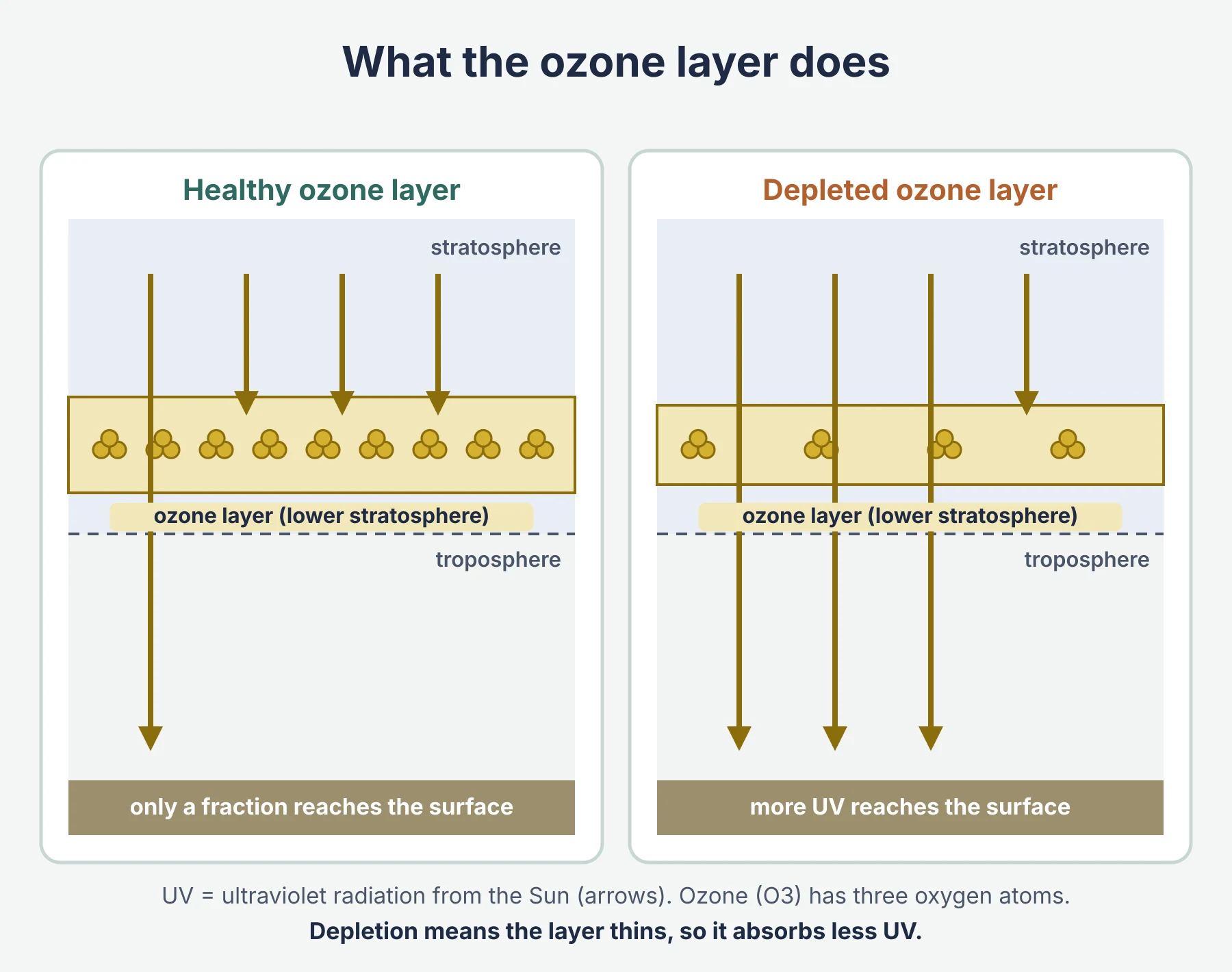
The ozone layer is in the lower stratosphere (sub-topic 4.1). Ozone is a form of oxygen whose molecules contain three oxygen atoms. In the stratosphere it absorbs much of the Sun’s ultraviolet radiation, so only a fraction of it reaches the Earth’s surface. “Ozone depletion” means the thinning of this layer, so that it absorbs less.
The cause (4.4.1)
The syllabus statement to learn is: chlorofluorocarbons (CFCs) in aerosols and refrigerants are the cause of ozone depletion in the ozone layer.
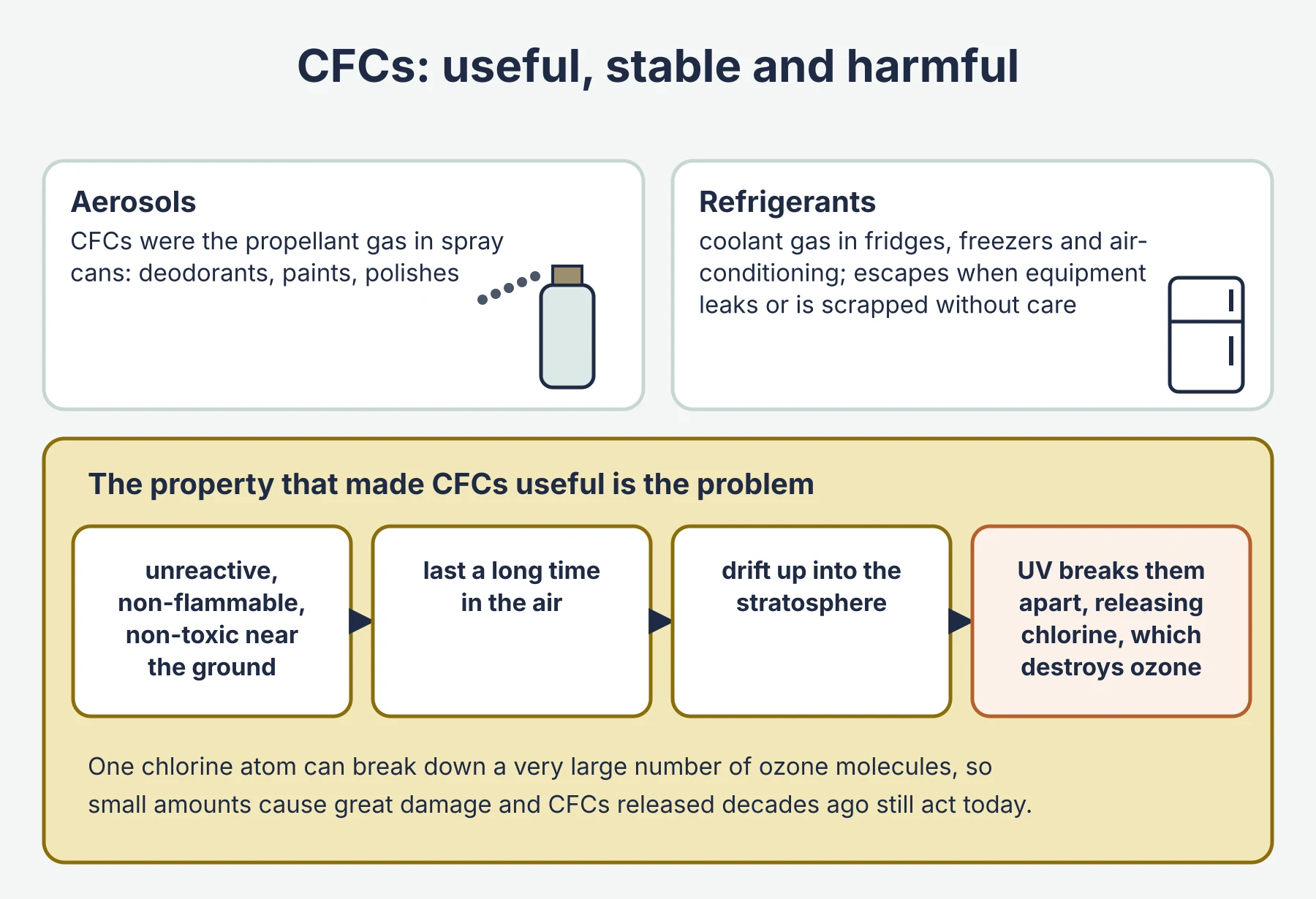
- Aerosols: CFCs were used as the propellant gas that pushes the contents out of spray cans, such as deodorants, paints and polishes.
- Refrigerants: CFCs were the coolant gas circulating in fridges, freezers and air-conditioning units. They escape when the equipment leaks or is scrapped without care.
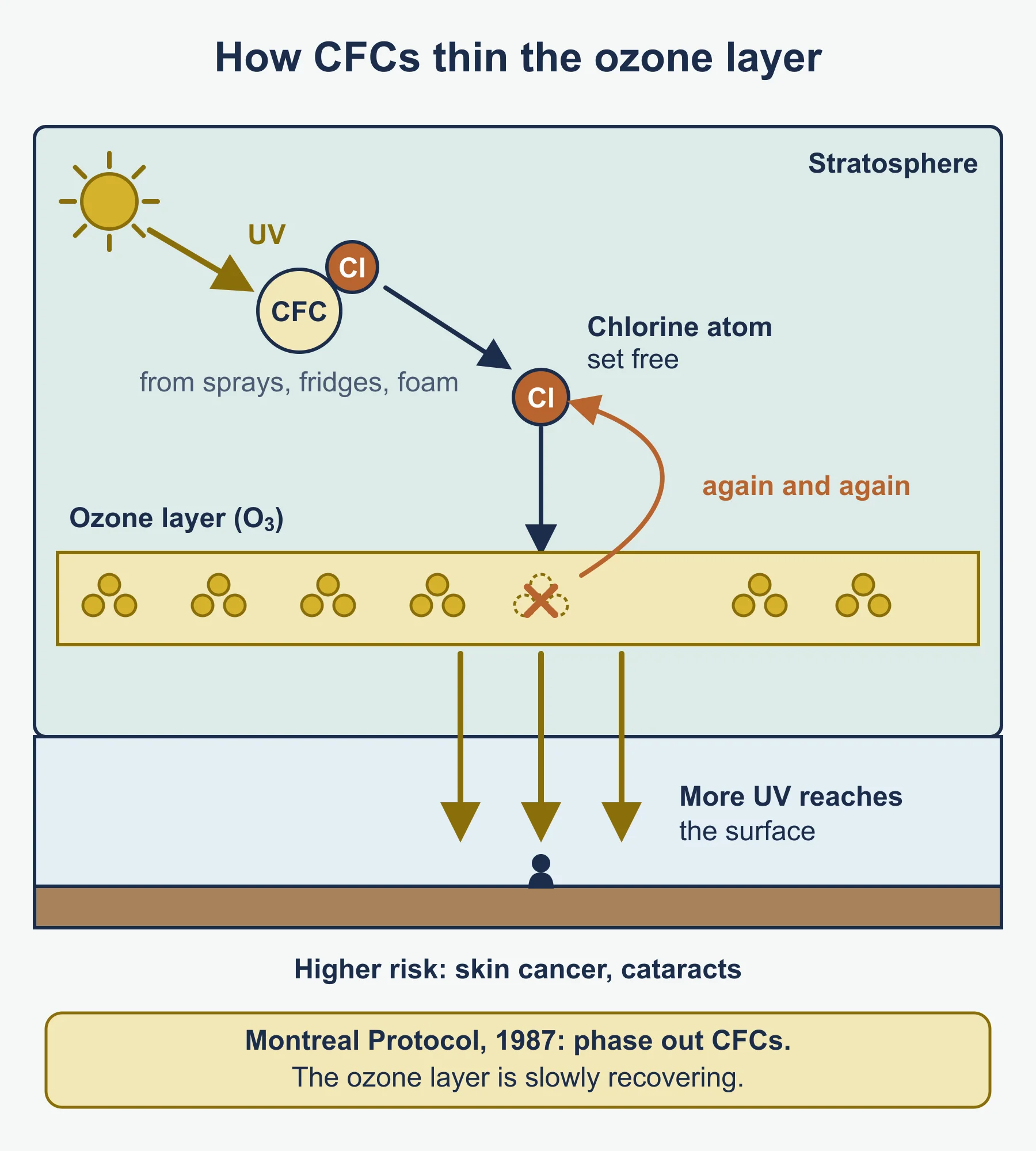
CFCs were popular because they are unreactive, non-flammable and non-toxic near the ground. That same stability is the problem: they last long enough in the air to drift up into the stratosphere. There, ultraviolet radiation breaks CFC molecules apart, releasing chlorine, which destroys ozone. Each chlorine atom can break down a very large number of ozone molecules before it is removed, which is why small amounts of CFCs cause so much damage, and why CFCs released decades ago are still affecting the ozone layer today.
The thinning is most dramatic over Antarctica in the southern spring, where an “ozone hole” forms each year, but the ozone layer has also thinned over other regions.
Impacts (4.4.2)
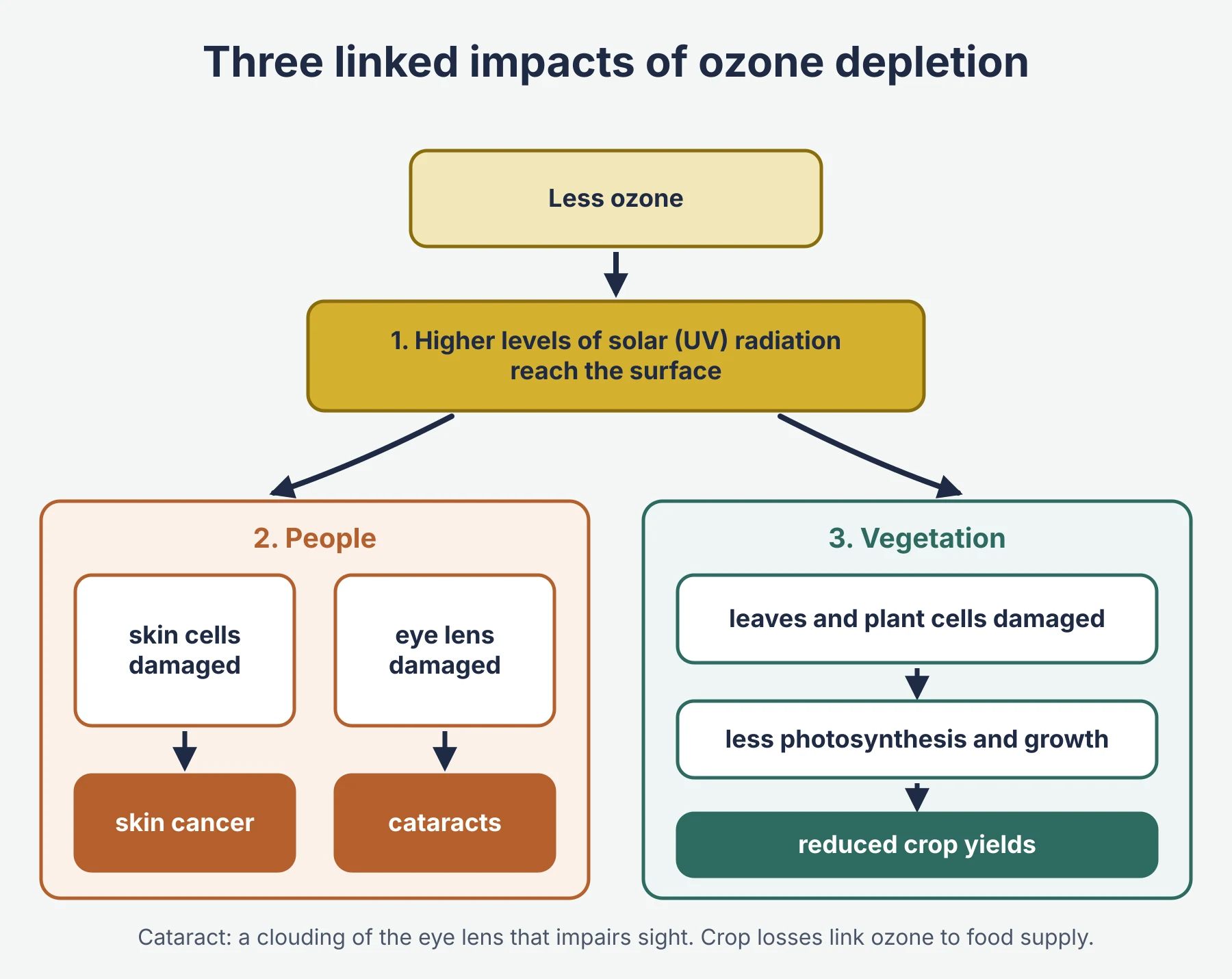
The syllabus limits impacts to three, and they follow one from another.
- Higher levels of solar radiation reaching the Earth’s surface. With less ozone to absorb it, more ultraviolet radiation passes through the atmosphere.
- Increased rates of cancer and cataracts. Ultraviolet radiation damages skin cells, raising the risk of skin cancer, and damages the lens of the eye, causing cataracts, a clouding of the lens that impairs sight.
- Damage to vegetation resulting in reduced crop yields. Ultraviolet radiation damages leaves and plant cells, reducing photosynthesis and growth, so yields fall. This links ozone depletion to food supply.
In an exam, write the chain: less ozone → more ultraviolet reaching the surface → named harm to people or plants.
Management strategies (4.4.3)
International agreement and policies
The ozone layer is a global resource, and CFCs released anywhere spread through the whole atmosphere, so no country could protect itself alone. The Montreal Protocol, agreed in 1987, committed countries to phase out the production and use of CFCs and other ozone-depleting substances, with later meetings tightening the timetable. Developed countries phased out first; developing countries were given longer and financial help to switch. National laws and policies put the agreement into practice.
CFC ban and alternatives to CFCs
Banning CFCs only works if there is something to replace them.
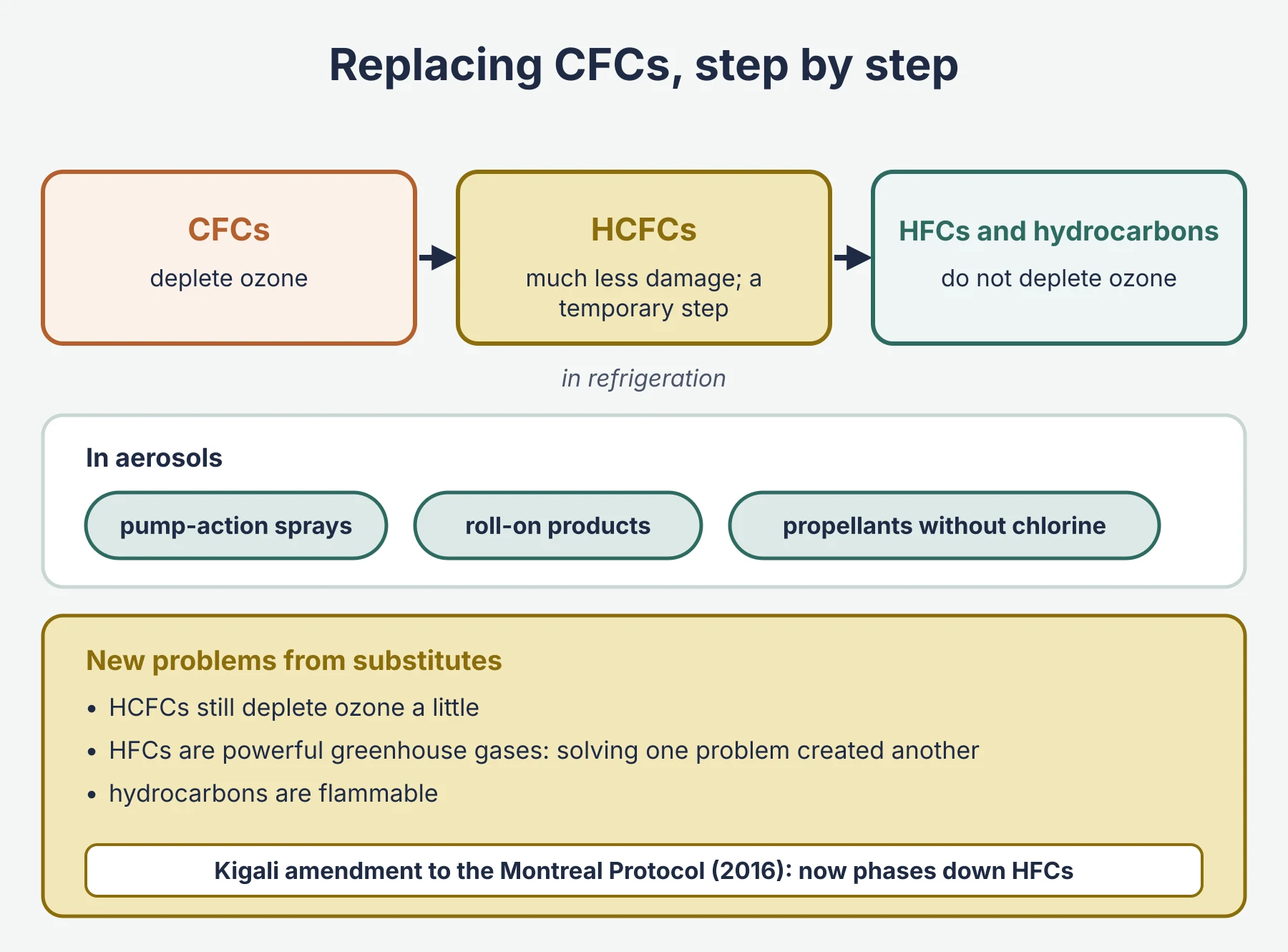
- In aerosols: pump-action sprays, roll-on products and other propellant gases that do not contain chlorine.
- In refrigeration: first hydrochlorofluorocarbons (HCFCs), which do much less damage and were treated as a temporary step, then hydrofluorocarbons (HFCs) and hydrocarbons, which do not deplete ozone.
Safe disposal of CFCs
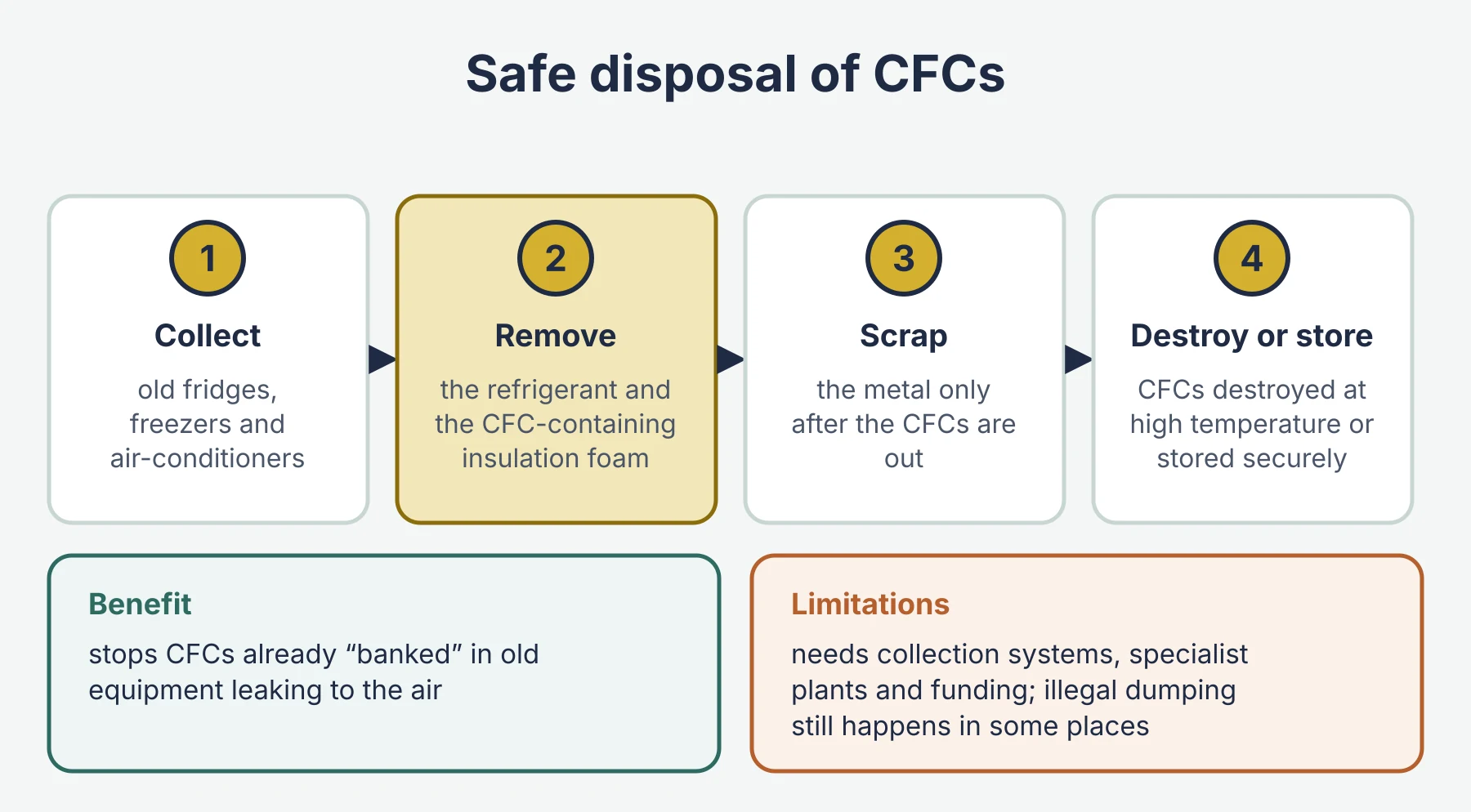
Millions of old fridges, freezers and air-conditioners still contain CFCs. Safe disposal means collecting old appliances and removing the refrigerant and the CFC-containing insulation foam before the metal is scrapped, then destroying the CFCs at high temperature or storing them securely, rather than letting them leak to the air.
Benefits and limitations (4.4.4)
| Strategy | Benefits | Limitations |
|---|---|---|
| International agreement and policies | Global problem tackled globally; joined by almost every country; production of CFCs has fallen dramatically | Depends on monitoring and honesty; illegal production and smuggling have occurred; recovery takes decades because CFCs persist |
| CFC ban and alternatives | Stops new CFCs entering the air; substitutes widely available and cheap | Some substitutes have problems: HCFCs still deplete ozone a little; HFCs are powerful greenhouse gases; hydrocarbons are flammable |
| Safe disposal | Prevents release of CFCs already “banked” in old equipment | Needs collection systems, specialist plants and funding; illegal dumping still happens in some places |
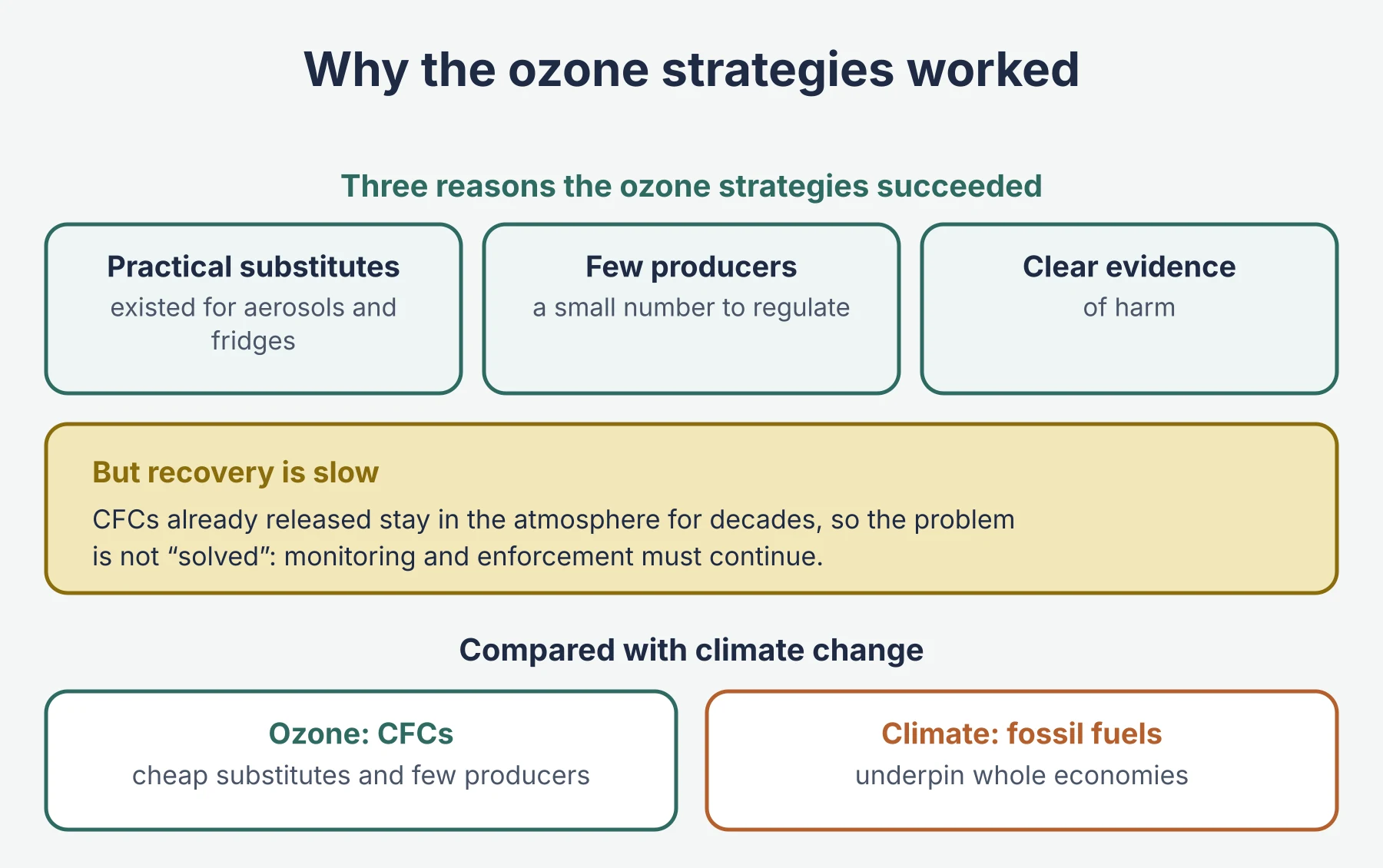
The key judgement point: the ozone strategies have been notably successful because there were practical substitutes, a small number of producers to regulate, and clear evidence of harm. Even so, the ozone layer recovers slowly because CFCs already released stay in the atmosphere for decades. The HFC problem shows that solving one environmental issue can create another; an amendment to the Montreal Protocol agreed in Kigali in 2016 now phases down HFCs for climate reasons.
Worked example 1: interpreting data
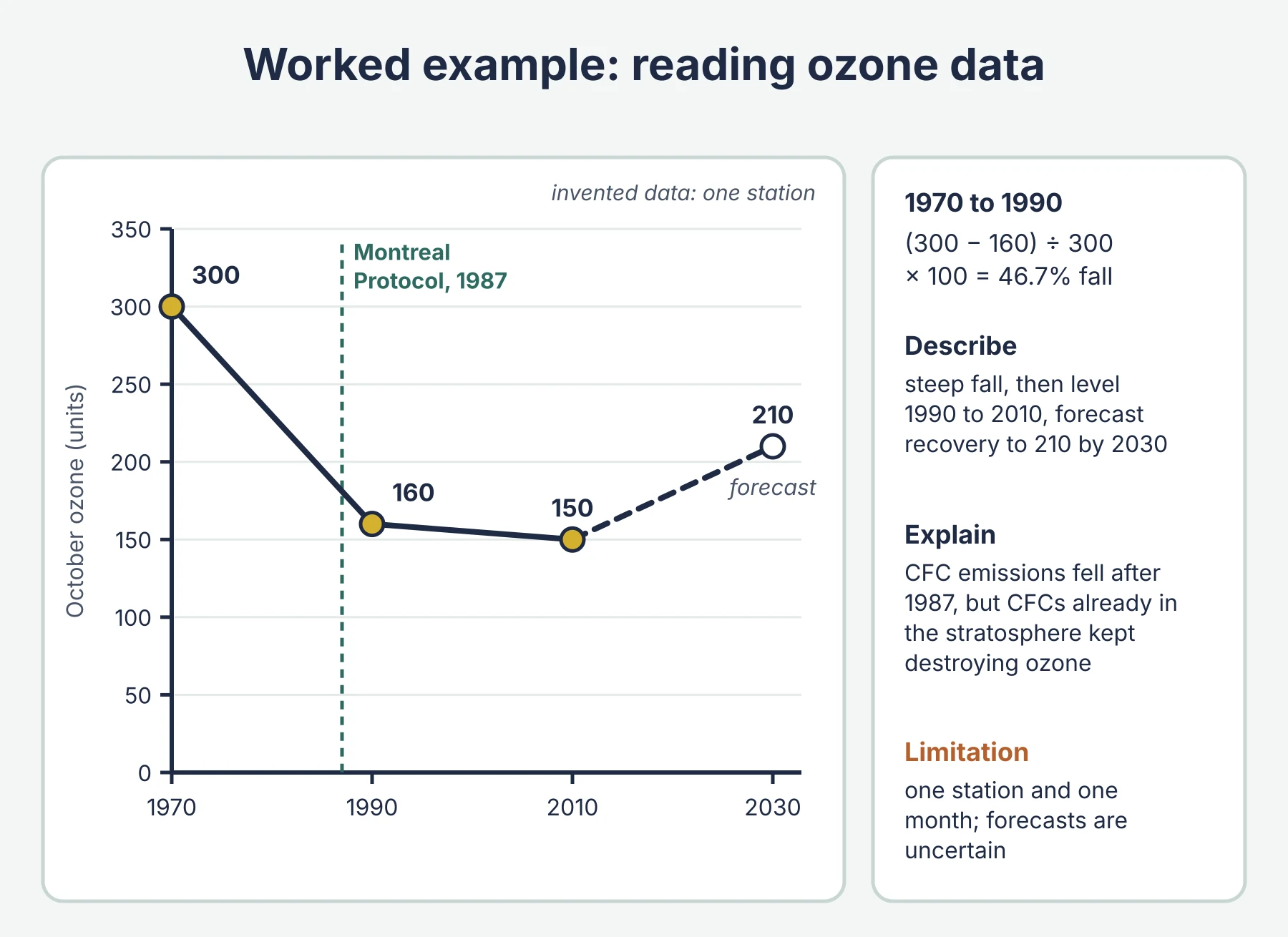
The figures are invented for practice. A research station measures ozone above it every October, in units of ozone thickness.
| Year | Ozone (units) |
|---|---|
| 1970 | 300 |
| 1990 | 160 |
| 2010 | 150 |
| 2030 (forecast) | 210 |
- Percentage fall from 1970 to 1990 = (300 − 160) / 300 × 100 = 46.7%.
- Description: ozone fell steeply between 1970 and 1990, then levelled off between 1990 and 2010, with a forecast recovery to 210 units by 2030.
- Explanation: CFC use rose until the late 1980s; after the Montreal Protocol, emissions fell, but CFCs already in the stratosphere continued to destroy ozone, so values stayed low for years. As CFC levels slowly decline, ozone is forecast to recover.
- Limitation of the data: one station and one month do not show the global picture; forecasts are uncertain.
Worked example 2: an annotated “discuss” answer
Question: discuss the benefits and limitations of the strategies used to manage ozone depletion. [6]
International agreement made all major producing countries phase out CFCs together, which was essential because CFCs spread globally (benefit). Bans were practical because alternatives existed for aerosols and fridges, so production fell sharply (benefit). Safe disposal stops CFCs in old fridges leaking out (benefit). However, CFCs last for decades, so the ozone layer will take many years to recover (limitation). Some substitutes, such as HFCs, are greenhouse gases that add to climate change (limitation). Overall, these strategies have been effective, but they need continued monitoring and enforcement to stop illegal production (judgement).
Why it scores: it covers all three named strategies, gives two developed limitations and ends with a supported judgement.
Common mistakes
- Saying the ozone hole causes global warming. Ozone depletion lets in more ultraviolet radiation; global warming is caused by greenhouse gases.
- Saying carbon dioxide destroys ozone. The syllabus cause is CFCs in aerosols and refrigerants.
- Writing “radiation causes cancer” without naming skin cancer and cataracts as the syllabus impacts, or forgetting crop yields.
- Claiming the problem is solved. Recovery is under way but slow.
- Placing the ozone layer in the troposphere.
Exam technique
State the cause in the syllabus words. For describe impacts, use the three-step chain. In discuss questions, cover each strategy, give at least one limitation, and use the comparison with climate change if asked whether ozone strategies were more successful: ozone had cheap substitutes and few producers, whereas fossil fuels underpin whole economies.
Condense this with the ozone depletion revision notes and practise with the ozone depletion practice questions. The location of the ozone layer is covered in the atmosphere study guide.
Related resources
-
Revision notes
Cambridge IGCSE Environmental Management: Land — Revision Notes
Recall notes on soils and crop growth, food production and soil erosion for Topic 2 Land of Cambridge IGCSE Environmental Management 0680, 2027-2029 series.
Environmental Management · Cambridge · IGCSE
Revise topic -
Practice questions
Cambridge IGCSE Environmental Management (0680): Ozone depletion – Practice Questions
Original practice questions with answers on CFCs, ozone depletion impacts, the Montreal Protocol and CFC alternatives for Cambridge IGCSE 0680.
Environmental Management · Cambridge · IGCSE
Try questions -
Revision notes
Cambridge IGCSE Environmental Management (0680): Ozone depletion – Revision Notes
Recall notes on CFCs, ozone depletion impacts, the Montreal Protocol, CFC alternatives and safe disposal, with a self-test, for Cambridge IGCSE 0680.
Environmental Management · Cambridge · IGCSE
Revise topic
Get free revision emails (optional)
Occasional emails with practice questions, worked explanations and links to free resources for the qualification and subjects you choose. No spam, and you can unsubscribe from any email. The free tools on this site never need an email.