
Revision Notes
Cambridge IGCSE Environmental Management (0680): Ozone depletion – Revision Notes
Recall notes on CFCs, ozone depletion impacts, the Montreal Protocol, CFC alternatives and safe disposal, with a self-test, for Cambridge IGCSE 0680.
- Subject
- Environmental Management
- Level
- IGCSE
- Topic
- Topic 4: The atmosphere and human activities
- Author
- Marlbridge Academic Team
- Updated
- Reviewed by
- Azam Siddique (what this means)
Aligned to Cambridge IGCSE Environmental Management (0680), 2027-2029. Official specification .
Syllabus page (what it covers and how it is assessed): Cambridge IGCSE Environmental Management.
Syllabus points this page covers
0680
- 4.4 Ozone depletion
Found an error? Report a correction.
Need help with this topic? Request a free trial class for IGCSE Environmental Management (0680).
Condensed notes for sub-topic 4.4 of Cambridge IGCSE Environmental Management (0680). The ozone depletion study guide explains each point and includes a data question and a model “discuss” answer.
The four syllabus points
- 4.4.1 State the cause.
- 4.4.2 Describe three impacts.
- 4.4.3 Describe three strategies.
- 4.4.4 Discuss the benefits and limitations of those strategies.
Cause (4.4.1): learn the sentence
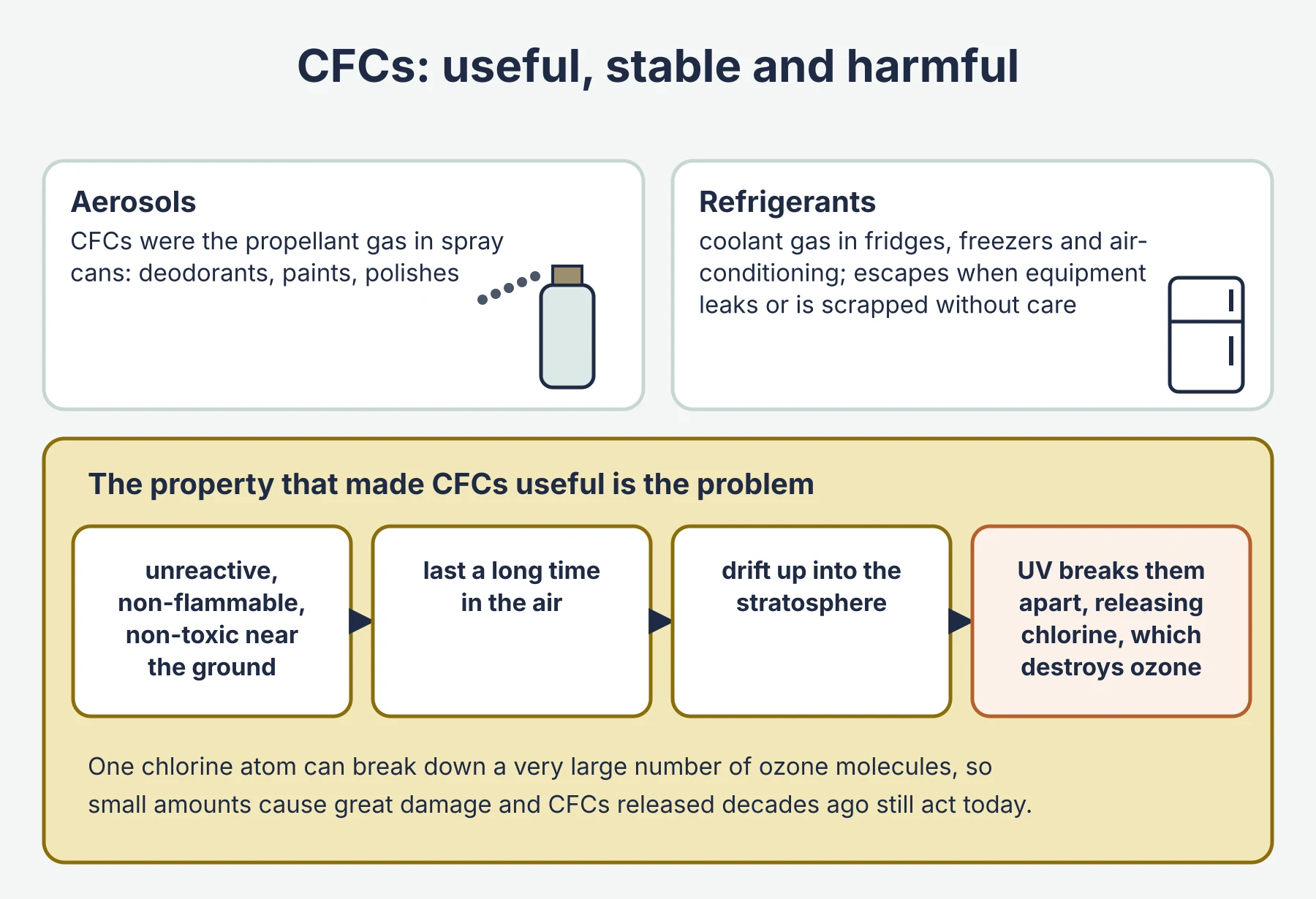
Chlorofluorocarbons (CFCs) in aerosols and refrigerants are the cause of ozone depletion in the ozone layer.
- Aerosols: CFCs were the propellant in spray cans.
- Refrigerants: CFCs were the coolant in fridges, freezers and air-conditioners.
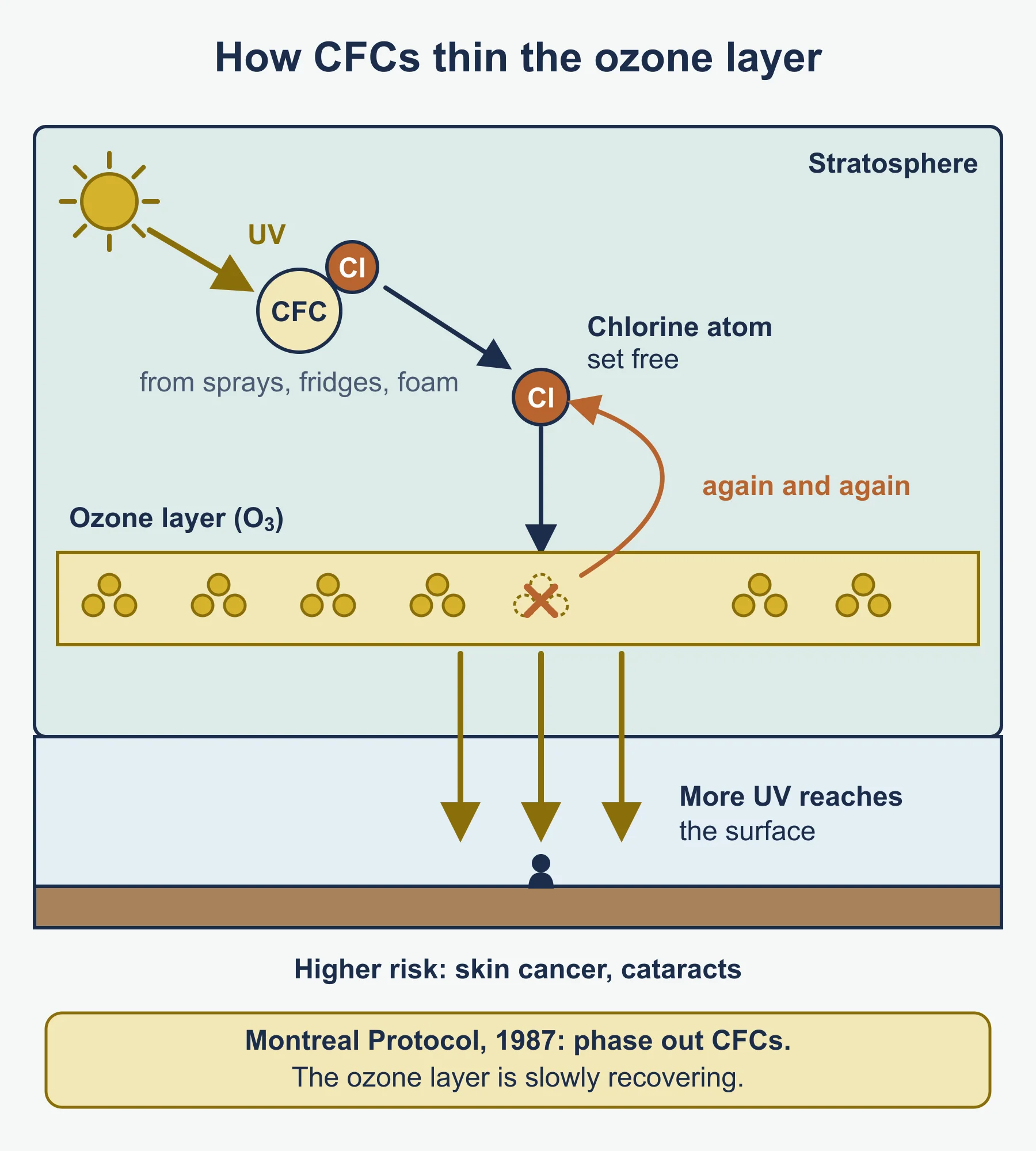
- Why so damaging: CFCs are very stable, so they survive long enough to reach the stratosphere; ultraviolet radiation breaks them up, releasing chlorine, which destroys ozone; one chlorine atom can destroy many ozone molecules.
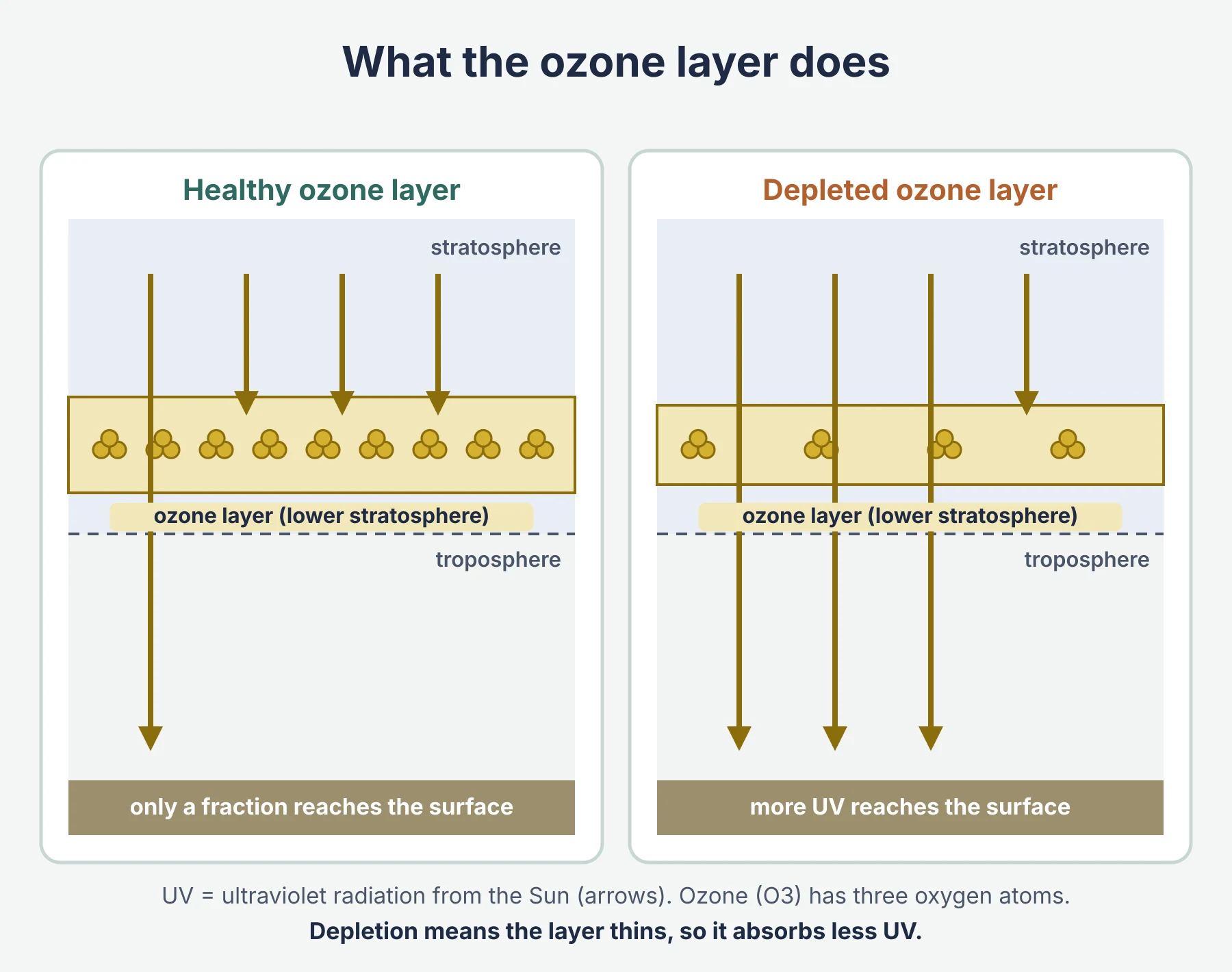
- Ozone layer location: lower stratosphere. Thinning is greatest over Antarctica in the southern spring (the “ozone hole”).
Impacts (4.4.2): a three-step chain
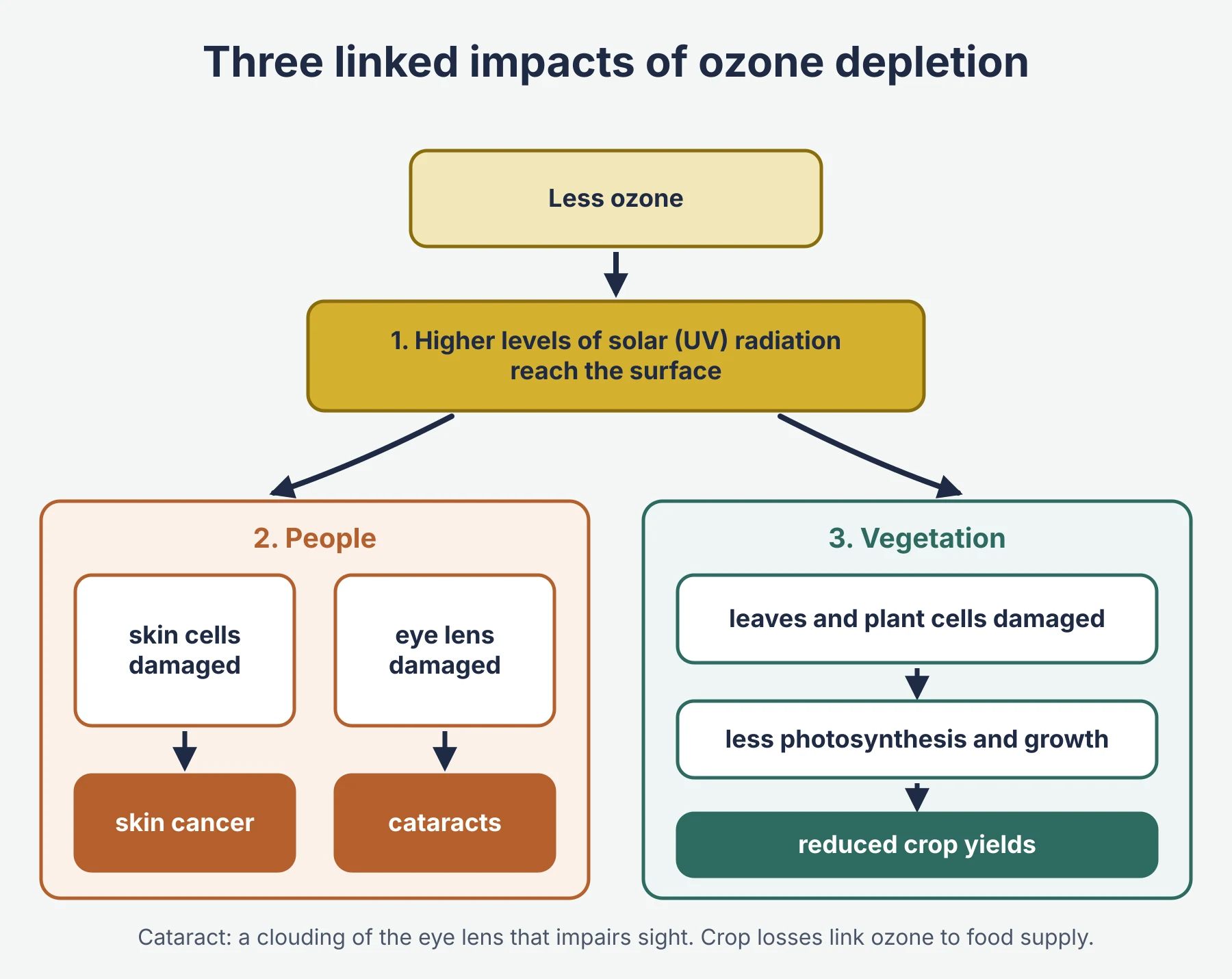
Less ozone → higher levels of solar (ultraviolet) radiation reaching the Earth’s surface →
- Increased rates of cancer (skin cancer) and cataracts (clouding of the eye lens).
- Damage to vegetation resulting in reduced crop yields (less photosynthesis and growth).
Strategies (4.4.3)
| Strategy | What it involves |
|---|---|
| International agreement and policies | Montreal Protocol (1987): countries phase out CFCs and other ozone-depleting substances; later meetings tightened timetables; developing countries given longer and financial help; national laws enforce it |
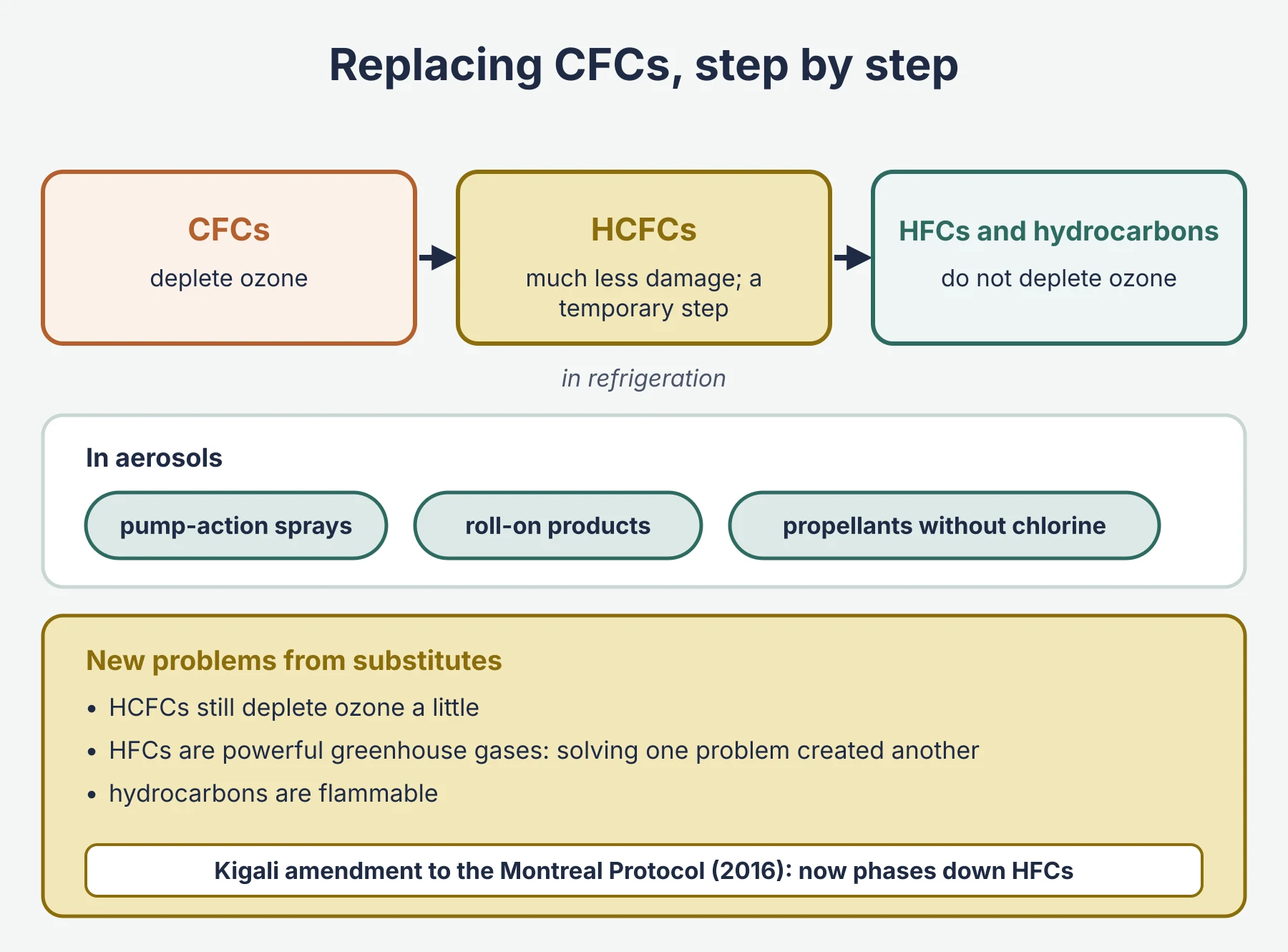
| CFC ban and alternatives to CFCs | Pump sprays and other propellants in aerosols; HCFCs as a temporary step, then HFCs and hydrocarbons in refrigeration |
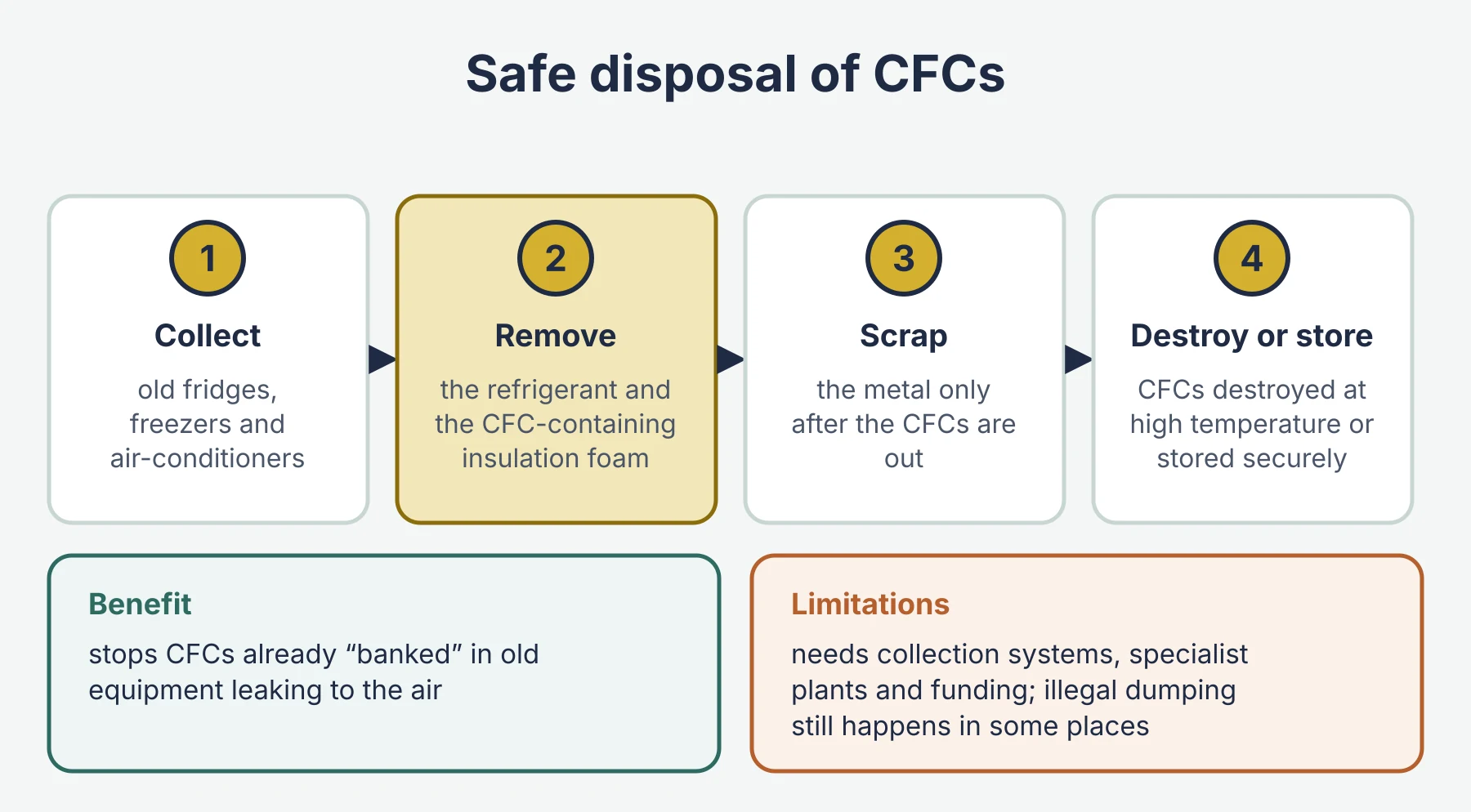
| Safe disposal of CFCs | Collect old fridges and air-conditioners; remove refrigerant and foam; destroy CFCs at high temperature or store securely |
Benefits and limitations (4.4.4)
| Strategy | + | – |
|---|---|---|
| International agreement | Global action on a global problem; near-universal membership; CFC production fell dramatically | Needs monitoring; illegal production and smuggling; slow recovery because CFCs persist |
| Ban and alternatives | Stops new CFCs; practical substitutes | HCFCs still deplete ozone a little; HFCs are strong greenhouse gases; hydrocarbons flammable |
| Safe disposal | Captures CFCs “banked” in old equipment | Costly collection and treatment; illegal dumping |
Judgement points:
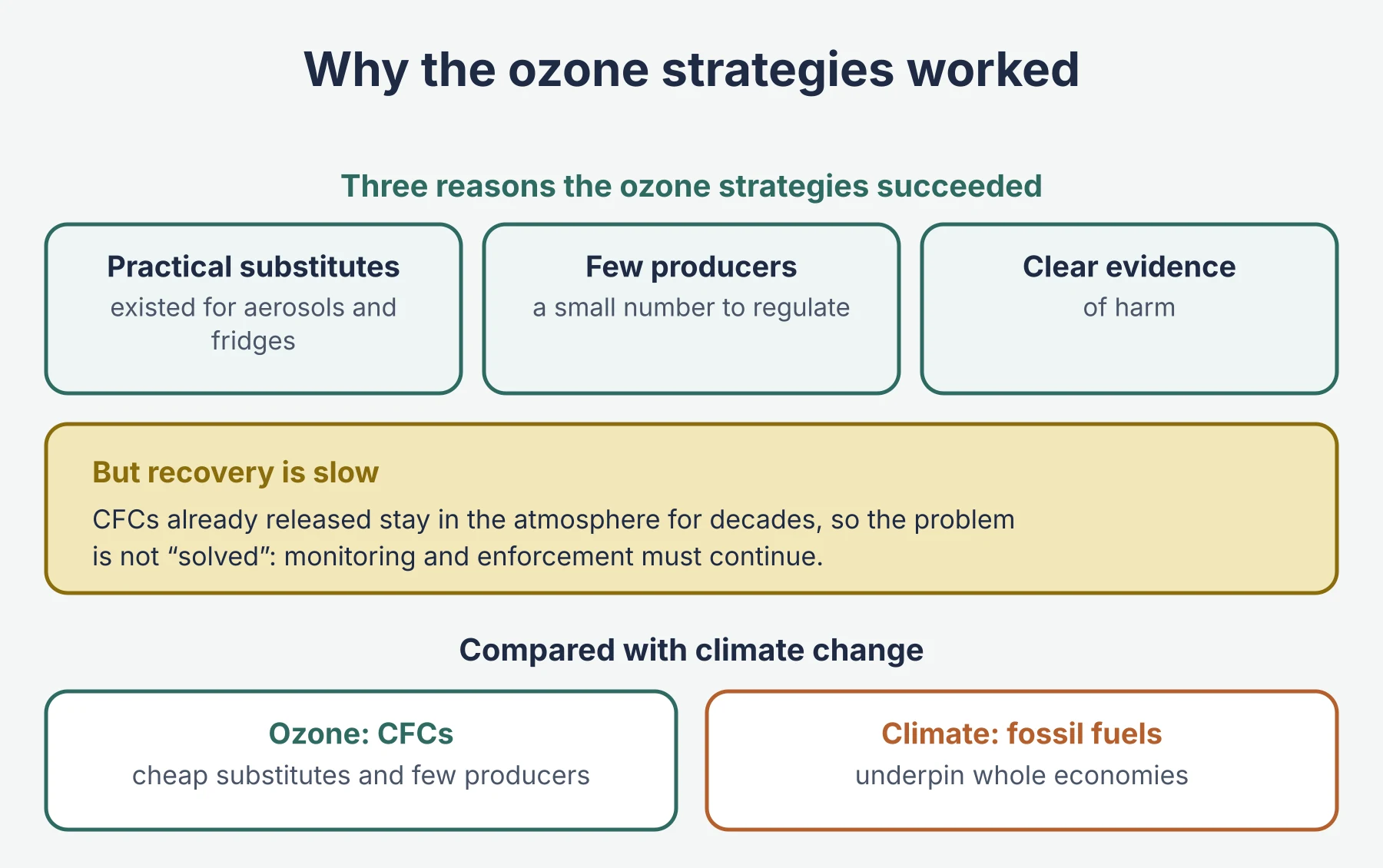
- Success factors: cheap substitutes, few producers, clear evidence of harm.
- Recovery is slow, over decades, because CFCs already released stay in the atmosphere.
- Solving one problem can create another: HFCs and climate change. A 2016 amendment agreed in Kigali phases down HFCs.
Key terms
| Term | Meaning |
|---|---|
| Ozone | A form of oxygen with three oxygen atoms per molecule |
| Ozone layer | Ozone-rich region in the lower stratosphere that absorbs ultraviolet radiation |
| Ozone depletion | Thinning of the ozone layer |
| CFCs | Chlorofluorocarbons; gases once used in aerosols and refrigerants |
| Propellant | The gas that pushes the contents out of an aerosol can |
| Refrigerant | The coolant gas in fridges and air-conditioners |
| Ultraviolet radiation | Part of solar radiation that damages living cells |
| Cataract | Clouding of the lens of the eye |
| Montreal Protocol | The 1987 international agreement to phase out ozone-depleting substances |
| HFCs | Hydrofluorocarbons; CFC substitutes that do not deplete ozone but are greenhouse gases |
Ozone depletion versus climate change
| Ozone depletion | Climate change | |
|---|---|---|
| Main cause | CFCs | Greenhouse gases (CO₂, CH₄, water vapour) |
| Where | Lower stratosphere | Whole climate system |
| What changes | More ultraviolet reaches the surface | Global temperatures rise |
| Main harms | Skin cancer, cataracts, lower crop yields | Sea-level rise, extreme weather, habitat loss and more |
Exam traps
- CFCs, not carbon dioxide, cause ozone depletion.
- The ozone hole does not cause global warming.
- Name both uses: aerosols and refrigerants.
- Name all three impacts, including crop yields, not just health.
- Do not claim the problem is solved: recovery is under way but slow.
- HFCs do not deplete ozone but are greenhouse gases; do not say they “damage the ozone layer”.
Self-test
- State the cause of ozone depletion in the syllabus words.
- What were CFCs used for in aerosols?
- Why can CFCs released at ground level damage the stratosphere?
- In which layer, and which part of it, is the ozone layer?
- What is the first impact of ozone depletion?
- Name two health effects of increased ultraviolet radiation.
- How does ozone depletion affect crops?
- Name the 1987 international agreement on ozone-depleting substances.
- Give one alternative to CFCs in aerosols and one in refrigerators.
- What does safe disposal of CFCs involve?
- Give one limitation of using HFCs as a CFC substitute.
- Why will the ozone layer take decades to recover even though CFC production has largely stopped?
Answers
- CFCs in aerosols and refrigerants are the cause of ozone depletion in the ozone layer.
- As the propellant gas that pushes the contents out of the can.
- They are very stable, so they last long enough to rise into the stratosphere, where ultraviolet radiation releases chlorine that destroys ozone.
- The lower stratosphere.
- Higher levels of solar (ultraviolet) radiation reach the Earth’s surface.
- Skin cancer and cataracts.
- Ultraviolet radiation damages vegetation, reducing photosynthesis and growth, so crop yields fall.
- The Montreal Protocol.
- Aerosols: pump-action sprays or a non-chlorine propellant. Refrigerators: HFCs, hydrocarbons or, as a temporary step, HCFCs.
- Collecting old fridges and air-conditioners, removing the CFCs, and destroying or storing them securely.
- HFCs are powerful greenhouse gases that add to climate change.
- CFCs already released remain in the atmosphere for decades, continuing to destroy ozone.
Linked pages
Practise with the ozone depletion practice questions, and compare with the climate change revision notes.
Related resources
-
Revision notes
Cambridge IGCSE Environmental Management: Land — Revision Notes
Recall notes on soils and crop growth, food production and soil erosion for Topic 2 Land of Cambridge IGCSE Environmental Management 0680, 2027-2029 series.
Environmental Management · Cambridge · IGCSE
Revise topic -
Study guides
Cambridge IGCSE Environmental Management (0680): The atmosphere
Layers and composition of the atmosphere, the ozone layer, climate versus weather and the natural greenhouse effect for Cambridge IGCSE 0680.
Environmental Management · Cambridge · IGCSE
Read guide -
Practice questions
Cambridge IGCSE Environmental Management (0680): The atmosphere – Practice Questions
Original practice questions with answers on atmospheric layers, air composition, climate and the natural greenhouse effect for Cambridge IGCSE 0680.
Environmental Management · Cambridge · IGCSE
Try questions
Get free revision emails (optional)
Occasional emails with practice questions, worked explanations and links to free resources for the qualification and subjects you choose. No spam, and you can unsubscribe from any email. The free tools on this site never need an email.