
Study Guides
Cambridge IGCSE Environmental Management (0680): Formation of rocks
How granite, basalt, limestone, sandstone, shale, marble and slate form, the eight rock cycle processes and rock permeability for Cambridge IGCSE 0680.
- Subject
- Environmental Management
- Level
- IGCSE
- Topic
- Topic 1 – Natural Resources
- Author
- Marlbridge Academic Team
- Updated
- Reviewed by
- Azam Siddique (what this means)
Aligned to Cambridge IGCSE Environmental Management (0680), 2027-2029. Official specification .
Syllabus page (what it covers and how it is assessed): Cambridge IGCSE Environmental Management.
Syllabus points this page covers
0680
- 1.1 Formation of rocks
Found an error? Report a correction.
Need help with this topic? Request a free trial class for IGCSE Environmental Management (0680).
Sub-topic 1.1 is the geology that the rest of Topic 1 depends on. Ores are extracted from rocks (1.2), fossil fuels form in sedimentary layers (1.4), and fracking exists because one sedimentary rock, shale, will not let gas flow through it (1.6). The syllabus limits you to seven named rocks, eight rock cycle processes and one property, permeability. Because the list is short, examiners expect precise descriptions: the right process, in the right order, for the right rock.
What the syllabus asks you to do
- 1.1.1 Describe the formation of named rocks: igneous (granite and basalt), sedimentary (limestone, sandstone and shale) and metamorphic (marble and slate).
- 1.1.2 Describe and interpret the rock cycle, limited to weathering, erosion, transportation, sedimentation, compaction, cementation, crystallisation and deposition.
- 1.1.3 Define permeability as the ability of water to pass through the pore spaces of rock and soil.
- 1.1.4 Classify rocks as permeable (most sedimentary rocks: limestone and sandstone) or impermeable (igneous, metamorphic and some sedimentary rocks: shale).
“Interpret” in 1.1.2 matters: you may be given an unfamiliar rock cycle diagram with letters or arrows and asked to name the process at each point.
Igneous rocks: crystallisation from molten rock
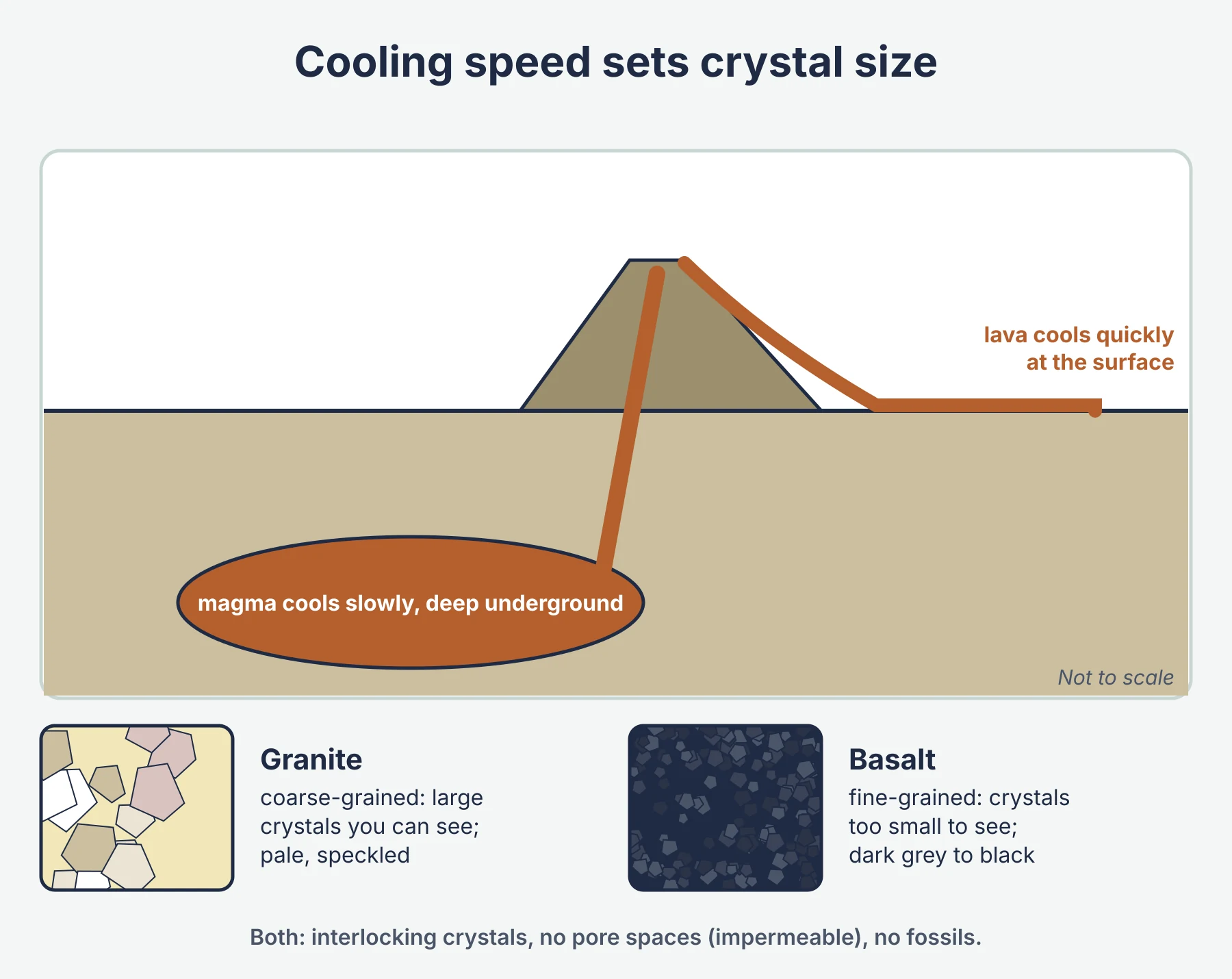
Igneous rocks form when molten rock cools and crystallises. Molten rock below the surface is called magma; when it reaches the surface it is called lava. The speed of cooling controls crystal size, and that is the key to telling the two named igneous rocks apart.
- Granite forms from magma that cools slowly, deep underground, insulated by the surrounding rock. Crystals have a long time to grow, so granite is coarse-grained, with crystals large enough to see. It is usually pale, speckled grey or pink.
- Basalt forms from lava that cools quickly at or near the surface, for example in lava flows from a volcano or where lava erupts on the sea bed. Crystals have little time to grow, so basalt is fine-grained, with crystals too small to see without a lens. It is dark grey to black.
Both are made of interlocking crystals with no pore spaces between them, which is why igneous rocks are impermeable. Neither contains fossils, because no organism survives being melted.
Sedimentary rocks: particles laid down in layers
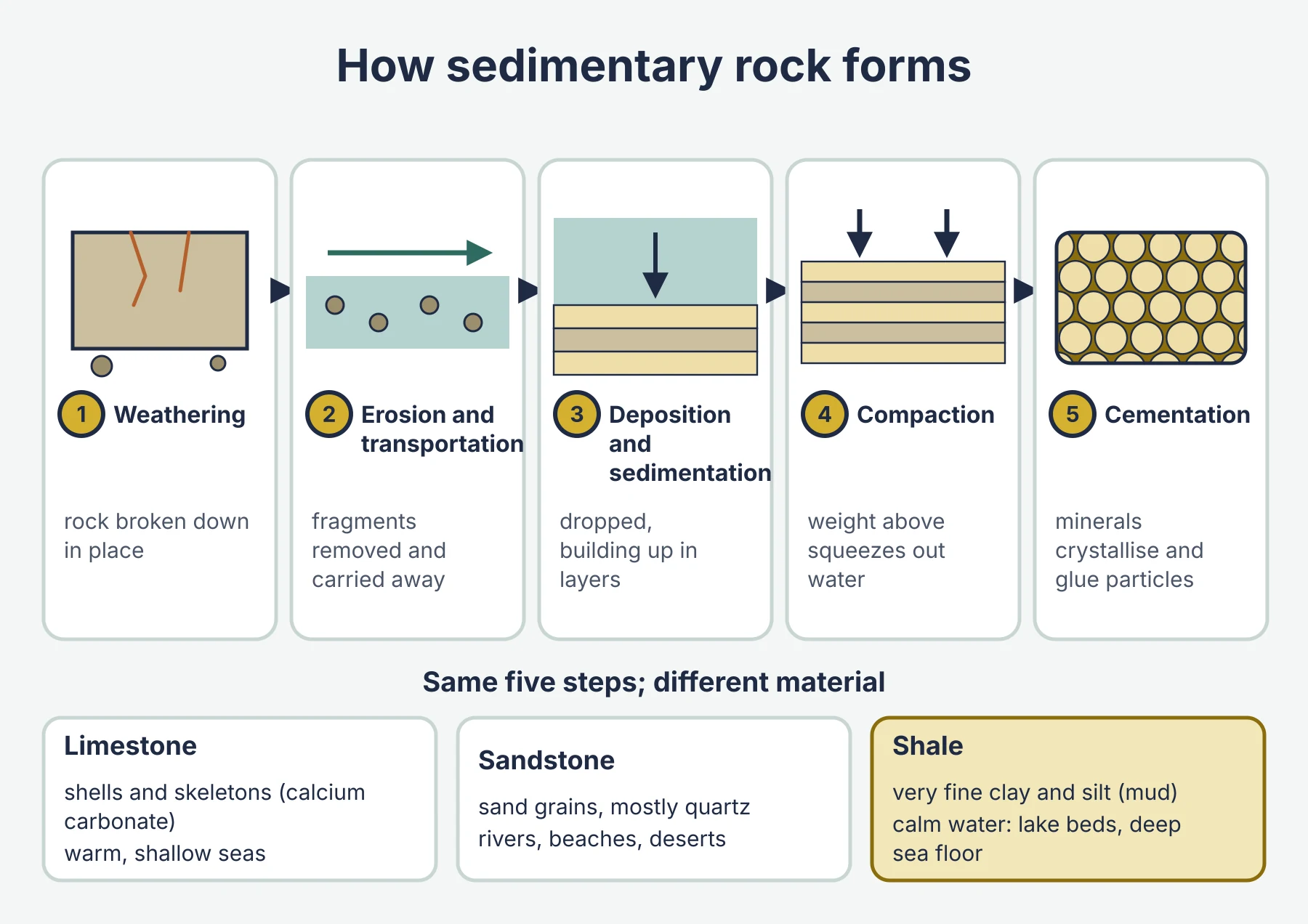
Sedimentary rocks form from fragments of older rock, or from the remains of living things, that are laid down in layers and turned into solid rock. The sequence is the same for all three named rocks:
- Existing rock is broken down by weathering.
- The fragments are removed by erosion and carried away by transportation (in rivers, by the wind, by ice or by the sea).
- When the carrying agent loses energy, the material is dropped: deposition. Over long periods it builds up in layers on a lake bed or the sea floor: sedimentation.
- The weight of new layers above squeezes out water and presses the particles together: compaction.
- Minerals carried in the water that seeps between the particles crystallise and glue them together: cementation.
What changes between the three rocks is the type and size of material:
| Rock | Material it forms from | Typical setting | Features |
|---|---|---|---|
| Limestone | Shells and skeletons of sea creatures, made of calcium carbonate | Warm, shallow seas | Often contains fossils; reacts (fizzes) with dilute acid |
| Sandstone | Sand grains, mostly quartz | Rivers, beaches, deserts | Gritty feel; grains visible; pore spaces between grains |
| Shale | Very fine clay and silt particles (mud) | Calm water such as lake beds and deep sea floors | Splits into thin layers; may contain organic matter |
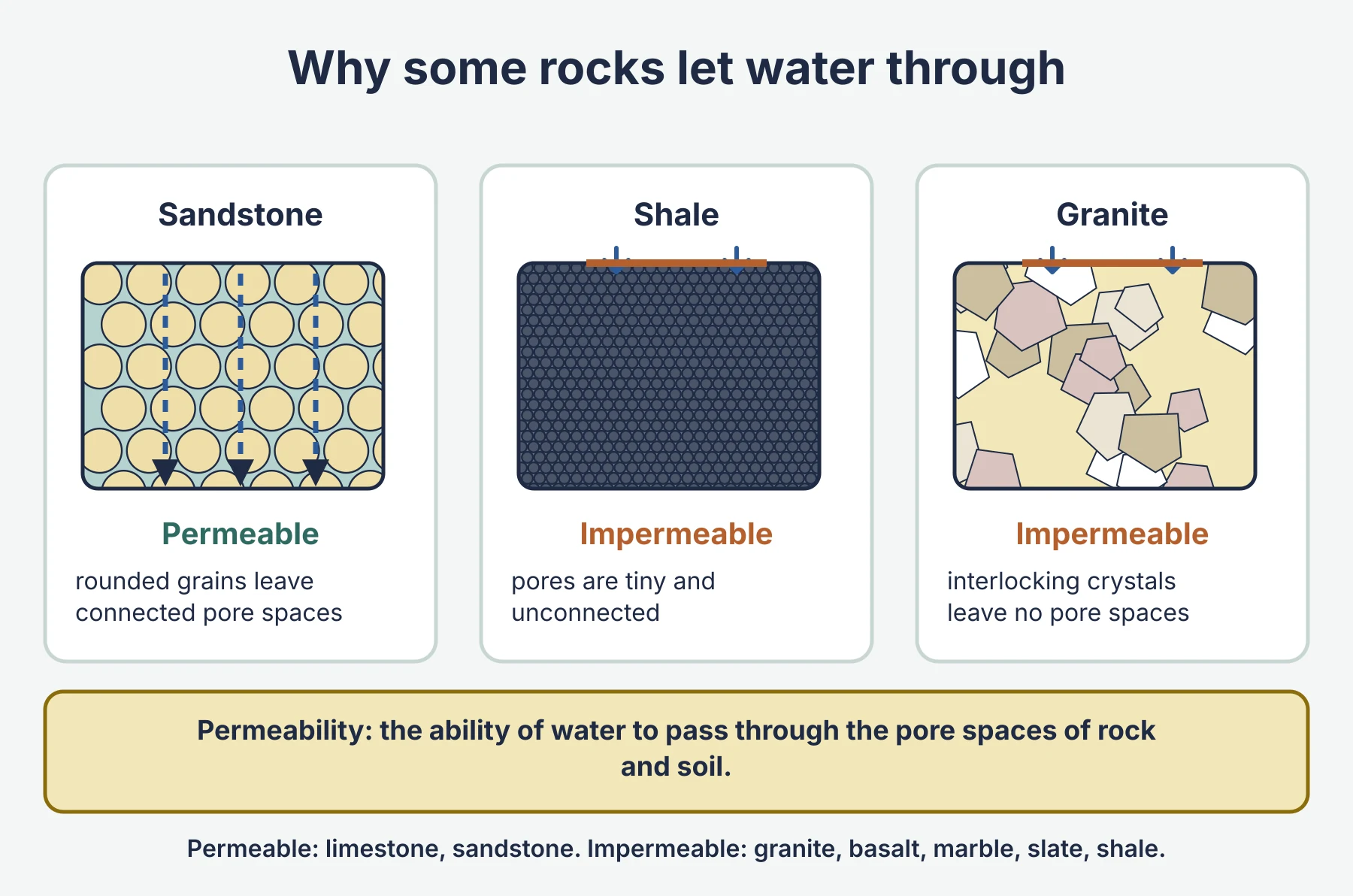
Shale is the odd one out among the three. Its particles are so fine and so tightly compacted that the tiny spaces between them are not connected, so water cannot pass through. This is why the syllabus lists shale as impermeable even though it is sedimentary.
Metamorphic rocks: changed without melting
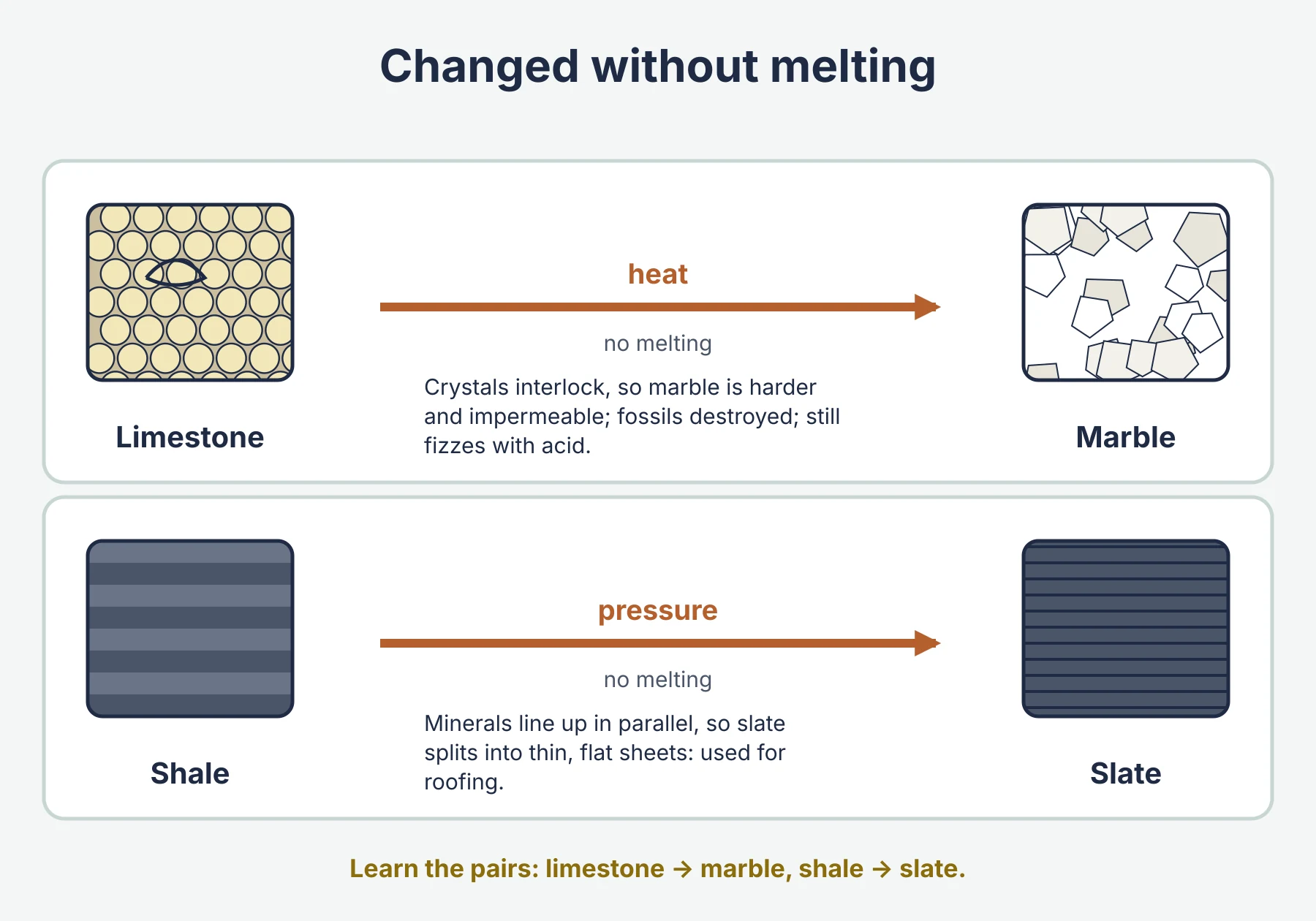
Metamorphic rocks form when an existing rock is altered by heat and/or pressure without melting. The minerals recrystallise into a new arrangement, producing a harder rock. This can happen when rock is close to a body of hot magma, or when it is buried deeply and squeezed during mountain building.
- Marble forms from limestone. Heat makes the calcium carbonate recrystallise into interlocking crystals, so marble is harder than limestone, has no pore spaces and is impermeable. Any fossils in the limestone are destroyed. Marble still fizzes with dilute acid, because it is still calcium carbonate.
- Slate forms from shale under pressure. The minerals line up in parallel, so slate splits cleanly into thin, flat sheets; this is why it has long been used for roofing.
Learn these as pairs: limestone to marble, shale to slate. A common error is to say marble forms from granite or slate from sandstone.
The rock cycle as a set of links
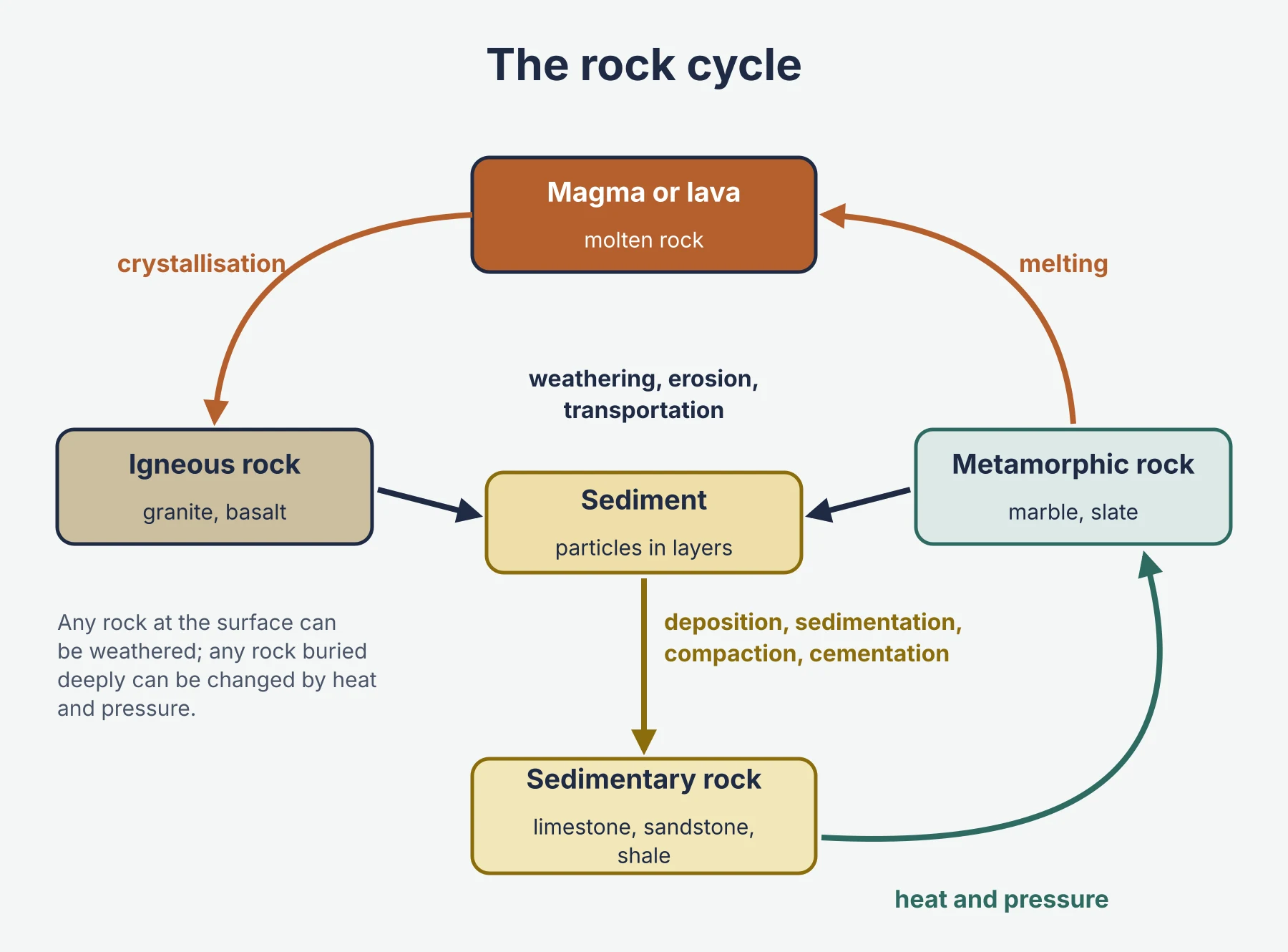
The rock cycle shows how any rock can become another type over very long periods. It is not one fixed loop. The main links are:
- Magma or lava crystallises to form igneous rock.
- Any rock exposed at the surface can be weathered, eroded and transported, then deposited, building up by sedimentation and turned into sedimentary rock by compaction and cementation.
- Any rock buried deeply can be changed by heat and pressure into metamorphic rock.
- Rock that is heated enough melts and becomes magma, ready to crystallise again.
Two pairs of terms are easily confused:
- Weathering vs erosion. Weathering is the breakdown of rock in place, by physical, chemical or biological action. Erosion is the removal of the broken material by a moving agent. If nothing moves, it is weathering.
- Deposition vs sedimentation. Deposition is the act of dropping material when the agent loses energy. Sedimentation is the build-up of that material in layers over time. Deposition happens first.
Permeability and why it matters
Permeability is the ability of water to pass through the pore spaces of rock and soil. A rock can only be permeable if it has pore spaces and those spaces are connected.
- Permeable: most sedimentary rocks, such as sandstone (gaps between rounded grains) and limestone.
- Impermeable: igneous rocks (granite, basalt) and metamorphic rocks (marble, slate), because their crystals interlock; and some sedimentary rocks such as shale, because its pores are tiny and unconnected.
Permeability links 1.1 to later sub-topics. Permeable rock can store ground water as an aquifer (3.1). Natural gas and oil can move upwards through permeable rock until trapped under an impermeable layer (1.4). Gas held within shale itself cannot flow to a well at all, which is the reason for hydraulic fracturing (1.6).
Worked example 1: interpreting rock samples
A student describes four samples. Identify each rock and give the evidence.
| Sample | Description |
|---|---|
| P | Large, interlocking pale crystals; no layers; water placed on it does not soak in |
| Q | Layers of rounded grains; feels gritty; water soaks in |
| R | Fine dark rock; splits into thin flat sheets; water does not soak in; no fizz with acid |
| S | Interlocking white crystals; fizzes with dilute acid; no fossils; water does not soak in |
Model answer:
- P is granite: large crystals show slow cooling underground; interlocking crystals make it impermeable.
- Q is sandstone: rounded grains in layers show sedimentary formation; connected pore spaces make it permeable.
- R is slate: splitting into flat sheets is typical of slate formed from shale under pressure; no fizz rules out limestone and marble.
- S is marble: the fizz shows calcium carbonate, but crystals rather than fragments and the absence of fossils show limestone has been changed by heat.
The marks come from linking each observation to a process, not just naming the rock.
Worked example 2: a permeability test
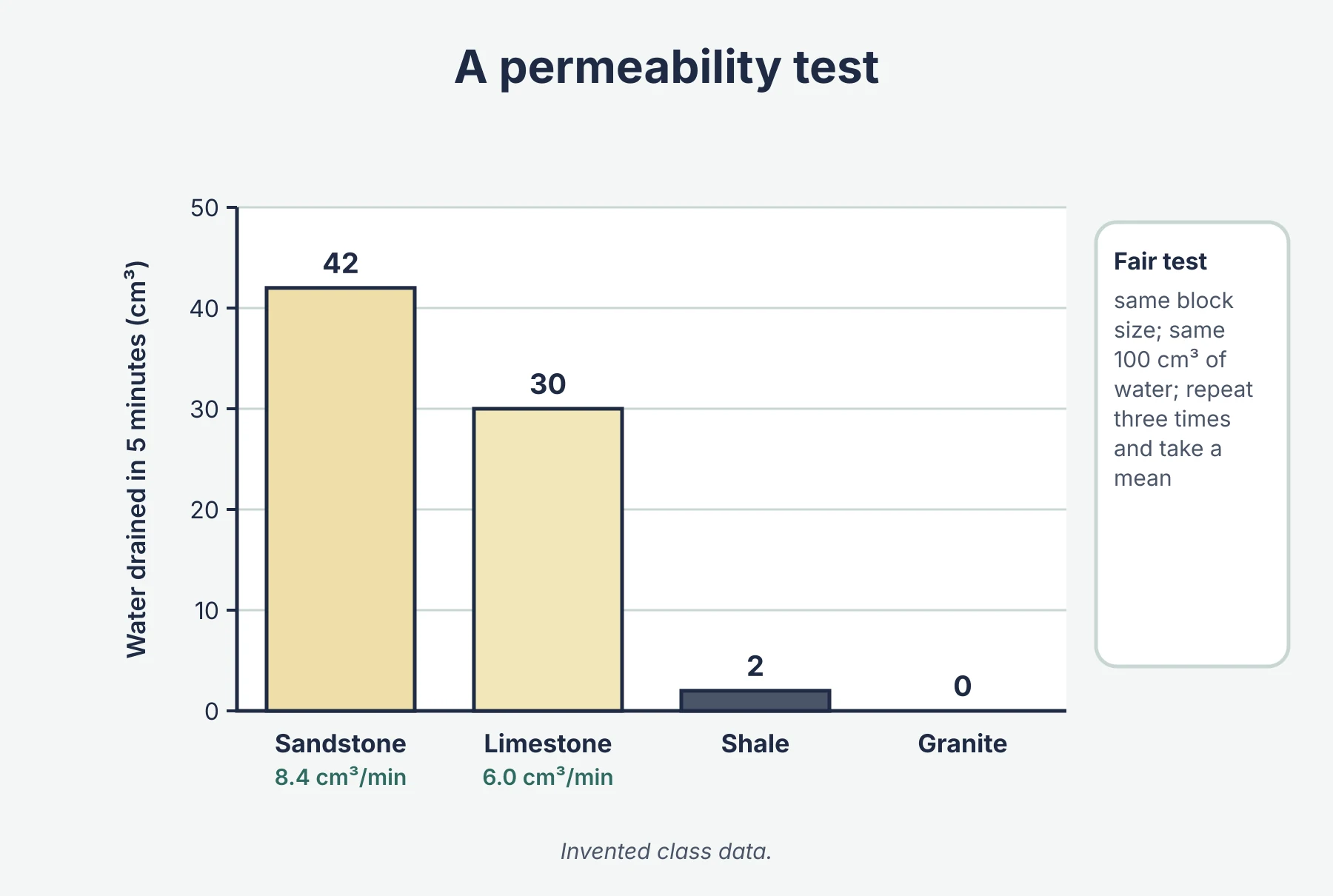
A class pours 100 cm³ of water onto equal-sized blocks of four rocks and measures how much drains through in 5 minutes. The figures below are invented for practice.
| Rock | Water drained through in 5 minutes (cm³) |
|---|---|
| Sandstone | 42 |
| Limestone | 30 |
| Shale | 2 |
| Granite | 0 |
The rate for sandstone is 42 ÷ 5 = 8.4 cm³ per minute; for limestone, 30 ÷ 5 = 6.0 cm³ per minute. Sandstone is the most permeable because its rounded grains leave connected pore spaces. Shale lets almost nothing through because its pores are not connected; the small volume may have run along the surface or a crack. To make the test fair, blocks must be the same size and the same volume of water used each time; repeating it three times and taking a mean improves reliability.
Common mistakes
- Saying granite has large crystals because it “cooled for longer” without saying it cooled slowly underground.
- Describing metamorphic rock as formed by melting. If it melts, it becomes magma.
- Calling all sedimentary rocks permeable. Shale is the named exception.
- Using “erosion” to mean the breakdown of rock where it stands.
- Leaving out cementation: compaction alone does not glue the particles together.
Exam technique
- Describe the formation of a named rock: give the starting material, the process and the conditions in sequence. Three clear steps usually earn three marks.
- Define permeability: use the syllabus wording, including “pore spaces of rock and soil”.
- Classify or identify: one word per rock is enough, but use the syllabus’s categories.
- Explain why a rock is permeable or impermeable: refer to pore spaces and whether they are connected, or to interlocking crystals.
- For a diagram labelled A to H, read the arrows. An arrow out of magma is crystallisation; an arrow from surface rock to sediment involves weathering and erosion.
Condense this page with the Formation of rocks revision notes, then test yourself with the Formation of rocks practice questions. For how rocks are mined, continue to the Extraction of rocks, ores and minerals study guide, and for the whole topic see the Natural Resources study guide.
Frequently asked questions
Why does granite have bigger crystals than basalt? Granite forms from magma that cools slowly deep underground, giving crystals time to grow. Basalt forms from lava that cools quickly at the surface, so its crystals stay small.
Is shale permeable? No. Shale is sedimentary, but its pores are tiny and unconnected, so the syllabus classifies it as impermeable alongside igneous and metamorphic rocks.
Which rocks does the 0680 syllabus name? Granite and basalt (igneous), limestone, sandstone and shale (sedimentary), and marble and slate (metamorphic). Questions on formation are limited to these seven.
Related resources
-
Revision notes
Cambridge IGCSE Environmental Management: Land — Revision Notes
Recall notes on soils and crop growth, food production and soil erosion for Topic 2 Land of Cambridge IGCSE Environmental Management 0680, 2027-2029 series.
Environmental Management · Cambridge · IGCSE
Revise topic -
Practice questions
Cambridge IGCSE Environmental Management (0680): Formation of rocks – Practice Questions
Twelve original questions with mark-scheme answers on rock formation, the rock cycle and permeability for 1.1 Formation of rocks, Cambridge IGCSE 0680.
Environmental Management · Cambridge · IGCSE
Try questions -
Revision notes
Cambridge IGCSE Environmental Management (0680): Formation of rocks – Revision Notes
Condensed notes on the seven named rocks, the eight rock cycle processes and permeability for 1.1 Formation of rocks, Cambridge IGCSE 0680, 2027-2029.
Environmental Management · Cambridge · IGCSE
Revise topic
Get free revision emails (optional)
Occasional emails with practice questions, worked explanations and links to free resources for the qualification and subjects you choose. No spam, and you can unsubscribe from any email. The free tools on this site never need an email.