
Revision Notes
Cambridge IGCSE Environmental Management (0680): Formation of rocks – Revision Notes
Condensed notes on the seven named rocks, the eight rock cycle processes and permeability for 1.1 Formation of rocks, Cambridge IGCSE 0680, 2027-2029.
- Subject
- Environmental Management
- Level
- IGCSE
- Topic
- Topic 1 – Natural Resources
- Author
- Marlbridge Academic Team
- Updated
- Reviewed by
- Azam Siddique (what this means)
Aligned to Cambridge IGCSE Environmental Management (0680), 2027-2029. Official specification .
Syllabus page (what it covers and how it is assessed): Cambridge IGCSE Environmental Management.
Syllabus points this page covers
0680
- 1.1 Formation of rocks
Found an error? Report a correction.
Need help with this topic? Request a free trial class for IGCSE Environmental Management (0680).
These notes condense sub-topic 1.1 for final revision. For full explanations and worked examples, use the Formation of rocks study guide.
The three rock families in one line each
- Igneous: molten rock cools and crystallises. Interlocking crystals, no fossils, impermeable.
- Sedimentary: particles are deposited in layers, then compacted and cemented. Grains or fragments, may hold fossils, mostly permeable (not shale).
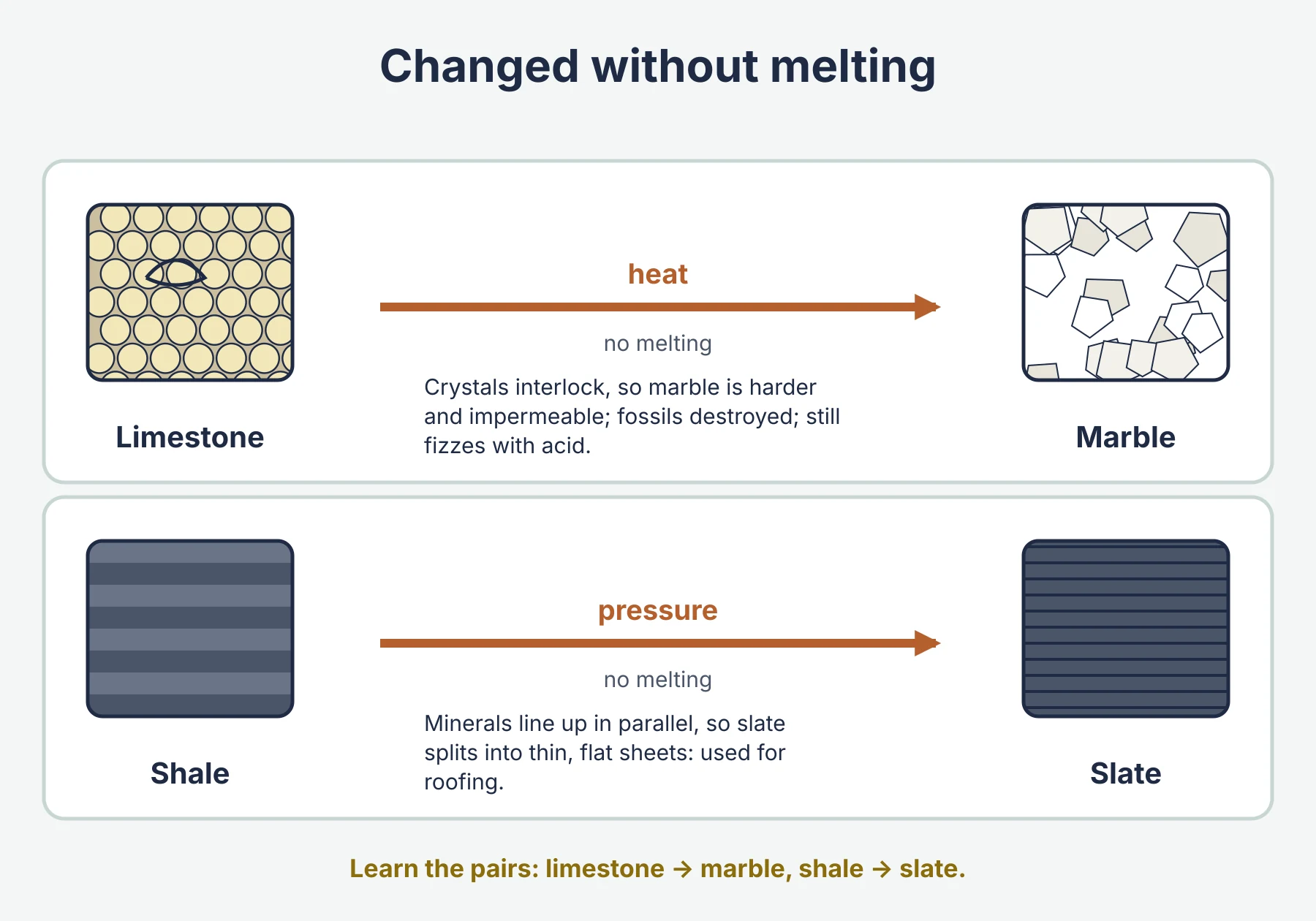
- Metamorphic: existing rock changed by heat and/or pressure without melting. Recrystallised, harder, impermeable, fossils destroyed.
The seven named rocks
| Rock | Family | Forms from | Key condition | Identifying feature |
|---|---|---|---|---|
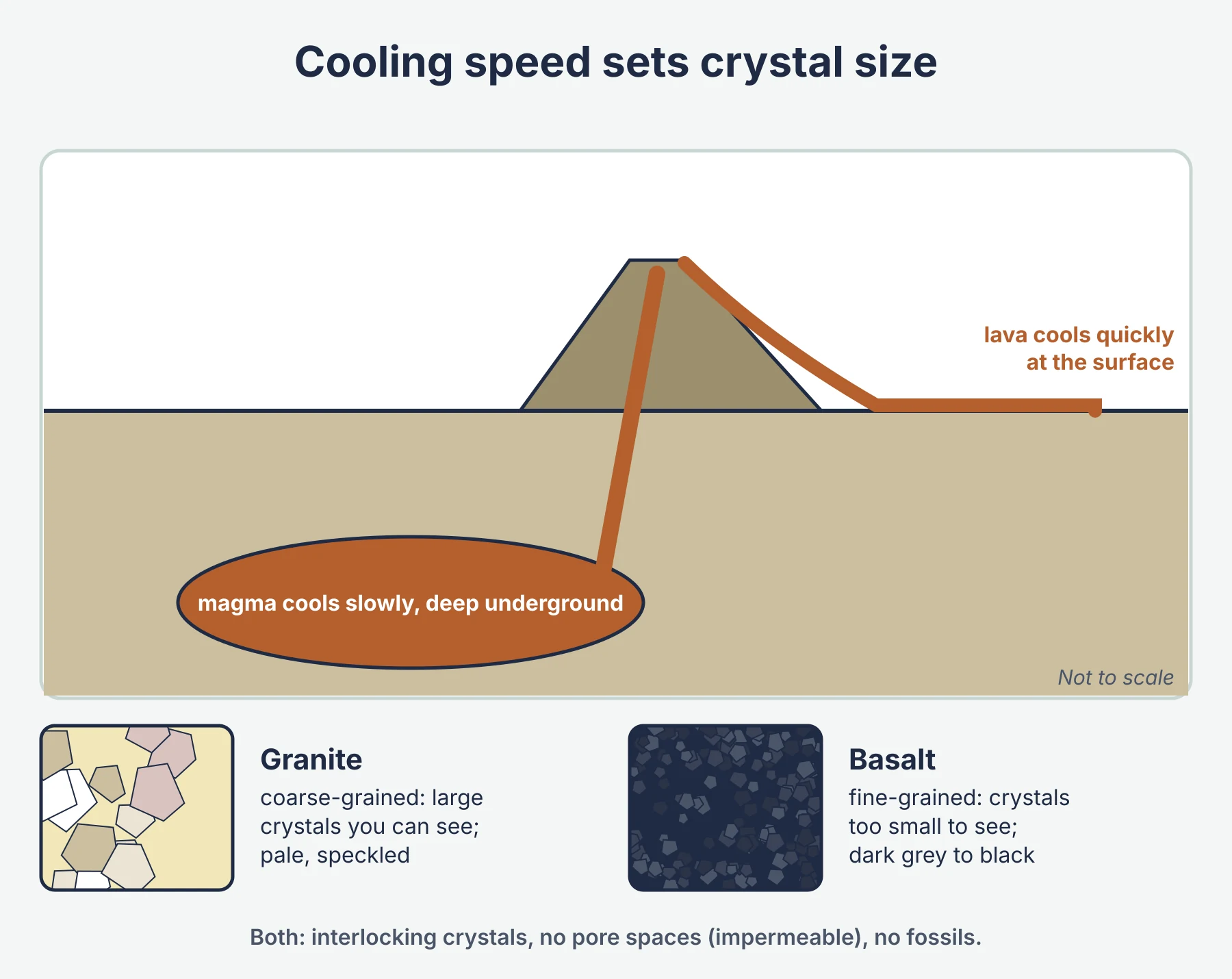
| Granite | Igneous | Magma | Slow cooling deep underground | Large, visible crystals |
| Basalt | Igneous | Lava | Rapid cooling at or near the surface | Tiny crystals; dark |
| Limestone | Sedimentary | Shells and skeletons (calcium carbonate) | Warm, shallow seas | Fossils; fizzes with acid |
| Sandstone | Sedimentary | Sand grains | Rivers, beaches, deserts | Gritty, rounded grains |
| Shale | Sedimentary | Clay and silt (mud) | Calm, still water | Thin layers; impermeable |
| Marble | Metamorphic | Limestone | Heat (and pressure) | White crystals; fizzes; no fossils |
| Slate | Metamorphic | Shale | Pressure | Splits into flat sheets |
Memory pairs: limestone → marble and shale → slate. Granite and basalt differ only in where and how fast they cooled.
The eight rock cycle processes, in the order they usually act
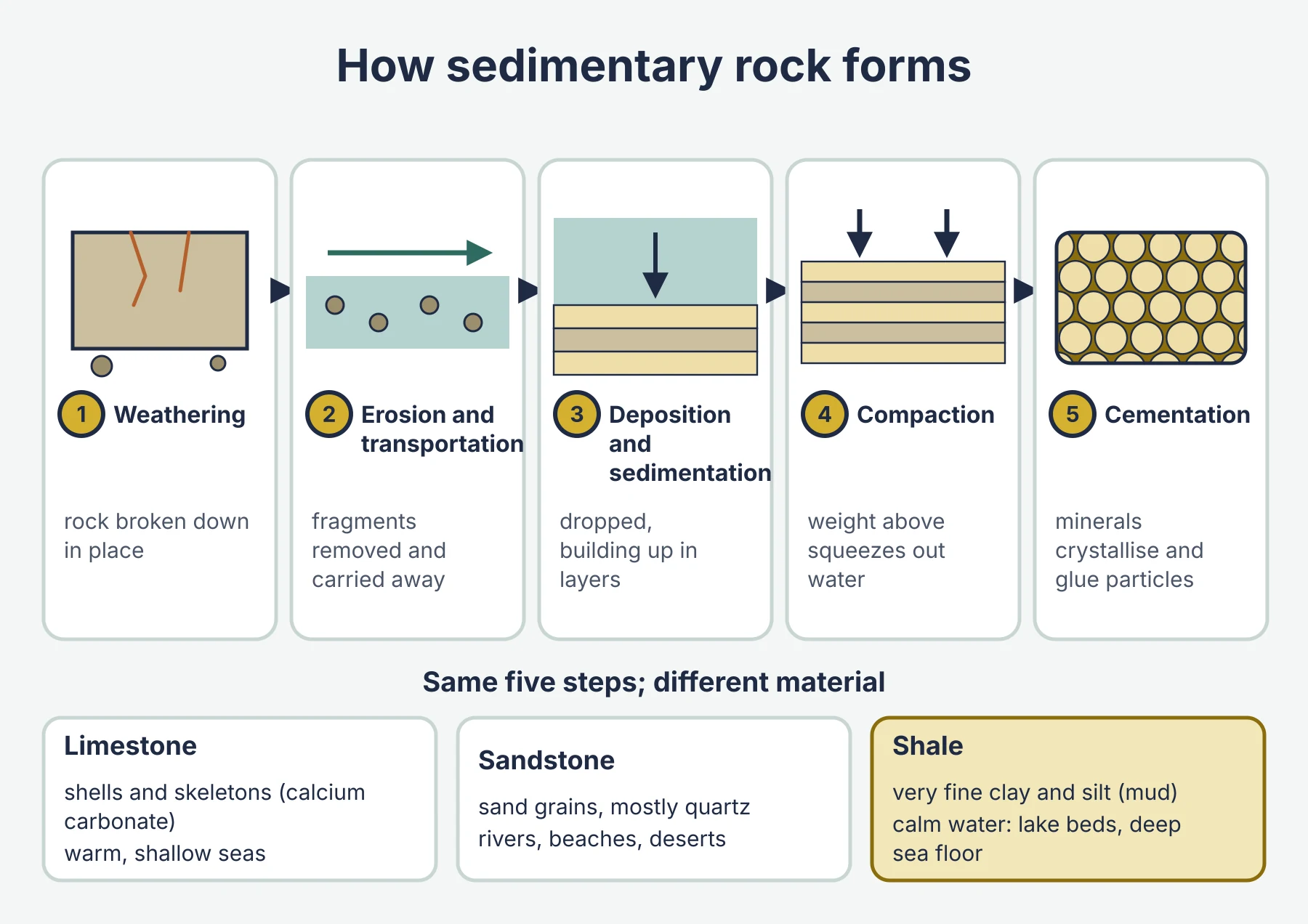
- Weathering: rock breaks down in place (physical, chemical or biological).
- Erosion: broken material is removed by water, wind, ice or the sea.
- Transportation: material is carried away from its source.
- Deposition: material is dropped when the agent loses energy.
- Sedimentation: deposited material builds up in layers.
- Compaction: weight of overlying layers squeezes particles together and pushes out water.
- Cementation: minerals from water crystallise between particles and glue them.
- Crystallisation: magma or lava cools and crystals form (igneous rock).
Three kinds of weathering to quote as examples:
- Physical: water in cracks freezes and expands, widening the crack until fragments break off (freeze-thaw).
- Chemical: rain is a weak acid and slowly dissolves calcium carbonate in limestone and marble.
- Biological: plant roots grow into cracks and force them apart; burrowing animals expose fresh rock.
Steps 1 to 7 make sedimentary rock. Step 8 makes igneous rock. Heat and pressure (no melting) make metamorphic rock; full melting returns rock to magma.
Reading a rock cycle diagram
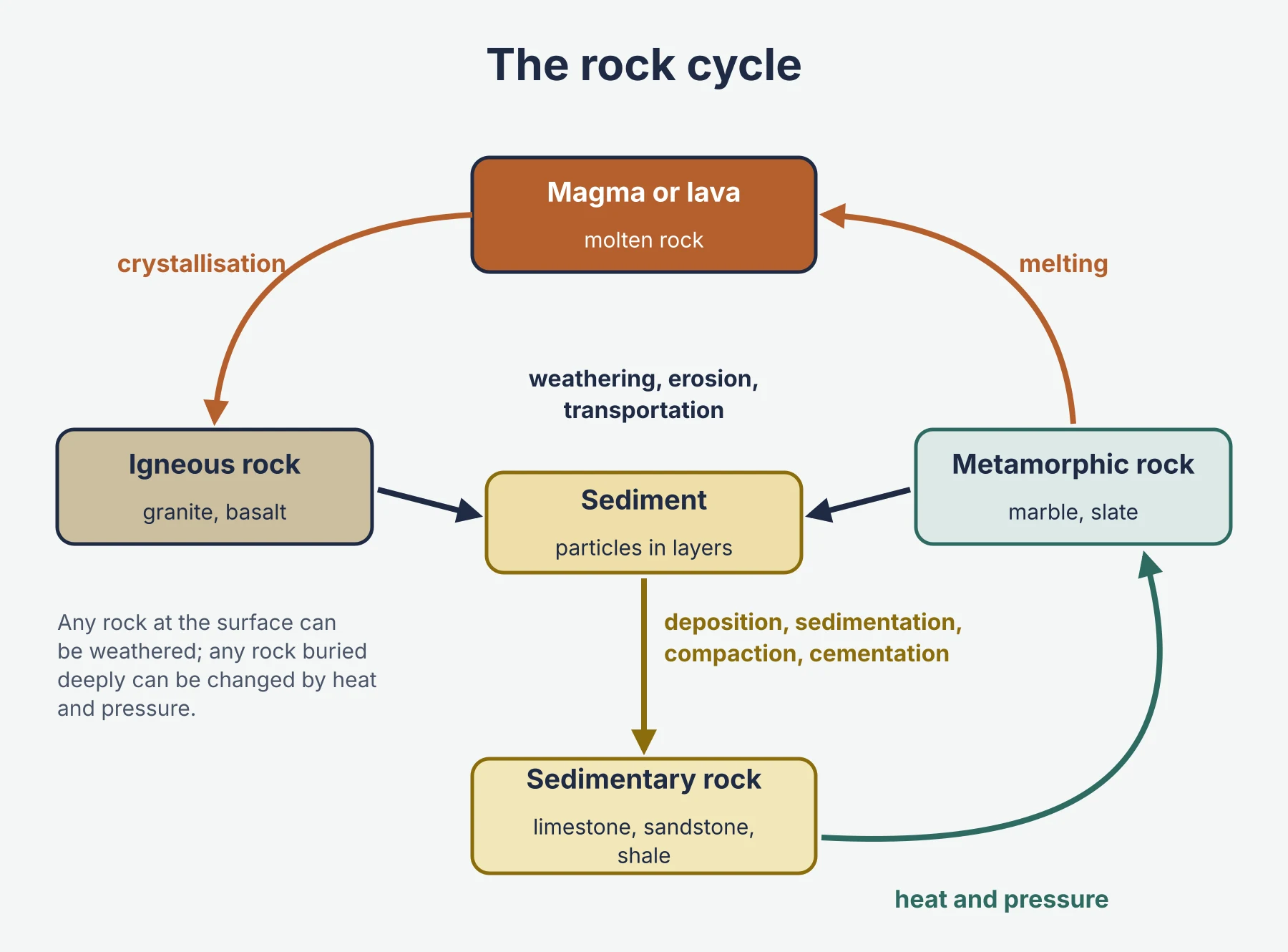
- Arrow from magma or lava to a rock: crystallisation (igneous).
- Arrow from any rock at the surface to sediment: weathering, erosion, transportation.
- Arrow from sediment to sedimentary rock: deposition, sedimentation, compaction, cementation.
- Arrow from rock deep underground to metamorphic rock: heat and pressure.
- Arrow from any rock back to magma: melting.
- The cycle branches: igneous rock can be weathered straight to sediment without becoming metamorphic first.
Permeability
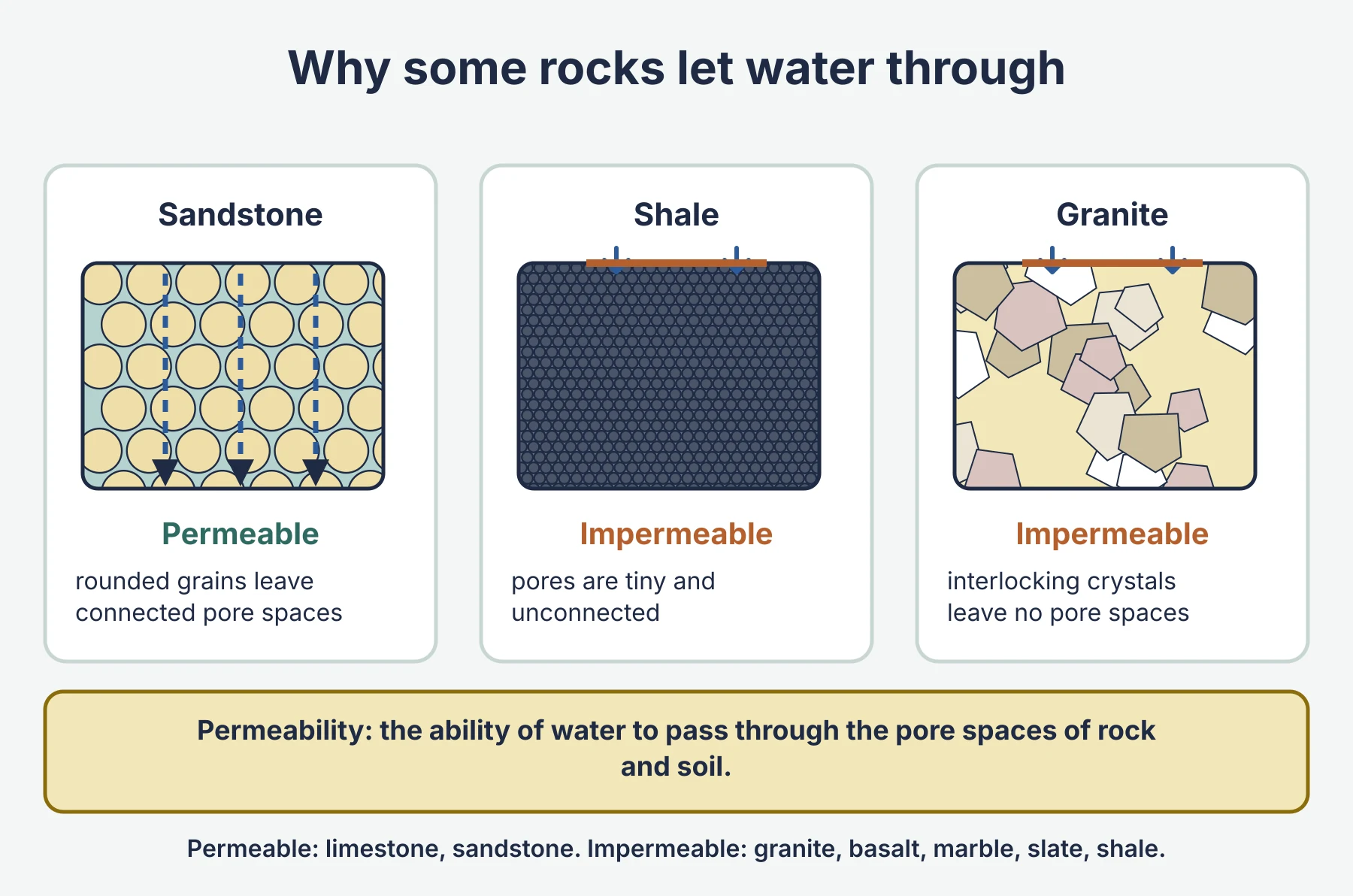
Definition (learn word for word): the ability of water to pass through the pore spaces of rock and soil.
| Permeable | Impermeable |
|---|---|
| Most sedimentary rocks: limestone, sandstone | Igneous: granite, basalt |
| Reason: connected pore spaces between grains | Metamorphic: marble, slate |
| Some sedimentary: shale | |
| Reason: interlocking crystals, or tiny unconnected pores |
Why it matters later in the course: permeable rocks store ground water (aquifers, 3.1); oil and gas move up through permeable rock until trapped beneath impermeable rock (1.4); gas locked inside impermeable shale needs fracking to release it (1.6).
Key terms
| Term | Meaning |
|---|---|
| Magma | Molten rock below the Earth’s surface |
| Lava | Molten rock that has reached the surface |
| Coarse-grained | Crystals large enough to see; sign of slow cooling |
| Fine-grained | Crystals too small to see easily; sign of rapid cooling |
| Pore space | Gap between particles in rock or soil |
| Fossil | Preserved remains or traces of an organism in rock |
| Recrystallisation | Minerals forming new crystals in solid rock under heat or pressure |
Exam traps
- “Weathering” for removal. Weathering stays in place; erosion moves material.
- Melting in metamorphism. Metamorphic change happens without melting.
- “All sedimentary rocks are permeable.” Shale is not.
- Wrong parent rock. Marble comes only from limestone and slate only from shale in this syllabus.
- Crystal size without cause. Always link large crystals to slow cooling underground, small crystals to fast cooling at the surface.
- Leaving out cementation. Compaction alone does not make solid rock.
- Naming rocks outside the list. Stick to the seven named rocks unless the question gives you another.
Self-test
- Define permeability.
- Which named igneous rock has large crystals, and why?
- Name the rock that marble forms from.
- Name the rock that slate forms from.
- Which named sedimentary rock is impermeable?
- Give the difference between weathering and erosion.
- Put these in order: compaction, deposition, cementation, transportation.
- Why do igneous rocks contain no fossils?
- Name a sedimentary rock formed mainly from the remains of sea creatures.
- Explain why marble is impermeable but limestone is permeable.
- Which process turns magma into igneous rock?
- A rock has small dark crystals and formed in a lava flow. Name it.
Answers
- The ability of water to pass through the pore spaces of rock and soil.
- Granite: it forms from magma that cools slowly deep underground, so crystals have time to grow.
- Limestone.
- Shale.
- Shale.
- Weathering breaks rock down in place; erosion removes the broken material by a moving agent.
- Transportation, deposition, compaction, cementation.
- They form from molten rock, which destroys any organic remains.
- Limestone.
- Heat recrystallises limestone’s calcium carbonate into interlocking crystals, closing the connected pore spaces that let water pass through limestone.
- Crystallisation (as it cools).
- Basalt.
Where to go next
Try the Formation of rocks practice questions, then move on to the Extraction of rocks, ores and minerals revision notes.
Related resources
-
Revision notes
Cambridge IGCSE Environmental Management: Land — Revision Notes
Recall notes on soils and crop growth, food production and soil erosion for Topic 2 Land of Cambridge IGCSE Environmental Management 0680, 2027-2029 series.
Environmental Management · Cambridge · IGCSE
Revise topic -
Study guides
Cambridge IGCSE Environmental Management (0680): Fracking
The syllabus definition of fracking, why shale needs it, and how to discuss its benefits and limitations for different stakeholders in Cambridge IGCSE 0680.
Environmental Management · Cambridge · IGCSE
Read guide -
Practice questions
Cambridge IGCSE Environmental Management (0680): Fracking – Practice Questions
Original questions with mark-scheme answers on the fracking process, its water use, stakeholder views and benefits and limitations for Cambridge IGCSE 0680.
Environmental Management · Cambridge · IGCSE
Try questions
Get free revision emails (optional)
Occasional emails with practice questions, worked explanations and links to free resources for the qualification and subjects you choose. No spam, and you can unsubscribe from any email. The free tools on this site never need an email.