
Revision Notes
Cambridge IGCSE Environmental Management (0680): Extraction of rocks, ores and minerals – Revision Notes
Recall notes on mining methods, extraction factors, impacts and land restoration for 1.2 Extraction of rocks, ores and minerals, Cambridge IGCSE 0680.
- Subject
- Environmental Management
- Level
- IGCSE
- Topic
- Topic 1 – Natural Resources
- Author
- Marlbridge Academic Team
- Updated
- Reviewed by
- Azam Siddique (what this means)
Aligned to Cambridge IGCSE Environmental Management (0680), 2027-2029. Official specification .
Syllabus page (what it covers and how it is assessed): Cambridge IGCSE Environmental Management.
Syllabus points this page covers
0680
- 1.2 Extraction of rocks, ores and minerals
Found an error? Report a correction.
Need help with this topic? Request a free trial class for IGCSE Environmental Management (0680).
Condensed notes for sub-topic 1.2. The full explanations, an ore grade calculation and an annotated discuss answer are in the Extraction of rocks, ores and minerals study guide.
Definition
Ore: rock containing minerals and metals. Learn this exact wording.
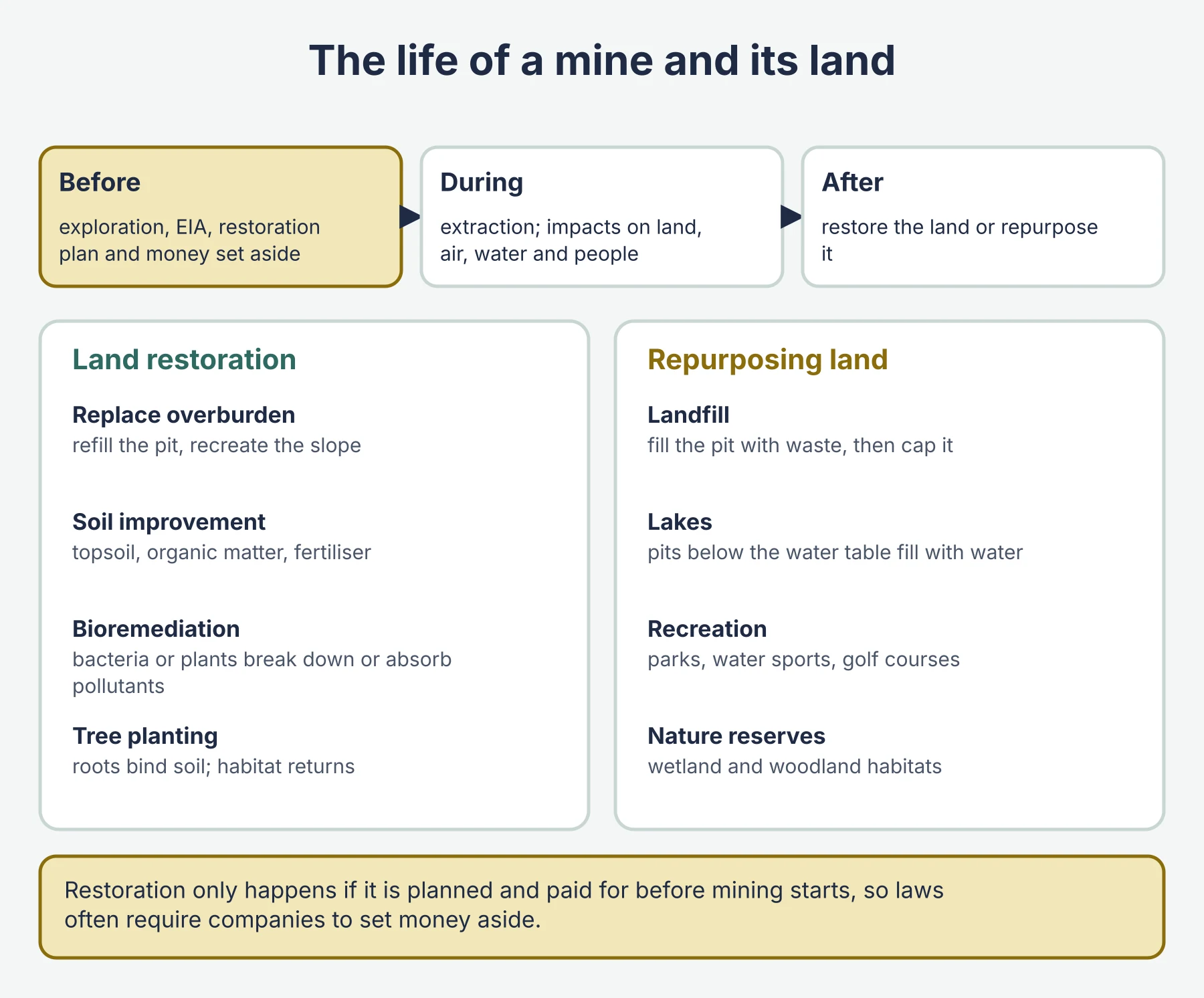
The life of a mine in four stages
- Decide (1.2.3): explore, assess the deposit, run an EIA, check costs against price.
- Extract (1.2.2): surface, subsurface or biological method.
- Operate (1.2.4): environmental, economic and social impacts.
- Close and manage (1.2.5 and 1.2.6): restore or repurpose the land.
Most extended questions sit at stage 3 or stage 4; most short questions sit at stages 1 and 2.
Extraction methods
| Group | Method | How it works | Best suited to |
|---|---|---|---|
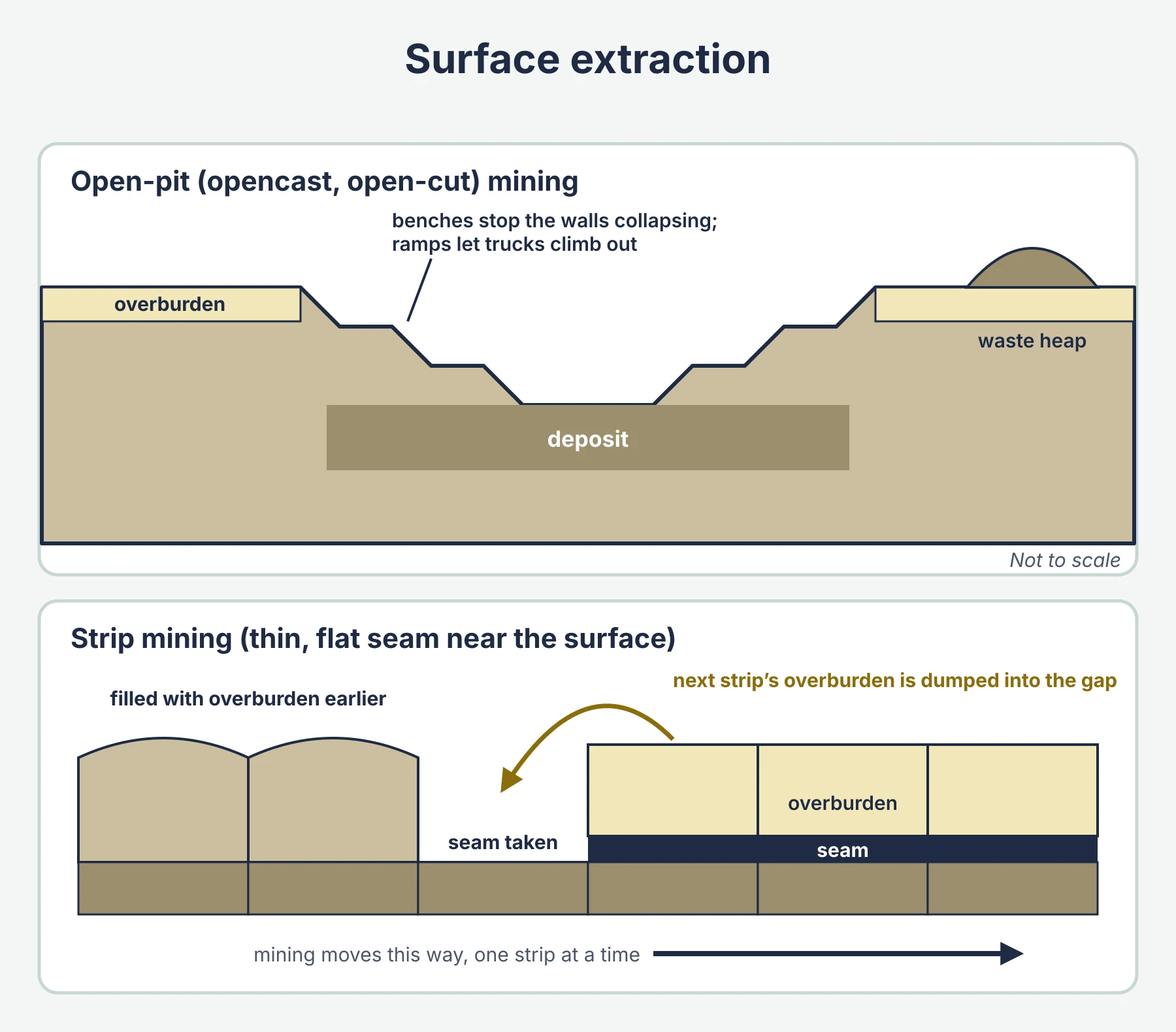
| Surface | Opencast / open-pit / open-cut | Overburden removed; deep stepped pit dug down to deposit | Large deposits near the surface |
| Surface | Strip mining | Overburden removed in long strips; each strip refilled with spoil from the next | Thin, flat seams near the surface, such as coal |
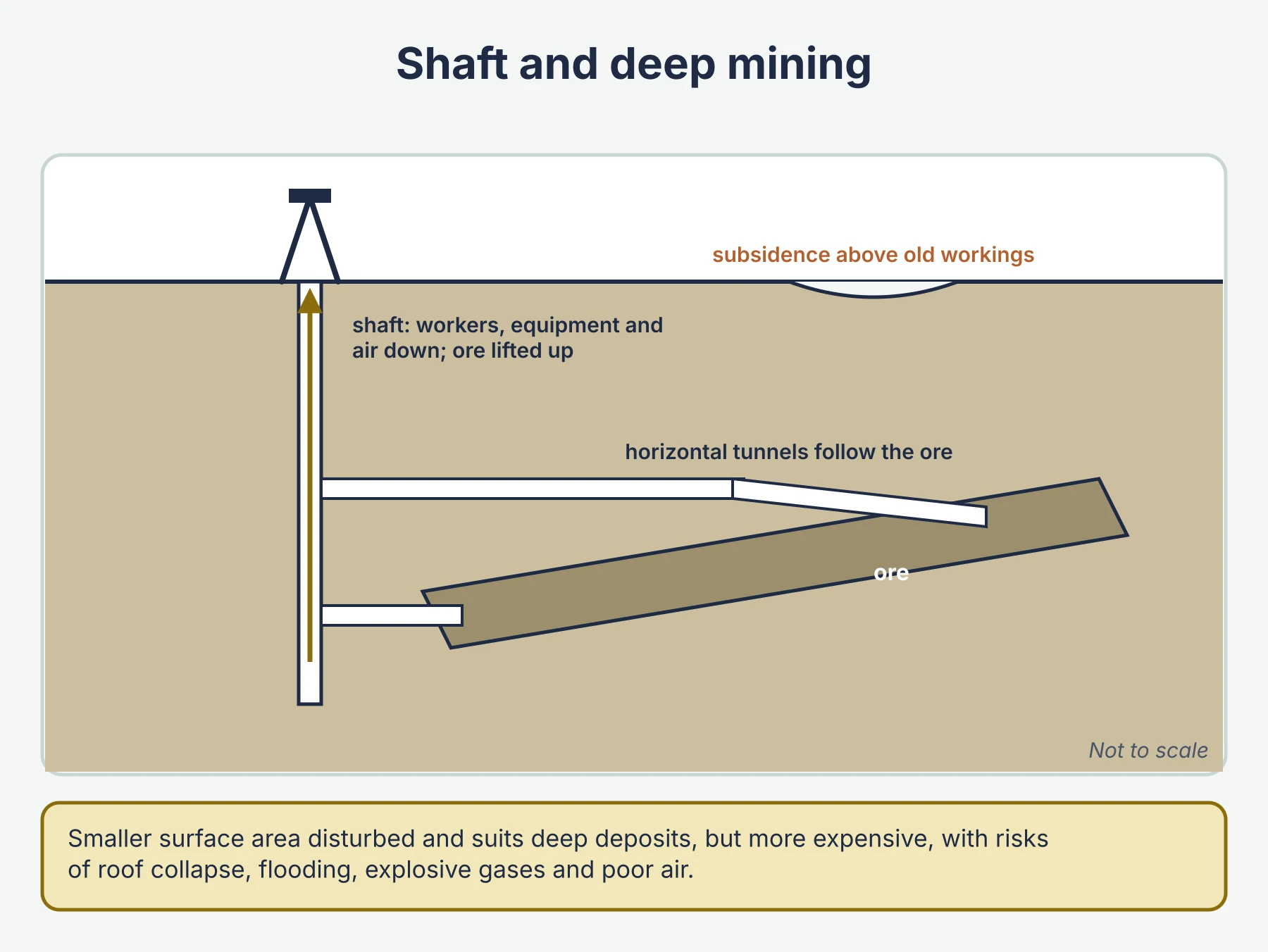
| Subsurface | Shaft mining | Vertical shaft sunk to the deposit; ore lifted up | Deep deposits |
| Subsurface | Deep mining | Shafts plus horizontal tunnels following the ore | Deep deposits in seams or veins |
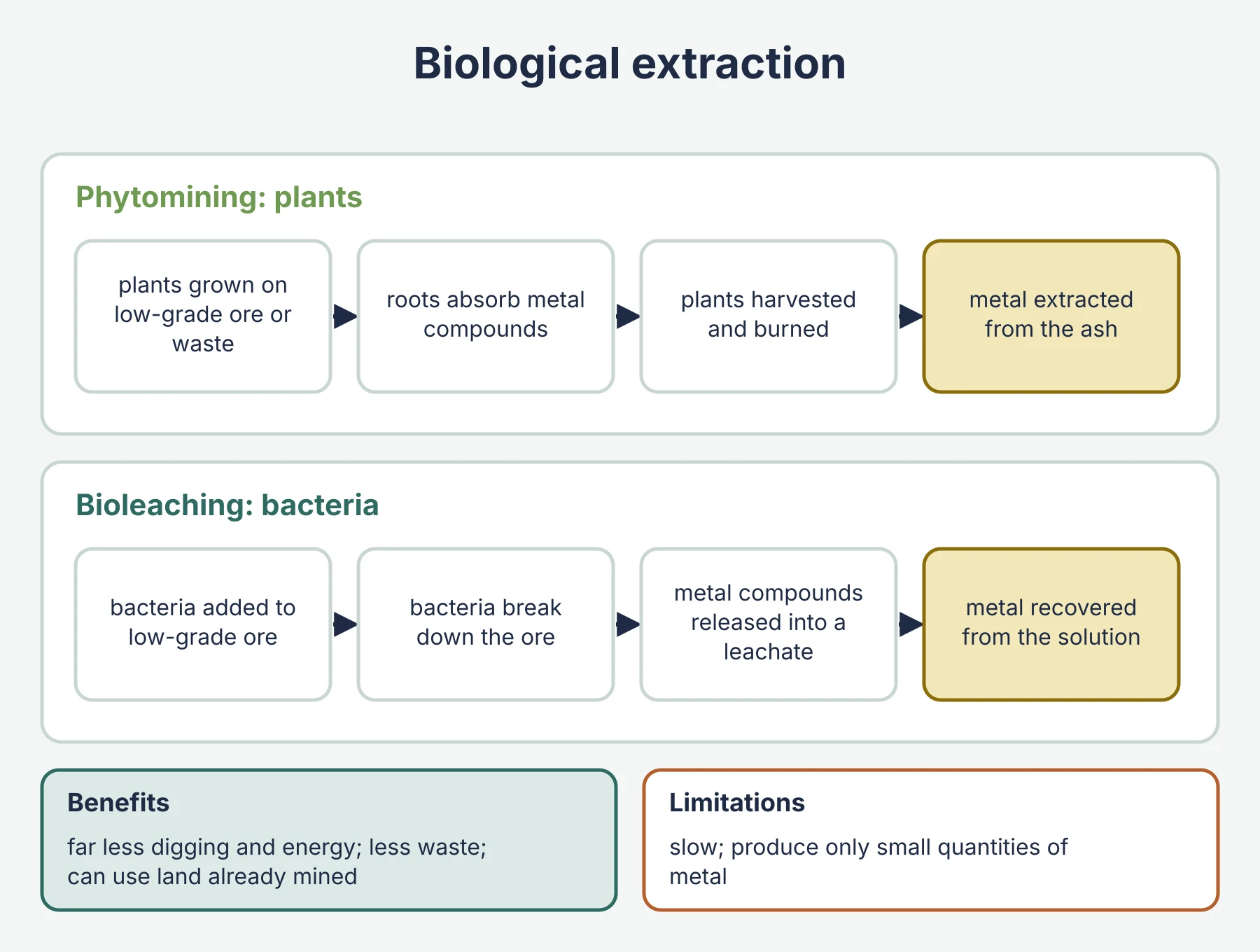
| Biological | Phytomining | Plants absorb metal; harvested and burned; metal extracted from ash | Low-grade ore and mine waste |
| Biological | Bioleaching | Bacteria release metal into a solution (leachate); metal recovered | Low-grade ore and mine waste |
Quick comparison
- Surface: cheaper, safer for workers, recovers more of the deposit; but large land disturbance and waste heaps.
- Subsurface: small surface footprint; but costly, dangerous (collapse, flooding, gas), risk of subsidence.
- Biological: little digging, low energy, uses waste; but slow and small quantities.
Eight factors in the decision to extract
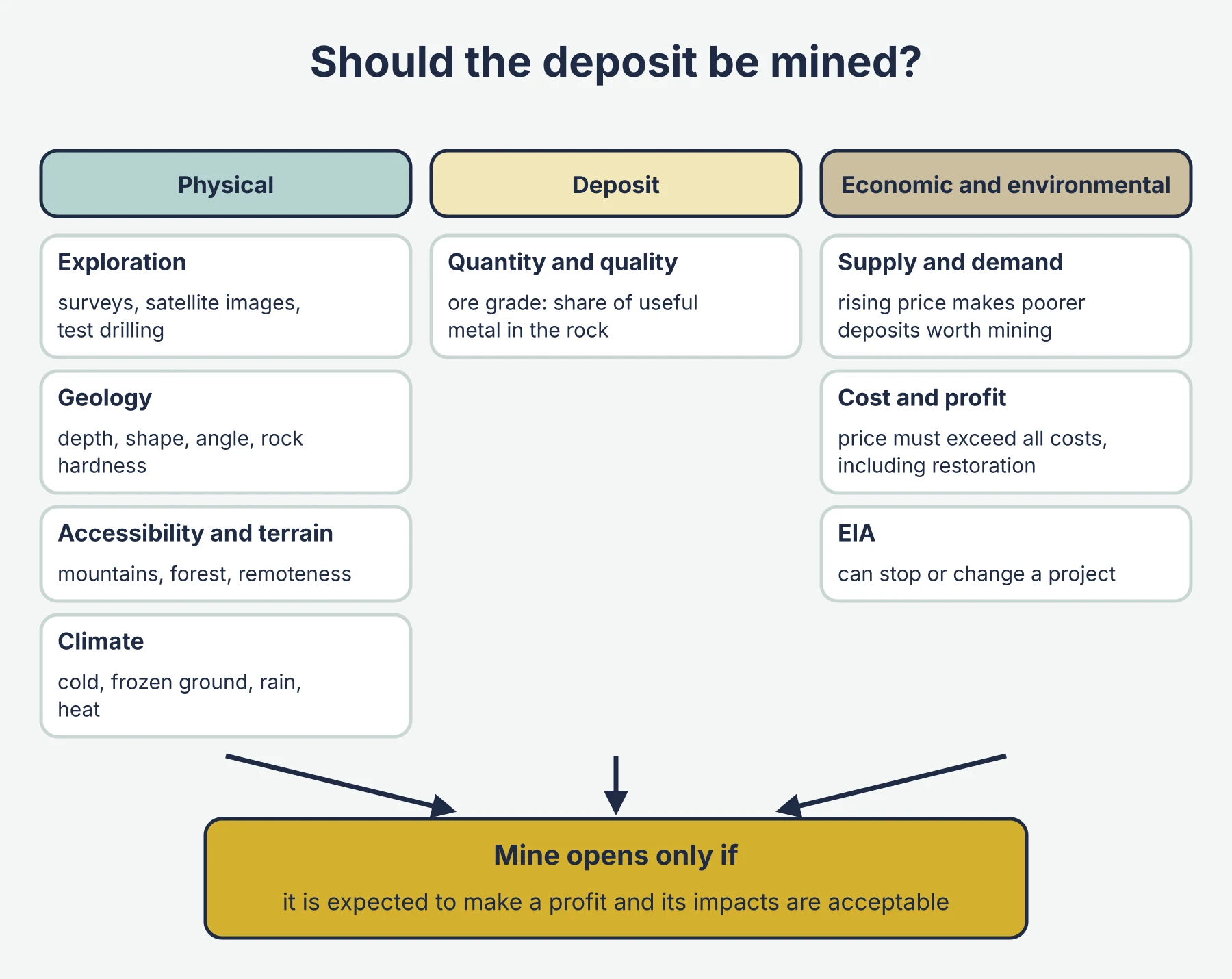
- Exploration: surveys and test drilling locate and size the deposit.
- Geology: depth, shape and angle of the deposit; hardness of surrounding rock.
- Accessibility and terrain: remote or steep land raises transport and building costs.
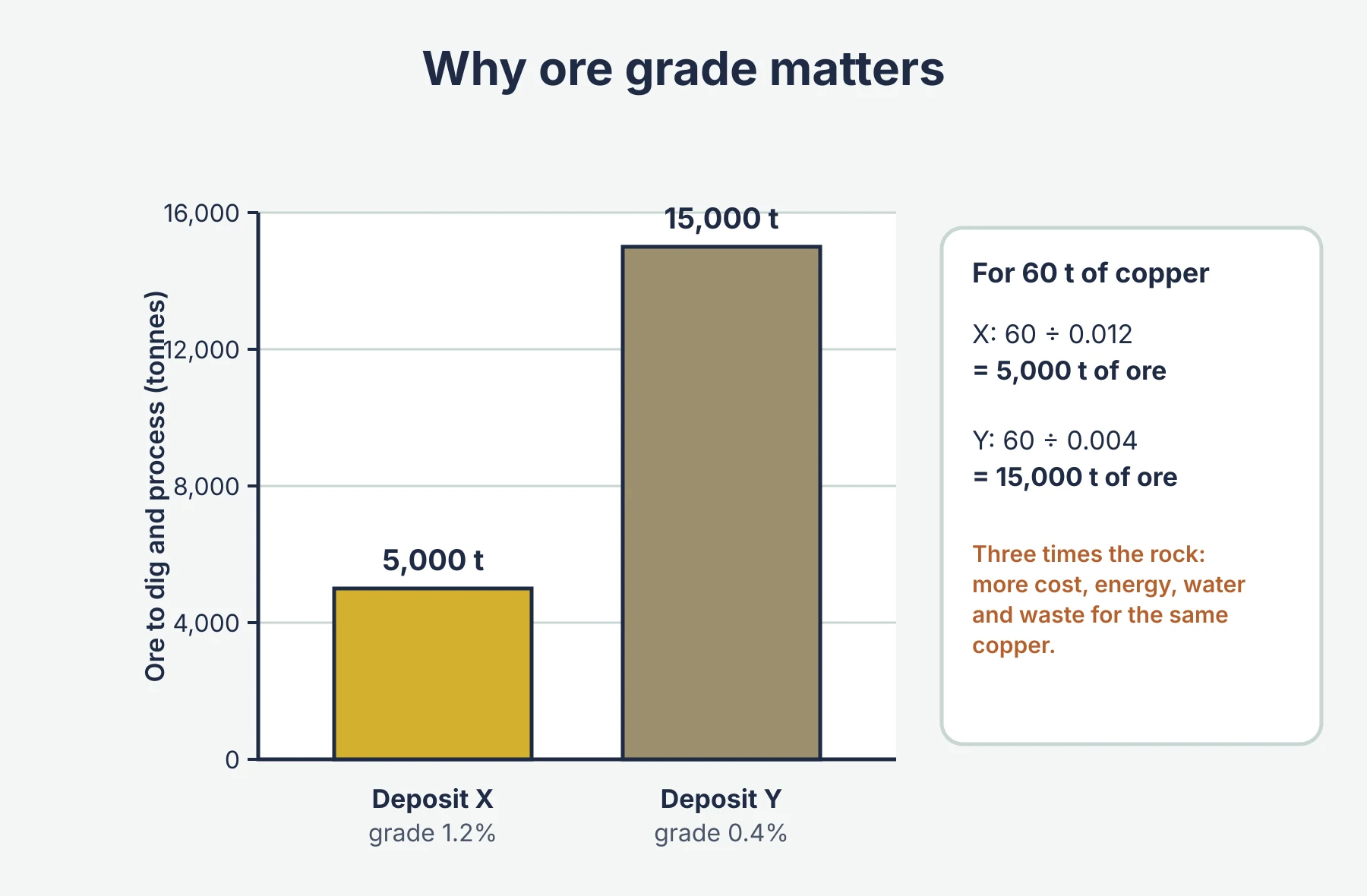
- Quantity and quality (ore grade): higher grade means less rock processed per tonne of product.
- Climate: extreme cold, heat or rain limit working conditions and damage equipment.
- Environmental impact assessment: assesses likely impacts before permission; can stop or alter a project.
- Supply and demand: rising demand raises prices and makes poorer deposits worth mining.
- Cost and profit: income must exceed costs, including restoration.
Ore grade arithmetic: mass of ore needed = mass of metal required ÷ (grade as a decimal). Halving the grade doubles the rock to be mined.
Impacts (1.2.4)
- Environmental: habitat and biodiversity loss; air (dust, fumes), land (spoil), noise, visual and water pollution; heavy water usage; waste rock and tailings to store.
- Economic: jobs; income for local businesses; taxes and exports for the national economy; boom then bust when the mine closes.
- Social: new facilities and infrastructure (roads, power, water, schools); health effects of dust and polluted water; noise; relocation of communities; jobs may go to outsiders.
Managing damaged land (1.2.5)
| Land restoration | Repurposing land |
|---|---|
| Replacement of overburden | Landfill |
| Soil improvement (topsoil, organic matter, fertiliser) | Lakes (pits fill with water) |
| Bioremediation (organisms remove pollutants) | Recreation (parks, water sports) |
| Tree planting | Nature reserves |
Discussing strategies (1.2.6): each has a benefit (habitat, jobs, safety, appearance) and a limitation (cost, time, pollution risk, safety of steep pits). Restoration works best when planned and funded before mining starts.
Key terms
| Term | Meaning |
|---|---|
| Overburden | Soil and rock lying above a deposit |
| Spoil heap | Pile of waste rock from mining |
| Tailings | Fine waste left after ore is processed |
| Ore grade | Proportion of useful metal or mineral in the ore |
| Subsidence | Sinking of the ground above old underground workings |
| Leachate | Liquid that has drained through material and carries dissolved substances |
| EIA | Study of a project’s likely environmental and social effects before approval |
Exam traps
- Phytomining = plants; bioleaching = bacteria. Swapping them loses both marks.
- Strip mining is a surface method.
- An EIA comes before extraction; restoration comes after.
- “Pollution” alone is too vague: say air, land, noise, visual or water, and what causes it.
- Discuss questions need benefits and limitations and a judgement.
- Economic impacts are not all positive: jobs and income can disappear when the mine closes.
Self-test
- Define an ore.
- Name the four surface extraction methods in the syllabus.
- Name the two subsurface methods.
- How does phytomining recover metal?
- What organism carries out bioleaching?
- What is overburden?
- Give two physical factors that affect the decision to extract.
- Why does a low ore grade increase the cost of extraction?
- A mine needs 30 tonnes of nickel from ore with a grade of 1.5%. How much ore must be processed?
- Give one social benefit and one social cost of a new mine.
- Name two ways of repurposing a closed mine.
- Give one limitation of using an old pit as landfill.
Answers
- Rock containing minerals and metals.
- Opencast, open-pit, open-cut and strip mining.
- Deep mining and shaft mining.
- Plants grown on low-grade ore absorb metal compounds; they are harvested and burned, and the metal is extracted from the ash.
- Bacteria.
- The soil and rock lying above a deposit, removed before surface mining.
- Any two: geology, accessibility and terrain, climate, quantity and quality of deposit.
- More rock must be dug, moved and processed for each tonne of metal, using more energy and producing more waste.
- 30 ÷ 0.015 = 2,000 tonnes.
- Benefit: new roads, power or schools. Cost: dust, noise or relocation of people.
- Any two: landfill, lakes, recreation, nature reserves.
- Leachate may pollute ground water, or methane may be released.
Where to go next
Practise with the Extraction of rocks, ores and minerals practice questions, then revise conservation of minerals in the Sustainable management of rocks, ores and minerals revision notes.
Related resources
-
Revision notes
Cambridge IGCSE Environmental Management: Land — Revision Notes
Recall notes on soils and crop growth, food production and soil erosion for Topic 2 Land of Cambridge IGCSE Environmental Management 0680, 2027-2029 series.
Environmental Management · Cambridge · IGCSE
Revise topic -
Study guides
Cambridge IGCSE Environmental Management (0680): Formation of rocks
How granite, basalt, limestone, sandstone, shale, marble and slate form, the eight rock cycle processes and rock permeability for Cambridge IGCSE 0680.
Environmental Management · Cambridge · IGCSE
Read guide -
Practice questions
Cambridge IGCSE Environmental Management (0680): Formation of rocks – Practice Questions
Twelve original questions with mark-scheme answers on rock formation, the rock cycle and permeability for 1.1 Formation of rocks, Cambridge IGCSE 0680.
Environmental Management · Cambridge · IGCSE
Try questions
Get free revision emails (optional)
Occasional emails with practice questions, worked explanations and links to free resources for the qualification and subjects you choose. No spam, and you can unsubscribe from any email. The free tools on this site never need an email.