
Study Guides
Cambridge IGCSE Environmental Management (0680): Sustainable management of rocks, ores and minerals
Finite resources, sustainable management and the seven strategies for conserving rocks, ores and minerals, with worked calculations, for Cambridge IGCSE 0680.
- Subject
- Environmental Management
- Level
- IGCSE
- Topic
- Topic 1 – Natural Resources
- Author
- Marlbridge Academic Team
- Updated
- Reviewed by
- Azam Siddique (what this means)
Aligned to Cambridge IGCSE Environmental Management (0680), 2027-2029. Official specification .
Syllabus page (what it covers and how it is assessed): Cambridge IGCSE Environmental Management.
Syllabus points this page covers
0680
- 1.3 Sustainable management of rocks, ores and minerals
Found an error? Report a correction.
Need help with this topic? Request a free trial class for IGCSE Environmental Management (0680).
Rocks, ores and minerals took millions of years to form, and people are using them in decades. Sub-topic 1.3 asks what can be done about that. It has two definitions to learn word for word, seven named strategies to describe, and one discussion statement that expects you to weigh the benefits of each strategy against its limitations. It builds directly on 1.2: the impacts of extraction are part of the reason for using less.
What the syllabus asks you to do
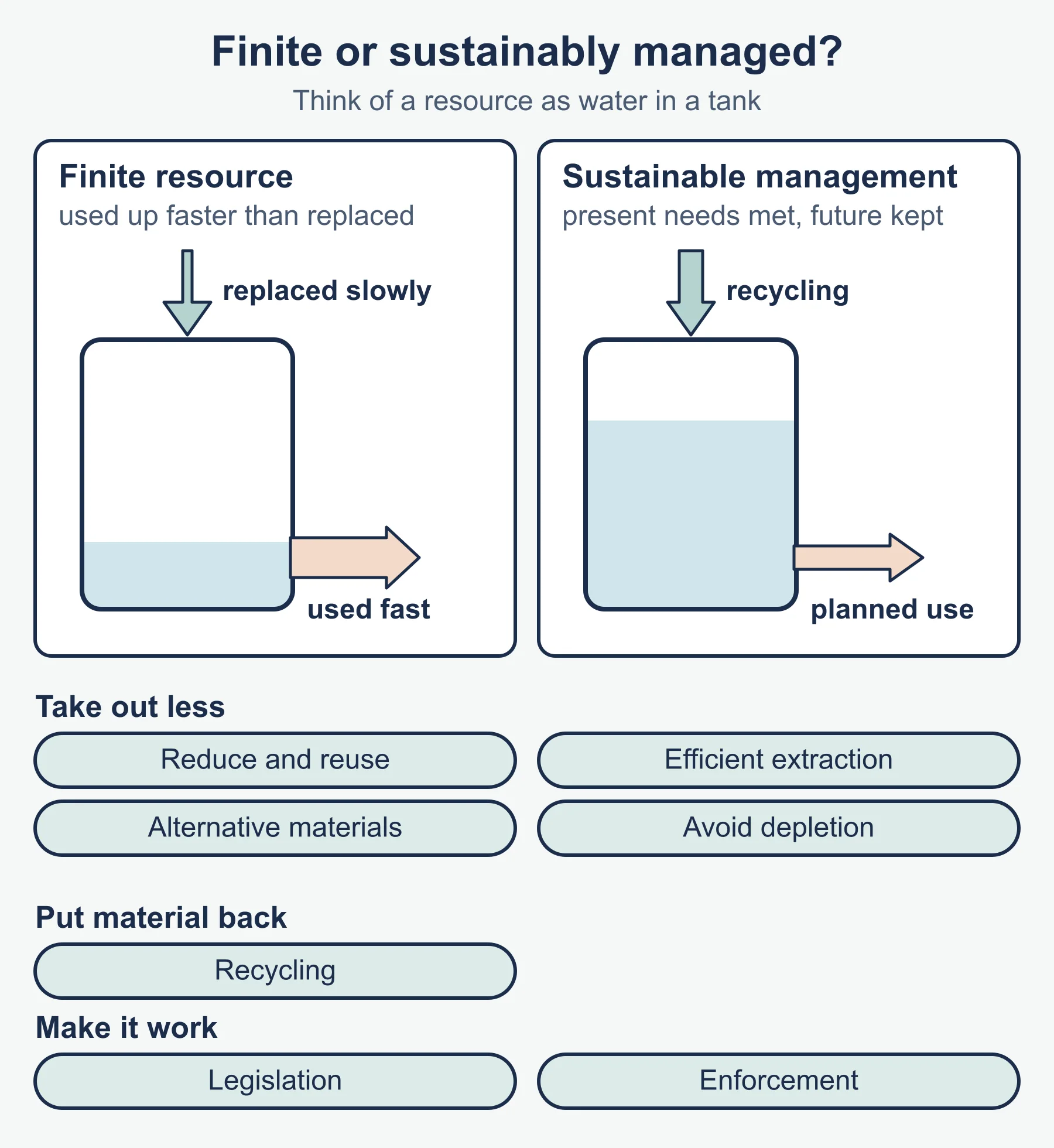
- 1.3.1 Define a finite resource as a natural resource that is used up at a faster rate than it is replaced.
- 1.3.2 Define sustainable management of resources as the use of strategies that ensure the needs of the present are met without compromising the ability of future generations to meet their own needs.
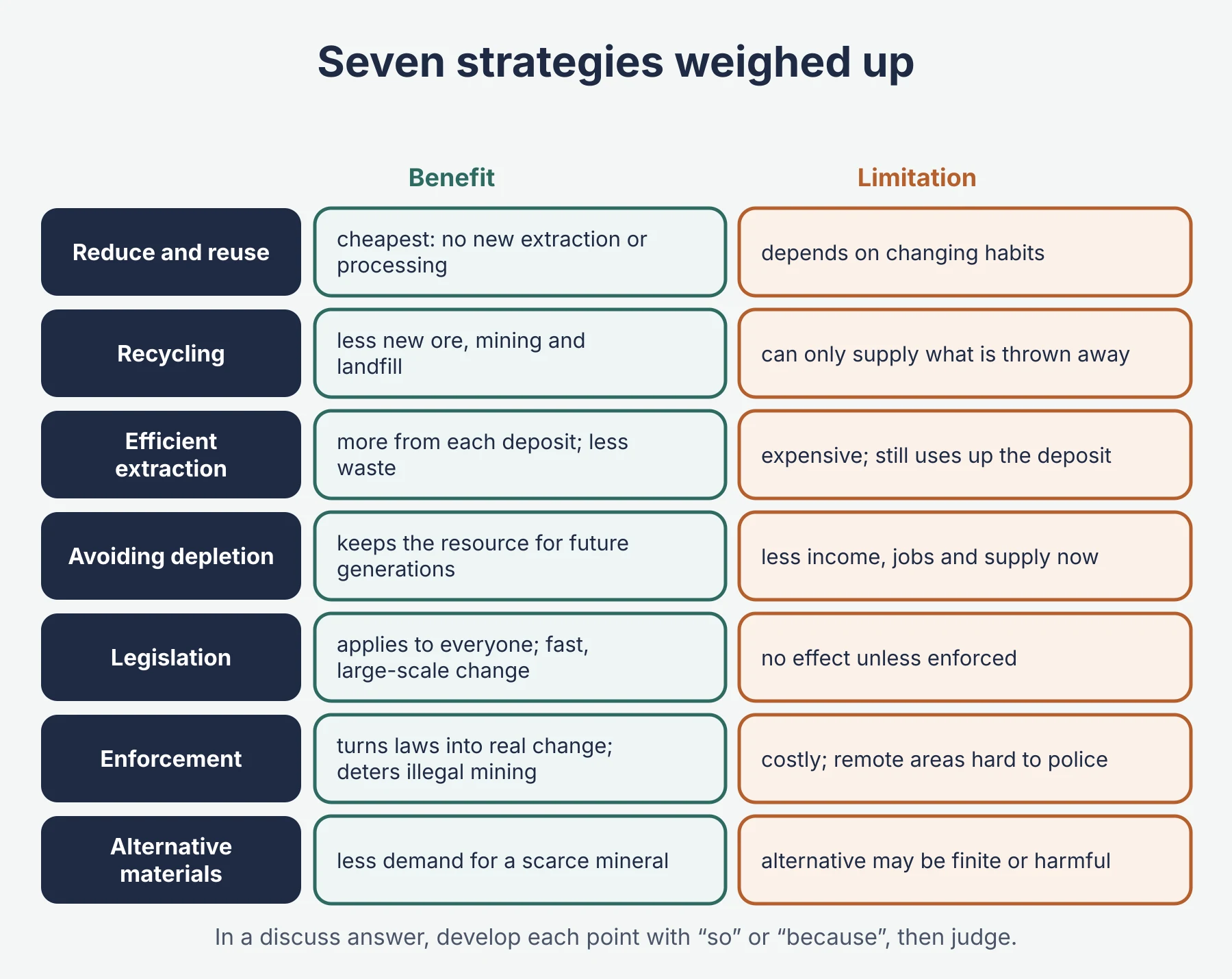
- 1.3.3 Describe sustainable management strategies for rocks, ores and minerals, limited to: reduce and reuse; recycling (accessibility, ease and education); increased efficiency of extraction; avoiding resource depletion; legislation; enforcement; use of alternative materials.
- 1.3.4 Discuss the benefits and limitations of these strategies.
Why rocks, ores and minerals are finite
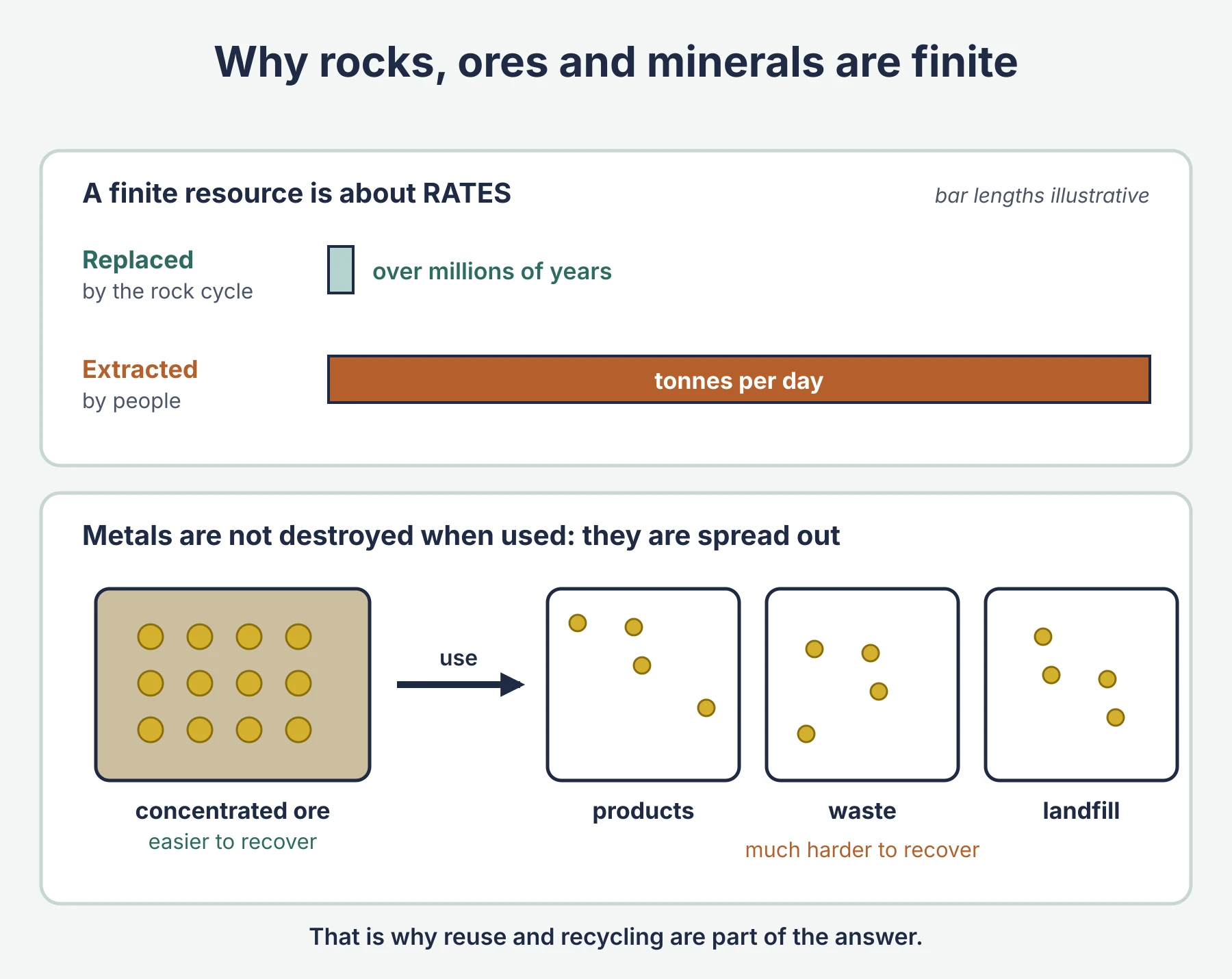
The definition of a finite resource is about rates, not about the total amount. New rock is forming somewhere all the time through the rock cycle, but at a rate measured over millions of years. People extract it at a rate measured in tonnes per day. Because use is so much faster than replacement, the usable stock falls. Strictly, metals are not destroyed when they are used; they are spread out into products, waste and landfill, where they are much harder to recover than from a concentrated ore. That is why reuse and recycling are part of the answer.
The definition of sustainable management has two halves, and both are needed for full marks: meeting present needs, and not compromising future generations. A strategy that conserves minerals but leaves people today without housing or jobs does not meet the first half.
The seven strategies
1. Reduce and reuse
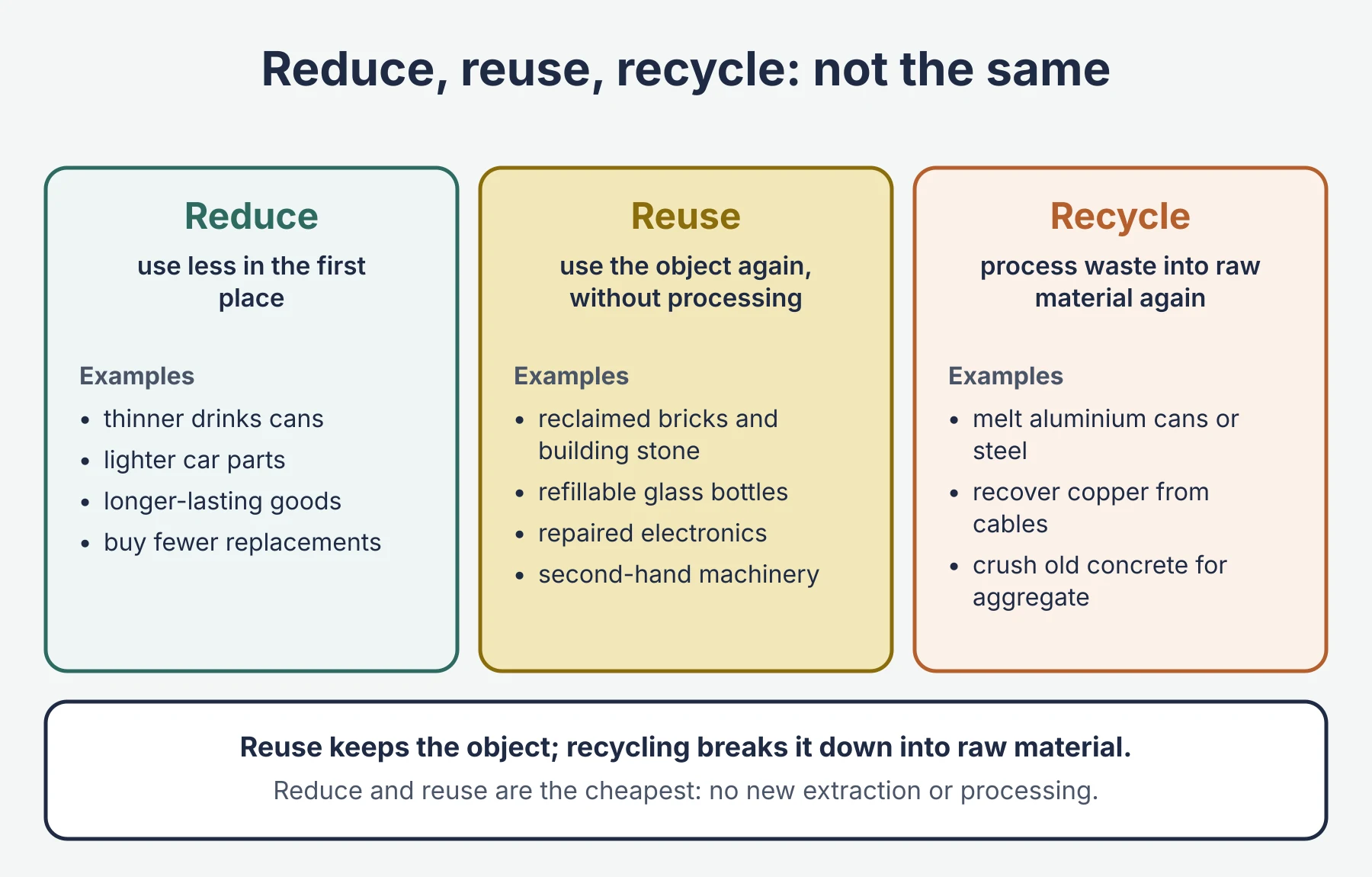
Reduce means using less material in the first place: designing products that need less metal (thinner drinks cans, lighter car parts), making goods that last longer, and buying fewer replacement items. Reuse means using an object again, for the same or a different purpose, without processing it: reclaimed bricks and building stone from demolished buildings, refillable glass bottles, repaired electronic devices, second-hand machinery.
- Benefits: the cheapest options, because no new extraction or processing is needed; they cut waste and energy use as well as conserving minerals.
- Limitations: depend on people and businesses changing habits; longer-lasting products may cost more to buy; reused items may not meet modern standards.
2. Recycling: accessibility, ease and education
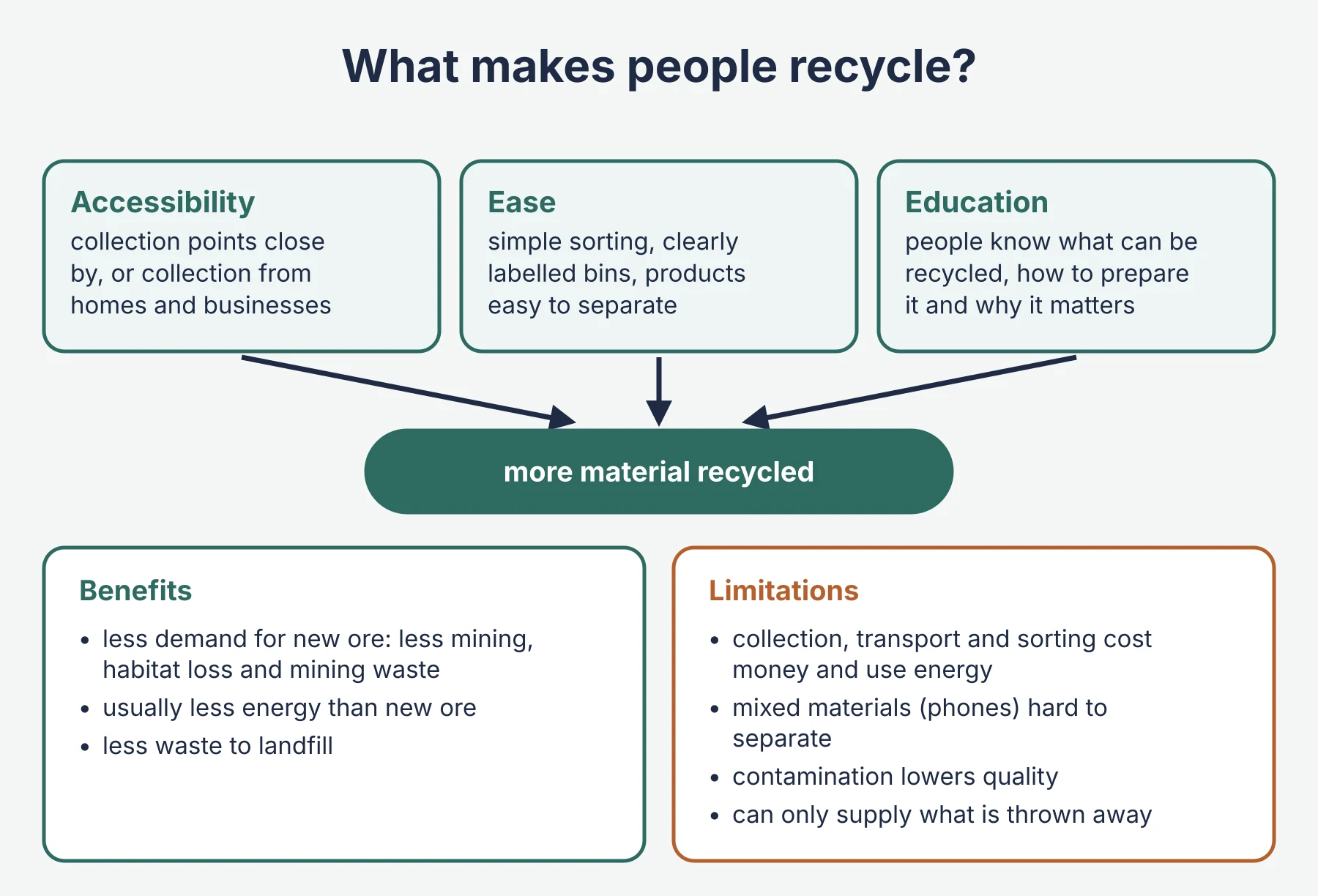
Recycling is processing waste material so that it can be used as a raw material again: melting down aluminium cans or steel, recovering copper from cables, crushing old concrete for use as aggregate. The syllabus names three conditions that decide how much is actually recycled:
-
Accessibility: collection points must be close by, or there must be collection from homes and businesses. If people must travel far, few will.
-
Ease: simple sorting, clearly labelled bins and products designed so that materials can be separated easily all raise recycling rates.
-
Education: people need to know what can be recycled, how to prepare it and why it matters.
-
Benefits: reduces demand for new ore, so less mining, less habitat loss and less mining waste; usually needs less energy than extracting and processing new ore; reduces waste sent to landfill.
-
Limitations: collection, transport and sorting cost money and use energy; items made of mixed materials, such as phones, are hard to separate; contamination lowers quality; recycling can only supply as much as is thrown away, so it cannot meet a growing demand on its own.
3. Increased efficiency of extraction
Using better technology to recover more of the mineral from each tonne of ore, or to recover minerals from material previously treated as waste. Old tailings and spoil heaps can be reprocessed; bioleaching and phytomining (1.2) recover metal from low-grade ore.
- Benefits: more product from the same deposit, so it lasts longer and less new land is disturbed; less waste per tonne of product.
- Limitations: new technology is expensive; it still uses up a finite deposit, only more slowly.
4. Avoiding resource depletion
Managing the rate of use so that reserves are not exhausted, for example by planning how fast a deposit is extracted, keeping scarce minerals for essential uses and combining the other strategies to cut demand for new extraction.
- Benefit: keeps the resource available for future generations, which is the heart of the definition of sustainable management.
- Limitation: slowing extraction can reduce income, jobs and supply now, and demand from a growing population makes it hard to achieve.
5. Legislation
Laws that set rules for how resources are used. Examples include laws that require a share of waste to be recycled, ban certain materials from landfill, require companies to restore mined land, limit how much may be extracted, or add a tax to newly extracted material so that recycled material becomes cheaper by comparison.
- Benefits: applies to everyone; can change behaviour quickly and on a large scale.
- Limitations: laws can be unpopular or costly for businesses; they have no effect unless they are enforced.
6. Enforcement
Making sure laws are obeyed through inspections, monitoring, licences that can be withdrawn, and fines or other penalties.
- Benefit: turns legislation into real change, and deters illegal mining and dumping.
- Limitations: inspectors and monitoring are expensive; remote mining areas are hard to police; weak governance or corruption reduces its effect.
7. Use of alternative materials
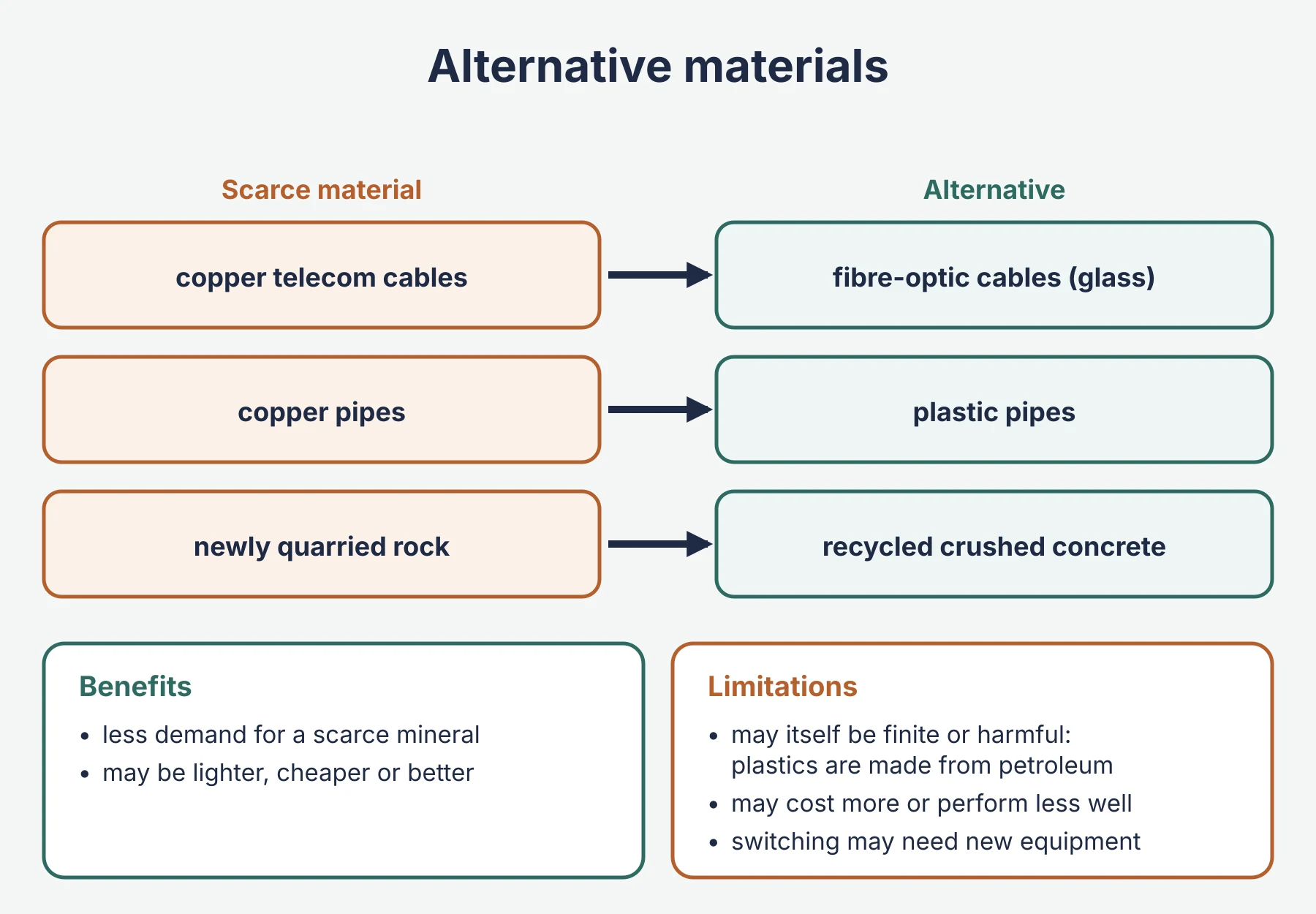
Replacing a scarce material with another that does the same job. Examples include fibre-optic cables, made from glass, in place of copper for telecommunications; plastic pipes in place of copper pipes; recycled crushed concrete in place of newly quarried rock.
- Benefits: reduces demand for a scarce mineral; the alternative may be lighter, cheaper or better.
- Limitations: the alternative may itself be finite or harmful (plastics are made from petroleum); it may be more expensive or perform less well; switching may need new equipment.
Worked example 1: how long will a reserve last?
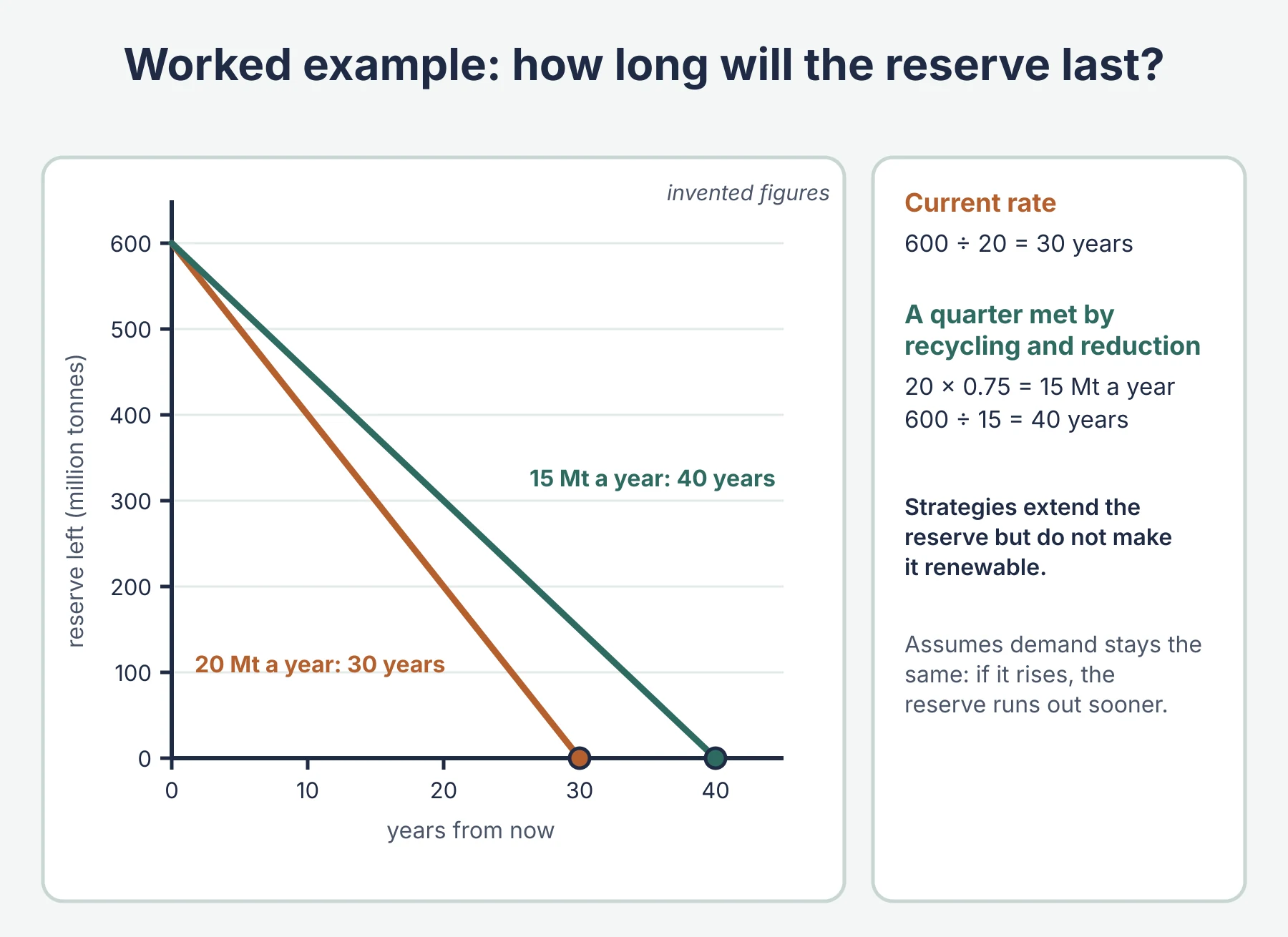
A country has a known reserve of 600 million tonnes of an ore and extracts 20 million tonnes a year. (Figures invented for practice.)
- At the current rate: 600 ÷ 20 = 30 years.
- If recycling and reduction meet one quarter of demand, new extraction falls to 20 × 0.75 = 15 million tonnes a year, and the reserve lasts 600 ÷ 15 = 40 years.
Two points earn credit in interpretation: the strategies extend the life of the reserve but do not make the resource renewable, and the estimate assumes demand stays the same. If demand rises, the reserve runs out sooner.
Worked example 2: does making recycling easier work?
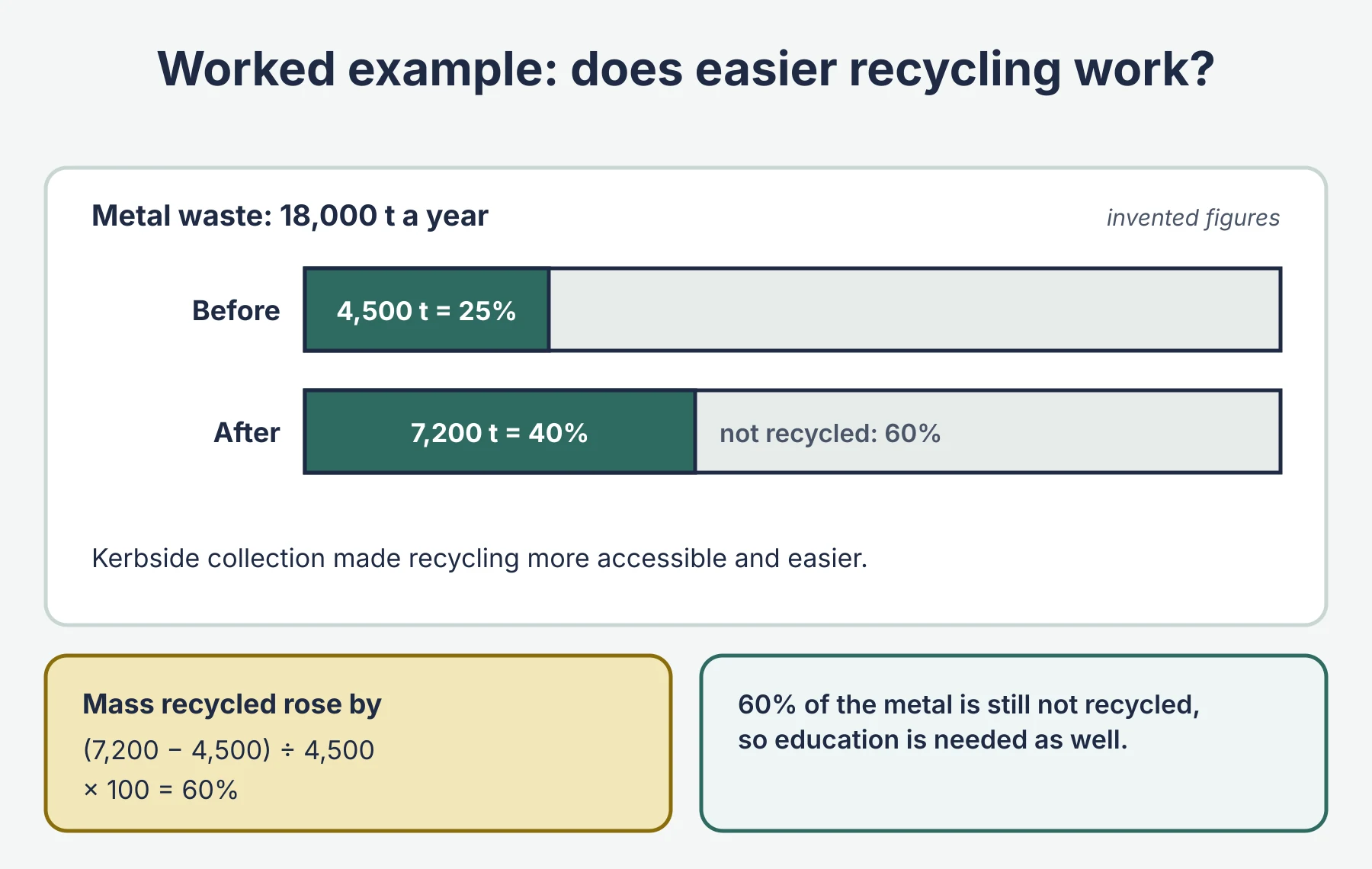
A town’s households throw away 18,000 tonnes of metal waste a year. Before a kerbside collection scheme, 4,500 tonnes were recycled. After the scheme, 7,200 tonnes were recycled. (Figures invented for practice.)
- Recycling rate before: 4,500 ÷ 18,000 × 100 = 25%.
- Recycling rate after: 7,200 ÷ 18,000 × 100 = 40%.
- Increase in mass recycled: (7,200 − 4,500) ÷ 4,500 × 100 = 60%.
This supports the syllabus point that accessibility and ease raise recycling. A good answer adds that 60% of the metal is still not recycled, which suggests a need for education as well.
Worked example 3: an annotated discuss answer
Question: Discuss the benefits and limitations of using legislation to manage mineral resources sustainably.
- Benefit, explained: a law requiring mined land to be restored makes every company pay for restoration, so damaged land does not become a cost to the community.
- Benefit, explained: a law setting recycling targets increases the supply of recycled metal, reducing the need for new mines.
- Limitation, explained: without enforcement, such as inspections and fines, companies may ignore the law, especially in remote areas.
- Limitation, explained: strict laws raise costs, and a company may move its operations to a country with weaker rules.
- Judgement: legislation is effective only when it is combined with enforcement and with education, so that people support it.
Each point is developed with a “so” or “because”; listing four one-word points would score far less.
Common mistakes
- Defining a finite resource as one that “will run out”. Use the rate wording from the syllabus.
- Giving only half of the definition of sustainable management.
- Confusing reuse (using the object again) with recycling (processing it into raw material).
- Treating legislation and enforcement as one strategy. The syllabus lists them separately.
- Claiming recycling uses no energy, or that an alternative material has no impacts.
Exam technique
Define: reproduce the syllabus wording. Describe a strategy: say what it involves and give an example. Discuss: give a benefit and a limitation for each strategy, develop each point, and finish with a judgement. When a source gives figures, use them: calculate a percentage or a reserve lifetime and say what it shows.
Consolidate with the Sustainable management of rocks, ores and minerals revision notes and test yourself with the Sustainable management of rocks, ores and minerals practice questions. For the impacts that these strategies reduce, see the Extraction of rocks, ores and minerals study guide.
Related resources
-
Revision notes
Cambridge IGCSE Environmental Management: Land — Revision Notes
Recall notes on soils and crop growth, food production and soil erosion for Topic 2 Land of Cambridge IGCSE Environmental Management 0680, 2027-2029 series.
Environmental Management · Cambridge · IGCSE
Revise topic -
Practice questions
Cambridge IGCSE Environmental Management (0680): Sustainable management of rocks, ores and minerals – Practice Questions
Original questions with answers on finite resources, recycling rates, reserve lifetimes and mineral conservation strategies for Cambridge IGCSE 0680.
Environmental Management · Cambridge · IGCSE
Try questions -
Revision notes
Cambridge IGCSE Environmental Management (0680): Sustainable management of rocks, ores and minerals – Revision Notes
Notes on finite resources, sustainable management and the seven mineral conservation strategies, with benefits and limitations, for Cambridge IGCSE 0680.
Environmental Management · Cambridge · IGCSE
Revise topic
Get free revision emails (optional)
Occasional emails with practice questions, worked explanations and links to free resources for the qualification and subjects you choose. No spam, and you can unsubscribe from any email. The free tools on this site never need an email.