
Revision Notes
Cambridge IGCSE Environmental Management (0680): Sustainable management of rocks, ores and minerals – Revision Notes
Notes on finite resources, sustainable management and the seven mineral conservation strategies, with benefits and limitations, for Cambridge IGCSE 0680.
- Subject
- Environmental Management
- Level
- IGCSE
- Topic
- Topic 1 – Natural Resources
- Author
- Marlbridge Academic Team
- Updated
- Reviewed by
- Azam Siddique (what this means)
Aligned to Cambridge IGCSE Environmental Management (0680), 2027-2029. Official specification .
Syllabus page (what it covers and how it is assessed): Cambridge IGCSE Environmental Management.
Syllabus points this page covers
0680
- 1.3 Sustainable management of rocks, ores and minerals
Found an error? Report a correction.
Need help with this topic? Request a free trial class for IGCSE Environmental Management (0680).
Condensed notes for sub-topic 1.3. For developed explanations, reserve and recycling calculations and an annotated discuss answer, use the Sustainable management of rocks, ores and minerals study guide.
Two definitions to learn word for word
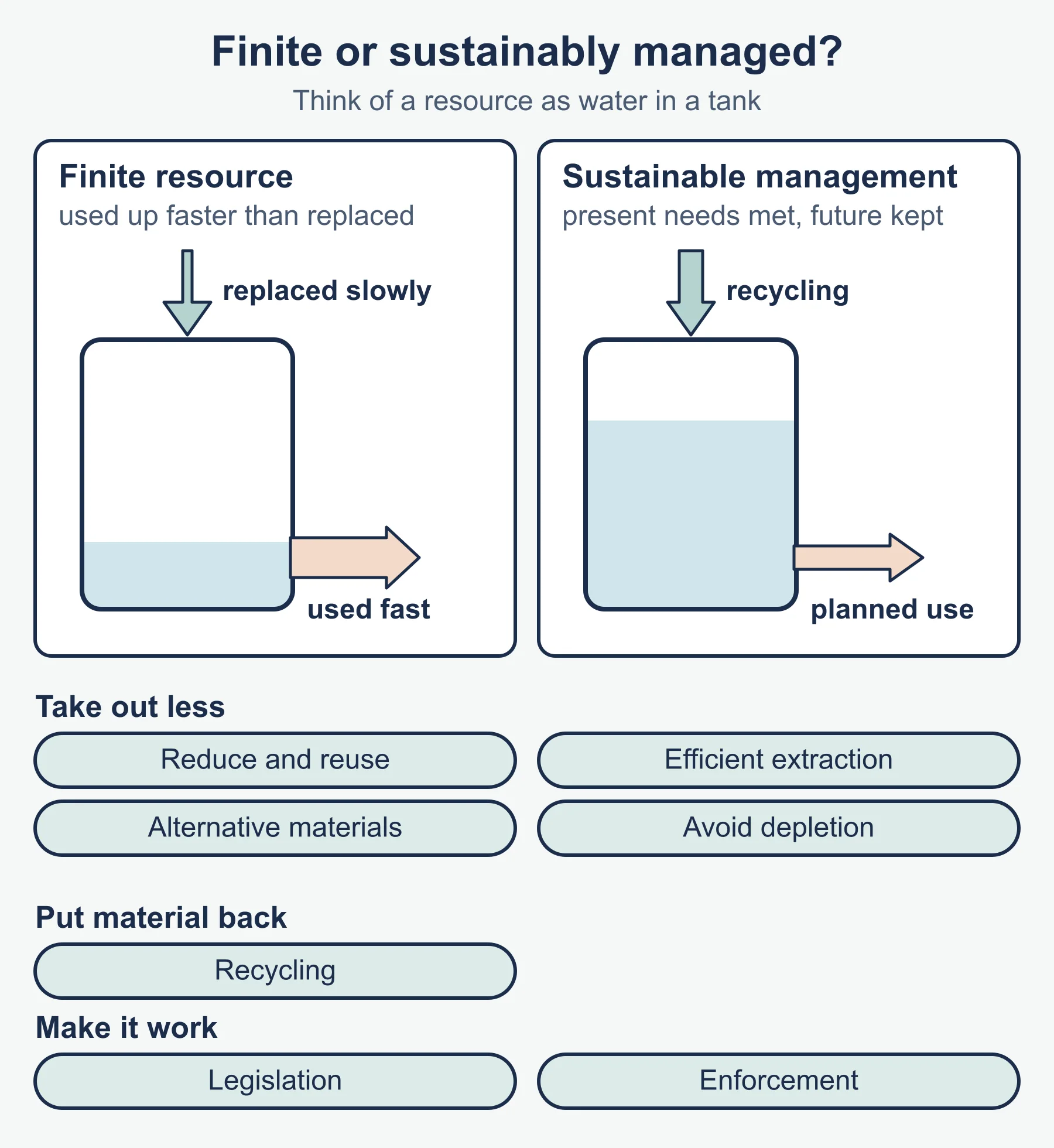
- Finite resource: a natural resource that is used up at a faster rate than it is replaced.
- Sustainable management of resources: the use of strategies that ensure the needs of the present are met without compromising the ability of future generations to meet their own needs.
Check both halves of the second definition in every answer: present needs and future generations.
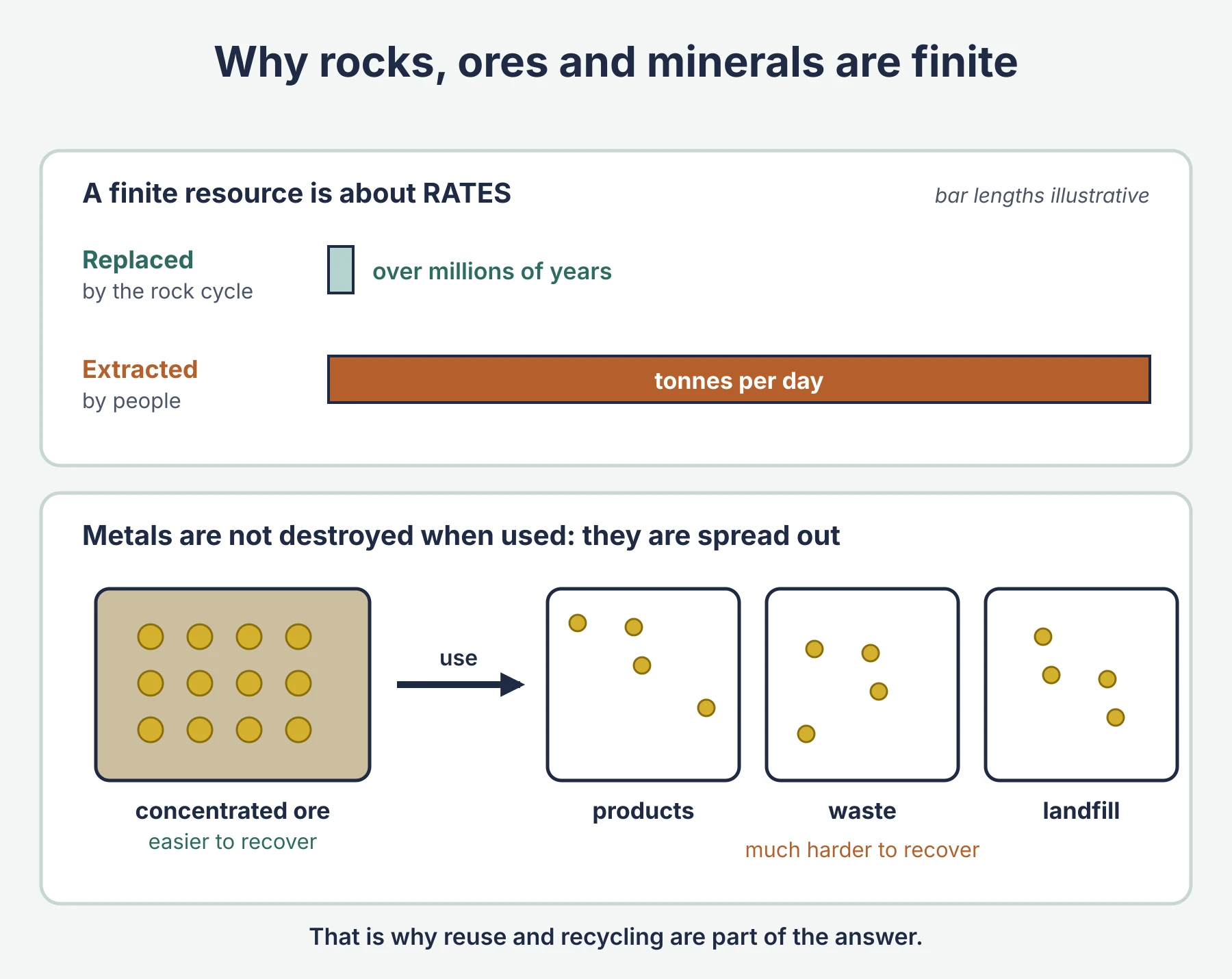
Why minerals are finite
- They form through the rock cycle over millions of years.
- People extract them far faster than that.
- Used metals are scattered in products and waste rather than destroyed, so they can sometimes be recovered: this is the logic behind reuse and recycling.
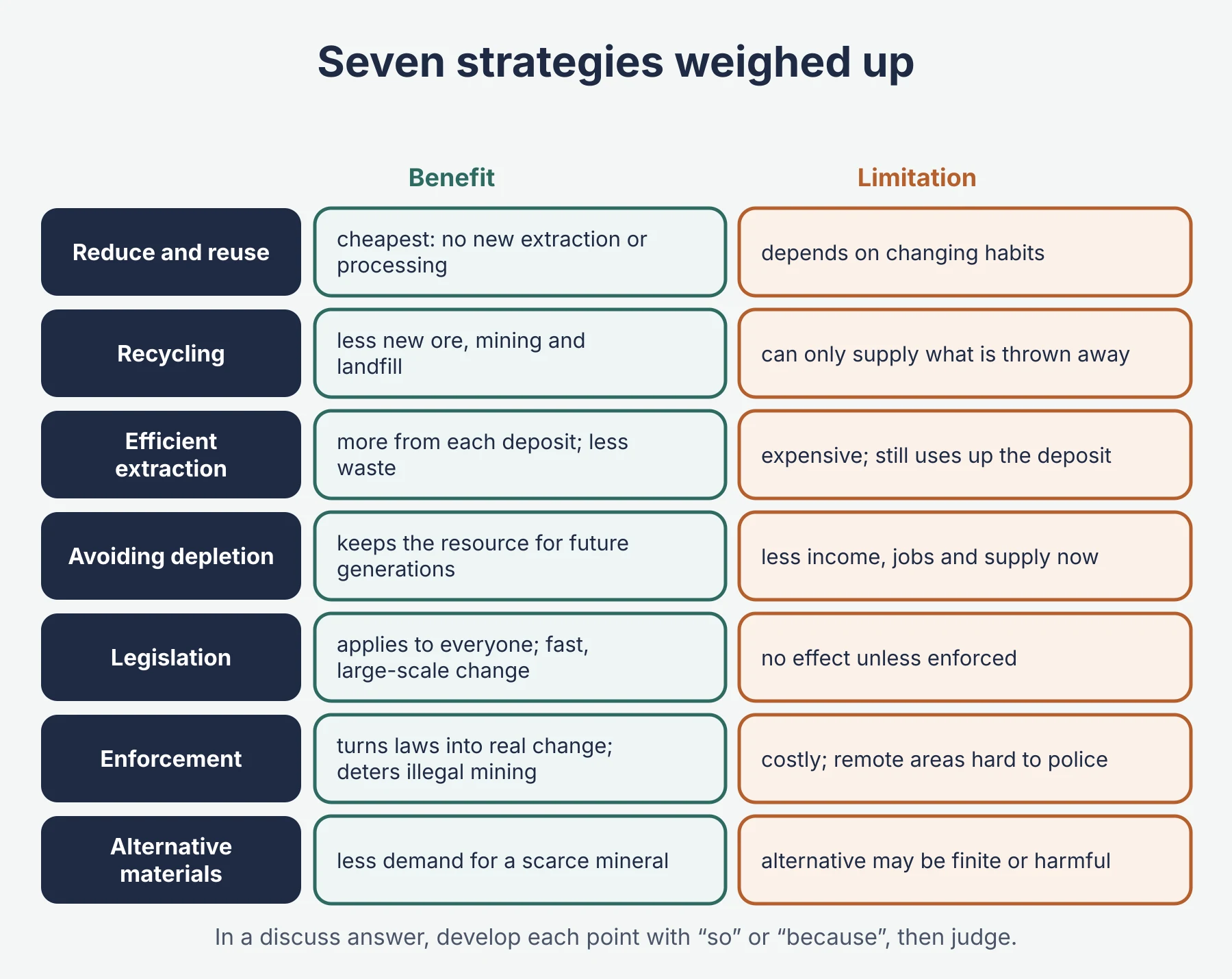
The seven strategies at a glance
| Strategy | What it means | Example | Benefit | Limitation |
|---|---|---|---|---|
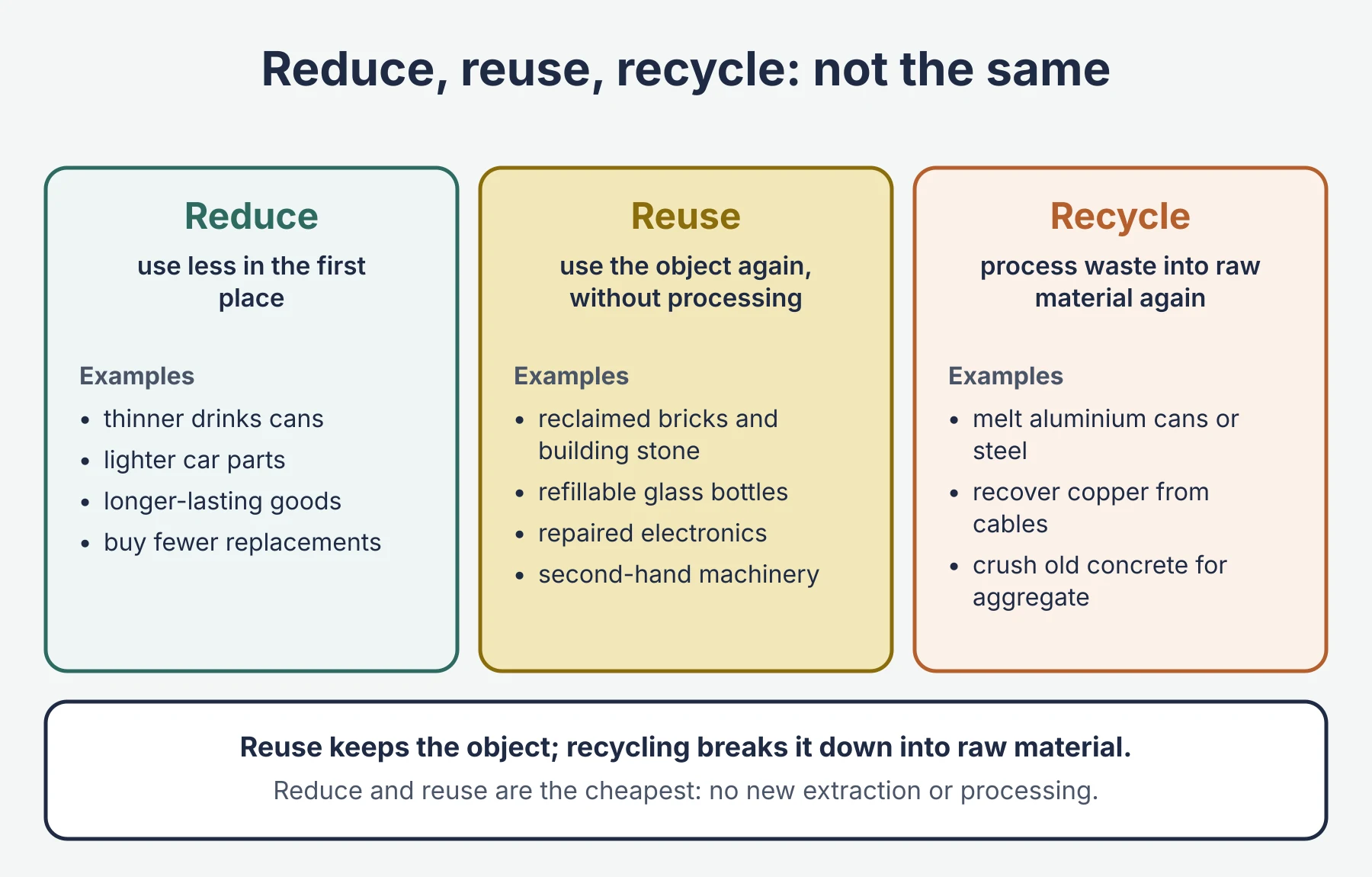
| Reduce and reuse | Use less material; use objects again without processing | Lighter cans; reclaimed bricks; repaired devices | Cheapest; saves energy and waste too | Relies on changing habits |
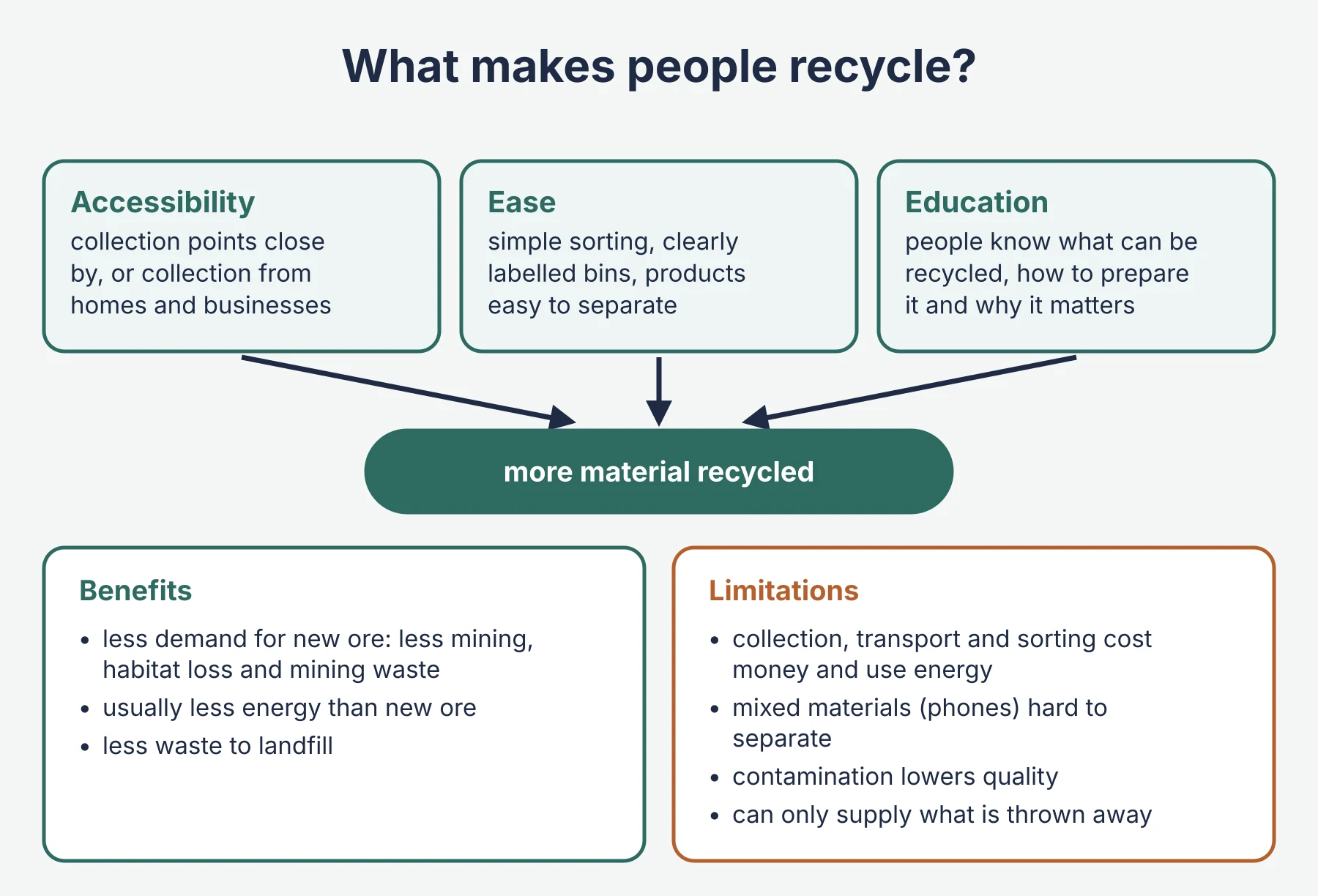
| Recycling | Process waste into raw material again | Melting aluminium cans; recovering copper from cables | Less mining and landfill; usually less energy than new ore | Collection and sorting cost money; mixed materials hard to separate |
| Increased efficiency of extraction | Recover more mineral per tonne of ore | Reprocessing tailings; bioleaching low-grade ore | Deposit lasts longer; less waste per tonne | Expensive technology; still uses a finite stock |
| Avoiding resource depletion | Control the rate of use so reserves last | Planned extraction rates; scarce minerals kept for essential uses | Protects future generations | Less income and supply now |
| Legislation | Laws on how resources are used | Recycling targets; required restoration; extraction limits | Applies to all; works at scale | Unpopular or costly; useless without enforcement |
| Enforcement | Making laws work | Inspections, fines, removing licences | Deters illegal mining and dumping | Expensive; hard in remote areas; corruption |
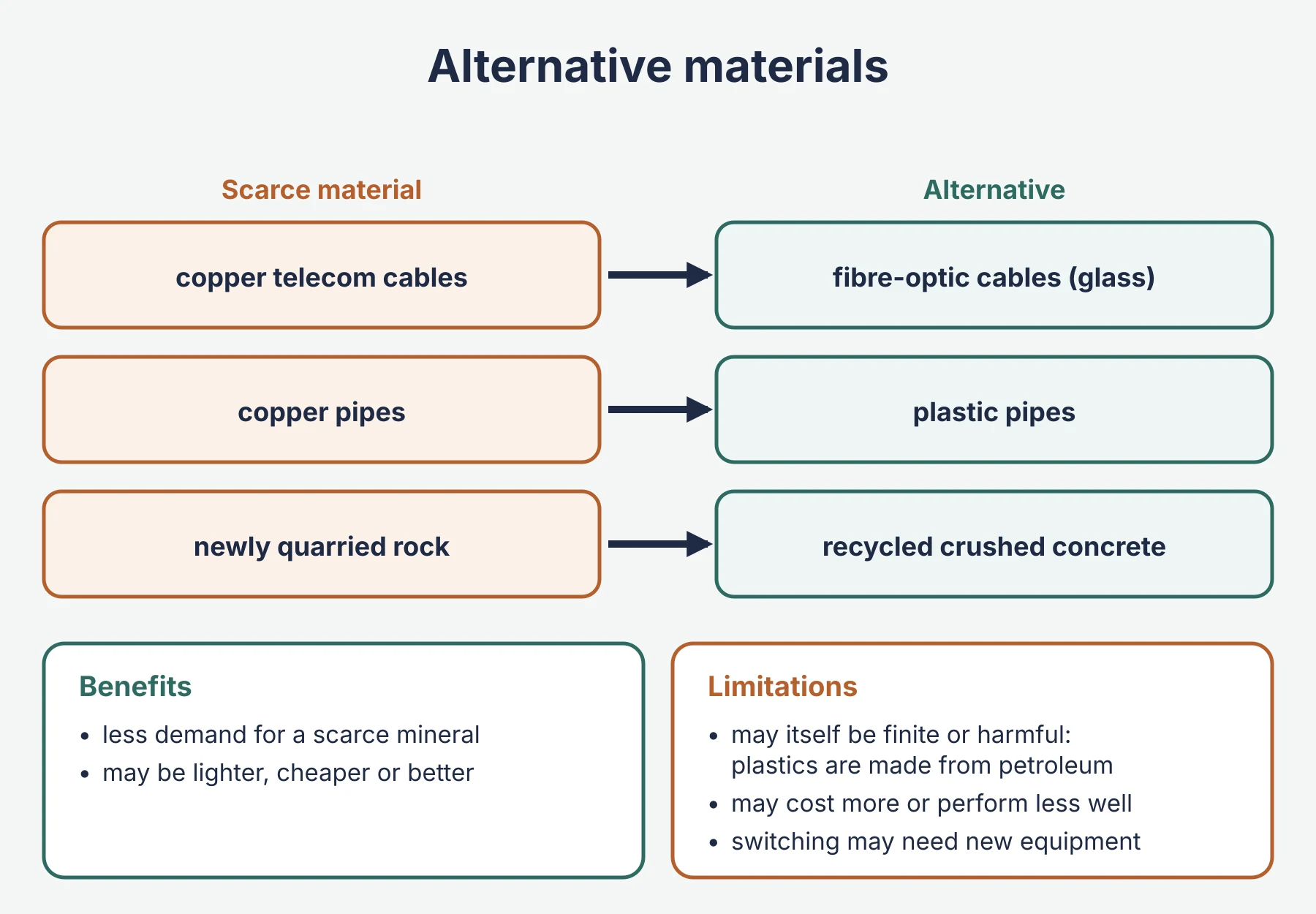
| Alternative materials | Swap a scarce material for another | Fibre-optic glass for copper cable; plastic pipes | Cuts demand for the scarce mineral | Alternative may be finite, harmful or costly |
Recycling: the three conditions
- Accessibility: collection points nearby, or collection from homes.
- Ease: simple sorting, clear labelling, products designed to come apart.
- Education: knowing what, how and why to recycle.
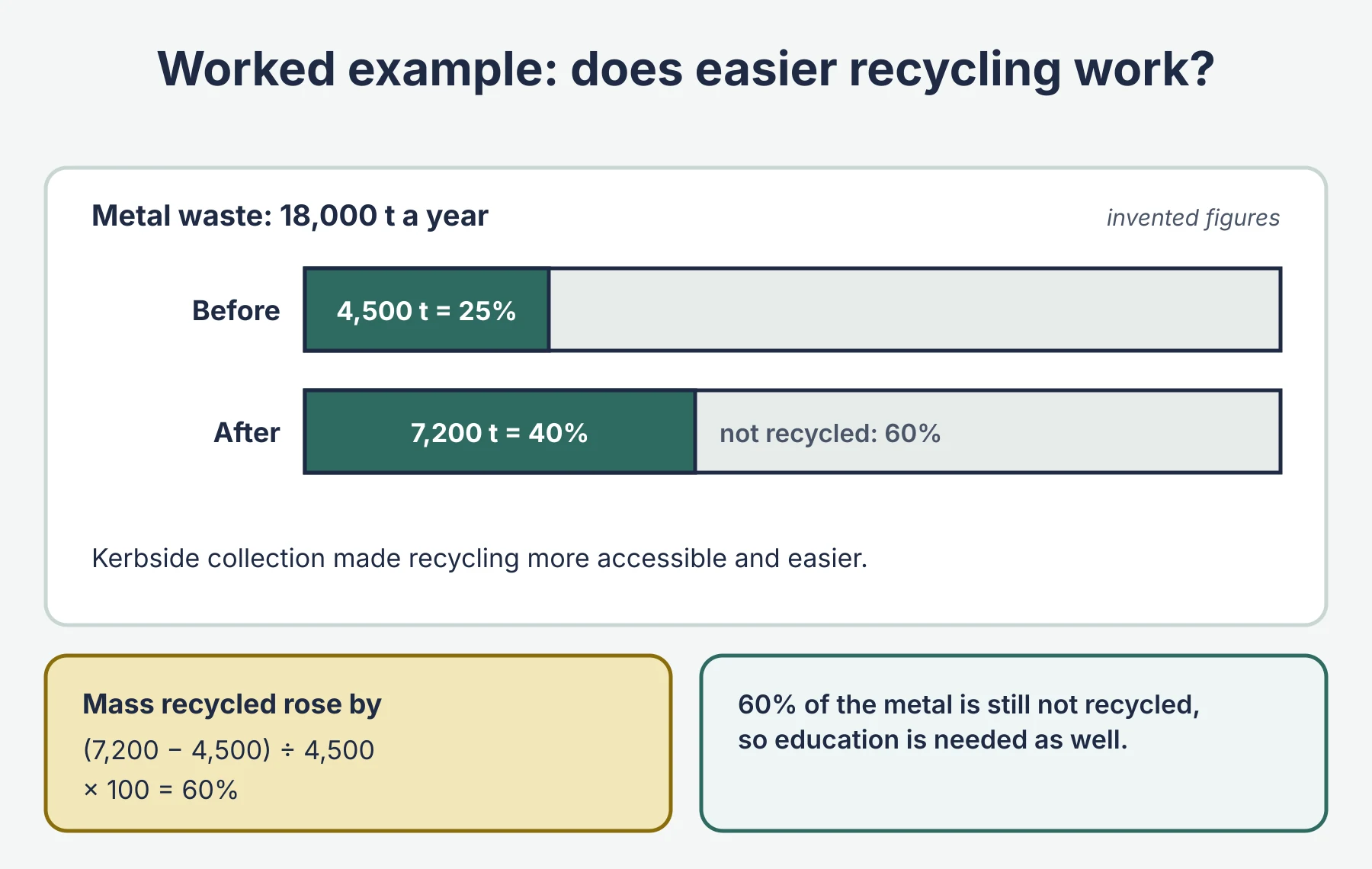
A question about low recycling rates is usually answered by identifying which of the three is missing.
Useful calculations
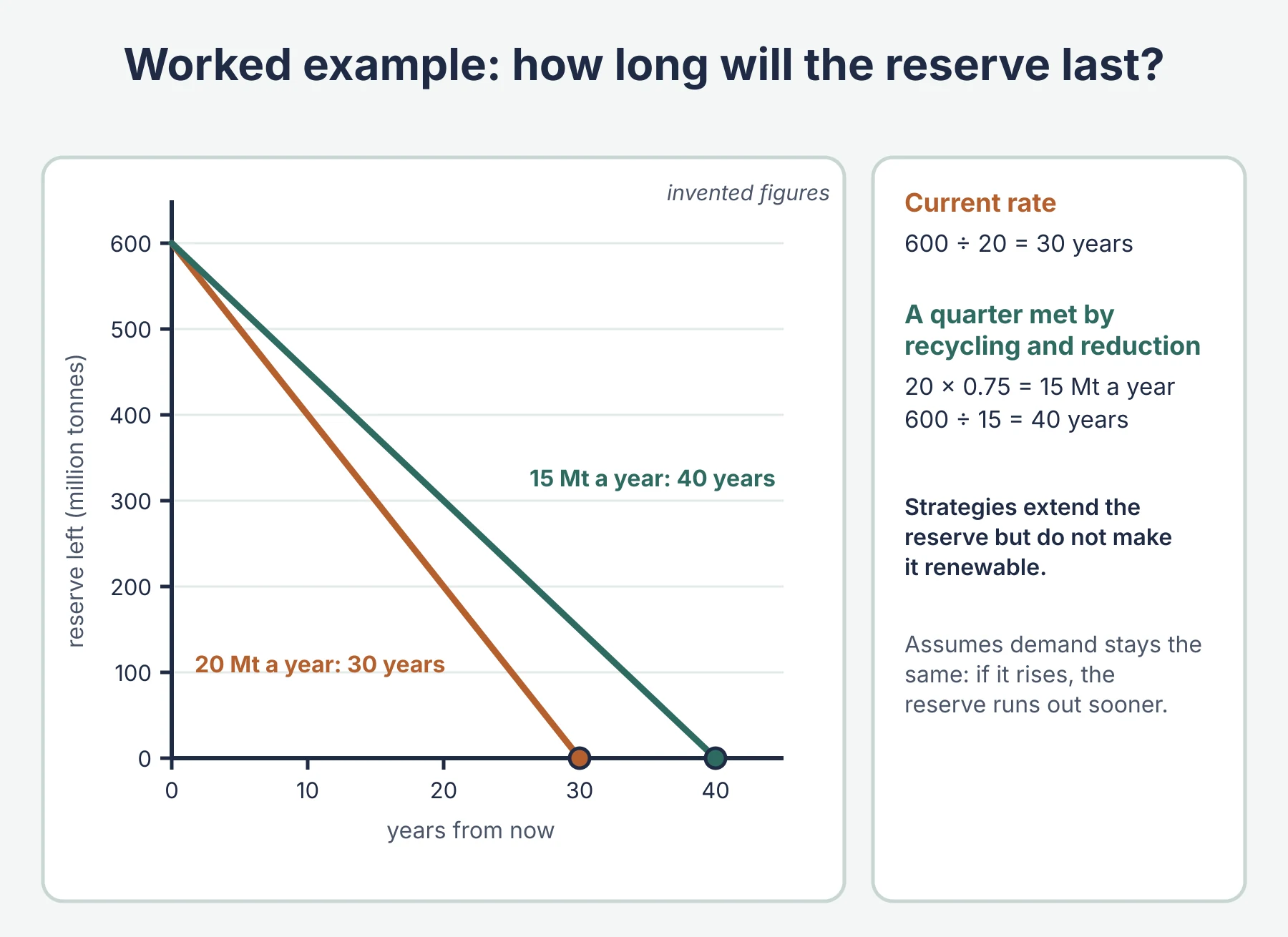
- Reserve lifetime (years) = reserve ÷ annual use. It assumes use stays constant; rising demand shortens it.
- Recycling rate (%) = mass recycled ÷ total mass of waste × 100.
- Percentage change = (new − old) ÷ old × 100.
Quick check: a reserve of 450 million tonnes used at 15 million tonnes a year lasts 450 ÷ 15 = 30 years. Cutting use by a third (to 10 million tonnes) extends this to 45 years.
How to build a discuss answer
- State the strategy and what it involves.
- Give a benefit and explain it with “so” or “because”.
- Give a limitation and explain it.
- Repeat for further strategies if the question asks for more than one.
- Finish with a judgement: which strategy, or which combination, works best and in what conditions.
Strong judgements usually say that strategies work in combination: legislation with enforcement, recycling with education.
Key terms
| Term | Meaning |
|---|---|
| Reserve | Known amount of a resource that can be extracted |
| Depletion | Using up a resource so that the stock falls |
| Substitution | Replacing one material with another |
| Tailings | Waste left after ore is processed, which may still contain some metal |
| Recycling rate | Percentage of waste that is recycled |
Exam traps
- “A finite resource will run out” is not the syllabus definition.
- Reuse and recycling are different: reuse keeps the object; recycling processes it.
- Legislation and enforcement are separate strategies; describe each.
- Recycling is not free of energy or cost.
- Extending the life of a reserve does not make the resource renewable.
- An alternative material can have its own impacts; say so in a discuss answer.
Self-test
- Define a finite resource.
- Define sustainable management of resources.
- Give one example of reducing and one of reusing minerals.
- Name the three conditions for successful recycling.
- Give one limitation of recycling.
- How can efficiency of extraction be increased?
- Why is enforcement needed as well as legislation?
- Give one example of using an alternative material.
- A reserve of 240 million tonnes is used at 8 million tonnes a year. How long will it last?
- A school recycles 1.2 tonnes of its 4.8 tonnes of waste. What is its recycling rate?
- Give one limitation of using alternative materials.
- Why does avoiding resource depletion link most closely to the definition of sustainable management?
Answers
- A natural resource that is used up at a faster rate than it is replaced.
- The use of strategies that ensure the needs of the present are met without compromising the ability of future generations to meet their own needs.
- Reduce: lighter cans or longer-lasting products. Reuse: reclaimed bricks or repaired devices.
- Accessibility, ease and education.
- Any one: collection and sorting cost money and energy; mixed materials are hard to separate; contamination lowers quality; it cannot meet rising demand alone.
- By using better technology to recover more mineral per tonne of ore, or by reprocessing old tailings and spoil.
- Laws have no effect unless inspections and penalties make people and companies obey them.
- Fibre-optic cables in place of copper, plastic pipes in place of copper pipes, or recycled concrete in place of quarried rock.
- 240 ÷ 8 = 30 years.
- 1.2 ÷ 4.8 × 100 = 25%.
- The alternative may be finite, harmful, more expensive or less effective.
- It keeps the resource available so that future generations can meet their own needs.
Where to go next
Test yourself with the Sustainable management of rocks, ores and minerals practice questions, then move on to the Energy resources revision notes.
Related resources
-
Revision notes
Cambridge IGCSE Environmental Management: Land — Revision Notes
Recall notes on soils and crop growth, food production and soil erosion for Topic 2 Land of Cambridge IGCSE Environmental Management 0680, 2027-2029 series.
Environmental Management · Cambridge · IGCSE
Revise topic -
Revision notes
Energy Management, New Energy Resources and Fracking: Revision Notes
Recall notes on the eight energy management strategies, blue and green hydrogen, heat pumps and fracking for Cambridge IGCSE Environmental Management 0680.
Environmental Management · Cambridge · IGCSE
Revise topic -
Practice questions
Natural Resources: Practice Questions
Original exam-style practice questions with full worked answers on renewable and non-renewable resources, energy, water and sustainability.
Environmental Management · Cambridge · IGCSE
Try questions
Get free revision emails (optional)
Occasional emails with practice questions, worked explanations and links to free resources for the qualification and subjects you choose. No spam, and you can unsubscribe from any email. The free tools on this site never need an email.