
Study Guides
Cambridge IGCSE Environmental Management (0680): Energy resources
Fossil fuel formation, renewable and non-renewable classification, electricity generation and the factors driving energy demand, for Cambridge IGCSE 0680.
- Subject
- Environmental Management
- Level
- IGCSE
- Topic
- Topic 1 – Natural Resources
- Author
- Marlbridge Academic Team
- Updated
- Reviewed by
- Azam Siddique (what this means)
Aligned to Cambridge IGCSE Environmental Management (0680), 2027-2029. Official specification .
Syllabus page (what it covers and how it is assessed): Cambridge IGCSE Environmental Management.
Syllabus points this page covers
0680
- 1.4 Energy resources
Found an error? Report a correction.
Need help with this topic? Request a free trial class for IGCSE Environmental Management (0680).
Sub-topic 1.4 covers where our energy comes from. It starts with how coal, oil and gas formed, sorts every named energy resource into renewable or non-renewable, asks how each one produces electricity, and ends with why some places use far more energy than others. The classification list is fixed by the syllabus, so learn exactly which resources sit on each side. This page goes beyond the summary table in the Natural Resources study guide by explaining each process step by step.
What the syllabus asks you to do
- 1.4.1 Describe the formation of fossil fuels: coal, petroleum (oil) and natural gas (methane).
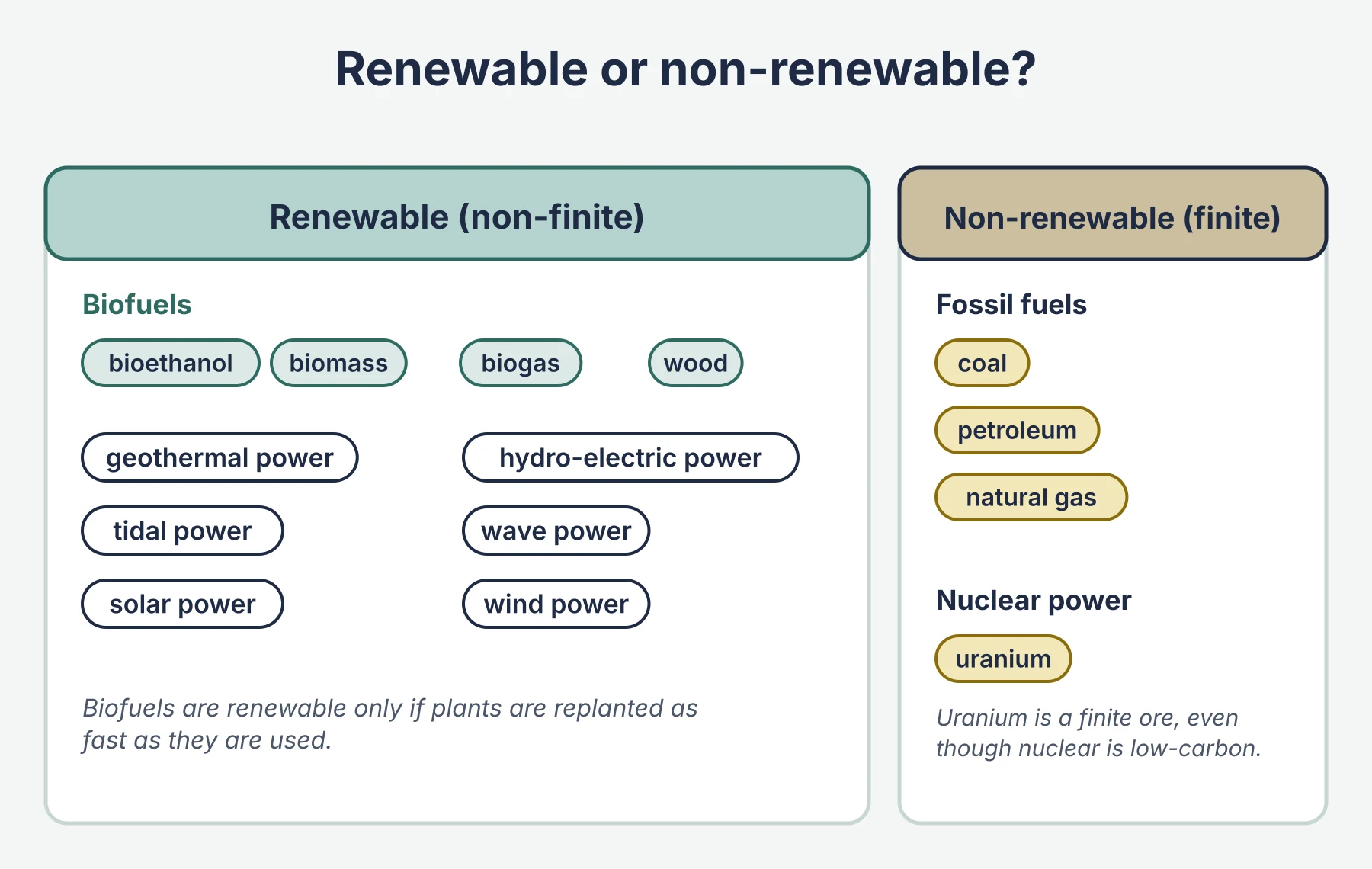
- 1.4.2 Classify energy resources as renewable (non-finite): biofuels (bioethanol, biomass, biogas and wood), geothermal power, hydro-electric power, tidal power, wave power, solar power and wind power; or non-renewable (finite): fossil fuels and nuclear power using uranium.
- 1.4.3 Describe how each of these resources is used to generate electricity.
- 1.4.4 Discuss their benefits and limitations.
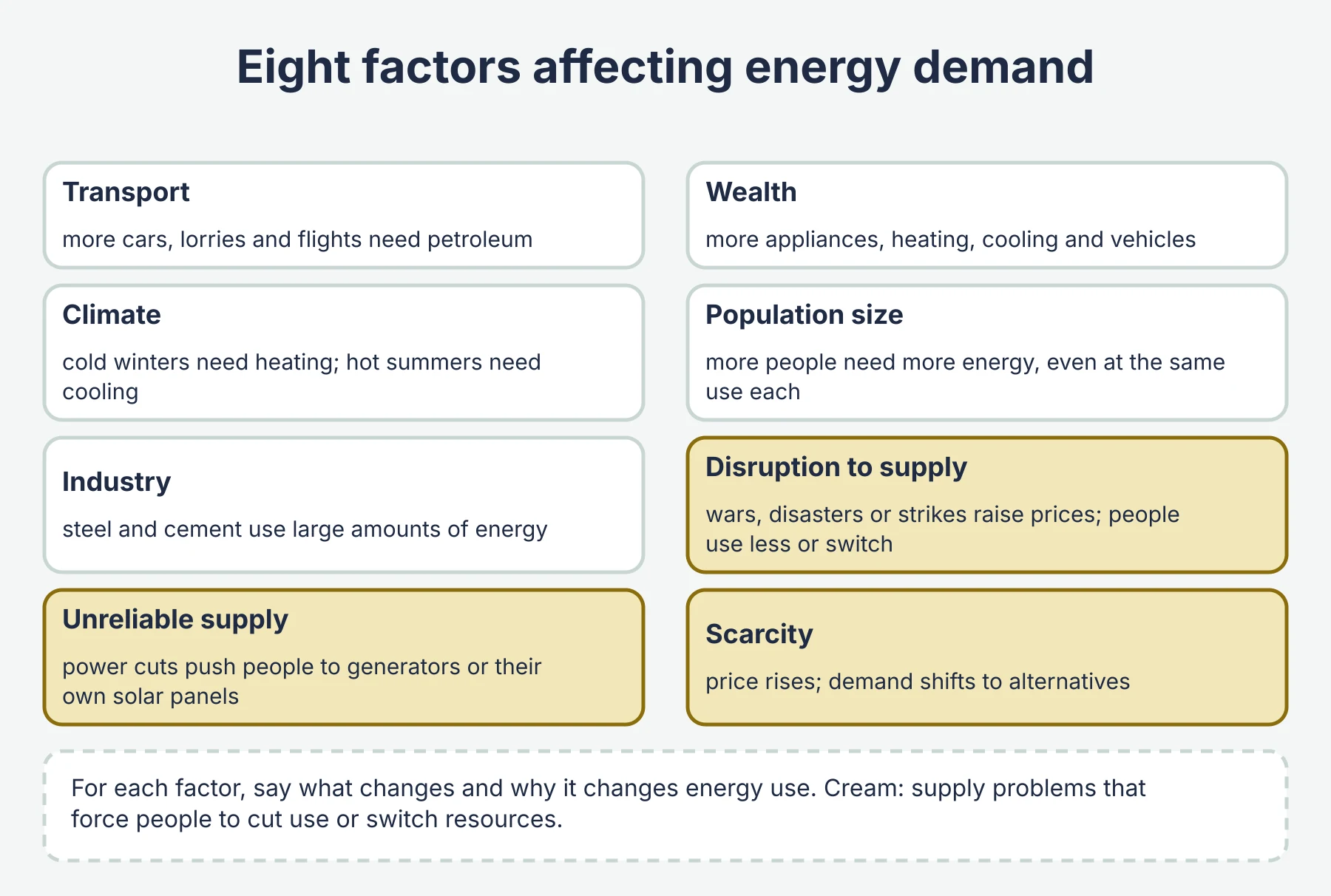
- 1.4.5 Describe and explain eight factors affecting demand for energy: transport, personal and national wealth, climate, human population size, industry, disruption to supply, unreliable supply, scarcity of resources.
How fossil fuels formed
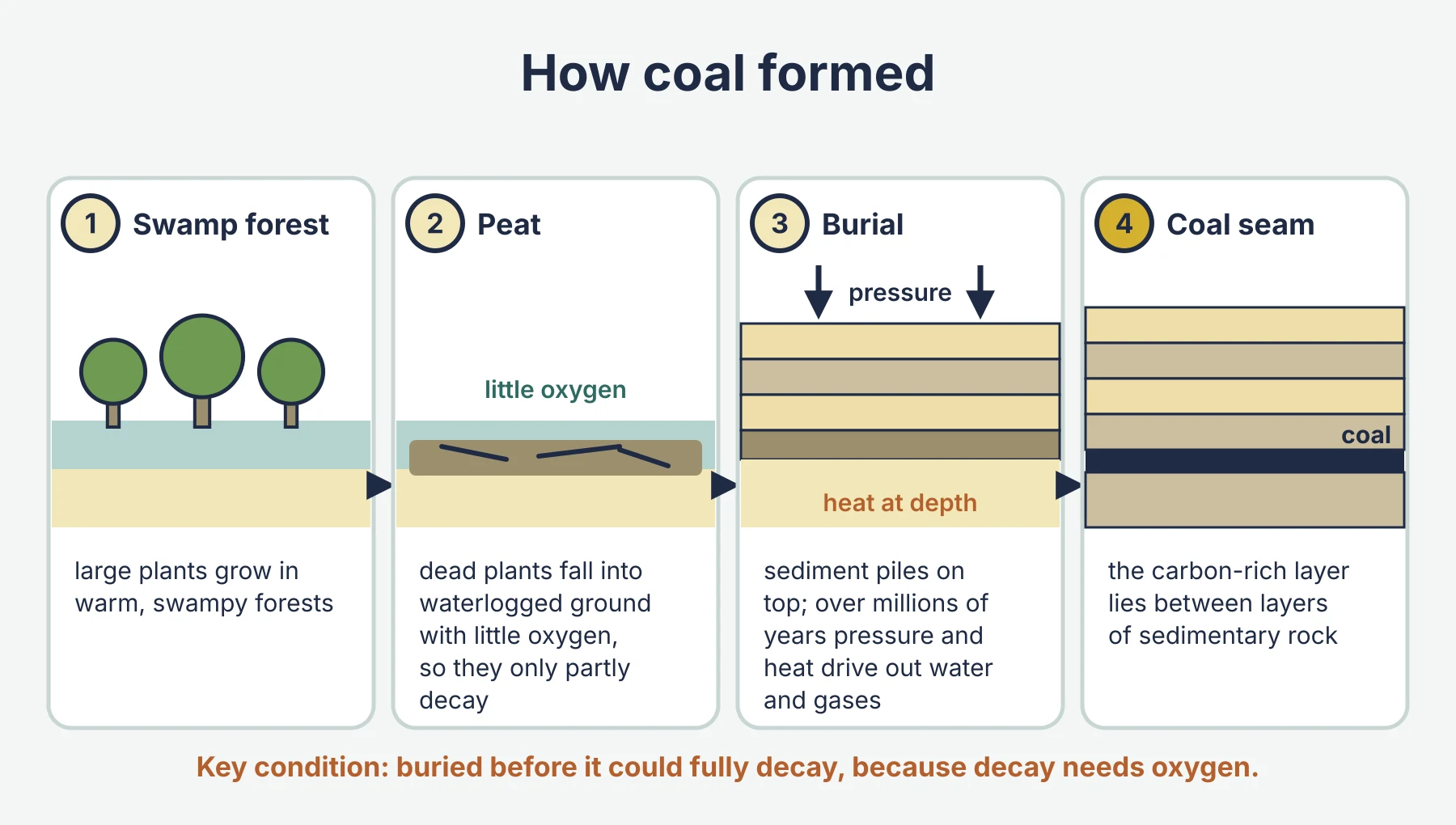
All three fossil fuels are the remains of living things that captured energy from the Sun by photosynthesis millions of years ago. The key condition in every case is that the remains were buried before they could fully decay, because decay needs oxygen.
Coal
- Large plants grew in warm, swampy forests.
- When they died, they fell into waterlogged ground. The water contained little oxygen, so decomposers could not break the material down completely.
- Layers of partly decayed plant material built up, forming peat.
- The peat was buried under layers of sediment. Over millions of years, the weight above compressed it and the heat at depth drove out water and gases, raising the proportion of carbon.
- The peat became coal, which occurs as seams between layers of sedimentary rock.
Petroleum (oil) and natural gas (methane)
- Tiny organisms, mainly plankton, lived in the sea. When they died, they sank to the sea floor.
- They were buried in mud with little oxygen, so they did not fully decay.
- As more sediment piled on top, the organic material was heated and compressed over millions of years and changed into oil and natural gas. Higher temperatures favour gas.
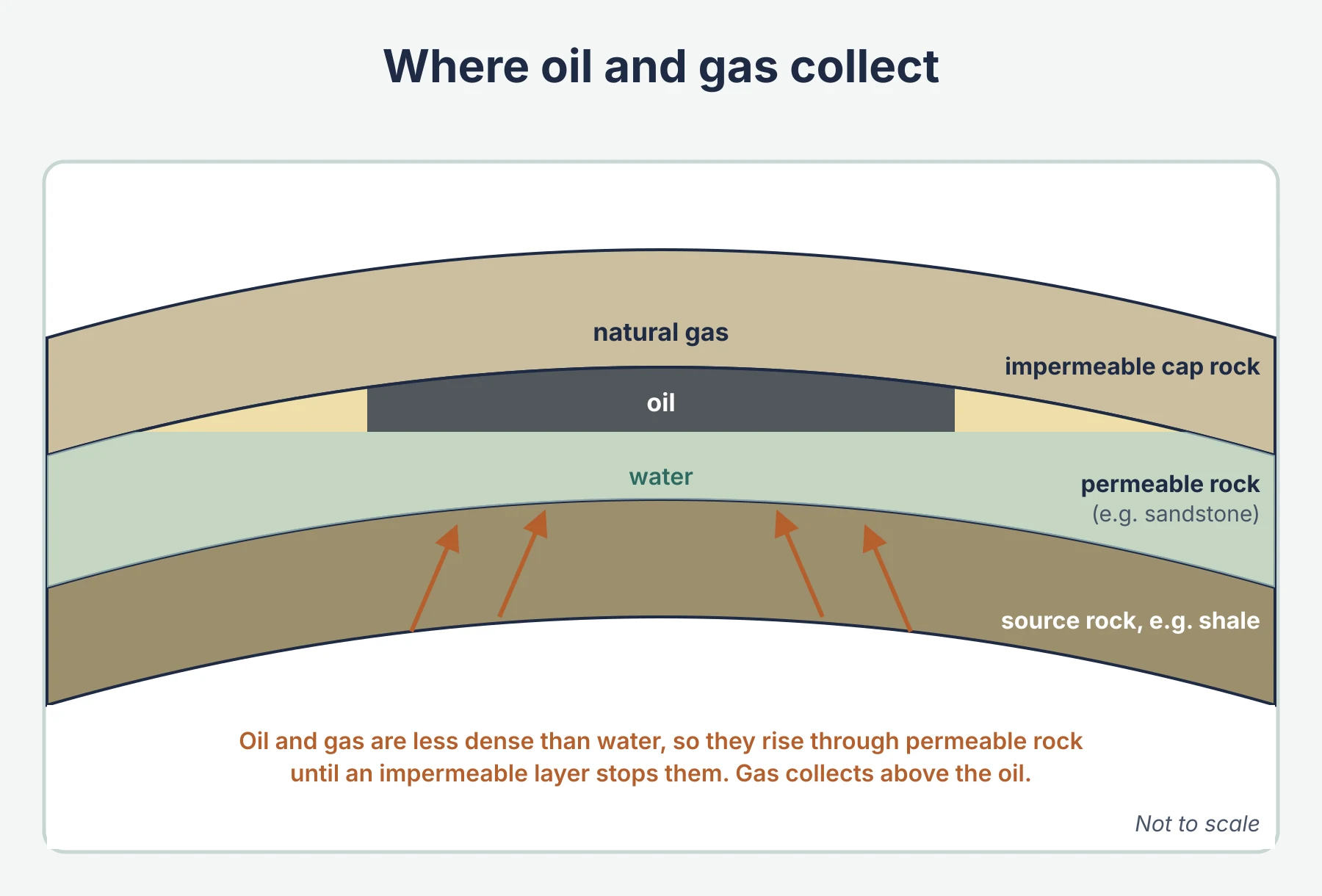
- Oil and gas are less dense than water, so they moved upwards through permeable rock such as sandstone.
- Where they met a layer of impermeable rock, they could rise no further and collected in the permeable rock beneath, forming a reservoir. Natural gas, mostly methane, collects above the oil.
This is where 1.1 links in. Without an impermeable cap rock, oil and gas would escape to the surface. Gas that never left its fine-grained source rock, shale, is the target of fracking (1.6).
Classifying energy resources
| Renewable (non-finite) | Non-renewable (finite) |
|---|---|
| Biofuels: bioethanol, biomass, biogas, wood | Fossil fuels: coal, petroleum, natural gas |
| Geothermal power | Nuclear power using uranium |
| Hydro-electric power (HEP) | |
| Tidal power, wave power | |
| Solar power, wind power |
Notes that earn marks:
- Nuclear power is non-renewable because uranium is a mineral ore with a finite stock, even though nuclear power releases very little carbon dioxide while operating.
- Biofuels are renewable because plants regrow within years, but only if they are replanted as fast as they are used.
- The four biofuels are different products: bioethanol is a liquid fuel made by fermenting sugar from crops such as sugar cane or maize; biomass is plant or animal material burned directly, such as crop waste; biogas is a methane-rich gas made when bacteria break down manure, food waste or sewage without oxygen; wood is burned for heat and in some power stations.
How each resource generates electricity
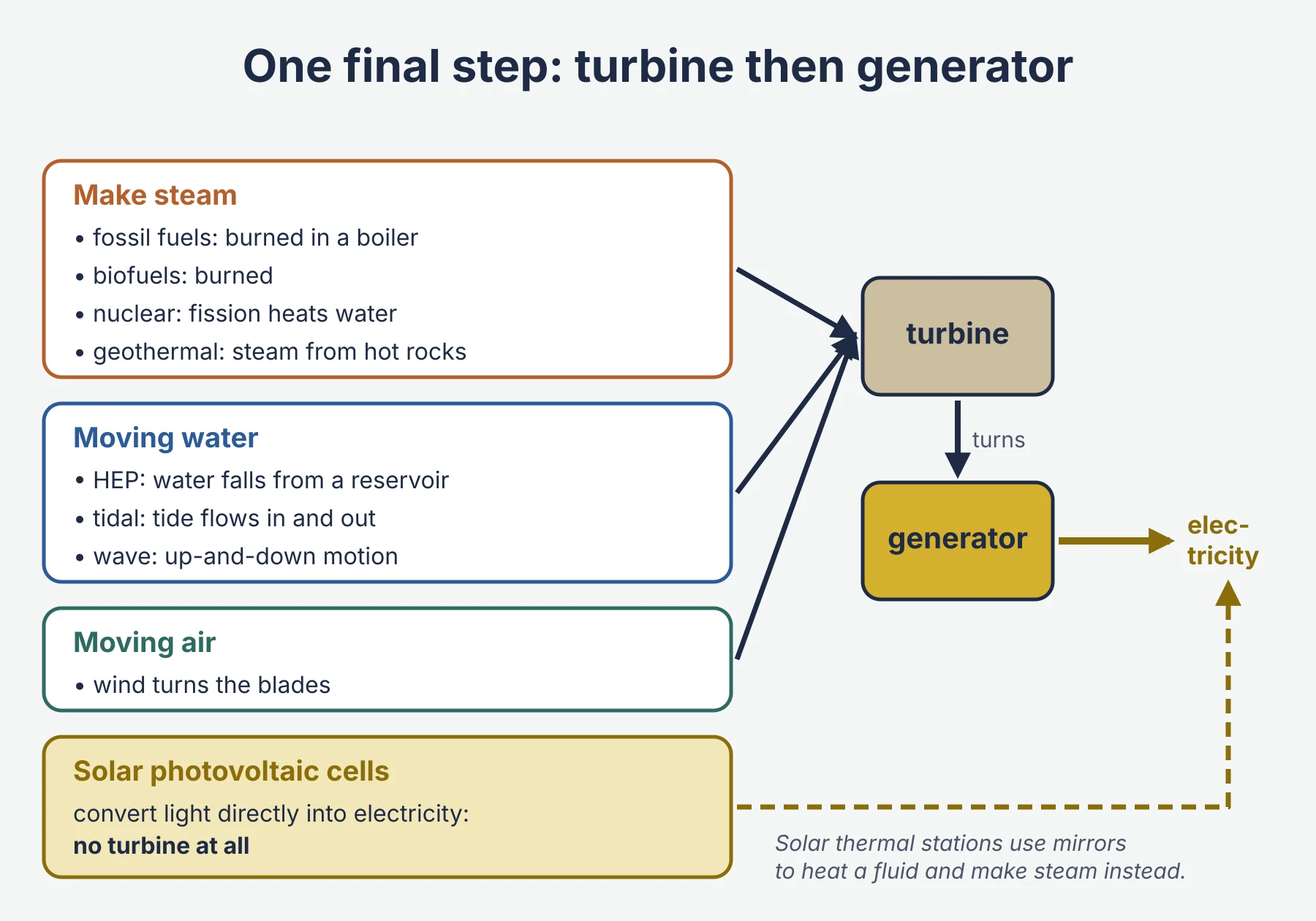
Almost every method uses the same final step: something turns a turbine, and the turbine turns a generator that produces electricity. What differs is what turns the turbine.
Resources that produce steam
- Fossil fuels: coal, oil or gas is burned in a boiler; the heat turns water into high-pressure steam, which turns a turbine. Gas can also be burned in a gas turbine directly.
- Biofuels: biomass and wood are burned like coal; biogas and bioethanol can be burned to drive a turbine or an engine attached to a generator.
- Nuclear power: uranium fuel undergoes nuclear fission in a reactor, releasing heat. The heat produces steam, which turns a turbine.
- Geothermal power: in tectonically active areas, wells bring hot water and steam up from heated rocks, or cold water is pumped down to be heated. The steam turns a turbine and the cooled water is returned underground.
Resources that use moving water
- HEP: a dam holds water in a reservoir. Water released through pipes falls to the turbines at the base of the dam, turning them.
- Tidal power: a barrage across an estuary, or turbines on the sea bed, uses the flow of water as the tide rises and falls.
- Wave power: the up-and-down motion of waves either pushes air through a turbine in a chamber or moves floating devices linked to generators.
Resources that need no steam
- Wind power: the wind turns blades attached to a shaft that drives a generator.
- Solar power: photovoltaic (solar) cells convert light directly into electricity, with no turbine at all. In solar thermal power stations, mirrors focus sunlight to heat a fluid that produces steam.
Benefits and limitations in brief
| Resource | Key benefit | Key limitation |
|---|---|---|
| Coal | Large reserves; reliable output on demand | Most carbon dioxide per unit of energy; sulfur dioxide causes acid rain |
| Oil | Easy to transport; essential for vehicles | Spills; finite; price swings |
| Natural gas | Less carbon dioxide than coal; flexible output | Still a fossil fuel; methane leaks are a greenhouse gas |
| Nuclear | Very little carbon dioxide in use; continuous output | Radioactive waste; high building and decommissioning costs; accident risk |
| Biofuels | Can use waste; renewable if replanted | Crops compete with food for land; burning releases pollutants |
| Geothermal | Continuous; small land area | Only in tectonically active areas |
| HEP | Reliable and controllable | Dams flood land and displace people |
| Tidal | Tides are predictable | Few suitable sites; affects estuary habitats |
| Wave | Large potential on exposed coasts | Storm damage; variable output |
| Solar | No fuel; no emissions in use | No output at night; large areas for big schemes |
| Wind | No fuel; land below can be farmed | Intermittent; noise and visual objections |
Factors affecting demand for energy
For each factor, say what changes and why it changes energy use.
- Transport: more cars, lorries and flights increase demand for petroleum fuels; car ownership rises as roads and incomes grow.
- Personal and national wealth: wealthier households own more appliances, heating, air conditioning and vehicles, so energy use per person is higher in richer countries.
- Climate: places with cold winters need heating and places with hot summers need cooling, so extreme climates raise demand.
- Human population size: more people need more energy for homes, transport and food production, even if use per person stays the same.
- Industry: manufacturing, such as steel and cement production, uses large amounts of energy, so industrialising countries see demand rise quickly.
- Disruption to supply: wars, natural disasters or strikes that cut supplies raise prices and force people and businesses to use less or switch fuels.
- Unreliable supply: frequent power cuts push households and businesses towards back-up generators or their own solar panels, changing which resources they use.
- Scarcity of resources: when a resource becomes scarce, its price rises; demand for it falls and demand for alternatives grows.
Worked example 1: interpreting an electricity mix
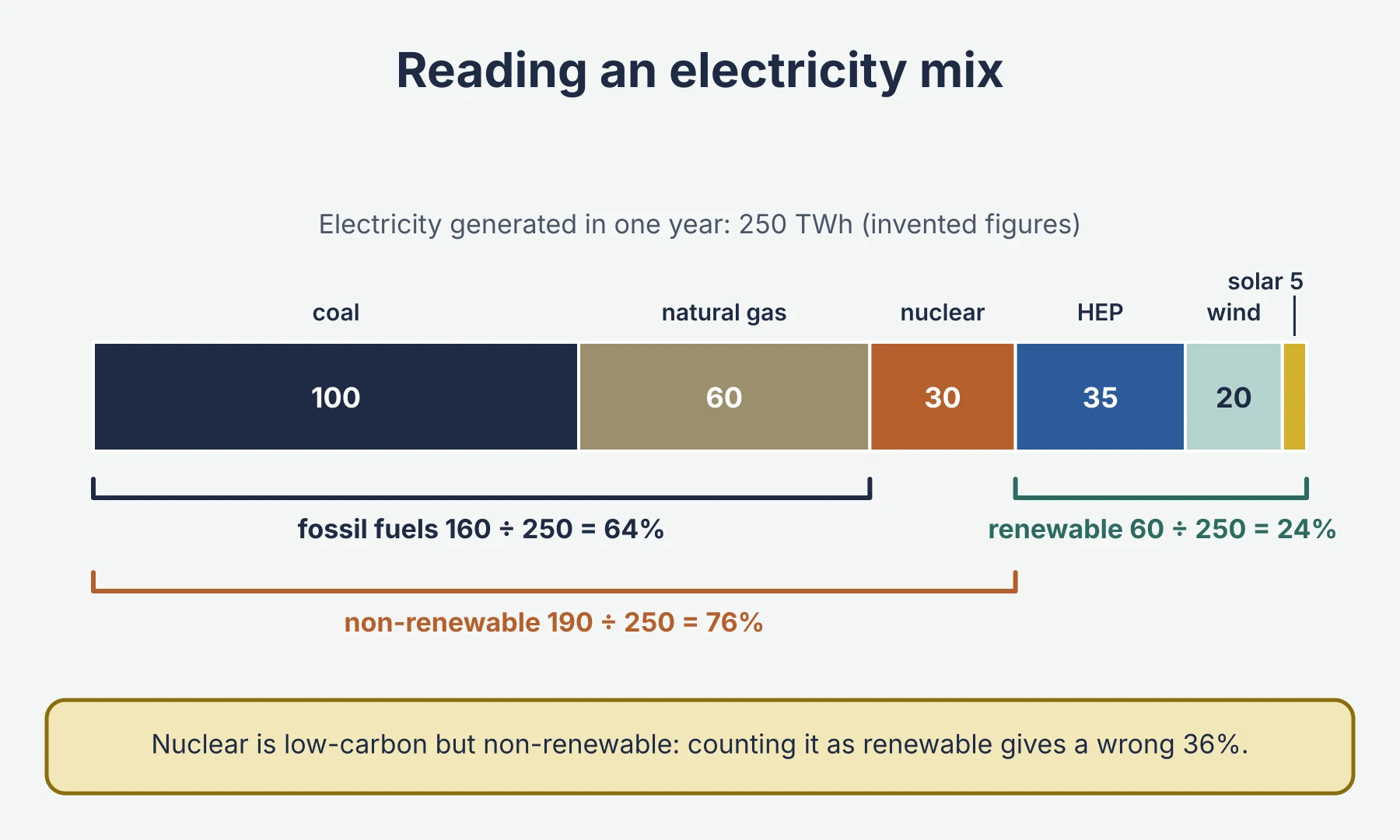
A country generates 250 terawatt-hours (TWh) of electricity in a year: coal 100, natural gas 60, nuclear 30, HEP 35, wind 20, solar 5. (Figures invented for practice.)
- Renewable share: (35 + 20 + 5) ÷ 250 × 100 = 60 ÷ 250 × 100 = 24%.
- Fossil fuel share: (100 + 60) ÷ 250 × 100 = 64%.
- Non-renewable share: (100 + 60 + 30) ÷ 250 × 100 = 76%.
A common error is to count nuclear as renewable because it is low-carbon; that would give 36% renewable and lose the mark.
Worked example 2: an “explain” answer on demand
Question: Explain why energy demand per person is usually higher in a wealthy country than in a low-income country.
Model answer: Wealthier households can afford more electrical appliances, such as fridges, washing machines and computers, and more homes have central heating or air conditioning, so each person uses more electricity. More people own cars and travel by air, increasing demand for petroleum. Wealthy countries also have more energy-intensive services and industry. (Three developed reasons, each linking wealth to a specific use of energy.)
Common mistakes
- Calling nuclear power renewable.
- Describing coal as formed from sea creatures, or oil from trees.
- Leaving out the lack of oxygen when explaining why the remains did not decay.
- Saying solar panels drive a turbine.
- Stating that population size alone explains demand, without noting wealth and industry.
Exam technique
Describe the formation of a fuel in sequence: organisms, burial without oxygen, heat and pressure over millions of years. Classify with the syllabus’s two categories. For describe how electricity is generated, give the chain from energy source to turbine to generator. For discuss, pair each benefit with a limitation and refer to the place in the question.
Condense this page with the Energy resources revision notes, practise with the Energy resources practice questions, then continue to the Conservation and management of energy resources study guide.
Related resources
-
Revision notes
Cambridge IGCSE Environmental Management: Land — Revision Notes
Recall notes on soils and crop growth, food production and soil erosion for Topic 2 Land of Cambridge IGCSE Environmental Management 0680, 2027-2029 series.
Environmental Management · Cambridge · IGCSE
Revise topic -
Practice questions
Cambridge IGCSE Environmental Management (0680): Energy resources – Practice Questions
Original questions with answers on fossil fuel formation, classifying energy resources, electricity generation and energy demand for Cambridge IGCSE 0680.
Environmental Management · Cambridge · IGCSE
Try questions -
Revision notes
Cambridge IGCSE Environmental Management (0680): Energy resources – Revision Notes
Recall notes on fossil fuel formation, classifying energy resources, generating electricity and energy demand for 1.4 Energy resources, Cambridge IGCSE 0680.
Environmental Management · Cambridge · IGCSE
Revise topic
Get free revision emails (optional)
Occasional emails with practice questions, worked explanations and links to free resources for the qualification and subjects you choose. No spam, and you can unsubscribe from any email. The free tools on this site never need an email.