
Study Guides
Cambridge IGCSE Environmental Management (0680): Conservation and management of energy resources
The eight energy management strategies, hydrogen fuels and heat pumps at home, city and national scale, with worked energy calculations, for IGCSE 0680.
- Subject
- Environmental Management
- Level
- IGCSE
- Topic
- Topic 1 – Natural Resources
- Author
- Marlbridge Academic Team
- Updated
- Reviewed by
- Azam Siddique (what this means)
Aligned to Cambridge IGCSE Environmental Management (0680), 2027-2029. Official specification .
Syllabus page (what it covers and how it is assessed): Cambridge IGCSE Environmental Management.
Syllabus points this page covers
0680
- 1.5 Conservation and management of energy resources
Found an error? Report a correction.
Need help with this topic? Request a free trial class for IGCSE Environmental Management (0680).
Sub-topic 1.5 asks how energy can be used more carefully so that finite resources last longer, bills fall and pollution is reduced. It lists eight strategies and four new energy resources, then asks you to discuss their benefits and limitations. The energy management and fracking guide summarises each strategy in a table; this page shows how the strategies work at different scales, how to put numbers on their savings, and how to write a balanced discussion.
What the syllabus asks you to do
- 1.5.1 Describe strategies for managing energy resources, limited to: reducing consumption; insulation; energy-efficient devices, including vehicles and electrically propelled vehicles; exploiting existing energy resources; education on energy conservation; transport policies; battery storage; development of new energy resources.
- 1.5.2 Describe the development of new energy resources, limited to: blue hydrogen fuel (produced from natural gas); green hydrogen fuel (produced using renewable resources); ground source heat pumps (transfer of heat from the ground for heating); air source heat pumps (transfer of heat from the air for heating).
- 1.5.3 Discuss the benefits and limitations of these strategies.
Two ways to manage energy
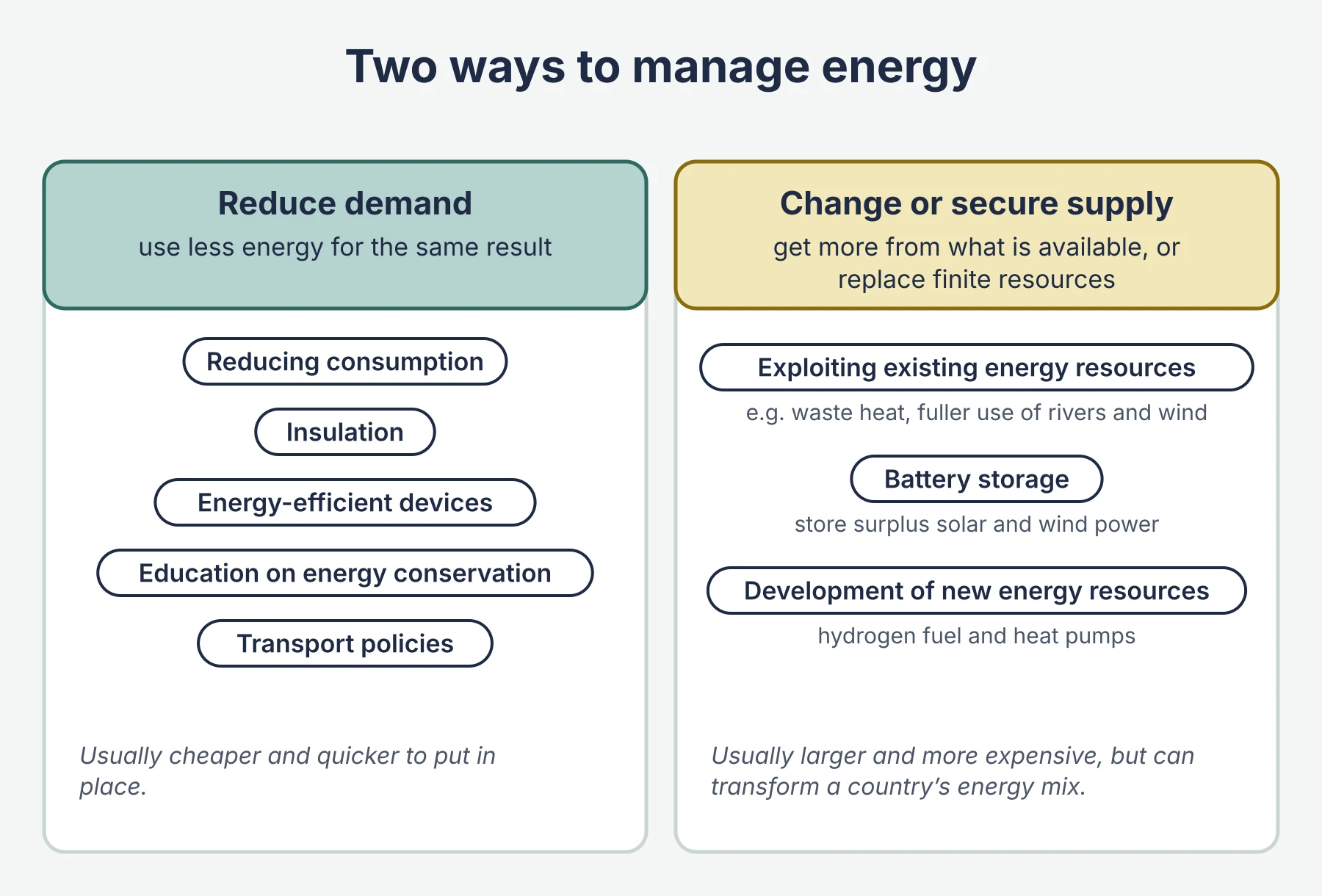
Every strategy does one of two things:
- Reduces demand: using less energy for the same result (reducing consumption, insulation, energy-efficient devices, education, transport policies).
- Changes or secures supply: getting more from what is available or replacing finite resources (exploiting existing resources, battery storage, new energy resources).
Sorting strategies this way helps in discuss questions. Demand-side strategies are usually cheaper and quicker; supply-side strategies are usually larger and more expensive but can transform a country’s energy mix.
The strategies at three scales
| Strategy | Household | Town or business | National government |
|---|---|---|---|
| Reducing consumption | Switch off standby devices; shorter showers; lower thermostat | Turn off office lighting at night | Campaigns asking people to cut use at peak times |
| Insulation | Loft insulation, double glazing, draught excluders | Insulating schools and offices | Building regulations; grants for insulation |
| Energy-efficient devices | LED bulbs; efficient fridges; an electric car | Efficient motors and lighting in factories; electric buses | Efficiency standards for appliances and vehicles |
| Exploiting existing resources | Using a wood-burning stove with locally available wood | Using waste heat from a factory to warm nearby buildings | Making fuller use of existing rivers, fields and power stations |
| Education | Reading energy labels | Staff training; energy displays in schools | National awareness campaigns; energy labelling laws |
| Transport policies | Choosing to cycle or use buses | Park-and-ride; bus lanes; car sharing | Rail investment; fuel taxes; low-emission zones |
| Battery storage | Storing solar power from the roof for the evening | Batteries for a hospital or data centre | Large grid batteries that smooth renewable output |
| New energy resources | Fitting a heat pump | Hydrogen buses for a city fleet | Funding green hydrogen production |
Using the scale named in a question is often what separates a general answer from a full-mark one.
How the less obvious strategies work
Electrically propelled vehicles. These include electric cars, buses, trains, trams and bicycles. They have no exhaust, so air quality in cities improves. Whether they reduce carbon dioxide overall depends on how the electricity that charges them is generated: they are most effective where the grid uses renewable resources.
Exploiting existing energy resources. This means getting more out of resources and infrastructure already available, rather than developing something entirely new: recovering more oil and gas from fields already in production, using waste heat from power stations or factories, or making greater use of a country’s existing rivers, sunshine or wind. It is often cheaper than building new infrastructure, but where it extends the use of fossil fuels it also extends their emissions.
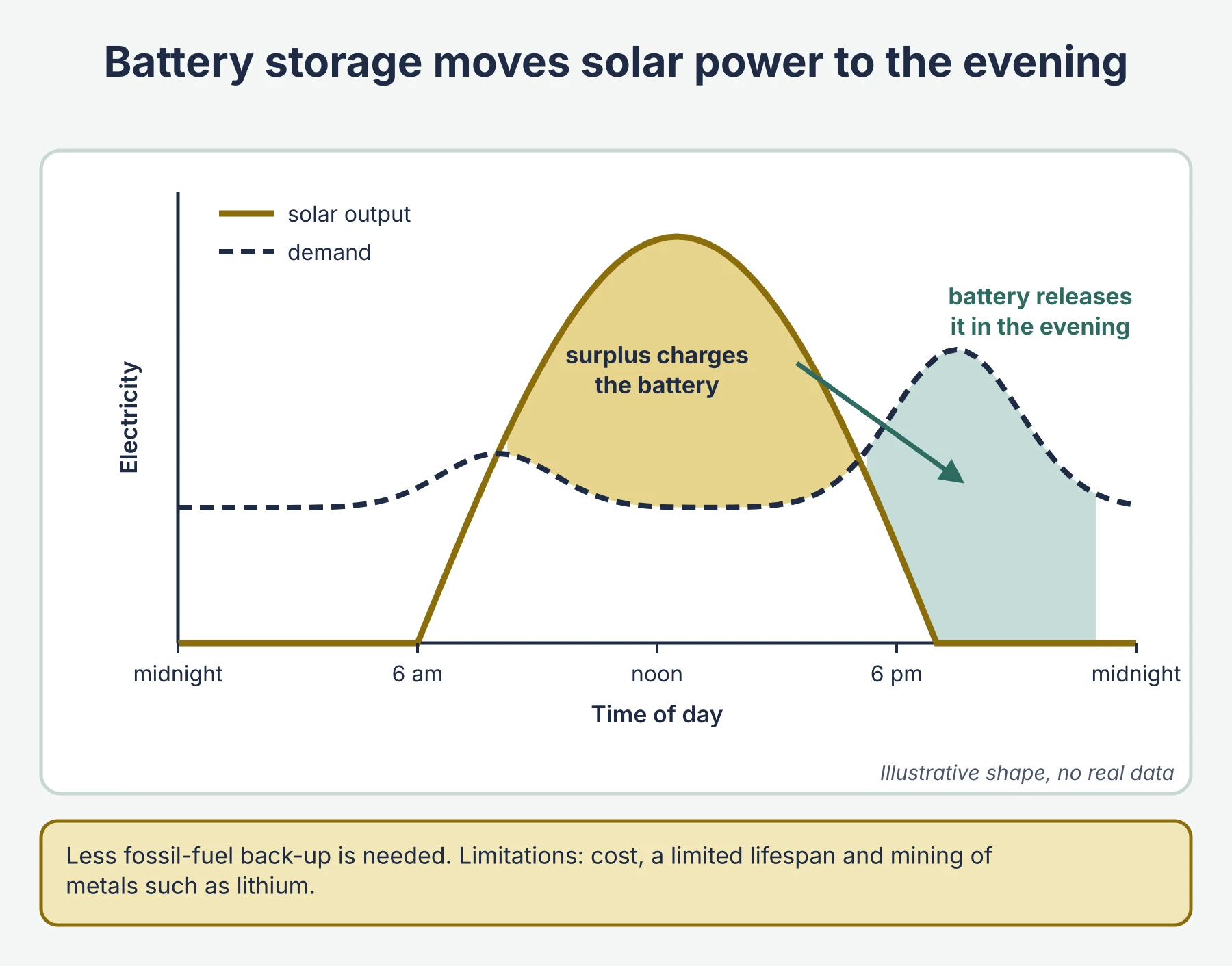
Battery storage. Solar and wind produce electricity when the sun shines or the wind blows, not necessarily when people need it. Batteries store the surplus and release it later, so less fossil-fuel back-up is required. Their limitations are cost, a limited lifespan and the mining of metals such as lithium to make them.
Transport policies. Transport is a major user of petroleum, so policies that move people from cars to buses, trains and bicycles reduce demand. Congestion charges and fuel taxes raise the cost of driving; bus lanes and cycle lanes make the alternatives faster and safer. Policies work best when good alternatives exist; otherwise they are resented.
New energy resources (1.5.2)
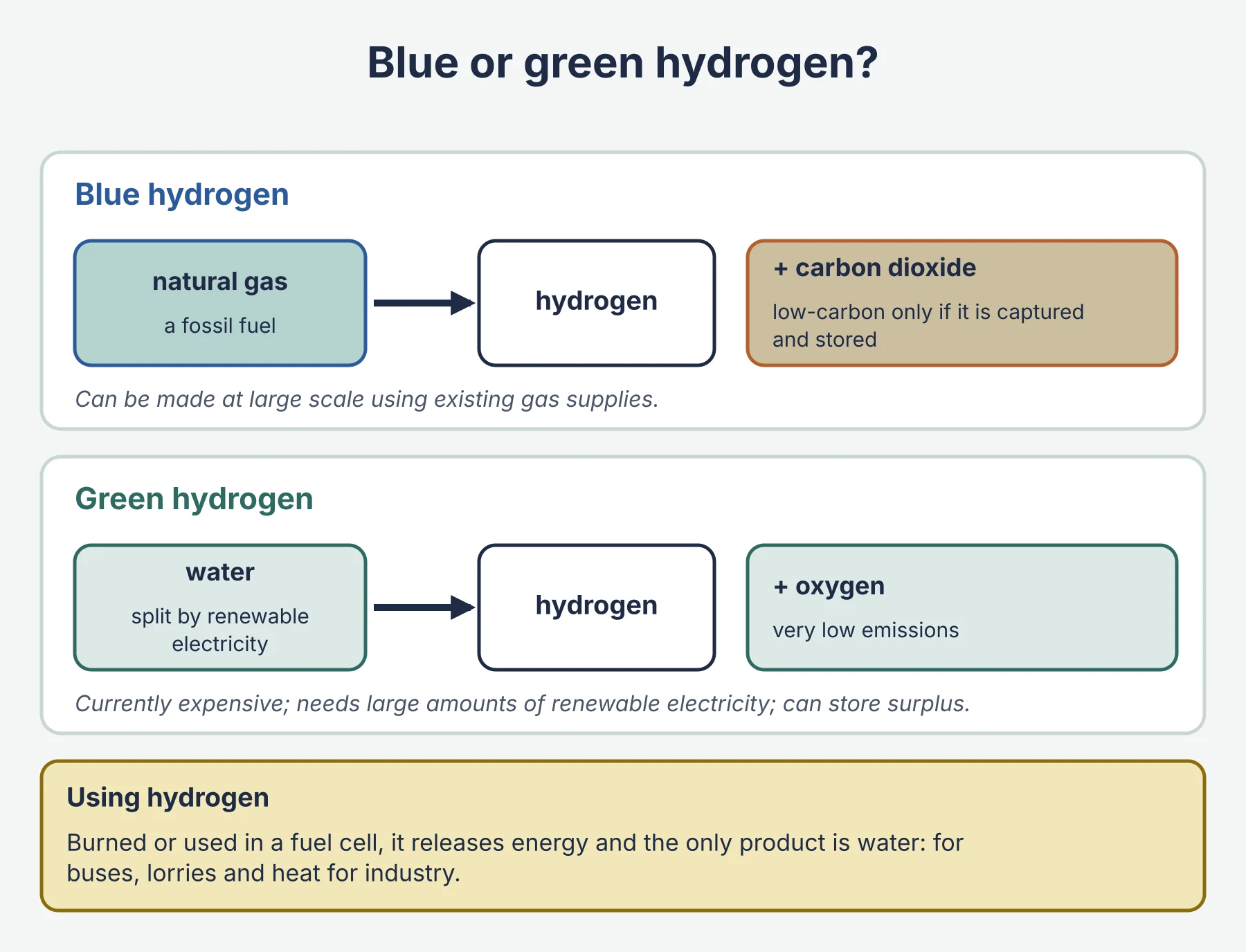
Hydrogen fuel releases energy in a fuel cell or when burned, and the only product is water. It can power vehicles, especially buses and lorries, and supply heat for industry.
- Blue hydrogen is produced from natural gas. The process releases carbon dioxide, so it is only low-carbon if that carbon dioxide is captured and stored. It can be produced at large scale using existing gas supplies.
- Green hydrogen is produced using renewable resources: renewable electricity splits water into hydrogen and oxygen. It has very low emissions, but is currently expensive and needs large amounts of renewable electricity. It also offers a way to store surplus renewable electricity as fuel.
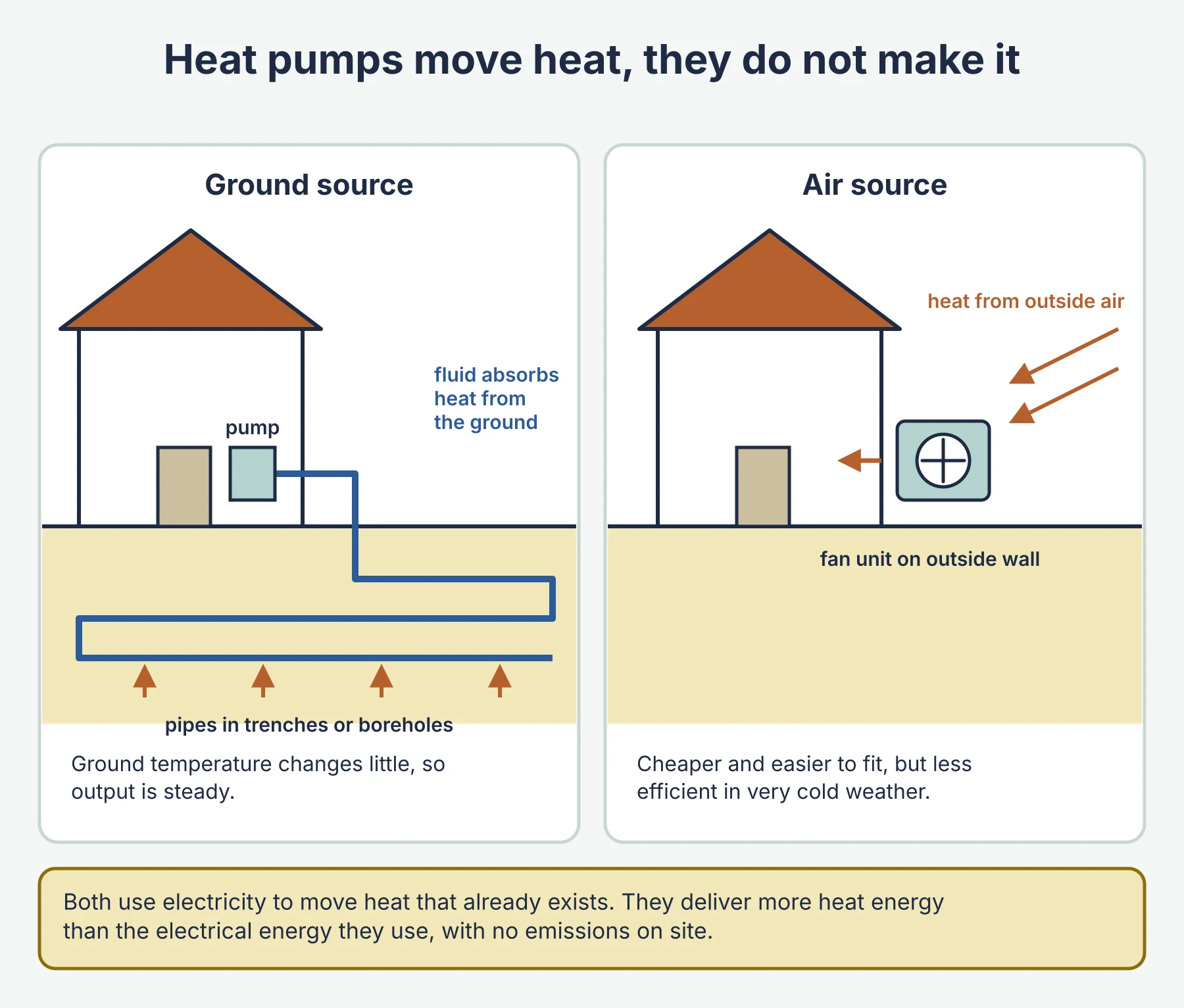
Heat pumps move heat that already exists in the environment into a building.
- A ground source heat pump circulates fluid through pipes buried in trenches or boreholes; the fluid absorbs heat from the ground, and the pump concentrates it to heat the building and its water. Ground temperature changes little through the year, so output is steady.
- An air source heat pump absorbs heat from outside air through a fan unit on an outside wall. It is cheaper and easier to fit than a ground source pump but less efficient in very cold weather.
Both use electricity to run, but deliver more heat energy than the electrical energy they use, and produce no emissions on site.
Worked example 1: comparing insulation options
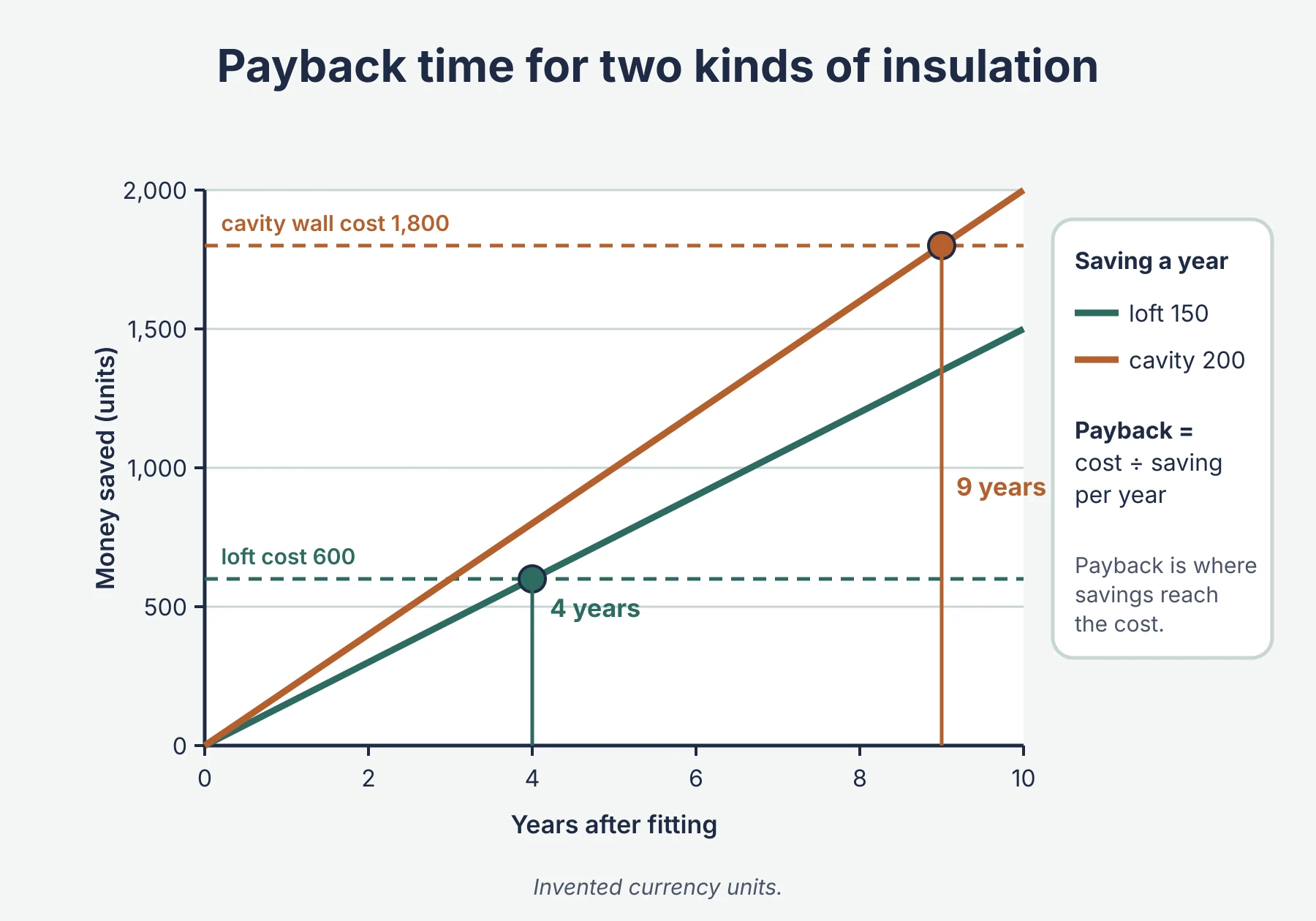
A household is choosing between two improvements. (Costs are in invented currency units.)
| Improvement | Cost | Saving per year |
|---|---|---|
| Loft insulation | 600 | 150 |
| Cavity wall insulation | 1,800 | 200 |
Payback time = cost ÷ saving per year.
- Loft: 600 ÷ 150 = 4 years.
- Cavity wall: 1,800 ÷ 200 = 9 years.
Loft insulation repays its cost sooner, so it is the better first choice for a household with limited money. Cavity wall insulation still saves more each year, so over a long period both are worthwhile.
Worked example 2: energy-efficient lighting
A school replaces ten 60 W bulbs with ten 8 W LED bulbs. The lights are on for 5 hours a day.
- Power saved: 10 × (60 − 8) = 520 W.
- Energy saved per day: 520 W × 5 h = 2,600 Wh = 2.6 kWh.
- Energy saved per year (365 days): 2.6 × 365 = 949 kWh.
- Percentage reduction for lighting: 52 ÷ 60 × 100 = 86.7%.
Worked example 3: heat pump versus electric heater
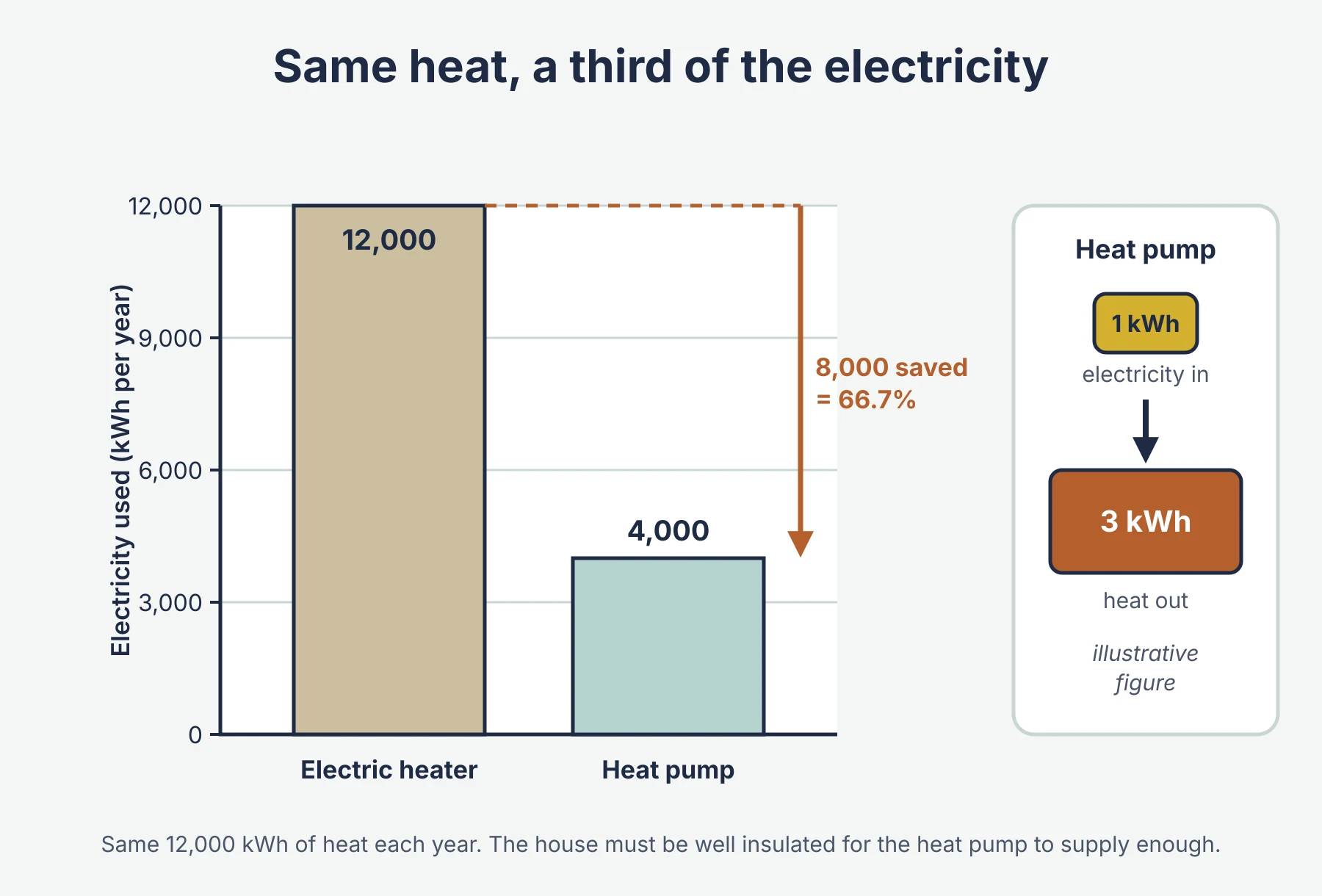
A house needs 12,000 kWh of heat a year. Assume the heat pump delivers 3 kWh of heat for every 1 kWh of electricity (an illustrative figure).
- Electric heater: 12,000 kWh of electricity.
- Heat pump: 12,000 ÷ 3 = 4,000 kWh of electricity.
- Saving: 8,000 kWh, which is 8,000 ÷ 12,000 × 100 = 66.7%.
The house must be well insulated for the heat pump to supply enough heat, which shows how strategies work best in combination.
Writing a discuss answer
Question: Discuss the benefits and limitations of encouraging people to buy electric cars.
- Benefit: no exhaust emissions, so air pollution in cities falls and health improves.
- Benefit: reduces demand for imported petroleum, improving energy security.
- Limitation: if charging electricity comes from coal, carbon dioxide emissions are moved to the power station rather than removed.
- Limitation: high purchase price and too few charging points discourage buyers.
- Limitation: batteries require mined metals, with the extraction impacts described in 1.2.
- Judgement: most effective when combined with renewable electricity, charging networks and transport policies that also improve public transport.
Common mistakes
- Describing heat pumps as generating heat from nothing: they transfer existing heat using electricity.
- Writing that electric vehicles cause no pollution at all.
- Mixing up blue and green hydrogen.
- Listing strategies without saying how each saves energy.
- Forgetting that education and transport policies are strategies in their own right.
Exam technique
Describe a strategy: what it is, an example and how it saves energy. Discuss: benefits and limitations, ideally at the scale in the question, then a judgement. For calculate, set out the formula, substitute and give units.
Revise with the Conservation and management of energy resources revision notes, practise with the Conservation and management of energy resources practice questions, and continue to the Fracking study guide.
Related resources
-
Revision notes
Cambridge IGCSE Environmental Management: Land — Revision Notes
Recall notes on soils and crop growth, food production and soil erosion for Topic 2 Land of Cambridge IGCSE Environmental Management 0680, 2027-2029 series.
Environmental Management · Cambridge · IGCSE
Revise topic -
Practice questions
Cambridge IGCSE Environmental Management (0680): Conservation and management of energy resources – Practice Questions
Original questions with answers on energy management strategies, payback time, hydrogen fuels, heat pumps and transport policies for Cambridge IGCSE 0680.
Environmental Management · Cambridge · IGCSE
Try questions -
Revision notes
Cambridge IGCSE Environmental Management (0680): Conservation and management of energy resources – Revision Notes
Condensed notes on energy management strategies, blue and green hydrogen and heat pumps, with payback and saving calculations, for Cambridge IGCSE 0680.
Environmental Management · Cambridge · IGCSE
Revise topic
Get free revision emails (optional)
Occasional emails with practice questions, worked explanations and links to free resources for the qualification and subjects you choose. No spam, and you can unsubscribe from any email. The free tools on this site never need an email.