
Study Guides
Cambridge IGCSE Environmental Management (0680): Fracking
The syllabus definition of fracking, why shale needs it, and how to discuss its benefits and limitations for different stakeholders in Cambridge IGCSE 0680.
- Subject
- Environmental Management
- Level
- IGCSE
- Topic
- Topic 1 – Natural Resources
- Author
- Marlbridge Academic Team
- Updated
- Reviewed by
- Azam Siddique (what this means)
Aligned to Cambridge IGCSE Environmental Management (0680), 2027-2029. Official specification .
Syllabus page (what it covers and how it is assessed): Cambridge IGCSE Environmental Management.
Syllabus points this page covers
0680
- 1.6 Fracking
Found an error? Report a correction.
Need help with this topic? Request a free trial class for IGCSE Environmental Management (0680).
Sub-topic 1.6 is the shortest in Topic 1, with just two statements, but it is built for extended writing. Almost every fracking question is a version of “discuss the benefits and limitations”, usually set around a source describing a proposed site. The content is not hard; the skill is organising it into a balanced, well-supported argument that uses the details you are given. The energy management and fracking guide lists the main benefits and limitations; this page explains the reasoning behind each and shows how to build a full answer.
What the syllabus asks you to do
- 1.6.1 Define fracking as the extraction of natural gas or petroleum from shale rock by hydraulic fracturing.
- 1.6.2 Discuss the benefits and limitations of fracking.
Unpacking the definition
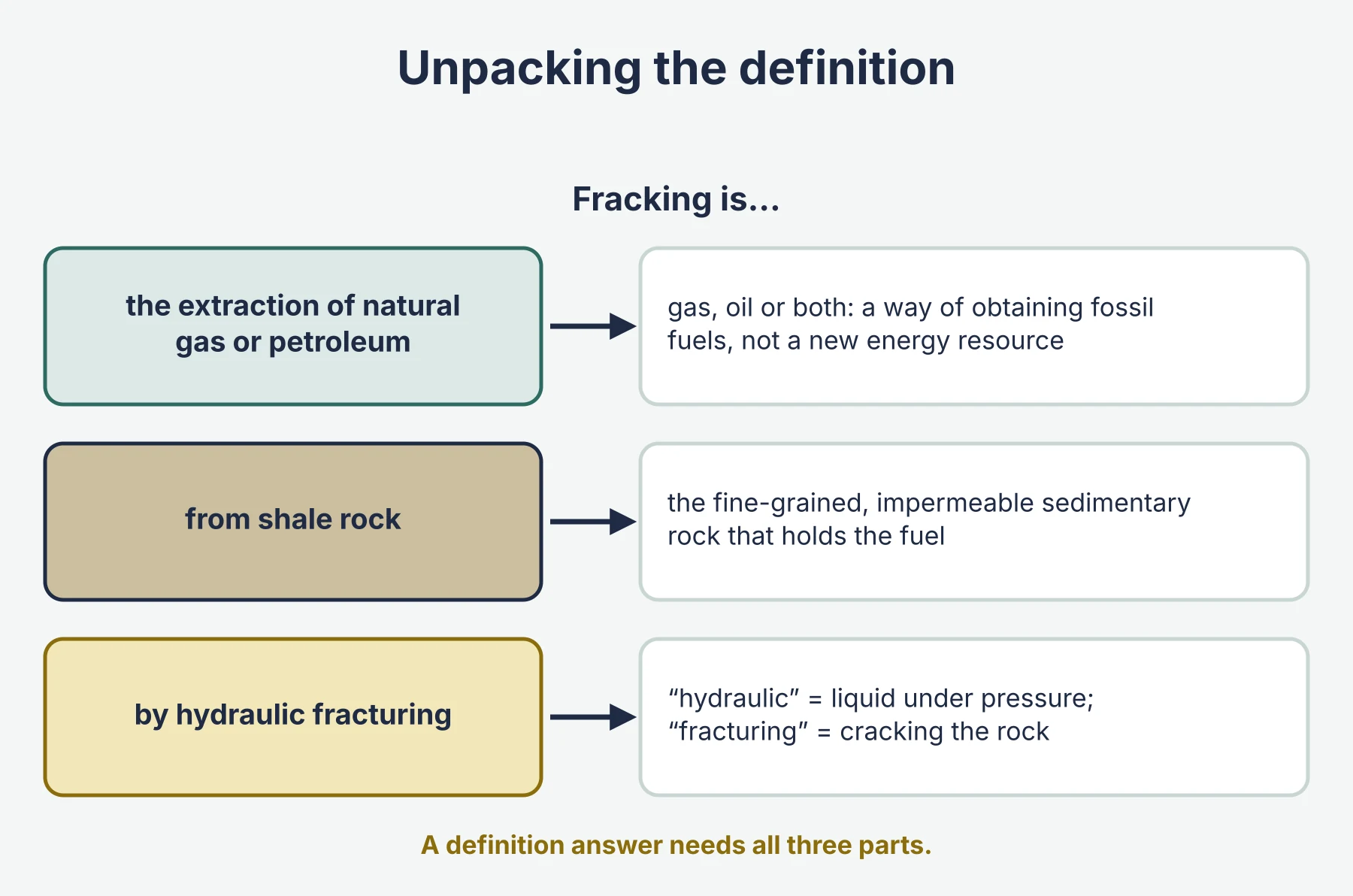
Each part of the definition carries meaning and should appear in your answer:
- Extraction of natural gas or petroleum: fracking can produce gas, oil or both. It is a way of obtaining fossil fuels, not a new energy resource.
- From shale rock: the fuel is held inside shale, the fine-grained sedimentary rock from 1.1.
- By hydraulic fracturing: “hydraulic” means using liquid under pressure; “fracturing” means cracking the rock.
Why shale needs to be fractured
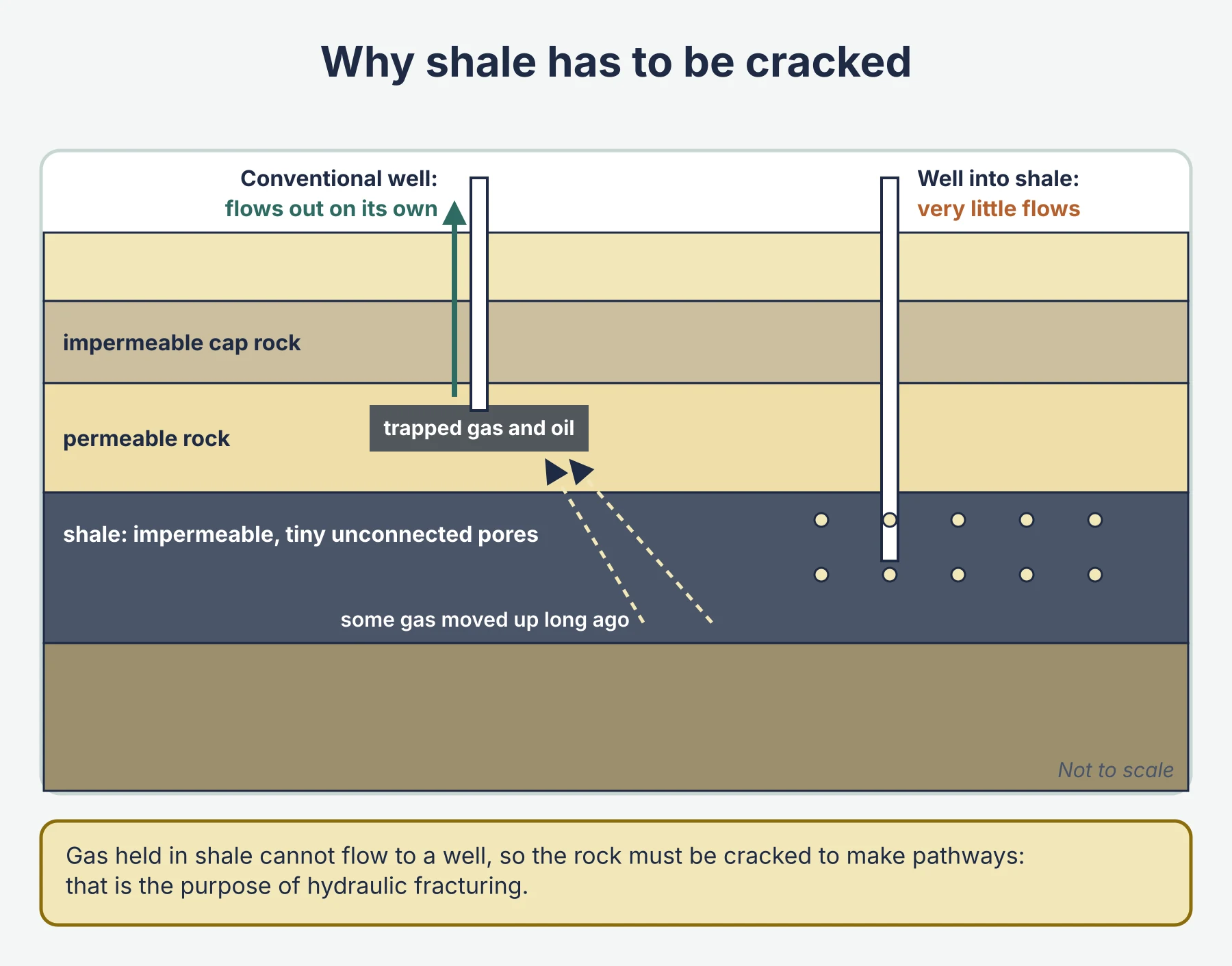
Sub-topics 1.1 and 1.4 explain why fracking exists. Oil and gas form from organic matter buried in fine mud, which becomes shale. In a conventional deposit, some of the oil and gas has moved out of the shale and up through permeable rock until it is trapped under impermeable rock; a well drilled into that permeable reservoir lets the fuel flow out on its own.
Much of the gas, however, never leaves the shale. Shale is impermeable: its pores are tiny and not connected, so the gas cannot flow through it towards a well. Drilling into shale releases very little. Cracking the rock creates pathways for the gas to escape. That is the purpose of hydraulic fracturing.
How the process works
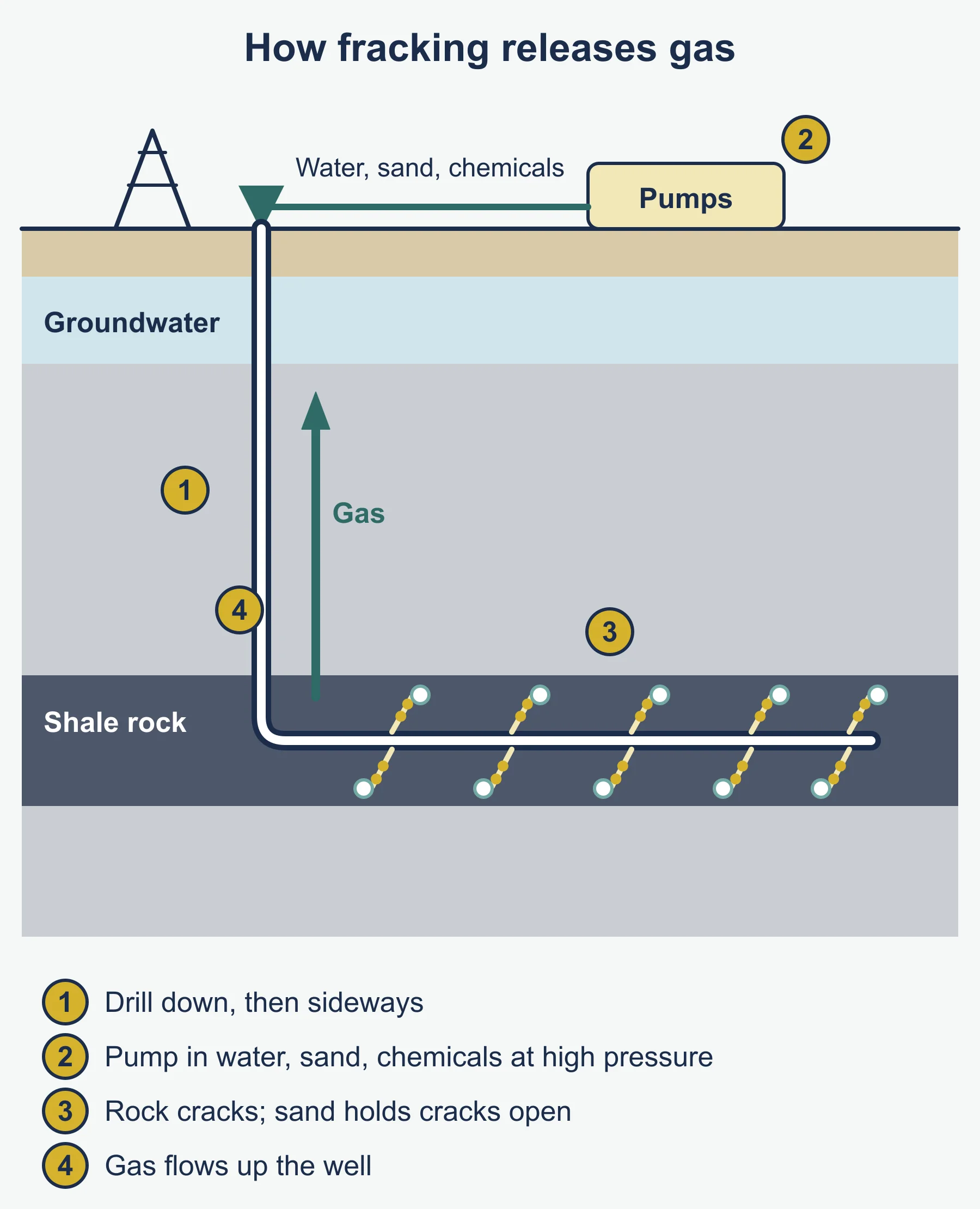
- Drilling: a well is drilled vertically down to the shale layer, then turned to run horizontally through it, so that a long section of the well is in contact with the shale.
- Sealing: the well is lined with steel casing and cement, especially where it passes through layers holding ground water.
- Fracturing: fracking fluid, mostly water mixed with sand and chemicals, is pumped down at very high pressure. The pressure cracks the shale.
- Holding the cracks open: the sand grains lodge in the cracks so they stay open when the pressure is released.
- Flowback and production: some of the fluid returns to the surface as wastewater, and gas or oil flows up the well to be collected.
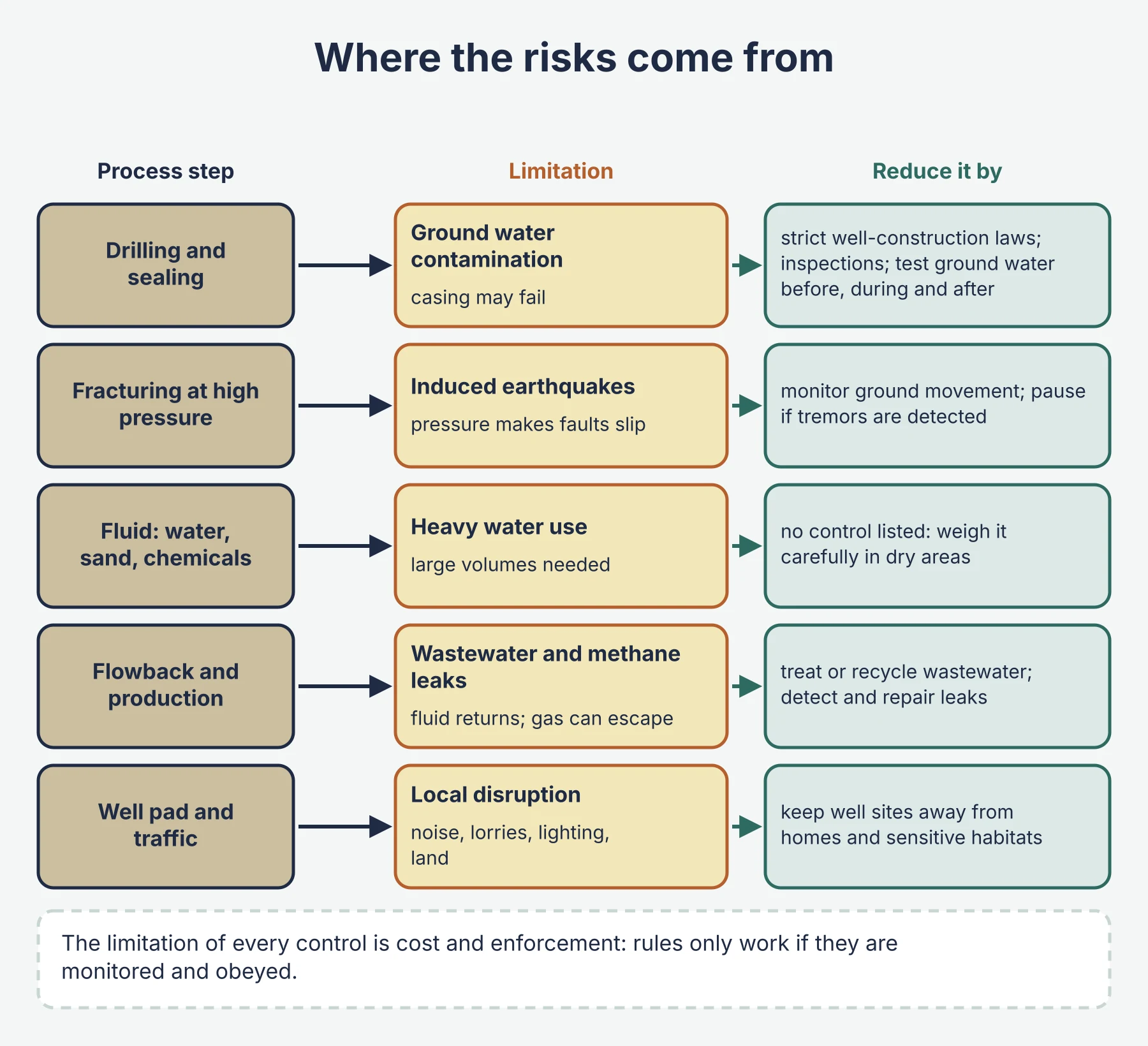
This sequence is the source of nearly every limitation. Large volumes of water are used at step 3, chemicals are involved at steps 3 and 5, and pressure is applied to rock deep underground.
Benefits, explained
| Benefit | Why it happens | Who gains |
|---|---|---|
| Greater energy security | Gas and oil produced within the country reduce reliance on imports, which can be disrupted or rise in price | The nation; consumers |
| Jobs and income | Drilling, transport and supply businesses employ workers; companies pay taxes and landowners may receive payments | Local workers and businesses; government |
| Lower energy prices | Large new supplies can reduce the price of gas | Households and industry |
| Lower emissions than coal | Burning natural gas releases less carbon dioxide and far less sulfur dioxide than burning coal for the same energy | The atmosphere, if gas replaces coal |
| Uses existing networks | Gas can be fed into pipelines and power stations already built | Energy companies; government |
| Access to new reserves | Fuel that could not be reached by conventional wells becomes available | Energy companies; the nation |
Limitations, explained
| Limitation | Why it happens | Who bears it |
|---|---|---|
| Induced earthquakes | High-pressure fluid injected underground can make faults slip, causing small tremors | Local residents; buildings |
| Ground water contamination | If casing fails, or fluid is spilled at the surface, chemicals or gas can reach aquifers | Farmers; people who use wells |
| Heavy water use | Each well needs large volumes of water, competing with farms and homes in dry areas | Local water users |
| Wastewater | Flowback contains chemicals and salts and must be stored, treated or disposed of safely | Local environment |
| Methane leakage | Methane can escape from wells and pipes; it is a powerful greenhouse gas | The global climate |
| Continued fossil fuel use | Cheap gas can delay investment in renewables and energy conservation | Future generations |
| Local disruption | Noise, lorry traffic, lighting, visual impact and loss of land at the well pad | Local communities; tourism |
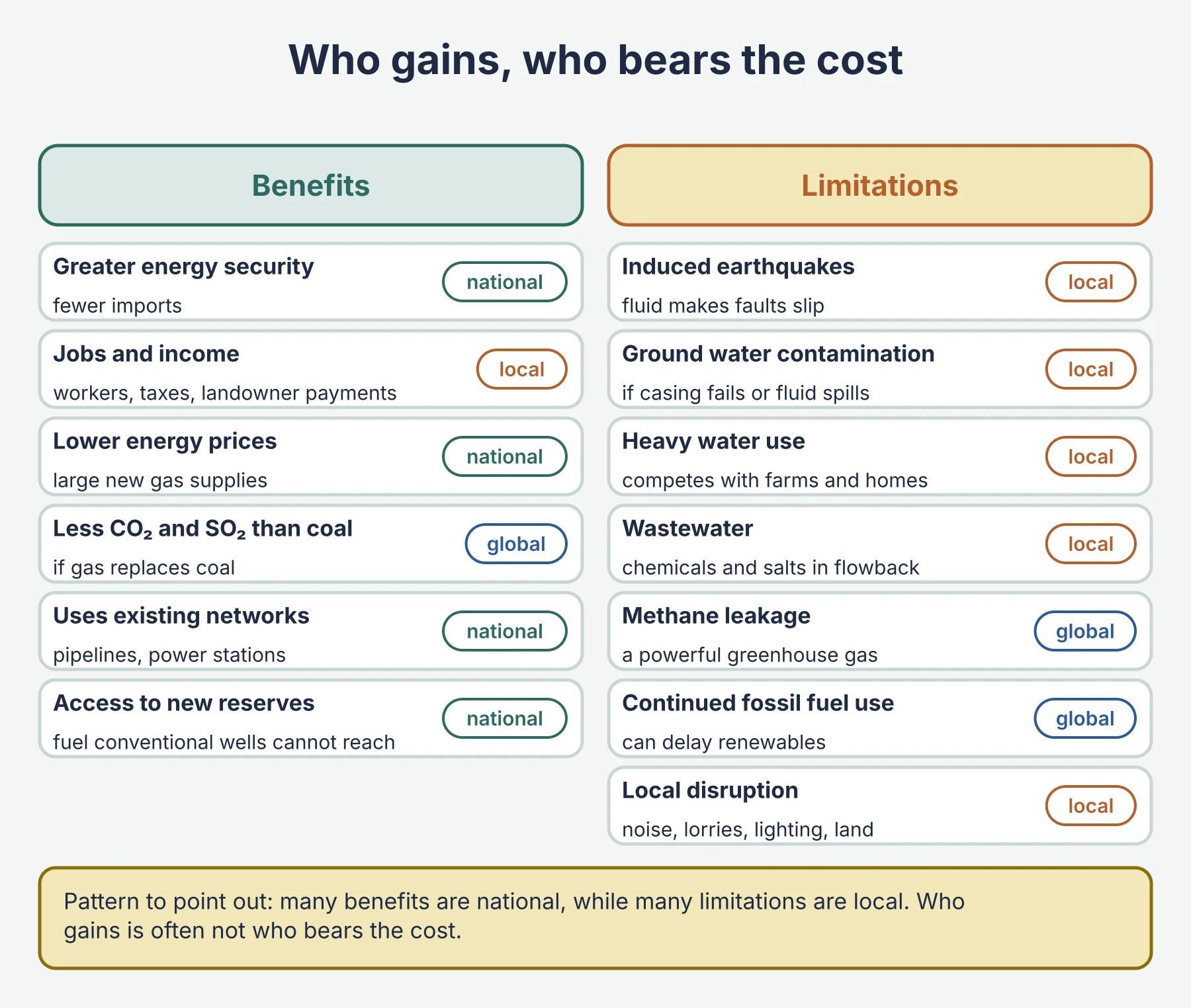
Notice the pattern: many benefits are national (energy security, tax), while many limitations are local (tremors, traffic, water). Pointing this out is an effective way to show understanding in a discuss answer.
Managing the limitations
A balanced answer often recognises that limitations can be reduced, though not removed:
- Strict laws on well construction, with inspections to make sure casing is sound.
- Monitoring of ground movement, with operations paused if tremors are detected.
- Testing of ground water before, during and after fracking.
- Treating or recycling wastewater rather than releasing it.
- Keeping well sites away from homes and sensitive habitats.
- Detecting and repairing methane leaks.
The limitation of all of these is cost and enforcement: rules only work if they are monitored and obeyed.
Worked example 1: putting the water use in context
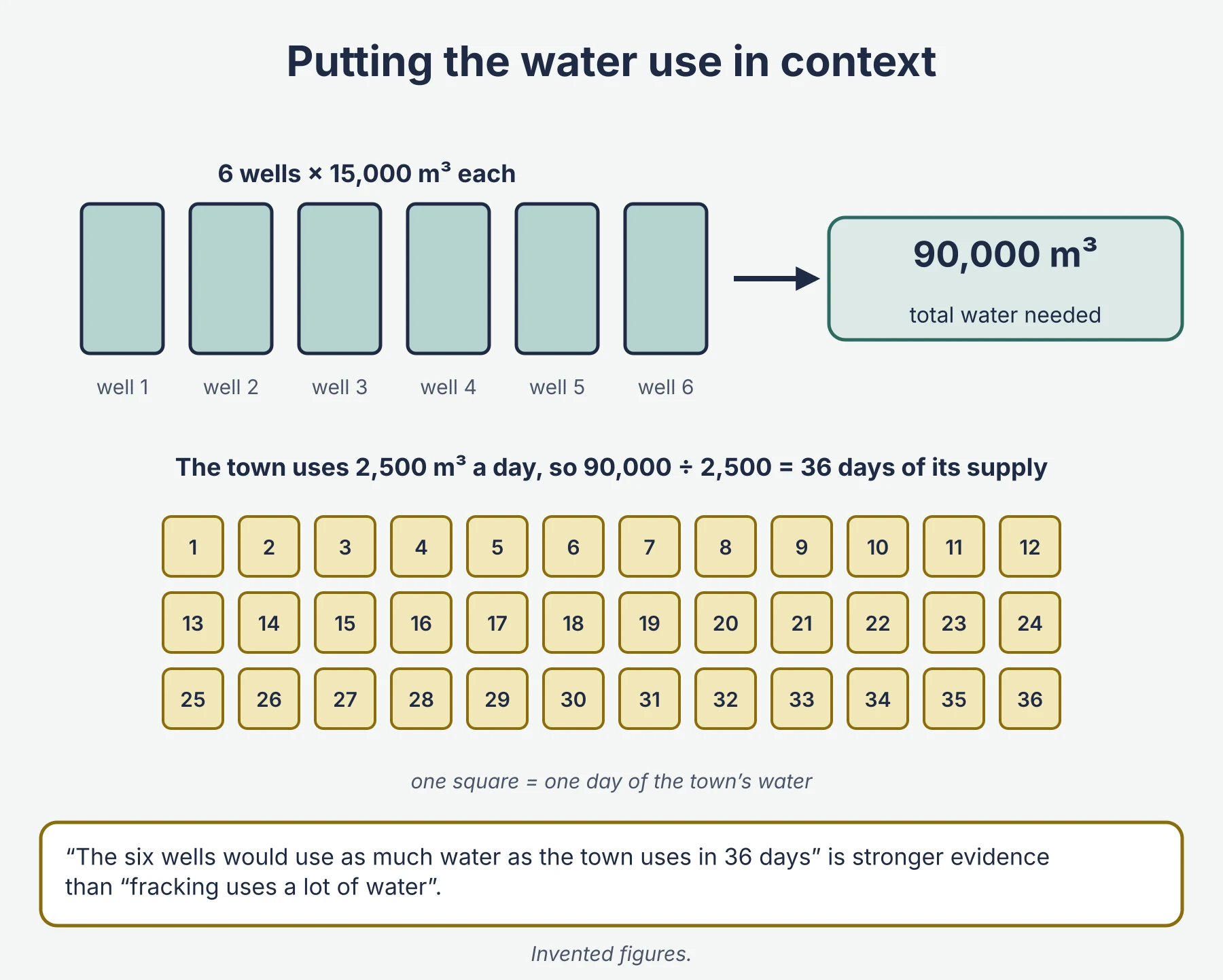
A proposed site has six wells. Each well needs 15,000 m³ of water for fracturing. A nearby town uses 2,500 m³ of water a day. (Figures invented for practice.)
- Total water needed: 6 × 15,000 = 90,000 m³.
- Equivalent days of the town’s supply: 90,000 ÷ 2,500 = 36 days.
Calculations like this turn a general point (“fracking uses a lot of water”) into strong evidence (“the six wells would use as much water as the town uses in 36 days”), which is more convincing in a discuss answer, especially if the source mentions a dry climate.
Worked example 2: a full discuss answer
Source summary: Country Z imports most of its gas. Shale lies beneath farmland 2 km from a town. Farms draw water from wells. The region has small natural earthquakes.
Question: Discuss the benefits and limitations of allowing fracking at this site.
Model answer:
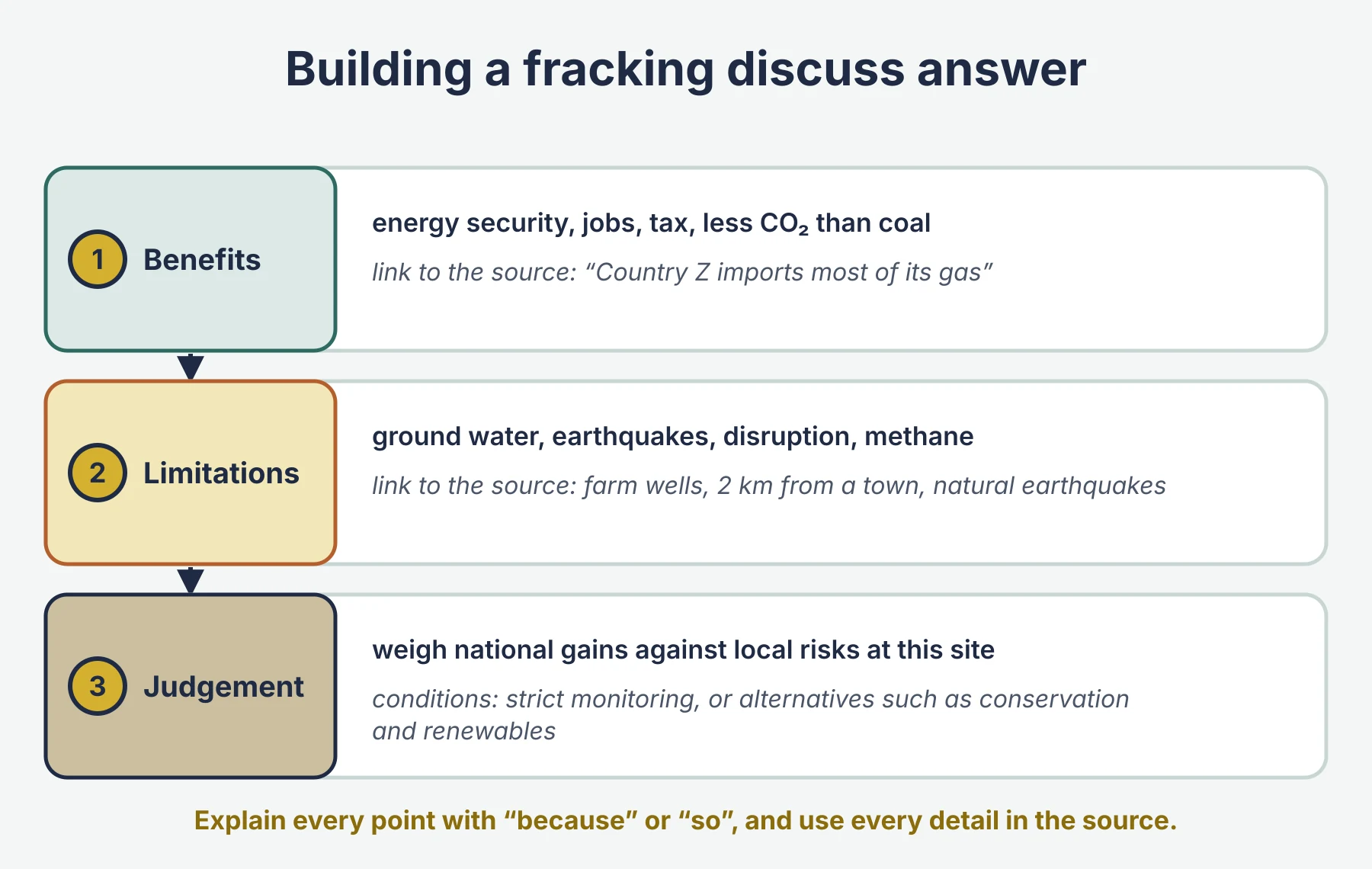
Fracking would increase Country Z’s own gas supply, reducing its reliance on imports and protecting it from sudden price rises. It would create jobs in drilling and transport and bring tax income. If the gas replaced coal in power stations, emissions of carbon dioxide and sulfur dioxide would fall.
However, the site has serious local risks. Because the farms rely on wells, any leak of fracking fluid into ground water could make the water unsafe for drinking and irrigation. The region already has natural earthquakes, so injecting fluid at high pressure could trigger further tremors that damage homes in the town only 2 km away. Lorries, noise and lighting would also affect residents. Gas is still a fossil fuel, so methane leaks and burning the gas would add to climate change.
Overall, the national benefits are real, but at this site the risks to ground water and from earthquakes are high. Fracking should only be allowed with strict monitoring of ground water and ground movement, or Country Z could invest in energy conservation and renewables instead.
Why it scores well: it uses every source detail (imports, farmland, wells, 2 km, earthquakes), explains each point with “because” or “so”, covers both sides and reaches a reasoned judgement linked to the site.
Common mistakes
- Defining fracking without “shale rock” or “hydraulic fracturing”.
- Calling fracking a renewable or “clean” energy source.
- Claiming fracking always causes earthquakes or always pollutes water; say it can or risks doing so.
- Giving benefits only, or limitations only.
- Ignoring the source and writing a general answer that could apply anywhere.
Exam technique
For define, give the syllabus wording. For discuss, aim for benefits and limitations in balance, each one explained, then a judgement that refers to the place in the source. Use the vocabulary of 1.1: shale is impermeable, which is why fracturing is needed.
Revise with the Fracking revision notes and practise with the Fracking practice questions. For the strategies that could be used instead, see the Conservation and management of energy resources study guide.
Related resources
-
Revision notes
Cambridge IGCSE Environmental Management: Land — Revision Notes
Recall notes on soils and crop growth, food production and soil erosion for Topic 2 Land of Cambridge IGCSE Environmental Management 0680, 2027-2029 series.
Environmental Management · Cambridge · IGCSE
Revise topic -
Practice questions
Cambridge IGCSE Environmental Management (0680): Fracking – Practice Questions
Original questions with mark-scheme answers on the fracking process, its water use, stakeholder views and benefits and limitations for Cambridge IGCSE 0680.
Environmental Management · Cambridge · IGCSE
Try questions -
Revision notes
Cambridge IGCSE Environmental Management (0680): Fracking – Revision Notes
Notes on the definition of fracking, the process, its benefits and limitations at local, national and global scale, and discuss technique for IGCSE 0680.
Environmental Management · Cambridge · IGCSE
Revise topic
Get free revision emails (optional)
Occasional emails with practice questions, worked explanations and links to free resources for the qualification and subjects you choose. No spam, and you can unsubscribe from any email. The free tools on this site never need an email.