
Revision Notes
Cambridge IGCSE Environmental Management (0680): Fracking – Revision Notes
Notes on the definition of fracking, the process, its benefits and limitations at local, national and global scale, and discuss technique for IGCSE 0680.
- Subject
- Environmental Management
- Level
- IGCSE
- Topic
- Topic 1 – Natural Resources
- Author
- Marlbridge Academic Team
- Updated
- Reviewed by
- Azam Siddique (what this means)
Aligned to Cambridge IGCSE Environmental Management (0680), 2027-2029. Official specification .
Syllabus page (what it covers and how it is assessed): Cambridge IGCSE Environmental Management.
Syllabus points this page covers
0680
- 1.6 Fracking
Found an error? Report a correction.
Need help with this topic? Request a free trial class for IGCSE Environmental Management (0680).
Condensed notes for sub-topic 1.6. The reasoning behind each point and a full annotated discuss answer are in the Fracking study guide.
The definition, word for word
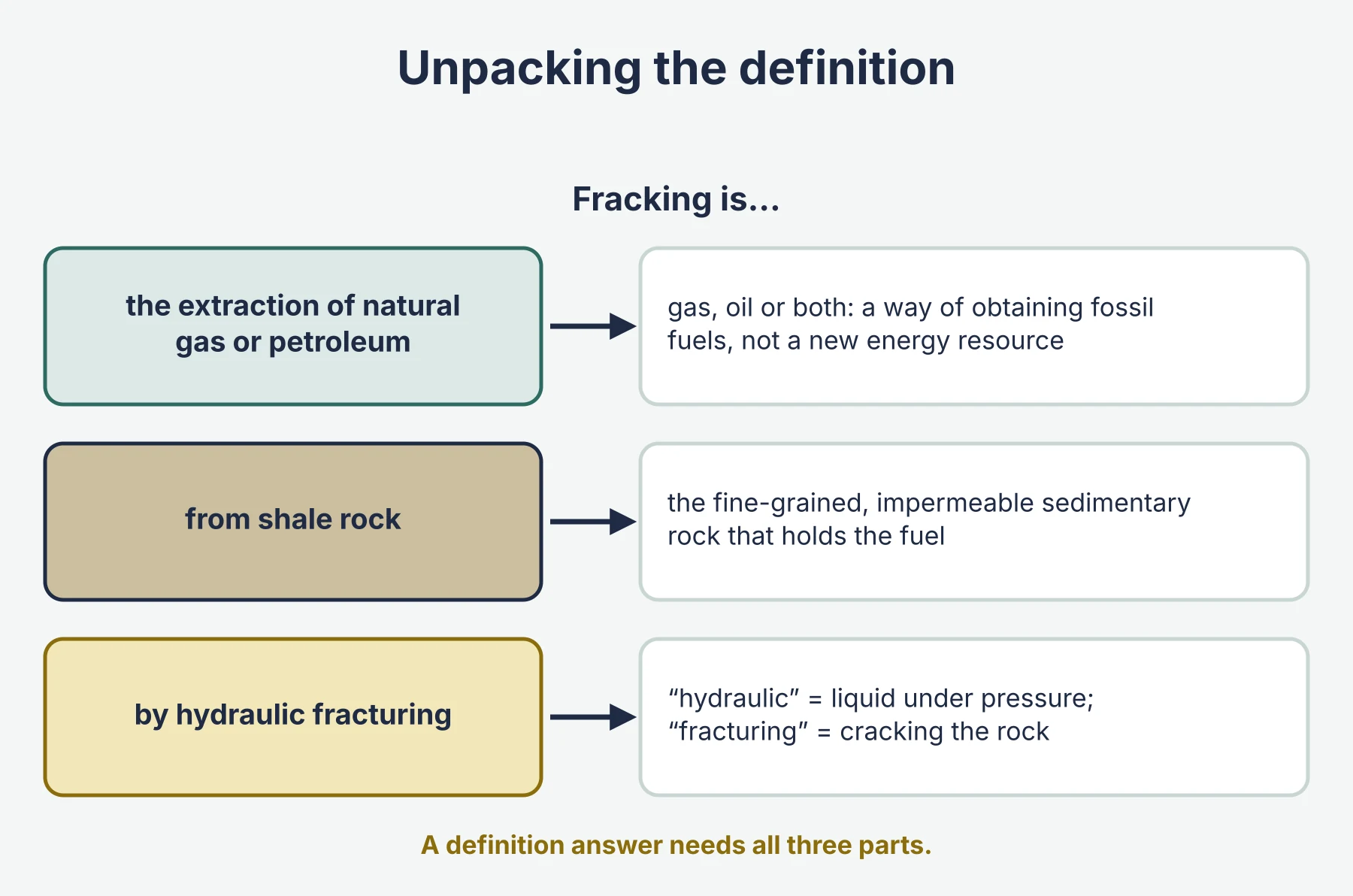
Fracking: the extraction of natural gas or petroleum from shale rock by hydraulic fracturing.
Three parts, three checks:
- What: natural gas or petroleum (a fossil fuel).
- From where: shale rock.
- How: hydraulic fracturing (liquid under pressure cracks the rock).
Why shale needs fracturing
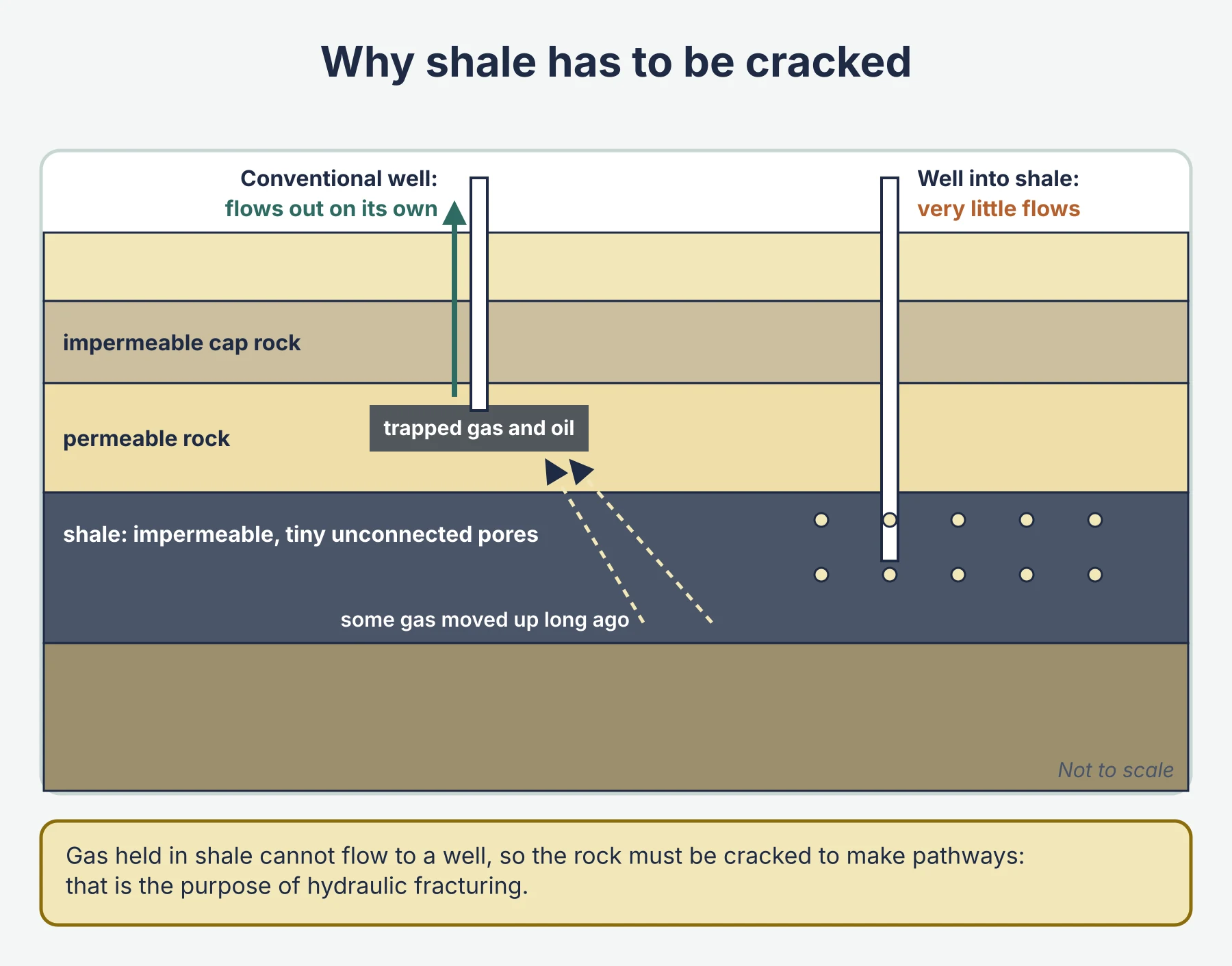
- Shale is an impermeable sedimentary rock: tiny, unconnected pores.
- Gas formed in the shale stays locked inside it.
- In a conventional deposit, gas has moved into permeable rock under an impermeable cap and flows to a well by itself.
- In shale, the rock must be cracked to create pathways to the well.
The process in five steps
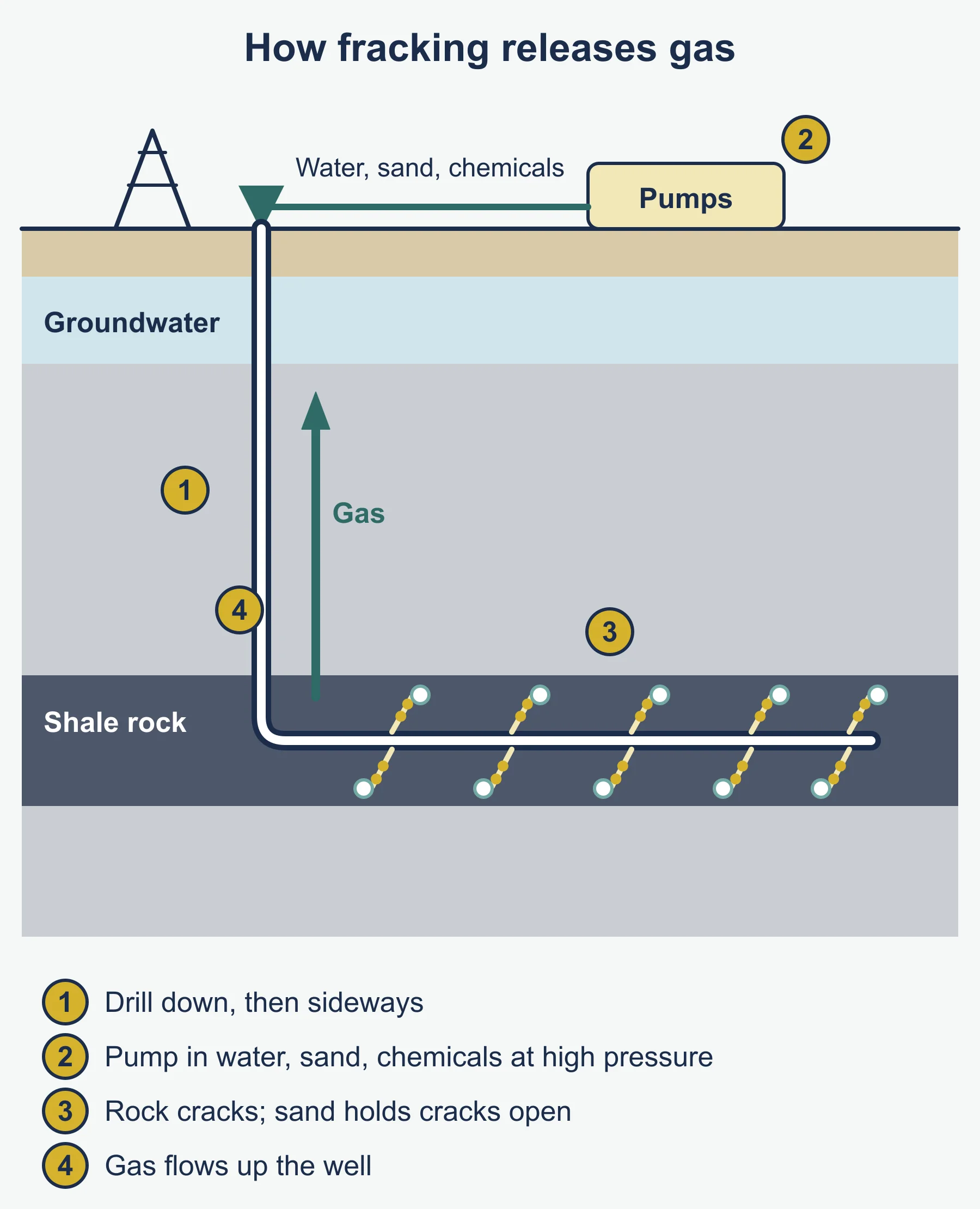
- Drill down to the shale, then horizontally through it.
- Line the well with steel casing and cement, especially through ground water layers.
- Pump fluid (mostly water, with sand and chemicals) down at very high pressure to crack the shale.
- Sand holds the cracks open.
- Wastewater flows back; gas or oil flows up the well.
Benefits
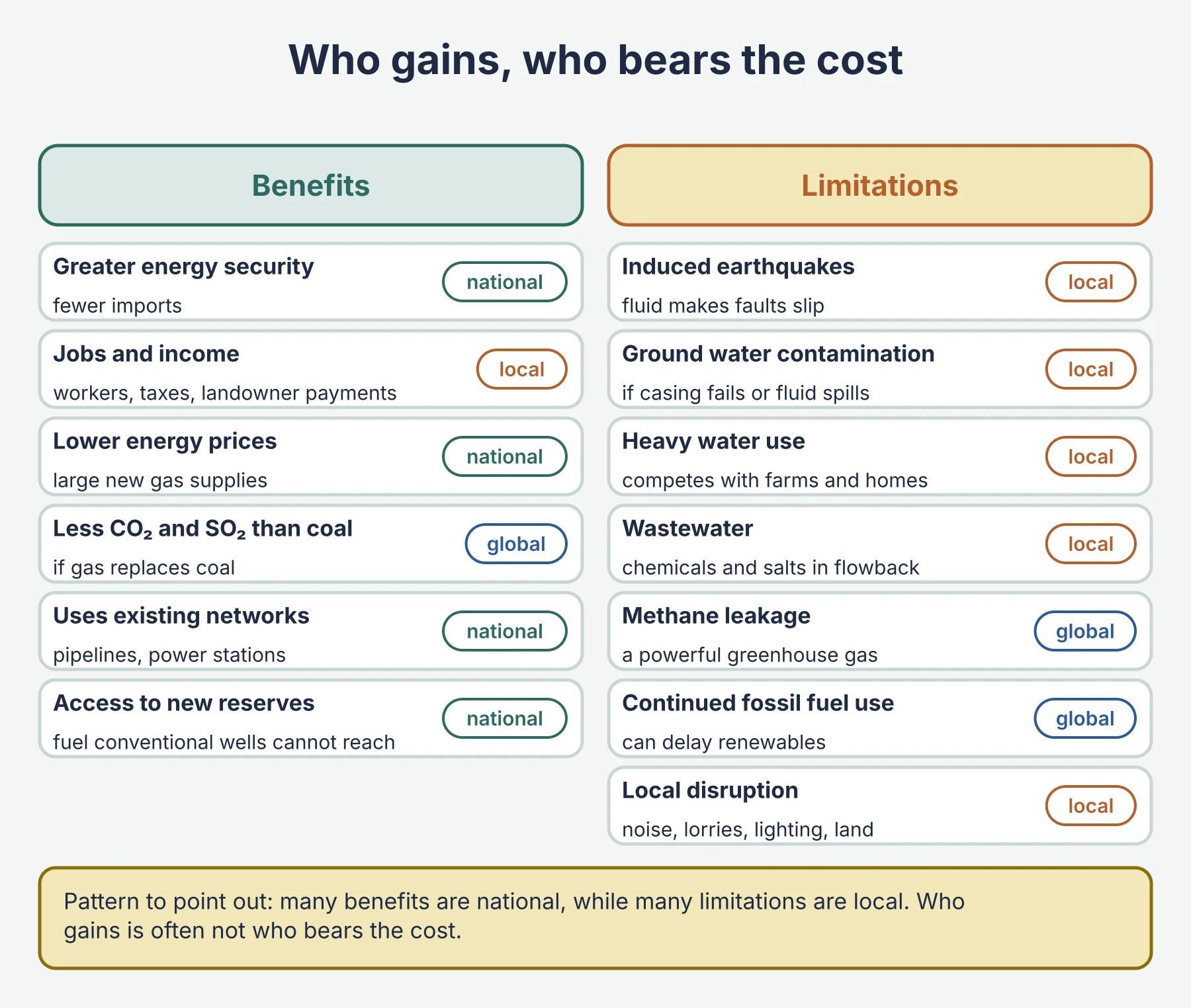
| Type | Benefit | Scale |
|---|---|---|
| Economic | Jobs in drilling, transport and supply | Local |
| Economic | Tax income; payments to landowners | Local and national |
| Economic | Lower gas prices if supply is large | National |
| Political | Energy security: fewer imports, less exposure to supply disruption | National |
| Environmental | Gas replacing coal emits less carbon dioxide and sulfur dioxide | National and global |
| Practical | Uses existing pipelines and gas power stations | National |
Limitations
| Type | Limitation | Scale |
|---|---|---|
| Environmental | Small earthquakes triggered by high-pressure fluid | Local |
| Environmental | Ground water contamination from failed casing or surface spills | Local |
| Environmental | Large water use, competing with farms and homes | Local |
| Environmental | Wastewater with chemicals and salts to treat or dispose of | Local |
| Environmental | Methane leaks: a powerful greenhouse gas | Global |
| Environmental | Continued fossil fuel use; delays renewables | Global |
| Social | Noise, lorry traffic, lighting, visual impact, loss of land | Local |
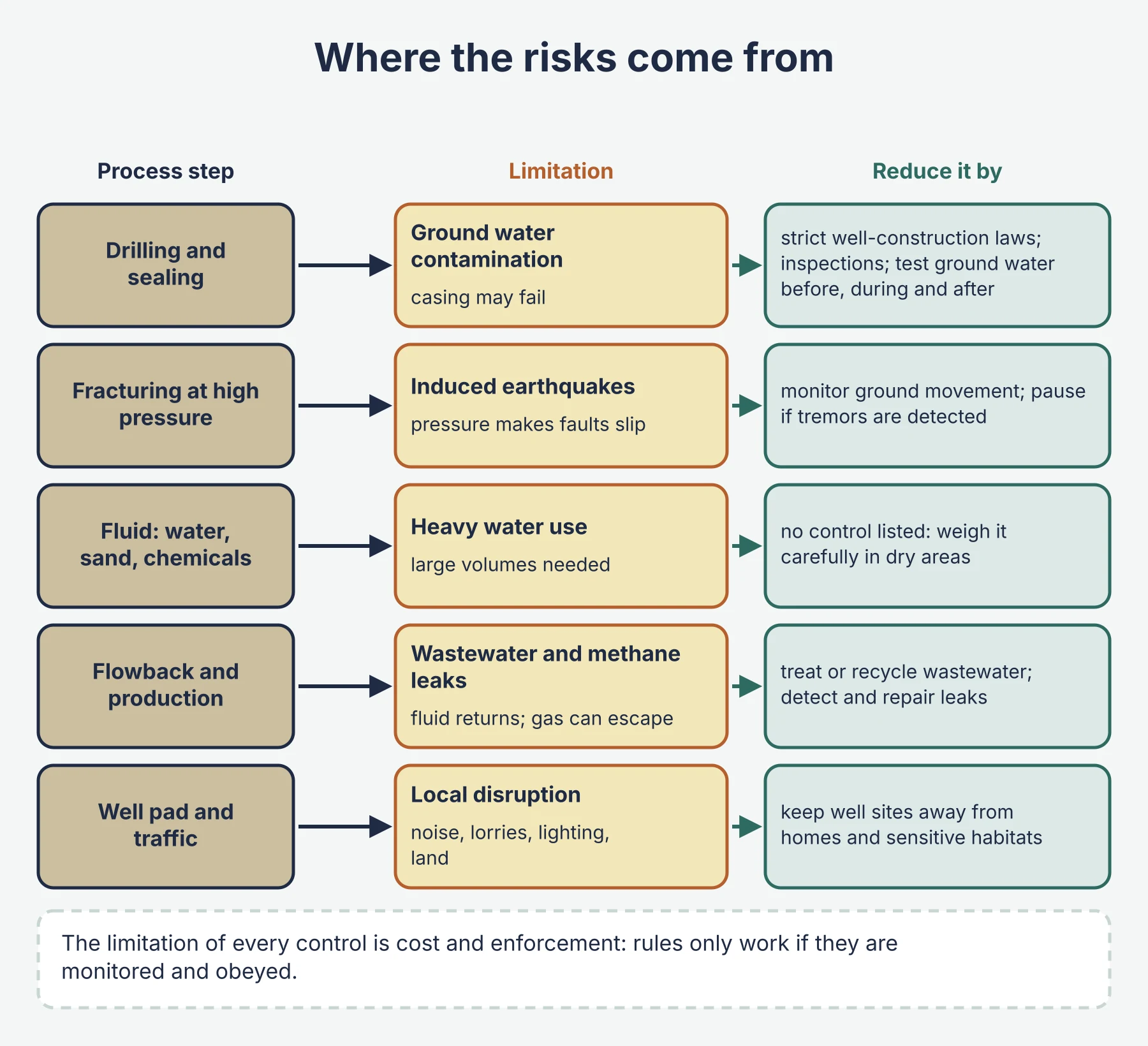
The pattern to point out: benefits are mostly national; limitations fall mostly on local people and the global climate.
Ways to reduce the limitations
- Laws on well construction, with inspections.
- Ground movement monitoring; pause operations if tremors occur.
- Ground water testing before, during and after.
- Treat or recycle wastewater.
- Keep sites away from homes and sensitive habitats.
- Detect and repair methane leaks.
Limitation of these measures: cost, and they depend on enforcement.
Building a discuss answer
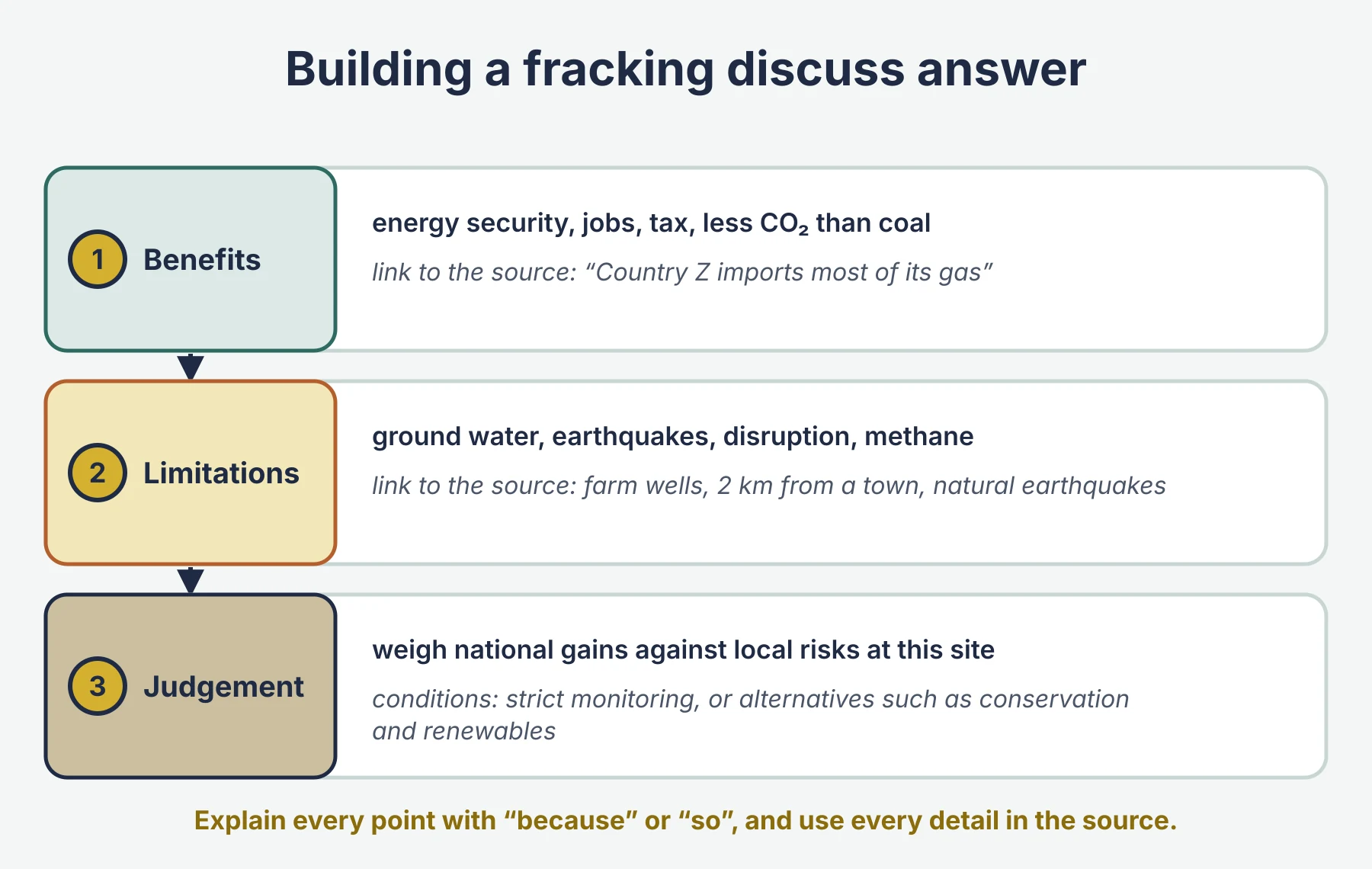
- Benefit + explanation + link to the source (for example, the country imports gas).
- Second benefit + explanation.
- Limitation + explanation + link to the source (for example, farms use wells).
- Second limitation + explanation.
- Judgement: allow, refuse or allow with conditions, and why, for this site.
Useful connecting words: “because”, “so”, “which means”, “however”, “on the other hand”, “overall”.
Using numbers from a source
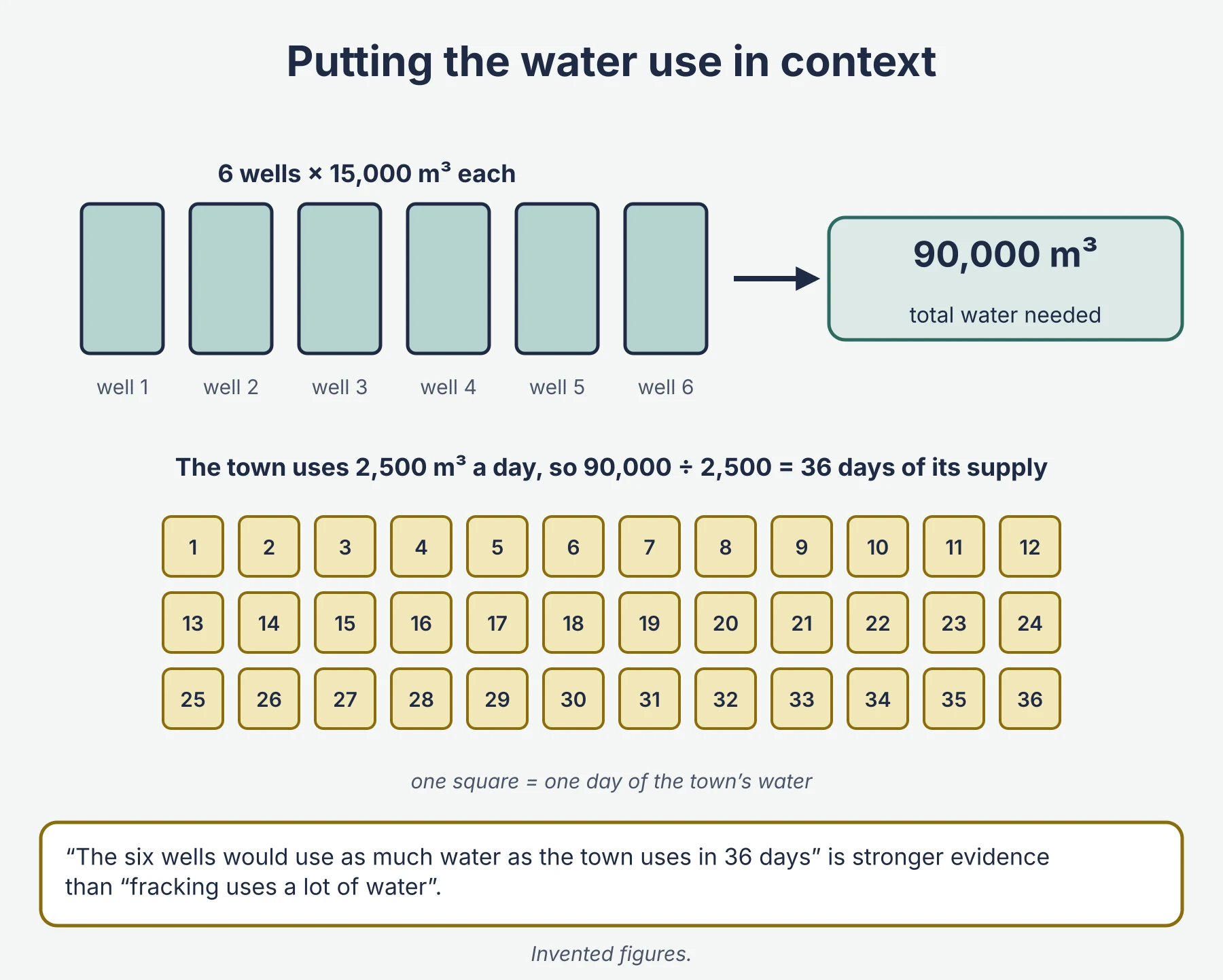
- Total water = number of wells × water per well.
- Compare with local use: total water ÷ daily use = days of supply.
- Quick check: 4 wells × 20,000 m³ = 80,000 m³; a town using 4,000 m³ a day would use that in 80,000 ÷ 4,000 = 20 days.
Key terms
| Term | Meaning |
|---|---|
| Hydraulic fracturing | Cracking rock with liquid pumped in under high pressure |
| Shale | Fine-grained, impermeable sedimentary rock that can hold gas and oil |
| Conventional gas | Gas that has collected in permeable rock and flows to a well without fracturing |
| Flowback | Fracking fluid that returns up the well as wastewater |
| Induced earthquake | Tremor caused by human activity, such as injecting fluid underground |
| Energy security | Having reliable, affordable access to energy |
| Casing | Steel lining cemented into a well to seal it from surrounding rock |
Exam traps
- Definition without “shale rock” or “hydraulic fracturing” loses marks.
- Fracking produces a fossil fuel; it is not renewable.
- Use “can” and “risks”: fracking does not always cause tremors or contamination.
- Gas is only “cleaner” compared with coal; it still emits carbon dioxide.
- One-sided answers are capped in discuss questions.
- A general answer that ignores the source loses application marks.
Self-test
- Give the syllabus definition of fracking.
- Why must shale be fractured to release its gas?
- What does the sand in fracking fluid do?
- Why is the well lined with steel and cement?
- Give two national benefits of fracking.
- Give two local limitations of fracking.
- Why can fracking trigger small earthquakes?
- Why is methane leakage a global limitation?
- Under what condition does fracking reduce carbon dioxide emissions?
- Name two ways the limitations of fracking can be reduced.
- Five wells each need 12,000 m³ of water. A village uses 1,500 m³ a day. How many days of the village’s supply is this?
- What should the final part of a discuss answer on fracking contain?
Answers
- The extraction of natural gas or petroleum from shale rock by hydraulic fracturing.
- Shale is impermeable, so the gas cannot flow through it to a well unless cracks are created.
- It holds the cracks open after the pressure is released.
- To seal it from surrounding rock, so gas and fluid do not leak into ground water.
- Any two: energy security; fewer imports; tax income; lower gas prices.
- Any two: earthquakes; ground water contamination; water use; wastewater; noise, traffic and visual impact.
- High-pressure fluid injected underground can make existing faults slip.
- Methane is a powerful greenhouse gas, adding to climate change everywhere.
- When the gas replaces coal, which emits more carbon dioxide for the same energy.
- Any two: well construction laws and inspections; ground movement monitoring; ground water testing; wastewater treatment; keeping sites away from homes; leak repair.
- 5 × 12,000 = 60,000 m³; 60,000 ÷ 1,500 = 40 days.
- A judgement on whether fracking should go ahead at that site, with reasons linked to the source.
Where to go next
Practise with the Fracking practice questions. For the rock science behind fracking, revisit the Formation of rocks revision notes.
Related resources
-
Revision notes
Cambridge IGCSE Environmental Management: Land — Revision Notes
Recall notes on soils and crop growth, food production and soil erosion for Topic 2 Land of Cambridge IGCSE Environmental Management 0680, 2027-2029 series.
Environmental Management · Cambridge · IGCSE
Revise topic -
Study guides
Cambridge IGCSE Environmental Management (0680): Sustainable management of rocks, ores and minerals
Finite resources, sustainable management and the seven strategies for conserving rocks, ores and minerals, with worked calculations, for Cambridge IGCSE 0680.
Environmental Management · Cambridge · IGCSE
Read guide -
Practice questions
Cambridge IGCSE Environmental Management (0680): Sustainable management of rocks, ores and minerals – Practice Questions
Original questions with answers on finite resources, recycling rates, reserve lifetimes and mineral conservation strategies for Cambridge IGCSE 0680.
Environmental Management · Cambridge · IGCSE
Try questions
Get free revision emails (optional)
Occasional emails with practice questions, worked explanations and links to free resources for the qualification and subjects you choose. No spam, and you can unsubscribe from any email. The free tools on this site never need an email.